Pirates have been a surprisingly rare theme in city-building games. Most games that fly the black flag focus on naval combat, exploration, or action, leaving the day-to-day business of running a pirate settlement largely unexplored. Corsair Cove, developed by Limbic Entertainment, approaches the fantasy from a different direction. Instead of casting players as a legendary captain chasing treasure across the seas, it asks them to build a thriving pirate colony from the ground up while balancing production, logistics, exploration, and the unruly needs of a growing crew.
The premise sounds familiar on paper. Gather resources, construct buildings, expand production, and unlock new technologies. The difference lies in how these systems interact. Nearly every mechanic in Corsair Cove feeds into another, creating a colony builder where efficiency matters just as much as expansion. The vertical design of the island forces players to think differently about movement and infrastructure, while naval expeditions ensure that success on land is closely tied to what happens at sea. Rather than feeling like two separate games stitched together, the city-building and piracy systems complement one another remarkably well.
That doesn’t mean everything works perfectly. Some mechanics rely a little too heavily on random outcomes, the interface occasionally struggles to communicate the growing complexity of your settlement, and progression can become demanding during the early hours. Yet even when frustrations emerge, they’re usually attached to systems that are ambitious rather than underdeveloped.
Corsair Cove may not reinvent the city-building genre, but it introduces enough fresh ideas to make it feel distinct from both traditional colony simulators and pirate adventures.
Gameplay and Mechanics
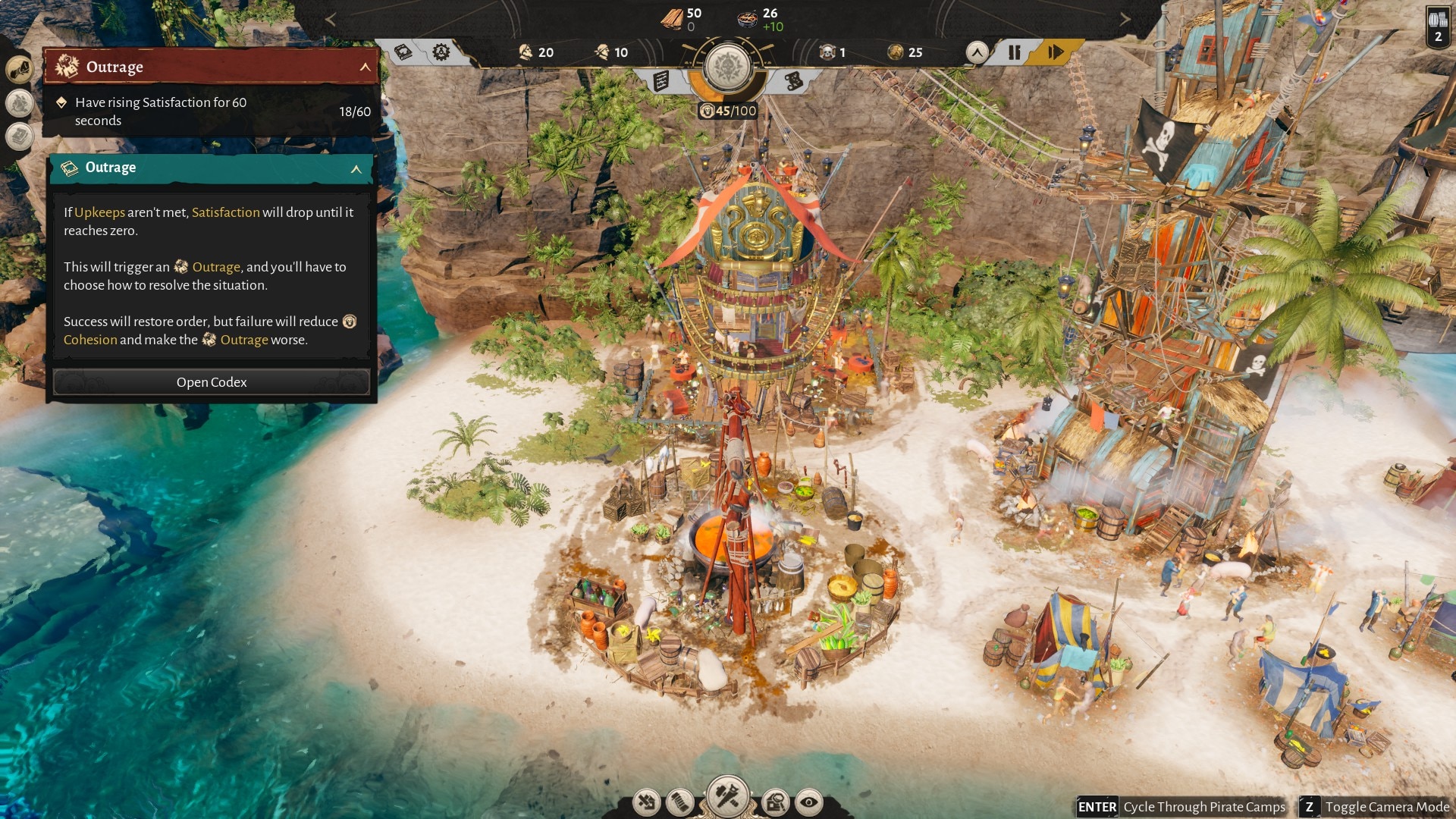
At its heart, Corsair Cove is a production and logistics game. Players begin with a small group of escaped pirates attempting to transform a deserted island into a prosperous haven beyond the reach of the Crown. Like most city builders, the early game revolves around collecting basic resources, providing shelter, and establishing food production. Before long, however, the game begins introducing increasingly elaborate production chains that transform simple raw materials into valuable goods.

Manufacturing isn’t simply a matter of placing the correct buildings. Every workshop depends on other industries, which themselves rely on transportation networks capable of moving supplies across cliffs, hillsides, and narrow pathways. Efficient planning quickly becomes more important than rapid expansion. A poorly connected settlement can produce plenty of resources while still suffering shortages because workers spend too much time transporting materials between distant structures.
This focus on logistics gives Corsair Cove much of its personality. Buildings display useful information about production efficiency, allowing players to identify bottlenecks before they become major problems. Instead of simply waiting for shortages to appear, the interface encourages proactive management, rewarding careful observation over constant micromanagement. It’s an elegant solution that makes the growing complexity far less intimidating than it initially appears.
The game also avoids overwhelming players with every mechanic at once. New industries, transportation options, and technologies appear gradually, giving enough time to understand one system before introducing another. Even so, the learning curve becomes noticeably steeper once manufacturing expands beyond basic necessities. Producing advanced equipment such as cannons or navigation tools often requires multiple interconnected industries operating efficiently at the same time. A single interruption somewhere along the chain can ripple throughout the entire settlement.
Despite the increasing complexity, the game rarely feels unfair. Most setbacks are consequences of planning decisions rather than hidden mechanics. If production stalls, there is usually a logical explanation waiting to be discovered.
What makes these management systems especially satisfying is that growth feels earned. Watching a chaotic pirate camp evolve into a carefully organized settlement creates the same sense of accomplishment that defines the best games in the genre.
Settlement Design
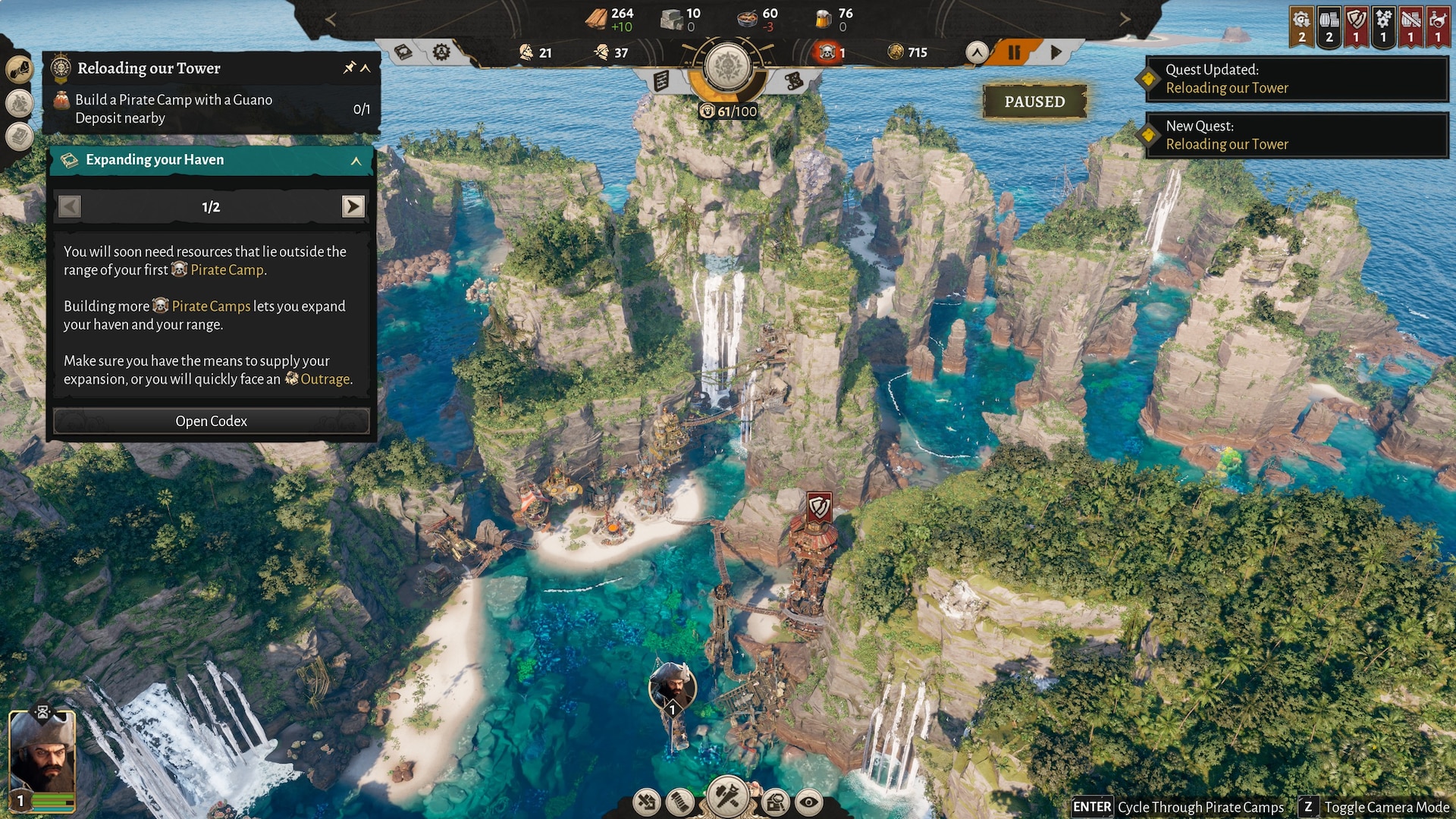
One of Corsair Cove’s most distinctive ideas is its approach to terrain. Rather than placing every structure across large, open plains, players develop settlements on layered islands filled with cliffs, elevated plateaus, beaches, and narrow passages. This verticality changes how cities grow from the very beginning. Expansion is rarely as simple as finding empty land. Reaching new areas often requires carefully planned stairways, bridges, ramps, and pathways that allow workers to move efficiently between different elevations.
The result is a settlement that feels organic rather than perfectly symmetrical. Production districts naturally emerge in flatter areas while residential quarters expand wherever space permits. Instead of encouraging rigid grid layouts, the landscape pushes players toward adapting their plans around the island itself. Every map develops its own character, and two settlements are unlikely to look exactly alike even if they pursue similar production goals.
Terrain also affects efficiency in meaningful ways. Long travel distances or poorly connected elevations can dramatically slow production chains, making infrastructure just as important as the placement of workshops themselves. It’s entirely possible to have every required building in place yet still struggle because workers spend too much time climbing between different sections of the island. Improving transportation often proves more valuable than constructing another production facility.
This emphasis on movement keeps city planning engaging throughout the campaign. Even late into a playthrough, earlier districts frequently require redesigns as new industries appear and demand better connections. Rather than treating the opening hours as disposable, the game encourages players to continually refine and optimize their existing settlements.
There are occasional frustrations. The increasingly dense layout can make selecting individual buildings more difficult than it should be, particularly once decorations, roads, and industrial structures begin overlapping visually. The camera generally provides enough flexibility to inspect crowded areas, but managing large settlements sometimes requires more zooming and rotating than feels ideal.
Nevertheless, the island design remains one of Corsair Cove’s strongest achievements. It creates meaningful planning challenges without relying on artificial restrictions and gives every successful settlement a distinct identity.
Exploration and Naval Expeditions
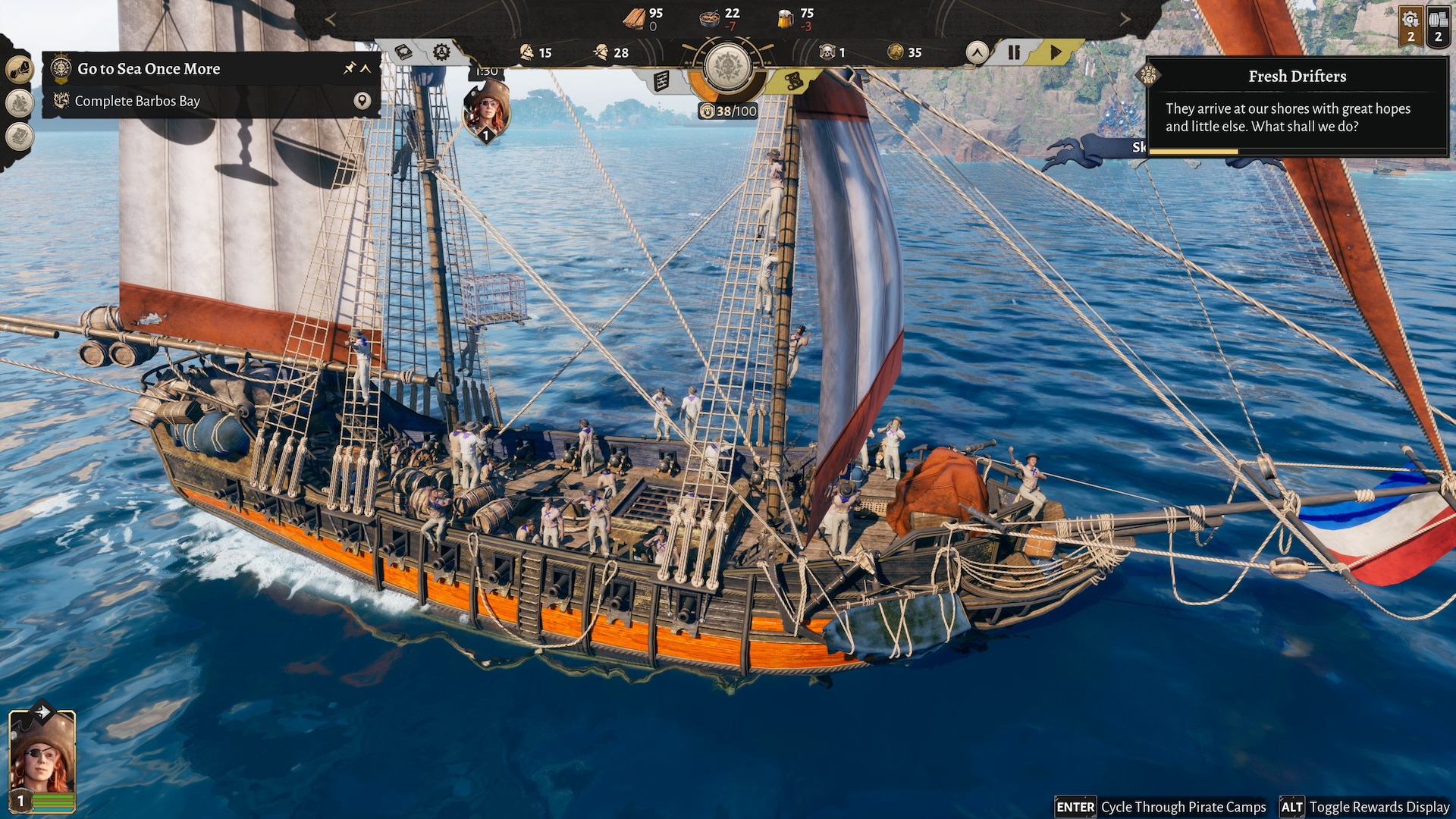
Although city building forms the core of the experience, Corsair Cove never lets players forget they are leading a band of pirates. As the settlement grows, ships become increasingly important, opening opportunities to explore surrounding waters, discover valuable resources, establish trade opportunities, and undertake expeditions beyond the home island.
These voyages provide a welcome change of pace from managing production chains. Instead of watching factories operate, players assemble crews, prepare vessels, and send them toward distant objectives that promise treasure, rare materials, or valuable rewards. Successful expeditions often unlock resources that cannot be produced locally, making naval exploration an essential part of long-term progression rather than an optional distraction.
The expeditions are presented through event-based encounters where decisions influence the outcome. Crew quality, equipment, and preparation all affect the likelihood of success, encouraging players to invest in capable sailors instead of treating ships as disposable assets. There is a satisfying sense that the prosperity of the colony depends on both efficient industry and successful piracy.
However, this is also where the game’s most divisive mechanic appears. While preparation certainly matters, expedition outcomes retain a noticeable element of randomness. Even well-equipped crews can return with disappointing results or suffer unexpected losses because of unfavorable events. The unpredictability fits the theme of dangerous voyages across open seas, but it occasionally undermines strategic planning. Players who enjoy complete control over every variable may find these moments frustrating, particularly when valuable resources are at stake.
Fortunately, the random elements rarely derail an entire campaign. A failed expedition represents a temporary setback rather than a catastrophic loss, and the game provides enough opportunities to recover through future voyages. Over time, better ships and stronger crews also reduce much of the uncertainty.
The balance between city management and naval activity is one of the game’s greatest strengths. Neither system overshadows the other. Building a successful colony funds exploration, while exploration supplies the rare resources needed for continued expansion. The two mechanics reinforce each other in a way that keeps the overall progression feeling varied over dozens of hours.
Progression and Replayability
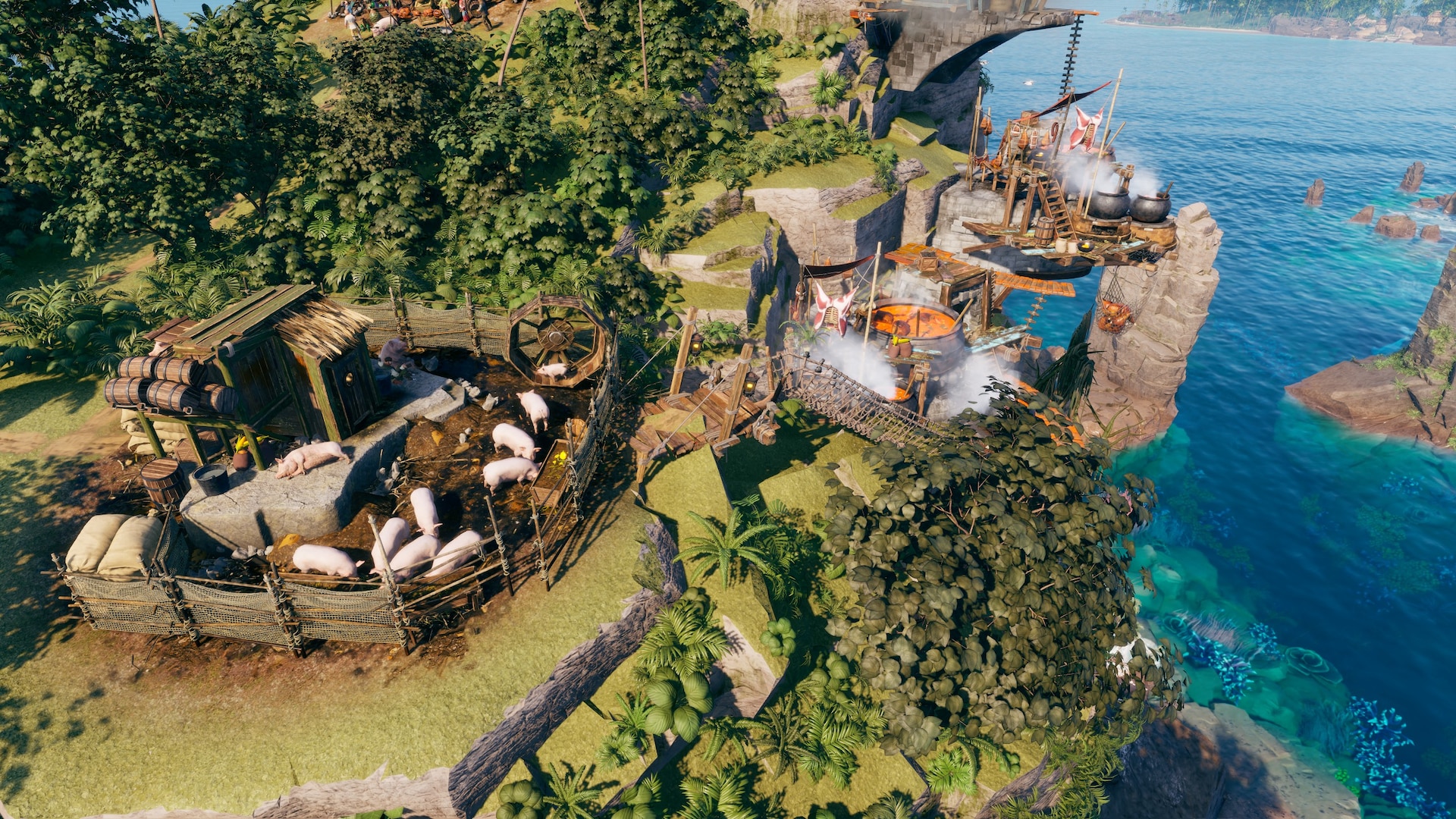
Progression in Corsair Cove is built around a steady expansion of both the settlement and the player’s responsibilities. What begins as a modest pirate encampment gradually develops into a bustling colony with specialized industries, advanced infrastructure, and an expanding fleet capable of supporting increasingly ambitious expeditions. New technologies unlock at a measured pace, ensuring that each stage introduces fresh possibilities without making earlier mechanics obsolete.
The technology tree strikes a sensible balance between accessibility and depth. Rather than presenting dozens of unrelated upgrades, it encourages players to think about how each new development fits into their broader economy. Unlocking a new production building is rarely an isolated improvement. It often requires additional raw materials, more workers, improved transportation, and expanded storage, creating a constant cycle of planning and adaptation.
That sense of interconnected growth is one of the game’s greatest strengths. Every advancement feels like the result of careful preparation rather than simply accumulating enough points to purchase another upgrade. Expanding too aggressively without reinforcing existing infrastructure often exposes weaknesses elsewhere in the settlement, making thoughtful pacing more rewarding than rapid expansion.
The campaign also does a respectable job of introducing new objectives throughout its runtime. Early goals focus on survival and basic resource production, while later chapters demand more sophisticated manufacturing, exploration, and economic management. This gradual increase in complexity helps maintain momentum even after players have become comfortable with the game’s core systems.
The challenge remains consistent without becoming unnecessarily punishing. Mistakes usually slow progress instead of ending a campaign outright, encouraging experimentation and refinement rather than repeated restarts. Players who enjoy optimizing production lines will likely spend considerable time revisiting older districts to improve efficiency, while those more interested in building attractive settlements can still create visually appealing pirate havens without sacrificing functionality.
Replay value comes primarily from the freedom to develop settlements differently, optimize production more effectively, and experiment with alternative layouts. The varied island terrain ensures that each new game presents different planning challenges, while changing priorities in exploration and production can lead to noticeably different strategies from one playthrough to the next.
The only area where long-term progression occasionally loses momentum is during the middle portion of the campaign. Once the basic production network is firmly established but before the most advanced technologies become available, the pace can slow as players focus on expanding existing industries. These stretches are not devoid of interesting decisions, but they lack some of the excitement generated by the opening hours or the satisfaction of managing a fully developed colony.
Fortunately, the late game introduces enough new demands to restore that sense of progression, rewarding players who have invested the time to build a stable and efficient economy.
Visual Presentation
Corsair Cove embraces a colorful, stylized art direction that complements its lighthearted interpretation of pirate life. Rather than chasing realism, it opts for exaggerated proportions, vibrant environments, and detailed animations that give the settlement a welcoming sense of activity. Workers carry supplies between workshops, ships drift through the harbor, smoke rises from chimneys, and busy docks gradually fill with evidence of a thriving pirate economy.
The islands themselves are particularly well designed. Cliffs, beaches, forests, and rocky outcrops create environments that are both visually attractive and mechanically significant. Because elevation plays such an important role in city planning, the landscape rarely serves as simple decoration. Every plateau and narrow passage has the potential to influence the layout of roads, buildings, and production chains.
Buildings are distinct enough to remain recognizable even as settlements become increasingly dense. Industrial districts naturally develop a busier appearance than residential areas, helping players identify different sections of the colony at a glance. Decorative objects also contribute to the atmosphere without overwhelming the practical side of city management.
Animation quality is consistently strong. Individual characters may be small on screen, but they display enough personality through their movements to make the settlement feel alive. Watching workers continuously travel between production sites reinforces the importance of logistics while adding visual energy to the world.
There are, however, moments when the presentation works against usability. As cities expand vertically and dozens of structures compete for space, visual clutter can make it difficult to select specific buildings or immediately understand what is happening in crowded areas. The interface provides useful overlays to assist with production management, but navigating densely packed settlements sometimes requires more camera adjustments than expected.
Even with those minor issues, the overall presentation remains appealing. The stylized visuals age well, communicate gameplay information effectively, and suit the game’s relaxed yet industrious atmosphere without distracting from the management systems that form the heart of the experience.
Audio Design
The audio presentation in Corsair Cove supports the gameplay without constantly drawing attention to itself. Rather than relying on dramatic orchestral themes or oversized pirate clichés, the soundtrack favors relaxed maritime melodies that reinforce the feeling of overseeing a growing settlement. Gentle acoustic arrangements accompany the quieter moments of city management, while livelier compositions emerge during periods of expansion and exploration. The music complements the pace of the game instead of trying to dictate it.
This understated approach works particularly well because city builders are often played over long sessions. The soundtrack remains pleasant after several hours and rarely becomes repetitive enough to encourage muting it in favor of external music. While few tracks are especially memorable on their own, they consistently establish the appropriate atmosphere without becoming intrusive.
Environmental sound effects contribute just as much to the overall experience. Workshops produce the expected clatter of industry, harbors feel busy with ships coming and going, and settlements gradually become noisier as populations increase. Individually, these sounds are subtle, but together they create the impression of a living colony where production never truly stops.
Workers and crew members communicate through short vocal reactions rather than extensive voice acting. These brief acknowledgements help confirm player commands without overwhelming the soundscape. The restrained use of spoken dialogue also keeps attention focused on managing the settlement instead of listening to repeated character lines.
The audio mix remains clear even during the busiest stages of the game. Important notifications stand out without becoming disruptive, making it easy to recognize when expeditions return or production issues require attention. It is a thoughtful balance that serves the gameplay well.
Although the soundtrack lacks standout compositions that players are likely to remember long after finishing the game, it succeeds in its primary role of supporting the experience. Like many aspects of Corsair Cove, the audio emphasizes consistency over spectacle, and the result is a soundscape that remains enjoyable throughout extended play sessions.
User Interface and Performance
A city builder lives or dies by the quality of its interface, and Corsair Cove performs well more often than not. The game presents a considerable amount of information, yet most essential tools remain within easy reach. Production statistics, workforce availability, storage capacity, and expedition management are organized into menus that become increasingly intuitive as players spend more time with them.
One of the interface’s strongest features is the clarity of its production data. Buildings provide useful feedback regarding efficiency, input shortages, and output levels, allowing players to identify problems before they spread through the wider economy. Instead of forcing players to guess why a production chain has stalled, the game usually points toward the source of the issue, making troubleshooting far less frustrating than it could have been.
Managing larger settlements inevitably introduces greater complexity, however. Once dozens of production buildings, warehouses, docks, and residential districts occupy multiple elevation levels, navigating the city becomes more demanding. Selecting structures hidden behind other buildings or positioned on crowded cliffs can occasionally test the player’s patience. Improved filtering tools or additional camera options would have helped reduce some of this friction.
The learning curve mirrors the interface itself. New players may initially find the number of available systems intimidating, particularly once naval expeditions and advanced manufacturing become central to progression. Fortunately, the gradual introduction of mechanics allows most players to adapt naturally, and the game’s information panels generally provide enough guidance without becoming overly prescriptive.
On PC, Corsair Cove delivers solid technical performance. During normal play, the game maintains stable frame rates while handling increasingly elaborate settlements filled with active workers and busy production lines. Loading times are short, camera movement remains responsive, and no widespread technical issues significantly undermine the overall experience according to early reviews and player reports.
Minor bugs and interface quirks are still present, which is fairly typical for a newly released management game. Some menu interactions occasionally require extra clicks, and pathfinding can produce the odd inefficient route when settlements become particularly crowded. These issues are noticeable but rarely severe enough to interrupt long-term enjoyment.
Considering the complexity of the simulation operating beneath the surface, Corsair Cove arrives in commendably polished condition. Most of its rough edges stem from interface refinement rather than technical instability, making them the sort of issues that future updates can realistically improve.
Final Verdict: 8/10
Corsair Cove succeeds because it understands what makes city-building games rewarding. Rather than chasing constant spectacle, it focuses on creating interconnected systems that encourage careful planning, steady optimization, and meaningful progression. Its combination of vertical settlement design, intricate production chains, and naval expeditions gives it a personality that distinguishes it from many of its contemporaries.
Not every idea lands perfectly. The random nature of some expeditions occasionally conflicts with the otherwise strategic design, and the interface becomes increasingly cumbersome as settlements grow in size and complexity. The middle stages of the campaign can also lose some momentum before the late-game systems restore the sense of discovery. None of these shortcomings, however, overshadow the strength of the core experience.
The game’s greatest achievement is how naturally its different mechanics support one another. Building an efficient colony enables successful voyages, while successful voyages provide the resources needed to further expand the settlement. That constant interplay keeps progression engaging across dozens of hours and ensures that players are almost always working toward a meaningful objective.
Fans of production-focused city builders will find plenty to appreciate here, particularly if they enjoy refining logistics and solving increasingly complex economic puzzles. Those expecting a traditional pirate adventure filled with naval battles may be surprised by how much of the experience revolves around industry and infrastructure, but the management-first approach ultimately proves to be the right choice.
Corsair Cove may not redefine the city-building genre, but it introduces enough original ideas and executes them with enough confidence to stand out. It is an absorbing management game that rewards patience, thoughtful planning, and a willingness to continually improve every part of a growing pirate settlement.