
Independent multiplayer games often rely on familiar ideas with a small twist to separate themselves from an increasingly crowded genre. Meccha Chameleon takes inspiration from hide-and-seek party games, but its central mechanic changes the formula enough that it develops its own identity within only a few matches. Instead of transforming players into environmental objects, the game asks them to paint their own characters so they visually blend into the surroundings, leaving success almost entirely in the hands of the player rather than an automatic transformation system. It is an uncomplicated premise that can be understood in minutes, yet it creates a surprising amount of room for experimentation because every disguise is built manually instead of selected from a predefined list.
That distinction shapes the entire experience. Meccha Chameleon is less about discovering the perfect hiding spot than it is about understanding the environment and recreating it convincingly. Players are constantly observing textures, colours and shapes while deciding whether to imitate a wall, a piece of furniture or another environmental detail. Even small differences in colour or positioning can determine whether a disguise survives until the end of a round or is immediately exposed. Because every player approaches that challenge differently, matches rarely unfold in exactly the same way, and much of the game’s appeal comes from watching simple mechanics produce situations that nobody involved expected.
Although the game has gained attention through livestreams and short social media clips, it is more than a source of amusing moments. The concept supports a competitive multiplayer game that rewards observation, patience and creativity in equal measure. It is also accessible enough that newcomers can begin contributing almost immediately, while experienced players gradually develop techniques that are difficult to anticipate until they have spent time learning how maps, colours and player behaviour interact. That combination gives Meccha Chameleon a stronger foundation than many recent party games whose appeal fades once players have experienced their central gimmick.

Gameplay and Mechanics
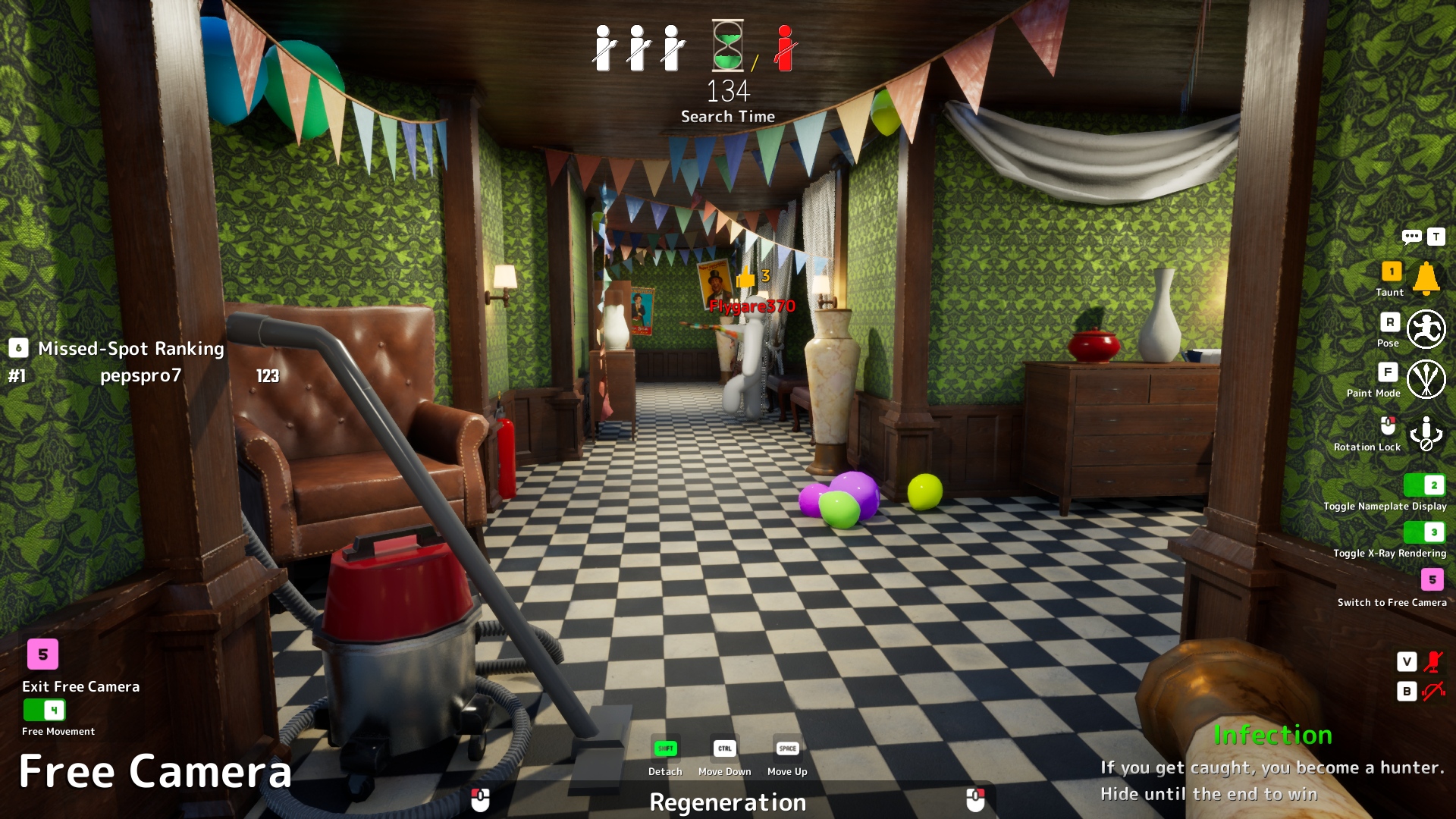
Each match divides players into two teams with clearly defined objectives. Hiders are given a preparation phase before seekers enter the map, allowing them to examine their surroundings and paint their characters to resemble nearby objects or surfaces. Rather than selecting a prop from a menu, players use painting tools to sample colours directly from the environment before applying them to different parts of their bodies.
The goal is not to become invisible but to blend into the environment convincingly enough that seekers dismiss the player as part of the scenery. Since opponents rarely stop to inspect every object closely, effective camouflage depends on convincing colour matching, sensible positioning and an understanding of how the environment is likely to be viewed, rather than creating a perfectly accurate recreation of nearby objects.
The painting system is the feature that distinguishes Meccha Chameleon from other games built around similar ideas. Although it is straightforward to understand, it provides enough flexibility that players gradually improve through practice rather than unlocking new abilities or equipment. During early matches, disguises often rely on matching broad colours while ignoring smaller details. After spending more time with the game, players begin paying attention to texture placement, lighting, outlines and the direction from which seekers are most likely to approach. None of these techniques are explained in depth, yet they emerge naturally through repeated play as players observe successful disguises and refine their own approach.
This emphasis on player skill creates a satisfying learning curve because improvement comes from better decision-making rather than statistical progression. A convincing disguise depends on several factors working together, including colour selection, body positioning and an understanding of how the environment is likely to be viewed by the opposing team. Standing beside a stack of boxes may initially seem like an obvious decision, but if the colours do not match or the silhouette remains too recognisable, experienced seekers will identify the deception quickly. Conversely, relatively simple paintwork can prove surprisingly effective when combined with a location that naturally draws little attention.
Playing as a seeker requires a different set of skills. Instead of relying on quick reactions or mechanical precision, seekers spend most of each round evaluating the environment and questioning whether individual objects belong where they appear. Familiarity with each map gradually becomes valuable because players learn which decorations remain fixed and which positions seem unusual. Observation, memory and pattern recognition therefore become more important than speed, giving both teams distinct styles of play without making either role feel secondary.
Round pacing contributes positively to the overall experience. Matches are short enough that unsuccessful hiding attempts rarely become frustrating, and players frequently alternate between the two roles, preventing the gameplay from becoming repetitive within a single session. The structure encourages experimentation because failure carries relatively little consequence. Trying an unusual disguise or selecting an unconventional hiding place may result in immediate elimination, but the next opportunity arrives only a few minutes later, making it easy to continue testing different ideas without feeling punished.
The game’s accessibility is another notable strength. Understanding the objective requires very little explanation, and the basic painting tools are intuitive after only a brief introduction. At the same time, the mechanics leave room for considerably more mastery than the initial learning process suggests. Experienced players often create disguises that rely on perspective, lighting or subtle environmental details that newcomers are unlikely to notice, giving long-term players meaningful opportunities to improve without creating an intimidating barrier for beginners.
That depth, however, does not eliminate every limitation. Meccha Chameleon depends heavily on the quality of its central mechanic because almost every match revolves around the same core activity. Although different maps encourage different camouflage strategies, the overall gameplay loop remains largely unchanged from one session to the next. Players expecting multiple game modes or a steady stream of mechanical variation may eventually feel that the experience has revealed most of what it has to offer. The enjoyment therefore comes less from discovering new systems than from seeing familiar mechanics produce different situations through player behaviour.
Maps and Replayability
The quality of the environments has a significant influence on how well Meccha Chameleon functions because the maps effectively become part of the gameplay system. Every surface, decorative object and colour palette provides another opportunity for camouflage, making environmental design far more important than it would be in many other multiplayer games. A successful map needs enough visual variety to support creative disguises while remaining readable enough that seekers can reasonably distinguish genuine environmental details from player-created imitations.
For the most part, the available maps achieve that balance successfully. Different locations encourage different approaches to camouflage rather than relying on a single dominant strategy. Some areas contain broad surfaces that reward careful colour matching, while others include smaller decorative details that invite more elaborate disguises. Learning each environment therefore involves more than memorising its layout. Players gradually identify overlooked corners, unusual textures and positions where a convincing disguise is less likely to attract attention. That process gives returning to familiar maps an ongoing sense of progression even though the environments themselves remain unchanged.
Replayability is driven primarily by player creativity rather than procedural systems or unlockable content. Since every disguise is created manually, no two matches develop in exactly the same way. A hiding place that succeeds repeatedly against one group may fail immediately against another, and strategies evolve naturally as players become more familiar with both the maps and the behaviour of experienced opponents. This unpredictability helps prevent the gameplay loop from becoming stale during longer sessions because the opposing players contribute as much variety as the environments themselves.
Even so, the game’s long-term appeal depends on continued content updates. The existing mechanics provide a strong foundation, but they also place considerable pressure on future additions to maintain player interest. Additional maps would naturally expand the range of camouflage opportunities, while new cosmetic options or gameplay variations could provide returning players with fresh objectives beyond simply improving their disguises. Without that ongoing support, there is a possibility that regular players will eventually exhaust the available environments despite the flexibility of the core mechanics.

Unlike progression-focused multiplayer games that encourage players to continue through extensive unlock trees or seasonal systems, Meccha Chameleon relies almost entirely on intrinsic enjoyment. Players return because they enjoy the interaction between creativity and observation rather than the constant pursuit of new equipment or abilities. That approach keeps the experience approachable while avoiding unnecessary complexity, but it also means that players seeking long-term progression may find fewer reasons to continue once they have mastered the available content.
Presentation and Audio
Meccha Chameleon adopts a bright, stylised visual direction that complements its mechanics without attempting to compete with larger productions on technical spectacle. The character models are intentionally uncomplicated, providing clear surfaces for the painting system rather than distracting players with excessive detail. That simplicity is a practical design choice because the game asks players to modify their appearance constantly, and highly detailed character models would make convincing camouflage considerably more difficult to achieve. As a result, the visual presentation consistently supports the gameplay instead of competing with it.
Environmental design serves a similar purpose. Objects are distinct enough that players can identify useful colours and textures quickly, while maps remain readable even when several disguised players are scattered throughout the area. This balance is important because the challenge should come from recognising well-executed camouflage rather than struggling to interpret cluttered scenery. Most environments provide a broad range of materials, colours and decorative objects, giving players enough freedom to experiment without making every surface equally effective as a hiding place.
The user interface follows the same philosophy. Menus are uncomplicated, essential information is presented clearly and the painting tools are easy to understand after a brief introduction. Since the game’s appeal depends on players spending as much time as possible experimenting with disguises, avoiding unnecessary interface complexity is the right decision. New players can begin learning the mechanics within a few rounds, while experienced players are able to focus almost entirely on the match itself rather than navigating menus or managing extensive systems between games.
The audio presentation is more restrained than the visual design, which suits the overall experience. Sound effects communicate gameplay events effectively without becoming intrusive, and the soundtrack remains largely in the background rather than attempting to dominate the atmosphere. Given that players spend much of each round concentrating on observation, a more aggressive audio design would likely become distracting. The existing approach allows conversations, player reactions and the tension of searching or hiding to become the defining elements of each match instead of relying heavily on music to create excitement.
Although the presentation is consistently effective, it is also relatively modest. Players expecting extensive visual customisation, elaborate animations or particularly ambitious production values may find that Meccha Chameleon focuses its resources almost exclusively on the mechanics that support its central idea. That decision is understandable for an independent multiplayer title, and the game generally benefits from directing its attention toward gameplay rather than visual excess, but it also means that presentation alone is unlikely to leave a lasting impression once players become familiar with the available content.
Multiplayer Experience
Meccha Chameleon is designed around multiplayer interaction, and nearly every aspect of the game benefits from playing with other people. While the mechanics function perfectly well with strangers through online matchmaking, the experience becomes noticeably more entertaining when players know each other well enough to recognise individual habits and attempt increasingly elaborate mind games. Friends quickly begin anticipating one another’s favourite hiding spots, deliberately avoiding obvious camouflage techniques and experimenting with increasingly unconventional disguises simply because they expect experienced opponents to search the most logical locations first.
That dynamic develops naturally because the game encourages observation rather than mechanical mastery alone. A successful round rarely depends on exceptionally fast reflexes or flawless aiming. Instead, players are rewarded for reading situations correctly, understanding how other people think and recognising subtle inconsistencies within familiar environments. Those qualities make victories feel satisfying without creating an especially high barrier to entry, allowing players with very different levels of gaming experience to participate together without one group feeling significantly disadvantaged.
Short match lengths also contribute to the game’s social appeal. Eliminated players never spend extended periods waiting for the next opportunity to participate, reducing frustration and encouraging experimentation throughout longer sessions. Since failure carries relatively little penalty, players are more willing to attempt unusual disguises or deliberately risky hiding locations, often producing the memorable situations that have helped the game attract attention online. The strongest moments are rarely the result of scripted events. Instead, they emerge naturally from players making unexpected decisions and successfully convincing others to question what they believe they are seeing.
The balance between the two roles generally supports that variety. Hiders spend the opening moments of each round making creative decisions before relying on patience and careful positioning, whereas seekers gradually develop confidence by learning how to identify visual inconsistencies more efficiently. Alternating between these perspectives keeps the overall experience fresh because each role encourages players to think about the same environments in completely different ways. Someone who has spent several rounds searching often becomes better at hiding afterwards, having developed a stronger understanding of which details attract attention and which are commonly ignored.
The multiplayer structure is nevertheless dependent on maintaining an active community. Meccha Chameleon offers little reason to play alone, and its long-term success will inevitably depend on continued player activity alongside developer support. That is not unusual for an online-focused party game, but it remains an important consideration for prospective players because the quality of the experience is closely tied to the availability of populated matches and a community willing to continue experimenting with the game’s unusual mechanics.
Technical Performance on PC
From a technical perspective, Meccha Chameleon is built around relatively modest hardware requirements, making it accessible to a wide range of PC players. The stylised presentation avoids placing unnecessary demands on modern systems, and the game generally benefits from quick loading times and responsive controls that keep attention focused on the gameplay rather than technical distractions.
Since individual rounds are designed to be brief, maintaining that pace is important, and the game succeeds in moving players efficiently between matches. Menus are straightforward to navigate, matchmaking generally transitions smoothly into gameplay, and the overall interface keeps unnecessary interruptions to a minimum. Those details may seem minor individually, but together they help preserve the game’s fast-paced rhythm by ensuring players spend more time experimenting with disguises and participating in matches than waiting for the next round to begin.
The overall interface is straightforward, with clearly organised menus and intuitive painting controls that reduce the amount of time required to become comfortable with the game’s core systems. New players are unlikely to spend long searching for essential options or attempting to understand the basic mechanics, which is particularly important for a multiplayer title that depends on quickly introducing newcomers to its central idea.
As with many independent online games, the long-term technical experience will depend partly on post-launch support. Multiplayer titles inevitably evolve after release as developers respond to player feedback, refine balance and address technical issues that emerge under larger player populations. While Meccha Chameleon presents a solid foundation, its continued success will depend on maintaining stability while expanding the game with additional content and improvements over time.
Final Verdict: 7/10
Meccha Chameleon succeeds because it builds an entire multiplayer experience around a mechanic that feels genuinely different without becoming unnecessarily complicated. Manually creating disguises rather than transforming into existing objects changes the relationship between players and the environment, rewarding observation, creativity and map knowledge in ways that remain engaging long after the basic rules have been learned. The satisfaction comes from knowing that a successful disguise reflects thoughtful decision-making rather than an automated ability, giving victories a sense of accomplishment that many comparable party games struggle to match.
The game also understands the value of accessibility. New players can begin contributing after only a handful of rounds, yet the mechanics leave enough room for gradual improvement that experienced players continue discovering more effective camouflage techniques over time. That balance makes Meccha Chameleon easy to recommend as a social multiplayer game because players of different skill levels can enjoy the same matches without progression systems or mechanical complexity creating unnecessary barriers between them.
Its limitations are largely tied to the same focused design that makes the game appealing in the first place. The central gameplay loop remains consistent throughout extended play sessions, meaning that players seeking frequent mechanical variation or extensive progression systems may eventually find that the available content has been fully explored. The long-term appeal therefore rests heavily on future maps, ongoing developer support and a healthy multiplayer community capable of keeping each session unpredictable through its own creativity.
Even with those reservations, Meccha Chameleon establishes a strong identity within a crowded multiplayer market by concentrating on a single idea and executing it effectively. Rather than relying on constant unlocks or increasingly elaborate systems, it trusts its core mechanics to create entertaining interactions between players, and for the most part that confidence is justified. Players willing to embrace its emphasis on experimentation and observation will find a multiplayer experience that consistently encourages creative thinking, produces memorable social moments and offers a refreshing alternative to more conventional competitive games.
While its longevity will ultimately depend on how the game develops after launch, the foundation is strong enough to suggest that Meccha Chameleon has the potential to remain an enjoyable multiplayer recommendation well beyond the initial excitement surrounding its release.


