
Sequels to successful roguelites often fall into one of two traps. Some play things so safely that they feel like oversized expansion packs, while others chase novelty at the expense of the mechanics that made the original enjoyable in the first place. Lost Castle 2 avoids both pitfalls. Rather than reinventing the series, Hunter Studio has refined nearly every aspect of the original game, expanding its combat, progression, and cooperative systems without losing the straightforward accessibility that attracted players nearly a decade ago.
Following an extended Early Access period, the full release feels substantially more complete than the version that first appeared on Steam. New biomes, additional bosses, expanded progression systems, a much broader selection of weapons, and countless balance adjustments have transformed what was already a promising foundation into a considerably richer experience. It still follows a familiar roguelite structure built around repeated dungeon runs, randomized loot, and permanent progression, but the execution is noticeably more polished than before.
That doesn’t mean every issue has disappeared. Some progression systems ask for more grinding than they probably should, procedural generation eventually begins to reveal familiar patterns, and multiplayer can become visually cluttered when four players unleash their strongest abilities at once. Even with those shortcomings, Lost Castle 2 succeeds because its fundamentals are consistently enjoyable. The combat is satisfying, experimenting with different builds is rewarding, and every run offers enough meaningful decisions to encourage one more attempt after an inevitable defeat.

Gameplay and Mechanics
Moment-to-moment combat is one of the clearest areas where Lost Castle 2 improves over its predecessor. The original Lost Castle was enjoyable in short bursts, but its combat system often leaned toward simplicity. Weapon types felt less distinct in practice, and many encounters were shaped more by raw damage values than by meaningful mechanical differences. As a result, fights could occasionally blur together, especially during longer runs where enemy patterns and player options didn’t evolve at the same pace.
The sequel addresses this with noticeably tighter control and stronger combat identity across the board. Movement feels more responsive, with better momentum and cleaner transitions between actions. Attacks land with greater weight, giving even basic weapons a clearer sense of impact. Enemy animations are also significantly improved, with more readable telegraphs that make it easier to anticipate danger. The overall effect is that encounters feel less like a numbers game and more like a system of timing, spacing, and observation, where success is earned through attention rather than guesswork.
Every expedition begins with a basic loadout before gradually introducing stronger equipment, relics, consumables, and passive upgrades. The familiar roguelite loop remains intact, but Lost Castle 2 gives players considerably more influence over how a run develops. Rather than simply equipping whatever weapon has the highest damage value, choosing equipment becomes an important strategic decision because each weapon class plays fundamentally differently.
Greatswords deliver heavy attacks capable of staggering tougher enemies, sacrificing speed for reach and raw damage. Spears reward careful spacing, allowing players to keep dangerous opponents at a distance. Daggers excel at aggressive close-range combat built around rapid attack chains, while bows provide a safer alternative for players who prefer maintaining distance. Magical staves lean heavily into spellcasting, whereas gauntlets emphasize relentless pressure through quick combinations and mobility. None of these categories feel like simple statistical variations of one another. Switching weapons often requires adjusting positioning, timing, and even the overall approach to an encounter.
The addition of weapon skills further separates each class. Every weapon possesses unique active abilities with independent cooldowns, creating opportunities to interrupt enemy attacks, clear large groups, or deal significant burst damage during brief openings. These skills add another layer of decision-making without overcomplicating combat. Using them effectively often matters more than landing a few additional standard attacks, particularly during boss encounters where every opening is valuable.
Enemy design complements this flexibility well. Standard foes are easy to understand individually, yet later rooms combine multiple enemy types in ways that force players to prioritize threats rather than mindlessly attacking the closest target. Fast melee enemies pressure positioning while ranged attackers punish careless movement, creating encounters that remain engaging even after dozens of runs. The game rarely relies on cheap surprises or unavoidable damage, instead rewarding players who learn enemy behavior and react accordingly.
Magic has also become far more integrated into combat than it was in the original game. Offensive spells provide valuable crowd control and elemental damage, while defensive abilities can create breathing room during particularly dangerous encounters. Because magical resources are limited, deciding when to cast a spell becomes another meaningful tactical choice rather than something players simply use whenever it becomes available.
Boss fights demonstrate the combat system at its strongest. Each encounter introduces recognizable attack patterns while gradually escalating the challenge through additional phases or more aggressive combinations. Success comes from understanding movement, timing dodges correctly, and making the most of whatever build has emerged during that particular run. Randomized progression means that even familiar bosses rarely play out exactly the same way twice. A build focused on critical hits approaches encounters differently from one built around elemental effects or sustained spell damage, giving repeat victories a welcome sense of variety.
Combat is not entirely free from frustration. Four-player sessions occasionally become visually overwhelming as spell effects, summoned companions, weapon abilities, and enemy attacks overlap on screen. During especially chaotic fights it can be difficult to identify incoming threats, leading to avoidable damage that feels more like a readability issue than a gameplay mistake.
Weapon balance also isn’t perfect. Every category is capable of clearing the game, but some naturally benefit more from certain relic combinations than others. Fast-hitting weapons often scale exceptionally well with effects that trigger on repeated attacks, while slower options can feel more dependent on finding specific relics to reach a similar level of effectiveness. The gap is far smaller than it was during Early Access, yet experienced players will still notice that some builds consistently outperform others.
These issues never overshadow the quality of the combat itself. The combination of responsive controls, meaningful weapon variety, satisfying enemy encounters, and rewarding boss fights gives Lost Castle 2 one of the strongest combat systems in its corner of the roguelite genre. It is approachable enough for newcomers while offering enough mechanical depth to keep experienced players experimenting long after the first successful run.
Progression and Build Variety
A roguelite lives or dies by its progression systems, and this is another area where Lost Castle 2 improves substantially over its predecessor. Every failed expedition contributes toward long-term advancement, ensuring that defeat rarely feels like wasted time. Instead of relying solely on permanent statistical upgrades, the game steadily expands the range of possibilities available during future runs.

Resources collected throughout expeditions can be invested back at the hub to unlock new features, strengthen the overall roster of available equipment, and improve future runs in meaningful ways. Progression is designed less around making characters overwhelmingly stronger and more around increasing the number of strategic options available. New weapons, relics, blessings, and other unlocks continually widen the pool of possible builds, making later runs feel more diverse rather than simply easier.
The relic system is the biggest reason experimentation stays enjoyable over dozens of hours. Passive bonuses range from straightforward improvements such as increased damage or survivability to more transformative effects that alter how entire builds function. Some relics reward aggressive melee play by restoring health after defeating enemies, while others enhance elemental damage, strengthen critical hits, or trigger additional effects when certain conditions are met. Individually, many bonuses appear modest. Combined, they can reshape an entire run.
This creates one of the game’s most satisfying qualities: adaptation. Instead of entering each expedition with a predetermined strategy, players gradually build around whatever opportunities appear. A run that begins with a heavy melee weapon may unexpectedly evolve into an elemental build after discovering complementary relics, while another might focus on mobility and rapid critical strikes. The strongest builds often emerge through improvisation rather than careful planning, giving every expedition its own identity.
The blessing system helps reduce the frustration that excessive randomness can create. While luck still plays an important role, blessings provide players with greater influence over how a build develops without eliminating uncertainty altogether. The balance feels well judged. Randomness remains central to the experience, but players retain enough agency that success rarely depends entirely on fortunate item drops.
Progression is paced effectively throughout the early and middle portions of the game. New mechanics arrive at regular intervals, additional equipment keeps expanding the sandbox, and each successful expedition introduces something worth experimenting with during the next attempt. The game consistently rewards curiosity, encouraging players to try unfamiliar weapon classes or relic combinations instead of settling into a single preferred playstyle.
The later stages of progression are less consistently paced. Unlocking some upgrades demands a noticeable amount of repeated play, and completionists may find the final stretch slower than expected. Because the underlying combat remains entertaining, the grind rarely becomes tedious, but there are moments when progression shifts from feeling naturally rewarding to feeling deliberately extended.
The upside is that the game rarely pressures players into chasing one mathematically optimal build. Most successful runs come from understanding core mechanics, recognizing useful synergies, and adapting to the resources available rather than following a fixed strategy. That flexibility gives Lost Castle 2 excellent replay value and helps ensure that experimentation remains rewarding long after the campaign’s initial completion.
Perhaps the sequel’s greatest achievement is that progression consistently serves the gameplay instead of replacing it. Permanent unlocks make future runs more interesting rather than dramatically easier, preserving the satisfaction of overcoming difficult encounters through improving skill as much as through expanding character options. It is a careful balance, and one that Lost Castle 2 maintains remarkably well.
Level Design
Like most roguelites, Lost Castle 2 leans heavily on procedural generation to encourage repeated playthroughs, but it does so with more confidence than its predecessor. Every expedition rearranges room layouts, encounter order, treasure locations, merchants, and optional events, ensuring that no two runs are completely identical. While experienced players will eventually recognize the individual building blocks, the game does enough to keep each journey feeling unpredictable for a long time.
The adventure is divided into several distinct regions, each introducing its own visual identity, enemy roster, and environmental hazards. Rather than relying on simple palette swaps, every biome asks players to adapt to new threats. Early areas focus on teaching combat fundamentals through relatively straightforward enemy combinations, while later regions introduce opponents with more demanding attack patterns and mechanics that require greater awareness of positioning and crowd control.
The overall pacing is one of the game’s strengths. Individual rooms are compact enough to keep the action moving without making exploration feel rushed. Most encounters last only a minute or two before rewarding players with a chest, a relic choice, a merchant, or another branching path. There is very little downtime, which suits the fast rhythm of the combat system.
Those branching paths add a welcome layer of strategy. Choosing between a merchant, an elite encounter, or an unexplored route rarely feels like an obvious decision because each option carries meaningful trade-offs. Elite enemies often guard some of the strongest relics available during a run, but taking them on too early can easily end an otherwise promising expedition. Likewise, spending currency at a shop means giving up the possibility of finding an even better item later. The game constantly asks players to balance short-term survival against long-term rewards, and those decisions become more important as the difficulty increases.
Environmental hazards also play a larger role than they did in the original Lost Castle. Certain rooms include traps, destructible objects, or terrain features that can complicate movement during hectic fights. These elements rarely dominate encounters, but they force players to pay attention to more than just enemy attack patterns, adding another layer of awareness without becoming intrusive.
That said, the procedural generation has limits. After enough hours, recurring room layouts become easier to identify, and players will start recognizing familiar encounter structures even if the enemies and rewards change. The game relies on remixing a strong set of handcrafted rooms rather than creating endlessly unique environments. It is a practical solution, but one that inevitably reveals itself over time.
Fortunately, combat does much of the heavy lifting. Because weapon builds, relic combinations, blessings, and enemy compositions vary from run to run, familiar rooms rarely produce identical situations. The layout may be recognizable, but the way a fight unfolds often isn’t. That distinction is important because it keeps replayability tied to gameplay rather than procedural generation alone.
The game also deserves credit for how naturally it escalates tension throughout a run. Later regions introduce larger enemy groups, more aggressive elite variants, and tougher environmental challenges without making earlier mechanics irrelevant. Instead of replacing previous ideas, the game gradually layers new complications on top of existing ones, creating a satisfying sense of progression that carries through to the final encounters.
While Lost Castle 2 doesn’t push procedural level design in new directions, it uses familiar ideas effectively. The environments remain varied, exploration consistently presents worthwhile decisions, and the pacing rarely loses momentum. More ambitious room variety would have strengthened the experience further, but the existing design supports the combat well enough that repetition takes many hours to become a significant concern.
Boss Encounters
Boss battles are where Lost Castle 2 delivers some of its strongest moments. Rather than acting as oversized health bars that simply conclude each biome, they function as meaningful tests of everything players have learned during the preceding stages.
Every major boss has a distinct identity, both visually and mechanically. Attack patterns are clearly telegraphed, encouraging players to learn movement and timing instead of relying on trial and error. Most encounters gradually evolve over multiple phases, introducing new attacks or combining existing ones in more demanding ways without feeling unfair. Defeat usually comes from a mistake the player can recognize and improve upon, not from unpredictable mechanics.
Randomized progression plays an important role here. Because every run produces different equipment, relics, and blessings, no single strategy dominates every encounter. A ranged build can maintain safer positioning while sacrificing burst damage, whereas slower melee weapons demand better knowledge of attack windows to stay effective. Spell-focused builds often excel at controlling space but require careful resource management during longer fights. This flexibility prevents boss encounters from becoming routine, even after repeated victories.
The encounters also strike a good balance between spectacle and readability. Bosses are large enough to command attention, yet their attacks remain visually distinct from the surrounding effects. Most dangerous abilities include clear animations or sound cues, allowing attentive players to react rather than simply absorb unavoidable damage.
Not every fight reaches the same standard. A few encounters rely heavily on summoning additional enemies, which can make the battlefield feel busier than necessary, particularly in multiplayer. Certain late-game bosses also become noticeably more difficult depending on the weapon class a player happens to be using, creating occasional balance inconsistencies between different builds.
Even so, the overall quality of the boss roster is consistently high. Victories feel earned, repeated attempts reveal new layers of strategy, and each successful defeat provides a satisfying conclusion to its respective biome. In a genre where boss fights often blur together after dozens of hours, Lost Castle 2 does a commendable job of keeping them engaging.
Multiplayer Experience
Although the game is perfectly enjoyable alone, it is obvious that cooperative play sits at the heart of Lost Castle 2’s design. Supporting up to four players online, the sequel expands on one of the original game’s greatest strengths while introducing enough mechanical depth to make teamwork feel more meaningful than simply adding extra damage to the screen.
The most successful groups naturally begin to divide responsibilities without the game explicitly assigning roles. Players wielding heavier weapons often occupy enemy attention, while ranged or magic-focused teammates attack from safer positions. Others may specialize in controlling crowds or dealing sustained damage to tougher enemies. The game never forces rigid character classes, but the diversity of weapon types allows these roles to emerge organically.
Sharing resources also becomes an important part of every run. Powerful relics, rare weapons, and limited consumables frequently create moments where the group must decide which player benefits most from a particular reward. Those discussions encourage cooperation rather than competition because improving one player’s build often increases the team’s overall chances of surviving later encounters.
Combat inevitably becomes more unpredictable with four players, but much of that chaos works in the game’s favor. Last-second revives, narrowly avoided defeats, and unexpected relic combinations regularly produce memorable moments that simply do not occur during solo play. Few roguelites capture that sense of shared improvisation as effectively.
The downside is visual clarity. As characters unlock stronger abilities and enemies become more elaborate, the screen can fill with spell effects, explosions, summoned companions, damage numbers, and overlapping attack animations. During especially intense boss fights, identifying individual threats occasionally becomes difficult. This issue rarely makes the game unplayable, but it is the one area where the presentation struggles to support the action.
Online performance is generally reliable. Throughout the full release, stability has improved considerably compared to earlier Early Access builds, with cooperative sessions feeling far more dependable overall. Minor latency can still appear depending on the host’s connection, but it seldom reaches the point of disrupting an entire run.
Players who prefer solo roguelites will still find plenty to enjoy, yet cooperative play is where Lost Castle 2 truly distinguishes itself. The combination of varied builds, shared decision-making, and frantic combat creates an experience that remains entertaining long after individual encounters become familiar.
Difficulty and Replayability
Lost Castle 2 follows the familiar roguelite philosophy that failure is part of progression rather than the end of it. Defeat is frequent, particularly during the early hours, but almost every unsuccessful run contributes something useful through permanent resources, greater familiarity with enemy behavior, or a better understanding of how different relics and weapons interact.
The difficulty curve is handled with care. Early expeditions introduce mechanics gradually enough that newcomers are unlikely to feel overwhelmed, while later regions steadily demand better positioning, smarter resource management, and a stronger understanding of build synergies. Success depends far more on improving as a player than on accumulating permanent upgrades, which helps preserve a satisfying sense of accomplishment throughout the campaign.
Randomness naturally influences individual runs, but it rarely determines the outcome on its own. Some expeditions provide exceptionally strong relic combinations that make progression noticeably easier, while others require players to work with less-than-ideal equipment. The important distinction is that the game almost always offers enough flexibility to recover from mediocre luck through careful decision-making and solid execution.
Replayability is where the sequel excels. The combination of numerous weapon classes, a large relic pool, blessings, permanent progression, and cooperative multiplayer creates a surprising number of viable playstyles. Even after completing the campaign, experimenting with unfamiliar builds remains rewarding because different combinations frequently produce unexpected results.
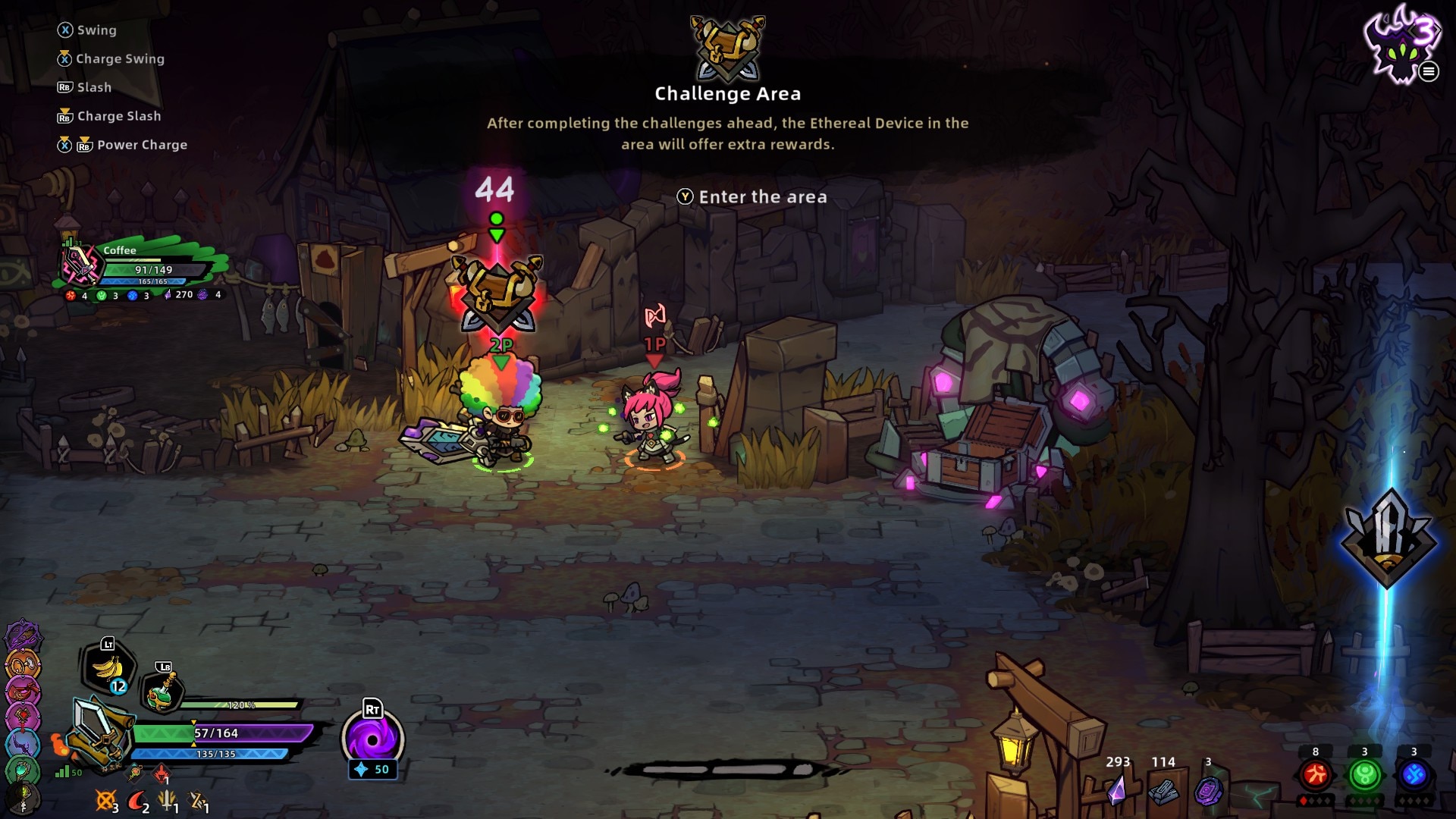
Eventually, repetition becomes unavoidable over longer play sessions. Familiar room layouts begin to stand out more clearly, enemy encounters repeat more often than they did in the early hours, and long-term progression slows as the remaining unlocks become increasingly expensive and time-consuming to obtain. These limitations are common across the genre, and Lost Castle 2 handles them better than many of its contemporaries because the underlying combat remains consistently enjoyable and engaging throughout.
That ultimately defines the game’s longevity. Players do not return simply to unlock another upgrade or complete another checklist. They come back because the process of fighting through another run, adapting to unexpected relics, and discovering a build that comes together at just the right moment continues to be genuinely satisfying dozens of hours later.
Presentation and Audio
Lost Castle 2 doesn’t chase photorealism or cutting-edge visual technology, and it is better for it. Instead, Hunter Studio builds on the colorful fantasy style of the original game with noticeably higher production values across the board. Character models are more detailed, environments feature richer lighting and stronger environmental storytelling, and the animation work gives combat a satisfying sense of weight that the first game occasionally lacked.
The shift to fully three-dimensional visuals while retaining a side-scrolling perspective proves to be one of the sequel’s smartest decisions. It preserves the readability that made the original approachable while giving artists far greater freedom to create expressive enemy designs, larger bosses, and more dynamic environments. The result is a game that immediately feels more modern without abandoning the series’ established identity.
Enemy variety plays a major role in keeping each biome visually interesting. Rather than relying on minor recolors or simple cosmetic changes, every region introduces creatures with distinct silhouettes and attack animations, making it easy to identify threats even during hectic battles. That clarity is especially important in a game where reacting to enemy tells is often the difference between surviving a difficult encounter and watching an otherwise promising run come to an abrupt end.
Environmental design deserves similar praise. Each biome establishes its own atmosphere through architecture, lighting, and background detail without overwhelming the foreground action. While procedural generation inevitably leads to repeated room layouts over time, the artistic variety between regions helps maintain a strong sense of progression throughout the campaign. Moving from one area to the next always feels like entering a genuinely different part of the world rather than another collection of recycled assets.
Animation quality is arguably the presentation’s biggest improvement over the original Lost Castle. Weapons communicate their weight convincingly, whether it is the deliberate swing of a greatsword or the rapid flurry of attacks delivered by daggers or gauntlets. Enemy reactions are equally satisfying, with stagger animations and impact effects providing immediate visual feedback whenever attacks connect. Even simple movement animations contribute to the overall responsiveness of the combat system.
Visual effects are generally well judged. Elemental attacks, magical abilities, and special weapon skills are impressive enough to make powerful builds feel rewarding without constantly drowning the battlefield in unnecessary spectacle. The developers clearly understand that visual effects should support gameplay rather than compete with it.
The only consistent exception appears during larger multiplayer sessions. Four players using high-level abilities can generate enough overlapping effects to reduce battlefield readability, particularly during late-game boss fights where enemy attacks become more elaborate. Important visual cues occasionally disappear beneath layers of friendly spell effects, forcing players to rely more heavily on memory than observation. It is an occasional annoyance rather than a constant problem, but one that becomes more noticeable the longer multiplayer sessions continue.
The soundtrack complements the action effectively without demanding constant attention. Its orchestral themes establish an adventurous tone during exploration before becoming more energetic during major encounters, yet the music rarely overpowers the action. Individual tracks may not linger in memory long after the credits roll, but they consistently support the atmosphere and avoid becoming repetitive despite the game’s emphasis on repeated runs.
Sound design leaves a stronger impression. Every weapon class produces distinct impact sounds that reinforce its identity, from the heavy crunch of oversized blades to the rapid strikes of lighter weapons. Enemy attacks are accompanied by clear audio cues that often provide valuable warnings during busy encounters, while spell effects deliver satisfying bursts of elemental energy without becoming excessive. These details quietly strengthen the combat, making every successful hit feel more impactful than visuals alone could achieve.
Voice acting is intentionally limited, with the game relying primarily on environmental storytelling and concise dialogue rather than lengthy narrative sequences. That restraint suits the genre well. Lost Castle 2 is fundamentally about repeated action-driven runs, and the presentation wisely avoids interrupting the pace with unnecessary exposition.
Taken as a whole, the audiovisual package reflects the same design philosophy that defines the rest of the sequel. It does not attempt to revolutionize the genre or compete with blockbuster productions through technical spectacle alone. Instead, it delivers polished, cohesive presentation that consistently enhances the gameplay.

Technical Performance on PC
Following its lengthy Early Access development, Lost Castle 2 arrives in notably better shape than many games in the genre at launch. Years of player feedback have allowed Hunter Studio to steadily refine performance, address numerous bugs, and improve overall stability before the full release, resulting in a more polished and dependable experience that rarely suffers from major technical problems.
Performance is consistently strong across a broad range of hardware. The game’s stylized art direction avoids placing unnecessary demands on modern systems, allowing it to maintain stable frame rates even when combat fills the screen with enemies and visual effects. Load times are brief, transitions between areas are seamless, and the game responds quickly to player input, all of which reinforce the responsive feel of the combat.
Just as importantly, the game demonstrates a high degree of stability. During extended play sessions, crashes are uncommon, save progression is reliable, and serious bugs that interrupt a run are rare. For a roguelite where a single expedition can represent a significant investment of time, that reliability matters just as much as graphical performance.
Most remaining technical issues are relatively minor. On rare occasions, enemies can become caught on environmental geometry before quickly correcting themselves, while certain animations occasionally fail to blend together as smoothly as intended. These moments are brief and seldom affect gameplay in any meaningful way.
Online multiplayer is also in a healthy state. Cooperative sessions are generally stable, with connection quality depending more on the host’s internet connection than on the game’s networking itself. Minor latency can still occur under less-than-ideal conditions, particularly during visually demanding encounters, but synchronization issues are infrequent enough that they rarely overshadow the experience.
The more noticeable shortcomings are related to balance rather than technical execution. Although every weapon class is capable of completing the game, some relic combinations remain substantially stronger than others, allowing certain builds to scale much more effectively. Likewise, a handful of permanent upgrades feel more valuable than the alternatives, slightly narrowing long-term progression choices for players interested in maximizing efficiency. These are design concerns rather than technical flaws, and they are the sort of issues that ongoing post-launch support can continue refining.
Overall, Lost Castle 2 launches in a polished and dependable state. It is not completely free of minor issues, but the experience is stable, well optimized, and significantly more refined than many roguelites at release.
Final Verdict: 8/10
Lost Castle 2 is exactly the kind of sequel long-time fans were hoping for. It respects the strengths of the original without becoming constrained by them, improving nearly every major system through more satisfying combat, deeper progression, greater build diversity, stronger boss encounters, and a noticeably more polished presentation. Instead of chasing sweeping innovation, Hunter Studio has focused on refining the fundamentals, and that decision pays off throughout the entire experience.
The combat is the clear highlight. Every weapon class offers a distinct playstyle, experimentation is consistently rewarding, and the combination of relics, blessings, and randomized equipment ensures that no two successful runs feel exactly alike. The game constantly encourages players to adapt rather than follow a predetermined strategy, giving every expedition its own rhythm and identity.
Its cooperative multiplayer is equally successful. While the game remains enjoyable as a solo experience, tackling expeditions with friends transforms even familiar encounters into unpredictable stories shaped by teamwork, fortunate relic drops, desperate recoveries, and the occasional disastrous mistake. Few roguelites capture that balance between accessibility and meaningful cooperation as naturally as Lost Castle 2.
Not everything is perfect. Procedural generation eventually begins to expose familiar room layouts, late-game progression slows more than it should, and visual clarity can suffer during four-player battles packed with overlapping effects. Balance between different weapon builds also leaves room for further refinement, particularly for players who invest enough time to uncover the most effective combinations. None of these shortcomings fundamentally undermine the experience, but they do prevent the game from reaching the very top tier of the genre.
What ultimately makes Lost Castle 2 stand out is its consistency. There are very few weak systems here. Nearly every mechanic complements the others, creating a gameplay loop that remains enjoyable well beyond the first successful run. Whether the reward is discovering a new relic synergy, mastering an unfamiliar weapon class, or finally overcoming a boss that previously seemed impossible, the game maintains a steady sense of progression without relying solely on larger numbers or endless unlocks.
The roguelite genre has become increasingly crowded, making it difficult for new releases to distinguish themselves. Lost Castle 2 succeeds not because it dramatically reinvents the formula, but because it executes familiar ideas with confidence and polish. It takes the foundation established by the original game, addresses many of its weaknesses, and expands its strengths in meaningful ways.
Players looking for an approachable action roguelite with satisfying combat, excellent cooperative play, and enough build variety to support dozens of hours of experimentation will find plenty to enjoy here. It may not redefine the genre, but it rarely feels like it needs to. By focusing on refinement rather than reinvention, Lost Castle 2 establishes itself as a sequel that comfortably surpasses its predecessor and earns a place among the stronger cooperative roguelites currently available on PC.


