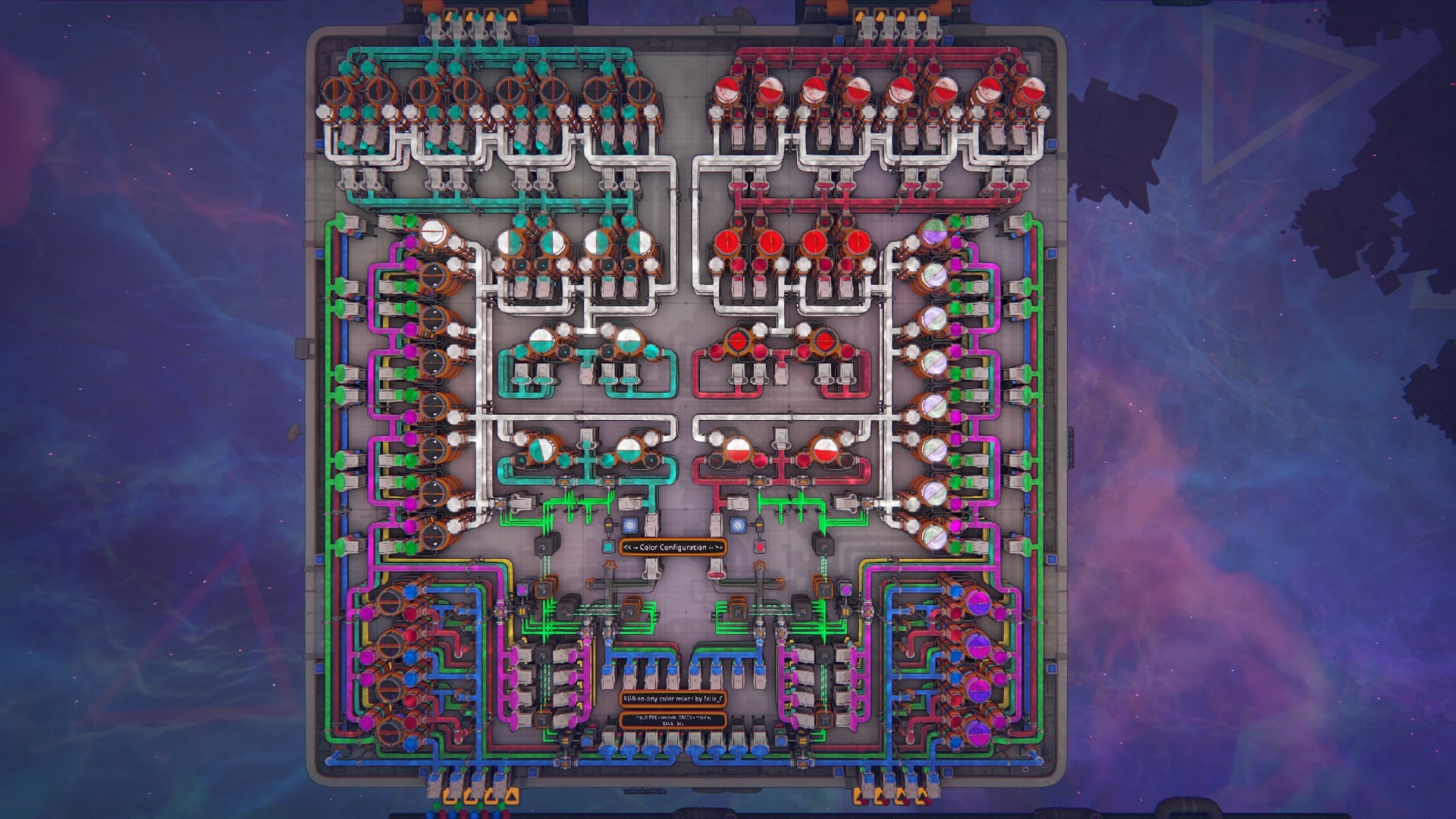
With the arrival of version 1.0, Shapez 2 settles into its final form with a quiet kind of confidence. It does not attempt a last-minute reinvention or a dramatic expansion to chase broader appeal. Instead, it refines and completes a vision that has been consistent from the beginning. That vision is strikingly focused: a factory-building game reduced to its logical core, where the challenge lies not in survival or expansion for its own sake, but in designing systems that transform simple inputs into complex outputs.
In a genre often defined by scale, friction, and layered mechanics, Shapez 2 takes a deliberately restrained approach. There are no enemies to defend against, no resource shortages to manage, and no narrative urgency pushing the player forward. The game removes nearly every external pressure and replaces it with something more internal—the drive to solve problems cleanly, efficiently, and, eventually, elegantly.
What makes the 1.0 release significant is not a shift in direction, but a strengthening of identity. Earlier versions occasionally felt like a collection of excellent systems still searching for structure, as if the underlying ideas were already solid but not yet fully arranged into a coherent long-term experience. The individual mechanics were strong, but the way they connected over time could feel slightly fragmented, especially during longer play sessions where progression sometimes lacked a clear sense of momentum.
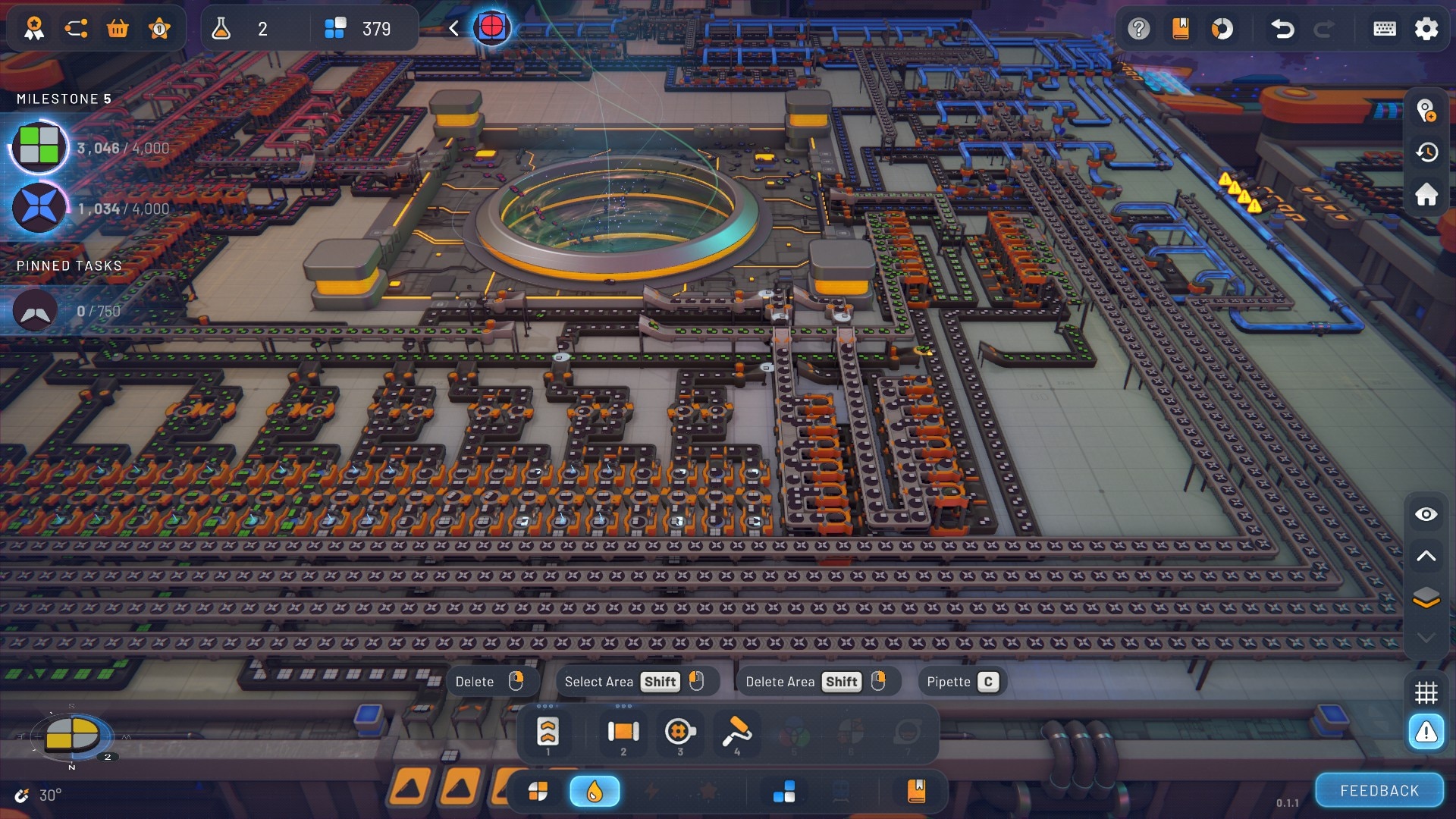
The full release addresses this by introducing clearer long-term goals, more cohesive progression, and a stronger sense of continuity across play sessions. Systems that once felt somewhat isolated now sit within a more deliberate framework, giving the overall experience a better-defined rhythm. There is a clearer feeling that each stage of development feeds meaningfully into the next, rather than existing as a self-contained puzzle to be solved and then left behind. It remains open-ended by design, but no longer feels undefined or structurally incomplete.
The result is a game that feels complete without feeling restrictive. It understands exactly what it wants to be, and it commits to that vision fully. Shapez 2 is not trying to appeal to every type of player, but for those drawn to systems, logic, and iteration, it offers a remarkably refined experience.
Gameplay and Mechanics
At its foundation, Shapez 2 is about transformation. Players extract basic geometric shapes—circles, squares, and their variants—and feed them into machines that alter them through clearly defined operations. These include cutting shapes into segments, rotating them, applying colors, stacking layers, and combining outputs into more complex forms.
Each individual action is straightforward, but the complexity emerges from how these actions interact. A single production line might involve multiple stages, each dependent on precise inputs. As requirements evolve, these lines begin to branch, merge, and overlap, forming intricate networks of interconnected processes. What begins as a simple chain quickly grows into a system that demands coordination across multiple parallel operations.
One of the game’s greatest strengths is how clearly it communicates these systems. Every transformation is visually intuitive. When a shape is cut, the result is immediately understandable. When colors are applied or layers are stacked, the outcome is predictable. This clarity removes ambiguity and allows players to focus entirely on problem-solving.
The early game introduces these concepts with care. Initial objectives are small in scope, designed to teach the fundamentals without overwhelming the player. Conveyor belts form the backbone of every factory, and their behavior is consistent and easy to grasp. Machines are clearly defined, and their functions are communicated visually as much as mechanically.
As progression continues, the demands placed on the player increase steadily. Shapes become multi-layered structures with precise color arrangements and spatial configurations. Producing these outputs often requires several independent production chains working in sync, feeding into a final assembly point. At this stage, efficiency, layout planning, and timing all become critical considerations.
What distinguishes Shapez 2 from many of its peers is the absence of traditional constraints. There is no resource cost for constructing machines, and raw materials are effectively infinite. This removes the need for resource management and shifts the focus entirely toward design.
That shift changes the nature of decision-making. Instead of asking whether something is worth building, players ask how it should be built. Optimization becomes a matter of preference rather than necessity. Some players will pursue maximum efficiency, minimizing space and maximizing throughput. Others will favor clarity, creating systems that are easy to read and maintain. Both approaches are equally valid.
Iteration sits at the center of the experience. Systems are rarely perfect on the first attempt. Players build, observe, identify flaws, and refine. The ability to quickly dismantle and rebuild without penalty ensures that this process remains fluid. Failure is not punished; it is part of the design cycle.
Over time, this loop becomes deeply engaging. The satisfaction of watching a complex system function correctly—of seeing dozens of moving parts align into a single, precise output—is where Shapez 2 finds its lasting appeal.
A Factory Game Without Pressure
Perhaps the most defining characteristic of Shapez 2 is its complete rejection of external pressure. There are no enemies, no time limits, and no scenarios where failure results in meaningful loss. The game does not threaten the player, and it does not rush them.
This absence of pressure fundamentally changes the tone. In many factory-building games, tension is a constant presence. Players must defend their infrastructure, manage dwindling resources, or respond to unexpected disruptions. These elements create urgency, but they also introduce stress.

Shapez 2 removes that layer entirely. The player is free to approach problems at their own pace, with no penalties for taking time to experiment. A production line can be left running indefinitely, paused, reworked, or completely rebuilt without consequence. The result is an experience that can feel almost meditative. There is a steady rhythm to the game: building, observing, adjusting, and refining. Conveyor belts carry shapes through carefully planned pathways, machines process them in predictable ways, and finished products emerge as the result of deliberate design.
At the same time, this design places greater responsibility on the player to stay engaged. Without external stakes, motivation must come from within. The game does not create urgency; it invites curiosity.
For players who enjoy problem-solving and system design, this approach is highly effective. It creates a space where experimentation is encouraged and where improvement is its own reward. For others, the lack of tension may make the experience feel subdued, particularly over longer sessions.
Scale and Multi-Layered Design
One of the most significant advancements in Shapez 2 is its approach to scale. Factories are no longer confined to a flat surface. Instead, players can build across multiple layers, stacking production lines vertically as well as expanding horizontally.
This multi-layered structure adds a new dimension to factory design. Space becomes more flexible, allowing for compact, efficient layouts or large, distributed systems. Verticality introduces new considerations, particularly when managing the flow of materials between layers.
As factories grow, complexity increases accordingly. Production chains can span multiple layers, with inputs and outputs moving through lifts and connectors. Understanding how these systems interact is essential for maintaining efficiency and avoiding bottlenecks.
Transportation systems, including trains, further expand the scale of the game. They allow players to connect distant parts of their factory, enabling the creation of large, distributed production networks. This encourages a broader perspective, where the focus shifts from individual machines to the overall structure of the system.
Managing this scale is made possible through a robust set of tools. Blueprints allow players to save and reuse designs, effectively turning solutions into modular components. Copy-paste functionality enables entire sections of a factory to be replicated quickly, reducing repetitive work.
These tools are essential rather than optional. Without them, the complexity of large-scale factories would quickly become overwhelming. With them, the game maintains its accessibility even as its systems grow more intricate.
Progression and Long-Term Structure
Progression in Shapez 2 is driven by the complexity of the shapes players are required to produce. Each milestone unlocks new machines, capabilities, or upgrades, gradually expanding the range of possible solutions.
The 1.0 release strengthens this system by introducing a more cohesive structure. Modes such as Manufacture Mode encourage players to build persistent factories that evolve over time, rather than treating each objective as an isolated challenge.
This shift creates a stronger sense of continuity. Infrastructure built early in the game can remain relevant later on, forming the foundation for more advanced systems. Decisions feel more meaningful, as they contribute to a growing, interconnected network rather than a series of temporary solutions.
Additional systems, including structured objectives and trade-based mechanics, provide more direction without restricting player freedom. These elements give players clear goals while still allowing multiple approaches to achieving them.
The pacing remains deliberate. The game builds gradually, introducing new concepts at a steady rate. This ensures that players have time to understand each mechanic before moving on. However, it also means that progression can feel slow at times, particularly for those who prefer more dramatic shifts in gameplay.

Interface and Usability
The interface in Shapez 2 is one of its most consistently successful elements. It is designed to minimize friction, allowing players to focus entirely on design and problem-solving. Placing, rotating, and connecting machines is intuitive. Controls are responsive, and actions can be undone quickly, encouraging experimentation. Players can dismantle and rebuild systems with minimal effort, making it easy to test different approaches.
Blueprints are a central feature, particularly in the later stages of the game. They allow players to save successful designs and reuse them across multiple contexts. This reinforces a modular approach to factory construction and reduces repetitive work.
Importantly, the interface scales well with complexity. Even as factories expand into large, interconnected systems, they remain manageable. The tools provided ensure that players are not overwhelmed by the scale of their creations.
Visual Design and Presentation
Shapez 2 embraces a minimalist visual style, but calling it simple undersells how carefully considered that simplicity actually is. Every visual element serves a functional purpose, and that purpose is clarity. In a game where players are constantly tracking multiple inputs, outputs, and transformations across large systems, readability is not just important—it is essential.
Shapes are rendered in clean, bold colors with sharp outlines, making them instantly distinguishable even when moving quickly through dense production lines. Color application is especially well handled, as painted segments remain visually distinct without blending or becoming ambiguous. This becomes increasingly important in later stages, where multi-layered shapes can involve several colors and structural components stacked together. Even at that level of complexity, the game rarely becomes visually confusing.
The transition to a multi-layered, three-dimensional building space is one of the most meaningful visual evolutions from the original game, and it is implemented with a strong sense of restraint. Rather than overwhelming the player with perspective shifts or unnecessary visual effects, the game keeps camera controls smooth and predictable. Layers are easy to navigate, and the spatial relationship between different parts of a factory remains clear at all times. This is not a game that tries to impress with spectacle; instead, it prioritizes spatial understanding.
Animation plays a subtle but important role in reinforcing this clarity. Conveyor belts move at a consistent, readable pace, and machines perform their functions with just enough motion to communicate what is happening without becoming distracting. Watching a shape pass through a cutter, split cleanly, and then move on to the next stage provides immediate feedback. These small visual confirmations accumulate, helping players quickly diagnose issues in their systems.
There is also a certain aesthetic satisfaction in seeing a well-designed factory in motion. Once a complex system is functioning correctly, it develops a kind of visual rhythm. Shapes flow through interconnected pathways, merge at precise points, and emerge as finished products in a way that feels almost choreographed. This is where the minimalist approach pays off most clearly. Without unnecessary visual noise, the player can appreciate the structure and logic of their design.
The 1.0 release adds a layer of polish that enhances these qualities without compromising them. Lighting, subtle effects, and improved visual feedback give the game a more finished look, but they never interfere with readability. It remains a game where function dictates form, and where visual design is entirely in service of gameplay.
Audio Design and Atmosphere
The audio design in Shapez 2 follows the same philosophy as its visuals: restrained, purposeful, and focused on supporting the core experience rather than drawing attention to itself. It is not a game that uses sound to create drama or tension. Instead, it builds an atmosphere that encourages concentration and long periods of engagement.
The soundtrack leans heavily into ambient tones, with slow, unobtrusive compositions that fade into the background without becoming repetitive. There are no dramatic crescendos or abrupt shifts. Instead, the music maintains a steady presence, creating a calm and consistent environment that complements the methodical nature of the gameplay. It is the kind of soundtrack that can play for hours without becoming intrusive, which is exactly what the game demands.
This approach works particularly well given the iterative nature of the experience. Players often spend extended periods refining a single system, making small adjustments and observing the results. A more aggressive or attention-grabbing soundtrack would quickly become distracting in this context. By keeping the audio understated, the game allows players to remain focused on their designs.
Sound effects are similarly restrained, but they serve an important functional role. Machines produce subtle audio cues when operating, conveyor belts emit a soft, consistent hum, and interactions provide immediate feedback. These sounds are not designed to be immersive in a cinematic sense; they are designed to be informative.

Over time, players begin to associate specific sounds with specific processes. A malfunctioning system, for example, may produce irregular audio patterns that signal a problem even before it is visually identified. This creates a secondary layer of feedback that complements the visual design. There is also a certain satisfaction in the cumulative soundscape of a functioning factory. As more systems come online, the combined audio creates a gentle, mechanical rhythm. It never becomes overwhelming, but it does provide a sense of activity and progression.
What stands out most about the audio design is its discipline. It never tries to do more than it needs to. In a game where focus and clarity are paramount, that restraint is not just appropriate—it is essential.
Modding and Longevity
With the introduction of full modding support in version 1.0, Shapez 2 significantly expands its long-term potential. While the base game already offers a substantial amount of content, its open-ended design makes it particularly well suited to community-driven expansion.
The modding tools are integrated in a way that feels natural rather than tacked on. Players can create and share modifications that range from small quality-of-life improvements to more substantial additions that alter how the game is played. This flexibility is important, as it allows the community to address different aspects of the experience depending on their interests.
For some, modding will focus on optimization and convenience. Improvements to interface elements, additional building tools, or more efficient ways to manage large factories can enhance the core gameplay without fundamentally changing it. For others, modding opens the door to entirely new challenges, introducing mechanics or constraints that the base game deliberately avoids.
This is particularly interesting given the game’s lack of inherent pressure. One of the most common criticisms of Shapez 2 is that it can feel too relaxed, too free of consequences. Modding provides a way to address that, allowing players to introduce their own forms of challenge if they choose to do so.
Beyond modding, the game’s longevity is supported by its inherent structure. Because the core loop is based on problem-solving rather than finite content, there is always room for improvement. Players can revisit their factories, refine designs, and push for greater efficiency long after completing the main progression.
The addition of structured modes and long-term goals in version 1.0 further reinforces this. Manufacture Mode, in particular, encourages sustained engagement by giving players a reason to maintain and expand their factories over time. This creates a sense of continuity that extends beyond individual challenges.
Achievements and optional objectives also play a role, providing additional milestones for players who want more direction. These systems are not intrusive, but they do offer a framework for continued play.
Ultimately, the longevity of Shapez 2 depends on how much players engage with its core loop. It is not a game built around constant updates or narrative progression. Instead, it offers a space for experimentation, refinement, and self-directed goals.
With modding support fully realized, that space becomes even more flexible. Players are not just interacting with the game as it is, but actively shaping it into something that suits their own preferences. For a game built around creativity and system design, that feels like a natural and fitting extension of its core philosophy.
Technical Performance on PC
From a technical standpoint, Shapez 2 is one of those factory-building games that clearly understands the importance of scalability. The genre lives and dies on whether a game can remain stable once the screen is filled with thousands of moving parts, and this is where the 1.0 release shows noticeable maturity compared to earlier builds.
On a typical mid-range gaming PC, performance remains stable during the early and mid-game, where factories are relatively compact and systems are still being expanded. The real test, as with any automation game, comes much later—once production lines span multiple layers, transport systems are active across long distances, and hundreds of machines are operating simultaneously.

Even at that point, Shapez 2 generally holds up well. Frame pacing remains consistent, and the game avoids the kind of sharp performance drops that often occur when simulation complexity scales faster than optimization. Large factories do naturally introduce some strain, particularly when multiple production chains converge or when the camera is zoomed out to show wide sections of the map, but these slowdowns tend to be gradual rather than disruptive. Loading times are also reasonable even when factories become large and multi-layered.
One of the more important technical strengths is stability. Crashes and hard performance-breaking bugs are not a regular occurrence in the 1.0 experience, which is notable for a game in this genre, where systems are inherently complex and heavily interconnected. The transition from Early Access to full release is particularly evident here, with a clear focus on polish and reliability rather than just feature expansion.
That said, the game is not entirely free of performance considerations. As factories scale into very large, heavily optimized layouts, players will naturally begin to notice the limits of their hardware. This is less a flaw and more an expected outcome of the genre, but it is worth acknowledging that extreme late-game setups can still push CPU usage noticeably higher than average gameplay.
Overall, the technical experience on PC is solid and dependable. Shapez 2 does not try to hide the complexity of its simulation, but it manages it well enough that performance rarely becomes the limiting factor in how the game is played. For a factory-builder that encourages large-scale, long-term construction, that level of stability is one of its most important strengths.
Final Verdict: 8.5/10
Shapez 2 stands as a confident and carefully executed entry in the factory-building genre. It does not attempt to compete on the same terms as larger, more complex titles. Instead, it offers a focused experience built around clarity, creativity, and problem-solving.
The 1.0 release strengthens the game’s foundation, adding structure and longevity without compromising its core identity. It remains a deliberately niche experience, but one that is exceptionally well crafted.
For players who enjoy designing systems and solving logistical challenges, it offers a deeply satisfying experience that rewards patience, experimentation, and attention to detail. It provides a space where creativity can flourish without constraint, and where improvement is driven by curiosity rather than necessity.
In a genre often defined by complexity and pressure, Shapez 2 demonstrates the value of restraint. By removing distractions and focusing entirely on its core idea, it delivers an experience that is both accessible and deeply engaging for those willing to invest the time.