Few indie successes in recent years have cast a longer shadow than Vampire Survivors, so it’s no small risk to follow it up with something that looks, at first glance, like a complete genre pivot. Vampire Crawlers: The Turbo Wildcard from Vampire Survivors—developed by poncle in collaboration with Nosebleed Interactive—does exactly that. It trades the chaotic, auto-attacking swarm gameplay of its predecessor for a first-person, turn-based dungeon crawler built around deckbuilding mechanics.
On paper, it sounds like a strange mutation, something that might struggle to justify its own existence beyond brand recognition. In practice, it’s something far more interesting: a game caught between two identities, occasionally brilliant, occasionally frustrating, and consistently difficult to put down.
Released in April 2026 for PC and consoles, Vampire Crawlers arrives as an official spin-off within the Vampire Survivors universe rather than a loose imitation. Early reception has been broadly positive among players, while critical response has been more measured, often pointing to pacing and balance concerns. That tension—between addictive design and uneven execution—defines the experience from the first hour to the fiftieth.
This is a game that hooks you early, loses you slightly in the middle, and then wins you back once its systems finally open up. The journey there, however, is not always smooth, and whether you stay long enough to see its best ideas depends largely on your tolerance for repetition and your curiosity about its underlying systems.
Gameplay and Mechanics
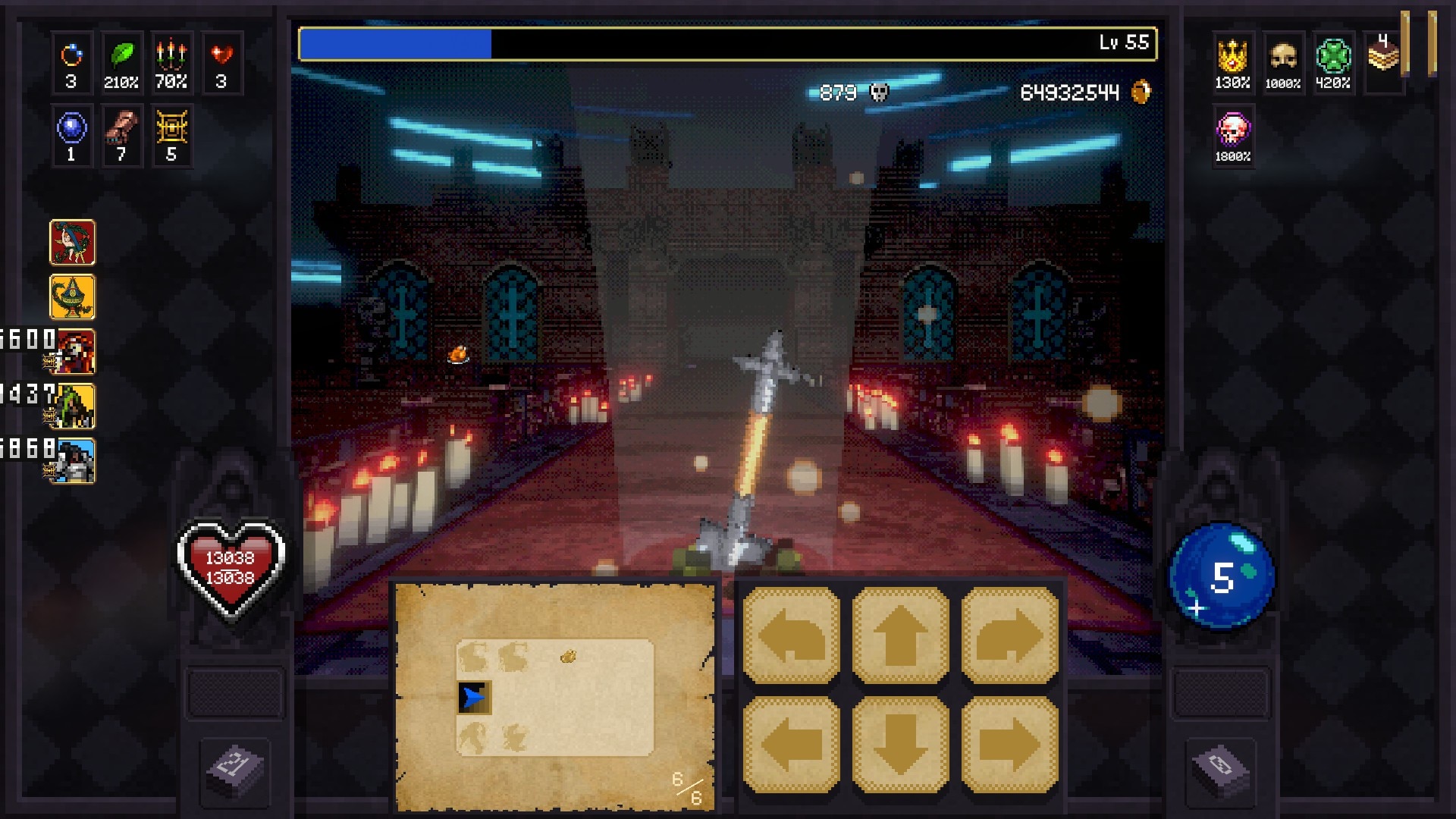
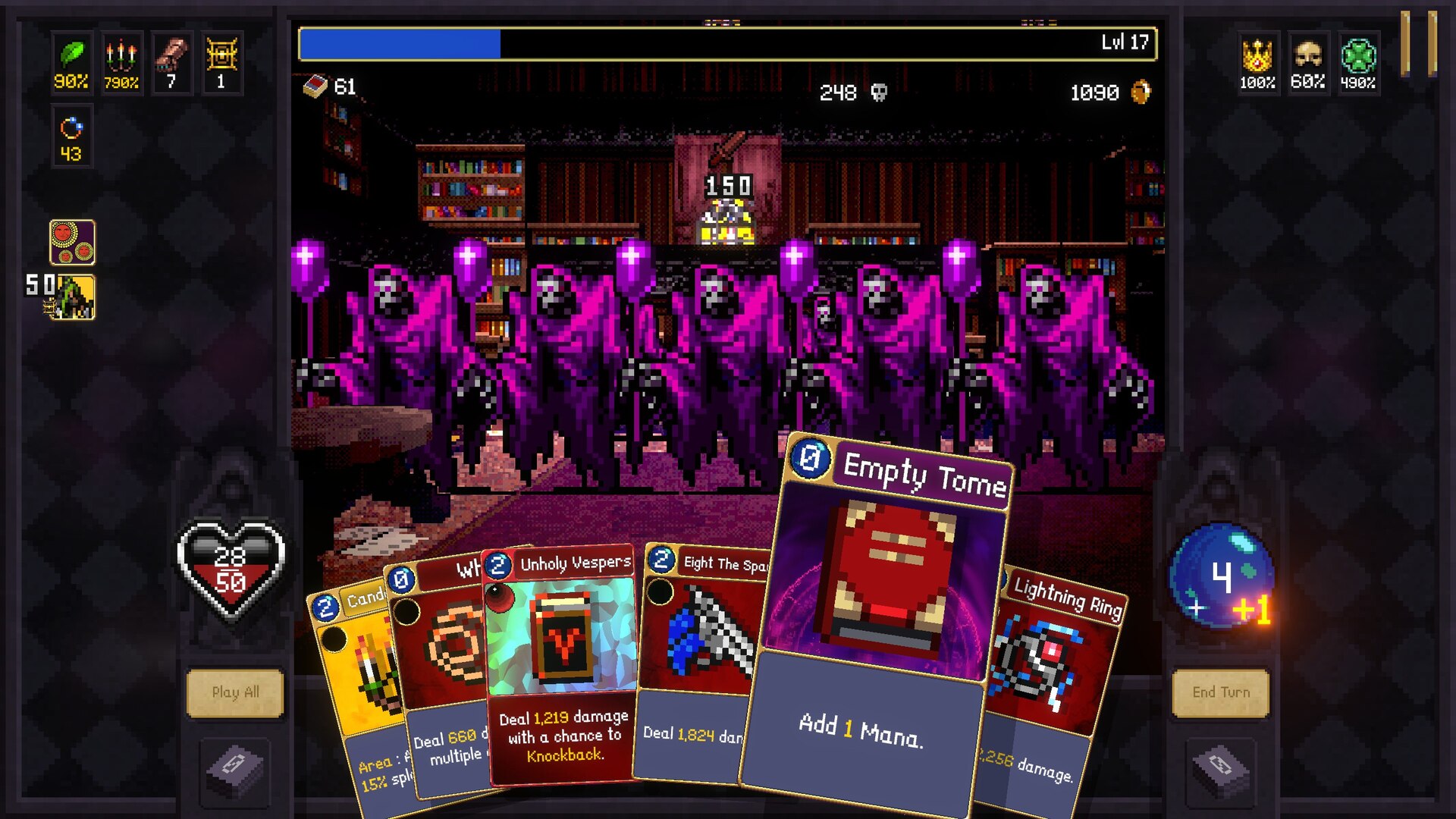
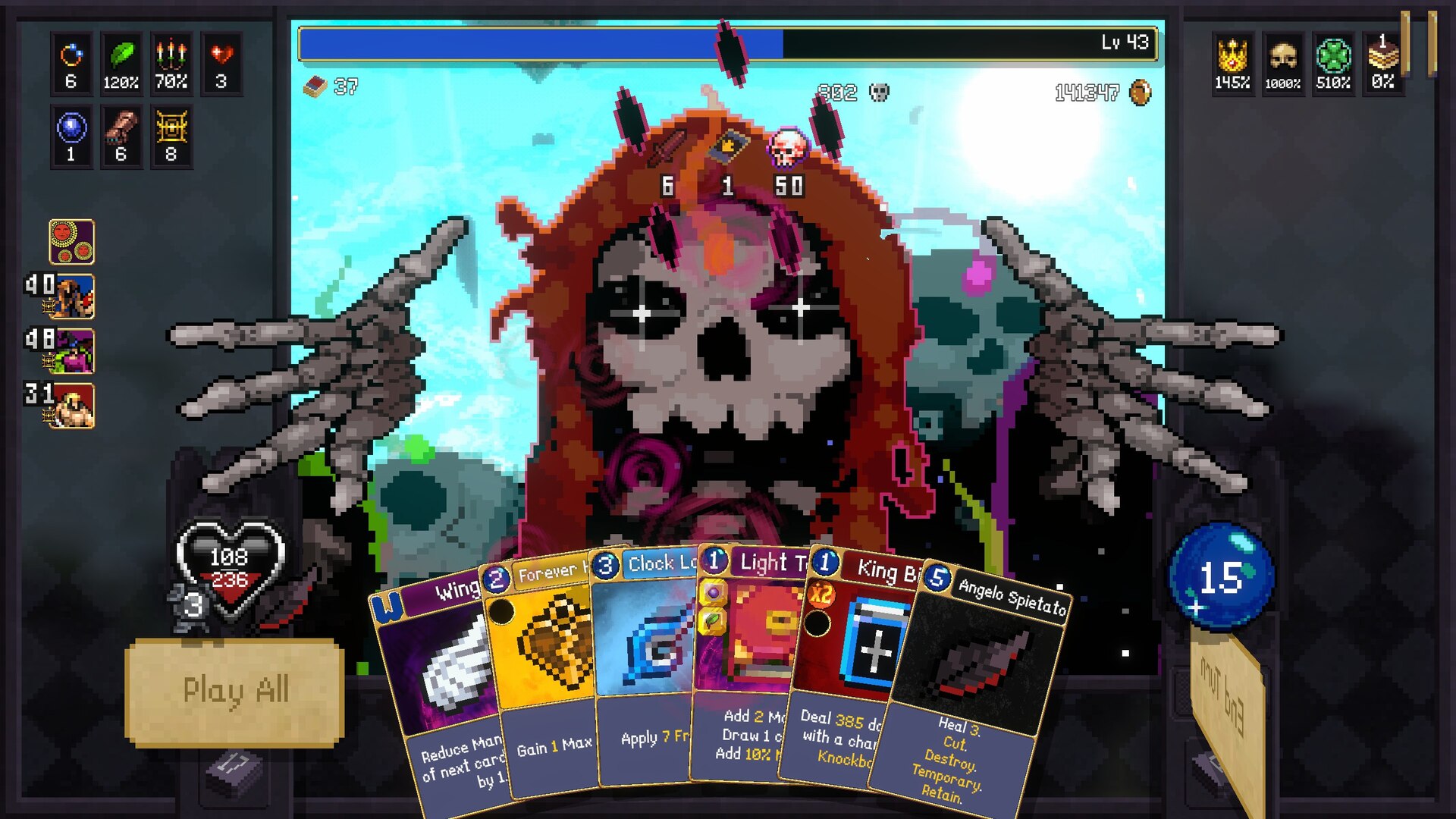
At its core, Vampire Crawlers is a hybrid: part roguelike dungeon crawler, part deckbuilding card game. You explore grid-based dungeons from a first-person perspective, moving step-by-step through narrow corridors and interconnected rooms populated by enemies, hidden treasure, and branching paths that gradually shape the direction of each run. Combat unfolds in turn-based encounters driven entirely by a deck of cards, each tied to a mana cost and specific effect, with outcomes shaped as much by sequencing and timing as by raw card power.
The defining mechanic is its combo system. Playing cards in ascending mana order builds a multiplier, increasing the effectiveness of subsequent cards and encouraging deliberate sequencing. This creates a subtle but important tension between efficiency and optimization: you are constantly weighing whether to maintain your combo chain or break it for a stronger immediate effect.
It’s a system that feels immediately accessible while gradually revealing depth. Compared to more rigid deckbuilders, Vampire Crawlers leans toward fluidity. Turns can be executed quickly, sometimes almost in bursts, giving combat a sense of momentum that prevents it from feeling static.
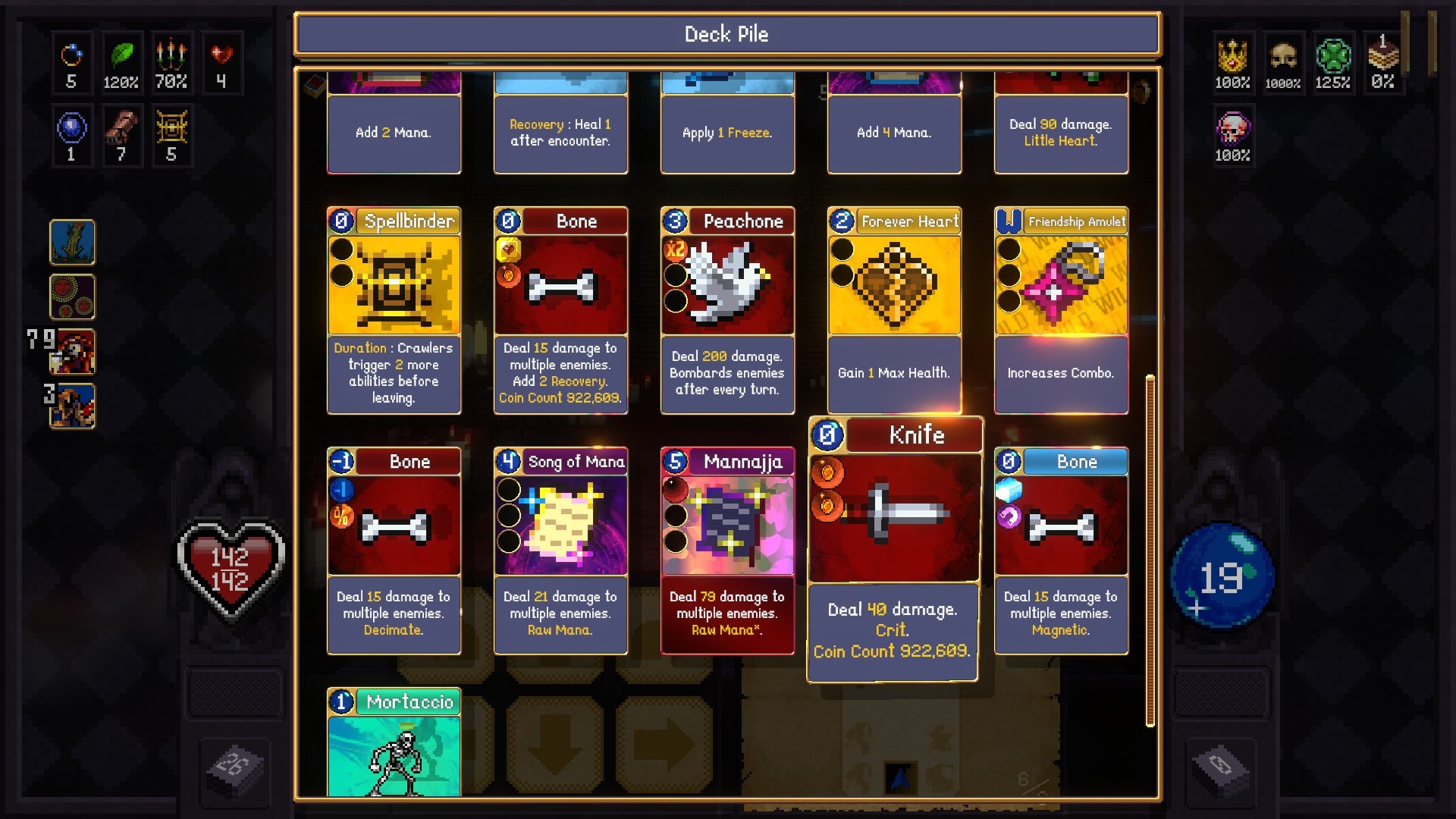
Cards themselves follow familiar archetypes—attack, defense, buffs, and utility—but are expanded through modifiers. Gems alter card behavior, while fusion systems allow players to combine cards into new forms, creating layered interactions that define each run.
However, the early game does not fully reflect this complexity. The initial card pool is limited, and optimal play patterns emerge quickly, leading to repetition. The system only becomes meaningfully engaging after extended play, when additional mechanics and synergies unlock. Until then, combat can feel narrower than it actually is.
Dungeon Crawling and Structure
The dungeon-crawling layer provides the structural backbone of the game, though it remains relatively straightforward. Movement is grid-based, and maps typically reveal upcoming encounters, including enemies, rewards, and branching paths.
This transparency shifts the focus away from exploration and toward planning. You are not uncovering hidden dangers so much as optimizing your route through visible choices. The result is a system that supports strategy but sacrifices a degree of tension and discovery that more traditional dungeon crawlers rely on.
Environments themselves are functional rather than distinctive. While the first-person perspective adds a sense of immersion, dungeon layouts lack strong visual or thematic identity. Over time, corridors and rooms begin to blend together, and the sense of place becomes secondary to the decisions you are making within it.
That said, the integration between exploration and progression works well. Every decision—whether to pursue a fight, collect resources, or take a risk—feeds directly into your evolving deck. This creates a satisfying loop where even simple choices feel meaningful in the broader context of a run.
Progression and Replayability
Like most roguelikes, Vampire Crawlers relies heavily on progression systems to sustain engagement. Runs typically last between thirty minutes and an hour, with each attempt contributing to both immediate and long-term advancement.
During a run, players acquire cards, currency, and upgrades that shape their build. Afterward, they return to a hub where permanent unlocks—new characters, additional cards, and upgrades—expand future possibilities.
This meta-progression is central to the game’s appeal. Even unsuccessful runs provide tangible rewards, creating a steady sense of forward momentum. It becomes easy to fall into the familiar loop of “just one more run,” driven not by narrative, but by the promise of incremental improvement.
Character variety adds another layer of replayability. Each Crawler begins with a distinct starting deck and abilities, subtly influencing playstyle and strategic direction. While differences are not always dramatic, they are enough to encourage experimentation and keep the experience from feeling static.
Still, progression pacing remains uneven. The game takes time to fully reveal its depth, and early runs can feel constrained. Meaningful variety often emerges only after several hours, which may frustrate players looking for immediate complexity.
Combat Depth and Build Variety
Where Vampire Crawlers excels is in its build crafting. The combination of cards, modifiers, and passive effects creates a wide range of potential strategies, allowing players to experiment with different approaches and discover synergies organically. Some builds emphasize defense, converting armor into damage through specific interactions. Others focus on duplication effects, creating cascading chains of attacks that grow stronger over time.
Resource-heavy builds allow for longer, more elaborate turns, where players can chain multiple effects together, set up synergies over several moves, and extract maximum value from a single hand of cards. These builds tend to feel more expressive, but also require careful planning to avoid collapsing under their own complexity. On the other hand, more direct strategies prioritize efficiency and consistency, focusing on straightforward damage or defense loops that are easier to execute and more reliable across different encounters, even if they offer less room for experimentation.
The combo system ties these elements together, rewarding careful sequencing and deck construction. As runs progress, players gain the tools to create increasingly complex interactions, and there is a real sense of satisfaction in watching a carefully planned build come together.
However, this depth is not always balanced. Once certain builds reach a critical threshold, they can become overwhelmingly powerful, reducing combat to a series of predictable actions. In some cases, the game shifts from decision-making to execution, where the outcome is largely predetermined.
This imbalance does not ruin the experience, but it does limit its longevity. The most interesting moments occur when you are still building toward something, rather than when you have already achieved it.
Visuals and Presentation
Visually, Vampire Crawlers stays firmly within the stylistic boundaries established by Vampire Survivors, leaning heavily on pixel art and retro-inspired design. Enemy sprites, effects, and interface elements carry a familiar look, creating a sense of continuity between the two games even as their gameplay diverges significantly.
The most noticeable change is the shift to a first-person perspective during exploration. This decision adds a layer of immersion that the original never attempted, placing the player directly within the dungeon rather than above it. While the environments themselves are relatively simple, the perspective change gives them a different kind of presence, making navigation feel more deliberate and grounded.
That said, the visual design of the dungeons does not evolve significantly over time. Areas lack strong thematic variation, and the repetition of textures and layouts can make extended play sessions feel visually monotonous. The game communicates information clearly, which is ultimately more important for its systems-driven design, but it rarely surprises or impresses on a purely aesthetic level.
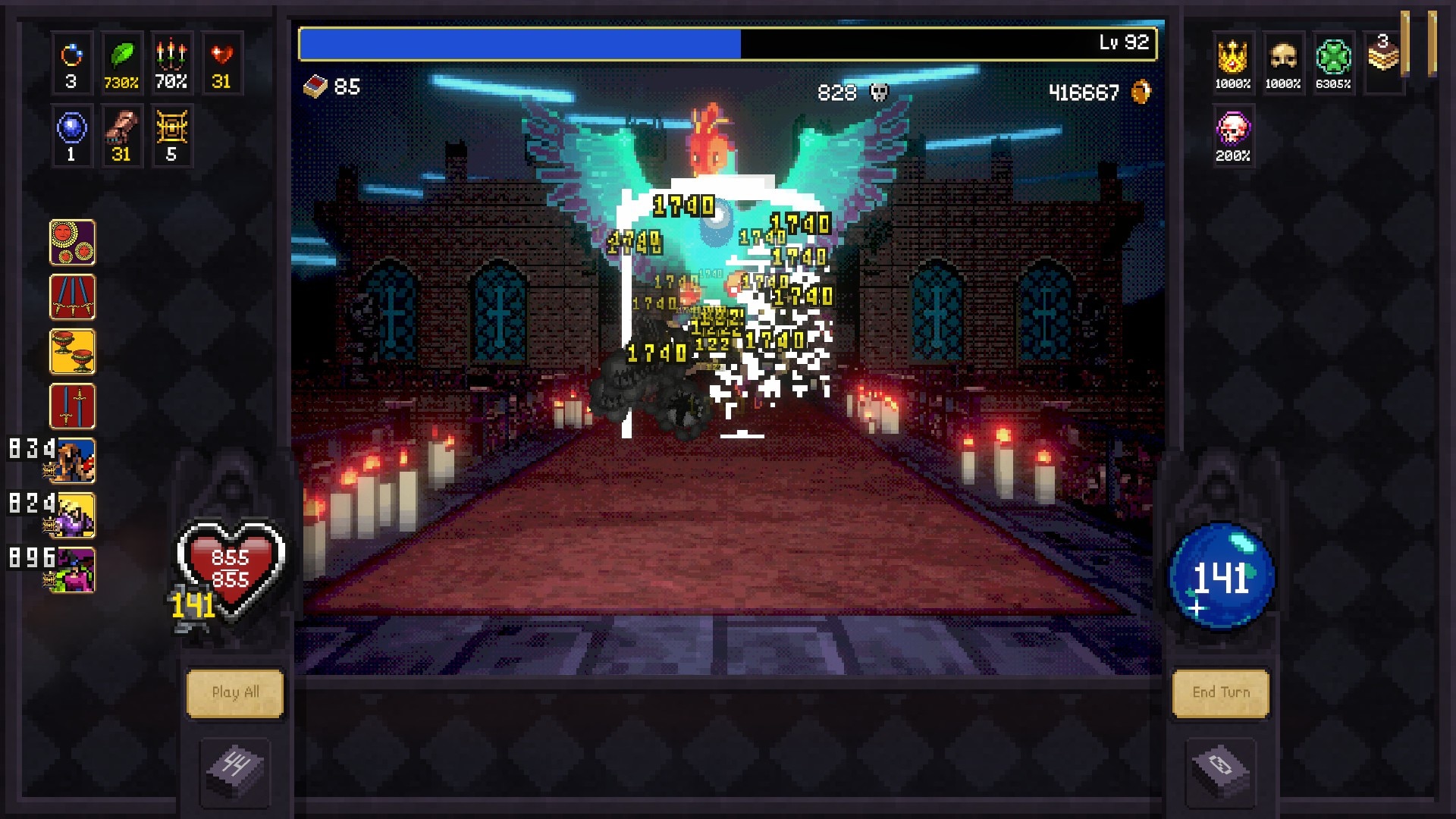
Combat, by contrast, is more visually dynamic. As builds become more complex, the screen fills with effects, animations, and layered interactions that reflect the underlying systems at work. There is a certain chaotic beauty in these moments, especially when a powerful combo unfolds exactly as planned. Even so, the visual feedback remains readable, which is crucial for a game built around sequencing and optimization.
The user interface is functional but not particularly elegant. Information is presented clearly enough, but menus and card displays can feel slightly cramped or unintuitive at first. Over time, familiarity smooths out these issues, though they never fully disappear.
Audio design complements the visuals without standing out on its own. Sound effects are responsive and satisfying, particularly during combat, where they reinforce the impact of each action. The soundtrack, however, is understated. It provides a consistent backdrop without becoming a defining feature, and few tracks leave a lasting impression.
Difficulty and Balance
Difficulty in Vampire Crawlers is uneven, and this unevenness shapes much of the player experience. Early runs are relatively forgiving, offering minimal resistance as players learn the basics of movement, card sequencing, and resource management. While this accessibility is welcome, it also means that the opening hours can feel less engaging than they should be.
As the game progresses, difficulty becomes more dependent on meta-progression. Unlocks and upgrades play a significant role in determining success, sometimes more so than player skill alone. This creates a sense that progress is gated not just by mastery, but by time investment.
This approach is common within the genre, but here it feels more pronounced. Players may find themselves repeating runs not to refine their strategies, but simply to accumulate the resources necessary to overcome later challenges. When combined with the game’s early repetition, this can lead to periods where progress feels slow or artificially constrained.
Balance issues also become more apparent over time. Certain builds can trivialize encounters, removing much of the intended challenge. While this aligns with the power fantasy that the game embraces, it also reduces the need for careful decision-making once a build is fully established.
The most engaging moments tend to occur in the middle of a run, when your build is taking shape but has not yet become unstoppable. This is where the game’s systems are at their most dynamic, and where player choice has the greatest impact.
Technical Performance on PC
From a technical standpoint, Vampire Crawlers is stable and accessible. Its relatively low system requirements ensure that it runs well on a wide range of hardware, making it easy to pick up regardless of your setup. Performance during gameplay is generally smooth, even during visually busy combat sequences. The game handles large numbers of effects without significant slowdown, which is essential given how quickly builds can escalate in complexity.
That said, the experience is not entirely free of rough edges. Minor bugs and interface quirks can occasionally disrupt the flow of play. These issues are not frequent enough to be considered major problems, but they do contribute to a sense that the game could benefit from additional polish.
The interface, in particular, can feel slightly cumbersome in certain situations. Navigating menus, managing cards, and interpreting information is not always as intuitive as it could be, especially for new players. While these issues become less noticeable over time, they remain part of the overall experience.
Narrative and World
Narrative plays a minimal role in Vampire Crawlers, and the game does little to elevate it beyond background context. Set within the same universe as Vampire Survivors, it features familiar enemies and thematic elements, but offers little in the way of structured storytelling.
The world exists primarily as a framework for gameplay rather than a fully realized setting. There are hints of a larger lore, but they are not explored in depth, and the game does not rely on narrative to drive engagement.
This approach is consistent with the design philosophy of its predecessor, where mechanics take precedence over story. For many players, this will not be an issue. However, those looking for a stronger sense of narrative progression or world-building may find the experience lacking in this regard.
Longevity and Player Experience
Longevity is one of Vampire Crawlers’ greatest strengths. The combination of relatively short runs, constant unlocks, and evolving build strategies creates a gameplay loop that is difficult to disengage from. It is the kind of game that encourages extended sessions, often without the player realizing how much time has passed.
The sense of progression is persistent, even when individual runs end in failure. There is always something new to unlock, experiment with, or refine, and this steady stream of rewards keeps the experience engaging over time.
At the same time, the game’s weaknesses become more noticeable during extended play. Repetition, particularly in the early stages, can wear down the experience, and balance issues may reduce the challenge in later runs. The pacing of unlocks also means that some players may not reach the game’s most interesting systems unless they commit several hours.
Despite these issues, the core loop remains compelling. For players who enjoy experimenting with builds and optimizing systems, Vampire Crawlers offers a significant amount of content and replay value.
Final Verdict: 8/10
Vampire Crawlers is an ambitious and often compelling evolution of the formula that made Vampire Survivors a phenomenon. By shifting to a turn-based, deckbuilding structure, it introduces new layers of strategy while retaining the addictive progression loop that defined its predecessor.
At its best, it offers a satisfying blend of planning, experimentation, and escalation. Building a powerful deck, watching synergies come together, and pushing through a difficult run can be genuinely rewarding.
But it’s not without flaws. Pacing issues, repetitive early gameplay, and balance problems prevent it from reaching the heights of the genre’s best. Combat can become predictable once optimal builds emerge, and the dungeon-crawling elements feel underdeveloped.
Ultimately, Vampire Crawlers is a game of contrasts. It is both fresh and familiar, deep and occasionally shallow, engaging and at times repetitive. For players willing to invest the time, it offers a rich and addictive experience. For others, its shortcomings may prove harder to overlook.
It may not fully capture the magic of Vampire Survivors, but it does not need to. What it does instead is carve out its own identity—uneven, experimental, and undeniably hard to ignore.