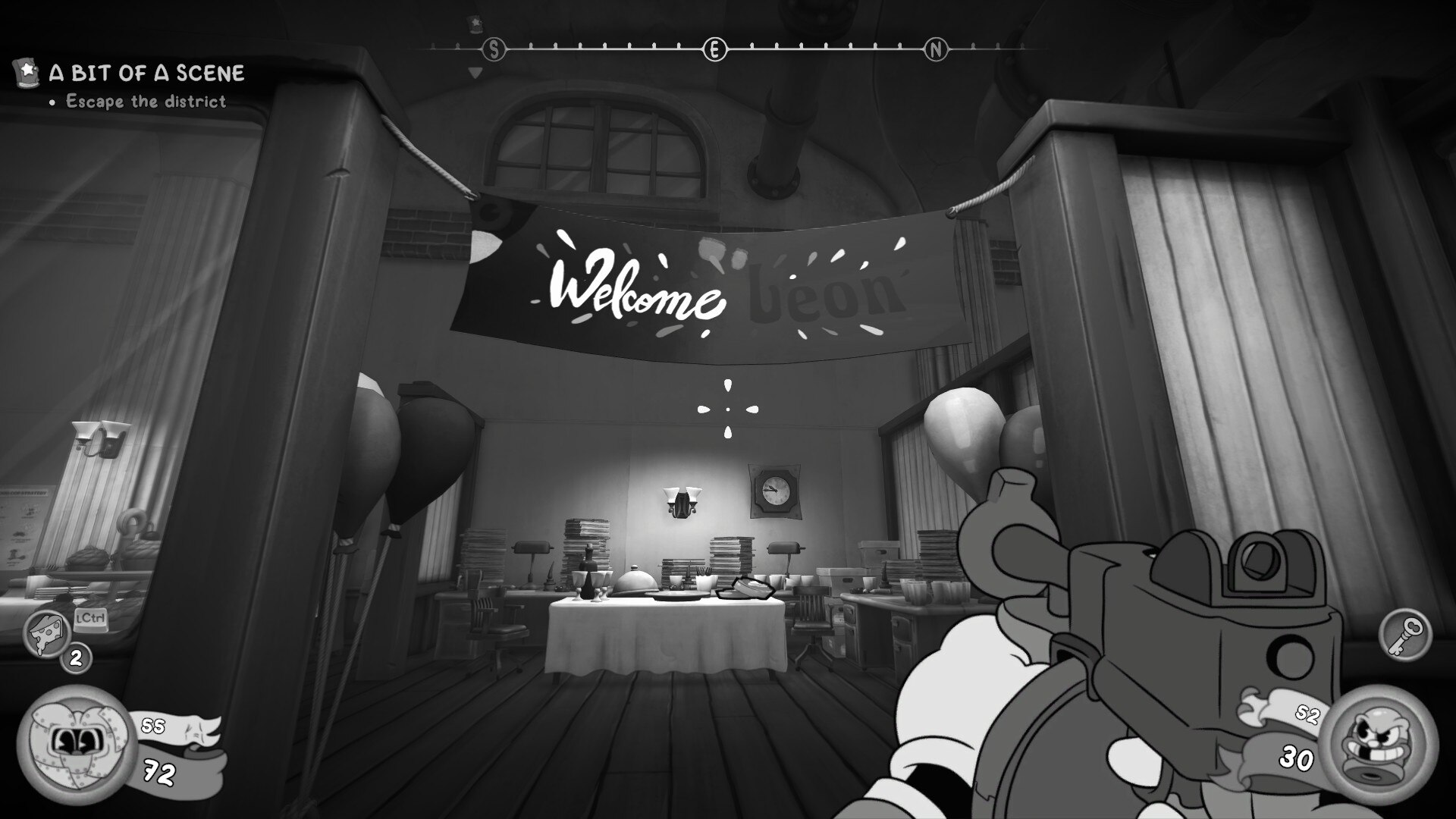
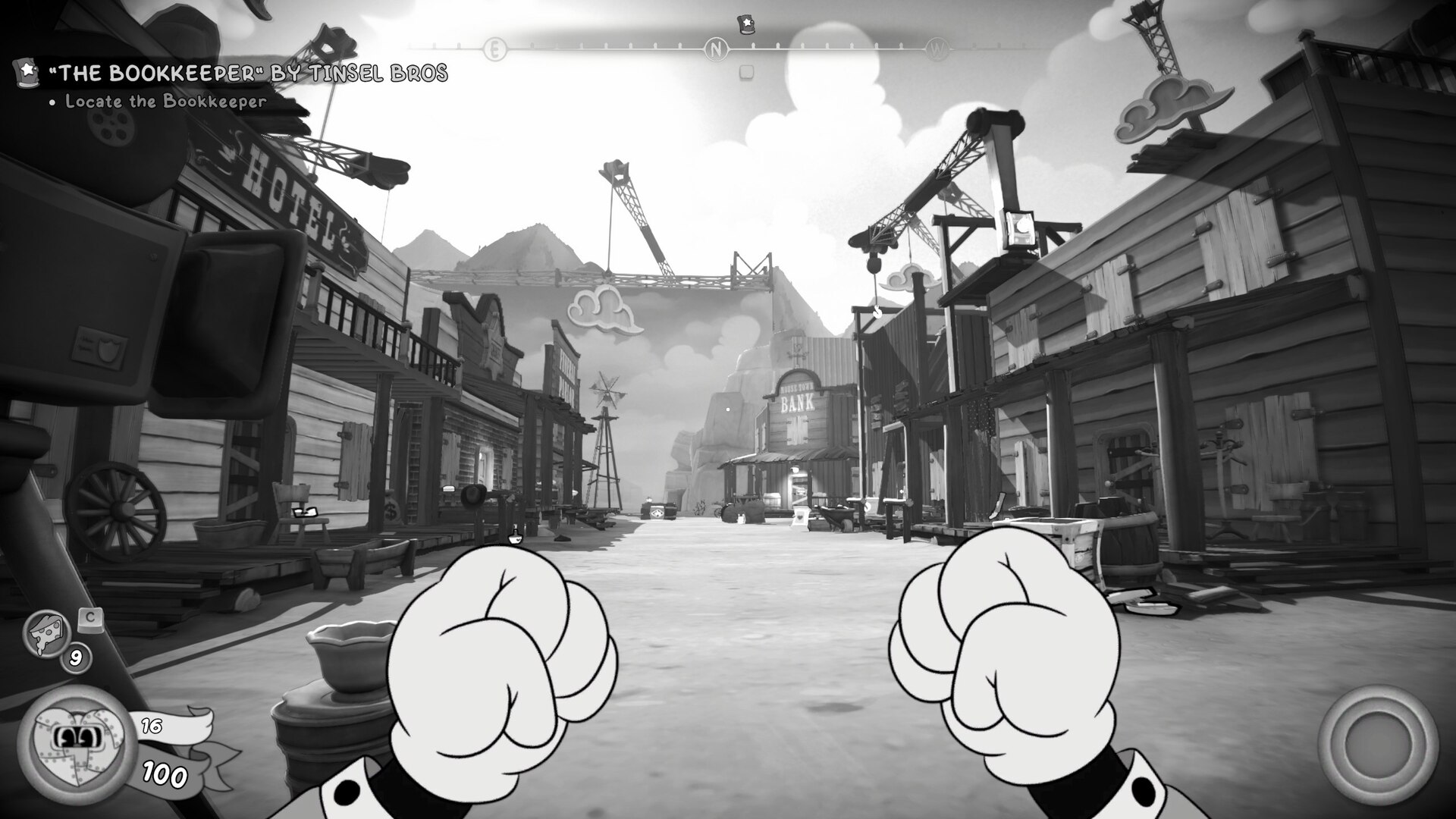
There’s a moment early in Mouse: P.I. For Hire when everything clicks into place. The exaggerated recoil of a weapon, the elastic movement of enemies, the way the world itself seems to bend under pressure—it all comes together in a way that feels both playful and deliberate. This is not a shooter that hides its influences, but it also isn’t content to simply imitate them. Instead, it uses them as a foundation to build something visually and tonally distinct.
Developed by Fumi Games, Mouse: P.I. For Hire positions itself at the intersection of retro-inspired first-person shooters and narrative-driven detective stories. You play as Jack Pepper, a private investigator navigating a city steeped in corruption, crime, and social decay. The premise is familiar, but the execution is anything but. The game’s black-and-white cartoon aesthetic, inspired by early animation, immediately sets it apart from nearly everything else on the market.
What’s interesting is how much the game leans on that identity. It doesn’t treat its visual style as decoration—it builds the entire experience around it. The humor, the violence, the pacing, even the level design all feed into this cohesive vision. For a while, it works remarkably well. The game feels fresh in a genre that often struggles to surprise.
But Mouse: P.I. For Hire is also a game of contrasts. Its strongest elements are often the most immediately apparent, while its weaknesses take longer to reveal themselves. Over time, the initial excitement gives way to a more uneven experience—one that remains engaging, but not always for the reasons it intends.
Gameplay and Mechanics
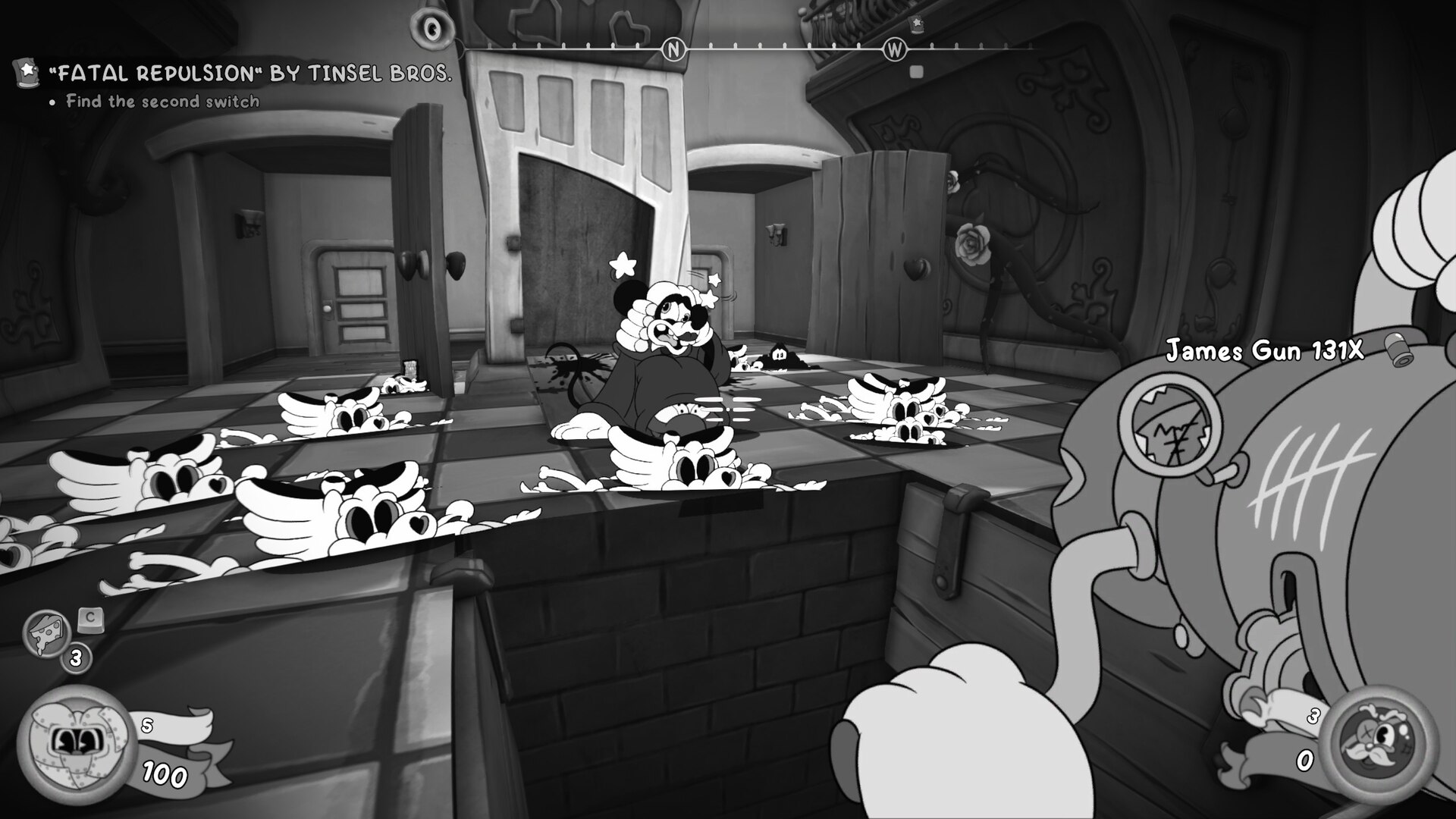
At its core, Mouse: P.I. For Hire is built on the foundations of classic first-person shooters. Movement is fast and fluid, encouraging constant motion rather than cautious positioning. The game clearly draws inspiration from the “boomer shooter” lineage, where momentum and aggression are key to survival. You are rarely standing still, and the design actively discourages defensive play.
Movement mechanics play a central role in shaping the experience. Strafing is responsive, jumps carry weight without feeling sluggish, and traversal abilities—such as grappling or environmental interaction—add layers of verticality and flexibility. The result is a control scheme that feels immediately intuitive but still offers room for mastery. Players who engage fully with the movement system will find themselves navigating encounters with a rhythm that feels almost musical.
Combat is structured around a growing arsenal of weapons, each with its own personality. Rather than relying purely on raw damage output, many weapons feature alternate fire modes or situational advantages. This encourages experimentation, particularly in the early stages of the game when new tools are introduced at a steady pace. Switching between weapons mid-combat becomes second nature, and the game rewards players who adapt to different scenarios rather than relying on a single approach.
Enemy design, at least initially, supports this flexibility. Encounters often throw multiple enemy types at you simultaneously, forcing quick decision-making and constant movement. Some enemies apply pressure through sheer numbers, while others demand priority targeting due to their abilities. This creates a dynamic combat loop that feels engaging and reactive.
However, this is also where the game begins to show its limitations. While the foundation is strong, the systems don’t evolve as much as they should over time. Enemy variety, while sufficient in the early hours, doesn’t expand in meaningful ways. Patterns become predictable, and encounters begin to feel less like challenges and more like repetitions of earlier scenarios.
Weapon progression also contributes to this issue. New additions to the arsenal are spaced out in a way that sometimes leaves long stretches of gameplay without significant mechanical change. When new weapons do arrive, they often feel like variations on existing ideas rather than transformative additions. This isn’t inherently a problem, but in a game that leans so heavily on its moment-to-moment action, the lack of evolution becomes noticeable.
Despite these shortcomings, the core mechanics remain satisfying. Shooting feels responsive, movement is consistently enjoyable, and the game rarely stumbles at a fundamental level. The issue is not that the gameplay is weak—it’s that it doesn’t grow enough to sustain its full runtime.
Level Design and Exploration
The structure of Mouse: P.I. For Hire blends linear mission design with a central hub that ties everything together. This hub serves as both a narrative anchor and a functional space where players can track progress, gather clues, and prepare for upcoming missions. It’s a smart choice that reinforces the detective theme while also providing a break from the intensity of combat.
Individual levels are where the game’s creativity shines. Each location is distinct, not just visually but structurally. From cramped alleyways to expansive interior spaces, the environments are designed to encourage movement and exploration. Verticality plays a key role, with multiple paths and hidden areas rewarding players who take the time to look beyond the obvious route.
Secrets and collectibles are scattered throughout the levels, often tucked away in corners that require careful observation or clever use of movement abilities to reach. This adds an extra layer of engagement, particularly for players who enjoy fully exploring game worlds. The inclusion of light progression gating—where certain abilities unlock new paths in previously visited areas—introduces a subtle metroidvania influence that enhances replayability.
In the early stages, this design feels cohesive and rewarding. Levels are dense without being overwhelming, and the balance between combat and exploration is well maintained. There’s a sense of discovery that keeps the experience fresh, even when the core gameplay loop remains consistent.
As the game progresses, however, the design begins to lose some of its focus. Later levels tend to stretch out more, sometimes without adding meaningful complexity. Backtracking becomes more common, but it doesn’t always lead to new or interesting interactions. What initially feels like a layered world gradually shifts toward something more linear and predictable.
This shift affects pacing as well. The interplay between exploration and combat becomes less dynamic, and the sense of progression slows. While the environments remain visually interesting, they don’t always offer the same level of mechanical engagement as earlier sections.
Even so, the overall quality of the level design remains solid. There’s a clear sense of intention behind each space, and the game rarely feels careless or rushed. The issue is more about consistency than capability—the ideas are strong, but they aren’t always sustained across the entire experience.

Story and Writing
The narrative of Mouse: P.I. For Hire leans heavily into noir traditions. Jack Pepper is a familiar archetype: a weary private investigator with a sharp edge and a tendency to get pulled into situations far beyond his control. The story begins with a relatively straightforward case but gradually expands into a broader conspiracy involving crime syndicates, political corruption, and social tension within the city.
What the game does well is atmosphere. The world feels lived-in, with a sense of history and complexity that extends beyond the immediate plot. Environmental storytelling plays a significant role, with details scattered throughout levels that hint at larger narratives. This approach helps compensate for some of the shortcomings in the main storyline.
The writing itself is more uneven. Dialogue often captures the tone of noir fiction, but it doesn’t always deliver memorable or impactful moments. Characters serve their roles effectively, but few stand out as particularly compelling or complex. The story moves forward at a steady pace, but it rarely surprises or challenges expectations.
One of the more interesting aspects is how the narrative integrates with gameplay. The case-based structure, combined with the hub system, creates a sense of progression that aligns with the detective theme. Solving cases, uncovering clues, and gradually piecing together the larger story adds context to the action, even if the individual plot points are not especially original.
There are moments where the game hints at deeper themes—corruption, inequality, the consequences of power—but these ideas are not explored in depth. They function more as background elements than central pillars of the narrative. This isn’t necessarily a flaw, but it does limit the emotional impact of the story.
Ultimately, the narrative serves its purpose. It provides motivation, structure, and context, but it doesn’t elevate the experience in the way the game’s visual design does. It’s competent, occasionally engaging, but rarely exceptional.
Art Direction and Visual Identity
If there is one aspect of Mouse: P.I. For Hire that defines it, it is the art direction. The game’s black-and-white, hand-drawn aesthetic is not just distinctive—it is foundational. Every element, from character design to animation to environmental detail, is crafted to evoke the style of early 20th-century cartoons.
This choice has a profound impact on the experience. Characters move with exaggerated, elastic animations that contrast sharply with the violence of the gameplay. Enemies react in ways that are both comedic and unsettling, creating a tone that is difficult to categorize. It’s not purely humorous, nor is it entirely serious—it exists somewhere in between.
The visual clarity is particularly impressive given the complexity of the style. In a fast-paced shooter, readability is crucial, and the game manages to maintain it despite the chaotic nature of its animations. Enemies are easy to distinguish, projectiles are visible, and the environment provides clear visual cues without breaking the aesthetic.
The use of contrast is another strength. The monochrome palette allows for strong visual emphasis, guiding the player’s attention in subtle but effective ways. Lighting and shading are used not just for atmosphere, but for gameplay clarity as well.
What makes the art direction truly effective is how well it integrates with the rest of the game. It’s not an overlay—it’s a core part of the design. The sound effects, the animations, the level layouts, and even the pacing all work together to support this unified vision.
Even when other aspects of the game begin to falter, the visual presentation remains compelling. It’s the element that consistently draws you back in, even during moments when the gameplay feels less engaging.
Audio and Sound Design
The audio design complements the visual identity in a way that feels intentional and cohesive. The soundtrack leans heavily into jazz influences, reinforcing the noir atmosphere while also providing energy during combat sequences. It’s not overly intrusive, but it’s always present, subtly shaping the tone of each moment.
Sound effects are stylized to match the cartoon aesthetic. Weapons produce exaggerated, almost theatrical sounds, and enemy reactions are similarly expressive. This adds a layer of personality to combat that helps distinguish it from more conventional shooters.
Voice acting plays a supporting role, particularly for the protagonist. Jack Pepper’s performance captures the tone of a hardboiled detective without feeling overly forced. While the script may not always give him standout lines, the delivery adds character and consistency to the role.
The overall audio experience is well balanced. Music, effects, and voice work all contribute to a cohesive soundscape that enhances the game’s identity. Like the visual design, it remains a consistent strength throughout the experience.

Technical Performance on PC
On PC, Mouse: P.I. For Hire delivers a stable and polished experience that rarely gets in the way of what the game is trying to do. The stylized visuals, while immediately striking, are not particularly demanding from a hardware perspective. This allows the game to maintain smooth performance across a wide range of systems, from mid-range setups to more powerful configurations. Frame rates remain consistently high, even during more chaotic combat encounters where multiple enemies and effects fill the screen.
One of the more impressive aspects of the technical performance is how well the game handles visual clarity under pressure. The combination of hand-drawn animation layered onto 3D environments could easily become visually noisy, especially during fast movement and heavy combat. Instead, the game manages to preserve readability without sacrificing its style. Animations remain smooth, enemy silhouettes stay distinguishable, and visual effects rarely obscure critical information. This balance is not easy to achieve, and it speaks to careful optimization and thoughtful visual design.
Load times are short and infrequent, which helps maintain the flow between exploration, combat, and narrative segments. The hub-based structure benefits from this efficiency, as returning to central areas or transitioning between missions never feels like a disruption. The game keeps you moving forward without unnecessary technical friction, which is particularly important for maintaining immersion in a fast-paced shooter.
Control responsiveness is another area where the PC version performs well. Input feels immediate and precise, whether using a keyboard and mouse or a controller. Mouse sensitivity scales predictably, and there is enough configurability to accommodate different playstyles. In a game that emphasizes movement and quick reactions, this level of responsiveness is essential, and it remains consistent throughout the experience.
In terms of graphical settings, the game offers enough flexibility to fine-tune performance without overwhelming the player with excessive options. Adjustments to resolution, effects, and general quality settings allow for easy optimization depending on hardware capabilities. While it may not cater to enthusiasts looking for extensive customization, it provides everything necessary to achieve a stable and visually coherent experience.
Minor technical issues do appear occasionally, but they are generally small in scope. These might include brief animation quirks or momentary inconsistencies in enemy behavior, but they rarely persist or significantly impact gameplay. There are no widespread reports of crashes or severe bugs, and overall stability remains strong from start to finish.
Another subtle strength lies in how well the game maintains performance during extended sessions. There is no noticeable degradation over time, no memory-related slowdowns, and no need for frequent restarts to maintain smooth operation. This reliability contributes to a more seamless experience, especially for players who prefer longer play sessions.
Overall, the technical execution supports the game’s design rather than drawing attention to itself. It doesn’t push hardware boundaries or aim for cutting-edge realism, but that’s not its goal. Instead, it focuses on consistency, clarity, and smooth performance, ensuring that the core gameplay and distinctive visual identity remain front and center at all times.
Pacing and Overall Structure
Pacing is where Mouse: P.I. For Hire faces its most significant challenges. The early hours are tightly constructed, with a steady introduction of mechanics, environments, and narrative elements. There’s a clear sense of progression, and the balance between action and exploration feels well considered.
As the game continues, however, this balance begins to shift. The introduction of new ideas slows, and the existing systems are not expanded in ways that keep the experience feeling fresh. Encounters become more predictable, and the sense of discovery diminishes.
This affects the overall structure of the game. What starts as a focused, engaging experience gradually becomes more uneven. Later sections feel longer, not necessarily because they contain more content, but because they lack the same level of variety and momentum.
The issue is not simply one of length. A shorter game with the same structure would likely feel more consistent, while a longer game with greater mechanical evolution could sustain its runtime more effectively. As it stands, Mouse: P.I. For Hire sits somewhere in between—long enough for its weaknesses to become apparent, but not expansive enough to fully develop its ideas.
Final Verdict: 8/10
Mouse: P.I. For Hire is a game defined by its identity. It takes a bold visual concept and builds an entire experience around it, resulting in something that feels genuinely distinct in a crowded genre. For a significant portion of its runtime, it succeeds in delivering a fast-paced, stylish shooter that stands out for all the right reasons.
Its strengths are clear. The art direction is exceptional, the core gameplay is solid, and the world it creates is both imaginative and engaging. These elements combine to form an experience that is easy to appreciate, even when it doesn’t fully deliver on its potential.
At the same time, the game struggles to maintain its momentum. Repetition, limited mechanical evolution, and uneven pacing prevent it from reaching the level of consistency needed to match its ambition. The ideas are strong, but they are not always developed as far as they could be.
Even so, Mouse: P.I. For Hire remains a memorable experience. It may not redefine the genre, but it pushes against its boundaries in meaningful ways. And in a space where familiarity often dominates, that alone makes it worth paying attention to.