World War I remains a strangely underused setting in video games. While the Second World War has been explored from nearly every angle imaginable, the muddy trenches and chaotic frontline assaults of the Great War have rarely been given the same attention. A handful of titles—most notably Verdun and Isonzo—have attempted to capture the brutal stalemates and sudden explosions of violence that defined the conflict. Into this niche steps Over the Top: WWI, a large-scale multiplayer shooter developed by Flying Squirrel Entertainment and published by GG Publishing.
Released for PC on March 6, 2026, the game aims to deliver an enormous sandbox depiction of the First World War. Its central promise is simple but ambitious: battles involving up to 200 participants, destructible maps, and terrain that can be reshaped by both artillery and players themselves.
That pitch places the game in an unusual position. On one hand, it tries to portray the gritty chaos of trench warfare. On the other, it leans heavily into sandbox-style systems that encourage experimentation, destruction, and emergent gameplay.
In many ways, Over the Top: WWI feels like a historical spin on the large-scale multiplayer formula popularized by Battlefield, originally developed by DICE and published by Electronic Arts. Large maps, vehicle combat, destructible structures, and objective-based warfare will feel instantly familiar to players who spent years fighting through Battlefield’s sprawling multiplayer battles.
But the WWI setting changes the tone considerably. Instead of modern rifles and helicopters, players rely on bolt-action rifles, primitive tanks, flamethrowers, and artillery. Combat is slower, more chaotic, and often far more unpredictable.
The result is a game that delivers some genuinely memorable battlefield moments, even if it occasionally struggles with polish and balance. Over the Top: WWI may not be the most refined multiplayer shooter on PC, but its ambition and scale make it an intriguing entry in the genre.

Gameplay and Mechanics
The core gameplay revolves around massive multiplayer matches where up to 200 players—or a mix of players and bots—fight across large battlefields inspired by the Western Front. This scale dramatically changes the feel of combat compared to traditional shooters. Instead of carefully controlled skirmishes between small teams, the battlefield is constantly alive with activity. Gunfire erupts across distant trenches, artillery shells explode across open fields, and squads of players push toward objectives scattered across the map.
Mechanically, the game allows players to switch between first-person and third-person perspectives. The third-person view provides greater awareness of the surrounding battlefield, while first-person aiming offers better precision during firefights. This hybrid system feels slightly unusual at first but becomes useful during chaotic engagements where situational awareness is critical.
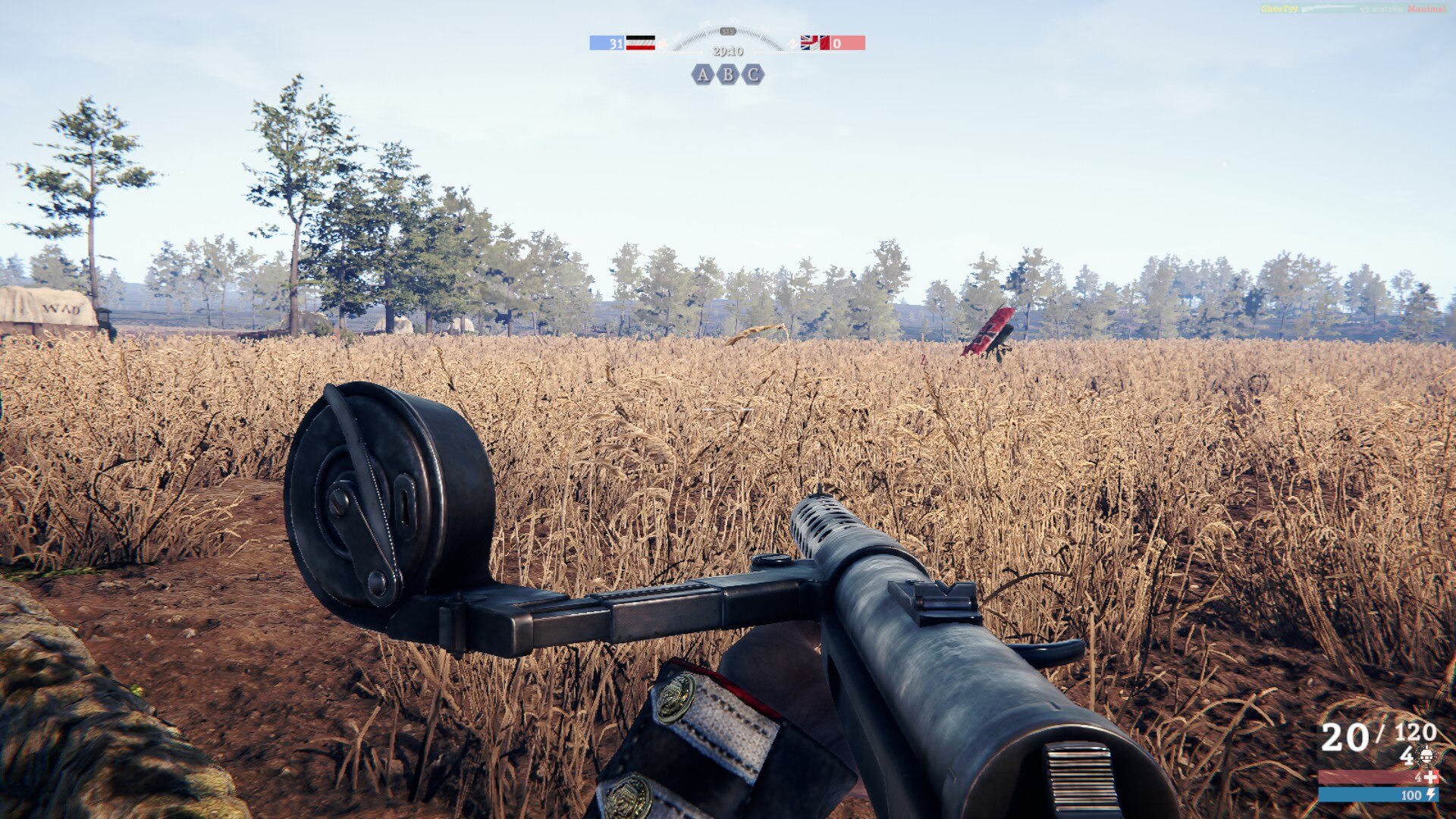
Movement and weapon handling are intentionally slower than in modern military shooters. Most soldiers carry bolt-action rifles that require careful aiming and deliberate timing between shots. Missing a shot often leaves players exposed for several seconds while cycling the next round.
The pacing of combat reflects the ebb and flow associated with trench warfare. A section of the front may remain quiet for a few minutes before suddenly erupting into violence when artillery strikes begin and dozens of soldiers charge across no man’s land.
Objective-based gameplay structures most matches. Teams capture and defend strategic positions across the map, gradually pushing the frontline forward or forcing the enemy to retreat. The design clearly draws inspiration from the conquest-style gameplay that Battlefield fans will recognize immediately.
However, the mechanics are not without issues. Movement can feel stiff at times, and weapon handling occasionally lacks the crisp responsiveness expected from modern shooters. While these flaws do not break the experience, they contribute to the sense that the game still carries some rough edges.
Classes, Weapons, and Equipment
Class-based gameplay forms the backbone of Over the Top: WWI. Players choose from several military roles, each with specific equipment and battlefield responsibilities. Roles typically include riflemen, engineers, officers, snipers, and support specialists. Engineers are particularly valuable because they can dig trenches, build defensive structures, and reshape terrain during combat. Officers, meanwhile, have access to powerful support abilities such as artillery strikes.
The weapon roster reflects the technology of the early twentieth century. Bolt-action rifles dominate the battlefield, supported by revolvers, machine guns, flamethrowers, grenades, and various melee weapons. The game includes more than fifty weapons overall, offering a surprising amount of variety within the historical setting.
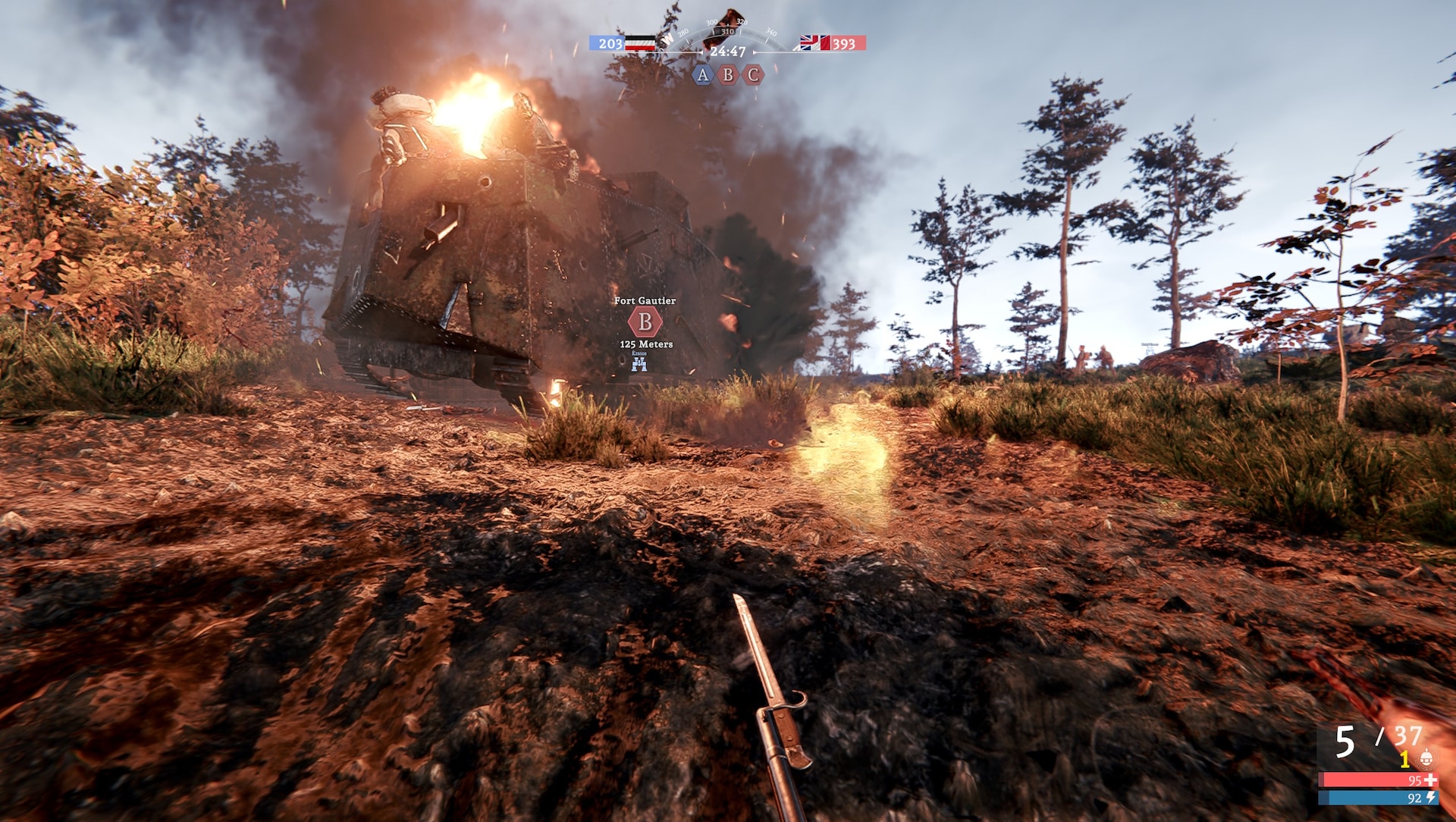
Vehicles also play a major role. Early tanks, armored vehicles, artillery pieces, and aircraft can dramatically influence the outcome of a match. Tanks are slow, heavy machines that often require multiple players to operate effectively. When used well, they can break through enemy defenses or provide cover for advancing infantry.
This vehicle-driven warfare again draws comparisons with Battlefield. However, the primitive nature of World War I technology creates a different dynamic. Tanks are clumsy and vulnerable, aircraft are fragile, and artillery can reshape the battlefield itself.
While the variety of equipment keeps gameplay interesting, balance is occasionally inconsistent. Certain weapons and roles—particularly long-range snipers—can feel disproportionately effective depending on the map and player positioning.
Destructible Battlefields
One of the game’s most distinctive features is its destructible environment system. Almost everything on the battlefield can be altered or destroyed. Buildings collapse under sustained fire, artillery shells carve massive craters into the landscape, and players can dig trenches or fortifications during the match. This system fundamentally changes how maps evolve during gameplay.
A quiet village may gradually turn into a field of rubble after several artillery strikes. Open farmland can become a maze of craters and trenches after repeated explosions.
These environmental changes are not purely cosmetic. They directly influence gameplay by altering lines of sight, cover positions, and movement routes. A newly created crater may suddenly provide valuable protection from enemy fire, while a destroyed building can expose previously hidden defenders.
The destructible terrain also creates a sense of battlefield chaos that feels appropriate for the setting. By the end of a match, maps often look dramatically different from how they started.
Players familiar with earlier Battlefield games will immediately recognize the influence here. However, Over the Top: WWI pushes the concept further by allowing the terrain itself to deform dynamically.
The system is not entirely permanent—maps eventually reset after multiple matches—but during a single battle the transformation of the environment can be striking.
Multiplayer Experience
Multiplayer is unquestionably the main focus of the game. The 100-versus-100 battles create an atmosphere that often feels closer to a chaotic war simulation than a typical shooter match. Frontlines shift constantly as squads push toward objectives, vehicles advance across the battlefield, and artillery reshapes the terrain.
The structure of these matches again echoes the large-scale warfare of Battlefield. Multiple objectives are scattered across the map, and teams must capture and defend them to maintain momentum.
Communication and teamwork can make a major difference. Coordinated squads that build defenses, repair vehicles, and support each other with artillery strikes often outperform groups of players acting independently.
That said, the massive scale of the battles also means that complete coordination is rare. Many matches devolve into chaotic charges across the battlefield, with players fighting wherever the action happens to be.
Surprisingly, that chaos is often part of the appeal. Even when strategies collapse, the battlefield remains active and unpredictable. Explosions erupt across distant hills while tanks push forward and infantry scramble through trenches in close combat.
These unpredictable moments often produce the most memorable experiences the game has to offer.
Visuals and Art Direction
Visually, Over the Top: WWI sits somewhere between indie and mid-tier production values, delivering environments and large-scale battlefield scenes that are convincing and atmospheric without reaching the technical fidelity or graphical polish of modern AAA shooters. The game clearly prioritizes scale and dynamic battlefield systems—such as destructible terrain and massive player counts—over cutting-edge visual detail, which results in presentation that can look impressive during large battles but occasionally reveals simpler models, textures, and animations when examined up close.

The environments successfully capture the grim atmosphere of the Western Front. Trenches snake across muddy landscapes, ruined villages stand half-destroyed by artillery, and farmland is scarred by explosions and shell craters. The developers clearly aimed to portray the war-torn landscape of World War I in a way that feels believable rather than stylized. Muddy terrain, wooden trench structures, sandbags, barbed wire, and shattered buildings all contribute to a battlefield that looks appropriately worn and battle-damaged.
Dynamic weather, seasonal variations, and changing lighting conditions help give maps a sense of variety. A battlefield might appear drastically different depending on whether it is covered in snow, soaked in rain, or illuminated by the warm light of sunset. These shifts are subtle but effective, adding visual diversity to battles that might otherwise take place in very similar environments.
The destruction system also contributes heavily to the visual spectacle. Watching buildings collapse or artillery blasts reshape the terrain can create dramatic moments that feel surprisingly cinematic. Entire sections of a village can crumble under sustained bombardment, while repeated explosions transform once-flat fields into crater-filled wastelands. Because the environment changes during battle, maps rarely look exactly the same by the time a match ends.
The large player counts also help sell the scale of the conflict. Seeing dozens of soldiers advancing across a battlefield at the same time creates a visual sense of warfare that smaller shooters cannot easily replicate. Massive assaults, tanks pushing through ruined streets, and aircraft flying overhead all combine to create moments that feel closer to a battlefield simulation than a typical multiplayer match.
However, character models and animations reveal the game’s smaller development budget. Movement animations can appear somewhat stiff, and some textures lack the sharpness and detail seen in higher-budget shooters. Close inspection of soldiers and weapons sometimes exposes simplified geometry or less refined visual effects.
Despite these shortcomings, the overall art direction does a solid job conveying the chaos and devastation of World War I. While the game may not compete visually with the biggest AAA shooters, its dynamic destruction, large battlefields, and evolving environments create a convincing sense of large-scale warfare.
Audio Design
Sound plays a significant role in establishing the game’s atmosphere. The crack of bolt-action rifles, the thunder of artillery barrages, and the rattling bursts of machine guns create a constant background of battlefield noise. During large battles, the combined effect can feel overwhelming in a way that suits the setting.
Explosions carry a heavy impact, and distant gunfire echoes across the landscape, giving players a sense of how much fighting is happening beyond their immediate surroundings. Vehicles also contribute to the soundscape. Tanks grind forward with heavy mechanical noises while aircraft engines buzz overhead. Voice communication and proximity chat add another layer of immersion, allowing players to shout warnings or coordinate attacks during intense firefights.
While the audio design does not attempt anything revolutionary, it effectively reinforces the scale and chaos of the battlefield.
Performance and Technical State
From a technical standpoint, Over the Top: WWI reflects both the ambition and limitations of a relatively small development team. The game runs on modest hardware requirements, making it accessible to a wide range of PC players. Mid-range systems can achieve playable frame rates with appropriate settings.
However, the enormous scale of the battles can occasionally strain performance. When dozens of players, vehicles, explosions, and destructible objects appear simultaneously, frame rate dips are not uncommon.
Other technical issues appear sporadically. Some players may encounter minor graphical glitches, inconsistent animations, or occasional bugs. None of these problems completely derail the experience, but they do highlight the challenges involved in maintaining stability in such large multiplayer environments.
Fortunately, the game’s ongoing updates suggest that technical improvements will continue over time.
Final Verdict: 7.5/10
Over the Top: WWI is an ambitious attempt to capture the chaos and scale of World War I in a multiplayer shooter. Its massive battles, destructible terrain, and sandbox-style gameplay create moments that few other WWI games can replicate. Charging across a cratered battlefield while artillery shells tear apart the landscape can feel genuinely exhilarating.
The influence of the Battlefield series is unmistakable. Large maps, vehicle combat, and objective-based multiplayer all feel familiar, yet the WWI setting introduces a slower and more methodical style of combat.
At the same time, the game’s rough edges are difficult to ignore. Movement and shooting mechanics occasionally feel unpolished, visuals are uneven, and large battles can stress performance.
Even so, the underlying ideas are strong enough to keep the experience engaging. When everything comes together—the scale, the destruction, and the chaotic frontline combat—Over the Top: WWI delivers moments that few multiplayer shooters can match.
It may not be the most polished war game on PC, but it is certainly one of the most ambitious.