
Cooperative zombie shooters have existed long enough that their structure has become instantly recognizable to most players, which means any new entry into the genre must work harder than ever to justify its existence. The core formula—four players entering hostile territory, scavenging resources, completing objectives, and fighting overwhelming hordes of enemies—remains undeniably entertaining when executed well, yet familiarity can quickly turn into repetition if developers fail to introduce new ideas or memorable twists. For that reason, modern horde shooters often succeed less through reinvention and more through personality, presentation, and the scale of the chaos they create.
Into this crowded genre arrives John Carpenter’s Toxic Commando, a cooperative first-person shooter developed by Saber Interactive and published by Focus Entertainment. The game attempts to stand out through its unapologetically pulpy tone, drawing inspiration from the horror filmmaking style of John Carpenter, whose work helped shape the gritty atmosphere of genre cinema throughout the late twentieth century. Rather than presenting a serious post-apocalyptic drama, Toxic Commando leans into exaggerated action, dark humor, and an aesthetic that feels deliberately reminiscent of late-night horror movies and cult science-fiction adventures.
At a glance, the gameplay framework will look very familiar to anyone who has played titles such as Left 4 Dead or World War Z, the latter of which is particularly relevant given Saber Interactive’s previous experience with massive enemy swarms. What Toxic Commando tries to add to the formula involves larger mission environments, a focus on off-road vehicles, and a narrative tone that embraces absurdity rather than attempting dramatic storytelling.

After spending significant time with the PC version, it becomes clear that Toxic Commando succeeds primarily when it focuses on chaotic cooperative action. Massive zombie hordes, frantic vehicle escapes, and unpredictable firefights create moments of genuine excitement that feel perfectly suited to multiplayer sessions with friends. At the same time, some of the surrounding systems struggle to maintain momentum over the long term, revealing familiar weaknesses in mission variety and progression pacing.
The result is a game that does not dramatically reinvent the cooperative shooter but manages to deliver a lively and entertaining experience whenever its systems align to produce the kind of chaotic battles that the genre does best.
Story and Setting
The narrative setup behind Toxic Commando embraces a level of absurdity that feels intentionally inspired by classic horror cinema, presenting a scenario that seems designed to support outrageous action rather than serious storytelling. Instead of building a grounded science-fiction narrative, the game introduces a supernatural disaster that spreads across the world in a manner that feels more like a pulp horror premise than a realistic global crisis.
The story begins with an ambitious scientific experiment intended to harness energy from deep within the Earth’s core. Predictably, the experiment goes catastrophically wrong and unleashes a mysterious entity known as the Sludge God, whose influence spreads through the environment and transforms ordinary people into grotesque undead creatures. As this corruption spreads, entire regions collapse into toxic wastelands filled with mutated horrors, abandoned towns, and crumbling industrial complexes.
Facing the consequences of his disastrous research, the scientist responsible for the accident attempts to hire elite mercenaries capable of entering the contaminated zones to retrieve experimental equipment and contain the supernatural outbreak. Unfortunately for him, hiring competent professionals proves far too expensive, which leads to the recruitment of a group of second-rate mercenaries who may lack impressive credentials but possess enough enthusiasm to face the apocalypse head-on.
This deliberately ridiculous premise establishes the tone that carries through the entire campaign. Toxic Commando never attempts to disguise the fact that its narrative exists primarily as a vehicle for chaotic gameplay scenarios. Characters exchange sarcastic remarks, exaggerated reactions, and occasional dark humor as they fight their way through contaminated landscapes, reinforcing the impression that the developers are aiming for entertainment rather than emotional depth.
The influence of John Carpenter’s cinematic style becomes visible not only in the game’s atmosphere but also in its willingness to embrace a slightly irreverent tone. Conversations between characters often feel closer to the banter found in cult action films than the dramatic dialogue of modern blockbuster games.
The campaign unfolds across nine missions that gradually take players deeper into contaminated territory as they attempt to recover equipment and slow the spreading corruption. Although the narrative progresses through cutscenes and in-mission radio conversations, the story rarely dominates the experience. Instead, it provides a loose framework that allows the gameplay to remain the primary attraction.
While the narrative never becomes particularly complex or surprising, its playful tone ensures that it rarely feels intrusive or overly serious. In many ways, the story functions exactly as it should for a cooperative shooter by providing just enough context to justify the action without slowing the pacing.
Gameplay and Mechanics
The core gameplay of Toxic Commando revolves around cooperative missions that combine exploration, resource gathering, and large-scale combat encounters within expansive environments. Teams of up to four players enter contaminated regions where they must complete objectives while surviving relentless waves of enemies.
Before each mission begins, players select from a variety of character classes, each designed with unique abilities and passive bonuses that encourage teamwork. These classes introduce subtle variations in playstyle, allowing some players to focus on support roles while others emphasize offensive capabilities. Although the distinctions between classes rarely redefine the core gameplay, they add enough variety to encourage coordinated team compositions.
Once deployed into a mission environment, the squad must navigate through dangerous terrain while completing a sequence of objectives that gradually advance the scenario. These tasks may involve activating machinery, recovering experimental devices, escorting vehicles, or defending strategic locations against large enemy assaults.
One of the most distinctive gameplay elements involves the heavy use of off-road vehicles. Rather than simply serving as background scenery, these vehicles function as essential tools that allow players to traverse the sprawling mission maps. Armored trucks can carry the entire squad across hazardous terrain while providing a mobile defensive platform against approaching enemies.
Vehicle mechanics introduce additional variables that complicate the traditional cooperative shooter formula. Muddy terrain can slow movement dramatically, making navigation through contaminated swamps a tactical challenge rather than a simple journey from one objective to another. Fuel must also be managed carefully, because running out of fuel in hostile territory can leave the squad vulnerable to enemy swarms.
Situations in which a vehicle becomes stuck in thick mud while hundreds of zombies converge on the team often produce some of the most memorable encounters in the game. During these moments, players must coordinate their actions quickly in order to repair the vehicle, defend their position, and escape before the enemy tide becomes overwhelming.
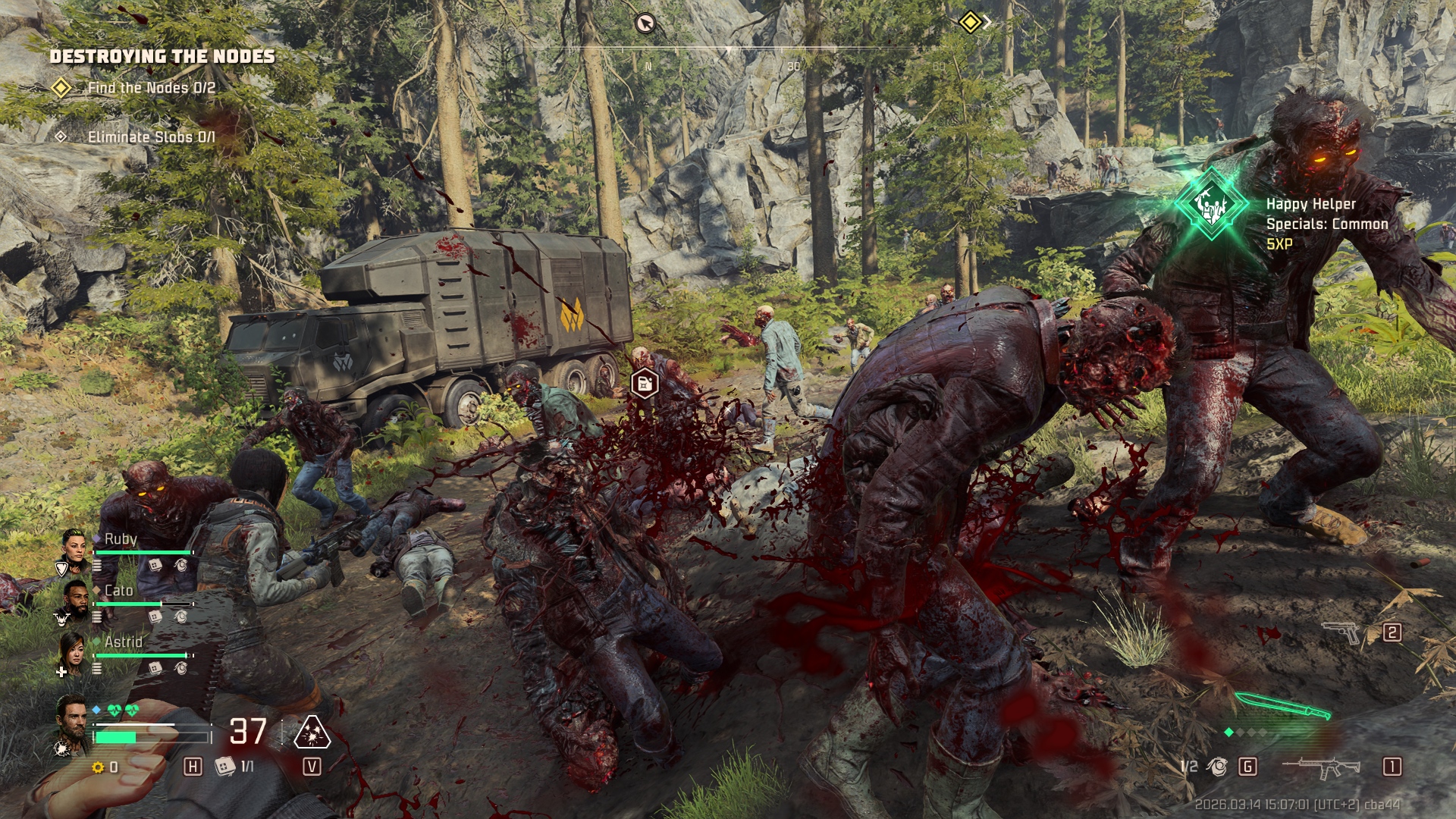
Combat itself remains fast-paced and heavily focused on large-scale encounters that demand constant attention and coordinated action. The game utilizes Saber Interactive’s swarm technology to generate enormous groups of enemies that advance across the battlefield in dense, almost overwhelming formations, creating a sense of relentless pressure that rarely lets players relax. These swarms are not merely static waves; they behave dynamically, often navigating terrain intelligently, climbing over obstacles, or piling on top of one another in an attempt to reach players positioned on elevated surfaces or behind cover.
The visual and mechanical complexity of these encounters ensures that every firefight feels chaotic and unpredictable, forcing players to balance aggression with careful positioning and quick reactions in order to survive against the overwhelming tide of adversaries.
The available arsenal includes a wide range of familiar weapons such as assault rifles, shotguns, heavy machine guns, and explosive launchers. Gunplay feels responsive and impactful, allowing players to cut through waves of enemies with satisfying bursts of firepower.
Although character abilities occasionally provide tactical advantages, most encounters ultimately depend on teamwork, positioning, and effective use of weapons.
Level Design and Exploration
Mission environments in Toxic Commando emphasize scale and freedom of movement, giving squads room to explore contaminated regions rather than forcing them along strictly linear paths. Each mission takes place within a relatively large map filled with abandoned structures, scattered resources, and environmental hazards that encourage exploration.
Players who search these areas carefully often discover useful supplies that can improve their chances of surviving the next major encounter. This scavenging element adds variety to the pacing by allowing quieter exploration phases between intense combat sequences.
The environments themselves reflect the spreading corruption unleashed by the Sludge God. Toxic swamps, decaying industrial facilities, and deserted settlements form the backdrop for most missions. Pools of glowing sludge appear throughout the terrain, reinforcing the sense that the world itself has been fundamentally altered by the supernatural disaster.
Lighting effects contribute significantly to the atmosphere, with fog drifting through ruined structures while the glow of contaminated chemicals casts eerie green illumination across the landscape.
Despite the impressive scale of these environments, however, the visual themes occasionally become repetitive over the course of the campaign. Many locations share similar color palettes and architectural elements, which can cause certain missions to blend together visually.
Even so, the open design frequently allows unscripted situations to emerge. Unexpected ambushes, chaotic defensive battles, and desperate vehicle escapes often arise naturally from the map layout, creating memorable moments that feel unique to each play session.
Enemy Design and Combat Encounters
Enemy variety plays an important role in maintaining tension within cooperative shooters, and Toxic Commando combines familiar zombie archetypes with large-scale swarm mechanics to keep battles engaging.
Standard undead enemies form the majority of the opposition, appearing in overwhelming numbers and relentlessly advancing toward the player’s position. While individual zombies remain relatively simple in behavior, their collective movement creates a powerful sense of pressure.
Special enemy variants introduce additional challenges that force players to adapt their strategies. Some enemies detonate when killed, which encourages careful positioning during firefights, while others charge aggressively in an attempt to disrupt defensive formations.
Mini-boss creatures occasionally appear during missions, demanding concentrated firepower from the entire squad. These encounters often occur alongside large swarms, increasing the difficulty by forcing players to divide their attention between multiple threats.
Although many of these enemy types will feel familiar to veterans of the genre, the scale of the battles helps maintain excitement. Watching hundreds of undead creatures surge across the battlefield creates a spectacle that reinforces the chaotic nature of the game.
Visuals and Art Direction
The visual presentation of John Carpenter’s Toxic Commando successfully captures the grimy atmosphere of a world corrupted by supernatural forces, combining environmental decay with exaggerated horror imagery that reflects the game’s B-movie inspirations. Rather than pursuing pristine realism, the art direction leans into a slightly stylized aesthetic in which contaminated landscapes, glowing sludge, and abandoned infrastructure create the impression of a world that has been both physically and spiritually poisoned. This approach reinforces the tone of the narrative, which intentionally favors pulpy horror spectacle over grounded realism.
Environmental design stands out as one of the game’s stronger visual elements, particularly in the way ruined industrial sites, collapsed highways, and flooded settlements contribute to the feeling that the outbreak has completely reshaped the landscape. Rusting machinery, broken pipelines, and scattered debris appear throughout the environments, adding layers of visual storytelling that hint at the chaos that unfolded before the player’s arrival. Many areas feel as though they were once ordinary places suddenly abandoned during the early stages of the disaster, which helps reinforce the sense of a world that has deteriorated rather than simply transformed overnight.
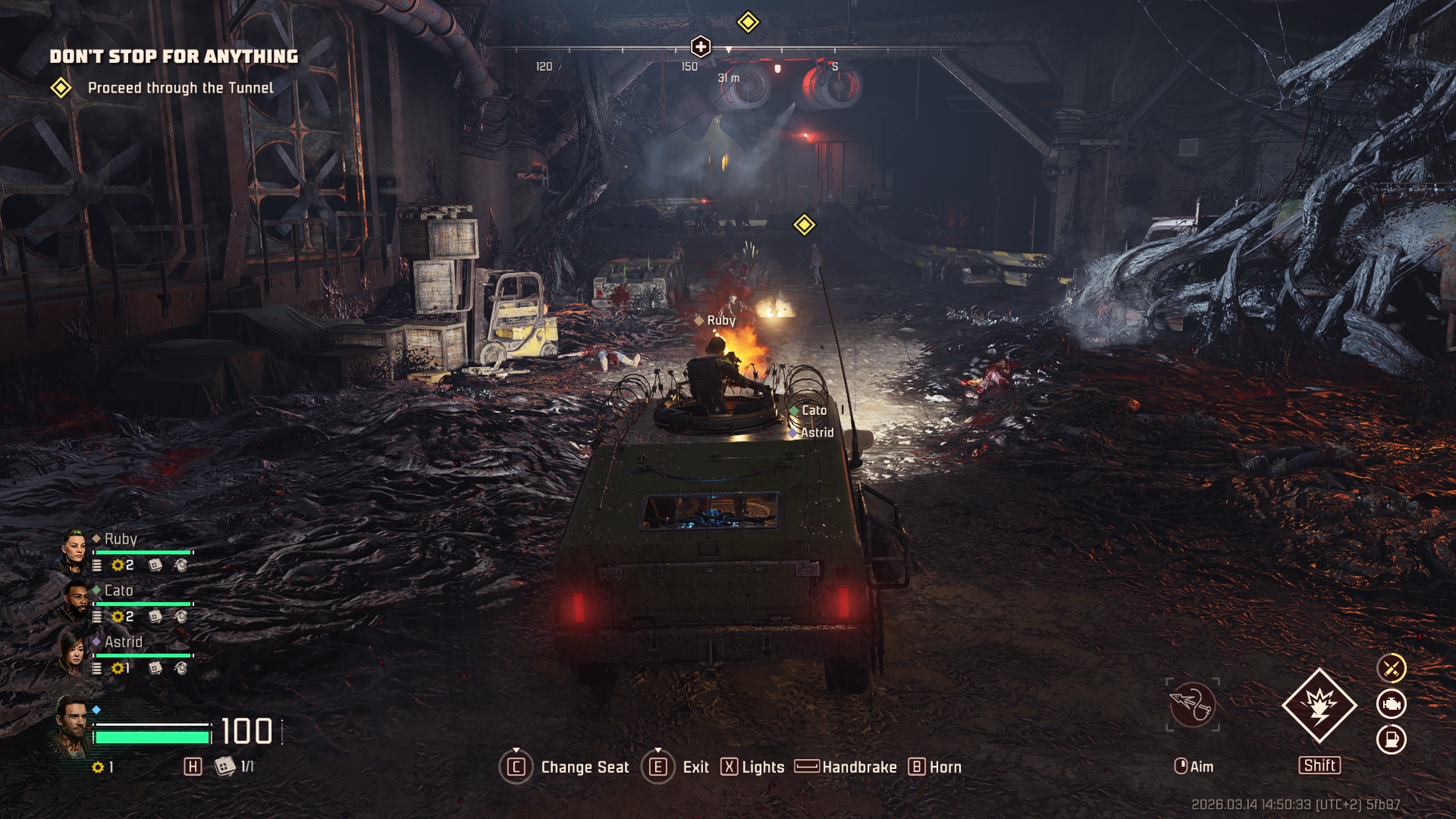
Lighting plays an especially important role in shaping the game’s atmosphere, as dark environments illuminated by toxic chemical pools or flickering industrial lights create dramatic contrasts that heighten tension during exploration. The glow of radioactive sludge often casts eerie green reflections across nearby surfaces, while distant fires or malfunctioning floodlights produce shifting shadows that give environments a slightly unsettling quality. These lighting choices help the game maintain a consistent horror tone even during quieter moments between combat encounters.
Character models and weapon animations remain solid throughout the campaign, with a level of detail that feels appropriate for a cooperative shooter focused primarily on large-scale battles. Weapons are visually distinct and include subtle design touches that reinforce the game’s rough, improvised aesthetic, while character animations remain fluid enough to support the fast pace of combat. Particle effects such as sparks, smoke, and flying debris add additional visual energy whenever firefights escalate into chaotic explosions.
Perhaps the most visually impressive aspect of the game involves the behavior of large enemy swarms, which often climb over one another in order to reach players positioned behind obstacles or on elevated terrain. Watching hundreds of undead creatures surge across the battlefield creates a disturbing spectacle that communicates both the scale of the threat and the technological ambition behind the game’s swarm system. These moments frequently become visual highlights because they transform ordinary environments into scenes of overwhelming chaos.
Although some environments eventually begin to resemble one another due to the consistent focus on toxic decay and industrial ruin, the art direction remains cohesive enough that the repetition rarely breaks immersion. The developers clearly prioritized atmosphere and readability during combat encounters, and the resulting aesthetic manages to support both goals while maintaining the grimy horror identity that defines the game’s overall presentation.
Audio and Music
Audio design contributes significantly to the identity of Toxic Commando, particularly through a soundtrack that embraces the electronic horror style associated with John Carpenter’s film scores.
The music relies heavily on synthesizers and pulsing rhythms that gradually intensify during combat encounters, creating an energetic backdrop for the chaotic battles.
Weapon sound effects deliver satisfying impact, while explosions echo across the environment with convincing weight. Meanwhile, the constant groans of approaching zombies maintain a steady sense of tension during exploration.
Voice acting performances capture the exaggerated tone of the script, with characters frequently exchanging sarcastic remarks that reinforce the game’s pulp-inspired personality.
Cooperative Play
The cooperative component of John Carpenter’s Toxic Commando represents the foundation around which the entire experience has been built, and the game consistently feels more dynamic and engaging when played with a full team of human players. From the structure of its missions to the design of its character classes and vehicles, nearly every major gameplay system assumes that players will be coordinating their actions in order to survive the increasingly dangerous situations that arise throughout the campaign. When four players work together effectively, the game begins to reveal the chaotic energy that the developers clearly intended to create.
Communication plays a significant role in making cooperative play satisfying. Teams that coordinate their movements and share resources tend to handle large encounters more efficiently than those that operate independently. Ammunition, health supplies, and defensive positioning often determine whether a squad survives the most intense enemy waves, and these moments become far more manageable when players communicate about incoming threats and adjust their strategy accordingly. The game rarely demands extremely complex coordination, but simple teamwork often makes the difference between a controlled defense and a frantic scramble to recover from a collapsing position.
Vehicle segments add another interesting layer to the cooperative experience because they introduce shared responsibilities that extend beyond basic combat roles. When the team travels in an armored truck or similar vehicle, one player typically focuses on driving through hazardous terrain while the others concentrate on defending the vehicle against approaching enemies. These sequences often create tense scenarios in which the entire squad must react quickly to changing circumstances, particularly when the vehicle becomes stuck in mud or begins taking heavy damage from surrounding hordes.
Moments when a vehicle stalls in the middle of a contaminated swamp while hundreds of zombies close in from every direction tend to produce some of the most memorable cooperative encounters in the game. In these situations players must combine defensive firepower, quick repairs, and coordinated movement in order to escape before the situation becomes overwhelming. These kinds of unscripted moments capture the chaotic spirit that cooperative shooters often strive for.
The game also encourages teamwork through its character class system, which allows players to specialize in different roles that support the squad as a whole. While these abilities do not dramatically change the structure of combat, they still encourage players to think about how their individual strengths contribute to the group’s overall survival. Support abilities, defensive bonuses, and offensive skills can complement one another when used at the right moment.

Although it is technically possible to play the game alone with AI companions, the solo experience rarely reaches the same level of excitement as multiplayer sessions. AI teammates perform their basic functions adequately enough to keep missions playable, yet they cannot replicate the unpredictable decisions and communication that human players bring to cooperative scenarios. Without real teammates reacting to unexpected threats or improvising new strategies, the experience loses much of the spontaneity that defines the game’s best moments.
For that reason, Toxic Commando ultimately feels like a game designed first and foremost for groups of friends who want to experience chaotic cooperative action together. The systems supporting teamwork may not be revolutionary, but they consistently encourage collaboration in ways that keep multiplayer sessions lively and entertaining.
Progression and Replayability
The progression systems in Toxic Commando aim to provide players with ongoing incentives to continue playing beyond the initial campaign completion, gradually expanding their arsenal and improving their characters through repeated missions. By rewarding players with resources and unlockable upgrades, the game attempts to create a sense of long-term development that complements the cooperative gameplay loop.
Completing missions allows players to earn currency and materials that can be used to unlock new weapon attachments and equipment upgrades. These improvements often enhance aspects such as weapon stability, damage output, or ammunition capacity, allowing players to tailor their loadouts according to their preferred style of combat. Over time, players can experiment with different combinations of attachments in order to find configurations that feel most effective during large swarm encounters.
Character classes also feature progression paths that gradually unlock additional abilities or passive bonuses. These upgrades tend to improve survivability or enhance the effectiveness of certain combat actions, making characters slightly more resilient during later missions. While the progression trees are not particularly complex, they still offer enough variety to encourage players to explore different roles within a squad.
Despite these systems, the overall progression structure leans more toward incremental improvements rather than dramatic changes in gameplay. Upgrades tend to enhance existing abilities rather than introducing entirely new mechanics, which means the core gameplay loop remains largely the same throughout the experience. For players who enjoy refining their strategies and improving their efficiency, this steady advancement can provide satisfying long-term goals. However, those hoping for major shifts in gameplay style may find the progression somewhat restrained.
Replayability also depends heavily on the cooperative nature of the game. Because missions can unfold differently depending on how a team approaches objectives, repeated playthroughs with different teammates can produce new situations and challenges. Unpredictable enemy spawns, vehicle mishaps, and spontaneous teamwork decisions often create scenarios that feel fresh even when revisiting familiar maps.
The game includes nine primary campaign missions, which means that players will likely experience most of the core content within a relatively manageable timeframe. Nevertheless, higher difficulty levels and cooperative experimentation can extend the lifespan of the experience for groups who enjoy refining their strategies against increasingly dangerous enemy swarms.
Ultimately, the replay value of Toxic Commando depends less on the complexity of its progression systems and more on the enjoyment players derive from its cooperative chaos. When played with friends who appreciate the unpredictable nature of large-scale horde battles, the game’s missions can remain entertaining well beyond the first completion of the campaign.
Technical Performance on PC
The PC version of John Carpenter’s Toxic Commando generally delivers stable performance across modern hardware configurations, offering a solid range of graphical options that allow players to adjust visual fidelity according to the capabilities of their systems. The settings menu provides familiar controls for resolution, texture quality, shadows, and post-processing effects, giving players enough flexibility to balance performance and image quality without much difficulty. On a reasonably modern gaming PC, the game is capable of maintaining smooth performance for the majority of the experience, even during missions that feature large enemy counts and heavy environmental effects.
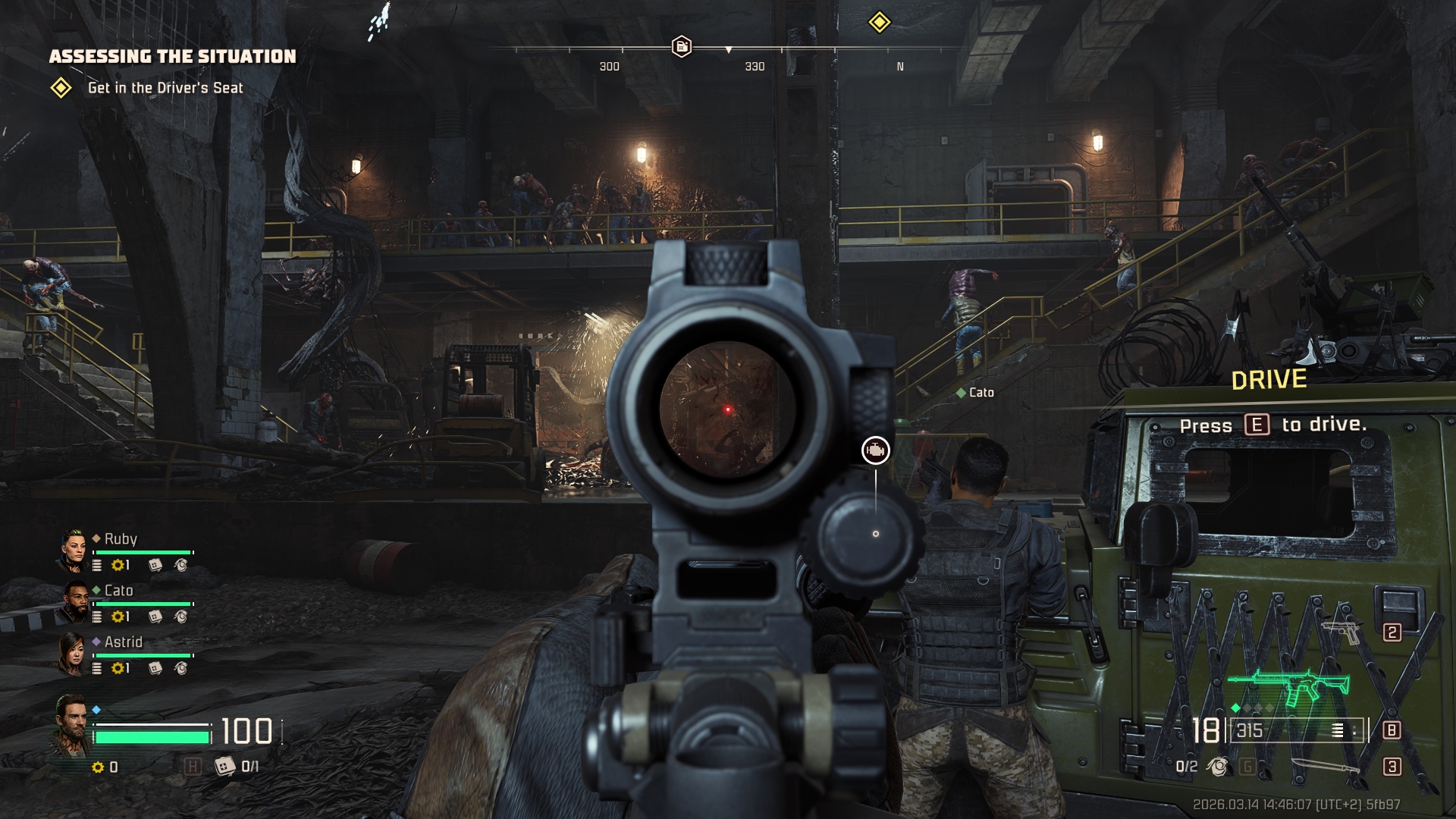
The moments when the engine experiences the greatest strain tend to occur during the largest swarm encounters, when hundreds of enemies flood the battlefield simultaneously while explosions, particle effects, and dynamic lighting fill the screen. During these intense sequences, frame-rate fluctuations can occasionally appear, particularly on mid-range hardware or systems that prioritize higher graphical settings. Even so, these performance dips rarely become severe enough to disrupt gameplay, and the overall experience remains playable even when the action becomes especially chaotic.
Large outdoor environments also introduce additional performance demands because the game frequently renders wide landscapes filled with environmental detail, distant structures, and moving enemy groups. While the engine generally handles these situations well, players may notice brief drops in performance when traveling quickly across the map in vehicles or when new enemy waves spawn in large numbers.
Loading times remain relatively short on solid-state drives, allowing players to move between missions without lengthy interruptions. The user interface remains responsive throughout gameplay, and menus load quickly enough that adjusting settings or managing equipment rarely interrupts the flow of a session. In addition, the game includes support for modern display options such as ultrawide resolutions, which allows players with larger monitors to take advantage of a wider field of view during exploration and combat.
One limitation that may frustrate some players involves the requirement for a persistent online connection, even when playing solo with AI teammates. While this design decision is common in cooperative-focused games, it does mean that offline play is not supported, which may be disappointing for players who prefer single-player experiences without network dependency.
Overall, the PC version offers competent technical performance that supports the scale of the game’s chaotic encounters without introducing major technical obstacles. Although occasional frame-rate dips during the largest battles remind players of the demanding nature of the swarm technology powering the game, these moments rarely undermine the overall experience, allowing Toxic Commando to deliver the large-scale action that forms the centerpiece of its design.
Final Verdict: 7.5/10
Toxic Commando delivers its strongest moments when chaotic cooperative gameplay takes center stage and players must work together to survive overwhelming enemy assaults.
The combination of massive zombie swarms, vehicle traversal, and explosive combat encounters creates memorable situations that capture the appeal of the genre. Although the experience occasionally suffers from repetitive mission design and gradual progression systems, the game’s energetic presentation and cooperative focus help sustain its entertainment value.
While Toxic Commando may not redefine the cooperative shooter genre, it succeeds in delivering chaotic multiplayer action that becomes particularly enjoyable when shared with friends, which ultimately represents the experience the game was clearly designed to provide.


