
When Slay the Spire first arrived in 2019, it quickly became one of the most influential indie games of its generation. The premise seemed almost deceptively simple: a roguelike adventure built around a deck of cards. Instead of traditional weapons or abilities, every action—attacking, defending, applying status effects—came from cards drawn each turn. What made it remarkable was how elegantly those systems fit together. The game captured the strategic tension of a collectible card game while maintaining the unpredictability and replayability of a roguelike dungeon crawler.
Over the years, its design left a noticeable mark on the industry. Dozens of deckbuilding roguelikes followed, borrowing ideas from its card economy, map structure, and relic systems. Few managed to capture the same balance of accessibility and depth. That combination is what made the original feel so special: it was easy to understand, but mastering it could take hundreds of hours.
With Slay the Spire 2, developer Mega Crit returns to that formula with a sequel that aims to expand the experience without losing the careful design philosophy that made the first game so compelling. Released in Early Access on PC, the sequel doesn’t attempt a dramatic reinvention. Instead, it approaches the concept more like a thoughtful evolution. The same core structure remains in place—choose a character, climb the Spire, build a deck, defeat increasingly dangerous enemies—but the systems around that loop have been broadened and refined.
At first glance, the game might even appear conservative. The art style is immediately recognizable. The interface looks familiar. The pacing of battles still follows the same rhythm. But after several runs, the differences begin to stand out. New characters encourage unfamiliar strategies, map navigation offers more meaningful choices, and cooperative multiplayer introduces an entirely different way to approach the climb.
That measured approach is probably the game’s greatest strength. Instead of chasing novelty for its own sake, Slay the Spire 2 builds on a foundation that was already extremely strong. The result is a sequel that feels both comfortably familiar and quietly ambitious.

Gameplay and Mechanics
The basic structure of Slay the Spire 2 remains almost identical to the original game. Each run begins with the selection of a character, who starts with a small, relatively simple deck of cards. From there, players climb a tower composed of branching paths filled with battles, treasure rooms, shops, random events, and powerful elite enemies. At the end of each floor waits a boss encounter that tests how well the deck has developed.
Combat continues to revolve around the same turn-based card system. Each turn, players draw a hand of cards and receive a limited amount of energy to spend. Cards might deal damage, block incoming attacks, apply status effects, or manipulate the deck itself. Once all available energy is spent, the turn ends and enemies respond with their own actions.
One of the most distinctive features of the series remains the enemy intent system. Before each turn, enemies telegraph what they plan to do—attack, buff themselves, apply debuffs, or summon additional threats. This mechanic transforms combat into a strategic puzzle. Players aren’t simply reacting blindly to damage; they are making informed decisions about how to counter upcoming attacks.
The elegance of this system is that it produces meaningful decisions almost every turn. Should you defend against a large attack, or gamble on defeating the enemy before it lands? Is it worth playing a setup card that weakens future enemies, even if it means taking damage now? These constant trade-offs are what give each run its tension.
Where the sequel expands things is in the surrounding structure. Map navigation has become slightly more nuanced, with certain areas now featuring environmental variations that influence the types of enemies or events encountered. Choosing a path through the tower can shape a run more dramatically than before. Players may deliberately seek out regions that favor their deck’s strengths, or avoid areas that introduce enemies particularly resistant to their strategy.
Enemy encounters themselves also feel more dynamic. Some foes now shift behavior based on the player’s actions, forcing more careful planning. Boss fights especially benefit from these changes. Rather than simply serving as damage checks, several bosses introduce mechanics that directly challenge specific deck styles. A deck built around stacking status effects might find itself disrupted by enemies capable of cleansing those effects, while a defensive build might struggle against foes that punish excessive blocking.
None of these changes fundamentally alter the core gameplay, but they make the experience feel less predictable. Veterans of the first game will quickly notice that familiar strategies no longer work exactly the same way. Adaptation remains essential.
Characters and Playstyles
The heart of Slay the Spire has always been its characters. Each one represents a completely different philosophy of combat, with their own card pools, relic interactions, and strategic possibilities. In the sequel, that tradition continues with a mix of returning favorites and entirely new additions.
Several characters from the original game make their return. The Ironclad remains a durable warrior capable of sustaining himself through combat while delivering heavy attacks. His decks often revolve around high-risk strategies that trade health for powerful damage output, supported by cards that restore lost health over time.
The Silent also returns, maintaining her focus on poison mechanics and evasive tactics. Her decks frequently emphasize stacking damage-over-time effects while weakening enemies with debuffs. In the hands of experienced players, she can dismantle powerful opponents without relying on direct damage alone.
The Defect once again introduces one of the game’s most distinctive mechanics: magical orbs that orbit the character and trigger passive or active effects. These orbs can generate energy, deal lightning damage, or provide defensive benefits depending on how they are configured. Managing them adds a layer of resource manipulation that feels very different from the other characters.
Alongside these returning heroes, the sequel introduces two new playable characters that push the design in new directions.
One of them, the Necrobinder, fights alongside a skeletal companion that participates in combat. The skeleton acts independently, attacking enemies or benefiting from certain card effects. This mechanic effectively introduces a form of unit management into the deckbuilding system. Players must consider not only their own actions, but also how their cards influence the companion’s behavior.
Another new character, the Regent, emphasizes summoning and scaling power over time. Many of the Regent’s cards revolve around creating smaller units that support the player or build up resources that can be converted into devastating attacks later in the fight. The playstyle encourages patience and careful setup, rewarding players who plan several turns ahead.
These additions significantly broaden the range of strategies available. Each character pushes players toward distinct archetypes—burst damage, poison stacking, defensive endurance, summoning tactics, or resource manipulation. Learning how to construct an effective deck for each one becomes its own long-term challenge.
Even returning characters benefit from expanded card pools. The developers experimented with hundreds of potential cards during development before narrowing the list to those that offered the most interesting interactions. As a result, familiar characters feel refreshed without losing their original identity.
Co-Op Mode
Perhaps the most surprising addition to Slay the Spire 2 is cooperative multiplayer. The original game was entirely single-player, and its tightly focused design seemed perfectly suited to solo play. Introducing multiple players into that formula might have seemed unnecessary at first glance, especially for a genre that traditionally emphasizes individual runs and personal strategy.
Yet the cooperative mode proves to be one of the sequel’s most interesting features.
In multiplayer runs, up to four players climb the Spire together. Each participant controls their own character and deck, but battles are shared between the entire party. Enemies scale to accommodate the larger group, often possessing greater health pools or gaining abilities that affect multiple players at once. The result is that encounters feel appropriately challenging without becoming overwhelming.
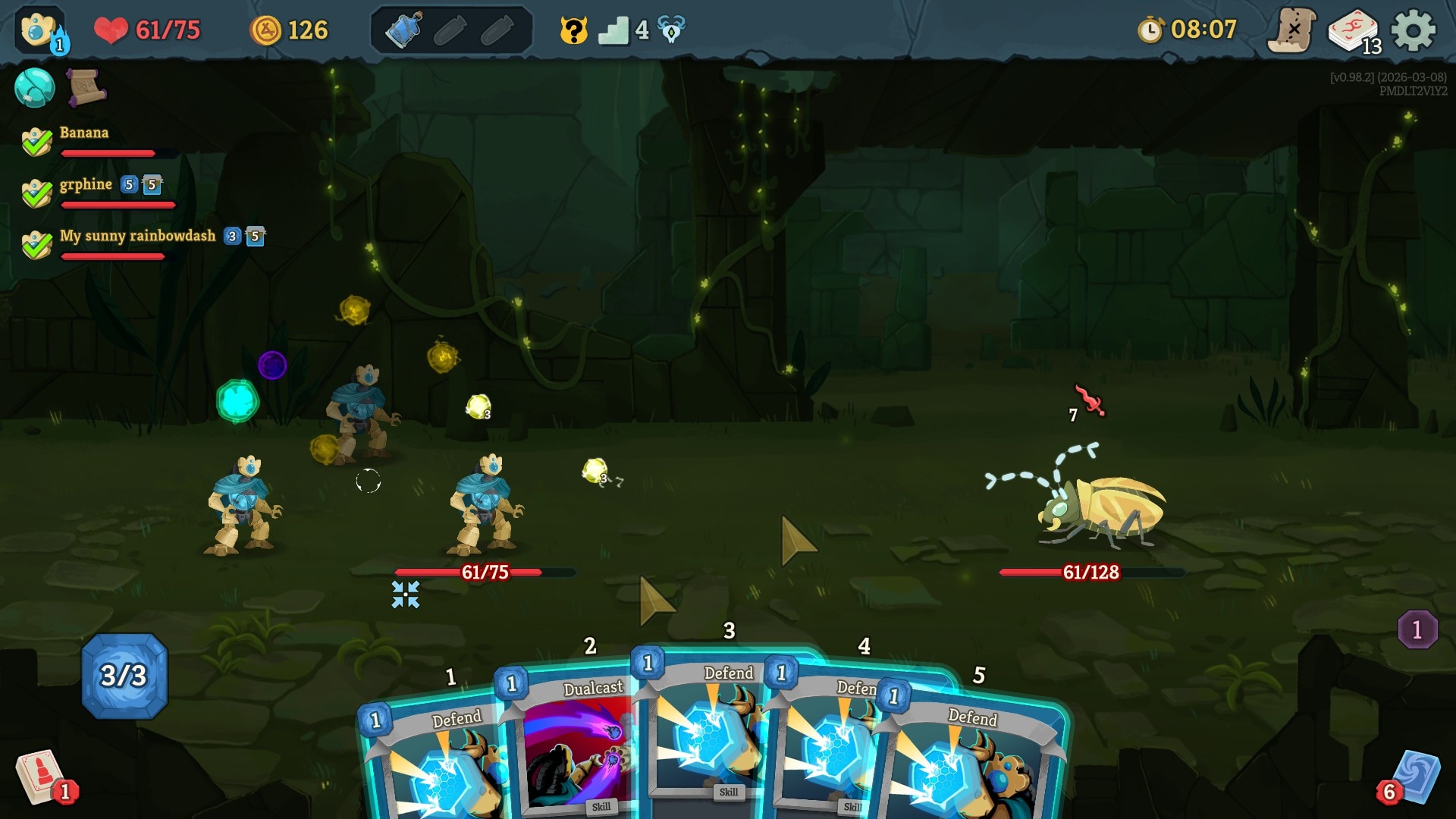
Combat remains turn-based, but the presence of multiple players changes the strategic dynamic considerably. Instead of optimizing a single deck, teams must think about how different characters complement one another. One player might focus on defensive cards that shield the entire group, while another concentrates on stacking damage modifiers that amplify the team’s attacks. Support-oriented strategies that might feel inefficient in solo play suddenly become extremely valuable when they benefit multiple teammates.
Communication becomes an important part of the experience. Players may coordinate which enemies to target first, decide when to use powerful potions, or plan turns around synergistic card effects. For example, one player might weaken an enemy so another can deliver a stronger attack, or set up status effects that teammates can exploit. These interactions can lead to surprisingly complex strategies that evolve over the course of a run.
The shared progression also adds an extra layer of decision-making outside of combat. When relics or rewards appear, players must decide who benefits most from each option. Sometimes the best choice is obvious, but other times teams must weigh whether to strengthen a single powerful build or spread resources more evenly across the group.
There are some drawbacks. Multiplayer runs naturally take longer, particularly if players spend time discussing every decision. Less experienced participants can slow the pace considerably, and groups that prefer quick runs may find the additional deliberation frustrating. However, these pacing issues are largely inherent to cooperative strategy games rather than flaws in the system itself.
When everything clicks, the mode creates moments that feel genuinely fresh. Watching a carefully coordinated sequence of cards dismantle a difficult boss can be immensely satisfying, and the collaborative problem-solving gives the game a very different energy compared to solo play. For a genre traditionally centered on individual runs, the addition of cooperative play opens a new perspective on the game’s systems and adds a welcome layer of variety to the overall experience.
Difficulty and Balance
Difficulty has always been a defining element of the Slay the Spire experience. The game does not hesitate to punish poor decisions, and a single mistake can sometimes derail an otherwise promising run.
The sequel maintains that challenging spirit. Early runs can feel unforgiving, particularly for players unfamiliar with deckbuilding mechanics. Enemies escalate quickly in strength, and poorly constructed decks often collapse under the pressure of later encounters.
However, the difficulty rarely feels arbitrary. Most defeats can be traced back to specific choices made earlier in the run. Perhaps too many situational cards cluttered the deck. Maybe a powerful relic was ignored in favor of short-term safety. These lessons accumulate over time, gradually improving the player’s decision-making.
Balancing offense and defense remains one of the most important considerations. Aggressive decks can eliminate enemies quickly, but they risk taking heavy damage if attacks fail to land. Defensive strategies prolong fights, which can become dangerous against enemies that grow stronger over time.
Because the game is still in Early Access, balancing adjustments are likely to continue. The developers have indicated that they plan to refine card interactions and enemy behavior based on player feedback. Even so, the current version already demonstrates the same careful design that made the original game so compelling.
Visual Design and Presentation
From a visual standpoint, Slay the Spire 2 closely resembles its predecessor. The art style retains the hand-drawn aesthetic that defined the first game, favoring stylized illustrations over realistic graphics.
This approach might initially seem modest for a sequel, but it serves an important purpose. The clarity of the visuals ensures that information remains easy to read. Card effects are immediately recognizable, enemy animations communicate intentions clearly, and the interface allows players to process large amounts of information quickly.
Some visual improvements are noticeable. Character animations appear smoother, enemy designs display more personality, and environments feel slightly more varied. The game also benefits from subtle interface refinements that make deck management and relic tracking more convenient.
Because the game is still in Early Access, certain elements remain unfinished. Some card illustrations are placeholders, and a few visual effects appear less polished than others. These details are expected to evolve as development continues.
Despite those rough edges, the presentation accomplishes its most important goal: it supports the gameplay without distracting from it.
Replayability
Replayability has always been central to the appeal of Slay the Spire, and the sequel builds on that foundation. Each run is procedurally generated, ensuring that enemy encounters, card rewards, relic discoveries, and event outcomes vary constantly.
The branching map system continues to play a crucial role in shaping each run. Players must decide whether to pursue risky elite battles for valuable relics, visit shops to refine their deck, or explore mysterious events that may bring rewards or unexpected consequences.
These decisions accumulate throughout the climb, gradually shaping the direction of a run. A single relic or rare card can dramatically alter a deck’s strategy, encouraging players to adapt their plans.
The addition of new characters and expanded card pools increases the number of possible deck combinations. Multiplayer adds another layer of variation, allowing players to experiment with cooperative strategies that combine different archetypes.
Even after dozens of runs, it remains difficult to predict exactly how a climb will unfold. That unpredictability is a large part of what keeps the game engaging over long periods.

Performance and Technical State
On PC, Slay the Spire 2 performs reliably across a wide range of hardware. The game’s relatively lightweight graphics and clean visual design keep system requirements modest, which means it runs comfortably even on mid-range or older machines. In testing, the game maintains a stable frame rate during combat, map navigation, and menus, with no noticeable slowdowns even when multiple card effects trigger simultaneously on screen.
Load times are minimal, and transitions between encounters happen quickly enough that the overall pacing of a run remains uninterrupted. This is particularly important in a game built around repeated attempts, where players often move rapidly between battles, events, and shops. The interface also responds instantly to inputs, which helps keep combat feeling smooth even during longer turns that involve several card interactions.
The user interface remains one of the strongest aspects of the experience. Cards are clearly readable, enemy intentions are easy to track, and important information such as relic effects, deck contents, and status modifiers can be accessed quickly without cluttering the screen. For a strategy game where players constantly evaluate dozens of variables, this clarity is essential. Small refinements compared to the original game—such as improved tooltips and slightly clearer visual indicators for status effects—make it easier to keep track of complex interactions.
As expected from an Early Access release, however, the game is not entirely free of rough edges. Minor bugs occasionally appear, particularly when certain cards interact in unusual ways or when relic effects combine in unexpected combinations. These issues rarely break a run, but they sometimes create confusing moments where outcomes don’t behave exactly as players might expect.
Multiplayer, which is one of the biggest additions in the sequel, is generally stable but still shows signs of being a relatively new feature. Most cooperative sessions run smoothly, with turns progressing without noticeable lag. However, occasional synchronization hiccups can occur, particularly if one player has a weaker connection. In those cases, the game may briefly pause while the state of the battle updates for all participants.
Despite these minor issues, the overall technical foundation feels solid. The game rarely crashes, and progress during runs is saved reliably. The core systems already appear stable enough to support long play sessions without major interruptions.
Because Slay the Spire 2 is still in Early Access, continued updates are expected. The developers have already indicated that the coming months will focus on polishing card interactions, refining balance, and expanding content while addressing technical feedback from the community. If the development path follows a similar trajectory to the original game, players can expect steady improvements as the project moves closer to its full release.
Even in its current state, the PC version provides a smooth and dependable experience. The technical performance does exactly what it needs to do: stay out of the way and let the strategy take center stage.
Final Verdict: 9/10
Slay the Spire 2 is not a radical reinvention of its predecessor, and it never tries to be. Instead, it builds carefully on a design that was already remarkably strong.
The familiar turn-based card battles remain as engaging as ever, offering a constant stream of meaningful decisions. New characters expand the range of strategic possibilities, while subtle changes to map navigation and encounter design keep the experience from feeling predictable.
The addition of cooperative multiplayer introduces an entirely new way to approach the climb, transforming a traditionally solitary challenge into a shared tactical experience. Even for players who prefer solo runs, the expanded card pools and character mechanics ensure that the game feels fresh.
As an Early Access title, the sequel still has room to grow. Some visual elements remain unfinished, and balance adjustments will likely continue as the community explores the game’s systems. Yet the core experience already feels polished and satisfying.
Ultimately, Slay the Spire 2 succeeds by respecting what made the original so special. It doesn’t attempt to overwhelm players with unnecessary complexity or flashy spectacle. Instead, it refines the delicate balance between simplicity and depth that defined the first game.
For fans of strategy games, roguelikes, or deckbuilders, climbing the Spire once again proves just as compelling as it did the first time. The journey may be familiar, but the challenges waiting along the way ensure that it still feels exciting.


