
ENA: Dream BBQ is a game that exists in deliberate opposition to conventional video game design. Where most titles prioritize clarity, progression systems, and mechanical engagement, Dream BBQ instead foregrounds atmosphere, visual identity, and interpretive ambiguity. Developed by the ENA Team and based on Joel Guerra’s surreal animated web series, the game represents a rare attempt to translate a deeply internet-native artistic language into an interactive format without sanding down its edges for broader appeal.
From its opening moments, ENA: Dream BBQ signals that it will not conform to familiar structures. Objectives are loosely defined, the world resists logical coherence, and the player is rarely told what to do in explicit terms. Rather than functioning as a guided experience, the game asks players to wander, observe, and slowly assemble meaning from fragments. In doing so, it positions itself closer to experimental art installations or interactive cinema than to traditional adventure games.
This approach is inherently divisive. For some, Dream BBQ will feel refreshingly uncompromising, a confident artistic statement in a medium often constrained by commercial expectations. For others, it may appear underdeveloped or alienating, lacking the mechanical scaffolding that typically justifies player engagement. Crucially, the game seems fully aware of this tension and embraces it rather than attempting to resolve it.

Narrative and Themes
Narrative in ENA: Dream BBQ operates on a symbolic rather than structural level. Players assume the role of ENA, a character defined by internal duality and emotional dissonance, navigating a world that feels simultaneously playful and hostile. The central motivation—to reach “the Boss”—is introduced early but never clearly contextualized. Who the Boss is, what they represent, and why ENA seeks them remains ambiguous throughout the chapter.
Dialogue is sparse and frequently abstract. Characters speak in fragments, riddles, or statements that feel detached from conventional conversational logic. Rather than advancing a clear plot, these interactions function as tonal markers, reinforcing the game’s themes of disconnection, fragmented identity, and institutional authority. Meaning emerges not through exposition, but through repetition, visual metaphor, and the emotional resonance of individual scenes.
Thematically, Dream BBQ draws heavily from surrealist traditions. Reality is unstable, language is unreliable, and cause-and-effect relationships are often undermined. The game’s world feels governed by arbitrary rules that are never fully explained, echoing the experience of navigating bureaucratic or hierarchical systems without understanding their logic. This reading is supported by recurring imagery of gates, thresholds, and figures of authority, all of which appear significant without ever being explicitly defined.
This narrative opacity is both a strength and a limitation. Players willing to engage with ambiguity will find the game rich with interpretive possibilities, inviting reflection and discussion long after completion. Conversely, those expecting a more conventional narrative arc may struggle to find emotional grounding or narrative payoff. The game offers no definitive answers, and it makes no effort to guide the player toward a singular interpretation.
Gameplay and Mechanics
Mechanically, ENA: Dream BBQ is restrained to the point of austerity. The game is presented in first-person perspective and revolves almost entirely around exploration, observation, and interaction. There is no combat system, no character progression, and no traditional challenge curve. Instead, gameplay exists to facilitate movement through the world and exposure to its ideas.
Players traverse a series of interconnected spaces, speaking with NPCs, collecting occasional items, and completing light tasks that open new areas. These objectives are rarely framed as quests in the traditional sense. Instructions, when they exist at all, are often indirect, requiring players to infer goals from context or dialogue. This design encourages attentiveness but can also result in moments of uncertainty where progress feels unclear.
Puzzles are present but understated. Some are intuitive, relying on spatial reasoning or environmental cues, while others verge on the opaque, requiring experimentation or a willingness to accept temporary confusion. Importantly, failure is rarely punished. The game avoids traditional fail states, reinforcing its emphasis on exploration over challenge.
Platforming elements appear sporadically, but they are simple and forgiving. Movement is functional rather than expressive, designed to support navigation rather than mastery. This minimalism reinforces the game’s tone, but it also highlights the extent to which Dream BBQ deprioritizes mechanical engagement. For players accustomed to systems-driven design, the gameplay may feel thin. For others, the restraint will feel intentional, a refusal to distract from the game’s artistic core.
Visual Direction
The visual design of ENA: Dream BBQ is its most immediate and defining feature, serving as both its primary means of expression and its strongest unifying force. Drawing heavily from early internet culture, low-polygon 3D environments, and surreal digital art, the game constructs a world that feels simultaneously nostalgic, artificial, and deeply alien. Rather than striving for realism or visual polish, Dream BBQ embraces distortion, abstraction, and inconsistency as deliberate aesthetic choices.
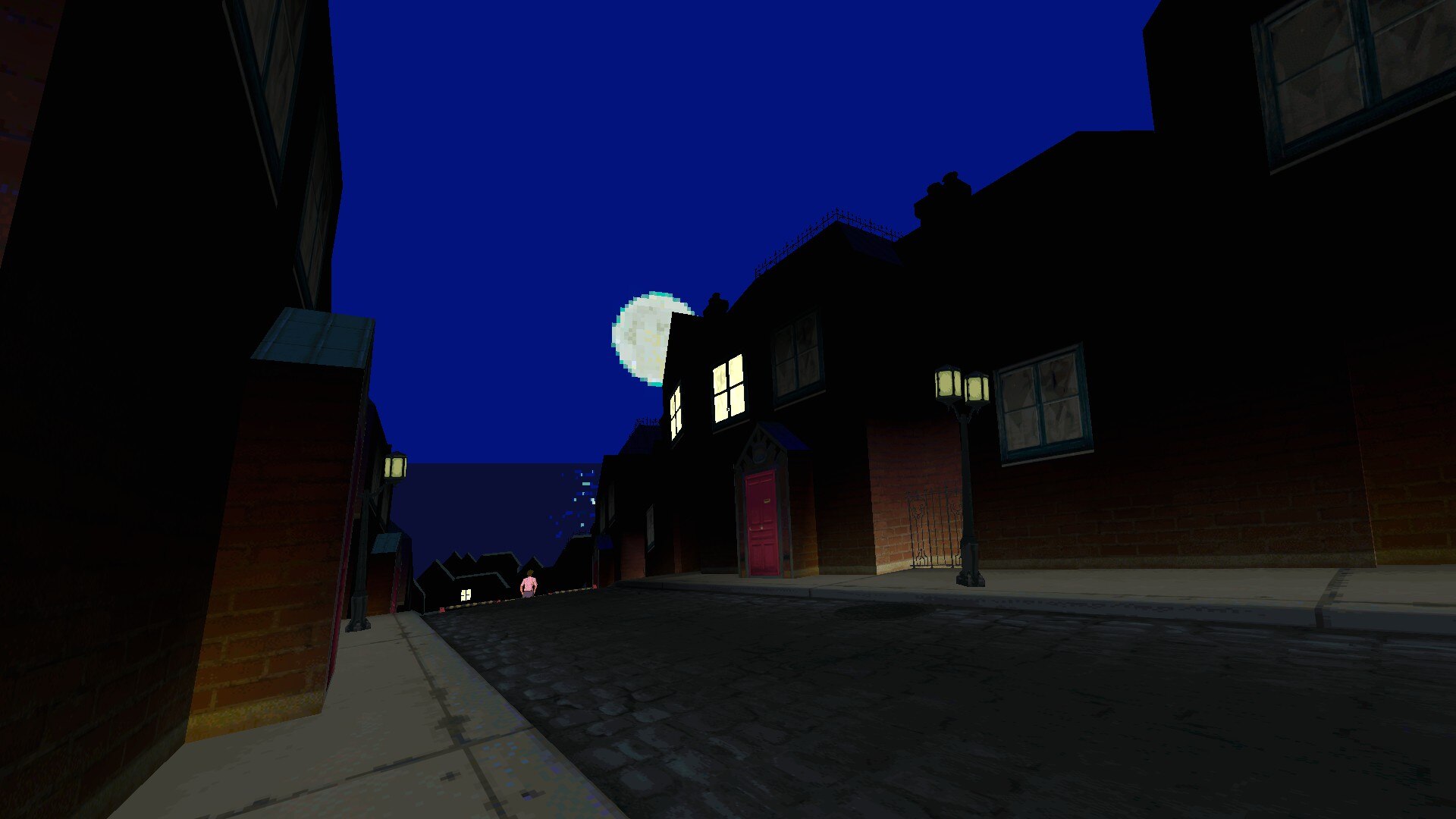
Environments vary dramatically in scale, color palette, and geometric logic. Some spaces are vast and disorienting, stretching into impossible perspectives or dissolving into visual noise, while others are tightly constrained, claustrophobic, and intentionally artificial. Textures are often flat, overly saturated, or starkly minimal, emphasizing symbolic presence over physical detail. This approach reinforces the sense that the world is not a coherent physical space, but a constructed mental or symbolic landscape.
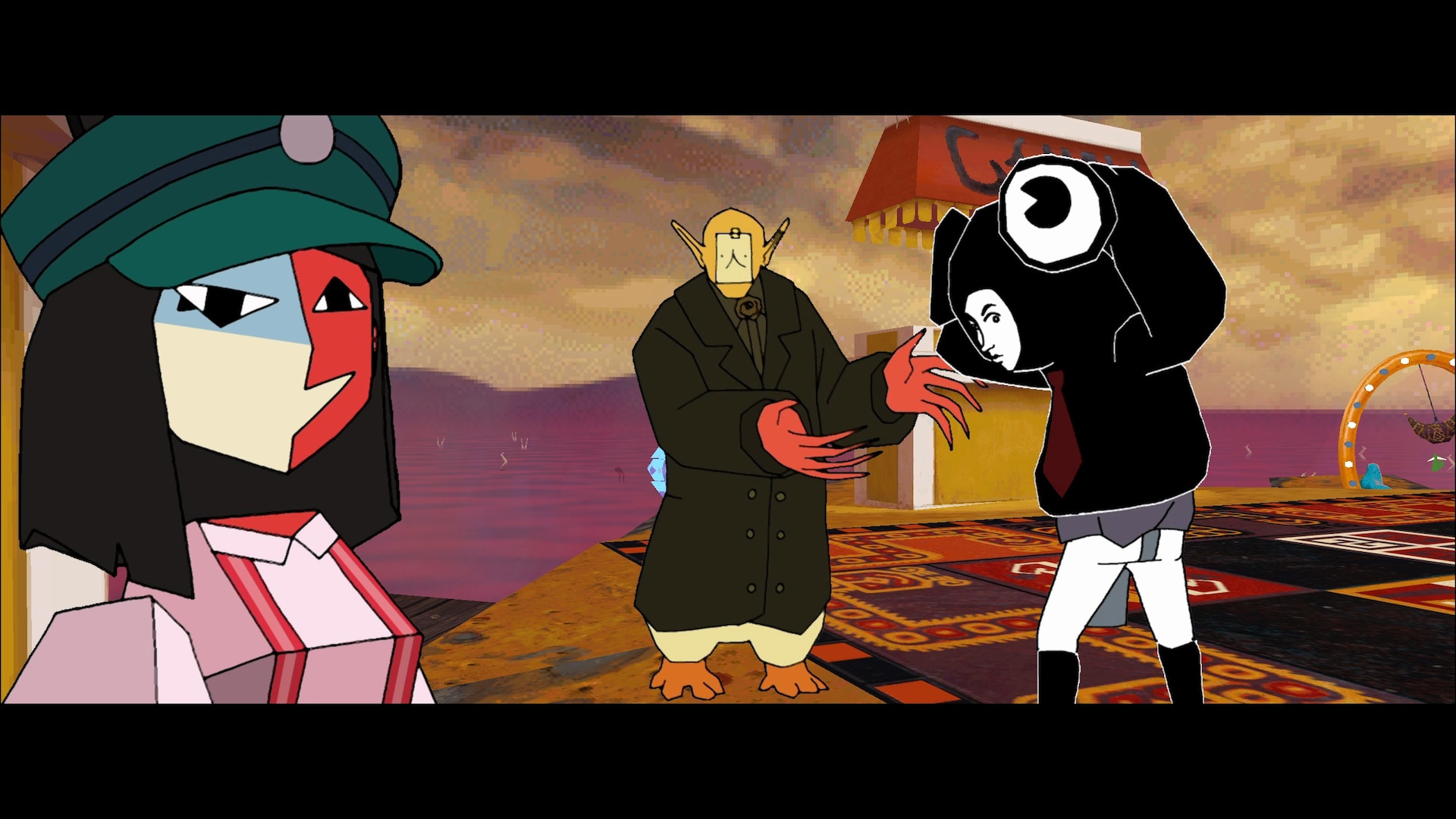
Character design further amplifies this effect. Figures are exaggerated, asymmetrical, and frequently uncanny, their proportions and expressions often bordering on grotesque. Facial features and body language feel intentionally unstable, reinforcing themes of fragmented identity and emotional dissonance. Characters rarely behave in ways that feel naturalistic, instead appearing as visual motifs or embodiments of abstract ideas rather than conventional narrative actors.
Abrupt stylistic shifts are common and intentionally disorienting. A brightly colored, almost playful environment may give way without warning to something stark, hostile, or visually oppressive. These transitions are not framed as technical limitations or tonal inconsistencies, but as extensions of the game’s dream logic. The lack of visual continuity ensures that players remain unsettled and attentive, never fully acclimating to the world’s rules.
While the game’s technical fidelity is modest by contemporary standards, its art direction is remarkably cohesive in intent. Every visual element appears carefully chosen to reinforce mood, symbolism, and thematic ambiguity. In this sense, ENA: Dream BBQ demonstrates how a strong, confident artistic vision can outweigh graphical complexity, using visual language not merely as decoration, but as the primary narrative and emotional driver of the experience.
Audio and Presentation
Audio design in ENA: Dream BBQ is used sparingly but effectively. Ambient soundscapes dominate much of the experience, with silence often employed as a tool to heighten unease. Environmental sounds feel detached and sometimes unnatural, reinforcing the sense that the world operates according to unfamiliar rules.
Music appears selectively, often tied to specific locations or narrative moments. Rather than guiding emotion in a conventional way, the soundtrack often contrasts with on-screen events, creating tonal dissonance. This approach aligns with the game’s broader commitment to destabilizing player expectations.
Voice acting is one of the game’s most distinctive presentational elements. Characters speak in multiple languages, and delivery is frequently flat, exaggerated, or emotionally ambiguous. Rather than striving for naturalism, performances feel performative and alien, reinforcing the idea that communication within this world is fractured and unreliable.
Together, the audio and visual presentation create a cohesive sensory experience. The restraint shown in sound design mirrors the game’s mechanical minimalism, ensuring that no single element overwhelms the others. This balance contributes significantly to the game’s atmosphere, even if it occasionally leaves scenes feeling intentionally sparse.
Pacing and Length
The pacing of ENA: Dream BBQ is deliberately slow and uneven. Moments of quiet exploration are punctuated by brief interactions or visual surprises, creating a rhythm that mirrors the unpredictability of dreams. The game rarely rushes the player, allowing ample time to absorb environments and reflect on their meaning.
The first chapter, Lonely Door, typically takes between two and four hours to complete, depending on how thoroughly players explore optional areas and engage with secondary interactions. While the chapter is relatively short, it feels dense, with much of its value derived from atmosphere rather than content volume.
Replay value exists primarily for completionists or those interested in uncovering missed interactions. However, the experience is largely defined by initial discovery. Subsequent playthroughs may deepen understanding, but they are unlikely to significantly alter the core experience.
Critical Reflection
Evaluating ENA: Dream BBQ requires acknowledging that its strengths and limitations are deeply intertwined. The game’s strongest qualities—its atmosphere, visual identity, and commitment to abstraction—are inseparable from the elements that may frustrate or alienate some players. Its refusal to provide clear objectives or traditional gameplay systems is both a statement of artistic intent and a barrier to accessibility.
For players receptive to experimental design, the game offers a rare sense of authorship. Every element, from visual transitions to dialogue delivery, feels intentional and cohesive. For those seeking mechanical depth, narrative clarity, or conventional pacing, the experience may feel incomplete or underwhelming.
Importantly, Dream BBQ does not attempt to reconcile these tensions. It presents itself on its own terms, inviting engagement but not accommodation. In doing so, it occupies a space that is still relatively rare within the medium: a game that prioritizes expression over engagement metrics, and mood over mastery.
Final Verdict: 8/10
ENA: Dream BBQ is not a game designed to be universally appealing, nor does it aspire to be. Instead, it stands as a confident and uncompromising work of interactive art, one that leverages the medium’s strengths to create a deeply atmospheric and interpretive experience.
While its limited mechanics and opaque narrative will not resonate with all players, those willing to embrace its ambiguity will find a thoughtfully constructed world rich with visual and thematic resonance. As the opening chapter of an episodic project, Lonely Door establishes a strong foundation, suggesting that future installments may further expand and refine its ideas.
For players interested in surrealism, experimental storytelling, and unconventional design, ENA: Dream BBQ is a distinctive and memorable experience that challenges traditional notions of what a video game can be.


