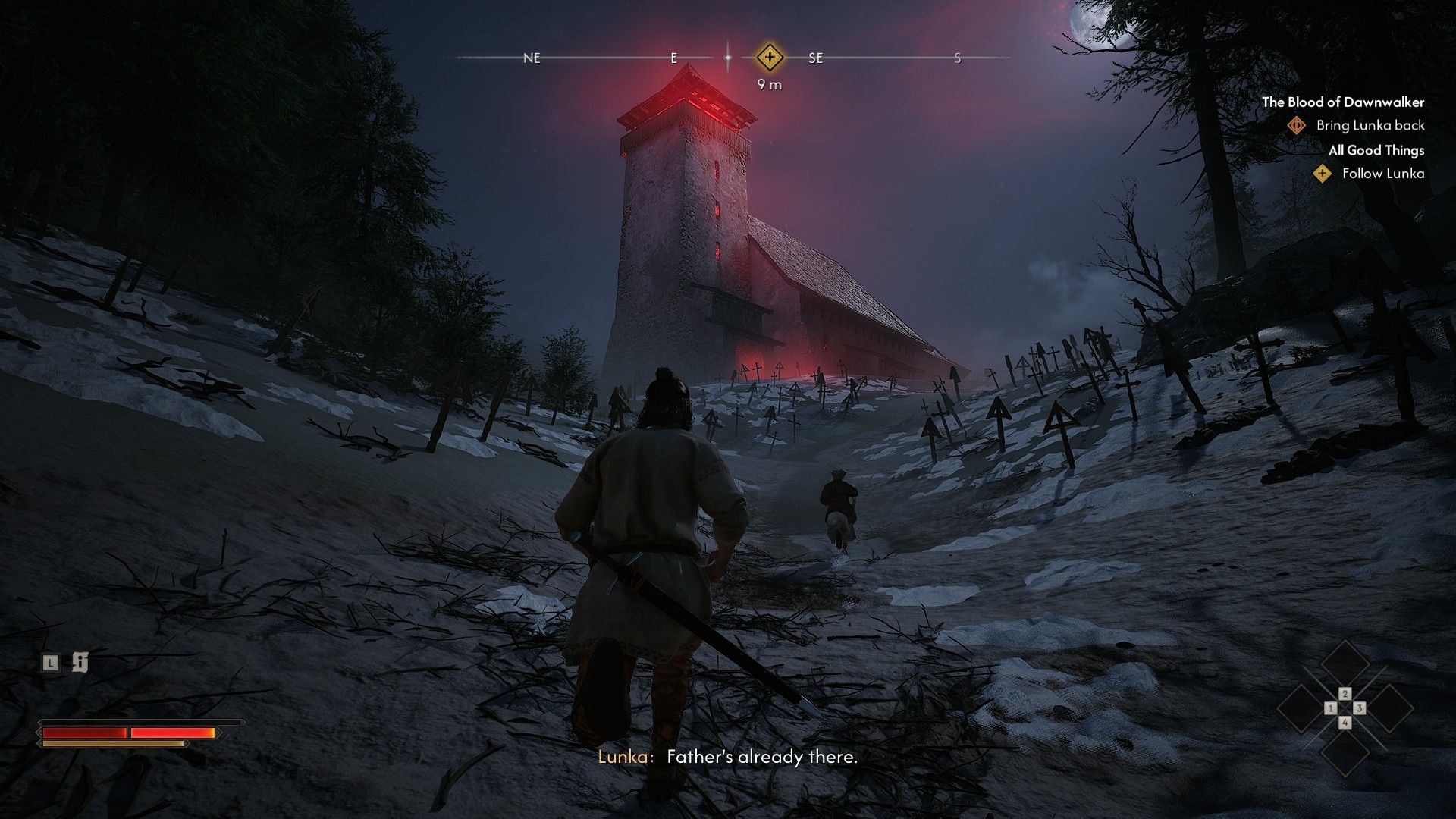
The Blood of Dawnwalker is built around a limitation that most open-world RPGs spend their entire campaigns trying to avoid. Coen, a young man living in the plague-ravaged region of Vale Sangora, has thirty days and nights to save his family from Brencis, a powerful vampire who has taken control of the region. After being transformed into a Dawnwalker, Coen exists between two worlds, relying on his human abilities during the day and drawing on vampiric powers at night. There is no expectation that everything on the map will be completed before the final confrontation. In fact, the game is designed around the opposite idea: some things will have to be left behind.
That decision gives Rebel Wolves’ first game its strongest characteristic. Quests, character development and other important activities consume portions of the limited time available, so deciding what to do becomes part of the role-playing experience. A quest is not simply another piece of content waiting to be cleared from the map. It is an investment, and choosing to pursue it can mean giving up another opportunity.
The idea is considerably more interesting than the way many open-world RPGs handle player choice. It also exposes the game’s weaknesses more clearly. The strongest parts of The Blood of Dawnwalker are genuinely good, particularly its longer quests, characters and central time-management system. The combat is enjoyable once its directional mechanics become familiar, and the world has a strong sense of place. At the same time, some exploration activities are routine, the vampire mechanics do not always have the influence their premise suggests, and the PC version can suffer from technical problems that undermine an otherwise impressive presentation.
The Blood of Dawnwalker is consequently an uneven game, but its better ideas are integrated deeply enough into the experience to make it stand apart from a conventional open-world action RPG.

Story and Setting
Vale Sangora is a fictional region inspired by 14th-century Eastern Europe, and the historical setting plays an important role in establishing the game’s atmosphere. The population is already dealing with plague, poverty and political instability when vampires emerge from the shadows and take advantage of the situation. This creates a world where supernatural horror is imposed on a society that was already struggling to survive.
Coen’s personal story keeps the main narrative focused. His family has been captured, and his transformation gives him the means to challenge the vampire forces controlling the region. The thirty-day-and-night structure reinforces that objective because Coen cannot spend unlimited time preparing for the final confrontation. The story has a clear destination, even though the route toward it can change considerably depending on what the player chooses to pursue.
Brencis and the vampires are also connected to the social structure of Vale Sangora rather than functioning solely as powerful enemies. Their influence affects the people living under their control, and the player encounters different responses to their rule. Some characters resist, others cooperate, and some are simply trying to survive. These relationships make the setting more convincing than it would be if the vampires existed only as monsters waiting for Coen to fight.
The writing is strongest when it concentrates on individual characters. Several of the game’s longer stories give their characters enough personality and motivation to make their problems worth following, and the consequences of becoming involved can extend beyond the immediate objective. Choices are not always presented as simple moral questions. Often the difficult part is deciding whether a particular person or situation deserves Coen’s limited time.
Coen himself is less distinctive. His circumstances provide a strong reason to continue through the story, but his personality does not always have the same impact as the people around him. That is not unusual for a role-playing protagonist, particularly one intended to accommodate different player choices, but it means the supporting cast often does more of the work when it comes to giving the narrative personality.
The World of Vale Sangora
Vale Sangora is large enough to provide a substantial adventure without feeling like a map designed entirely around size. Forests, plains, swamps, mountains, settlements and ruins give the region enough geographical variation, while the architecture and environmental details maintain a consistent medieval character. The world also contains traces of an older civilization and other mysteries that reward players who investigate locations rather than simply following the main quest.
Exploration works best when the game allows discoveries to emerge naturally. A location may contain information about the region, a seemingly insignificant character can become important later, or an optional area can reveal something that changes how a particular situation is understood. These moments give the world more personality than a simple collection of map markers would provide.
The problem is that the quality of exploration is inconsistent. Alongside the more carefully constructed discoveries are familiar activities involving enemy camps, resources, loot and repeated combat encounters. These tasks are functional, but they do not always feel connected to the game’s more unusual approach to time and consequence. The difference becomes particularly obvious when a thoughtful quest is followed by an activity whose purpose is essentially to provide another fight and another reward.
That does not make the open world poor. It means the player gets more from it by being selective. The Blood of Dawnwalker is not especially well suited to the mindset of clearing every icon on the map. Its structure encourages players to investigate what looks interesting and move on when something does not justify the time required.
Gameplay and Mechanics
The thirty-day system is the game’s most distinctive mechanic. After the opening section, Coen has a limited number of days and nights in which to rescue his family, but the clock does not run continuously while he explores. Instead, significant actions such as taking on quests and other major activities consume defined portions of his available time, and the game tells the player how much time an activity will require.
That distinction is important because the system is less about racing against a real-time clock than about managing a finite resource. Roaming through the world does not constantly eat away at the deadline, so players can investigate locations and explore without feeling that every minute spent looking around is damaging their chances. Time advances when Coen commits himself to actions that matter.
This makes the system manageable rather than stressful. Accepting a quest, pursuing an objective or spending time preparing Coen can move the clock forward, meaning that each decision has an opportunity cost. The player may become stronger or help a particular character, but that time could have been spent pursuing another objective instead.
The system becomes more effective when quests have their own timing and consequences. Some objectives can change depending on when they are approached, while others can eventually be missed altogether. The game does not treat that as an error that must be corrected. The story continues, and the player has to live with the consequences of what they chose to prioritize.
This is an important difference from the usual approach to RPG choices. In many games, the player can eventually complete almost everything and see the majority of the content in one long campaign. The Blood of Dawnwalker deliberately prevents that. There are more things worth doing than there is time to do them, and progression itself competes with quests for the player’s limited schedule.
The system is not always as urgent as its premise might suggest. Because the clock advances through meaningful actions rather than ordinary exploration, there are long stretches where the deadline sits in the background rather than creating immediate pressure. Some players may therefore experience the thirty-day structure more as a planning system than as a source of constant tension.
That does not make it ineffective. Its greatest strength is the way it changes the value of optional content. Spending time on a quest feels different when another quest might have been pursued instead, while preparing Coen for a difficult encounter becomes a decision rather than an automatic part of progression. The clock works because it changes how the player evaluates activities.
Day and Night
Coen’s transformation gives the day-and-night cycle a mechanical purpose. During the day, he fights as a human, using his sword and magic, while nighttime allows him to draw on his vampiric abilities. The two sides of the character provide different approaches to combat, movement and problem-solving, making the passage between day and night more than an aesthetic change.
The distinction is particularly effective when the player begins to consider which form is better suited to a particular situation. Human Coen is more dependent on conventional weapon-based combat and magic, while his vampire form gives him supernatural abilities, greater mobility and a more aggressive approach to encounters. The result is a useful change in rhythm rather than two completely separate games.
The vampire side also has a greater physical presence than simply providing another collection of attacks. Coen can use supernatural movement and combat abilities, including his claws and vampiric powers, while feeding can become part of how he sustains himself during encounters. These mechanics give the nighttime form a different feel from his human fighting style.
The game also allows many quests to be approached at different times, meaning that changing forms can affect how the player tackles certain situations. This is one of the better uses of the day-and-night system because it connects Coen’s transformation to the broader structure of the game rather than treating it purely as a combat switch.
Still, the concept does not have quite as much influence as it could. The game provides meaningful differences between Coen’s two forms, but vampirism does not completely transform the entire open world or turn every social interaction into a fundamentally different experience. The supernatural side is therefore strongest in combat, traversal and selected story situations rather than as a complete alternative way of living in Vale Sangora.

Combat and Vampire Abilities
Combat uses directional attacks and defense, requiring the player to pay attention to where an enemy’s strike is coming from. A neutral block can protect Coen but consumes stamina, while blocking in the correct direction is more efficient and can create opportunities for a counterattack. The system initially feels unfamiliar, but once the relationship between positioning, stamina and timing becomes clear, fights become more deliberate.
That precision works particularly well in one-on-one encounters. Watching an opponent, recognizing an attack and responding correctly gives combat a sense of physical timing that is missing from simpler action-RPG systems. Successful counters also feel earned because the player has to read the attack rather than simply press a button whenever an indicator appears.
The problem is that the combat system does not always have enough enemy variety to support it. Once familiar opponents and attack patterns have been encountered repeatedly, the directional mechanics become less interesting because the player is solving the same basic problem again. Encounters involving multiple enemies can also become less comfortable, with positioning and camera behavior occasionally making it difficult to read what is happening.
Coen’s vampire abilities provide a more substantial change of pace. At night he can fight with claws, use supernatural powers and take advantage of greater mobility, giving him options that are not available in his human form. Feeding can also be used during combat, making the vampire’s hunger a practical part of surviving encounters rather than merely a story detail.
These abilities are most effective when the player deliberately builds a fighting style around them. Vampire combat can be more aggressive and physical, while human combat encourages a more conventional approach based around swordplay and magic. Switching between the two makes Coen’s transformation mechanically relevant throughout the game.
There is nevertheless a gap between the promise of the vampire concept and its implementation. Being a vampire sounds as though it should completely change how Coen interacts with the world, but much of that difference remains concentrated in combat, traversal, progression and selected interactions. The supernatural powers are enjoyable, but the game stops short of making vampirism the foundation of every major gameplay system.
The combat is therefore one of the game’s more successful supporting systems, but it is not its defining achievement. Its strongest encounters are satisfying, while repeated enemy types and less interesting group fights expose its limitations.
Character Progression
Character development is tied to the same time economy that governs the rest of the game. Becoming stronger is not simply a matter of collecting experience and immediately unlocking another ability. Developing Coen can require time, meaning that improving his capabilities competes directly with other activities.
This makes progression more meaningful than it might initially appear. Spending time on an upgrade can make a later fight easier, but that benefit has to be weighed against whatever else could have been accomplished during the same period. The player is encouraged to think about preparation rather than treating character development as an automatic process.
Coen’s human and vampire abilities provide separate areas of development, allowing players to emphasize different approaches. Exploration also contributes to progression by providing useful discoveries and resources, giving players another reason to investigate the world.
The individual upgrades are generally more incremental than transformative. There are useful improvements and new capabilities, but progression rarely produces the kind of dramatic change that completely alters the way the game is played. Its greatest strength comes from how it connects to the time system rather than from the complexity of the skill trees themselves.
Quests, Choices and Consequences
Quest design is where The Blood of Dawnwalker makes its strongest case for its unusual structure. The better missions are built around characters and situations rather than a sequence of interchangeable objectives, and the limited-time system gives those stories consequences beyond the immediate reward.
A character can need help while Coen is dealing with something else. A situation can develop while the player is pursuing another objective. A quest can be missed entirely because the player decided that something else was more important. These possibilities make the player’s schedule part of the narrative rather than a separate system running alongside it.
The willingness to let the player fail is particularly effective. A missed quest does not necessarily result in a reload or a message explaining that the player has taken the wrong path. The story can simply continue without that particular outcome. Characters can also die or disappear as a consequence of the player’s choices, changing later events and relationships rather than simply closing off a single dialogue option.
This makes the world feel less like a sequence of tests and more like a place in which events continue whether Coen is present or not. Inaction can matter almost as much as direct intervention, which gives the game’s limited-time structure a genuine narrative purpose.
It also gives replaying the game a genuine purpose. A second playthrough is not simply an opportunity to make different dialogue choices at the same moments. Different priorities can lead to different quests, relationships and discoveries because the player cannot devote time to everything.
Not every quest is equally successful. Some optional activities are much closer to standard open-world design and can feel repetitive when compared with the game’s strongest character-driven stories. Even so, the best missions demonstrate what Rebel Wolves is trying to achieve, and they are among the most memorable parts of the game.
Visuals and Atmosphere
Vale Sangora has a convincing visual identity. The combination of medieval settlements, forests, mountains, swamps and ruined locations creates an environment that feels shaped by its history rather than assembled purely for gameplay variety. The plague and vampire setting also gives ordinary locations an appropriate sense of decay and vulnerability.
Unreal Engine 5 provides plenty of environmental detail, particularly in larger outdoor areas. Lighting is especially important to the presentation because the transition between day and night is tied directly to Coen’s two forms. Darkness is not simply a filter placed over the same world; it corresponds to a different set of abilities and a different mood.
The presentation is less consistent when it comes to characters. Facial animation and movement can occasionally look dated beside the quality of the environments, and technical glitches can break the illusion during otherwise effective scenes. These issues are noticeable because the environmental work creates expectations that every part of the presentation will be equally polished.
The sound design complements the setting without overwhelming it. Environmental audio gives settlements and wilderness their own character, while the music supports the darker atmosphere and more important story moments. The voice performances are generally effective, particularly in the longer character-focused quests where believable delivery is essential.

Technical Performance on PC
The PC version is technically demanding, and the official requirements call for 16GB of RAM and an SSD. The minimum graphics specification is a GTX 1060 or Radeon RX 580, while the recommended tier includes an RTX 4060, Radeon RX 7600 XT or Intel Arc B580. Those recommendations should not be treated as a guarantee of a consistently high frame rate, particularly at higher resolutions or settings.
Performance varies considerably between hardware configurations and areas of the game. Dense environments and locations with many characters can be demanding, and players looking for higher resolutions and frame rates may need to use upscaling or adjust settings. The game’s visual ambition comes with a significant hardware cost.
More concerning are the reports of stuttering, uneven frame pacing, texture-loading problems and other technical inconsistencies. The severity is not identical across every system, but these issues are significant enough to affect the overall experience on PC. They are particularly unwelcome in combat because the directional defense system depends on timing.
At the same time, the PC version is capable of looking excellent when the hardware and settings are appropriate. The problem is consistency rather than the game’s underlying visual technology. The technical issues do not undermine the design of The Blood of Dawnwalker, but they can make an otherwise strong experience feel less polished than it should.
Final Verdict: 8/10
The Blood of Dawnwalker succeeds because it gives its open world a purpose beyond simply being large. The thirty-day-and-night limit changes how the player evaluates quests, exploration and character progression, while the possibility of missing content makes decisions more meaningful than they are in an RPG where everything can eventually be completed.
Its strongest quests take full advantage of that structure. Characters have problems that cannot always wait for Coen’s attention, and the player has to accept that pursuing one objective can mean losing another. The willingness to let quests fail and allow the story to continue is particularly effective because it turns consequences into part of the experience instead of treating them as mistakes that should always be corrected.
The combat is less distinctive, but it is still enjoyable. Directional defense, counters and stamina management provide a more deliberate system than a basic attack-and-dodge model, while Coen’s vampire abilities offer a genuinely different way to approach combat at night. The limited enemy variety prevents the system from remaining equally interesting throughout the entire campaign, and the vampire mechanics do not reach as far into the world as the premise suggests they could.
The same unevenness affects exploration. Vale Sangora is an appealing setting with worthwhile discoveries and a strong sense of place, but some activities are familiar enough to feel detached from the game’s more interesting ideas. The time system encourages players to be selective, and that is probably the best way to approach the world. There is little reason to treat every activity as equally valuable when the game itself is built around deciding what deserves attention.
Technical performance is the other significant weakness on PC. The game can look excellent, but its demanding presentation and inconsistent performance mean that the experience depends more heavily on hardware and settings than the official requirements might suggest. Some of these problems may improve through patches, but they remain relevant to the PC experience.
What makes The Blood of Dawnwalker worth playing is not that it perfects any single part of the action-RPG formula. Its combat is not the deepest in the genre, its open world is not free from familiar activities, and its vampire mechanics could have been more ambitious. Its value comes from the way several systems support one another, particularly the relationship between time, quests and player choice.
Rebel Wolves has made an RPG in which completing everything is neither necessary nor possible. That decision gives its better stories more importance and makes the player’s priorities matter in a way that a conventional checklist-driven open world rarely manages. The Blood of Dawnwalker is not without rough edges, but its most interesting ideas are strong enough to carry it through those shortcomings.
For players who enjoy character-driven RPGs, reactive quests and the freedom to accept that some content will remain unseen, The Blood of Dawnwalker is an easy recommendation. Those looking primarily for a deep vampire simulation or consistently varied action combat may find less here than the premise initially promises. For everyone else, it is a well-realized and atmospheric action RPG whose best qualities come from making the player decide not only what to do, but what is worth the time.