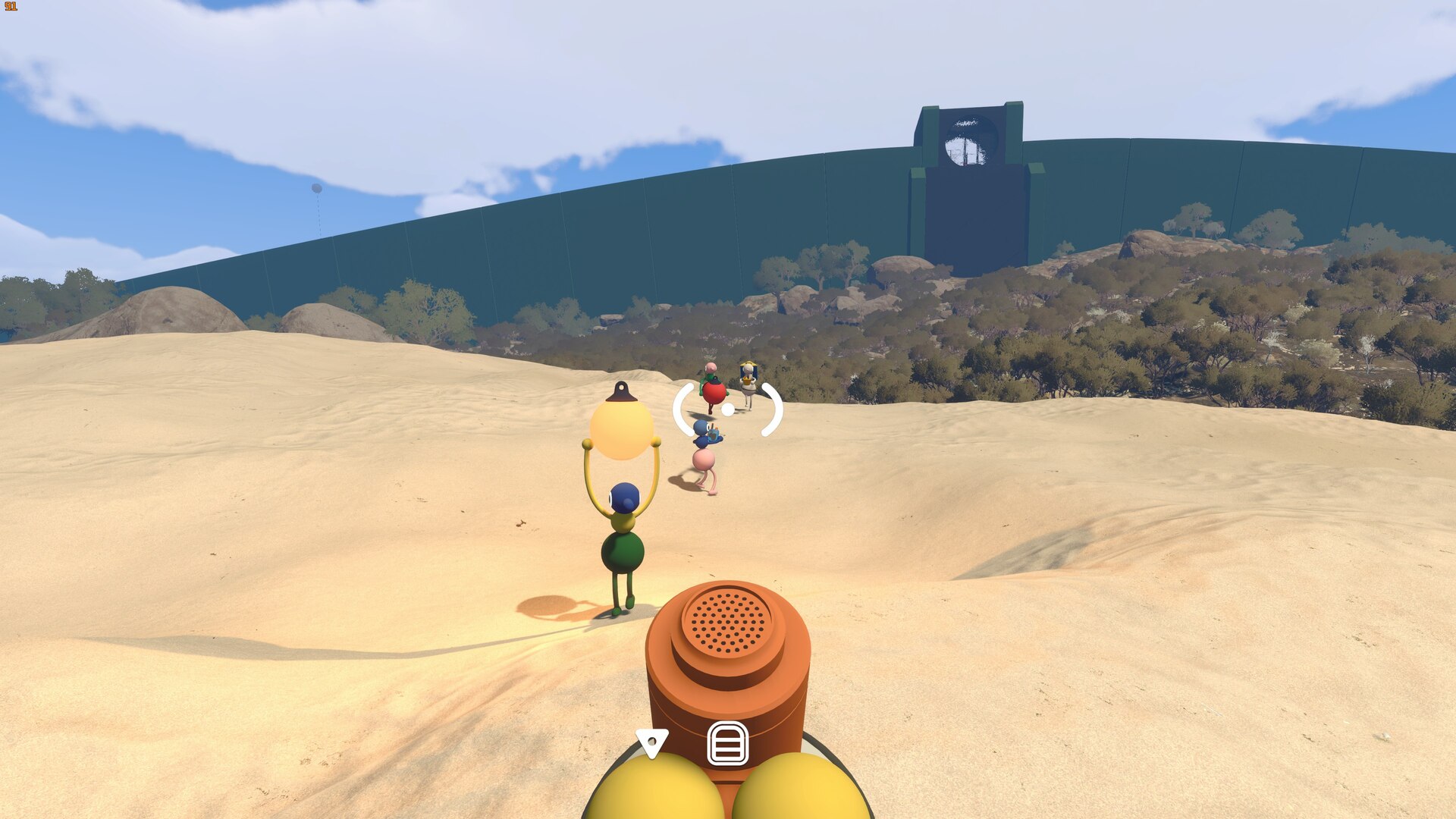
Big Walk is an unusual game to review because its most important mechanic is something that usually exists outside the game itself: talking to other people. House House, the Melbourne studio behind Untitled Goose Game, has built its latest release around the idea that exploring a world with friends can be an adventure in its own right. There are puzzles to solve, places to discover and an eventual ending to reach, but the way players communicate with one another is just as important as any conventional game mechanic.
The premise is straightforward. Between two and twelve players explore a large island together, solving environmental puzzles, finding useful objects and gradually making their way through a handcrafted cooperative adventure. There is no combat, traditional character progression or conventional quest log directing everyone toward the next objective. Instead, the game gives players a world to investigate and enough tools to interact with it, then leaves much of the problem-solving to the group. House House describes it as both an adventure and a place to spend time with friends, and that is a more accurate description than simply calling it a puzzle game.
That approach works surprisingly well because Big Walk understands something that many multiplayer games overlook: cooperation is often more entertaining when the game does not completely organise it for you. There are moments when everyone knows exactly what needs to happen, but there are just as many when nobody is quite sure what they are doing. A player wanders off, someone misunderstands an instruction, an important object ends up somewhere it should not be, and suddenly the group has created its own problem to solve.
This also makes Big Walk dependent on its audience in a way that most games are not. A patient group that enjoys exploring and experimenting will get much more from it than players who expect constant objectives and quick rewards. The same design decisions that make the game memorable can also make it slow, confusing and occasionally frustrating. That tension is present throughout the experience, but it is ultimately what gives Big Walk its character.

Gameplay and Mechanics
The basic mechanics are deliberately simple. Players move through the world in first person, jump, crouch, point, wave and manipulate objects with their characters’ unusually expressive arms. There is no complicated combat system or collection of abilities to learn, and there is little conventional progression beyond what the group discovers and unlocks during its journey. The simplicity allows the environment and the players themselves to become the focus.
Most of the game’s challenges are environmental rather than traditionally puzzle-oriented. You might have to work out where an object belongs, figure out how to reach a particular location or coordinate several players so that different parts of a mechanism can be operated at the same time. The difficulty usually comes from recognising what the game wants you to do and communicating that idea to everyone else rather than from solving an intricate logic problem on your own.
That distinction is important. Big Walk is not designed around the satisfaction of sitting in front of a puzzle until you independently discover an elegant solution. Its puzzles are often deliberately social. One player might see something that another cannot, somebody might need to describe a landmark from a distance, or several people may need to position themselves correctly before anything happens. The solution belongs to the group, which means the conversation leading to it is part of the gameplay rather than background chatter.
The physical interaction helps make these situations more entertaining. Players can pick up and move objects, and the game gives them an assortment of equipment that can be useful for both solving problems and communicating. Walkie-talkies, binoculars, laser pointers, megaphones, flares and other objects are among the tools available, while gestures can become important when speaking is impossible or impractical. The Steam version describes the arms themselves as another form of communication, which is an accurate reflection of how often players end up pointing or waving instead of simply explaining what they mean.
The physics also give players enough freedom to make their own mistakes. Dropping something in the wrong place or taking an object somewhere it was not intended to go does not necessarily result in a conventional failure state. Instead, the group has to work out how to recover from the situation. That can turn an otherwise ordinary puzzle into a memorable sequence of increasingly bad decisions, particularly when nobody immediately admits that they caused the problem.
There is no combat to interrupt this process and no constant threat pushing the group forward. That gives Big Walk a relaxed rhythm, but it also exposes one of its biggest weaknesses. When a puzzle is engaging, the lack of pressure gives everyone room to experiment. When the group is simply travelling or cannot figure out what the game expects, the same lack of pressure can make the experience feel slow rather than relaxing.
Communication and Proximity Chat
Communication is where Big Walk becomes genuinely distinctive. The game includes both voice and text chat, but neither works like a conventional party-chat system. Distance matters. Voices fade as players move away from each other, sounds can be affected by walls and enclosed spaces, and certain objects can change how players communicate. The text system follows the same basic restrictions, so players who do not use microphones are not excluded from the game’s central design.
House House goes further than simply recommending that players use the game’s voice chat. The developers explicitly discourage communicating through Discord or other external programs because unrestricted communication bypasses one of the game’s central mechanics. That may sound excessive, particularly to PC players accustomed to using Discord for practically every multiplayer game, but it makes sense once the game’s puzzles start relying on players being unable to communicate freely.
The result is that distance becomes meaningful. If one player walks over a hill, the rest of the group can no longer simply hear everything they are saying. If somebody ends up in an isolated location, they may have to use an in-game tool to communicate or physically find their way back. A walkie-talkie is therefore not merely a novelty; it can change the practical possibilities available to the group.
Non-verbal communication becomes equally important. Pointing toward a distant structure, waving somebody over or using a light to signal from across the landscape can sometimes communicate more effectively than speech. This is particularly useful when the group becomes separated, and it gives the simple character animations a genuine gameplay purpose rather than treating them as decoration.
The design is clever because it creates situations that would disappear if everyone were connected through an unrestricted voice channel. A player who sees something important cannot necessarily explain it to everyone immediately. Instead, the group has to work within the limitations of the environment and the communication tools available. That creates small problems that are rarely difficult on their own, but become surprisingly satisfying when the players solve them together.
There is one significant problem with the launch version, however. Voice volume and audio mixing have been criticised by players, with reports that teammates can be difficult to hear unless they are relatively close. This is particularly unfortunate because restricted voice communication is not an optional feature in Big Walk; it is central to the game’s design. House House has acknowledged the issue, making it an obvious area for post-launch improvement.
Exploration and World Design
The island is not structured like a conventional open-world game filled with icons, side quests and collectible markers. Instead, Big Walk expects players to look at the environment and remember what they have seen. There is no constant stream of objective indicators telling everyone exactly where to go, so landmarks, unusual structures and changes in the landscape become important navigational tools.
This makes exploration feel more physical than it does in most modern open-world games. Players need to understand where they are in relation to the rest of the group, and describing a location to someone who cannot see it becomes a legitimate part of navigating. A distant tower, a distinctive hill or an unusual structure can become a reference point for the entire group.
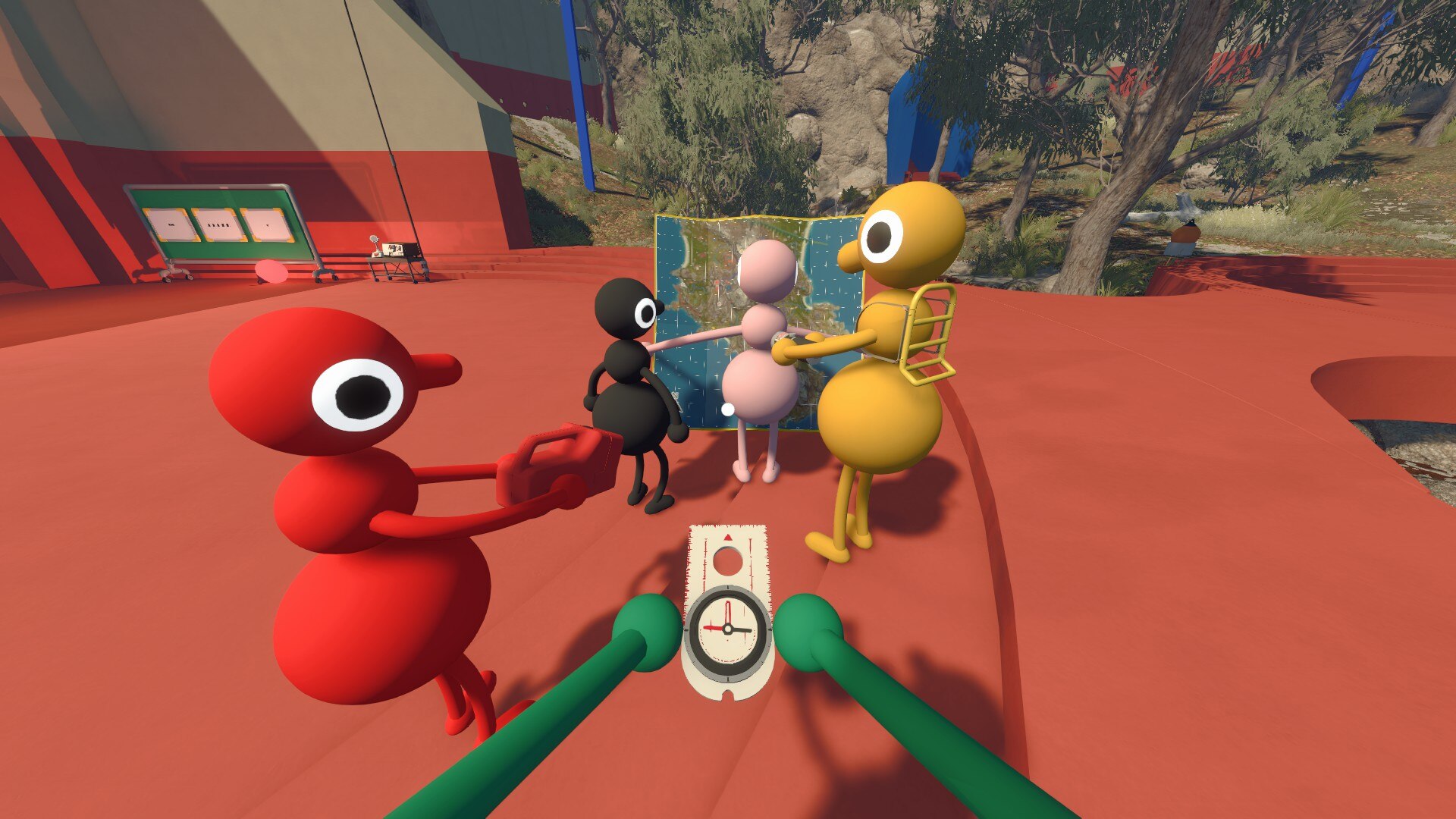
The lack of traditional navigation assistance can also produce genuine uncertainty. Sometimes that uncertainty is exactly what the game needs, giving exploration a stronger sense of discovery. Discovering an unexpected location because the group wandered away from its intended route feels different from following a marker directly to a destination. Other times, however, the same system can become tiring, particularly when everyone has forgotten where they came from, nobody is certain which direction to take, and the group has to retrace its steps.
The scale of the world is therefore both a strength and a weakness. The island feels large enough to support exploration, but travelling across it can take time. The Guardian’s review similarly praised the atmosphere and spontaneous discoveries while noting that the walking itself can become repetitive. The Verge also pointed to the potential for tedium when the game’s slower traversal and lack of conventional guidance work against the player.
The changing environment helps keep the journey interesting. The day-night cycle alters the appearance and visibility of familiar areas, while darkness can make it considerably harder to keep track of other players. This is not merely a visual effect. When visibility drops, communication and navigation become more important, and objects that seemed pointless earlier can suddenly become useful.
There is a fine line between giving players freedom and leaving them without momentum, and Big Walk occasionally crosses it. The game is at its best when wandering leads to discovery or conversation. When the group is simply covering a long distance without anything new happening, the deliberately slow pace has less to offer.
Multiplayer and Progression
The multiplayer structure is one of the game’s most important design decisions. Big Walk supports anywhere from two to twelve players, and the host chooses a two-player, three-player or four-or-more-player version of the world when starting a session. Some elements of the world change depending on that choice, allowing the challenges to accommodate different group sizes.
Two players provide a more controlled experience. Communication is easier, there is less chance of losing someone and each person’s contribution is easier to understand. Larger groups create more possibilities, but they also introduce more chaos. With six, eight or twelve people moving through the same environment, somebody will inevitably wander off, misunderstand an instruction or start investigating something completely unrelated to the current objective.
That chaos is clearly intentional, and it is often funny. The game does not attempt to force everyone into tightly defined roles, so players are free to decide how they want to approach a situation. The problem is that this also means a poorly coordinated group can make the experience much harder than it needs to be.
There is no public matchmaking system, which is a substantial limitation for anyone without an established group. Players can connect through platform friends lists or use a temporary Join Code, but the responsibility for finding the people to play with remains outside the game’s matchmaking infrastructure. House House has designed Big Walk specifically around playing with friends rather than strangers, and that decision is fundamental to the experience rather than an accidental omission.
The save system reinforces that approach. Progress is automatically saved, but the host is the keeper of the save. If the group wants to continue its existing journey, that host needs to start the next session. Other players can join once the host is online, but they cannot simply take the campaign and continue independently.
This works well for a regular group but creates scheduling problems for everyone else. If one person becomes unavailable, the group may have to wait for that player before continuing the same campaign. It is a small inconvenience compared with the absence of matchmaking, but together these decisions make it clear that Big Walk is less of a drop-in multiplayer game and more of a shared campaign.
Visuals and Audio
Visually, Big Walk is built around a striking contrast between its characters and environments. The player characters are deliberately simple and expressive, while the island itself has a more detailed and naturalistic appearance. That contrast gives the game a distinctive look without relying on excessive visual effects or a conventional cartoon aesthetic.
The environments also serve a practical purpose. Since players are expected to navigate through observation, the landscape needs to contain recognisable features. Hills, structures, paths, caves and distant objects all become useful reference points. The world therefore looks good without feeling disconnected from the mechanics that govern exploration.
Audio is even more important because of the proximity-chat system. Environmental sounds help establish the scale of the island, while the way voices change according to distance makes other players feel physically present. Hearing somebody gradually become quieter as they walk away is a simple effect, but it reinforces one of the game’s central ideas: you are all occupying the same space.
The launch audio mixing problem weakens this otherwise effective system. If voices are difficult to hear over environmental sounds, the problem is not merely cosmetic because players depend on those voices to solve puzzles. This is one of the few areas where the launch version feels less polished than the underlying design deserves.
Technical Performance on PC
Big Walk is a technically interesting PC release because its modest visual style does not necessarily translate into modest hardware demands. The game has to maintain a large, continuous environment while handling physics interactions, multiple player characters and online communication, and there are reports of inconsistent performance on some systems. Frame rates can fluctuate noticeably while moving through the world or simply turning toward a different area, with some players reporting substantial drops even after lowering the game’s overall quality setting. These reports are not universal, but they suggest that optimisation is one of the weaker aspects of the PC version at launch.

Graphical customisation is also more limited than what many PC players will expect from a modern release. Rather than providing an extensive collection of individual options for fine-tuning specific effects, Big Walk primarily uses broad quality presets. That makes configuration straightforward, but it gives players less control when trying to address a particular performance problem. Being able to lower one demanding setting without sacrificing the overall visual quality would have been useful, particularly for a game where performance can vary considerably from one part of the world to another.
The game’s first-person controls translate well to mouse and keyboard, and the relatively small number of actions means there is little need for an elaborate control scheme. Looking around the environment with a mouse feels natural, particularly when examining objects or trying to point something out to another player. Controller support is available as well, giving players a straightforward alternative without requiring them to adapt to a fundamentally different interface.
Loading is less of a concern. Big Walk is built around a large, connected world rather than a series of small levels, so players are not constantly being interrupted by loading screens between objectives. This suits the game’s exploratory structure, although the technical advantage is somewhat offset by the performance fluctuations that can occur while travelling through different parts of the island.
Online functionality is well suited to the PC audience. Crossplay allows PC players to join friends on PlayStation 5 and Nintendo Switch 2, while Steam provides the expected infrastructure for inviting friends and joining sessions. The game remains dependent on a host for campaign progression, however, so the technical convenience of Steam does not remove the practical limitation of needing the same group to return to the same hosted save.
Audio is currently the most noticeable technical problem. Big Walk relies heavily on proximity voice chat, with voices changing according to distance and the environment between players. In principle, this is an excellent implementation because communication becomes part of the physical world. At launch, however, player voices have been widely reported as being too quiet, sometimes becoming difficult to hear even when teammates are nearby. House House has acknowledged that voices are quieter than intended and is working on the issue, making this a clear area for improvement rather than an intentional part of the design.
Overall, the PC version gets the fundamentals right but falls short of being technically polished. The controls and online infrastructure work well, loading rarely interferes with the experience, and the proximity-chat technology is closely integrated with the game’s design. Performance inconsistency, limited graphics customisation and the launch voice-volume problem are more difficult to overlook. For a game that relies so heavily on simply moving through a large world and talking to other players, those technical issues are noticeable, even if they do not undermine the underlying quality of the game itself.
Final Verdict: 9/10
Big Walk works because it is unusually comfortable with leaving space for the players. It does not constantly reward progress, point out every interesting object or interrupt exploration with another objective. Instead, it gives a group of people a large environment, a set of tools and a series of problems, then allows them to determine how they want to approach them.
Its best ideas are remarkably consistent. The proximity-chat system makes distance matter, the world encourages players to navigate by observation, and the puzzles depend more on cooperation than on complicated individual logic. Even the game’s limitations are connected to the same philosophy. The lack of public matchmaking and host-based saves make the game less convenient, but they also reflect House House’s decision to design around a persistent group of friends rather than anonymous matchmaking.
That does not mean every part of the experience is equally successful. The slow movement across the island can become repetitive, and the lack of conventional navigation can turn curiosity into aimless wandering. Larger groups can be hilarious but difficult to coordinate, while smaller groups provide greater control at the expense of some of the unpredictable interactions that make the game memorable. The launch voice-chat problems are particularly frustrating because they affect the mechanic the entire experience is built around.
Even with those shortcomings, Big Walk stands apart from most cooperative games. It is not built around combat, progression systems or an endless stream of rewards. It is built around the simple act of doing things with other people and allowing communication to become part of the challenge. That makes it a poor choice for players looking for a quick multiplayer game they can play with whoever happens to be online, but a very good one for a group of friends willing to spend several evenings exploring together.
The strongest moments are rarely the ones that would look impressive in a trailer. They are the smaller situations that develop naturally: someone spotting something in the distance, another player trying to explain where they are, a group getting completely lost, or everyone gradually working out how a seemingly insignificant object fits into a larger problem. Those moments are where Big Walk feels most confident because they belong to the players rather than the script.
House House has taken a simple idea and given it enough mechanical depth to sustain an entire cooperative adventure. The result is not flawless, and its deliberately slow structure will not appeal to everyone, but it is difficult to confuse Big Walk with another multiplayer game. Its focus on communication is not a feature added to an existing formula; it is the formula.
For players with the right group, that makes Big Walk an unusually rewarding cooperative adventure. It asks for patience, curiosity and a willingness to occasionally get lost, but it gives something back that many multiplayer games have difficulty producing: the feeling that the memorable parts of the experience were created by the people playing it.