
When Assassin’s Creed IV: Black Flag launched in 2013, it represented one of the most unusual successes in Ubisoft’s franchise history. It was marketed as another chapter in the Assassin-Templar conflict, but its strongest qualities came from stepping away from the series’ established formula. The game’s appeal was not limited to assassination missions or historical conspiracies; it came from the experience of becoming a pirate captain, managing a ship, exploring the Caribbean, and building a reputation through combat and discovery.
More than a decade later, Assassin’s Creed Black Flag Resynced returns to that world with a much larger goal than a traditional remaster. Ubisoft has rebuilt the game using a modern version of the Anvil Engine, updating the visuals, expanding certain systems, improving several gameplay mechanics, and adding new content intended to make the experience feel more appropriate for current hardware. Rather than simply increasing resolution and frame rate, the remake attempts to modernize parts of the original design while preserving the structure that made Black Flag so popular.
That approach creates an interesting challenge. The original game remains highly regarded because its core ideas were strong, and many of its systems still work well today. A remake of a game that already succeeded does not have the same opportunity as a remake of a title limited by outdated technology. Ubisoft is not repairing a fundamentally flawed experience; it is trying to refine one that many players still consider one of the best entries in the franchise.

The result is a remake that understands what made the original successful while making selective changes rather than completely reinventing the adventure. The Caribbean is more detailed, stealth is more flexible, combat has been adjusted, and additional content gives returning players new reasons to revisit Edward Kenway’s story. At the same time, the game’s mission structure, progression systems, and overall design philosophy remain closely connected to the 2013 release.
The biggest question surrounding Black Flag Resynced is therefore not whether it is a good game. The foundation is too strong for that to be in doubt. The more difficult question is whether the improvements justify a full-priced release, especially for players who already own the original version.
At $59.99 for the standard edition and $69.99 for the Deluxe Edition on PC, the remake enters the market alongside new AAA releases rather than occupying the usual lower price range associated with older-game revivals. That pricing does not make the remake unreasonable by default, especially considering the scale of the technical rebuild, but it does raise expectations. A premium remake needs to provide more than nostalgia and visual improvements; it needs to offer a clear reason for both new players and returning fans to invest again.
Assassin’s Creed Black Flag Resynced succeeds because it is built around one of Ubisoft’s strongest open-world adventures. It struggles because improving a classic that was already successful is a much harder task than simply bringing an old game back to life.
Story and Setting
The story of Assassin’s Creed Black Flag Resynced remains centered around Edward Kenway, a pirate and privateer whose pursuit of wealth and status gradually places him at the center of the conflict between the Assassin Brotherhood and the Templar Order. Unlike many protagonists in the series, Edward does not begin his journey with a clear sense of purpose or a personal commitment to a larger cause. His early motivations are practical and selfish: he wants money, recognition, and the freedom to escape an ordinary life.
That foundation continues to make him one of the franchise’s more interesting protagonists. Edward is not immediately presented as a heroic figure, and the game does not ignore the consequences of his decisions. His ambition frequently damages his relationships and puts others at risk, creating a character arc that feels more gradual and believable than some of the series’ more traditional revenge-driven stories.
The remake benefits from returning to a cast that remains one of the strongest aspects of the original. Historical figures such as Blackbeard, Anne Bonny, Mary Read, and Charles Vane are not simply included as recognizable names from pirate history. They are used to create a world filled with competing personalities, conflicting ambitions, and different interpretations of what freedom means.
The additional story content introduced in Resynced expands certain character relationships and adds new material for returning players, although it does not completely restructure Edward’s journey. The remake respects the original narrative rather than attempting to replace it with a fundamentally different interpretation.
The biggest narrative weakness remains the same as it was in 2013: the Assassin and Templar storyline often feels less compelling than the pirate adventure surrounding it. The franchise mythology provides the framework for the story, but the strongest moments usually come from Edward’s crew, the Jackdaw, and his changing understanding of what he actually wants from life.
The modern-day sections continue to be the least engaging part of the experience. They provide context for the wider Assassin’s Creed universe, but they interrupt the momentum of the historical setting rather than strengthening it. The Caribbean is where the game develops its strongest identity, and moving away from it often highlights how much more effective the pirate-focused portions are.

The setting itself remains one of Ubisoft’s best open worlds. The remake’s improved technology helps the Caribbean feel more detailed and convincing, but the appeal comes primarily from the original design. The world encourages exploration without requiring every activity to be approached as a mandatory objective. Players can sail toward an unfamiliar island, investigate a wreck, discover a hidden location, or engage another ship simply because the opportunity appears.
That sense of curiosity is one of the reasons Black Flag has aged better than many open-world games from the same period. The remake improves the presentation, but the strength of the setting comes from how consistently it supports the fantasy of being a pirate rather than simply providing a large map filled with activities.
Gameplay and Mechanics
The core gameplay structure of Assassin’s Creed Black Flag Resynced remains built around the combination of stealth, exploration, melee combat, and naval progression that defined the original release. Ubisoft’s approach with the remake is not to transform the game into a modern action RPG or redesign its identity around newer Assassin’s Creed mechanics. Instead, the focus is on addressing areas where the original design showed its age while preserving the systems that made the game distinctive.
That decision works in the remake’s favor. One of the risks of revisiting an older Assassin’s Creed title is attempting to force it into the design philosophy of the newer games. Black Flag was never at its best because of complex character builds, equipment systems, or extensive RPG progression. Its appeal came from the relationship between Edward, the Jackdaw, and the world around them. The remake understands that the experience depends on maintaining that balance.
The most noticeable gameplay improvements come from stealth. The original Black Flag offered functional stealth mechanics, but some of its mission design reflected the limitations of early 2010s open-world games. Tailing missions were often restrictive, enemy awareness could feel inconsistent, and players were sometimes required to follow very specific paths rather than approach situations creatively.
Resynced introduces more flexibility by allowing Edward to crouch freely during stealth situations and by revising certain mission structures to provide more room for player choice. These changes do not completely redesign stealth, but they make it feel less dependent on following predetermined instructions. Players have more control over positioning, movement, and timing, which makes infiltration feel more deliberate.
Combat receives similar refinement. The original game’s sword fighting system was accessible and visually satisfying, but it was also relatively simple. Much of the combat relied on countering enemy attacks and waiting for opportunities to execute finishing moves. The remake introduces additional defensive options, including revised parry mechanics, which provide more variety without changing the fast-paced style of combat that suited Edward’s character.
This is an important distinction. A more complex combat system could have made the game feel modern on paper while weakening what made it work. Edward is not meant to feel like a heavily armored warrior from a role-playing game. He is a skilled but vulnerable fighter whose abilities improve through experience and equipment rather than through extensive statistical customization.
The remake also benefits from improvements to overall presentation and responsiveness. Movement, combat transitions, and general interaction feel more polished, although the fundamental structure remains recognizable. Players familiar with modern Assassin’s Creed games may notice that the animation system and environmental interaction are still based on an older approach, but the remake avoids the temptation to unnecessarily redesign every aspect.
The progression system is another area where Black Flag continues to stand apart from later entries. Upgrading equipment, expanding Edward’s abilities, and improving the Jackdaw remain straightforward systems tied directly to exploration. Resources have a clear purpose, and upgrades generally produce noticeable benefits rather than existing simply to encourage repeated grinding.
However, some of the original game’s limitations remain visible. Enemy artificial intelligence is more predictable than what players might expect from newer open-world games, and some mission structures still rely on objectives that feel dated. Certain activities exist primarily to provide additional rewards rather than offering genuinely different gameplay experiences.
The difference is that Black Flag has a stronger sense of direction than many larger open-world games. Almost every major system contributes to the same central fantasy. Hunting provides materials, naval battles provide resources, exploration reveals upgrades, and those upgrades allow players to take on greater challenges. The game rarely feels like it is adding content simply to increase playtime.
The remake improves this foundation without losing its focus, which is ultimately the correct approach. A completely redesigned Black Flag could have become a different game entirely. The challenge was not replacing the original formula but finding ways to make it work better on modern platforms.

Naval Combat and Exploration
The naval combat system remains the defining feature of Assassin’s Creed Black Flag Resynced, and it is the area where the remake most clearly demonstrates why the original release became such a memorable entry in the series. Many games have attempted to create open-world pirate experiences, but few have managed to make controlling a ship feel as accessible while still maintaining a sense of scale.
The Jackdaw functions as more than a method of transportation. It is one of the central progression systems in the game, and upgrading the ship provides a constant sense of improvement throughout the adventure. Players begin with a relatively limited vessel and gradually transform it into a powerful warship capable of challenging larger and better-equipped enemies.
The strength of the naval combat comes from the balance between accessibility and tactical decision-making. Battles are not complicated simulations, but they require more thought than simply aiming at targets and firing continuously. Players must manage positioning, distance, wind direction, and weapon selection while deciding whether to destroy an enemy ship or attempt to board it for additional rewards.
Boarding remains one of the most satisfying elements because it connects naval combat with the broader progression system. Damaging another ship creates the opportunity to gather resources, recruit crew members, or expand Edward’s influence. The process reinforces the feeling that every encounter contributes to building the pirate empire rather than existing as an isolated activity.
The remake’s technical improvements enhance these encounters considerably. The ocean, weather effects, ship details, and environmental lighting benefit from the updated engine, making large battles and open-water exploration more visually impressive. The improved presentation does not change the underlying mechanics, but it strengthens the atmosphere that was already one of the original game’s greatest achievements.
Exploration across the Caribbean also remains one of the remake’s strongest elements. Modern open-world games often compete through size and quantity, but Black Flag Resynced continues to work because its world is structured around discovery rather than simply providing a large amount of content.
The player is frequently encouraged to investigate locations because they are interesting rather than because the game constantly demands completion. A distant island may contain a treasure map, a hidden upgrade, a collectible, or simply an unusual location worth visiting. The world rewards curiosity, which helps exploration feel more natural.
The underwater sections remain a particularly effective change of pace. Diving into shipwrecks creates a different atmosphere from the open ocean, replacing the speed and freedom of sailing with slower exploration. These sequences are not the deepest underwater gameplay ever created, but they provide variety and reinforce the sense that the Caribbean is a place with history beneath the surface.
The remake does not completely modernize the open world according to current industry standards. Settlements are not as dynamic as those in newer games, wildlife interactions are limited, and many optional activities follow familiar Ubisoft patterns. Players looking for a world that constantly reacts to their actions may find the design more traditional than contemporary.
However, Black Flag Resynced benefits from having a clear purpose behind its systems. The world exists to support the pirate experience, and that focus prevents many activities from feeling disconnected. The game is not trying to simulate an entire ecosystem or create endless procedural content. It is trying to make players feel like they are building a life at sea, and that remains its greatest strength.
Graphics and PC Performance
The visual improvements in Assassin’s Creed Black Flag Resynced represent one of the clearest differences between the remake and the original release. Ubisoft’s decision to rebuild the game using a modern version of the Anvil Engine allows the Caribbean to be presented with improved lighting, environmental detail, character models, and technical features that were impossible when the original game was designed.
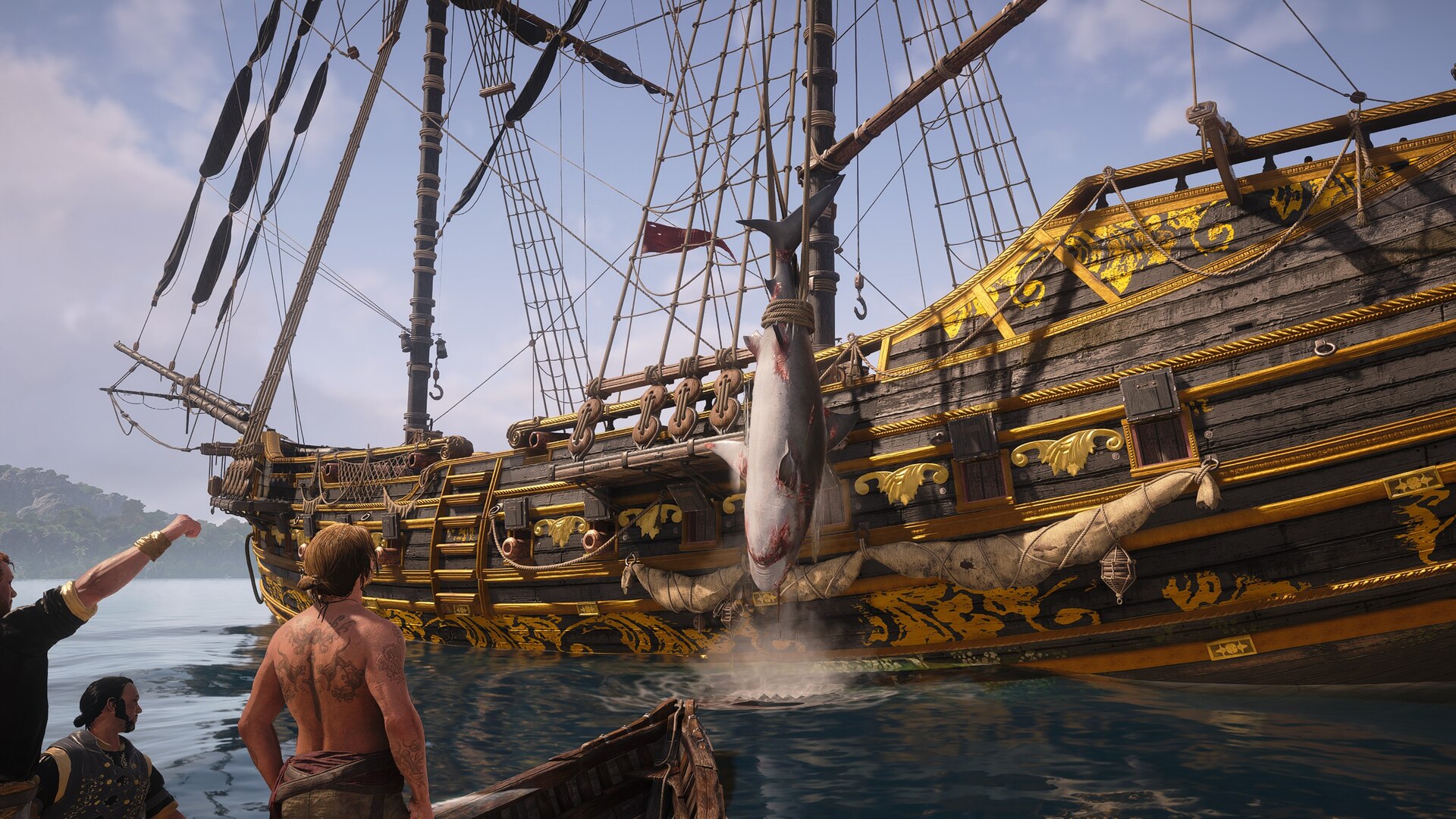
The ocean is naturally the centerpiece of the visual upgrade. Water has always been one of Black Flag’s strongest technical achievements, and the remake expands on that foundation with improved reflections, more detailed waves, enhanced weather effects, and more convincing environmental transitions. Storms and naval battles benefit particularly from these changes because they emphasize the scale of the world rather than simply making individual objects look sharper.
The improved rendering technology also helps the islands and cities feel more detailed. Vegetation, architecture, and environmental effects receive additional attention, creating locations that feel less limited by the hardware generation for which the original was developed. Features such as ray-traced lighting further modernize the presentation, although the overall visual style remains recognizable as Black Flag rather than a completely different interpretation.
Character improvements are more mixed. Important characters receive updated models and improved presentation, but the remake is still working with a story and performance structure created around the original game. Facial animation, dialogue delivery, and certain cinematic sequences do not always match the standards of the newest AAA releases.
That is an unavoidable challenge with a remake of this type. Improving assets and technology can make a game look significantly better, but it cannot completely erase the design decisions and performance capture methods of the era in which the original was created.
On PC, the remake benefits from the flexibility of the platform. Higher resolutions, adjustable graphical settings, and support for modern hardware allow players to experience the game with fewer limitations than were present during the original release. The ability to tailor performance and image quality is especially valuable for a game built around large environments and long-distance views.
At the same time, PC players are also the audience most likely to question the value of the upgrade. The original Black Flag was already a strong PC release, and many players were able to enjoy improved resolution and performance through hardware upgrades or community adjustments. The remake therefore needs to offer more than technical convenience to justify a purchase from existing owners.
Visually, Black Flag Resynced succeeds in making the Caribbean feel more modern. Whether those improvements are enough to justify the asking price depends largely on how much value a player places on revisiting a familiar world with significantly improved presentation.
Price and Value
The most difficult aspect of evaluating Assassin’s Creed Black Flag Resynced is not the quality of the remake itself. Ubisoft has clearly invested more effort here than it would in a standard remaster. The game has been rebuilt on a newer version of the Anvil Engine, several mechanics have been adjusted, additional content has been added, and the presentation has been substantially upgraded. Treating it as nothing more than a texture update would be inaccurate.
The problem is that the remake is priced like a new major release. At $59.99 for the standard edition and $69.99 for the Deluxe Edition on PC, Black Flag Resynced asks players to make a purchase decision normally associated with a brand-new AAA game rather than an updated version of an older title.
That pricing creates a complicated situation because the remake occupies an uncomfortable middle ground. It is clearly more ambitious than a typical remaster, but it is also not a complete reinvention of Black Flag. The core structure, mission design, progression systems, and overall flow remain closely connected to the original game.
For players who never experienced Black Flag, the value proposition is much easier to understand. They are getting one of the strongest entries in the Assassin’s Creed series with improved visuals, modernized mechanics, and additional content included from the beginning. The game still offers a lengthy single-player adventure with a distinctive setting, a memorable protagonist, and one of the best naval combat systems Ubisoft has created.
For returning players, the calculation is far less straightforward. Many already own the original game, often including its downloadable content, and the remake’s improvements need to provide enough additional value to justify another full-priced purchase. The question is not whether the new version is better; it is. The question is whether it is different enough.
This is where the pricing becomes the remake’s biggest weakness. A lower price would better reflect the relationship between the original game and the new release. A premium price requires the remake to feel like an essential new interpretation rather than simply the preferred version of an existing classic.
The comparison with other major remakes also works against Black Flag Resynced. Some modern remakes have justified full pricing by dramatically changing the experience, rebuilding combat systems, redesigning environments, expanding campaigns, or rethinking how the original game works. Resynced improves and modernizes Black Flag, but it is still fundamentally the same adventure.
That does not make it a poor remake. In fact, preserving the original identity is one of its strengths. The developers clearly understood that the appeal of Black Flag came from its balance of exploration, naval combat, and character-driven storytelling. However, respecting the original design and charging a premium price create competing expectations.
The remake would be easier to recommend at a reduced launch price or during an early sale. At full price, it becomes a purchase that depends heavily on the player’s relationship with the original. Newcomers are likely to see it as a polished modern release, while longtime fans may view it as an expensive upgrade to a game they already know.
Final Verdict: 8/10
Assassin’s Creed Black Flag Resynced is a careful and respectful remake of one of the franchise’s most distinctive entries. Ubisoft has avoided the common mistake of changing the game so aggressively that it loses its identity. Instead, the remake focuses on improving the areas where the original has aged while preserving the elements that made it memorable.
The updated visuals are a significant improvement, particularly across the Caribbean environment and naval sections. The ocean, weather systems, lighting, and environmental detail benefit greatly from modern technology, making exploration more impressive than it was in the original release. The gameplay adjustments are also mostly well judged, with improved stealth flexibility and refined combat mechanics that address some of the original game’s weaker areas without changing its overall character.
The strongest aspects of Black Flag remain its strongest aspects here. Edward Kenway continues to be one of the more interesting protagonists in the franchise because his journey feels personal rather than purely connected to Assassin’s Creed mythology. The Jackdaw remains an excellent progression system, and naval combat still provides a sense of freedom and excitement that few open-world games have successfully recreated.
However, the remake’s greatest challenge is also its most obvious one: it is rebuilding a game that was already highly playable and widely appreciated. The improvements are meaningful, but the experience is not transformed to the same degree as some of the most ambitious modern remakes. The structure of the game remains rooted in 2013 design, which means some mission layouts, enemy behavior, and open-world activities still feel older than the updated presentation suggests.
The $59.99 asking price therefore becomes the central criticism. Black Flag Resynced is not overpriced because Ubisoft did not put effort into it. The remake clearly represents a significant technical and design investment. The issue is that the price places it alongside entirely new releases, and that comparison makes the value proposition more difficult for existing players to accept.
For newcomers, this is the definitive way to experience one of Assassin’s Creed’s best adventures. The remake provides a polished version of a game that remains enjoyable because its foundation was always strong.
For returning players, the recommendation depends on how much they value the improvements. Those who want a modern presentation, updated mechanics, and additional content may find enough here to justify returning to the Caribbean. Those who are satisfied with the original version may prefer waiting for a discount.
Assassin’s Creed Black Flag Resynced is a successful remake because it understands why the original worked. It improves a classic without losing what made it distinctive. Its main weakness is not the quality of the work involved, but the difficulty of convincing players that a familiar adventure deserves a full premium price.


