
Party games often succeed because they take a familiar idea and twist it into something that encourages players to create their own stories. Some focus on cooperation, others on competition, while a handful thrive on complete unpredictability. Gamble With Your Friends falls squarely into the latter category. At first glance, it looks like little more than a collection of casino minigames wrapped in a humorous multiplayer package, but that description barely scratches the surface of what TEAM GWYF has created. Beneath the intentionally silly presentation is a cooperative roguelite where every wager carries consequences for the entire group rather than a single player.
The premise is simple enough. Up to six players owe an enormous debt to a loan shark and are given a chance to work it off inside Jeff Booth’s Paradise, a towering casino filled with increasingly elaborate gambling games. Every in-game day lasts just five minutes, during which the group must earn enough money to reach a required quota before time expires. Failure means unpleasant consequences, while success allows the team to continue climbing the casino’s themed floors in search of bigger payouts and one of several possible endings. The entire experience can be completed in a few hours, but randomized layouts, multiple endings, unlockables, and the inherent unpredictability of chance-based games encourage repeat runs.
What immediately separates Gamble With Your Friends from countless other cooperative party games is its shared economy. Every dollar belongs to everyone. Every reckless decision affects the entire team. Unlike games where one player’s mistakes are quickly forgotten, a disastrous all-in bet here can derail an otherwise successful run. Conversely, one lucky streak can instantly transform a desperate situation into a comfortable lead over the day’s quota. That constant tension between cooperation and selfishness forms the backbone of nearly every memorable moment the game produces.

It is also refreshingly aware of its own identity. The developers never pretend this is a realistic casino simulation or a deep gambling strategy game. Instead, they embrace absurdity through exaggerated physics, ridiculous items, bizarre interactions, and an atmosphere that constantly encourages players to make questionable decisions simply because they might work. Even when a carefully planned strategy falls apart due to terrible luck, the resulting chaos usually becomes more entertaining than the successful outcome would have been.
That doesn’t mean everything lands perfectly. The game’s heavy reliance on randomness occasionally undermines player agency, solo play feels more like an optional challenge than a fully supported mode, and its launch version contains technical issues ranging from minor annoyances to more serious bugs capable of disrupting entire runs. Those problems don’t completely overshadow what the game accomplishes, but they do prevent it from fully realizing the potential of its excellent central concept.
Gameplay and Mechanics
Although gambling naturally forms the centerpiece of the experience, Gamble With Your Friends is far more concerned with teamwork than probability. Every run begins inside a modest headquarters where players can purchase items, customize their appearance, prepare strategies, and generally waste time teasing one another before climbing into the limousine that transports everyone to the casino. Once the doors open, the five-minute countdown immediately begins, creating a constant sense of urgency without ever feeling overwhelming.
The casino itself spans four themed floors that gradually introduce more lucrative opportunities alongside greater risks. Rather than presenting the exact same layout every run, each floor randomizes its available gambling stations, encouraging exploration instead of allowing players to memorize optimal routes. This procedural approach keeps repeated playthroughs engaging because even familiar games appear in different locations and combinations.
Across these floors are seventeen different games of chance, offering far more variety than many players may initially expect. Traditional casino staples like Blackjack, Roulette, Plinko, Keno, Craps, Poker, Slot Machines, and Hi-Lo sit alongside more unconventional attractions that fit the game’s exaggerated tone. Some games are relatively safe and reward careful decision-making, while others are little more than controlled chaos where players knowingly embrace terrible odds in hopes of landing enormous payouts.
Importantly, these games rarely attempt to simulate real casinos with complete accuracy. Their purpose is to produce interesting multiplayer situations rather than faithfully recreate professional gambling environments. That decision ultimately benefits the experience. Rules are easy to understand, rounds move quickly, and even players with virtually no knowledge of casino games can become productive contributors within minutes.
The shared bank account remains the mechanic that ties everything together. Every bet comes from the same pool of money, creating an unusual dynamic where individual freedom constantly clashes with collective responsibility. Watching a teammate confidently wager nearly half the group’s savings on a high-risk opportunity is simultaneously hilarious and horrifying. Sometimes they return moments later having doubled the bank balance. Other times they quietly admit they lost everything.
Because the consequences affect everyone equally, communication naturally becomes one of the game’s strongest mechanics despite never being formally required. Groups begin assigning responsibilities without the game explicitly encouraging them. One player might repeatedly focus on Blackjack because they’re comfortable managing probabilities, while another searches the floor for safer opportunities or keeps track of remaining time. Others inevitably ignore every sensible plan and sprint toward the nearest slot machine hoping fortune smiles upon them.
Surprisingly, both approaches remain viable because randomness is carefully balanced against consistency. Conservative teams usually reach their quotas through steady earnings, while more reckless groups experience dramatic swings between spectacular success and catastrophic failure. Neither style feels objectively superior, which allows every session to develop its own personality depending on the people involved.
Time pressure reinforces these decisions brilliantly. Five minutes sounds generous until multiple players scatter across an unfamiliar casino, arguments break out over spending priorities, and someone suddenly announces they’ve accidentally lost several thousand dollars. As the timer approaches zero, coordinated planning often dissolves into frantic desperation as everyone searches for one last opportunity capable of pushing the shared account above quota. The final thirty seconds consistently generate some of the game’s funniest moments because careful strategy gives way to instinctive risk-taking.
Beyond gambling itself, players earn Tickets by surpassing quotas, completing challenges, and occasionally through more questionable means. Those Tickets purchase a collection of strange items that subtly or dramatically alter future runs. Some increase the likelihood of favorable outcomes, others manipulate risk, while a few exist almost entirely to create comedic situations between teammates. None completely eliminate the importance of luck, but they introduce just enough progression to make each successful run feel worthwhile.
Items also add another layer of resource management. Since Tickets are limited, deciding whether to spend them immediately or save them for more valuable purchases becomes an ongoing consideration. Cosmetic customization shares this same currency, creating a surprisingly effective trade-off between improving future odds and simply making your bizarre little gambler look increasingly ridiculous.
One area where the game shows restraint is progression. Rather than burying players beneath permanent skill trees, dozens of upgrade currencies, or endless unlock systems, Gamble With Your Friends focuses on preserving the integrity of each run. Success comes primarily from improving teamwork and understanding risk rather than accumulating overwhelming statistical advantages. That approach fits the game’s relatively short campaign and prevents experienced players from trivializing its core challenge.
The downside is that long-term progression can feel somewhat limited after repeated completions. Cosmetic unlocks remain enjoyable, but players hoping for significant permanent upgrades or deeper roguelite systems may eventually find themselves relying almost entirely on the strength of the multiplayer experience to justify additional sessions.
Another limitation involves solo play. While technically supported, it quickly becomes obvious that nearly every mechanic was designed with multiple participants in mind. Managing every responsibility alone removes much of the spontaneous decision-making that defines the game at its best. The shared economy loses much of its appeal when there is nobody else capable of making disastrous financial decisions, and the humorous social interactions that elevate ordinary casino games simply cannot be replicated by artificial tension alone. TEAM GWYF openly acknowledges that solo play is possible but not the intended experience, and after spending time with both modes, that assessment feels entirely fair.
Perhaps the greatest compliment that can be paid to Gamble With Your Friends is that it consistently transforms basic probability into memorable stories. Nobody remembers every successful Blackjack hand, but everyone remembers the friend who ignored every warning, bet nearly the entire team’s savings on an absurd long shot, somehow won, and immediately became the group’s unlikely hero. Likewise, nobody forgets the opposite outcome, where one terrible decision sends the entire run spiraling into disaster. The mechanics succeed because they constantly create these moments without ever forcing them.
Multiplayer and Online Experience
Although Gamble With Your Friends supports solo play, there is little doubt that the multiplayer component is the reason the game exists. Nearly every system, from the shared bank account to the quota structure and purchasable items, has been designed around the unpredictable behavior of other human players. While many cooperative games encourage communication, this one practically depends on it. Success rarely comes from having the best gambler in the group. Instead, it comes from convincing everyone else not to spend the entire budget on an improbable long shot.
That shared responsibility creates a surprisingly interesting social dynamic. In many cooperative games, players naturally divide into specific roles based on character classes or abilities. Here, those roles emerge organically. Someone usually becomes the cautious accountant who constantly reminds everyone how much money remains. Another player develops a reputation for consistently winning at a particular game and becomes responsible for generating reliable income. Meanwhile, at least one person inevitably embraces complete recklessness, disappearing for several minutes before either returning as the team’s unlikely savior or the individual responsible for ruining the entire run.
The game wisely avoids punishing these different playstyles too heavily. While reckless decisions can absolutely sink a session, they can also produce spectacular recoveries that conservative strategies could never achieve. Because the outcome always remains uncertain, even experienced groups find themselves debating whether a risky wager is justified. Those conversations often become the most entertaining part of the experience.
Proximity voice chat is included, and while it certainly adds immersion, its usefulness depends heavily on the group you’re playing with. Hearing teammates shout in celebration from another room before realizing they’ve just lost a significant portion of the shared funds is undeniably amusing, and the localized audio contributes to the feeling that everyone is scattered throughout an active casino. At the same time, the game’s emphasis on constant coordination means many groups will likely default to Discord or another external voice application where communication remains uninterrupted regardless of distance. The built-in system works well enough, but it feels more like an optional novelty than a defining feature.
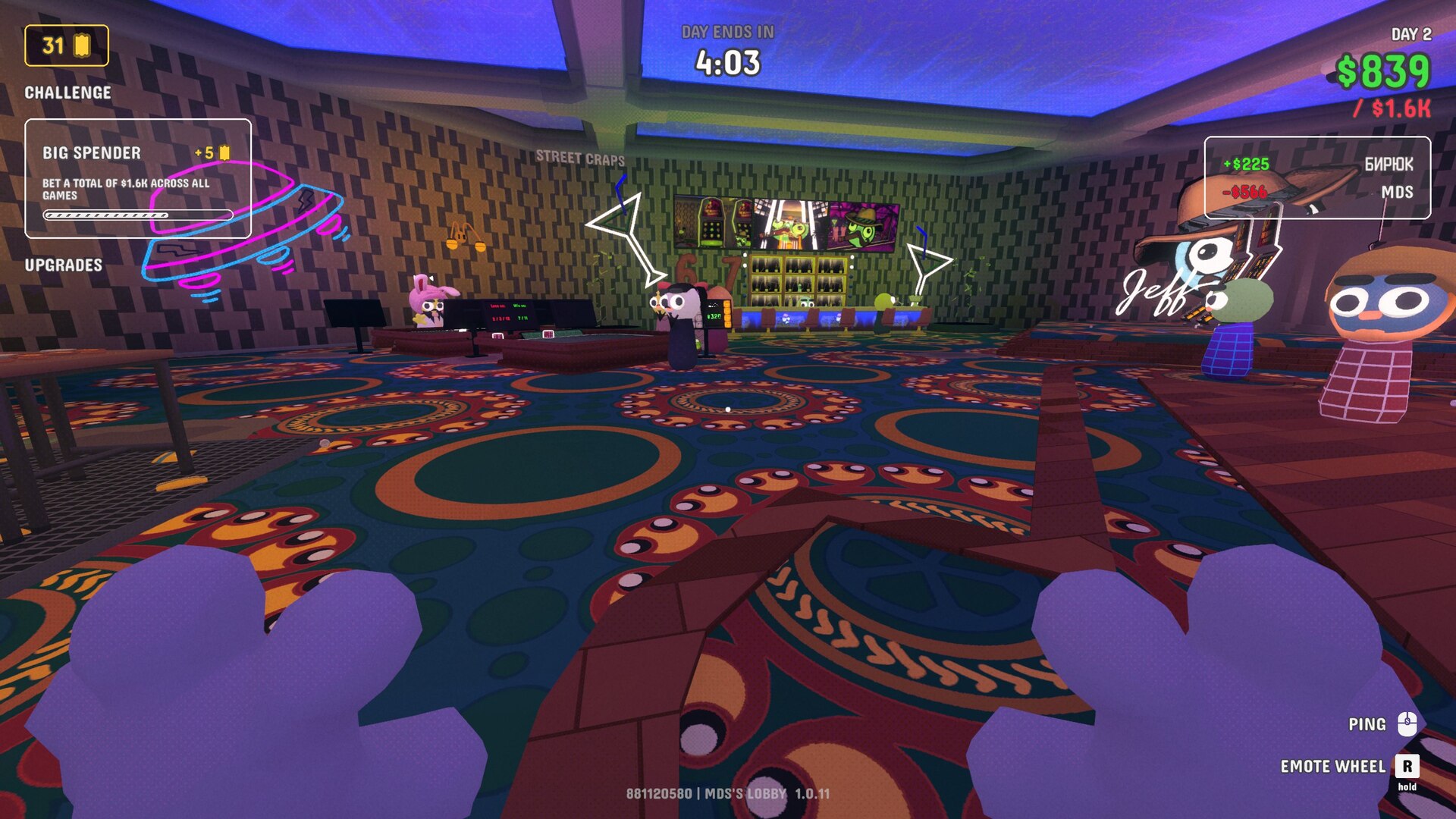
Another strength is how accessible the multiplayer remains. Since none of the gambling games require extensive knowledge of real-world casino rules, newcomers rarely feel excluded. A first-time player may not immediately understand the optimal strategy for every table, but they will quickly grasp the broader objective of balancing risk against the group’s overall financial health. That low barrier to entry makes Gamble With Your Friends an easy recommendation for mixed groups where some players regularly enjoy roguelites while others simply want an entertaining evening with friends.
One limitation worth mentioning is that the game currently supports only friends-only sessions. There is no matchmaking with random players, which makes sense considering how dependent the experience is on trust and communication. Still, it does mean players without a regular group may struggle to experience the game as intended. Solo mode exists, but it never fully replaces the spontaneous interactions that make multiplayer memorable.
Visuals and Audio
Visually, Gamble With Your Friends adopts a stylized, exaggerated aesthetic that prioritizes personality over technical sophistication. Character models are intentionally goofy, animations frequently lean into slapstick comedy, and the casino itself feels like an oversized playground rather than a realistic gambling establishment. It is an art direction that fits the game’s tone remarkably well.
Each casino floor introduces a different visual identity, helping progression feel more meaningful than simply unlocking increasingly difficult gambling tables. Environmental variety prevents longer sessions from becoming visually repetitive, and randomized layouts ensure familiar locations never become completely predictable. While individual rooms are not especially detailed, they contain enough environmental touches to establish distinct personalities without distracting from the gameplay.
The headquarters between runs deserves particular mention. Although mechanically simple, it provides a pleasant break from the constant pressure of meeting quotas. Players can purchase cosmetics, browse available items, experiment with emotes, and generally relax before returning to the casino. It also reinforces the game’s social focus by giving groups somewhere to gather naturally between runs instead of jumping directly from one session into the next.
Customization follows a similarly lighthearted philosophy. Cosmetic options are varied enough to give every player a distinct appearance without becoming overwhelmingly extensive. Since these purchases compete with gameplay-enhancing items for the same Ticket currency, they also create amusing debates within the group. Spending hard-earned Tickets on fashionable clothing instead of practical equipment may not improve the team’s chances of survival, but it certainly creates memorable arguments.
Audio complements the presentation effectively. The soundtrack captures the energetic atmosphere of an arcade-style casino without becoming repetitive during longer sessions. Music intensifies naturally during stressful moments while remaining subdued enough that player conversations always take priority. Sound effects are equally satisfying, with slot machines, roulette wheels, card tables, and jackpot celebrations delivering just enough feedback to make successful wagers feel rewarding.
Perhaps the presentation’s greatest achievement is consistency. Every visual and audio element reinforces the idea that this is not a realistic simulation of gambling but a comedic multiplayer sandbox where terrible financial decisions become entertainment. The game never attempts to be glamorous or sophisticated, and it benefits from embracing that identity wholeheartedly.
Technical Performance on PC
From a technical perspective, Gamble With Your Friends delivers mixed results. On one hand, its relatively modest visual demands allow it to run comfortably across a wide range of PC hardware. Frame rates remain stable during normal gameplay, loading times are short, and the overall experience generally feels responsive.
On the other hand, the game’s launch period has been accompanied by a noticeable collection of bugs and occasional stability issues. Some are relatively harmless, such as interface inconsistencies or visual glitches, while others have the potential to interrupt progress or temporarily break multiplayer sessions. Community reports have highlighted issues involving progression, interaction bugs, score displays, and rare save-related problems, several of which have already begun receiving developer attention through post-launch updates.
Fortunately, none of these problems fundamentally undermine the game’s core design. Most sessions proceed without major interruptions, and the developers have demonstrated an encouraging willingness to respond quickly with patches. Nevertheless, players should expect a handful of rough edges, particularly if they’re joining during the early months following release.
The user interface also leaves room for refinement. While generally functional, some information could be communicated more clearly during the frantic final moments of a quota run. Better visual feedback regarding team resources and certain item effects would improve readability without compromising the intentionally chaotic nature of the experience.
Even with these shortcomings, the technical foundation feels solid enough to support future updates. This is less a case of an unstable game struggling to function and more one of a polished concept that still requires ongoing quality-of-life improvements.
Replay Value
For a game that can realistically be completed in a single evening, Gamble With Your Friends offers more replay value than its premise initially suggests. On paper, the objective never changes. Players enter the casino, earn enough money to meet increasingly demanding quotas, survive long enough to reach the top floor, and eventually escape their debt. Repeating that process dozens of times could easily have become repetitive, yet the game does enough to ensure individual runs rarely play out in exactly the same way.
A significant part of that longevity comes from procedural generation. Since casino layouts change from run to run, players cannot rely entirely on memorized routes or carefully planned strategies. Some attempts might place reliable money-makers close together, allowing the group to establish a comfortable financial cushion early on. Others force players to adapt to less favorable combinations of games, encouraging them to take risks they would normally avoid. It is a relatively simple system, but one that successfully keeps each session feeling fresh.
The variety of gambling activities also contributes to the game’s staying power. With seventeen different games spread throughout the casino, players naturally develop favorites while occasionally being pushed toward activities they normally ignore. That variety becomes especially important during multiplayer sessions, as different members of the group often gravitate toward different tables based on personal preference rather than statistical efficiency. Even after several successful runs, it remains enjoyable to discover that a teammate has suddenly become remarkably good—or remarkably unlucky—at a game they had previously avoided.
The item system provides another incentive to keep playing. While progression is intentionally restrained, unlocking additional items and cosmetics gives players achievable goals beyond simply reaching the ending again. Tickets accumulate at a satisfying pace, making each completed run feel productive even if it ultimately ends in failure. The decision to tie cosmetic rewards and gameplay items to the same currency also remains surprisingly effective throughout the game’s lifespan. Players constantly weigh whether they should invest in something that improves future runs or spend their earnings on purely cosmetic customization.
Multiple endings further encourage repeat playthroughs without overstaying their welcome. Although the journey through the casino remains broadly familiar, knowing there are different outcomes gives players another reason to experiment with new strategies and continue climbing after their first successful completion. These endings are not transformative enough to redefine the entire experience, but they provide a welcome sense of progression beyond simply watching the credits roll.

That said, the game’s longevity is still heavily dependent on the people you’re playing with. The procedural systems and unlockables provide a solid foundation, but they are not substantial enough to carry the experience indefinitely on their own. Eventually, most players will become familiar with every gambling game, understand the overall progression, and recognize the general rhythm of each run. At that point, the enjoyment shifts away from discovering new mechanics and toward creating entertaining moments with friends.
Fortunately, that transition plays directly into the game’s greatest strength. Much like successful party games such as Lethal Company or Content Warning, the memorable moments rarely come from scripted events. They emerge naturally from unpredictable player behavior. One session might feature perfect teamwork and calculated decision-making, while the next dissolves into complete financial chaos because someone decided that betting nearly the entire bank balance on a single outcome seemed like a reasonable idea. The game constantly provides opportunities for these stories to develop without forcing them through artificial scenarios.
Solo players, however, will likely reach that point of familiarity much sooner. Without other people introducing unexpected decisions into every run, the procedural elements have to shoulder far more of the experience. They do an admirable job, but they cannot completely replace the social unpredictability that defines the game at its best. Anyone planning to spend dozens of hours exclusively in single-player should temper their expectations accordingly.
The encouraging aspect is that Gamble With Your Friends feels well-positioned for future growth. Its underlying systems leave plenty of room for additional casino games, themed floors, items, cosmetics, and seasonal events without fundamentally changing the experience. Assuming the developers continue supporting it with meaningful updates, the game has every opportunity to remain a regular fixture in multiplayer game nights for quite some time.
Final Verdict: 7.5/10
Gamble With Your Friends succeeds because it understands exactly what kind of experience it wants to deliver. Rather than attempting to simulate casino gambling with complete authenticity or overwhelm players with complex roguelite progression systems, it focuses on creating situations where teamwork, poor judgment, and outrageous luck collide in consistently entertaining ways. The shared economy is an inspired central mechanic that transforms even the simplest casino games into tense cooperative challenges, while the quota system provides enough urgency to keep every decision meaningful without making sessions feel exhausting.
Its accessibility is another major strength. Players do not need extensive knowledge of gambling games to enjoy themselves, and the straightforward progression makes it easy for newcomers to jump into a session without lengthy explanations. The result is a multiplayer game that is immediately approachable yet capable of producing surprisingly memorable stories after only a few rounds.
There are, however, limitations that prevent it from becoming an easy recommendation for everyone. Solo play lacks the dynamic interactions that give the game its personality, long-term progression may feel somewhat light for players seeking a deeper roguelite experience, and the current technical issues serve as a reminder that the game is still maturing. None of these problems fundamentally undermine the excellent foundation, but they do occasionally interrupt the smooth flow that the rest of the design works so hard to establish.
What ultimately elevates Gamble With Your Friends above being just another collection of casino minigames is the way every system feeds into player interaction. Winning money is satisfying, but convincing your friends to trust an absurdly risky strategy—and somehow proving them wrong—is where the game truly shines. Likewise, spectacular failures often become even more memorable than successful runs, turning expensive mistakes into stories that groups will laugh about long after the session ends.
In an increasingly crowded market filled with cooperative party games trying to generate viral moments, Gamble With Your Friends achieves that goal through smart design rather than forced spectacle. It trusts its mechanics to create entertaining situations on their own, and more often than not, they do exactly that. Although a handful of launch issues and relatively modest progression hold it back from greatness, the core experience is remarkably strong and consistently enjoyable with the right group of players.
It may not become the next endlessly replayable multiplayer phenomenon for every audience, but for friends looking for a cooperative game that combines strategy, luck, and just enough chaos to keep everyone on edge, Gamble With Your Friends proves that sometimes the biggest gamble is trusting your teammates with the group’s money.


