
There are few names in video games that carry as much baggage as Bubsy. For years, the franchise existed mostly as an industry punchline. Bubsy himself became shorthand for nearly every problem associated with the awkward early years of 3D platforming: slippery controls, chaotic cameras, irritating voice clips, and design ideas that sounded far more ambitious than they actually played. The original Bubsy 3D built such an infamous reputation that the mere announcement of Bubsy 4D sounded less like a legitimate revival and more like an elaborate prank aimed at nostalgic players.
That assumption would have been understandable at the time. Mascot platformers are difficult enough to revive successfully even when the original games are remembered fondly. Reviving a franchise associated primarily with failure is an entirely different challenge. After all, mascot platformers are difficult enough to revive successfully even when the original games are fondly remembered. Reviving a franchise associated primarily with failure is an entirely different challenge. Yet Bubsy 4D is not a cynical joke release, nor is it a low-effort nostalgia bait project designed purely to cash in on internet irony. Against all expectations, developer Fabraz approached the game with genuine enthusiasm for the genre itself. Beneath the self-aware humor and intentionally chaotic presentation sits a surprisingly competent 3D platformer with strong movement systems, clever pacing, and an obvious affection for late-1990s collectathon design.
That does not mean Bubsy 4D is secretly a masterpiece waiting to be rediscovered. The game still struggles with inconsistent level quality, repetitive aesthetics, underdeveloped combat, and humor that can become exhausting over longer sessions. Some mechanics feel unfinished. Certain ideas work far better in theory than they do in practice. But the truly surprising thing is that Bubsy 4D earns its existence. It is a legitimately enjoyable platformer built around one of gaming’s most ridiculed mascots, and that alone makes it one of the most fascinating releases of the year.
The Impossible Task of Reviving Bubsy
Part of Bubsy 4D’s appeal comes from how openly it acknowledges the impossible position it occupies. The game knows exactly what players think about the franchise. Rather than pretending the past never happened, the script constantly references Bubsy’s disastrous history. Bubsy himself is portrayed less like a triumphant returning hero and more like an outdated mascot desperately trying to claw his way back into relevance after decades of ridicule.
Sometimes that self-awareness works extremely well. The game develops a strange underdog charm because it understands how absurd its own existence is. There is something genuinely funny about watching this aggressively outdated cartoon cat stumble through bizarre worlds while constantly attempting to convince everyone, including himself, that he still matters. The writers clearly understand the internet’s relationship with Bubsy and lean heavily into the idea that the character’s reputation has become inseparable from gaming history.
At the same time, the humor can become overwhelming. Bubsy rarely stops talking, and nearly every scene contains some kind of reference to retro platformers, internet culture, gaming nostalgia, or the franchise’s own terrible reputation. Some jokes land surprisingly well because they feel naturally integrated into the world. Others feel painfully forced, as though the game is trying too hard to prove that it is in on the joke.
The biggest issue is repetition. Bubsy 4D occasionally pushes its self-awareness so aggressively that the writing starts feeling strained rather than playful. The game is at its best when the humor emerges naturally from the absurdity of the situation instead of directly explaining the joke to the player.
Bubsy 4D frequently returns to the same comedic ideas long after they have stopped being amusing. The script occasionally mistakes constant dialogue for personality, resulting in stretches where the game becomes exhausting simply because it never slows down. Players who enjoy hyperactive mascot energy may find the relentless pacing entertaining, but anyone sensitive to nonstop chatter will likely feel fatigued by the midpoint.
Still, the sincerity underneath the humor ultimately carries the writing through its weaker moments. Bubsy 4D never feels cynical. Even when the jokes fail, the game still feels like it was made by developers who genuinely love weird platformers and wanted to create one themselves instead of merely mocking the genre.
Gameplay and Mechanics
The most surprising accomplishment in Bubsy 4D is how quickly it establishes mechanical confidence. Within the first hour, it becomes obvious that the developers understood exactly what kind of platformer they wanted to build. Rather than chasing cinematic storytelling, massive open worlds, or RPG-style progression systems, Bubsy 4D focuses almost entirely on movement feel and player momentum. That design philosophy gives the game a sense of clarity many larger modern platformers lack.
The single biggest reason Bubsy 4D succeeds is movement. Everything else in the game fluctuates in quality, but controlling Bubsy himself is consistently satisfying.
Fabraz clearly understood that a modern 3D platformer lives or dies based on how good basic movement feels. Bubsy’s moveset is surprisingly extensive almost immediately. He can double jump, glide, wall scramble, pounce forward, roll into a high-speed sprint, and chain various momentum boosts together in midair. None of these mechanics are individually revolutionary, but the way they connect creates a movement system that feels fast, expressive, and flexible.
Once the controls click, traversal becomes the heart of the experience. Bubsy 4D constantly encourages players to improvise movement routes rather than simply follow obvious paths. Long jumps can feed naturally into wall climbs. Glides can transition directly into momentum boosts. Speed can be maintained through careful chaining of abilities, rewarding players who learn how the physics systems interact.
There is a noticeable speedrunning influence embedded throughout the game’s design philosophy. Levels contain shortcuts, alternate routes, hidden momentum opportunities, and movement chains that become more rewarding with practice. The better players understand Bubsy’s abilities, the more satisfying traversal becomes.
What makes the movement especially effective is how forgiving the game feels without becoming overly simplistic. Bubsy has generous air control, quick recovery animations, and movement abilities that encourage experimentation rather than punishing mistakes. Falling off a platform rarely feels catastrophic because the game wants players to keep moving instead of approaching every jump cautiously. That creates a playful rhythm that fits the tone far better than a more punishing design would have.
The controls themselves are responsive throughout most of the campaign. Bubsy accelerates quickly, directional inputs remain precise even during high-speed movement, and transitions between abilities feel smooth enough to support improvisation. Some traversal systems clearly borrow inspiration from more successful modern platformers, but the game combines those influences effectively enough to create its own mechanical identity.
At times, Bubsy 4D almost resembles a hybrid between a traditional mascot platformer and a lightweight action speedrunner. Certain levels reward aggressive movement so heavily that simply reaching the end is far less satisfying than learning how to move through the environment elegantly. Players willing to engage with that side of the design will likely enjoy the game far more than those approaching it as a slow-paced exploration platformer.
There is also an admirable lack of mechanical bloat. Modern platformers often overload players with crafting systems, upgrade trees, or progression mechanics that distract from basic movement. Bubsy 4D keeps its priorities simple. The goal is to make movement fun first and build the rest of the game around that core strength. Levels contain shortcuts, alternate routes, hidden momentum opportunities, and movement chains that become more rewarding with practice. The better players understand Bubsy’s abilities, the more satisfying traversal becomes.
This emphasis on movement over exploration will absolutely divide players. Bubsy 4D clearly prefers forward momentum over methodical discovery, and that decision shapes nearly every aspect of the campaign structure.
Bubsy 4D is not structured like a traditional collectathon built around dense sandbox environments filled with layered secrets. Exploration exists, but it rarely feels like the primary focus. Many collectibles are placed in fairly obvious locations, and the game generally prioritizes movement flow over careful environmental discovery.
That decision helps the pacing considerably. Bubsy 4D moves quickly and rarely wastes the player’s time. New mechanics appear regularly, levels remain compact enough to stay engaging, and the game avoids the bloated structure that drags down many modern platformers. However, players hoping for intricate worlds packed with meaningful secrets may find the environments somewhat shallow compared to genre classics.
Still, the quality of the movement system compensates for many of the game’s shortcomings. Bubsy feels better to control than almost anyone expected, and that alone elevates the experience dramatically.
Level Design
One of the most interesting aspects of Bubsy 4D’s level design is how heavily it prioritizes rhythm over realism. The environments rarely feel like believable locations, but they often function effectively as mechanical playgrounds. Platforms are positioned to encourage chaining abilities together, hazards are placed to maintain forward momentum, and verticality is used constantly to keep traversal visually dynamic.
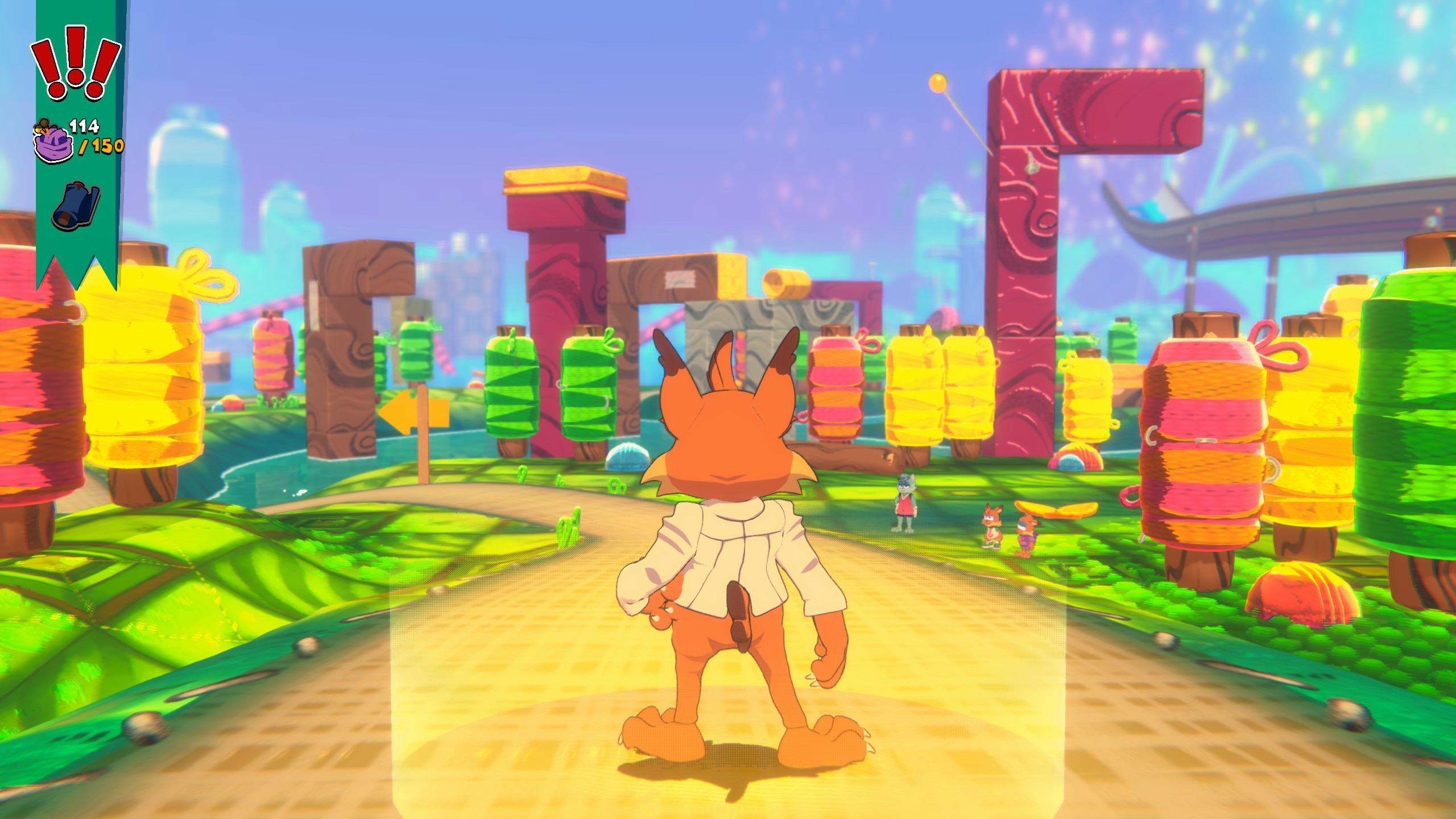
The level design in Bubsy 4D is simultaneously imaginative and inconsistent. The game contains a wide range of themed environments that embrace exaggerated artificiality rather than realism. Yarn-covered landscapes, paper-craft cities, retro-futuristic obstacle courses, toy-box factories, and bizarre cosmic playgrounds give the game a deliberately chaotic visual identity.
Some stages are genuinely memorable. One world built around folded paper textures and ruler-marked platforms resembles a playable arts-and-crafts project. Another transforms a giant cosmic factory into a high-speed traversal playground filled with rails, launch pads, and momentum loops that encourage constant movement.
The strongest levels understand how to combine visual identity with mechanical design. Movement opportunities are integrated naturally into the environment, encouraging players to experiment with traversal rather than simply moving from one platform to another. In these moments, Bubsy 4D captures the kind of energetic flow that made classic platformers so appealing.
Unfortunately, the quality varies noticeably across the campaign. Some stages feel sparse and underdeveloped, with large stretches of empty terrain lacking meaningful interaction. Platform placement occasionally feels arbitrary rather than carefully structured. Enemy encounters rarely integrate naturally into the level design and often feel like decorative obstacles placed into environments after the fact.
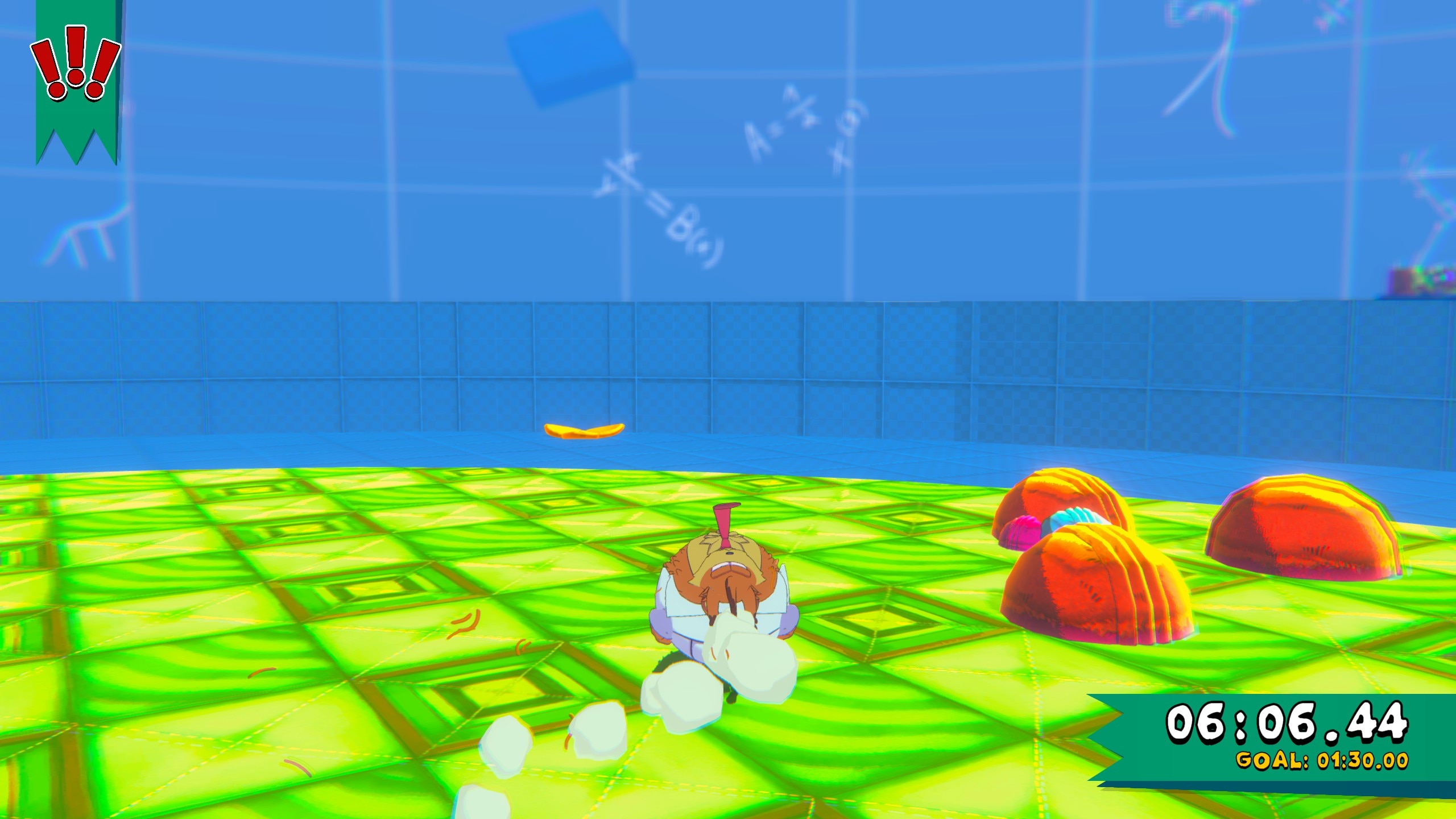
This inconsistency becomes one of the game’s defining weaknesses. The best levels are genuinely exciting, but weaker stages reveal the limitations of the project’s budget and scope. Compared to the genre’s strongest examples, Bubsy 4D’s environments often lack density. The worlds look creative, but they do not always feel alive.
Yet there is still something admirable about the game’s confidence. Bubsy 4D rarely plays things safe. Even its weaker levels usually contain at least one memorable visual concept or traversal gimmick that separates them from the rest of the campaign.
The game also benefits from avoiding the repetitive objective design that hurts many modern collectathons. Rather than forcing players through endless variations of identical side activities, Bubsy 4D generally introduces ideas quickly and moves on before they become exhausting. Some mechanics disappear almost as soon as they are introduced, which occasionally makes the experience feel underdeveloped, but it also prevents the campaign from stagnating.
There is a noticeable arcade-like mentality underlying the structure. Levels are designed to be replayed, optimized, and mastered rather than simply completed once and forgotten. That design philosophy gives even shorter stages a surprising amount of longevity because players naturally begin experimenting with movement efficiency after becoming comfortable with the controls.
Even when certain ideas fail, the worlds maintain personality. Bubsy 4D embraces cartoon nonsense completely rather than chasing realism or cinematic presentation. In an era where many mid-budget releases feel visually interchangeable, this game at least commits fully to its identity.
Combat and Boss Fights
Combat is easily the weakest major system in Bubsy 4D, largely because the game never fully figures out how to merge enemy encounters with its movement-focused design philosophy. Regular enemies rarely pose much of a threat, and most encounters can be solved with a single attack or by simply avoiding the enemy entirely.
The problem is not necessarily that combat lacks complexity. The bigger issue is that it actively interrupts the game’s strongest qualities. Bubsy 4D shines whenever players maintain momentum and improvise traversal routes through the environment. Combat often slows that momentum to a halt.
Many enemies feel disconnected from the movement systems rather than integrated into them. Instead of enhancing traversal, enemy encounters frequently function as minor obstacles standing between platforming sequences. The game occasionally hints at more interesting possibilities involving movement-based combat or environmental hazards, but these ideas are never explored deeply enough.
Boss fights are somewhat stronger, though still fairly basic. Most follow familiar platforming patterns involving attack cycles, dodge phases, and vulnerability windows. They are functional and visually entertaining, but few remain memorable after completion.
Fortunately, combat occupies a relatively small portion of the overall experience. Bubsy 4D understands that platforming is its true strength and wisely focuses most of its attention there.
Visuals and Art Direction
Bubsy 4D’s art direction deserves credit simply for committing fully to its own bizarre identity. In a market increasingly dominated by safe visual trends, the game embraces exaggerated cartoon chaos without hesitation. It is loud, messy, overdesigned, and occasionally visually exhausting, but it is never anonymous.
Calling Bubsy 4D visually beautiful would be inaccurate, but calling it generic would be even more inaccurate. The game embraces loud, exaggerated visual chaos almost constantly.
Bright neon colors clash aggressively across environments. Textures resemble cardboard, yarn, plastic toys, and craft materials. Character animations exaggerate every movement into theatrical slapstick. Menus overflow with visual noise, particle effects, and intentionally tacky presentation choices.
Whether this aesthetic works depends heavily on personal taste. Some players will find the presentation energetic and distinctive. Others will find it exhausting after only a few hours. Bubsy 4D absolutely risks alienating players who prefer cleaner visual direction.
Still, even when the art direction becomes abrasive, it remains memorable. The game rarely resembles anything else currently on the market. That uniqueness gives Bubsy 4D an identity stronger than many technically superior releases.
The visual design also complements the game’s movement systems surprisingly well. Bright colors and exaggerated geometry help players read traversal routes quickly during high-speed sequences. The environments may appear visually overwhelming at first glance, but important gameplay elements generally remain readable once players acclimate to the style.
There is also an oddly charming handmade quality to the entire presentation. Many environments resemble physical craft projects or toy sets brought to life digitally. That aesthetic helps separate Bubsy 4D from the increasingly standardized realism dominating much of the industry.
The visual presentation also reinforces the game’s sense of humor effectively even when individual jokes fail. Character animations are exaggerated constantly, environmental details lean heavily into absurdity, and nearly every world contains intentionally ridiculous props or visual gags hiding in the background. The game rarely stops trying to entertain the player visually, even during quieter sections.
There are moments where the presentation borders on sensory overload, particularly during later stages filled with particle effects, bright lighting, and overlapping visual elements. Yet even these excesses feel oddly appropriate for a franchise built around cartoon chaos. Bubsy 4D succeeds largely because it understands that restraint would probably have made the experience feel less authentic.
Many environments resemble physical craft projects or toy sets brought to life digitally. That aesthetic helps separate Bubsy 4D from the increasingly standardized realism dominating much of the industry.
Sound Design and Music
The audio design follows the same philosophy as the visuals: energetic, messy, and intentionally overwhelming. Nearly every sound effect, music track, and voice clip is designed to reinforce the game’s exaggerated cartoon tone. The soundtrack blends retro-inspired synth melodies with cartoon percussion, exaggerated sound effects, and hyperactive pacing.
Some tracks genuinely enhance the momentum-focused gameplay. Fast electronic rhythms pair naturally with traversal-heavy sections and help maintain the game’s energetic tone. Other tracks become repetitive over longer sessions and occasionally blend into background noise.
Voice acting is similarly inconsistent. Bubsy himself remains intentionally irritating, though the performance now feels more controlled than the shrill chaos associated with earlier games. The writers clearly wanted Bubsy to remain obnoxious while also becoming strangely sympathetic.
That balancing act works better than expected, but players sensitive to constant dialogue may still want to reduce voice volume fairly quickly. Bubsy comments on nearly everything happening around him, and the sheer frequency of dialogue becomes tiring during extended play sessions.
Despite these issues, the sound design succeeds at reinforcing the game’s personality. Bubsy 4D commits completely to its absurd cartoon energy, and the audio presentation supports that commitment consistently.
Structure, Length, and Replayability
Bubsy 4D is relatively short by modern standards, and that ultimately works heavily in the game’s favor. The campaign remains focused enough that the strongest mechanics stay enjoyable before repetition begins overwhelming the experience. A straightforward playthrough will likely take between six and eight hours depending on skill level and completion goals.
Completionists chasing collectibles, unlockables, and optimized time trial runs can extend that considerably, but this is not an enormous open-world platformer designed to consume dozens of hours. Instead, Bubsy 4D remains tightly focused on delivering a compact movement-driven experience.
That shorter runtime prevents many of the game’s weaknesses from becoming overwhelming. The humor remains tolerable because the campaign moves quickly. New mechanics appear regularly enough to maintain interest. Levels rarely overstay their welcome.
Replayability depends heavily on how much players enjoy mastering the movement systems. If Bubsy’s traversal mechanics click, replaying stages to discover faster routes and cleaner movement chains becomes genuinely addictive. Players uninterested in optimizing movement, however, may find limited reasons to revisit completed content.
The game clearly understands its intended audience. Bubsy 4D is not trying to compete directly with gigantic open-world releases. Instead, it targets players who miss focused platformers built around expressive movement systems and replayable stage design.
Technical Performance on PC
The PC version of Bubsy 4D performs reasonably well overall, especially considering how visually noisy and mechanically fast the game can become during later stages., particularly considering the game’s intentionally chaotic presentation style. The hardware requirements are fairly modest by modern standards, and the game scales comfortably across a wide range of systems.
On mid-range hardware, frame rates generally remain stable throughout most of the campaign. The game targets fluid movement above all else, and maintaining consistent responsiveness is crucial because of how heavily the platforming depends on momentum and timing. During normal gameplay, Bubsy 4D largely succeeds in preserving that responsiveness.
That said, the technical presentation is not entirely polished. Occasional frame pacing hiccups appear during larger set pieces or visually dense sequences. Camera behavior can also become unreliable during particularly fast traversal sections, especially when the environment contains multiple vertical layers or narrow interior spaces.
Animation glitches appear from time to time as well. Characters occasionally clip into geometry, physics interactions can behave strangely, and some environmental objects lack proper visual consistency. None of these problems are severe enough to ruin the experience, but they contribute to an overall sense that the game could have benefited from additional polish.
Load times on SSDs are short, which helps maintain the game’s pacing. The settings menu is also surprisingly robust for a mid-budget platformer. Players can adjust numerous graphical options, performance settings, accessibility features, and control customization elements. The inclusion of extensive remapping support and scalable visual settings is especially appreciated because the game’s exaggerated presentation style may not appeal equally to all players.
Perhaps the most impressive technical achievement is the camera itself. Given Bubsy’s history, simply delivering a mostly functional 3D camera already feels like a victory. Bubsy 4D’s camera is not perfect, but it generally succeeds at keeping the action readable even during high-speed traversal chains.

The Legacy Problem
No discussion of Bubsy 4D can ignore the strange cultural shadow hanging over the franchise. Part of the game’s positive reception inevitably comes from surprise because, realistically, very few players expected a new Bubsy title to be genuinely competent, let alone mechanically enjoyable. If this exact same platformer had launched under a completely original mascot without decades of baggage attached to it, reactions might actually have been harsher in certain areas, particularly regarding the uneven level quality and inconsistent humor.
Much of the goodwill surrounding Bubsy 4D comes from the simple shock that the game functions as well as it does. Critics and players alike frequently frame the experience around expectations being exceeded, and that context absolutely shapes the conversation surrounding the game. However, that does not invalidate the achievement itself. Reviving a franchise associated almost entirely with failure is genuinely difficult, especially when the original reputation has become deeply embedded in gaming culture. Most publishers approaching a property like Bubsy would probably have leaned fully into parody or shallow nostalgia bait. Instead, Fabraz created a mechanically legitimate platformer that occasionally comes surprisingly close to greatness despite carrying one of gaming’s least respected mascots.
The result feels strangely similar to the redemption arcs certain forgotten platforming franchises have experienced over the years. Bubsy 4D does not erase the series’ disastrous history, nor does it attempt to pretend those older games never existed. Instead, it transforms that history into part of its identity. The self-aware humor works specifically because the developers understand how impossible this comeback initially seemed, and the game repeatedly uses that awareness to create an oddly sincere underdog atmosphere beneath all the exaggerated cartoon chaos.
Underneath the constant jokes, loud presentation, and intentionally chaotic energy lies a surprisingly genuine attempt to prove that Bubsy was never conceptually doomed as a mascot platformer. The franchise mainly suffered from poor execution, awkward timing, and the technical limitations of early 3D game design. Against all odds, Bubsy 4D manages to make that argument feel fairly convincing by delivering something the series has never consistently had before: strong mechanical fundamentals.
Final Verdict: 7/10
What ultimately makes Bubsy 4D so interesting is not simply that it turns out to be good, but that it feels genuinely confident in what it wants to be. Many franchise revivals spend so much time apologizing for their own existence that they forget to establish an actual identity beyond nostalgia references and self-awareness. Bubsy 4D avoids that trap surprisingly well. While the game constantly references the franchise’s disastrous reputation, it never feels embarrassed to exist, and that confidence gives the entire experience far more personality than many safer modern platformers.
Underneath all the self-aware humor sits a development team that clearly loves fast-paced platformers and understands the appeal of expressive movement systems. That sincerity gives the project an unexpected amount of charm even when individual mechanics or jokes fail to land properly. Bubsy 4D is messy, uneven, loud, visually chaotic, and occasionally exhausting, but it also possesses a kind of mechanical energy that many larger and more polished games struggle to capture.
The combat lacks depth, the exploration systems feel somewhat underdeveloped, and several levels clearly needed additional refinement before release. Yet the movement mechanics are consistently excellent, the pacing remains smart throughout most of the campaign, and the worlds themselves maintain enough personality to stay memorable despite their inconsistencies. Most importantly, the game understands exactly what makes momentum-driven platformers satisfying and builds nearly every successful aspect of the experience around that understanding.
No, this is not among the greatest 3D platformers ever made, nor does it completely reinvent the genre. It does not consistently match the creativity, polish, or refinement of the genre’s strongest examples. What it accomplishes instead is arguably more surprising. Bubsy 4D transforms one of gaming’s most infamous mascots into the star of a legitimately enjoyable platformer without relying entirely on irony to justify its existence.
After decades of ridicule, that alone feels almost impossible.


