There was never any chance that Zero Parades: For Dead Spies would arrive quietly. The moment ZA/UM announced a new dialogue-heavy RPG built around political paranoia, psychological collapse, and skill-driven roleplaying, the comparisons were inevitable. The studio’s history practically guaranteed it. Some players wanted a direct continuation of the ideas behind Disco Elysium. Others expected disaster. Plenty simply wanted proof that the studio still knew how to write a great roleplaying game after years of public controversy and creative upheaval.
What makes Zero Parades interesting is that it understands all of that baggage and folds it directly into the experience. This is a game about failure, about institutions eating themselves alive, about people trapped between loyalty and exhaustion. It is also a game that occasionally feels trapped by its own inheritance. At its best, Zero Parades delivers some of the sharpest writing and most absorbing roleplaying systems seen in years. At its worst, it can feel too aware of the shadow hanging over it.
Even so, this is not some hollow imitation desperately trying to recreate lightning in a bottle. It is messier than that. Stranger, too. The game takes the skeleton of Disco Elysium and bends it into something colder, more paranoid, and more emotionally restrained. Instead of drunken self-destruction and chaotic comedy, Zero Parades focuses on professional burnout, compromised ideals, and the psychological erosion that comes from living as a political tool. The result is one of the most fascinating RPGs released in years, even if it occasionally struggles under the weight of its own ambitions.

Story and Setting
You play as Hershel Wilk, codenamed CASCADE, a disgraced intelligence operative dragged back into the field after years in political exile. Five years earlier, an operation went catastrophically wrong, destroying her network and leaving psychological scars that still define her every conversation. She arrives in the coastal city of Portofiro expecting a straightforward assignment. Instead, she finds missing contacts, fractured alliances, political extremists, rival intelligence groups, and a city that feels permanently on the edge of collapse.
Portofiro is the game’s greatest achievement. Like Revachol before it, this city feels less like a backdrop and more like an active participant in the narrative. Portofiro is exhausted. Its streets carry the residue of failed ideologies, economic decline, and political manipulation. Every district has its own emotional texture. Rusted industrial blocks sit beside fading luxury hotels. Broadcast towers loom over cramped apartments. Government offices feel temporary and nervous, as though everyone inside expects evacuation orders at any moment.
What separates Portofiro from typical RPG cities is how much history clings to ordinary interactions. Even minor characters speak with the weight of old betrayals and failed political movements hanging over them. Conversations rarely exist just to move quests forward. They reveal social fractures, personal compromises, and the lingering trauma of people who survived ideological disasters and never really recovered.
The writing is dense without becoming unreadable. That distinction matters. Zero Parades contains enormous amounts of dialogue, but it usually understands rhythm. Long philosophical exchanges are broken up by sharp jokes, emotional reversals, or sudden revelations that completely change the tone of a scene. Some conversations resemble interrogations. Others feel like confessions interrupted by paranoia.
The espionage framing gives the game a very different emotional texture from Disco Elysium. CASCADE is not an unpredictable wreck stumbling through a mystery. She is trained, guarded, and deeply uncomfortable with vulnerability. That changes the tone of almost every interaction. Instead of improvisational chaos, conversations become exercises in controlled pressure. You are constantly evaluating people, deciding how much information to reveal, wondering whether someone is manipulating you or genuinely trying to help.
This slower emotional burn may frustrate players expecting immediate eccentricity. CASCADE is deliberately harder to warm to than Harry Du Bois. Her personality emerges gradually through contradictions. She is intelligent but emotionally exhausted. Ruthless but frequently uncertain. Professional in public, fragmented in private. By the midpoint, the character becomes genuinely compelling precisely because the game refuses to turn her into a lovable disaster archetype.
That said, the story occasionally overextends itself. Several late-game political threads compete for attention at the expense of emotional clarity. Some supporting characters disappear for long stretches before returning during critical moments, weakening their impact. The game also has a habit of layering conspiracies on top of conspiracies until individual reveals lose some power. Still, even when the narrative becomes tangled, the writing remains engaging enough to carry momentum. The game trusts players to follow complicated political discussions without oversimplifying them, which is increasingly rare in big-budget RPG storytelling.
Gameplay and Mechanics
Zero Parades is technically an RPG without traditional combat, though calling it non-violent would be completely inaccurate. Violence exists everywhere in the game. Threats, intimidation, sabotage, psychological coercion, and occasional direct physical confrontations shape the entire experience. The difference is that these moments are resolved through dialogue systems, skill checks, resource management, and dramatic encounter sequences rather than real-time fighting.
Much of the gameplay revolves around investigation and conversation. You gather intelligence, reconstruct events, recruit contacts, manipulate factions, and survive politically dangerous situations. The structure will feel familiar to anyone who played Disco Elysium, but ZA/UM has refined several systems in meaningful ways.
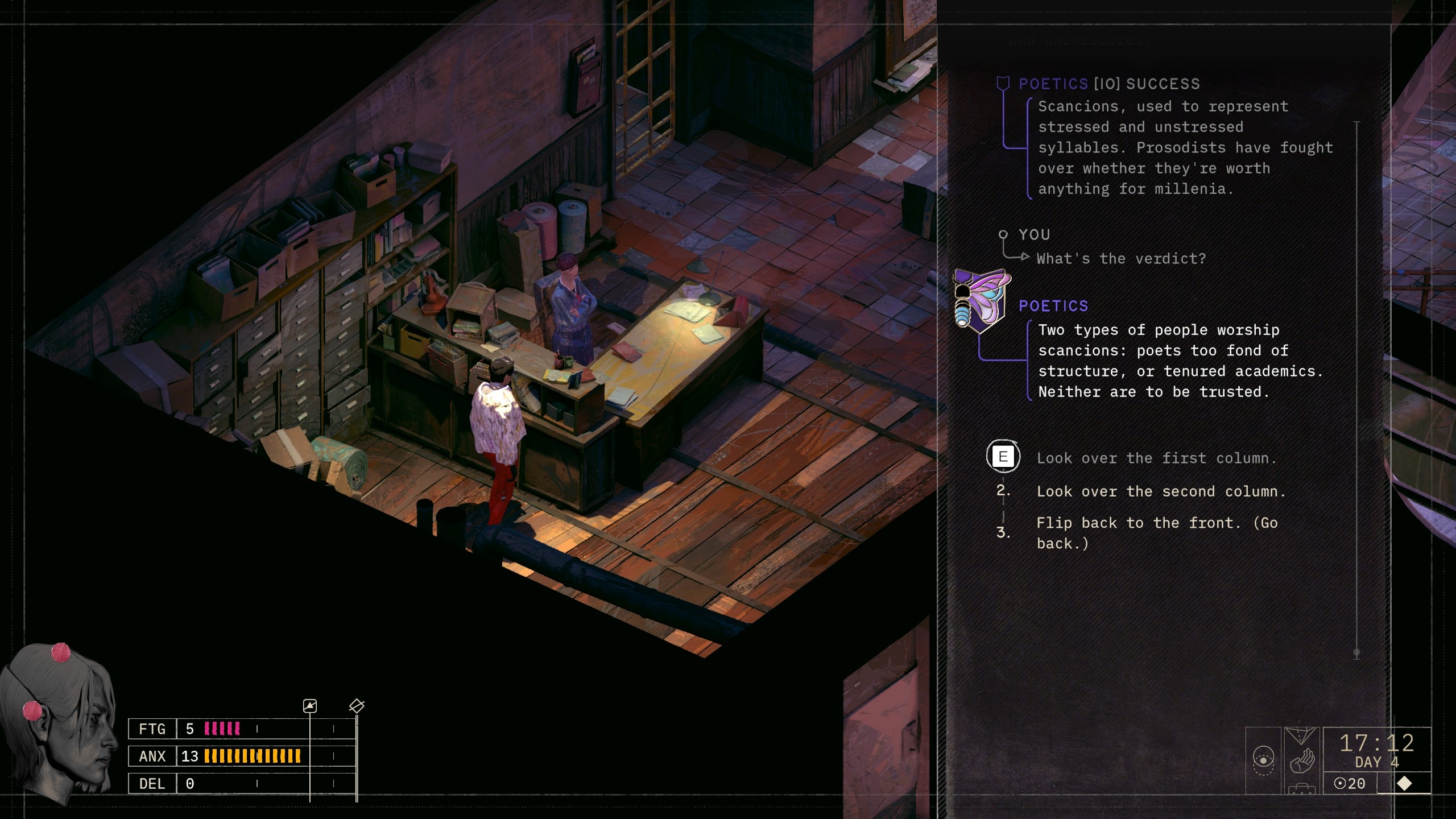
The skill system remains the heart of the experience. Instead of passive statistical bonuses, skills behave like active voices inside CASCADE’s mind. Some encourage caution. Others push aggression, paranoia, or emotional honesty. Internal dialogue constantly interrupts conversations, creating a psychological tug-of-war that shapes your interpretation of events.
The difference here is tone. In Disco Elysium, skills often felt theatrical and exaggerated. In Zero Parades, they are subtler and more oppressive. Several skills blur together intentionally, creating the sense that CASCADE’s internal systems are becoming unstable under pressure. Even so, the system still produces excellent roleplaying opportunities because skills directly influence not only success rates but emotional framing. Two players can experience the same scene very differently depending on how their character is psychologically configured.
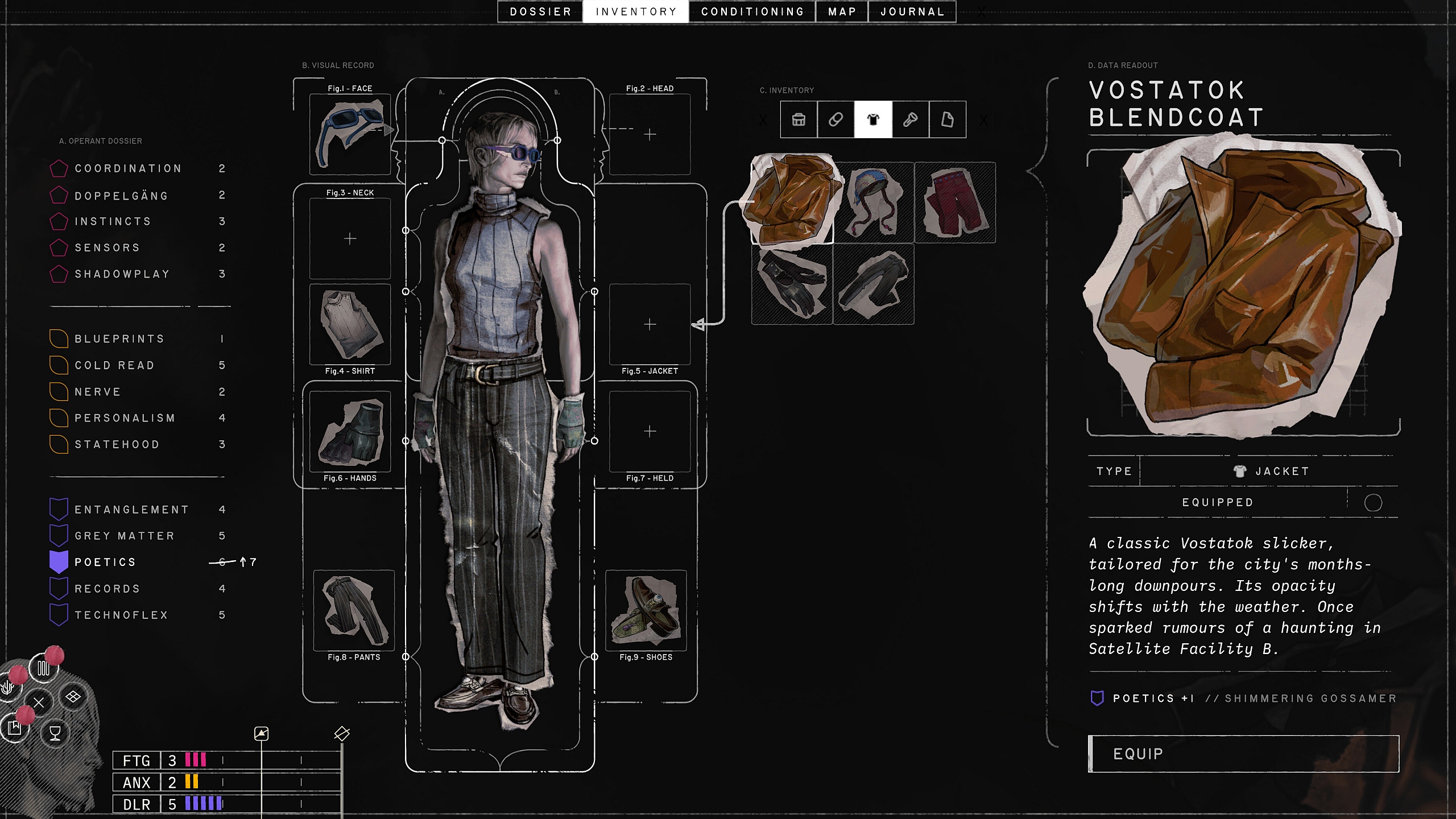
The new Conditioning system is especially strong. Instead of simply equipping thoughts for passive bonuses, you reshape CASCADE’s operational mindset over time. Certain ideological or emotional adaptations permanently alter gameplay logic, dialogue pathways, and even how the game interprets specific situations. It creates a satisfying sense that your version of CASCADE evolves psychologically rather than merely leveling up numerically.
The fatigue, anxiety, and delirium systems add another layer of pressure. Pushing yourself during difficult situations can temporarily improve odds during dramatic encounters, but excessive strain creates long-term consequences. Some breakdowns permanently affect dialogue options or skill interactions. It is an elegant mechanic because it turns psychological deterioration into a strategic decision rather than a scripted narrative event.
The game’s dramatic encounters deserve particular praise. These sequences replace traditional action scenes with tense, branching decision chains where timing, preparation, and psychological state matter enormously. A negotiation can collapse into violence within seconds. A surveillance operation can unravel because CASCADE hesitates at the wrong moment. These scenes generate real tension because failure rarely means game over. Instead, failure creates new complications and story directions.
That design philosophy may be the game’s greatest strength. Zero Parades consistently understands that roleplaying becomes more interesting when failure remains narratively productive. Bad decisions do not simply lock content away. They mutate the story. You can lose allies, damage operations, expose yourself politically, or trigger psychological consequences that follow CASCADE for hours afterward.
The downside is pacing. The game is extremely text-heavy, even by genre standards. Some conversations stretch too long without meaningful interaction. Several exposition-heavy sequences could have been trimmed significantly. Players looking for faster mechanical progression may struggle with how much time the game spends inside dialogue trees and introspection.
Traversal also remains somewhat clunky. Moving through Portofiro occasionally feels sluggish, and the interface still inherits some awkwardness from Disco Elysium. Inventory management is functional rather than elegant, and certain menus are unnecessarily cumbersome. These issues never ruin the experience, but they do prevent the mechanics from feeling fully polished.
Writing and Characters
The quality of the writing is ultimately the reason Zero Parades works. Few RPGs trust language the way this game does. Conversations are layered, emotionally unstable, and often surprisingly funny in deeply uncomfortable ways. Characters contradict themselves constantly. Political ideologies become coping mechanisms. Personal histories leak into ordinary discussions about cigarettes, train schedules, outdated media broadcasts, and failed television programs. Even casual exchanges often contain an undercurrent of paranoia, as though every character is trying to decide how honest they can afford to be.
The humor is especially effective because it emerges naturally from character psychology rather than forced quirkiness. One exhausted bureaucrat spends several minutes trying to convince CASCADE that a collapsing surveillance network is technically functioning because nobody filed the correct forms declaring it broken. Another character delivers an emotional confession while simultaneously attempting to manipulate you into committing espionage on their behalf. The game repeatedly finds comedy in institutional absurdity and emotional repression without turning characters into caricatures.
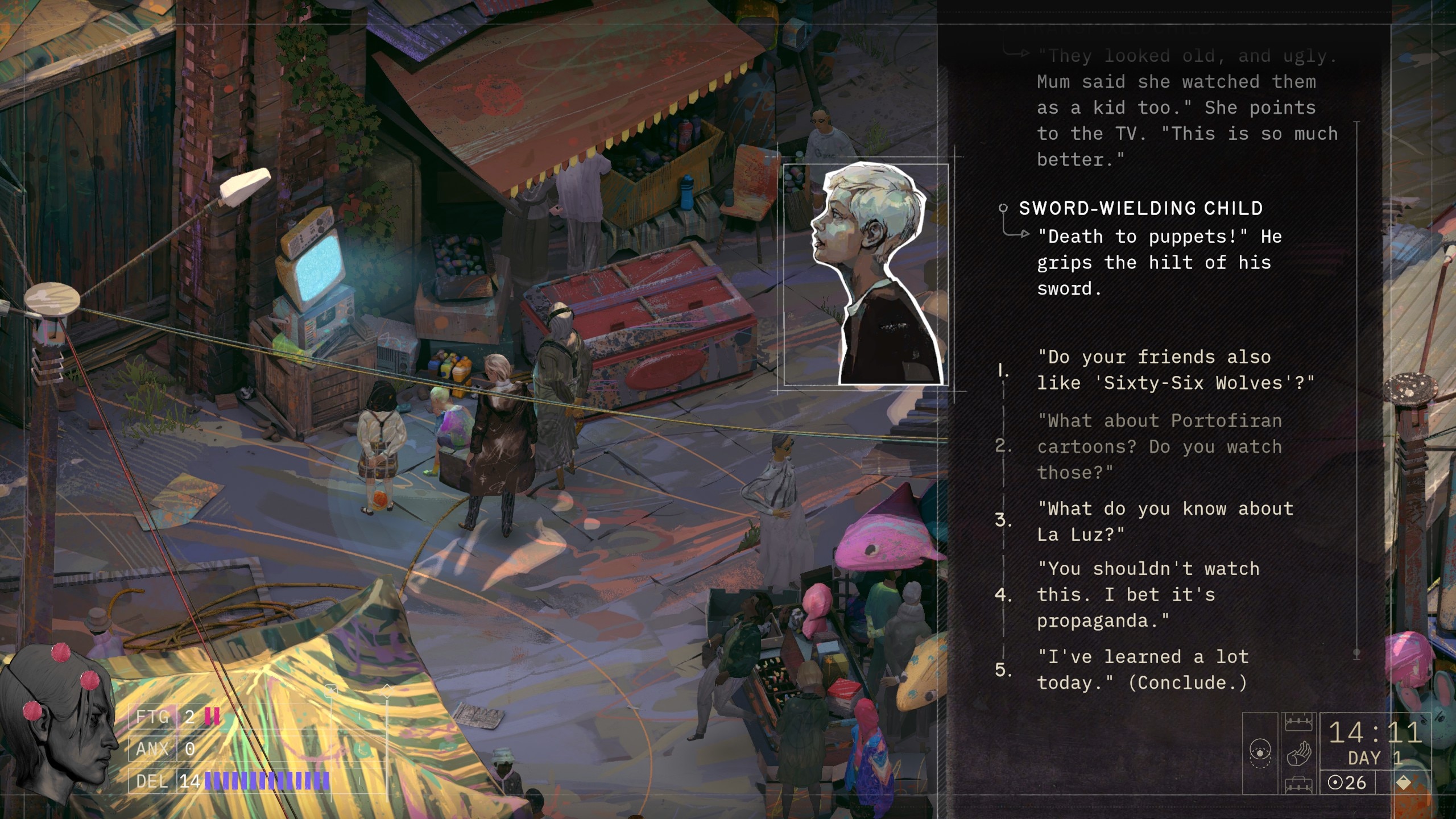
What makes the dialogue especially impressive is its sense of rhythm. Zero Parades contains enormous amounts of text, yet conversations rarely feel static for long. Discussions constantly shift direction as new information surfaces, emotions crack unexpectedly, or internal skills interrupt with conflicting interpretations. Characters frequently avoid answering direct questions, forcing players to read tone, implication, and hesitation rather than relying purely on exposition. This gives interactions a level of tension that many dialogue-heavy RPGs struggle to maintain.
The supporting cast is excellent overall, though not every character reaches the iconic heights of Disco Elysium’s best companions. There is no equivalent to Kim Kitsuragi here, no single stabilizing presence grounding the narrative emotionally. Instead, Zero Parades builds a fragmented network of former allies, informants, rivals, and political opportunists who drift in and out of CASCADE’s orbit. Some are genuinely sympathetic. Others are manipulative, exhausted, or ideologically consumed. Most exist somewhere in between.
This approach fits the espionage tone, but it can also make the game feel emotionally colder. Relationships are transactional by design. Trust rarely lasts long. Even moments of intimacy carry suspicion underneath them. Characters often speak like people who have spent years filtering every sentence for political or professional consequences. That restraint creates a fascinating emotional texture because moments of vulnerability feel genuinely rare rather than mechanically scripted.
CASCADE herself is one of the game’s greatest strengths. Unlike many modern RPG protagonists designed around instant charm or exaggerated personality, she feels guarded and difficult to fully understand. The writing slowly reveals her through contradictions, operational habits, fragmented memories, and emotional slips during stressful encounters. Some of the game’s best scenes occur when her professional composure briefly collapses, exposing fear, guilt, or exhaustion she normally refuses to acknowledge. The internal dialogue system reinforces this beautifully, turning her mind into a battlefield between discipline, paranoia, self-preservation, and suppressed emotion.
What impressed me most is how effectively the game handles ideological conflict. Most modern RPGs reduce politics to faction branding or simplistic morality systems. Zero Parades treats ideology as something deeply personal and psychologically corrosive. Characters cling to political beliefs because they need those beliefs to justify survival, guilt, compromise, or betrayal. Several conversations become less about determining who is objectively right and more about understanding why people emotionally need certain worldviews to survive the reality around them.
The game also avoids easy cynicism. It critiques institutions constantly, but it does not reduce every political conviction to hypocrisy. Some characters genuinely believe in rebuilding something better, even while recognizing how broken the world around them has become. Others are fully aware they are compromising their own ideals yet continue doing so because they no longer believe meaningful change is possible. That moral exhaustion becomes one of the game’s defining themes.
There are weak spots. Certain monologues drift into self-conscious philosophical performance, where characters sound more like writers presenting thematic arguments than believable people. The game occasionally mistakes density for depth, especially during late-game conversations that stretch slightly beyond their emotional payoff. Some secondary characters disappear for long periods before returning during critical narrative moments, which weakens a few relationship arcs that deserved slightly more development and emotional continuity.
Still, even weaker scenes contain enough intelligence, personality, and emotional texture to remain engaging. Very few RPGs aim this high narratively anymore, and even fewer successfully maintain this level of tonal consistency across dozens of hours. Zero Parades understands that strong writing in games is not just about clever dialogue or philosophical ambition. It is about creating characters who feel shaped by history, ideology, exhaustion, and personal failure in ways that continue lingering after the credits roll.
Visuals, Sound and World Design
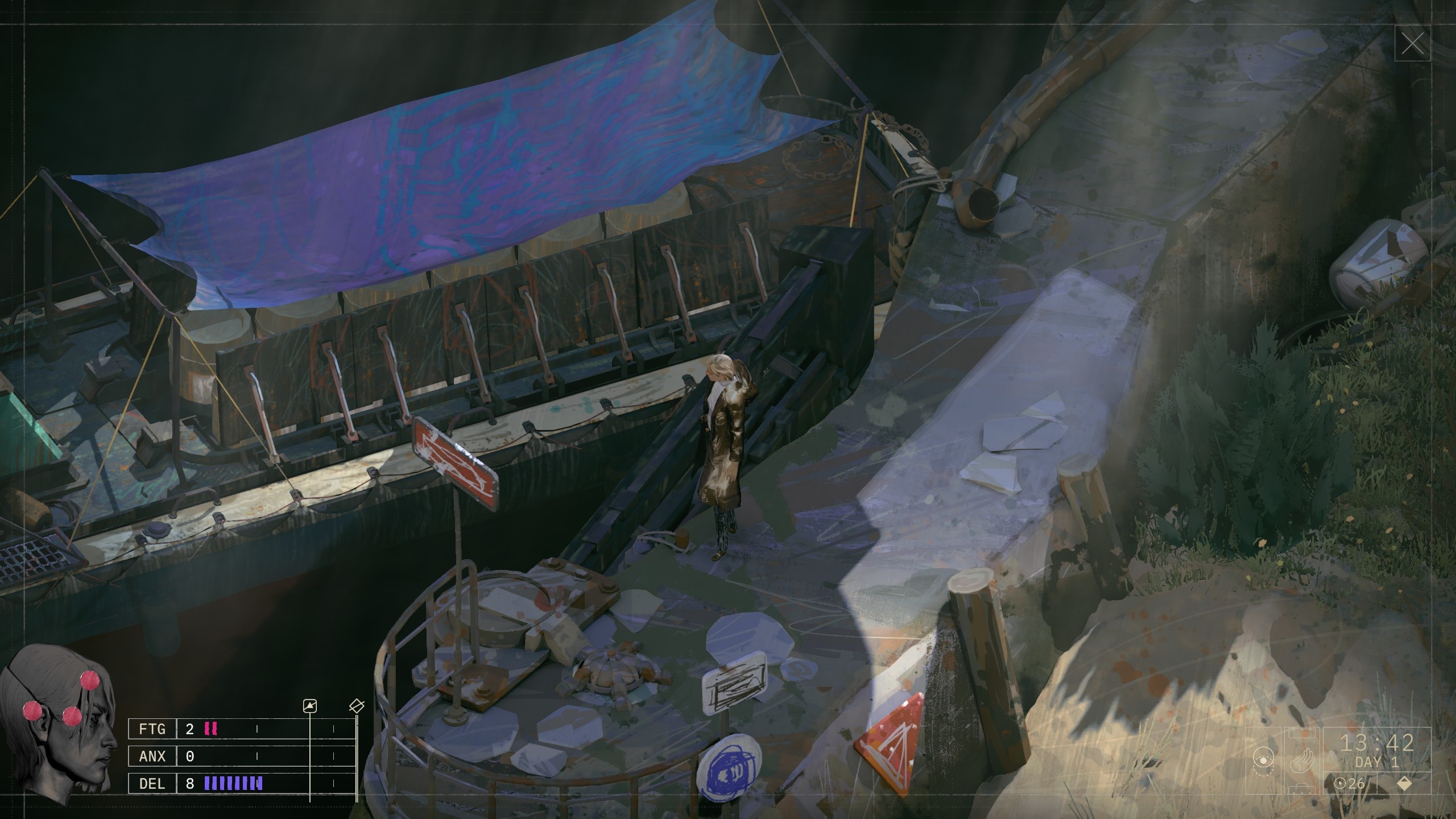
Visually, Zero Parades: For Dead Spies is one of the strongest-looking RPGs released in recent years, not because it pushes technical realism, but because every artistic decision feels deliberate. The game understands that atmosphere matters more than raw polygon counts, and Portofiro becomes memorable precisely because it looks unstable, exhausted, and emotionally contaminated. The painterly presentation immediately invites comparisons to Disco Elysium, but Zero Parades develops its own visual identity over time. Revachol was chaotic and broken in an almost romantic way. Portofiro feels colder and more oppressive. Its architecture looks temporary even when it clearly is not. Government buildings resemble repurposed bunkers. Hotels feel abandoned while still operating. Apartment interiors are cluttered with aging technology, damp walls, cigarette burns, and the residue of lives that stopped moving forward years ago.
Lighting plays a major role in establishing mood. Much of the game takes place under weak fluorescent interiors, polluted sunsets, flickering neon, and dense coastal fog that softens distant structures into silhouettes. The result is a city that often feels half-erased. Nighttime scenes are particularly impressive because the game avoids exaggerated cyberpunk spectacle. Streets are dim rather than flashy. Light sources bleed awkwardly into fog and rain. Reflections shimmer unevenly across cracked pavement. The city rarely looks beautiful in a traditional sense, but it constantly feels convincing. Certain late-game districts almost resemble oil paintings in motion, with muted color gradients and distorted shadows creating a dreamlike sense of disorientation.
The environmental detail is exceptional throughout. Portofiro communicates history through physical space better than most RPGs manage through exposition. Offices are filled with outdated propaganda posters, malfunctioning electronics, overflowing filing cabinets, and half-repaired infrastructure. Industrial areas are covered in rust, leaking pipes, and neglected machinery that looks as though it has been running continuously for decades. Wealthier districts never feel truly luxurious either. Even expensive locations carry visible signs of decline, reinforcing the idea that the entire city is decaying regardless of class or political alignment.
Character design is equally strong. Faces look worn, stressed, unhealthy, and emotionally complicated. ZA/UM continues to use portrait art more effectively than almost any modern RPG studio. Conversations gain tremendous emotional weight because portraits subtly evolve alongside dialogue. Tiny changes in expression completely alter the tone of interactions. CASCADE herself is especially well realized visually. Her posture, tired eyes, and restrained expressions communicate exhaustion long before the writing explicitly addresses it. Several supporting characters are memorable almost entirely because of visual presentation. One intelligence officer permanently looks as though he has not slept in weeks. Another political organizer appears outwardly composed but visibly terrified underneath the performance. These details matter because Zero Parades depends heavily on reading emotional instability during conversations.
Animation quality is more mixed. Movement during exploration can occasionally look stiff, especially in crowded areas where pathfinding becomes awkward. Some transitional animations lack fluidity, and a handful of scripted scenes feel slightly undercooked compared to the strength of the artwork surrounding them. However, the game compensates through framing and environmental composition. Camera placement during important conversations is excellent, often emphasizing isolation, paranoia, or imbalance between characters without becoming overly cinematic.
The sound design deserves even more praise because it quietly carries much of the game’s tension. Portofiro constantly sounds alive in deeply uncomfortable ways. Electrical humming leaks through apartment walls. Distant sirens echo through fog. Old ventilation systems rattle endlessly in government buildings. Rainwater drips through broken ceilings. Radio static bleeds faintly from nearby rooms. Industrial machinery groans somewhere beyond visible spaces. These layers rarely call attention to themselves individually, but together they create a city that feels physically oppressive.
What makes the audio work especially well is restraint. Many modern RPGs overwhelm scenes with dramatic music cues and exaggerated ambient effects. Zero Parades often does the opposite. Silence becomes one of the game’s most effective tools. Several major conversations occur with little more than distant environmental noise underneath them, forcing players to focus entirely on dialogue and vocal performance. The absence of constant musical guidance creates unease because scenes never tell you exactly how to feel.
When music does appear, it is excellent. The soundtrack leans heavily into ambient electronics, degraded synth textures, low industrial percussion, and sparse melodic fragments that fade in and out almost imperceptibly. Certain tracks sound as though they were recorded onto damaged tape equipment. Others resemble distorted radio transmissions struggling to stay coherent. The score rarely aims for immediately memorable themes, but it excels at sustaining psychological pressure. Some tracks build tension so subtly that players may not consciously notice the music intensifying until conversations become emotionally volatile.
The game also uses music intelligently during investigative sequences. Rather than shifting into traditional suspense scoring, tracks often become colder and emptier as situations grow more dangerous. This creates a feeling of emotional numbness instead of cinematic excitement, which fits the tone perfectly. During several critical moments, the soundtrack nearly disappears altogether, leaving only environmental ambience and fragmented voice acting. Those scenes become some of the most effective in the entire game because the silence feels intentional rather than empty.
Voice acting is mostly excellent, though not completely consistent across the entire cast. CASCADE’s performance carries enormous weight throughout the game and succeeds because it avoids exaggeration. She sounds exhausted without becoming melodramatic. Her delivery often feels restrained, as though she is constantly filtering her own emotions before speaking. That subtle control makes occasional cracks in her composure significantly more powerful. Several major supporting characters are similarly strong, particularly intelligence operatives, political officials, and former allies whose conversations carry years of unresolved resentment underneath professional dialogue.
Some minor characters are less convincing. A handful of performances sound oddly flat or disconnected from the emotional intensity of certain scenes. There are also moments where line delivery pacing feels unnatural, especially during longer philosophical exchanges where actors occasionally emphasize lines too theatrically. These problems are relatively minor overall, but they stand out because the strongest performances are genuinely exceptional.
The fully voiced presentation also changes the rhythm of the writing compared to Disco Elysium. Conversations feel slower, heavier, and more deliberate because actors are given room to breathe between lines. This benefits emotional scenes tremendously, though faster readers may occasionally skip ahead before performances finish. Fortunately, the voice direction generally understands restraint. Characters rarely shout unless situations truly justify it, and emotional scenes are often played with quiet discomfort rather than dramatic outbursts.
Technically, the PC version presents all of this very well. Ultra-wide monitor support works properly, visual settings are flexible, and the art style scales nicely across different hardware configurations. Texture detail remains sharp even at lower settings because the painterly aesthetic hides technical compromises effectively. Lighting options make a noticeable difference, particularly during nighttime exploration, while volumetric fog contributes heavily to atmosphere without crippling performance on modern GPUs.
There are occasional technical imperfections. Certain areas produce brief stuttering during scene transitions, some audio lines trigger too early or overlap awkwardly, and environmental effects occasionally desync during crowded sequences. However, none of these issues significantly damage immersion. More importantly, the game’s artistic direction is strong enough that even minor technical flaws become easier to forgive.
What ultimately makes Zero Parades visually and sonically impressive is cohesion. Every part of the presentation supports the same emotional tone. The graphics, lighting, music, ambient sound, and performances all reinforce the feeling of living inside a collapsing political machine where exhaustion has become a permanent social condition. Few RPGs achieve that level of consistency across every artistic layer, and it is one of the main reasons Portofiro lingers in memory long after the game ends.
Technical Performance on PC
On PC, Zero Parades performs reasonably well overall, though it is not entirely free from technical rough edges. The game is far less demanding than most modern AAA releases thanks to its isometric presentation and stylized visuals, but there are still occasional optimization inconsistencies. Frame rates remain stable for the majority of the experience, even on mid-range hardware, though certain densely layered areas in Portofiro can produce noticeable stuttering during camera transitions or when loading large conversation sequences. These hitches are not constant, but they appear often enough to be worth mentioning.
Load times are generally short on SSDs, especially compared to other dialogue-heavy RPGs that constantly stream assets between districts. The interface responds quickly, and quick-saving during conversations is thankfully almost instantaneous. That matters in a game built around experimentation and branching decisions.
The biggest technical strength is readability. ZA/UM clearly understood how much text players would be processing over dozens of hours, so the PC version includes excellent font scaling, interface customization, subtitle controls, and accessibility options for dialogue presentation. Players can adjust text size, background opacity, and several interface elements without disrupting the game’s visual identity.
Mouse-and-keyboard controls feel natural, especially during investigation segments and inventory management. The point-and-click structure translates perfectly to PC, and navigation becomes intuitive after a few hours. Controller support exists and works competently enough, but the game still feels fundamentally designed around mouse precision and rapid dialogue navigation.
Bugs exist, though most are relatively minor. During my time with the game, I encountered a handful of animation glitches, repeated voice lines, and one quest trigger that required reloading a save. None were catastrophic, but they reinforce the sense that Zero Parades occasionally lacks the final layer of polish separating great RPGs from truly immaculate ones. What matters more is that the technical presentation rarely disrupts immersion. Even when small issues appear, the strength of the writing and atmosphere quickly pulls attention back into the world.
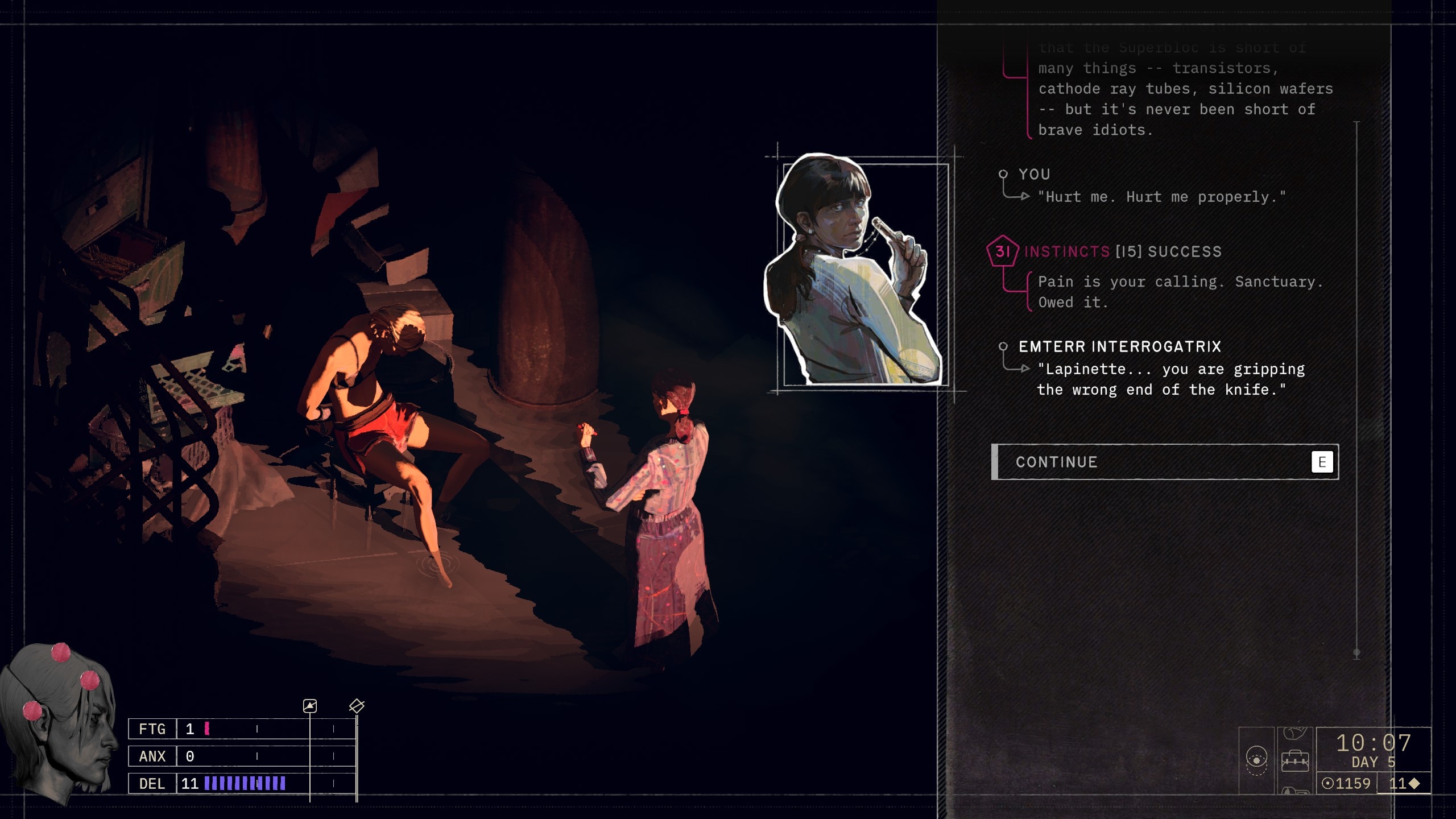
The Shadow of Disco Elysium
There is no way to discuss Zero Parades honestly without addressing the comparison dominating every conversation around it. Yes, this game resembles Disco Elysium constantly. The structure, dialogue systems, psychological skills, political introspection, painterly visuals, and investigative pacing all clearly descend from the same design DNA. Sometimes the similarities become distracting. Certain mechanics feel so directly inherited that they risk reducing the game’s identity.
But the more time spent with Zero Parades, the clearer its differences become. Disco Elysium was chaotic, self-destructive, and strangely hopeful beneath its cynicism. Zero Parades is colder and more disciplined. It is about institutional paranoia instead of personal collapse. About professional identities replacing genuine human connection. About people who survived ideological disasters and kept working because they no longer know how to exist outside systems that damaged them.
That emotional distinction matters. The espionage framing also changes player behavior significantly. You are encouraged to think strategically, conceal intentions, and manage relationships carefully. The roleplaying becomes less performative and more psychologically defensive. Even humor feels sharper and more exhausted.
The problem is that Zero Parades sometimes appears reluctant to fully escape comparison. Certain stylistic echoes feel almost too deliberate, as though the game occasionally wants players to recognize familiar rhythms instead of completely reinventing itself. Still, expecting any studio to casually produce another Disco Elysium-level cultural phenomenon was never realistic. Judged on its own merits, Zero Parades succeeds far more often than it fails.
Final Verdict: 8/10
Zero Parades: For Dead Spies is one of the most intellectually ambitious RPGs released in years. It delivers exceptional writing, a richly realized setting, meaningful roleplaying systems, and some genuinely unforgettable moments of psychological tension. Portofiro feels alive in the way only the best RPG settings do, and CASCADE gradually becomes one of the genre’s more compelling protagonists.
The game is not flawless. Pacing issues, uneven voice work, interface awkwardness, and occasional narrative overreach hold it back from true greatness. The comparisons to Disco Elysium are unavoidable, and sometimes the game struggles to escape them.
But even with those problems, Zero Parades succeeds because it understands what made that earlier style of RPG compelling in the first place. Not just clever dialogue or political commentary, but the idea that roleplaying can be deeply psychological. That conversations can feel dangerous. That failure can be more interesting than victory.
Most RPGs are about becoming stronger. Zero Parades is about surviving the consequences of who you already are, and that makes it difficult to forget.