
There’s something inherently risky about building an entire game around routine, especially in a medium that so often prioritizes constant stimulation, escalating challenges, and a steady stream of rewards designed to keep players engaged over long sessions. Not action, not strategy in the traditional sense, and not even narrative in a conventional form—but routine, repetition, and familiarity form the backbone of Retro Rewind, and somewhat surprisingly, that gamble pays off far more often than it has any right to.
Developed by Blood Pact Studios, this small-scale indie release puts you in charge of a 1990s video rental store, tasking you with responsibilities that range from stocking VHS tapes and organizing shelves to managing late fees and dealing with impatient or indecisive customers who all arrive with their own expectations and quirks. While the premise might initially sound almost aggressively mundane, the execution transforms these everyday tasks into a strangely compelling gameplay loop that taps into nostalgia, rhythm, and low-stakes management in a way that feels both refreshing and oddly absorbing without ever relying on spectacle.
At the same time, Retro Rewind is not a game that attempts to appeal to everyone, nor does it try to disguise its limitations behind scale or complexity, which means that your enjoyment will depend heavily on what you expect from a simulation experience and how much value you place on atmosphere and repetition over depth, challenge, or long-term mechanical evolution.
Concept and Premise
At its core, Retro Rewind is a shop management simulator set in a stylized version of the early 1990s, where players begin with a modest video rental store and gradually expand it by ordering new tapes, organizing inventory, managing customer interactions, and eventually hiring staff to streamline daily operations as the business grows in both size and demand.
The game leans heavily on nostalgia, but rather than relying on licensed content or recognizable films that would anchor it to real-world media, it builds a fictional catalog of VHS titles that are presented with hand-drawn covers, exaggerated genre tropes, and playful naming conventions that feel authentic without being derivative. This approach turns out to be one of the game’s more effective creative decisions, because it shifts the focus away from recognition and toward immersion, allowing players to engage with the act of browsing and managing a video store rather than simply reacting to familiar titles.
There is no overarching narrative pushing the player forward, no dramatic storyline about saving the business from collapse, no rival corporations threatening your survival, and no forced objectives that impose urgency or tension, which results in an experience defined almost entirely by its systems and the player’s willingness to engage with them over time. This absence of narrative pressure gives the game a distinctive identity, but it also means that motivation must come from within the gameplay itself rather than from external storytelling hooks.
Gameplay and Mechanics
The gameplay loop establishes itself quickly and remains largely consistent throughout the experience, with each in-game day beginning with preparation tasks such as checking returned tapes, rewinding them, organizing shelves, and ensuring that inventory is in order before opening the store to customers who browse, make requests, and rent items until closing time signals the end of the cycle.
Interacting with customers involves scanning items, handling payments, offering recommendations based on genre preferences, and occasionally dealing with complaints about late fees or unavailable reservations, all of which are presented through systems that emphasize clarity and responsiveness over complexity. These interactions are simple on the surface, but they are supported by enough variation to prevent them from feeling entirely mechanical, particularly in the early hours when the player is still learning the flow of the game.
As players progress, additional features such as hiring employees, expanding the store layout, and managing a larger inventory become available, which introduces a sense of growth without fundamentally altering the nature of the gameplay. Employees can take over repetitive tasks, allowing players to focus on organization and customer interaction, but they do not introduce deeper management systems or meaningful strategic decision-making.
What makes this loop engaging is not difficulty or depth in the traditional sense, but rather the tactile quality of the interactions and the rhythm that emerges as tasks become familiar, creating a flow state where even repetitive actions feel purposeful and satisfying. However, this same design philosophy also defines the game’s limitations, because the management systems remain intentionally lightweight, with predictable customer behavior, minimal consequences for mistakes, and little need for long-term planning or optimization.
Over time, the loop becomes less about discovery and more about maintenance, which can either reinforce its relaxing qualities or highlight its lack of variation depending on how long the player remains engaged.
Progression and Structure
Progression in Retro Rewind is steady, consistent, and clearly structured, but it rarely introduces transformative changes that significantly alter the core gameplay loop, instead focusing on expanding the scale of the experience through additional inventory, larger store layouts, improved equipment, and the gradual introduction of staff members who can automate certain aspects of daily operations.
Unlockable decorations and customization options allow players to shape the visual identity of their store, adding a layer of personalization that complements the management systems without interfering with them. These elements contribute to a sense of ownership and progression, even if they do not directly impact gameplay in a meaningful way.
Seasonal events and occasional gameplay variations tied to holidays or environmental conditions provide moments of change, such as increased customer traffic during certain periods, shifts in demand based on themed events, or minor gameplay twists that alter the rhythm of a given day. While these additions help break up the routine, they are typically short-lived and do not introduce lasting changes to the underlying systems.
This approach to progression creates a horizontal expansion of the experience rather than a vertical one, meaning that while there is always something new to unlock or improve, the fundamental mechanics remain largely unchanged from the early hours of the game. For players who enjoy consistency and incremental development, this structure works well and reinforces the game’s identity, but for those looking for evolving systems or increasing complexity, it may feel as though the experience reaches its peak relatively early and maintains that level without significant escalation.
Atmosphere and Presentation
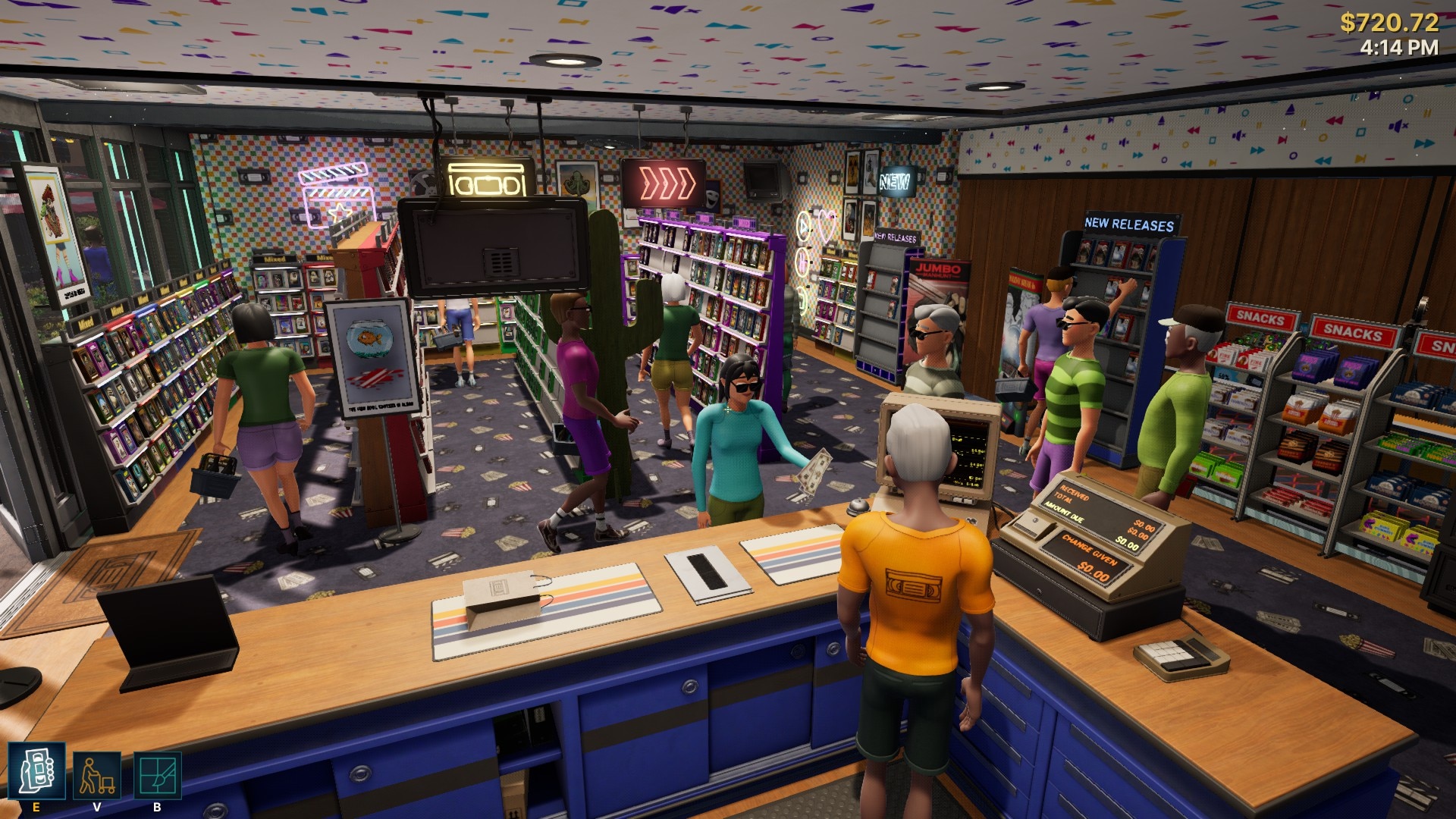
Where Retro Rewind consistently distinguishes itself is in its ability to create a cohesive and immersive atmosphere that captures the essence of a 1990s video rental store without relying on direct replication or licensed material, instead opting for a stylized interpretation that feels both authentic and distinct. Rather than chasing realism, the game leans into a curated version of the past, one that emphasizes memory and mood over accuracy, which ultimately makes the setting feel more inviting and readable without losing its cultural grounding.
The cartoonish visual style, characterized by bright colors, exaggerated proportions, and carefully designed VHS cases, creates a version of the era that feels immediately recognizable while still maintaining its own identity. Shelves are slightly overstocked in a way that feels intentional, aisles are just narrow enough to suggest busyness without becoming frustrating, and the covers themselves are packed with playful details that reward closer inspection. There is a consistent visual language at work, where everything from signage to furniture feels purpose-built for this world, giving the store a sense of cohesion that extends beyond simple decoration. Even as the layout expands over time, that clarity remains intact, ensuring that the environment never becomes visually overwhelming or difficult to navigate.

Lighting is used in a subtle but effective way, with the soft, slightly artificial glow of fluorescent fixtures giving the space a distinctly indoor, late-evening feel that reinforces the setting. It avoids dramatic contrasts or stylized shadows, instead maintaining a steady, almost flat illumination that mirrors the practical lighting of real retail spaces. This choice might seem understated, but it plays a crucial role in sustaining the game’s relaxed tone, as nothing in the visual presentation feels harsh or distracting during long play sessions.
Environmental details further strengthen the sense of place, as small touches such as wall posters, genre labels, checkout counters, and backroom storage areas all contribute to the illusion of a functioning business. These elements are not just decorative, but contextual, helping players intuitively understand how the space operates without the need for explicit explanation. The result is an environment that feels lived-in and functional rather than staged, which is essential for a simulation built around routine.
Sound design plays an equally important role in reinforcing this atmosphere, with ambient noises such as the hum of fluorescent lights, the clatter of plastic cases, the soft mechanical clicks of scanning items, and the subtle murmur of customers browsing combining to create a layered audio environment that enhances immersion without becoming intrusive. There is a deliberate restraint in how sound is used, with no overly prominent music tracks or exaggerated effects competing for attention, allowing the ambient audio to carry much of the experience. This creates a kind of auditory consistency that mirrors the visual design, where everything feels grounded and appropriately scaled.
Customer presence is also conveyed effectively through sound, as snippets of movement, shifting footsteps, and low background chatter give the impression of a steady flow of activity even when the player is focused on a specific task. These details help prevent the store from ever feeling empty or static, reinforcing the idea that it is a space that continues to exist beyond the player’s immediate actions.
The game also incorporates a light sense of humor through its fictional movie titles, occasional customer interactions, and small environmental details that reward observation, adding personality without overwhelming the experience or distracting from its core loop. Many of the VHS covers play with familiar genre tropes or exaggerated concepts, creating a sense of playful recognition without relying on parody or direct references. Customer behavior occasionally leans into subtle absurdity, but it never crosses into exaggeration that would break immersion, maintaining a tone that feels grounded while still allowing for moments of charm.
Importantly, the game shows restraint in how it delivers these touches, avoiding the temptation to overemphasize nostalgia or humor at the expense of consistency. The result is an atmosphere that feels stable and believable over long periods of play, where the combination of visuals, sound, and environmental design works together to support the gameplay loop rather than distract from it. This balance between tone, detail, and restraint is one of Retro Rewind’s most quietly impressive achievements, and it plays a significant role in making the experience as engaging as it is.
Technical Performance on PC
From a technical standpoint, Retro Rewind delivers a stable and reliable experience that aligns well with its design goals, prioritizing smooth performance and accessibility over visual complexity or technical ambition.
The game runs comfortably on modest hardware, maintaining consistent performance even as the store grows in size and the number of active elements increases, which is particularly important for a title built around repetition and routine where technical interruptions could quickly become frustrating. Load times are short, transitions between activities are seamless, and the interface responds quickly to player input, all of which contribute to a smooth and uninterrupted gameplay experience.
The simplicity of the visuals means that there is little emphasis on advanced graphical features, with lighting, animation, and environmental detail serving functional roles rather than attempting to impress on a technical level. While this may limit the game’s visual impact, it also ensures that performance remains stable across a wide range of systems.
There are occasional quirks, particularly in the behavior of NPCs, who can sometimes move awkwardly, cluster in unnatural ways, or react inconsistently to certain situations, which can momentarily break immersion. However, these issues are relatively minor and do not significantly affect gameplay, serving more as small distractions than serious flaws.
User Experience and Accessibility
One of the most notable strengths of Retro Rewind lies in its accessibility, as it introduces its systems gradually and allows players to learn through interaction rather than relying on extensive tutorials or complex instructions that might interrupt the flow of the experience.
Controls are intuitive, actions are context-sensitive, and the interface is designed to communicate information clearly without overwhelming the player, which makes it easy to understand and engage with the game from the very beginning. This approach lowers the barrier to entry and makes the game appealing to a wide range of players, including those who may not typically engage with management simulations.
The overall structure of the game also supports a flexible playstyle, allowing players to engage with it in short sessions or extended periods without feeling pressured to maintain a certain pace or achieve specific goals within a limited timeframe. This makes it particularly well-suited as a secondary or “background” game that can be played alongside other activities.
However, the same qualities that make the game accessible also reduce its intensity, as the lack of meaningful consequences, strict time constraints, or challenging objectives can diminish the sense of progression and accomplishment over time. While this aligns with the game’s relaxed tone, it may limit its appeal for players who prefer more demanding or goal-oriented experiences.

Strengths and Limitations
Retro Rewind is a game that derives much of its appeal from its clarity of vision and its willingness to fully commit to a specific type of experience, executing its central concept with a level of polish that makes even the most mundane tasks feel engaging over extended periods of time. The gameplay loop is consistent, the atmosphere is well-realized, and the overall presentation creates a cohesive environment that is easy to become absorbed in.
The tactile nature of the interactions, combined with the rhythm of daily tasks, creates a sense of flow that is difficult to replicate, allowing players to settle into a routine that feels both relaxing and rewarding in its own understated way. The stylized setting and attention to detail further enhance this experience, giving the game a strong sense of identity that sets it apart from more conventional simulation titles.
At the same time, the game’s commitment to simplicity results in systems that rarely evolve beyond their initial design, which means that while the experience remains enjoyable, it does not significantly deepen as players progress. The expansion of the store and the addition of new features provide a sense of growth, but they do not fundamentally change how the game is played, leading to a gradual sense of repetition that becomes more noticeable over time.
There is also a lack of meaningful challenge or consequence, which can make the experience feel somewhat static for players who are looking for more dynamic or demanding gameplay. While this design choice is consistent with the game’s overall tone, it also limits its long-term appeal, particularly for those who expect a management simulator to offer strategic depth or evolving complexity.
Final Verdict: 7.5/10
Retro Rewind succeeds by focusing on a specific type of experience and delivering it with consistency and attention to detail, rather than attempting to compete with larger or more complex simulation titles that prioritize scale and depth over atmosphere.
It offers a nostalgic and low-pressure environment built around routine and repetition, supported by solid mechanics and a strong sense of identity, making it particularly appealing to players who value relaxation, immersion, and steady progression over challenge and variety. At the same time, its limited mechanical depth and gradual repetition mean that it may struggle to maintain long-term engagement for players who are looking for a more dynamic or evolving experience.
Ultimately, the game stands as a well-crafted example of a focused indie project that understands its strengths and limitations, delivering an experience that is both enjoyable and constrained by the very design choices that define it.


