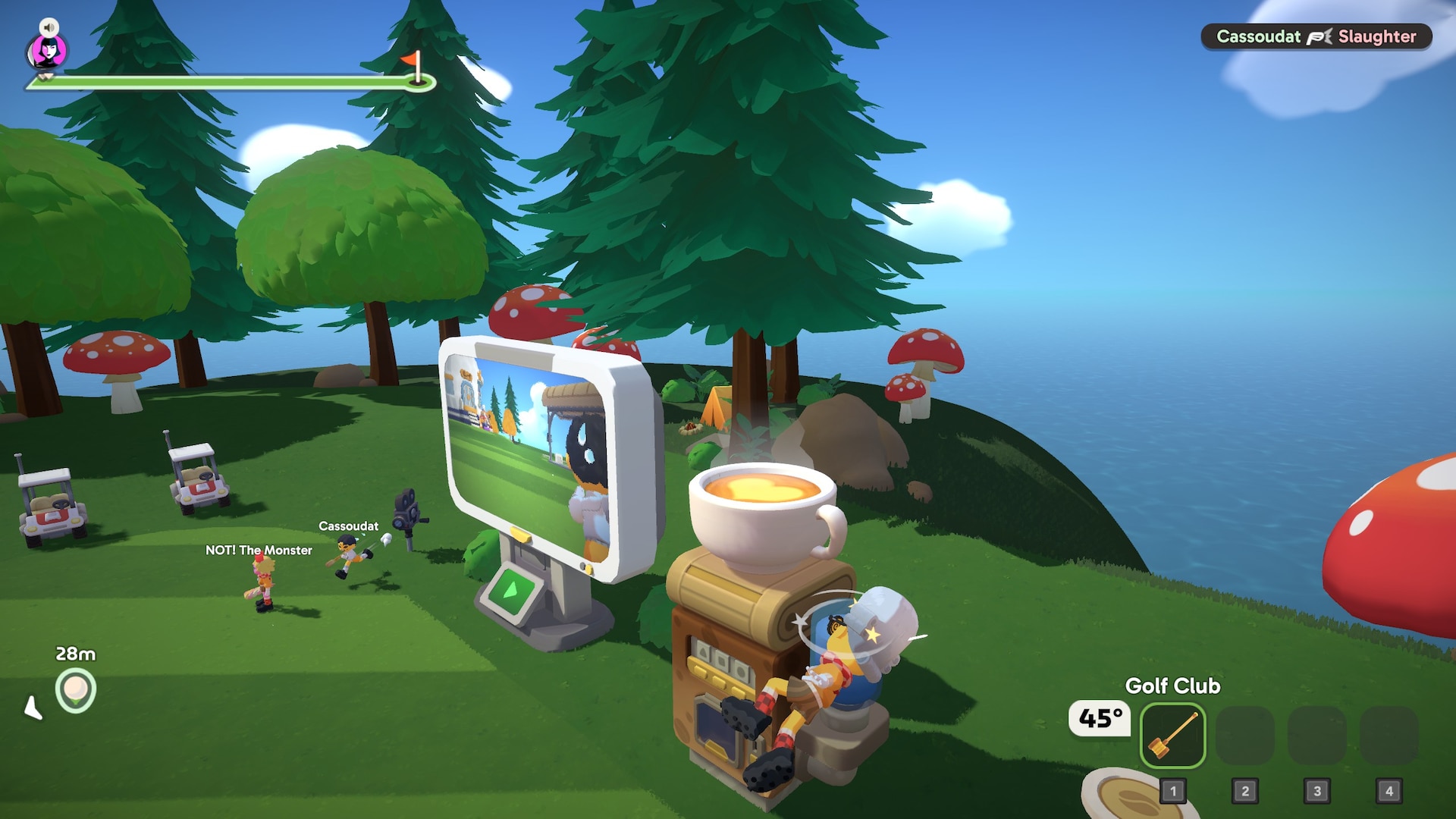
Sports games tend to settle into familiar patterns. Some pursue authenticity, building detailed simulations aimed at enthusiasts who want precision and realism. Others lean toward arcade accessibility, simplifying mechanics to reach a broader audience. Super Battle Golf deliberately occupies a different space, using golf as a structural framework for what is essentially a competitive multiplayer party game built around speed, disruption, and improvisation. Developed by Brimstone and published by Oro Interactive for PC, it makes its priorities clear within minutes: this is not about recreating golf, but about transforming it into something chaotic and social.
The central concept is deceptively simple. Players race to reach the hole, but instead of taking turns, everyone plays simultaneously in real time. That single design decision reshapes the entire experience. Matches feel less like golf and more like a hybrid between racing, physics puzzles, and arena combat. Gadgets, hazards, and other players constantly interfere with progress, forcing quick decisions rather than careful planning. The pacing is fast enough that even mistakes rarely feel punishing for long, because the next opportunity arrives almost immediately.
What makes Super Battle Golf stand out is not just its chaos, but how intentionally it builds systems that encourage interaction between players. Many memorable moments emerge organically from player behavior—someone accidentally knocking a friend into a hazard, a desperate last-second shot that ricochets perfectly, or a well-timed attack that completely reshapes the leaderboard. The game understands that social unpredictability is more valuable than mechanical perfection.
Whether that approach sustains long-term engagement depends on context. Players with regular groups of friends will likely find far more value than those playing alone. Still, as a multiplayer concept, it feels fresh in a genre that often repeats itself.
Gameplay and Mechanics
The simultaneous play structure is the defining feature, and it works remarkably well. Everyone tees off at once and continues toward the hole without interruption. There is no waiting for turns, no downtime between shots, and no extended periods of observation. The moment a player finishes one shot, they are already preparing the next. This creates a constant sense of urgency that keeps matches energetic from start to finish.
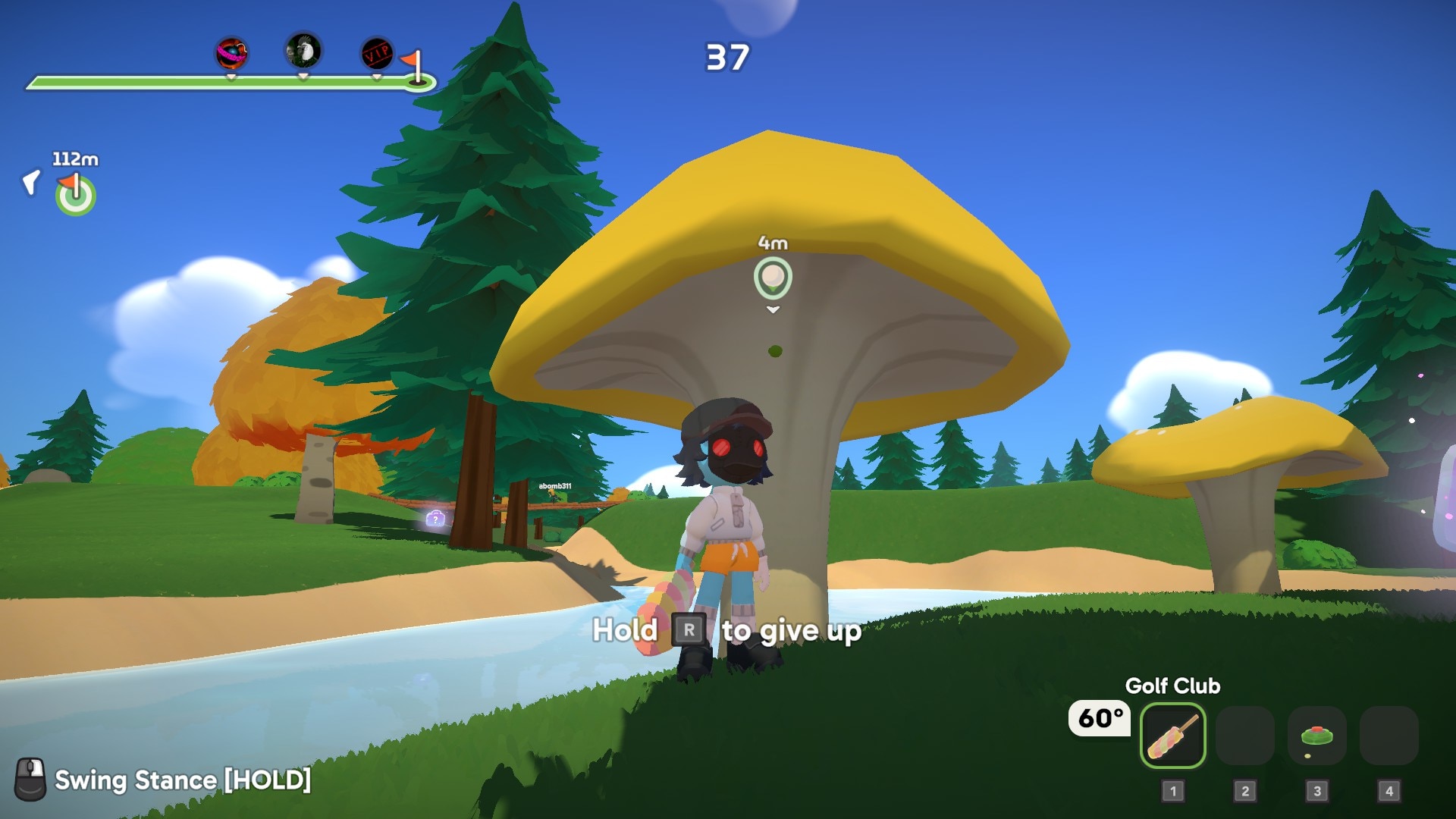
Controls are intentionally approachable. Angle and power adjustments are intuitive, allowing new players to understand the fundamentals within minutes. That accessibility is crucial because the game relies on bringing groups together quickly without a steep learning curve. However, simplicity does not eliminate depth entirely. Terrain elevation, collision angles, and environmental hazards still require judgment, and experienced players learn to anticipate how surfaces will affect ball movement. Over time, skill expression emerges through efficiency and decision-making rather than mechanical complexity.
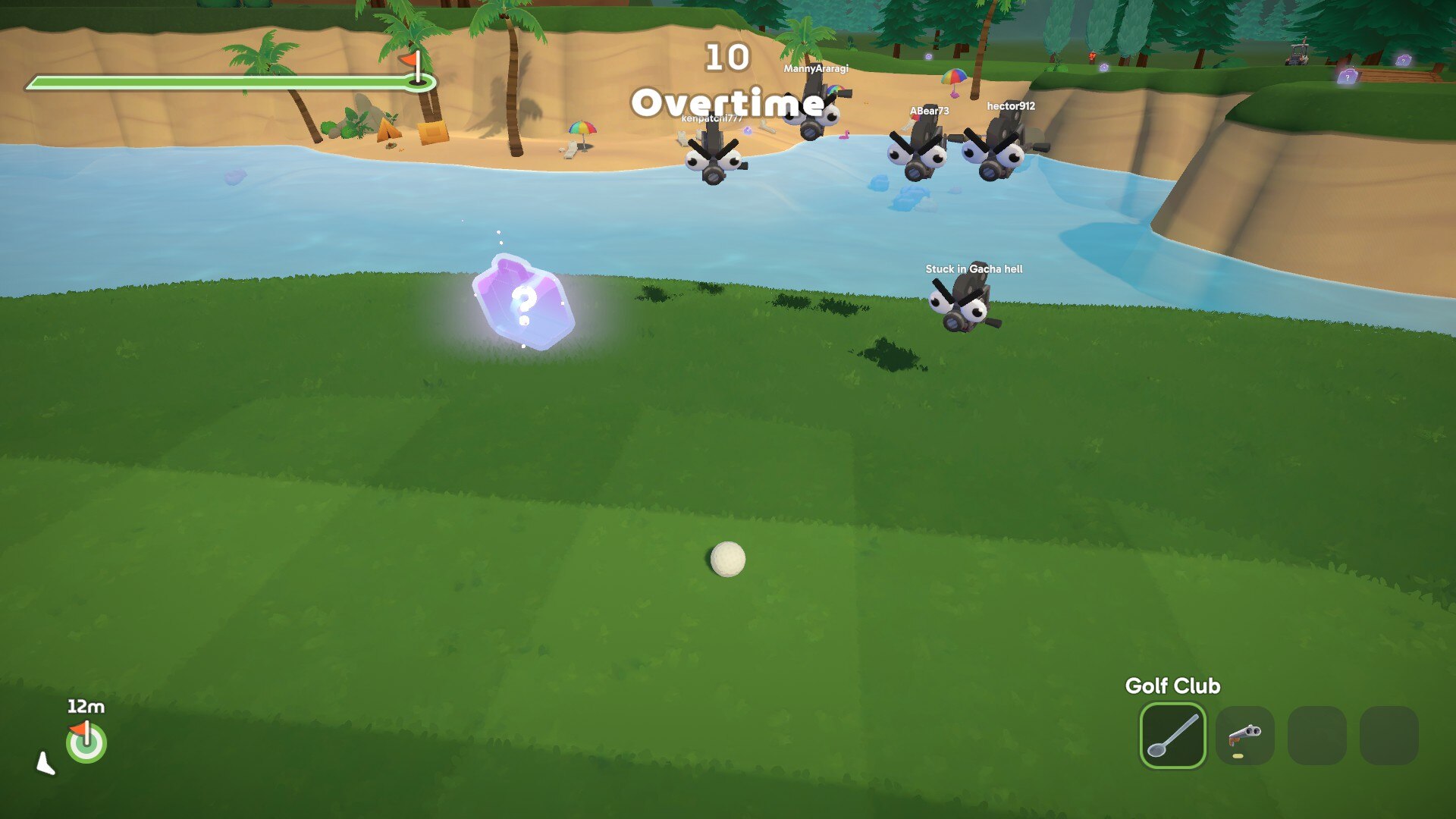
Course design is one of the strongest aspects of the game. Traditional golf hazards such as sand and water exist, but they are only the starting point. Courses include moving obstacles, explosive traps, destructible barriers, environmental gimmicks, and unconventional shortcuts that reward experimentation. Some holes encourage safe, methodical play, while others practically demand risky maneuvers to stay competitive. The variety keeps matches from feeling repetitive, even after multiple sessions.
Items introduce a second layer of interaction. Offensive tools allow players to disrupt opponents directly, while defensive and utility items provide recovery options or movement advantages. Timing becomes important. Using an item too early might waste an opportunity, while waiting too long risks losing positioning. The presence of items also ensures that matches rarely feel predetermined, because even players who fall behind can create opportunities to catch up through smart usage.
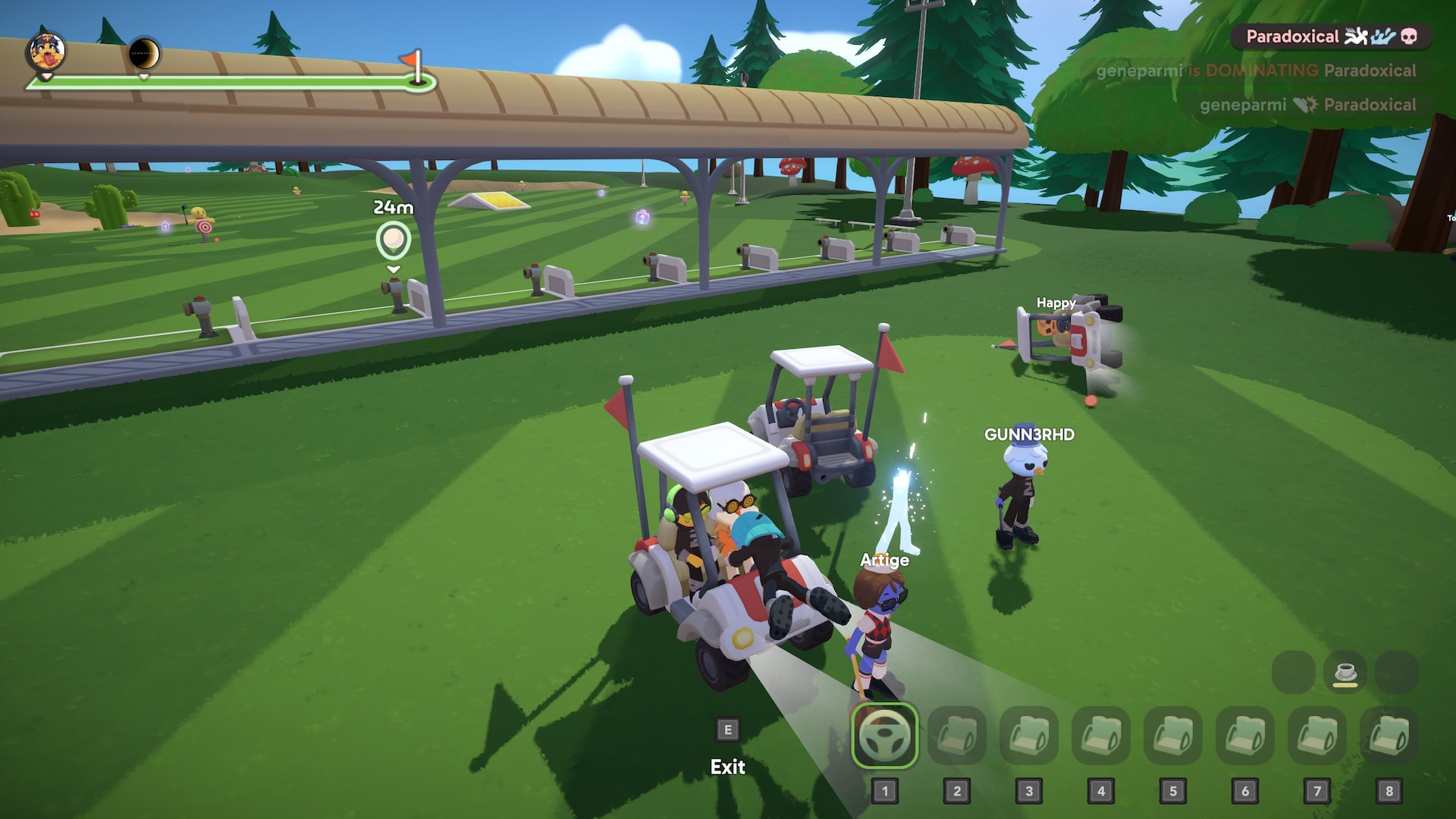
Vehicles, particularly shared golf carts, add another unexpected dimension. These moments often lead to spontaneous cooperation or chaotic collisions as multiple players attempt to control the same movement. The feature could easily have felt gimmicky, but instead it contributes personality and humor. It is the kind of mechanic that generates stories players recount afterward, which is exactly what a party-focused game needs.
The scoring system blends racing logic with golf tradition. Finishing early provides significant advantages, but efficient shot counts still matter. This hybrid approach encourages players to balance speed with accuracy. It also helps maintain engagement for those who are not leading, since performance still contributes to overall results.
Overall, the mechanics succeed because they align with the game’s intent. Every system reinforces the idea that golf is simply a vehicle for competitive interaction rather than the main focus.
Multiplayer Experience
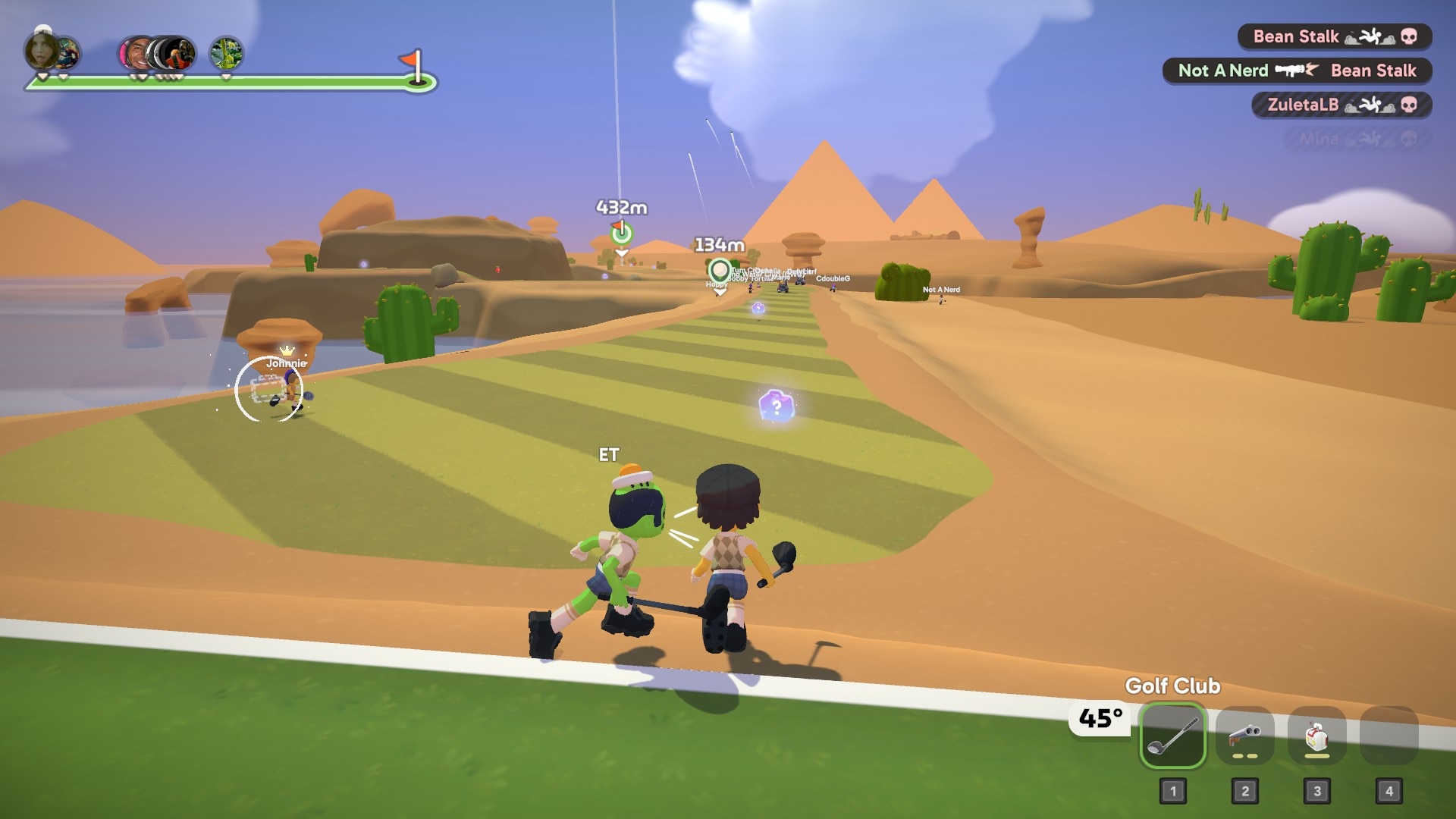
Multiplayer is where Super Battle Golf truly comes alive. Matches support up to eight players, and the difference between small and large lobbies is immediately noticeable. With only two players, the experience can feel quiet and somewhat mechanical. With four or more, the chaos increases dramatically, creating constant interference and unpredictable outcomes. At full capacity, matches often feel like controlled chaos, with balls flying in multiple directions, hazards triggering simultaneously, and players scrambling to adapt.
The social dimension cannot be overstated. Voice communication transforms the game from a mechanical activity into a shared event. Hearing someone celebrate a lucky shot or complain about being knocked off course adds emotional texture that scripted systems cannot replicate. Even frustration tends to feel humorous rather than negative because the chaos is clearly part of the design.
Simultaneous play also eliminates one of the biggest problems in traditional multiplayer golf games: downtime. There is no waiting for others to finish their turns, which keeps engagement high throughout each round. Players remain active participants rather than observers, and matches maintain momentum even when someone makes a mistake.
Matchmaking works effectively when player populations are healthy, though like many multiplayer-focused titles, long-term success will depend on community activity. Private lobbies with friends remain the ideal way to experience the game, since they guarantee consistent player counts and communication.
Solo Play and Modes
Solo play exists primarily as a supplementary feature rather than a main attraction. Competing against AI removes much of the unpredictability that defines the game’s appeal. Without human interference, matches feel more predictable and less emotionally engaging. The mechanics still function well, but the absence of social chaos makes the experience feel somewhat hollow compared to multiplayer.
That said, solo mode serves useful purposes. It allows players to learn mechanics at their own pace, experiment with shot techniques, and familiarize themselves with course layouts. For newcomers who feel hesitant about jumping directly into multiplayer, this can provide a comfortable entry point. It also offers a way to enjoy the game when friends are unavailable, even if the excitement level is lower.
Team-based modes introduce cooperative dynamics, encouraging communication and coordination. These modes can be enjoyable, particularly with organized groups, because they shift the focus from individual performance to shared strategy. Players may coordinate item usage, plan routes, or assist teammates with positioning. While still rooted in chaos, teamwork adds a different kind of satisfaction.
Ultimately, solo and cooperative modes expand flexibility but do not replace the core multiplayer appeal.
Visual Design and Presentation
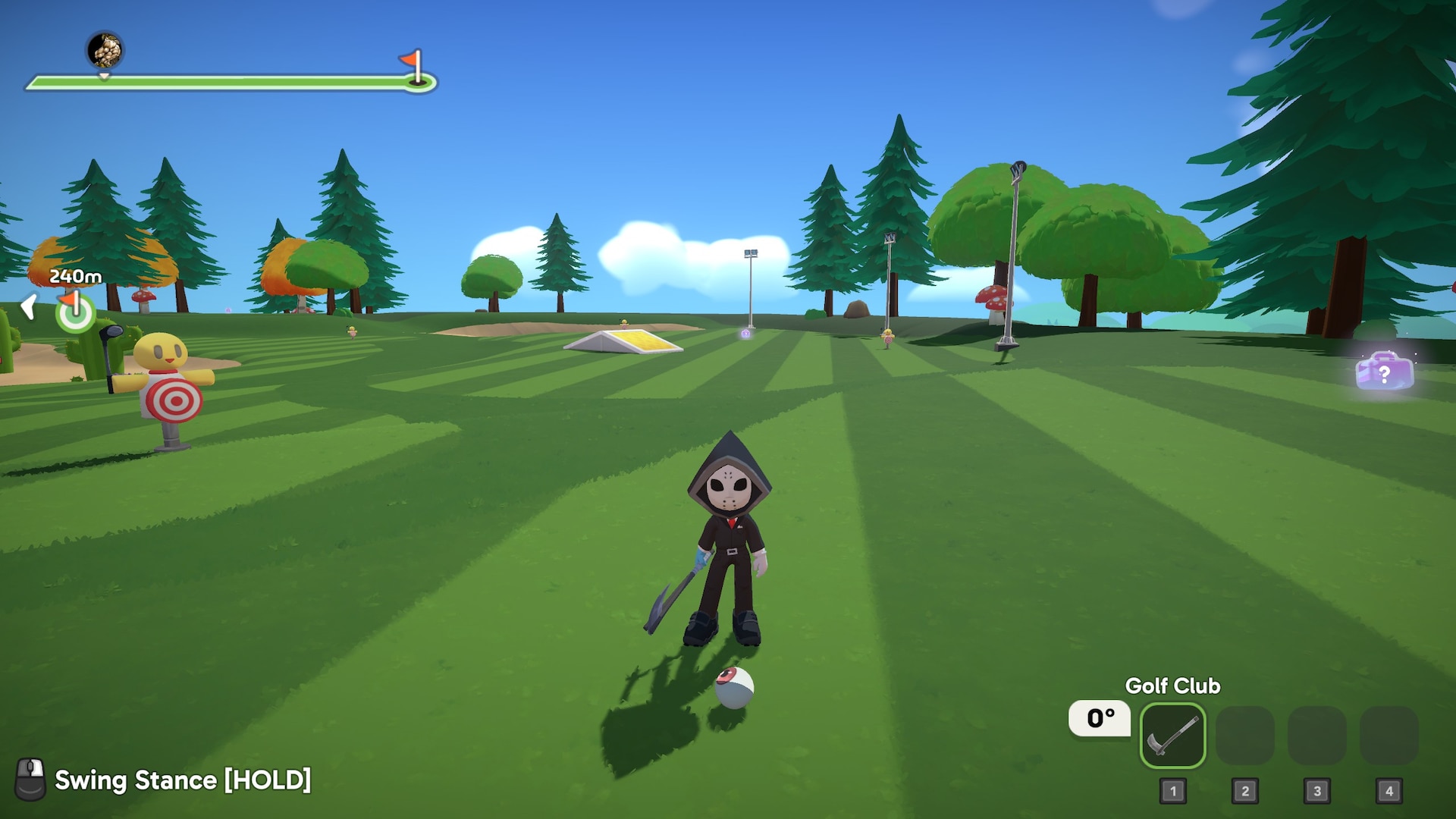
The visual style prioritizes clarity and personality over realism. Characters are stylized with exaggerated features and expressive animations that fit the playful tone. Environments are bright and colorful, making it easy to track movement even during chaotic moments. This readability is essential because players often need to react quickly to hazards and opponents.
Customization options allow players to express individuality through cosmetic items such as hats, accessories, hairstyles, and club skins. These elements do not significantly affect gameplay, but they enhance the social atmosphere. Seeing a friend wearing an absurd outfit or wielding an unconventional club contributes to the game’s humor.
User interface design is clean and functional. Important information remains visible without cluttering the screen, and menus are easy to navigate. Visual feedback for shots, impacts, and item effects is clear enough that players rarely feel confused about what happened.
The presentation overall feels cohesive. Nothing attempts to appear more serious than the gameplay itself, which helps maintain consistency in tone.
Audio and Atmosphere
Audio design complements the visual style effectively. Impact sounds are exaggerated in a satisfying way, reinforcing the comedic energy without becoming overwhelming. Environmental cues provide useful information, such as hazards activating or items being deployed nearby, allowing players to react quickly even when visual chaos increases.
The soundtrack supports the experience but does not dominate it. Music maintains an upbeat tempo that matches the pace of gameplay, though individual tracks are not particularly memorable on their own. In practice, player voices and in-game effects often take center stage, which feels appropriate given the multiplayer emphasis.
Voice chat integration is one of the most important atmospheric components. Hearing real-time reactions transforms matches into social experiences rather than isolated gameplay sessions. Laughter, mock frustration, and celebratory shouting become part of the game’s identity. The emotional impact of these moments often outweighs any scripted audio element.
Technical Performance
From a technical perspective, the PC version of Super Battle Golf performs reliably across a wide range of hardware configurations. System requirements are modest, allowing players with mid-range or even older systems to run the game comfortably without extensive graphical compromises. Frame rates remain stable during most gameplay situations, including busy matches with multiple effects occurring simultaneously, which is particularly important given how quickly the action unfolds. Even when several players are triggering items and environmental hazards at once, performance rarely drops enough to affect responsiveness.
Network performance is generally solid, though occasional latency spikes can occur, particularly in larger lobbies or when connections are unstable. These moments are noticeable but rarely severe enough to disrupt the experience significantly. Because gameplay is inherently chaotic, minor synchronization inconsistencies sometimes blend into the overall unpredictability rather than standing out as technical flaws. Still, competitive players may occasionally notice brief desynchronization when multiple interactions occur at once.
Controller support is well implemented, providing an alternative to mouse and keyboard input. Both control schemes feel responsive, and switching between them is seamless. Input latency remains low, which is essential for a game where timing shots and reacting quickly to hazards can determine outcomes. The interface also adapts cleanly to different input methods, avoiding the awkwardness that sometimes appears in PC ports.
Load times are short, and menus transition smoothly, contributing to a polished feel overall. Stability during extended play sessions is strong, with no widespread reports of crashes or major bugs. While the game is not technically groundbreaking in terms of graphical fidelity or engine complexity, it achieves something more important for a multiplayer title: consistency and reliability. That stability helps ensure that the focus remains on player interaction rather than technical distractions.
Strengths and Limitations
Super Battle Golf’s greatest strength is its ability to create memorable moments through player interaction. The combination of simultaneous play, environmental hazards, and item-based disruption produces situations that feel spontaneous rather than scripted. Even repeated courses can feel fresh because outcomes depend heavily on player behavior.
Accessibility is another major advantage. New players can participate immediately without extensive tutorials, making the game easy to introduce in social settings. At the same time, experienced players can refine strategies, route choices, and timing, allowing some depth to emerge over time.
The game also benefits from a clear and confident identity. It knows it is a chaotic multiplayer party experience and does not attempt to be anything else. This focus prevents design contradictions and helps systems work together cohesively.
However, that same focus creates limitations. Solo play lacks emotional engagement, and players without regular multiplayer groups may find the experience loses appeal quickly. The reliance on social context means enjoyment depends heavily on external factors.
Balance can occasionally feel inconsistent due to item randomness. While unpredictability contributes to fun, it may frustrate players seeking skill-based competition. Customizable lobby settings help address this issue but do not eliminate it entirely.
Content quantity is solid but not extensive. The available courses provide variety, but dedicated players may eventually desire more environments, items, or modes to maintain long-term interest.
Replay Value and Longevity
Replay value depends largely on social engagement. With a consistent group of friends, the game can remain entertaining for dozens of hours because interactions rarely repeat exactly. Each match becomes a new story shaped by player decisions, mistakes, and improvisation.
Without that social element, longevity decreases. While progression systems and unlockable cosmetics provide goals, they are unlikely to sustain engagement alone. Players returning primarily for solo play may lose interest more quickly.
Future updates could significantly extend the game’s lifespan. Additional courses, seasonal events, new items, or community features would provide reasons to return. The foundation is strong enough that ongoing support could maintain a healthy player base if handled well.
Final Verdict: 7/10
Super Battle Golf succeeds because it understands its purpose. By transforming golf into a fast-paced multiplayer playground filled with disruption and improvisation, it creates an experience that feels fresh and energetic. Its simultaneous gameplay structure eliminates downtime, while items and hazards generate constant unpredictability.
It is not designed for realism or deep solo progression, and players seeking competitive precision may find its randomness frustrating. But for those looking for a social, chaotic multiplayer experience, it delivers exactly what it promises.
When played with the right group, Super Battle Golf produces frequent moments of laughter, surprise, and friendly rivalry. Its long-term success will depend on community health and developer support, but as a PC experience, it provides a strong and entertaining foundation that stands out in a crowded genre.