
Star Trek has always been a property that seems well suited to video games, yet the results over the years have been inconsistent. The franchise’s strengths—exploration, problem-solving, leadership, and ethical decision-making—do not always translate easily into interactive systems. Many games have leaned toward action, sometimes at the expense of what makes Star Trek distinctive. Star Trek: Voyager – Across the Unknown takes a different approach. Instead of focusing on direct control of characters or combat, it centers on managing a stranded starship and the people aboard it.
Developed by Gamexcite and published by Daedalic Entertainment, the game is built around the premise of the television series Star Trek: Voyager, in which the U.S.S. Voyager is displaced far from Federation space and forced to survive while searching for a way home. The developers translate that narrative into a management-focused strategy experience. Players take responsibility for rebuilding damaged systems, maintaining crew morale, allocating scarce resources, and making decisions that shape both gameplay progression and story outcomes.
The result is a title that sits somewhere between a survival strategy game and a narrative management simulator. It does not aim for blockbuster production values, and its mid-budget scope is evident throughout. Instead, its primary ambition is to create a sense of responsibility and long-term planning consistent with the idea of commanding a stranded starship. On PC, the interface design and control scheme are clearly tailored to mouse-and-keyboard play, which suits the complexity of the systems involved.
Across the Unknown is not a game designed for immediate gratification. It unfolds gradually, with consequences emerging over time rather than instantly. Players who enjoy thoughtful planning and systemic problem-solving are likely to find more value in it than those looking for constant action. Whether the experience ultimately succeeds depends on how well its mechanics, narrative elements, and presentation come together over extended play.

Gameplay and Mechanics
At its core, Across the Unknown revolves around ship management. Voyager is represented through a grid-based deck system in which players repair damaged compartments, construct new facilities, and restore critical functions such as life support and energy distribution. Actions occur within a cycle-based progression structure, meaning that most tasks require time to complete. This approach encourages planning ahead rather than reacting in the moment.
Resources are limited from the beginning, and scarcity remains a consistent pressure throughout the game. Energy production, raw materials, food supplies, crew availability, and storage capacity are interconnected systems that require careful balancing. Allocating too many resources to research, for example, might leave life support underpowered. Repairing structural damage could delay other priorities. Because mistakes may not become obvious immediately, players must think several steps ahead.
This interconnected design is one of the game’s strongest features. The feeling of gradually restoring a damaged starship is convincing, and the systems reinforce the narrative premise. Instead of abstract numbers, players are managing recognizable components of a functioning vessel, which helps maintain immersion even when the presentation is relatively simple.
Combat exists but is not the main focus. Engagements are handled through command decisions rather than direct piloting. Players assign crew members to tactical roles, select abilities, and monitor ship status during encounters. Crew skills influence performance, making personnel choices important. While combat adds variation, it can become repetitive over time, particularly because encounters rely on similar mechanics across multiple scenarios.
Away missions provide additional variety. Players assemble small teams with different specializations to explore planets, abandoned ships, or anomalies. Success depends on selecting the right combination of skills, and outcomes may include new resources, narrative developments, or complications. These missions are generally shorter and less complex than ship management but serve as useful pacing changes.
The integration between narrative events and gameplay systems deserves particular attention. Decisions often have tangible mechanical effects, such as altering resource availability or crew status. This reinforces the sense that the player’s choices matter beyond dialogue. Even when the story elements are relatively straightforward, their connection to gameplay helps maintain engagement.
Narrative and Player Choice
The narrative structure is built around alternate scenarios inspired by the Voyager television series. Players are not restricted to canonical outcomes and can pursue different technological strategies, alliances, or risk-taking decisions. This flexibility supports replayability, as different choices lead to different circumstances.
Many decisions involve trade-offs rather than clear right or wrong answers. Pursuing experimental technology might offer long-term advantages but introduce short-term instability. Conserving resources could improve immediate survival but slow overall progress. These situations are presented more through gameplay consequences than extended dialogue sequences, which fits the management-focused design.
The inclusion of roguelike elements further increases variability. Events, encounters, and resource distribution can change between playthroughs, preventing a fully predictable experience. In some cases, important characters may be lost, which affects subsequent gameplay and narrative direction. This unpredictability encourages multiple attempts and experimentation with different strategies.
That said, not every decision feels equally significant. Some choices produce noticeable consequences, while others appear to have limited impact beyond short-term adjustments. Players expecting complex branching storylines with extensive character interactions may find the narrative somewhat restrained. However, the systemic integration of decisions with gameplay still provides a sense of agency.
Crew Management and Characterization
Managing the crew is as important as managing the ship itself. Each crew member has skills that influence performance in engineering, research, combat, or medical roles. Assigning personnel efficiently becomes essential for maintaining operational stability.
Morale functions as another layer of management. Positive outcomes and stable conditions improve crew performance, while repeated crises can reduce efficiency or create complications. This system adds realism to the leadership aspect of the game, reinforcing the idea that decisions affect people as well as systems.
Character portrayal remains generally consistent with the Star Trek universe, though depth varies. Some crew members receive narrative attention through logs or events, while others primarily function as gameplay units. The emphasis on systemic mechanics sometimes limits opportunities for more detailed character development, but the overall presentation remains recognizable for fans of the series.
Visual Design and Presentation
The visual presentation reflects the project’s mid-range budget. The user interface is clear and functional, with logical layouts that support complex decision-making. Deck construction and repair animations communicate progress effectively, helping players understand the state of the ship at a glance. Color coding and iconography are used consistently, which makes it easier to identify damaged systems, resource shortages, or priority tasks without excessive menu navigation. This clarity is particularly important in a management-heavy game, and overall the interface succeeds in delivering information in a readable way.
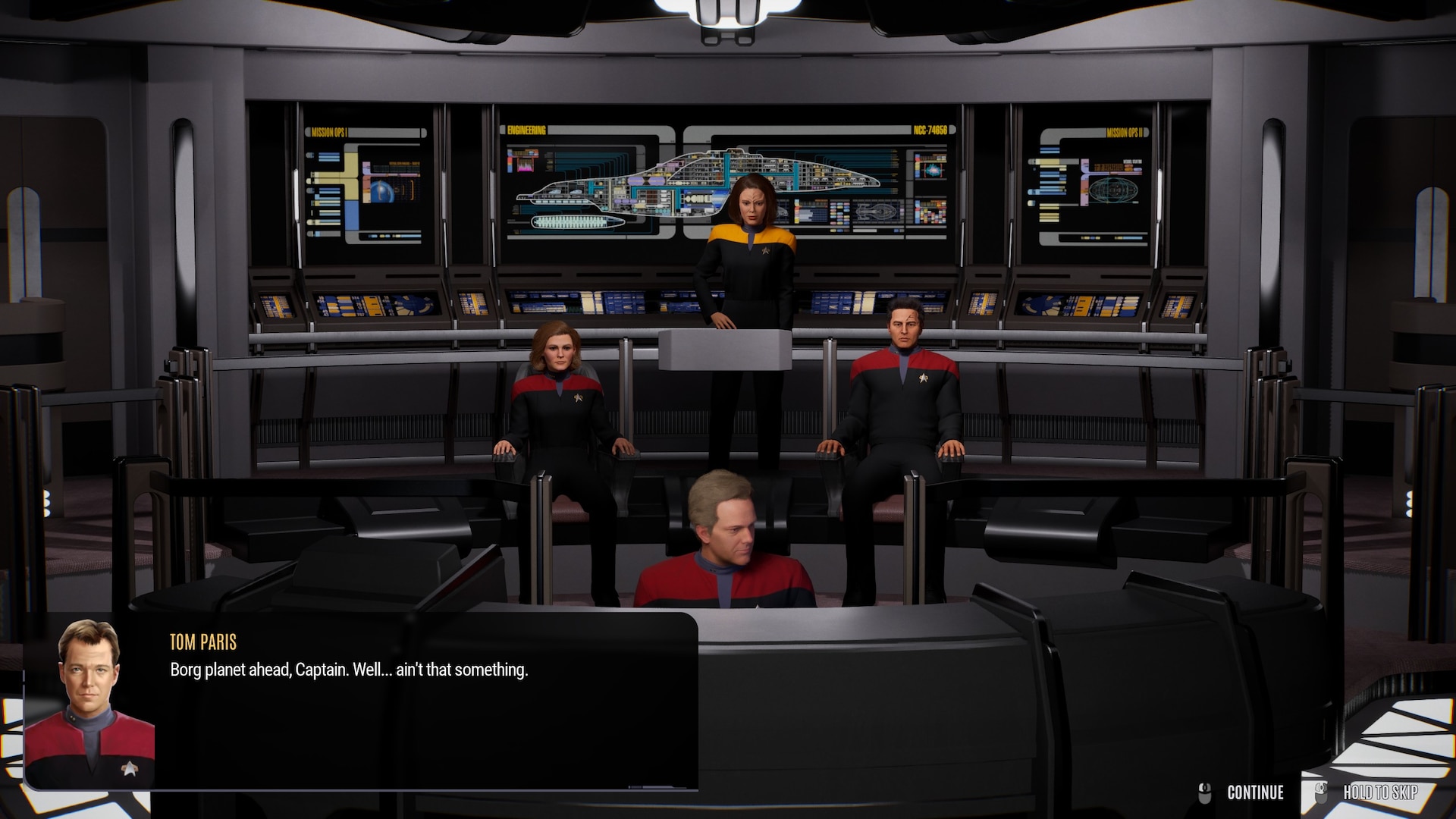
Character models and cinematic sequences are less polished. Animations can appear rigid, and facial expressions do not always convey emotional nuance. These limitations are most noticeable during narrative scenes intended to carry dramatic weight, where the visual presentation sometimes fails to fully support the writing. Camera work in cutscenes is functional rather than cinematic, with limited movement and staging that reinforce the sense of a modest production. While this does not prevent the story from being understood, it can reduce the emotional impact of key moments.
Environmental design is more successful. Planetary surfaces, interior ship sections, and space encounters provide enough variation to avoid monotony. Individual locations often include small visual details—damaged consoles, flickering lighting, or environmental hazards—that help communicate context without relying entirely on text. Space backdrops and anomaly effects are simple but effective, contributing to the atmosphere without overreaching technically. While not visually impressive compared to higher-budget titles, the environments remain coherent and appropriate for the setting.
Lighting and effects are used sparingly but generally well. Energy surges, system failures, and environmental hazards are communicated through visual cues that support gameplay clarity. Particle effects and damage indicators are functional rather than spectacular, but they serve their purpose without distracting from the management interface. The restrained approach works in the game’s favor, as overly complex visuals might have conflicted with the need for readability.
Performance on PC is generally stable, with graphical settings that scale well across different hardware configurations. Load times remain reasonable, and the game maintains consistent responsiveness even during complex scenarios involving multiple active systems. Minor visual glitches may occur occasionally, but they rarely interfere with gameplay. Overall, the presentation delivers what is necessary for the experience, even if it lacks the polish associated with larger productions.
Audio and Voice Acting
The soundtrack stands out as one of the stronger aspects of the presentation. Orchestral themes and atmospheric compositions complement the Star Trek setting and help establish mood during tense or significant moments. Music often compensates for the visual limitations by adding emotional context.
Voice acting quality is uneven. Some performances capture character personalities effectively, while others feel less natural. Not all dialogue is voiced, leading to inconsistency between scenes. Transitions between voiced and text-only moments can disrupt immersion, particularly during important narrative developments.
Sound effects provide adequate feedback during gameplay but are not especially memorable. They fulfill their functional role without drawing attention.
User Interface and Accessibility
The interface is well suited to PC controls. Mouse navigation, tooltips, and menu organization allow players to manage complex systems efficiently. Access to detailed information about resources and crew status supports strategic planning without excessive menu navigation.
During high-pressure scenarios involving multiple problems at once, the interface can become crowded, which may overwhelm new players. Accessibility options exist but are limited, focusing mainly on control customization and scaling rather than broader features.
Tutorials explain the basic mechanics adequately, though mastering the interconnected systems requires experimentation and time.
Difficulty and Learning Curve
The learning curve can be challenging, particularly for players unfamiliar with management or strategy games. Early stages emphasize survival with limited resources, requiring players to quickly understand how systems interact.
Difficulty comes primarily from long-term consequences rather than immediate challenges. Mistakes accumulate gradually, and recovery may require careful planning over multiple cycles. This approach rewards patience and attention but may frustrate players who prefer faster feedback.
Multiple difficulty settings allow adjustments to resource availability and event frequency, making the game more approachable while preserving depth for experienced players.
Replayability and Longevity
Replayability is one of the game’s most notable strengths. Branching decisions, variable events, and multiple strategic approaches create distinct experiences across playthroughs. Players can experiment with different research priorities, crew assignments, and risk levels to discover new outcomes.
The length of each campaign varies depending on performance and difficulty. Successful runs can take many hours, while failed attempts may end much earlier. This variability contributes to longevity, though pacing can occasionally feel uneven.

Strengths and Limitations
Across the Unknown combines thoughtful design with clear limitations. Its interconnected systems create a cohesive experience in which ship management, crew dynamics, and narrative progression support each other effectively. Resource scarcity and delayed consequences encourage careful planning, and the variability between playthroughs provides strong replay value.
The soundtrack enhances atmosphere, and the PC version benefits from stable performance and controls that suit the complexity of the interface.
At the same time, the game shows signs of its budget constraints. Character animation and cinematic presentation lack refinement, which sometimes reduces narrative impact. Voice acting inconsistency and incomplete coverage weaken immersion, and combat encounters can feel repetitive over time. Not all narrative choices carry equal weight, and the learning curve may discourage players unfamiliar with management-focused gameplay.
These factors place the game in a middle ground where its strengths are meaningful but its shortcomings remain noticeable.
Final Verdict: 8/10
Star Trek: Voyager – Across the Unknown succeeds most when it focuses on long-term planning and systemic decision-making. The process of rebuilding and guiding a damaged starship creates a distinctive gameplay experience that aligns well with the premise of being stranded far from home. Its mechanics offer enough depth to sustain engagement across multiple playthroughs, particularly for players who enjoy strategy and resource management.
The game does not reach the technical polish of higher-budget titles, and its presentation inconsistencies are difficult to ignore. However, its design ambition, replayability, and integration of narrative with gameplay systems make it a worthwhile experience for the right audience. On PC, stable performance and intuitive controls further support the overall experience.
Players seeking fast-paced action are unlikely to find what they are looking for here. Those interested in methodical strategy and the Voyager setting, however, may find it engaging despite its imperfections. Overall, Star Trek: Voyager – Across the Unknown stands as a solid mid-budget entry that offers meaningful depth and replay value, even if it falls short of broader genre leaders.


