Cult of the Lamb is an ambitious and unusually self-assured hybrid that resists easy categorization. At a glance, it presents itself as a whimsical, cartoon-styled action game, populated by wide-eyed animals and rendered in soft, inviting shapes. Yet beneath this surface lies a game deeply concerned with darker subject matter, including religious devotion, authoritarian power structures, and the moral elasticity of leadership. Developed by Massive Monster and published by Devolver Digital, the game exemplifies a modern indie philosophy that favors conceptual boldness over genre purity.
From its opening sequence, Cult of the Lamb establishes an uneasy relationship between innocence and corruption. The player, cast as a lamb condemned to death, is resurrected not out of benevolence but obligation, bound to serve an imprisoned deity in exchange for life. This framing is not merely narrative flavor; it informs the game’s mechanical and thematic trajectory in subtle but persistent ways. Authority is always conditional, faith is always instrumental, and survival is never free.
On PC, the experience is particularly well-suited to extended sessions. Performance is stable, input is precise, and the interface accommodates the game’s dual focus without becoming cluttered. More importantly, the platform allows the game’s pacing to breathe, encouraging players to sink into its routines and reflect on its systems. The later addition of the Woolhaven expansion expands this framework significantly, adding new pressures and perspectives that recontextualize much of the base experience.

Core Structure and Gameplay Philosophy
The structural foundation of Cult of the Lamb is built around deliberate alternation. The player is constantly moving between two states of being: conqueror and caretaker. These roles are not merely sequential but symbiotic, each feeding directly into the other. Progression is impossible without accepting both responsibilities, and mastery emerges from understanding how they reinforce one another.
Dungeon exploration provides resources, converts new followers, and advances narrative milestones, while the cult itself functions as both engine and constraint. Its needs dictate when and how the player can act, and its growth defines the scale of future expeditions. This interlocking design ensures that the game rarely feels directionless, even when the player is free to choose priorities.
Philosophically, the game embraces control as its central mechanic. Time, labor, belief, and fear are all variables to be managed, optimized, and occasionally exploited. Unlike many management simulations that reward harmony and balance, Cult of the Lamb is comfortable with asymmetry. The player is not encouraged to see followers as equals, but as participants in a system that exists for a higher purpose. This framing grants the game a distinct identity while raising implicit questions about leadership and agency.
As the game progresses, its structure subtly shifts. Early play is reactive and survival-oriented, while later stages emphasize maintenance, expansion, and ideological consolidation. This evolution mirrors the narrative arc of the Lamb’s rise to power, creating a sense of coherence between story and system that persists throughout the experience.
Combat and Roguelike Elements
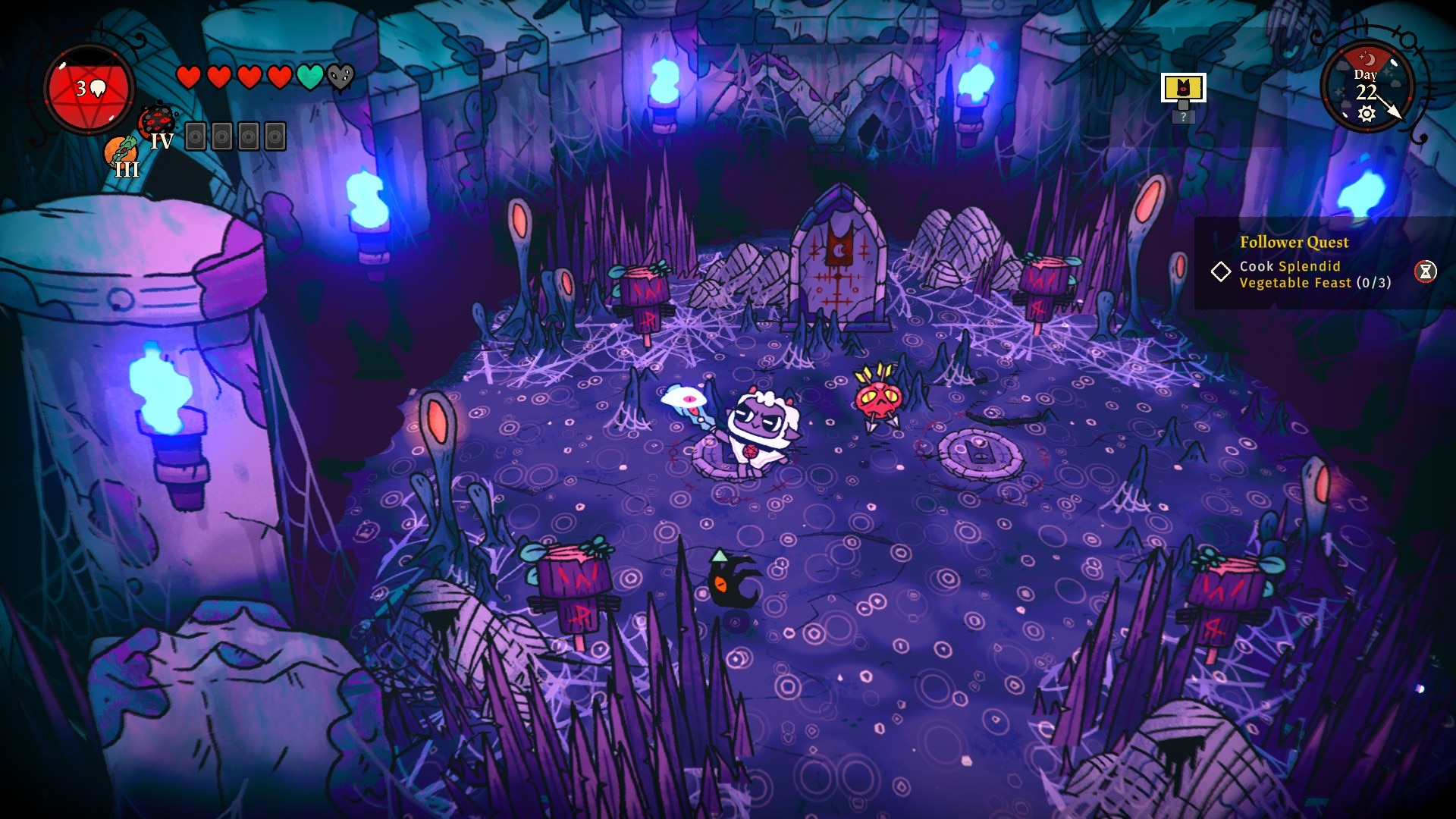
The combat design in Cult of the Lamb reflects a conscious choice to favor accessibility and flow over depth and difficulty. Dungeon runs are compact, fast-moving affairs that emphasize rhythm and responsiveness rather than technical mastery. Attacks are clear, dodges are forgiving, and enemy behavior is readable, allowing players to focus on momentum rather than memorization.
Weapon variety provides the primary source of mechanical variation. Each weapon type alters attack speed, range, and cadence, encouraging adaptive playstyles. However, the randomness inherent in weapon assignment limits long-term planning, reinforcing the game’s focus on improvisation rather than optimization. This design choice aligns with the narrative theme of servitude, as the Lamb is rarely fully in control of its circumstances.
Supplementary systems such as tarot cards and curses add short-term modifiers that shape individual runs. These elements are impactful without being overwhelming, offering strategic inflection points rather than complete transformations. While this restraint keeps the system approachable, it also constrains its expressive potential over extended play.
Enemy and boss design emphasize spectacle and symbolism. Regular foes are often thematically tied to their regions, while major bosses embody ideological opposition rather than purely mechanical challenge. These encounters function as narrative punctuation, reinforcing the sense of progression even when the mechanical demands remain consistent.
Over time, the limitations of this approach become more apparent. Combat remains enjoyable and polished, but its relative lack of escalation can lead to a sense of familiarity that borders on repetition. The system is well-tuned but intentionally bounded, prioritizing consistency over evolution.

Cult Management and Player Agency
The cult management layer is where Cult of the Lamb most fully articulates its identity, functioning as the primary space in which the game’s thematic ambitions are translated into interactive form. Rather than presenting leadership as a collaborative or benevolent process, the system frames authority as an exercise in control, ritual, and enforcement. Players are not simply asked to guide a community, but to command it, shaping belief and behavior through a combination of incentives, coercion, and symbolic acts.
Followers are individually characterized through traits, preferences, and routines, lending them a degree of personality that encourages emotional investment, yet this individuality exists in constant tension with their role as instruments of the cult’s survival. Their needs must be addressed not out of altruism, but because stability, productivity, and faith are resources to be managed. In this way, the management system transforms abstract concepts such as devotion, obedience, and sacrifice into tangible mechanics, reinforcing the game’s central assertion that belief is both a social construct and a tool of power.
Daily life within the settlement involves a constant negotiation between productivity and belief. Food must be prepared, work must be assigned, and rituals must be performed to maintain faith. When stability falters, the player is offered a range of responses, many of which involve coercion, sacrifice, or deception. The game neither condemns nor rewards these choices explicitly, allowing players to define their own moral boundaries.
Doctrines play a crucial role in formalizing authority. Each doctrinal choice reshapes the cult’s values and mechanics, embedding ideology directly into gameplay. This integration is subtle but powerful, reinforcing the idea that belief systems are not neutral but functional constructs designed to sustain power.
Despite its strengths, the management system exhibits diminishing complexity as the game progresses. Once efficient routines are established, intervention becomes less frequent, and the cult can feel more like a solved problem than a dynamic system. While follower traits and random events introduce occasional disruptions, they rarely challenge established structures in meaningful ways.
Visual Design and Audio Presentation
The game’s visual identity is one of its most immediately striking features. Character designs are intentionally simple yet expressive, using exaggerated animation to convey emotion and intent. This approach allows the game to communicate complex ideas with minimal visual clutter, enhancing both readability and tone.
Environmental design reinforces the game’s thematic contrasts. Safe spaces are warm and inviting, while hostile regions are abstract and oppressive, often leaning into surreal imagery. The use of color and motion guides the player’s emotional response without relying on overt cues.
Audio design supports this cohesion through careful restraint. The soundtrack avoids constant presence, instead accentuating key moments with ritualistic or foreboding themes. Sound effects are precise and functional, reinforcing player actions without overwhelming the soundscape.
On PC, the presentation benefits from smooth performance and scalable options. The interface is clear and responsive, allowing players to navigate complex systems with minimal friction, even during extended sessions.
Narrative and Thematic Cohesion
Narrative in Cult of the Lamb is conveyed primarily through implication rather than exposition. The game trusts players to interpret its symbols and systems, allowing meaning to emerge organically through play. The Lamb’s ascent is marked not by cutscenes but by expanding authority, deeper control, and increasingly consequential decisions.

Themes of devotion, fear, and manipulation are embedded directly into mechanics, ensuring that narrative and gameplay are inseparable. The absence of explicit moral judgment invites reflection rather than instruction, positioning the player as both participant and observer. This approach lends the game a sense of thematic maturity, though it may alienate players seeking more traditional storytelling. Character development is minimal, and emotional resonance arises more from systemic interaction than scripted moments.
The Woolhaven Expansion
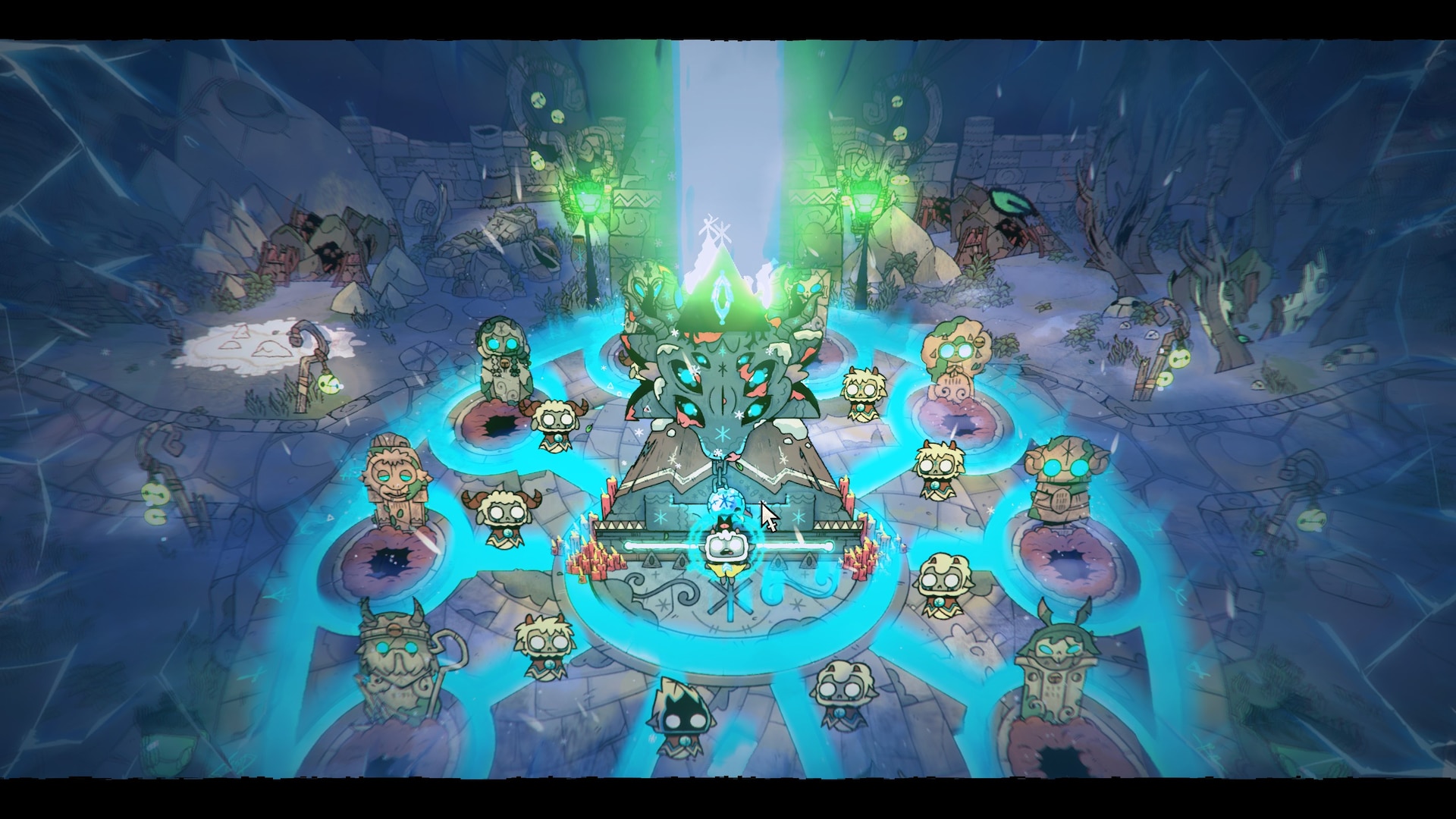
The Woolhaven expansion represents a meaningful evolution of Cult of the Lamb’s core ideas. Set in a frozen, hostile region, the expansion introduces environmental adversity as a central organizing principle. Cold, scarcity, and decay reshape the player’s relationship with both exploration and management.
These conditions reintroduce vulnerability into systems that may have become stable or predictable. Infrastructure must be reconsidered, resource flows must be diversified, and long-term planning becomes essential. This shift restores tension and reinforces the game’s survival themes.
Narratively, Woolhaven expands the game’s mythology by exploring origins rather than outcomes. The tone is more reflective and somber, emphasizing endurance and legacy. This additional context enriches the world without undermining its ambiguity, maintaining the game’s interpretive openness.
Mechanically, the expansion integrates new systems smoothly, avoiding the sense of artificial layering that often plagues add-on content. Combat additions remain consistent with the established framework, while environmental pressure gives new weight to familiar mechanics.
Design Strengths and Structural Limitations
Viewed holistically, Cult of the Lamb is a game defined by intentional constraint. Its systems are not designed to scale indefinitely, but to serve a specific thematic and experiential goal. This focus gives the game clarity and cohesion, but also imposes natural limits on longevity.
Players seeking endless variation or mechanical escalation may find the experience finite. However, within its chosen boundaries, the game exhibits a high degree of polish and consistency. The Woolhaven expansion mitigates some structural limitations by reintroducing challenge and uncertainty, but it does not fundamentally alter the game’s design philosophy.
Final Verdict: 8.5/10
On PC, Cult of the Lamb stands as a confident example of modern indie design, prioritizing thematic integration and conceptual clarity over maximalist systems. Its fusion of roguelike combat and cult management is executed with care and purpose, resulting in an experience that is both approachable and thought-provoking.
The Woolhaven expansion enhances this foundation by deepening narrative context and introducing environmental pressure that revitalizes core mechanics. Together, the base game and expansion form a cohesive and memorable whole, offering a distinctive exploration of power, belief, and control.
While it may not satisfy players seeking infinite depth or systemic complexity, Cult of the Lamb succeeds on its own terms, delivering a tightly focused experience that lingers not because of its difficulty, but because of its ideas.