The Midnight Walk is a deliberately restrained narrative adventure that places artistic intent, emotional texture, and sensory immersion above conventional gameplay systems. Developed by MoonHood, a studio known for its striking visual sensibilities and fairy-tale darkness, the game represents a conscious narrowing of focus—one that values cohesion and mood over scale or complexity.
Rather than positioning itself as a traditional adventure game, The Midnight Walk functions more as an interactive passage through a carefully sculpted emotional landscape. Its ambitions are modest in terms of mechanical scope, but precise in execution. Every element, from its pacing to its silence, is designed to serve a singular goal: sustained atmospheric immersion.
On PC, the experience feels purposeful and complete, even as it resists easy categorization. It is neither a puzzle game nor a walking simulator in the strictest sense, but something that exists between forms—borrowing elements from each without fully committing to any. This ambiguity is central to its identity, and while it limits mass appeal, it also gives the game its quiet confidence.

Narrative and Themes
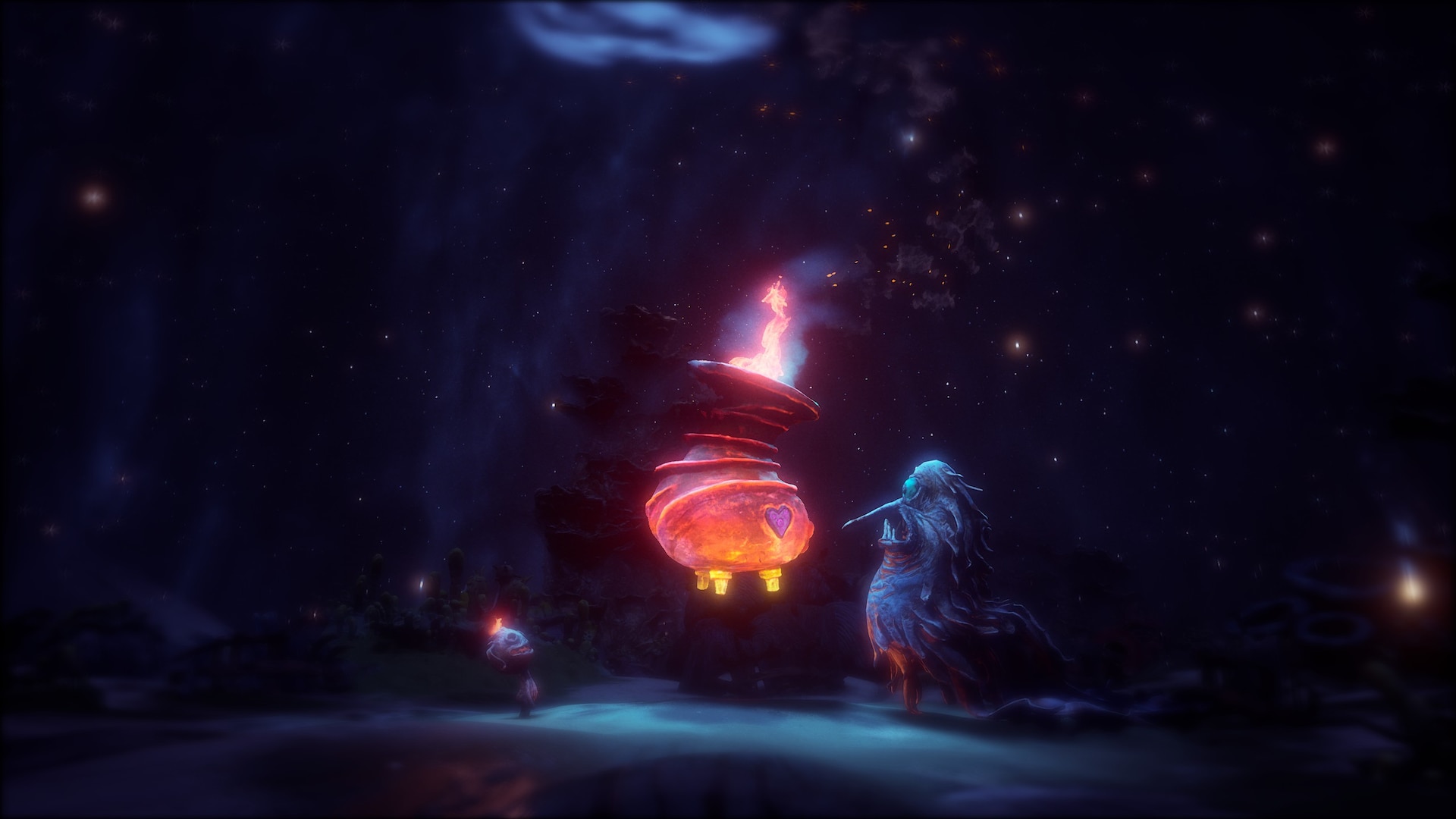
Narrative in The Midnight Walk is conveyed indirectly, relying on symbolism, implication, and environmental storytelling rather than explicit exposition or dialogue. Meaning is suggested through visual details and atmosphere, inviting interpretation rather than clear explanation. Players take on the role of the Burnt One, a voiceless figure navigating a dim, unsettling world in the company of Potboy, a small flame-bearing creature whose presence is both comforting and fragile, offering guidance while underscoring the constant sense of vulnerability.
The game resists traditional narrative structure. There are no clearly defined acts, climaxes, or resolutions in the conventional sense. Instead, the story unfolds as a sequence of moments—some tender, some threatening, others merely strange. These moments accumulate meaning gradually, encouraging players to reflect rather than react.
Thematically, The Midnight Walk explores grief, dependency, fear of loss, and the fragile nature of hope. Darkness functions as both a physical and emotional force, shaping not only the world but the player’s behavior within it. Light, conversely, is never abundant or secure; it must be protected, rationed, and sometimes withheld.
Potboy’s flame becomes a powerful symbol throughout the journey. It represents companionship and responsibility, but also vulnerability. Progress often depends on how carefully the player manages this fragile source of light, reinforcing the game’s recurring theme of mutual reliance.
For players receptive to abstract storytelling, this approach can be deeply affecting. However, the narrative’s refusal to provide clear answers or explicit motivations may feel unsatisfying to those who prefer defined characters or plot-driven momentum. The Midnight Walk asks for interpretation, not comprehension—and that distinction is crucial.
Art Direction and Visual Design
Visually, The Midnight Walk is extraordinary. Its clay-sculpted aesthetic is not a stylistic flourish but the foundation upon which the entire experience is built. Every character and environment was physically sculpted before being digitized, resulting in a world that feels tactile, imperfect, and unmistakably human.
The stop-motion-inspired animation enhances this handcrafted quality. Movement is intentionally uneven and slightly stilted, lending characters a sense of weight and presence that polished digital animation often lacks. Rather than breaking immersion, these imperfections deepen it, reinforcing the game’s themes of fragility and unease.
Environmental design is equally considered. Spaces are sparse but evocative, using scale, shadow, and negative space to convey emotion. The world often feels empty, but never lifeless; every structure, path, and object seems placed with intent. Visual storytelling replaces explicit exposition, encouraging players to read meaning into architecture and layout.
Lighting is perhaps the most important visual tool in the game. Darkness is pervasive, frequently limiting visibility and forcing players to rely on Potboy’s flame. Moments of illumination are rare and meaningful, often signaling safety, revelation, or emotional release.

On PC, the presentation is largely successful, though not without limitations. Some textures appear softer than expected at higher resolutions, and finer sculpted details can lose clarity depending on display settings and hardware configurations. This occasionally reduces the tactile sharpness of the clay models, particularly in close-up views. While these issues do not detract from the overall aesthetic or artistic intent, they do slightly blunt the impact of the game’s most intricate visual work, especially when viewed on high-end displays.
Gameplay and Mechanics
Mechanically, The Midnight Walk is minimal by design. Player interaction is intentionally constrained, focusing on movement, observation, and basic environmental interaction. There are light puzzles, occasional stealth encounters, and simple progression gates, but no complex systems or layered mechanics.
The core loop revolves around navigating darkness, managing light, and responding to environmental threats. Enemies and hazards are present, but encounters are designed to evoke tension rather than test skill. Failure is rarely punitive, and the game often prioritizes forward momentum over challenge.
Puzzles are straightforward and largely contextual, integrated seamlessly into the environment. They rarely require prolonged thought or experimentation, serving instead as brief pauses that reinforce pacing. This approach ensures accessibility but also limits engagement for players seeking mechanical depth.
Stealth sections follow a similar philosophy. Threats are introduced sparingly, and their behaviors are predictable once understood. The emphasis is on mood and anticipation rather than mastery.
This restraint will divide players. Those looking for agency, choice, or challenge may find the experience too passive. However, the simplicity allows the game’s atmosphere and themes to remain unbroken, ensuring that mechanics never distract from emotional intent.
Audio and Atmosphere
Audio design plays a critical role in sustaining immersion. The soundtrack is sparse and understated, relying on ambient tones and subtle melodic fragments rather than memorable themes. Music fades in and out almost imperceptibly, often yielding to silence.
Environmental audio is carefully curated. Footsteps, distant echoes, flickering flames, and subtle ambient noises fill the soundscape without overwhelming it. Silence is frequently used as a narrative tool, amplifying tension and reinforcing isolation.
Voice work is minimal and deliberate. Characters speak rarely, and when they do, their dialogue is cryptic and subdued. This restraint ensures that spoken words retain impact, while also maintaining the game’s dreamlike tone.
Together, the audio and visual elements form a unified atmospheric identity. Neither dominates the experience; instead, they support one another in creating a sustained emotional state that defines the game from beginning to end.

Technical Performance (PC)
From a technical standpoint, The Midnight Walk performs reliably on PC in standard display mode. Frame rates are stable on mid-range hardware, and the game’s modest technical demands make it accessible to a wide range of systems. Load times are brief, and the experience is largely free of major bugs or progression-breaking issues. The interface is minimal and unobtrusive, reinforcing immersion rather than interrupting it.
VR support introduces additional immersion but also additional complexity. Performance and visual clarity vary depending on hardware, and some users may encounter reduced sharpness or occasional instability. While VR enhances presence, it is not essential, and the PC version remains the most consistent way to experience the game.
Overall, the technical execution is competent and supportive of the game’s goals, even if it does not push the boundaries of visual fidelity or performance.
Final Verdict: 8/10
The Midnight Walk is a quietly assured, artistically focused experience that succeeds precisely because it knows what it is—and what it is not. Its claymation-inspired visuals, subdued storytelling, and carefully controlled pacing set it apart from more conventional narrative adventures, offering an experience that feels closer to an interactive art installation than a traditional game.
Its limitations are evident: a short runtime, minimal mechanical depth, and a narrative that favors ambiguity over clarity. These choices will not appeal to everyone, particularly players seeking challenge, choice, or narrative exposition. Yet for those willing to meet the game on its own terms, these same qualities become strengths.
By committing fully to restraint and cohesion, The Midnight Walk delivers an experience that lingers in memory long after it ends—not for dramatic moments or mechanical achievements, but for the emotions it quietly evokes. It is a game defined by atmosphere, intention, and confidence in its vision.