Deep Rock Galactic: Survivor represents a careful and deliberate expansion of the Deep Rock Galactic universe rather than a simple attempt to capitalize on its popularity. In a market increasingly saturated with survivor-like roguelikes, the game distinguishes itself not through novelty alone, but through the thoughtful integration of mechanics that reflect the spirit of its source material. Instead of leaning on cooperative chaos and first-person immersion, Survivor refocuses the experience around individual agency, spatial awareness, and long-term mastery.

Set once again on the hostile planet Hoxxes IV, the game reframes familiar concepts — mining, hostile fauna, and resource management — through a top-down lens. This shift in perspective allows for a more systems-driven approach, one that emphasizes decision-making over reflexes and planning over improvisation. From its earliest moments, Deep Rock Galactic: Survivor communicates a clear design philosophy: survival is not about overwhelming power, but about understanding the environment and using it intelligently.
While the survivor-like genre often risks blending into homogeneity, Survivor avoids this pitfall by maintaining a strong identity rooted in terrain manipulation, structured objectives, and incremental progression. It is a game that reveals its depth gradually, rewarding sustained engagement rather than instant gratification.
Gameplay and Mechanics
On a mechanical level, Deep Rock Galactic: Survivor operates within a familiar framework. Movement is player-controlled, combat is largely automated, and enemy pressure escalates continuously throughout each run. However, the game’s execution of these elements is markedly more deliberate than many of its genre counterparts. Enemy placement, map density, and upgrade pacing are tuned to create constant tension, ensuring that the player is rarely passive or disengaged.
Each run demands active evaluation of risk versus reward. Whether deciding when to mine, when to engage enemies directly, or when to prioritize objectives, the player is consistently encouraged to make meaningful choices. The result is a gameplay loop that feels less like endurance and more like a test of strategic competence.
Mining as Strategy
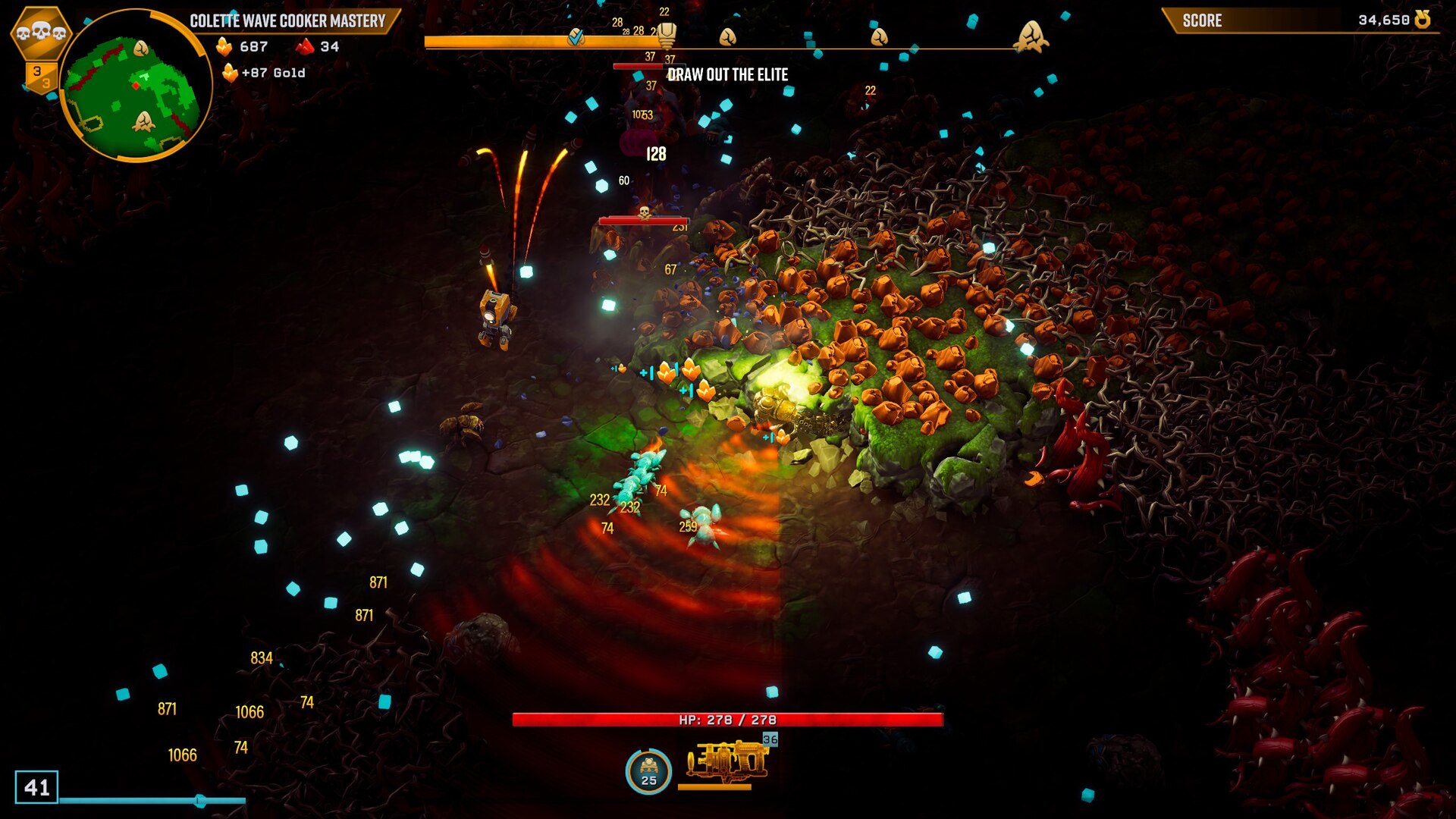
Mining is the cornerstone of Deep Rock Galactic: Survivor’s design and its most significant contribution to the survivor-like genre. Fully destructible terrain allows players to reshape the environment in real time, carving pathways, isolating threats, or creating defensible positions. This transforms the cave system into a dynamic battlefield rather than a static arena.
As enemy swarms intensify, the importance of intelligent terrain manipulation becomes increasingly apparent. Creating narrow corridors can concentrate firepower, while poorly planned excavation can leave the player exposed or trapped. Mining also introduces a temporal element, forcing players to balance the time spent reshaping the environment against the ever-present threat of encroaching enemies.
Crucially, mining is not merely a novelty mechanic. It is deeply intertwined with combat flow, resource acquisition, and survival planning. Mastery of terrain manipulation often marks the difference between successful runs and abrupt failure, lending the game a distinctive strategic identity.

Objectives and Structure
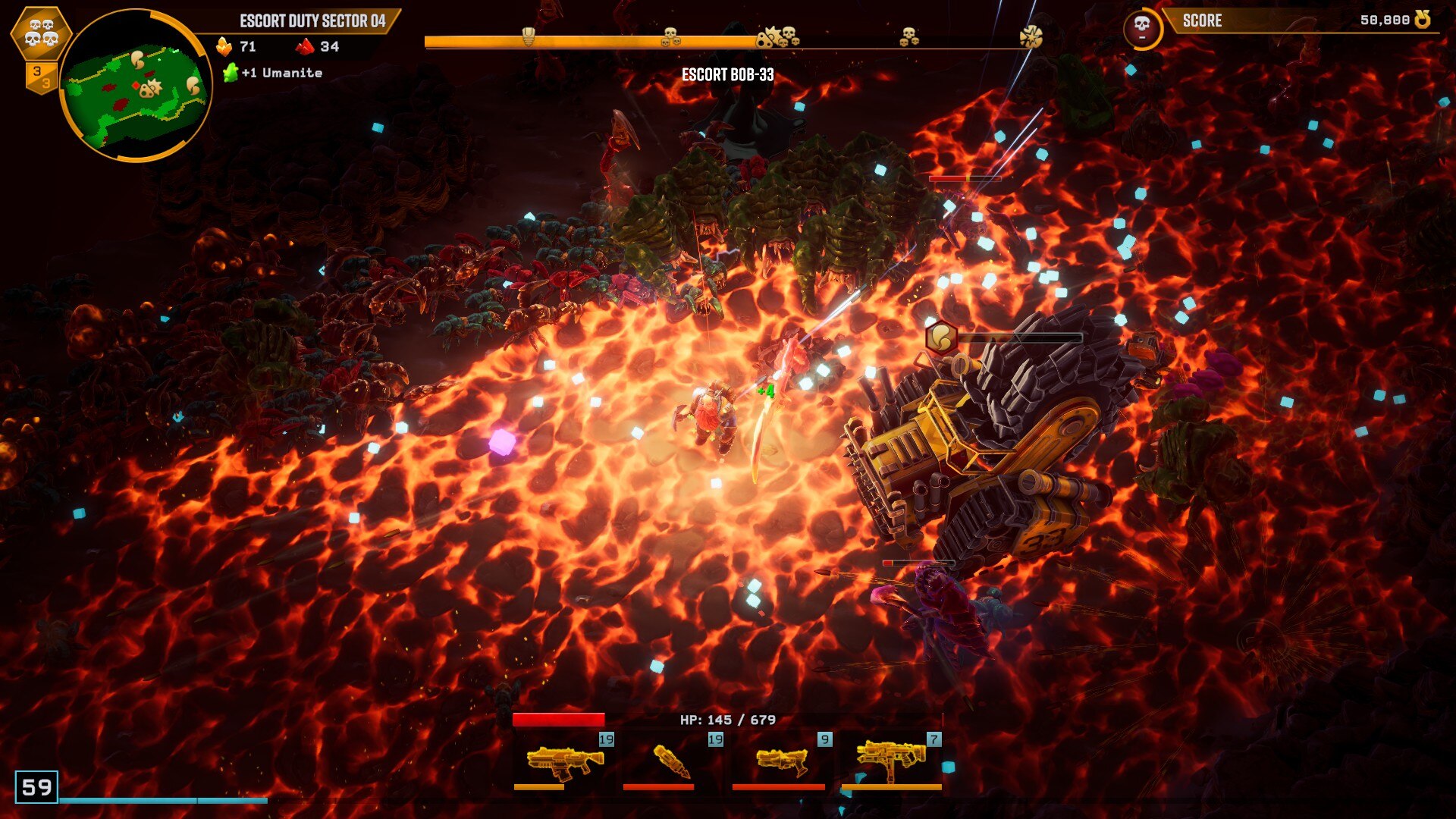
Unlike many survivor-likes that rely on open-ended survival until inevitable defeat, Deep Rock Galactic: Survivor employs a structured, stage-based approach. Each run is divided into discrete segments with defined objectives, such as resource extraction, enemy elimination, or survival challenges. These objectives introduce variety and pacing, preventing the experience from devolving into repetitive motion.
The presence of objectives also reinforces intentional play. Players must adapt their strategies to the demands of each stage, shifting focus between aggression, exploration, and positioning. This structure provides a sense of progression within individual runs, creating natural peaks and valleys in intensity that enhance long-term engagement.
Progression
Progression in Deep Rock Galactic: Survivor is multi-layered and deliberately paced. In-run upgrades offer immediate tactical advantages and allow players to shape distinct builds, while meta progression unlocks new weapons, perks, and modifiers that expand strategic options across future attempts.
Overclocks, in particular, introduce meaningful trade-offs that encourage experimentation rather than optimization. These modifiers can dramatically alter weapon behavior or player capabilities, often forcing players to adapt their approach mid-run. While the early progression phase can feel restrictive, especially for newcomers, the gradual expansion of available tools ultimately supports a deep and rewarding mastery curve.
Presentation and Atmosphere
Visually, Deep Rock Galactic: Survivor prioritizes function over flourish. The top-down perspective and clean art direction ensure that critical information remains legible even during moments of extreme enemy density. While the visual style lacks the expressive character animations of its predecessor, it compensates with clarity and consistency.
Environmental design plays a significant role in establishing atmosphere. Biomes, though mechanically similar in some respects, convey distinct moods through lighting, color palettes, and terrain composition. This environmental variety reinforces the sense of descending deeper into hostile territory as runs progress.
The audio design is similarly restrained but effective. Weapon effects provide clear feedback, enemy sounds communicate threat levels, and ambient audio reinforces the sense of isolation inherent in the game’s single-player focus. The soundtrack supports the game’s pacing without overshadowing it, maintaining tension without becoming repetitive or distracting.
Difficulty, Balance, and Design Trade-offs
Deep Rock Galactic: Survivor strikes a careful balance between challenge and approachability. The difficulty curve is demanding but largely fair, rewarding knowledge and adaptability over brute force. As players become more familiar with enemy patterns and terrain mechanics, the game reveals layers of depth that are not immediately apparent.
However, this design philosophy comes with certain trade-offs. Early progression can feel repetitive, as limited unlocks restrict build diversity and expose the game’s structural similarities across runs. Enemy variety and biome differentiation become more pronounced over time, but patience is required before the full scope of the game’s systems is realized.
The choice to focus exclusively on single-player play further emphasizes these design priorities. While this allows for precise balance and a tightly controlled experience, it also distances Survivor from the cooperative identity that defined Deep Rock Galactic. For some players, the absence of shared chaos and social interaction may feel like a significant departure, even as others appreciate the game’s introspective, mastery-driven approach.
Despite occasional interface issues and minor balance inconsistencies, the overall design remains cohesive. The lack of narrative framing may disappoint players seeking story-driven motivation, but the emphasis on systemic depth aligns clearly with the game’s core goals.
Final Verdict: 8.5/10
Deep Rock Galactic: Survivor stands as a compelling example of how thoughtful design can elevate a familiar genre. By integrating mining, structured objectives, and terrain-based strategy into the survivor-like framework, it delivers an experience that rewards planning, adaptability, and long-term engagement.
While it does not replicate the cooperative energy of its predecessor, it offers a different kind of satisfaction — one rooted in personal mastery and strategic understanding. For fans of survivor-like roguelikes, it ranks among the most mechanically engaging entries on PC. For Deep Rock Galactic enthusiasts, it serves as a respectful and intelligent reinterpretation of a beloved universe.