After years of steady refinement, Football Manager 26 (FM26) was billed as the dawn of a new era. Sports Interactive promised that this year’s entry — the first built entirely on the Unity engine — would redefine the long-running series, both visually and structurally. New animation technology, an overhauled interface, expanded player interactions, and smarter scouting tools were all meant to modernize the franchise for a new generation.
And in some ways, FM26 genuinely does feel like a step into the future. It’s sharper, faster in some areas, and easier to approach for newcomers. But the journey to modernization has come at a cost: technical instability, design regressions, and a user interface that seems to value aesthetics over usability. For all its ambition, FM26 feels like a transitional chapter — bold, uneven, and occasionally infuriating.

A New Engine for a New Era
For the first time in over a decade, the Football Manager series has switched engines, moving from its long-serving in-house framework to Unity. The results are immediately noticeable. Matches now look and feel more alive, with improved lighting, smoother animation blending, and better ball physics. The days of stiff, puppet-like players trudging across flat, lifeless pitches are finally fading.
Dynamic shadows, more reactive crowds, and a reworked camera system give each match a sense of spectacle that the series has historically lacked. Watching your team execute a perfectly timed counterattack now feels genuinely cinematic rather than merely statistical.
But while the visual step forward is undeniable, the move to Unity has not been seamless. Many players have reported crashes, erratic frame rates, and long load times — even on high-end machines. Save corruption issues and stability problems persist, and Sports Interactive’s patch cycle has been busier than ever trying to address them. The ambition is admirable, but the technical foundation remains shaky.
The irony is that FM26’s most significant upgrade — its new engine — is also its biggest liability.
Matchday Matters: More Life, Same Logic
The match engine itself, long the heart of the series, sees its most tangible upgrade in years. Movement is more natural, with players better at adjusting their runs, anticipating loose balls, and pressing intelligently. Wing play feels more dynamic, with overlapping fullbacks and inverted wingers combining in patterns that finally resemble real football.
Set pieces have also been reworked, with greater control over routines and positioning. The addition of subtle off-ball animations — gestures, reactions, and improved collision physics — helps give the illusion of real-world match flow.
However, the AI logic behind these new visuals doesn’t always match the polish on the surface. Defenders still misjudge through balls, goalkeepers parry shots into danger, and midfielders sometimes stand still as play develops around them. The tactical engine remains powerful, but its unpredictability is both its charm and its curse. Matches often oscillate between moments of brilliance and bouts of inexplicable chaos.
If you love tinkering with tactics and squeezing marginal gains out of shape and roles, FM26 still offers the deepest sandbox in sports gaming. But if you expect tactical realism on par with what the visuals now promise, you’ll occasionally be left frustrated.
Transfers, Scouting, and Club Building
This year’s headline off-pitch addition is the new TransferRoom integration, inspired by the real-world networking platform used by professional clubs. It allows you to more easily list players for sale, discover potential buyers, and receive proactive approaches from other managers.
It’s a fantastic concept, and when it works, it streamlines one of Football Manager’s most complex systems. Scouting is cleaner, feedback more detailed, and the game better at surfacing relevant transfer opportunities. Negotiations feel more fluid, too, with agents and directors now having greater influence on proceedings.
The AI’s behavior, though, hasn’t caught up with the sophistication of the system. Rival clubs will still offer nonsensical deals, overpay for fringe players, or repeatedly lowball even after multiple rejections. The global economy of football remains somewhat exaggerated — inflated transfer fees and inconsistent budgets create bizarre market dynamics that break immersion.
Still, the scaffolding for future depth is here. FM26 finally treats the transfer market as an evolving ecosystem rather than a static database, even if the execution isn’t yet airtight.

Tactics, Data, and Player Management
Tactics in Football Manager 26 are as expansive as ever, and in many ways, even more expressive. The new tactical creator encourages experimentation with clearer role descriptions, improved visual feedback, and a more intuitive breakdown of team shape. Player roles now feature expanded sub-instructions, giving obsessive managers even finer control over how individuals behave in specific match phases.
However, the new tactical interface has divided the fanbase. It’s visually polished, with better color coding and layout design, but it also hides essential data behind multiple clicks. What was once instantly visible — fitness, morale, form, and role suitability — now requires navigating between separate sub-menus. The new dashboard looks modern but sacrifices the quick readability that defined the series for years.
Advanced data analytics have also been scaled back in presentation, possibly to avoid overwhelming new users. The xG (expected goals) graphs and team metrics are still present, but the removal of customizable analysis screens limits how deeply veterans can dissect performance.
In short, FM26 offers the same incredible tactical sandbox as before, but accessing and interpreting its depth now feels slower and more fragmented.
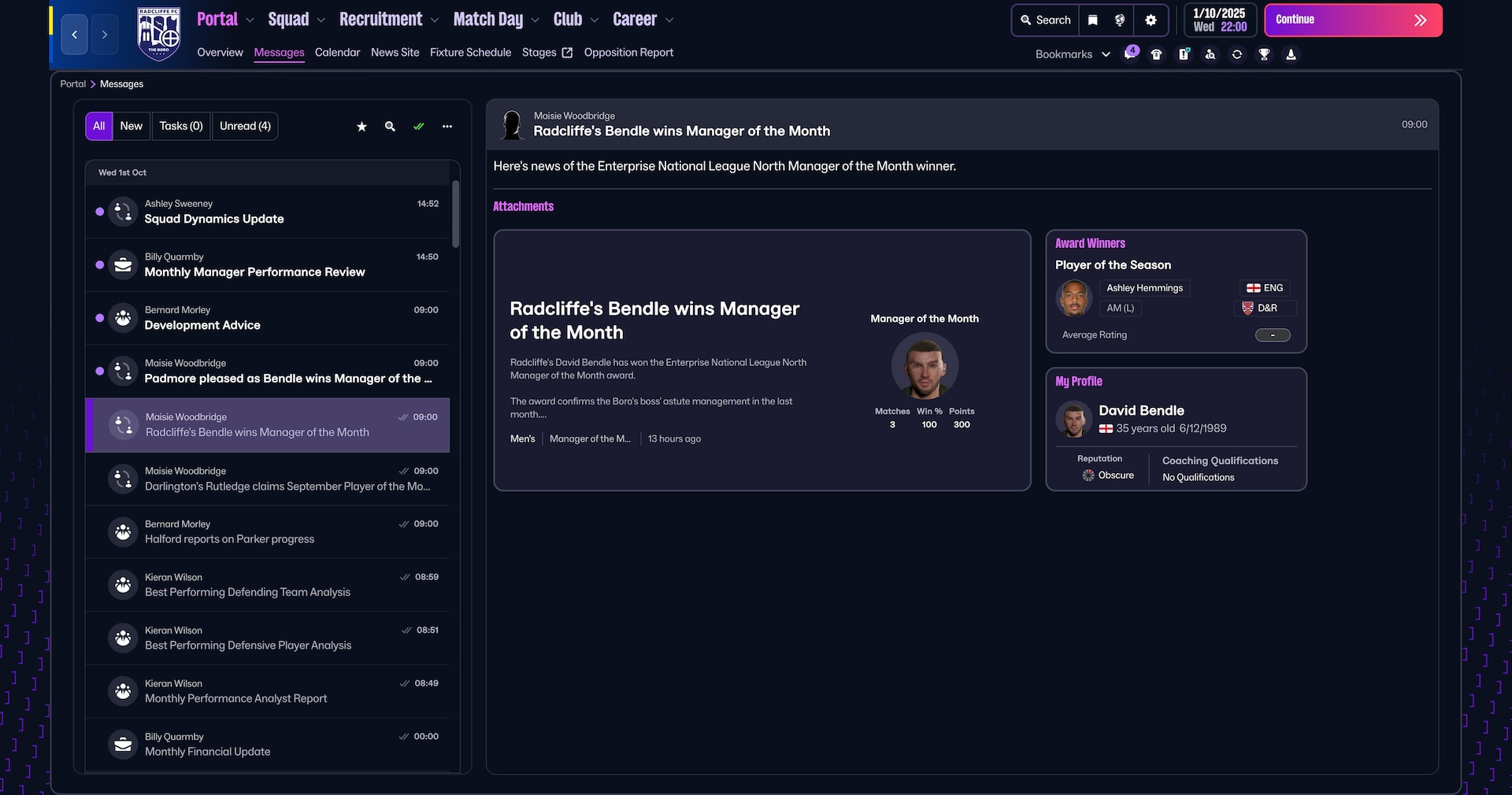
Interface and Usability: Modern, But Maddening
Visually, Football Manager 26 is the cleanest and most professional-looking entry in the series. The typography, color contrast, and menu transitions are leagues ahead of the utilitarian look of FM24. The onboarding experience is also vastly improved. Tutorials, contextual tips, and the new FMPedia system guide new managers through key concepts without overwhelming them.
However, this polish hides a fundamental issue: usability. Longtime fans will immediately notice the loss of information density — fewer tables, fewer cross-screen comparisons, and a frustrating tendency for menus to prioritize aesthetics over function. Tasks that once took seconds, like checking player morale across your squad or filtering scouting reports, can now take several clicks longer.
The irony is that FM26’s interface feels designed more for watching football than managing it. It’s clean, but in a game built on data, minimalism is not always a virtue.
Performance, Bugs, and Stability
The rough launch of FM26 cannot be ignored. Upon release, thousands of players reported technical problems ranging from crashes and corrupted saves to severe frame rate drops during 3D matches. Sports Interactive has since released multiple hotfixes, but the game remains less stable than previous entries.
This matters because Football Manager thrives on long-term saves. Players can invest hundreds of hours building dynasties, developing youth academies, and reshaping club identities. Losing that progress due to instability is devastating — and it undermines trust in the game’s new foundation.
The Unity engine’s flexibility promises a brighter long-term future for the series, but FM26’s technical fragility makes it feel more like an extended beta test than a polished release.
Presentation and Atmosphere
For all its gameplay hiccups, Football Manager 26 undeniably feels more alive. The redesigned matchday experience — complete with animated pre-match lineups, broadcast-style camera cuts, and contextual commentary panels — adds immersion that earlier games simply couldn’t muster.

Crowd reactions, weather effects, and stadium lighting have also seen meaningful upgrades. Matches now feel like actual events, with a sense of rhythm and atmosphere that draws you in, even when results don’t go your way.
This new presentation direction hints at the series’ next evolution: blending its unmatched simulation depth with the sensory drama of real football. It’s not there yet, but FM26 lays the foundation.
A Platform for What’s Next
In its best moments, Football Manager 26 feels like the future. It’s more cinematic, more immersive, and more welcoming than any entry before it. But its worst moments — the instability, the half-finished systems, the inconsistent AI — remind you just how risky this generational transition has been.
There’s brilliance in the ambition, but the execution is uneven. Sports Interactive clearly wants to turn Football Manager into a living platform that can evolve continuously, and FM26 feels like the groundwork for that future rather than a fully realized game in its own right.
If you’re a veteran of the series, patience will be essential. If you’re a newcomer, this might actually be the best entry point yet — provided you can tolerate the technical growing pains.
Final Verdict: 6/10
Football Manager 26 is both a celebration and a cautionary tale. It celebrates progress — visual fidelity, accessibility, and ambition — but cautions against losing sight of what made the franchise special: depth, stability, and data-driven design. There’s greatness on the horizon, but this season feels more like pre-season — full of potential, not yet performance. A bold but troubled rebuild that shows the future of the franchise — just not its best present.