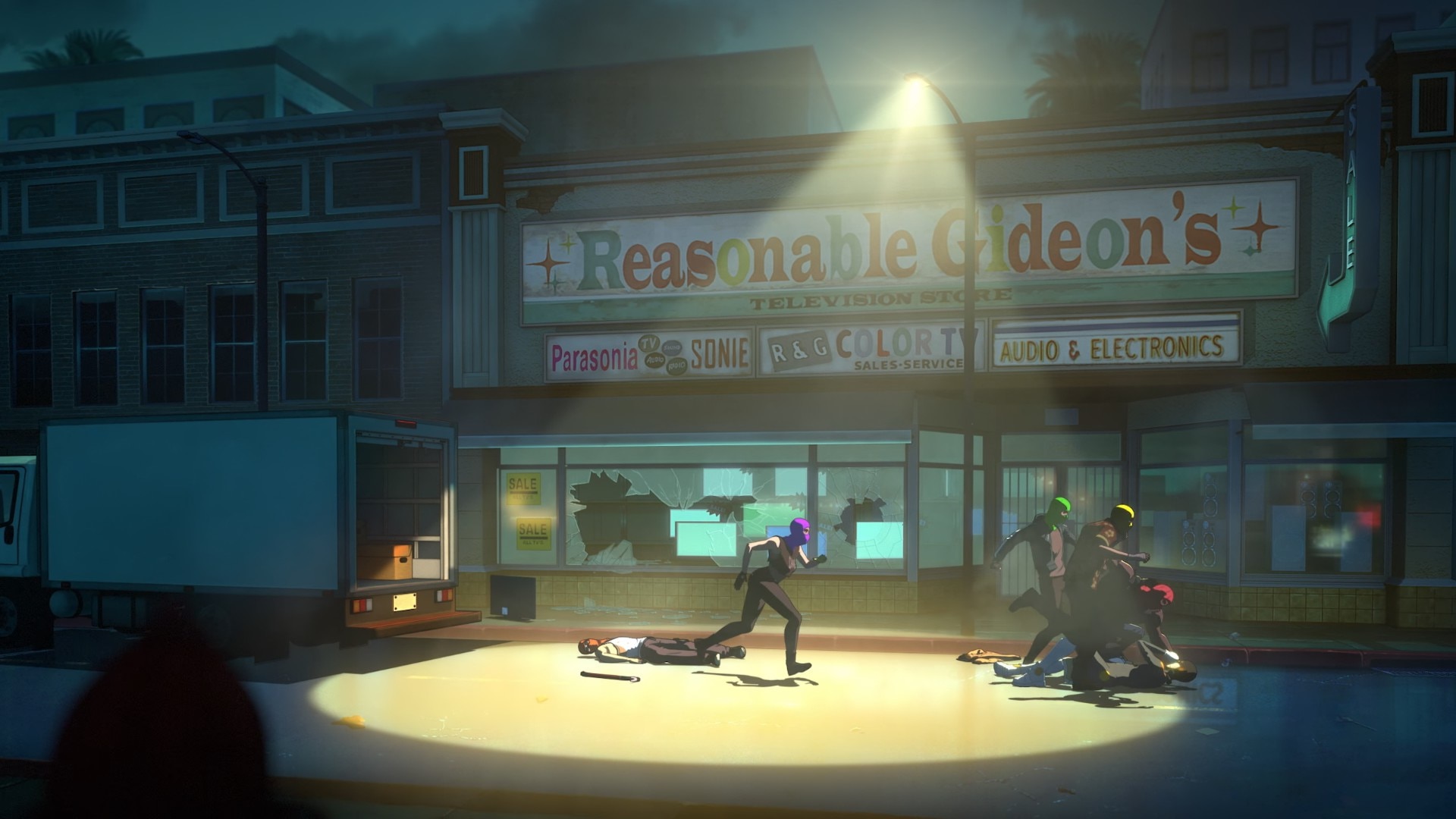
The superhero genre in gaming has long favored spectacle over substance — soaring flight sequences, apocalyptic stakes, and the comforting binary of good and evil. Dispatch, the new episodic adventure from AdHoc Studio, inverts that formula completely. Here, you don’t leap from rooftops or punch asteroids. You sit in a cubicle. You stare at a flickering monitor. You listen to desperate voices crackle through comms as you decide which dysfunctional, half-reliable superhero to send into danger.
It sounds almost absurd — and that’s exactly the point. Dispatch isn’t interested in power fantasies. It’s interested in responsibility, bureaucracy, and the quietly tragic comedy of being a hero who’s been benched. Developed by former Telltale Games veterans, it blends narrative-driven storytelling with a light but clever management layer to explore what happens after the glory days fade.

Story and Characters
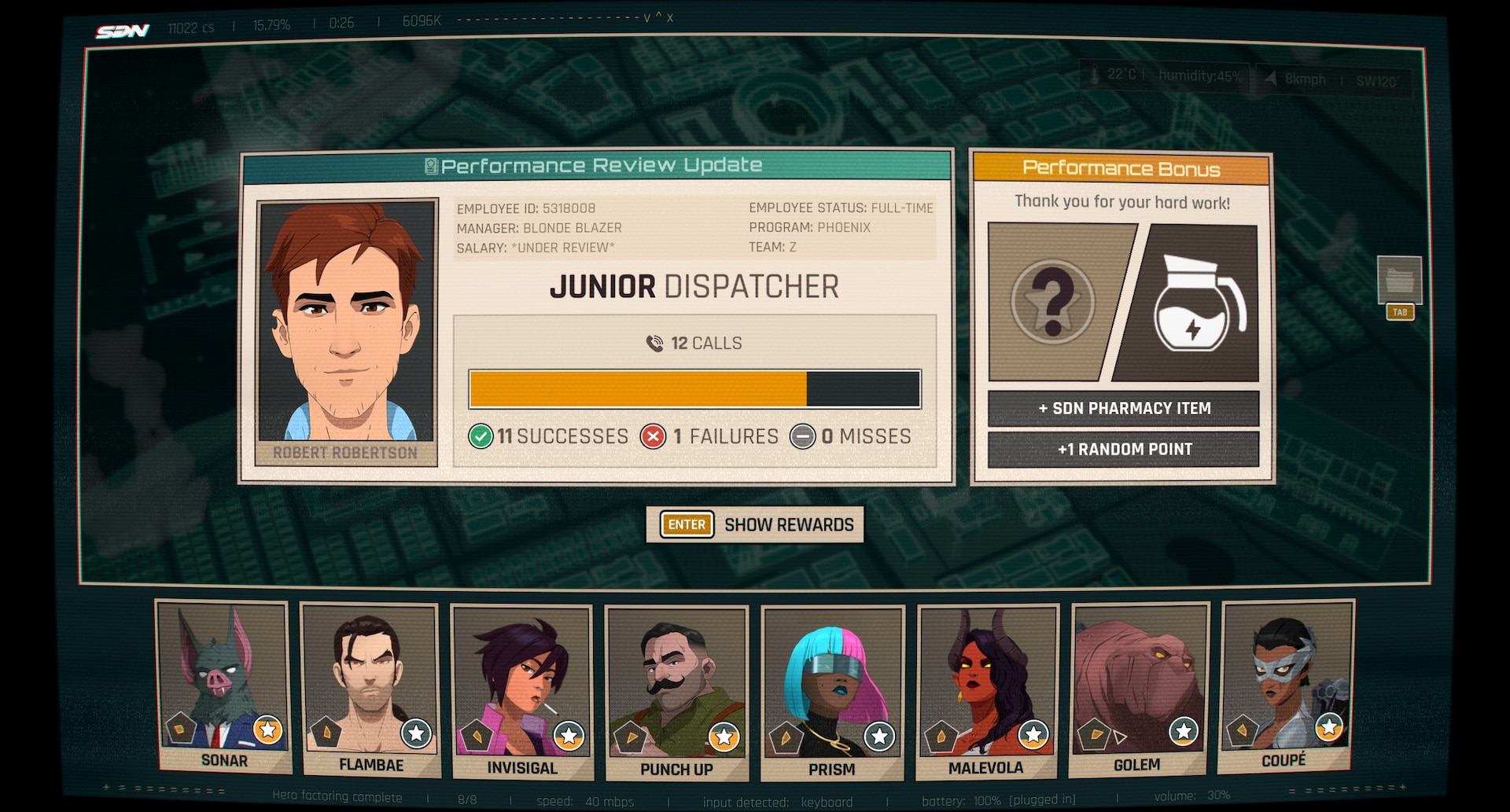
The story centers on Robert Robertson, once known as “Mecha Man,” a retired hero turned dispatcher for a privatized superhero agency known as The Watch. The opening scene sets the tone perfectly: a morning routine punctuated by passive-aggressive emails, half-empty coffee cups, and the low hum of fluorescent lights. Robert’s world is one of post-heroic malaise, populated by colleagues who were once sidekicks, nemeses, or fallen legends themselves.
The narrative unfolds primarily through branching dialogue and dynamic mission briefings. Each conversation — whether it’s a tense call from headquarters or an awkward lunchroom chat — reveals more about the game’s world and Robert’s crumbling sense of purpose. The writing is whip-smart, alternating between sardonic humor and understated melancholy. It skewers corporate culture with uncomfortable accuracy: mandatory “hero sensitivity training,” PR teams spinning disasters into marketing wins, and mid-level managers who measure success in metrics rather than lives saved.
Yet beneath the satire lies genuine pathos. Robert’s struggle isn’t just professional — it’s existential. He’s a man haunted by his own mythology, clinging to relevance through spreadsheets and radio chatter. The game’s emotional resonance comes not from saving the city, but from the quiet moments: a voicemail from an old teammate, a late-night self-reprimand, the silence after sending a team into danger knowing they might not return.
Aaron Paul delivers an exceptional performance in the role, capturing Robert’s dry wit and weary introspection with subtle nuance. The supporting cast — including Laura Bailey, Jeffrey Wright, and newcomer Amara Lee — is uniformly strong. Their chemistry, even when filtered through intercom static or office banter, gives Dispatch a sense of ensemble realism rarely achieved in games. The voice direction and pacing of dialogue feel meticulously edited, closer to serialized television than to the staccato rhythm of traditional branching games.
Gameplay and Mechanics
The gameplay alternates between interactive narrative segments and the dispatch interface — the latter being where Dispatch truly distinguishes itself. From your command terminal, you review incident reports, analyze threat levels, and assign heroes based on their skills, personalities, and current mental state.
Each mission presents a set of variables: the nature of the emergency, the expected opposition, and environmental factors like weather or time pressure. Heroes have stats — competence, empathy, stability — that fluctuate according to success or trauma. One hero might excel in high-intensity combat but crumble under moral dilemmas; another may be useless in a fight but a miracle worker in negotiations.
This system creates a delicate web of risk and reward. Sending the same hero too frequently may increase their burnout, while ignoring personal conflicts among the team can lead to mission failures or interpersonal blowups that echo across future episodes. Decisions are rarely black and white; they carry psychological and logistical consequences that ripple through dialogue and relationships.
The management mechanics are accessible rather than complex, but the emotional framing gives them weight. It’s not a numbers game — it’s a people game. You begin to understand each hero’s limits, sometimes pushing them too far for the sake of saving others, and the guilt that follows feels tangible.
During missions, the game occasionally shifts into lightly interactive sequences — brief quick-time events, branching radio dialogues, or short cinematic decisions — that reveal how your chosen hero is handling the crisis. The tension lies in watching from afar, knowing you can only influence events indirectly.

Performance and Presentation
On PC, Dispatch is impressively optimized, though not flawless. The visual design blends stylized realism with a painterly animation aesthetic reminiscent of rotoscope techniques. Characters are expressive without entering uncanny territory, and the environmental art captures the oppressive sterility of office spaces with quiet precision. Neon reflections, cluttered desks, and dynamic lighting add texture to an otherwise monotonous world — a visual metaphor for Robert’s state of mind.
The PC version benefits from high-resolution textures, adjustable frame-rate caps, and ultra-wide support. Running on a mid-range GPU (RTX 4070 or equivalent), the game consistently hits 120 FPS at 1440p. However, a few players have reported minor issues such as occasional stuttering during transitions and UI scaling quirks at nonstandard resolutions. These are minor irritants rather than deal-breakers, and AdHoc has already released one post-launch patch addressing mouse-cursor lag and save-file desyncs.
Audio is another standout. The ambient sound design — the quiet whir of computers, the hum of distant sirens — is subtle yet immersive. The original score by Ben Prunty (known for Into the Breach and Faster Than Light) blends percussive electronic beats with melancholy synth undertones, evoking both tension and fatigue. On PC, the spatial audio mix benefits from good headphones, making every phone call, every muffled shout through static, feel eerily intimate.
Accessibility options are extensive: fully remappable controls, scalable text, optional color-blind filters, and even adjustable dialogue pacing for players who prefer to read subtitles without time pressure. The interface’s clean, minimal aesthetic complements the setting’s bureaucratic tone — sleek yet claustrophobic.
Pacing and Episodic Structure
Each of the two currently released episodes runs roughly two to three hours, depending on player exploration and reading pace. The pacing is deliberate, encouraging introspection over adrenaline. Dialogue scenes are unhurried, and the management segments allow you to linger over each choice. It’s a rhythm that rewards patience and observation rather than impulse.
Between episodes, the game preserves all your previous decisions, allowing character relationships and outcomes to carry forward. Subtle references to earlier mistakes — a hero’s passive-aggressive comment, a changed office dynamic — build continuity that feels organic rather than forced.
Still, the episodic model demands commitment. Dispatch clearly plays the long game, establishing emotional and thematic threads that are only beginning to surface by the end of Episode 2. Players seeking closure or large-scale branching consequences may need to wait until later in the season to see the full impact of their decisions.

Themes and Interpretation
What makes Dispatch remarkable isn’t its mechanics but its perspective. By turning heroism into an administrative task, it reframes the entire mythology of superheroes as a metaphor for workplace fatigue, accountability, and emotional labor. Robert’s struggle mirrors that of countless professionals in real-world bureaucracies: the dissonance between the ideals they once believed in and the compromises their jobs now demand.
The game also interrogates the commodification of heroism. The Watch doesn’t save people out of altruism; it does so to maintain contracts, reputation, and quarterly performance bonuses. Through dialogue, Dispatch draws uncomfortable parallels to real-world institutions — private healthcare, corporate philanthropy, defense contracting — without ever feeling didactic.
The humor keeps the tone buoyant even as the themes darken. Some of the best scenes come from the absurdity of office life colliding with world-saving stakes: HR meetings about “inter-team romance policies,” PR debates over whether to market disasters as “controlled interventions,” or Robert’s exasperation at being cc’d on yet another “Hero Brand Identity” memo. It’s all painfully believable and bitingly funny.
Final Verdict: 8/10
Dispatch is not a power fantasy — it’s a reflection on power’s decay. It’s a story about control, responsibility, and the small tragedies that unfold when people who once saved the world now struggle just to keep their jobs.
On PC, it runs beautifully, looks sharp, and sounds exceptional. Its narrative depth, voice performances, and writing quality elevate it far above most episodic fare. The gameplay may lack mechanical complexity, but it compensates with emotional intelligence and an understanding of how choice, consequence, and context can form powerful storytelling.
As of its first two episodes, Dispatch stands as one of the most intriguing narrative experiments of 2025 — a smart, bittersweet meditation on what it means to matter when the spotlight fades. If AdHoc Studio can maintain this standard through the remaining chapters, Dispatch may well redefine what the “episodic adventure” can achieve.