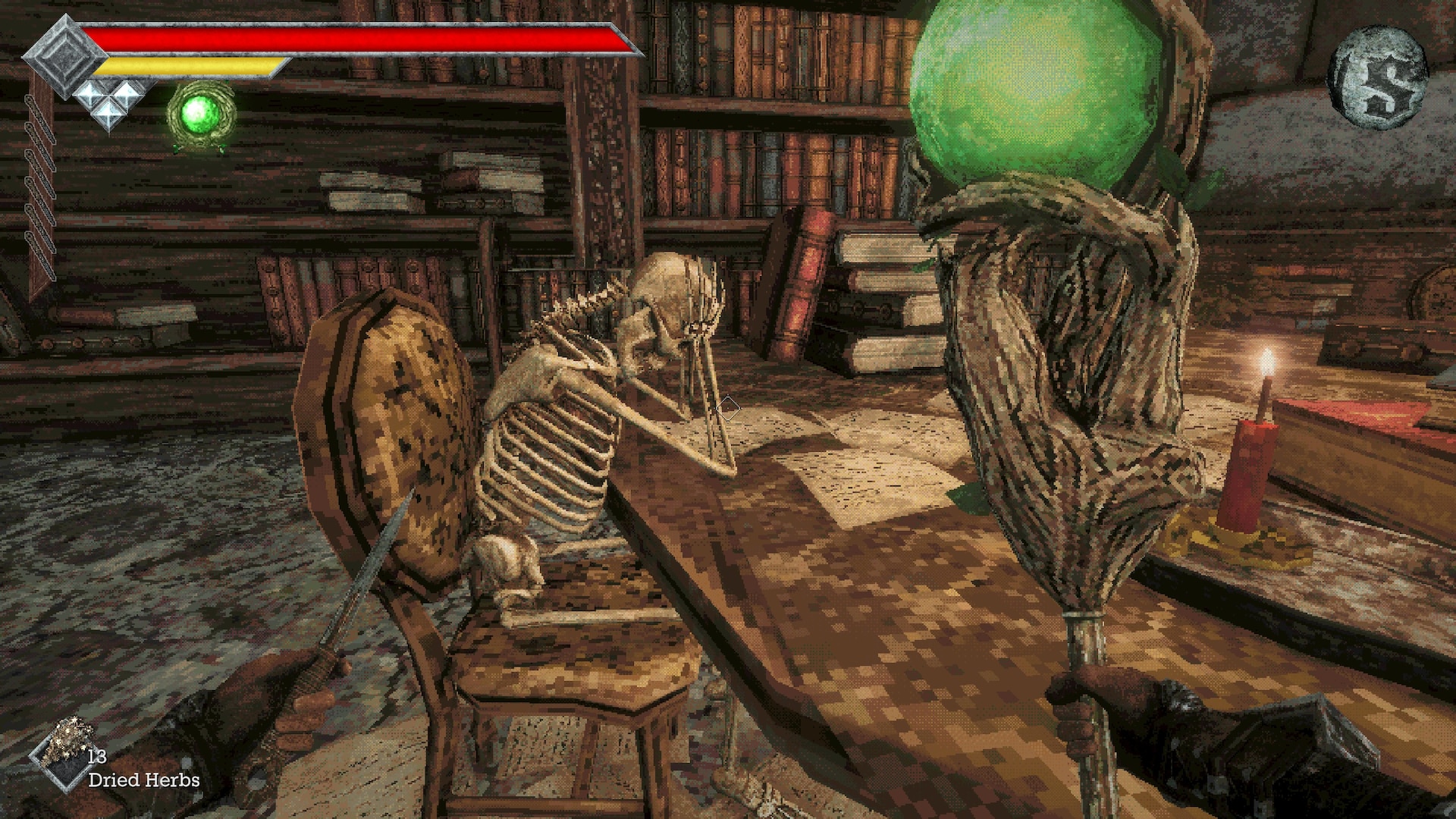
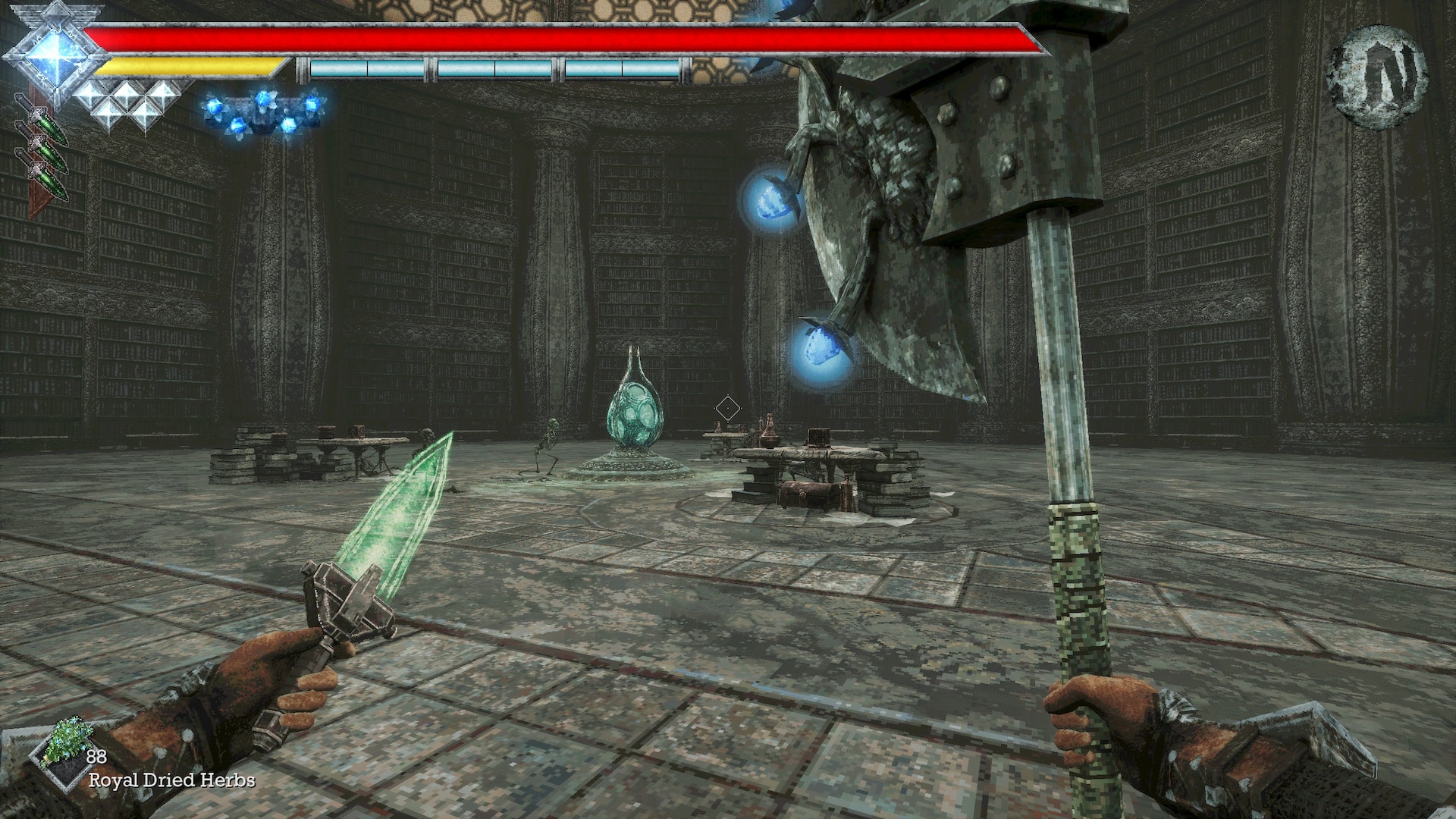
There is something appealing about games that trust players to find their own way. In an industry where objective markers, quest logs, and carefully guided progression have become standard, a game that simply drops players into an unfamiliar world and expects them to figure things out can feel surprisingly refreshing. Queen’s Domain, developed by Freshly Baked Games, embraces this philosophy wholeheartedly. Inspired by FromSoftware’s early first-person RPGs, particularly the King’s Field series, it attempts to recapture the atmosphere and sense of discovery associated with those games while introducing a few ideas of its own.
Set on the mysterious Isle of Neasied, the adventure follows a prince whose father, King Gius Abraon, has disappeared after leading an expedition to confront an ancient evil. Following an attack that destroys his ship, the prince finds himself stranded on the island and must continue his father’s mission, exploring its ruins, underground passages, and dangerous territories while uncovering the secrets surrounding its inhabitants and history. The threat comes from Queen Siraatsu, a powerful figure whose awakening puts the island and potentially much more in danger.
The premise is straightforward, and the storytelling rarely becomes the main attraction. Instead, Queen’s Domain places most of its emphasis on exploration, environmental design, and gradual character progression. Its world is an enormous interconnected labyrinth filled with hidden passages, optional areas, shortcuts, and treasures that reward players for looking beyond the obvious route. A particularly clever movement mechanic gradually expands the possibilities, transforming seemingly inaccessible locations into destinations worth investigating.
The result is a substantial adventure that understands what made its inspirations memorable. Its combat can be slow and occasionally repetitive, and its reluctance to provide guidance sometimes creates unnecessary frustration. Nevertheless, Queen’s Domain offers a compelling combination of old-school dungeon crawling and modern exploration mechanics, making it considerably more than a straightforward nostalgia trip.
Gameplay and Mechanics
At first glance, Queen’s Domain appears to be a fairly conventional first-person action RPG. Players explore the environment, fight monsters, collect equipment, discover new areas, and improve their character through experience and equipment upgrades. Combat revolves around managing a resource called the Power Meter, weapon selection, and positioning, while exploration gradually introduces new abilities that expand the player’s access to the island.
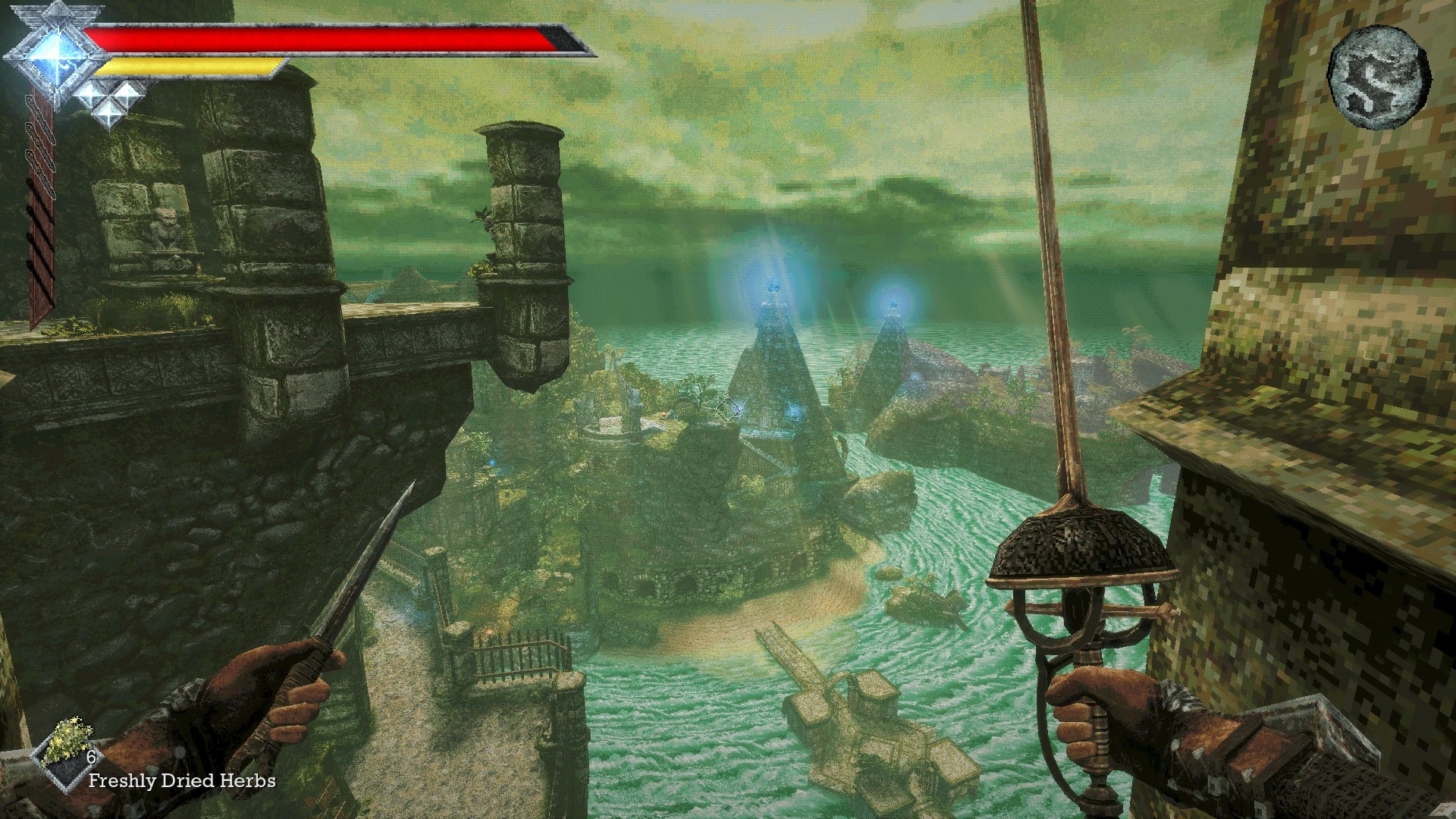
The most important of these abilities comes from the Holy Sword Endu, an ancient weapon obtained relatively early in the adventure. Although it can be used in combat, its real significance lies in its special movement ability. Endu allows the player to perform a forward dash and glide through the air, making it possible to cross large gaps and reach otherwise inaccessible platforms. Additional Wind Gems discovered throughout the island increase the number of consecutive aerial dashes available.
This mechanic fundamentally changes how the game is played. Initially, distant ledges and isolated platforms appear to be little more than background scenery. As more Wind Gems are collected, however, previously unreachable locations become viable destinations. A narrow opening in a distant wall might conceal a valuable weapon, while a seemingly insignificant platform beneath a cliff could lead to an entirely new section of the island.
The clever part is that the game rarely announces these opportunities. Players must examine their surroundings, estimate distances, and experiment with their available movement abilities. There is considerable satisfaction in discovering a route that the game never explicitly identifies as a possible path. It also encourages revisiting earlier locations, since acquiring additional movement upgrades can reveal secrets that were impossible to reach during the first visit.
This gives Queen’s Domain a strong Metroidvania influence without abandoning its first-person RPG foundations. Progression is tied not only to character development and equipment but also to the player’s growing ability to navigate the environment. Endu is therefore much more than another weapon or movement upgrade; it is the central mechanic around which the island’s level design is constructed.
The game also offers a considerable amount of equipment to discover. Its catalogue includes more than 50 melee weapons and over 20 types of secondary throwing weapons, providing plenty of opportunities to experiment with different approaches. These weapons have different damage characteristics and special attacks, giving players reasons to adjust their equipment according to the enemies they encounter.
One particularly interesting feature is weapon evolution. Equipment improves through use, gradually increasing its effectiveness and sometimes transforming into entirely different weapons. Certain rusty weapons, for example, can eventually evolve into unique alternatives after being used extensively. This system gives even relatively unimpressive discoveries a potential long-term purpose and encourages experimentation rather than immediately abandoning anything that initially seems weak.
Character development is also tied to collecting food. Certain food items provide additional statistical improvements, making exploration and resource collection worthwhile beyond their immediate benefits. These bonuses complement the experience-based levelling system and give players another reason to investigate the island thoroughly.
Exploration and Level Design
Exploration is unquestionably Queen’s Domain’s greatest achievement. The Isle of Neasied is not simply a collection of disconnected dungeons arranged around a central hub. Its various environments form an interconnected network of locations that gradually reveal their relationships as players progress.
The level design frequently relies on verticality. Paths lead upward toward ruined structures, descend into enormous underground complexes, or wind around cliffs and seemingly inaccessible sections of the landscape. Areas often connect through shortcuts that make returning to previously explored locations considerably easier, while hidden passages provide additional routes for those willing to investigate their surroundings.
This structure creates a particularly satisfying rhythm. Players might spend considerable time navigating an unfamiliar dungeon, only to discover that a previously locked door connects it to an area visited much earlier. Such discoveries make the world feel cohesive rather than artificially divided into individual stages. The island gradually becomes easier to understand, not because the game explains its geography, but because players develop their own mental map through exploration.
The Holy Sword Endu makes this approach considerably more interesting. Unlike conventional ability upgrades that simply unlock another door or remove a particular obstacle, its additional aerial dashes introduce new possibilities across almost every environment. A ledge that once appeared completely inaccessible might become reachable with another Wind Gem, while a seemingly bottomless drop could conceal an alternative route or valuable treasure.
Secrets are everywhere, and the game rarely makes finding them effortless. Hidden walls, concealed platforms, unusual environmental details, and overlooked corners can contain useful equipment and resources. Some discoveries are relatively straightforward, while others require considerable experimentation. Certain items and tools can also help reveal otherwise difficult-to-spot secrets, adding another layer to the exploration.
The environments themselves are varied enough to keep the experience interesting over its lengthy runtime. Lush outdoor areas provide a welcome contrast to dark underground passages, while ancient ruins, unusual architectural structures, and more elaborate dungeons help establish the island’s mysterious character. Enemy placement and environmental hazards also encourage players to approach unfamiliar locations carefully.
The game does not provide a conventional world map or a quest-marker system. Instead, players must rely on landmarks, their own memory, and the compass to navigate. This can initially feel disorienting, especially when several passages lead into similarly structured areas. However, it also contributes to the sense of actually exploring an unfamiliar place rather than following a predetermined route.
There are occasional problems with readability. Some important items blend into the surrounding scenery, and the game’s willingness to leave players without clear directions can make it difficult to distinguish between a deliberately hidden route and a path that simply cannot be accessed yet. Nevertheless, these issues rarely undermine the overall quality of the level design.
Queen’s Domain understands that exploration works best when the world itself provides the motivation to keep moving. Even after spending considerable time in a particular area, there is usually another passage, shortcut, or unexpected discovery waiting somewhere nearby.
Combat and Enemy Design
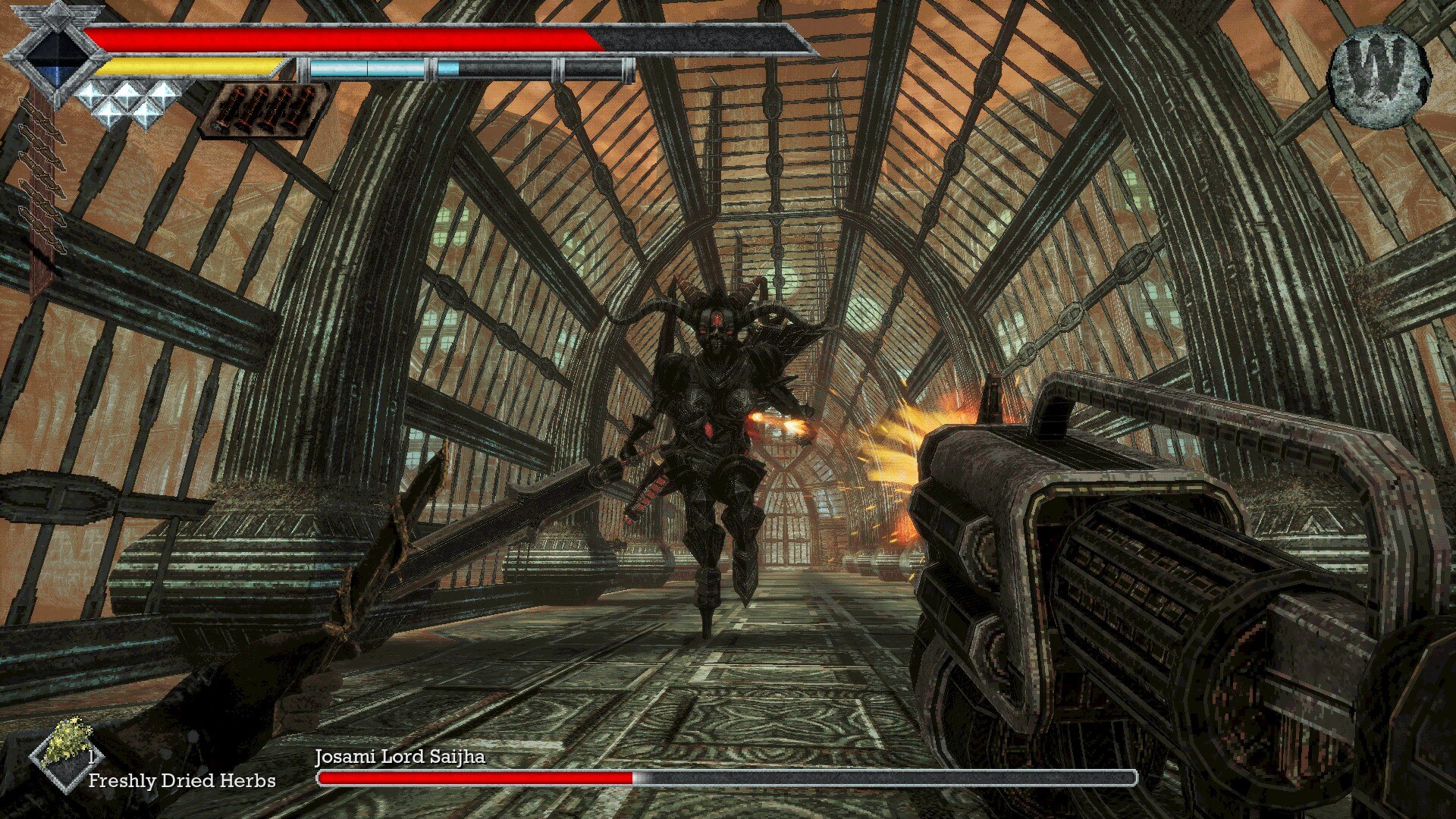
Combat is considerably more traditional than the game’s exploration mechanics. Battles take place from a first-person perspective, with players using melee weapons, throwing weapons, and equipment with magical abilities to deal with the creatures inhabiting Neasied.
The Power Meter is central to the experience. It functions as a stamina system, but it also directly influences the damage dealt by melee attacks. Attacking when the meter is full produces considerably more damage than swinging a weapon when it is depleted. Holding the attack button allows players to charge their attacks further, increasing their effectiveness.
Running also drains the Power Meter, although it does not prevent players from running when the meter is empty. The drawback is that the meter will not recharge while running, leaving melee attacks considerably weaker until the player stops and allows it to recover. This creates an interesting balance between movement and combat, particularly when attempting to reposition during an encounter.
Instead of constantly attacking, players must observe enemy behaviour, choose opportunities to strike, and reposition themselves when necessary. There is relatively little emphasis on elaborate combos or highly responsive defensive techniques. Movement and spacing are the primary tools for avoiding damage.
Weapon selection adds some welcome depth. Enemies have different weaknesses, and the distinction between slashing, piercing, and impact damage can make a noticeable difference. Players can consult the Bestiary to learn more about creatures they have encountered, including their defensive characteristics. A weapon that performs poorly against one creature might be considerably more effective against another.
The throwing weapons are particularly useful because they provide an alternative to conventional melee combat. Daggers, chakrams, and other projectiles can be used against distant enemies or when approaching a dangerous opponent would be unwise. They operate through a recharge system rather than conventional ammunition, encouraging players to incorporate them into their regular combat strategies.
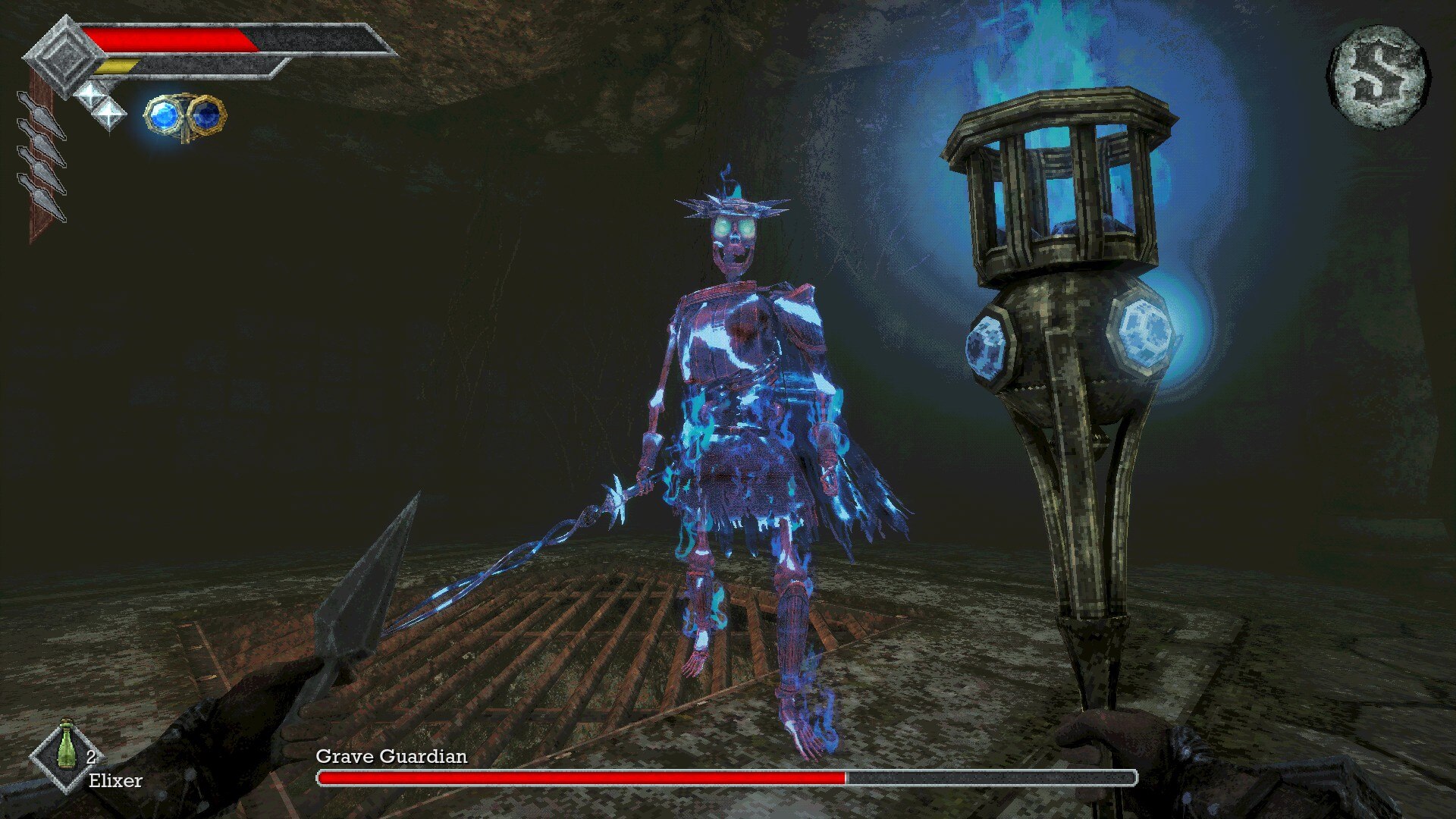
Boss encounters provide more substantial challenges, although their quality is not entirely consistent. Some demand careful positioning and an understanding of enemy attack patterns, while others are less memorable than the exploration leading up to them. Enemy variety is generally respectable, with more than 100 enemies, minibosses, and bosses advertised as part of the game’s content. However, the game does occasionally reuse familiar creatures in later areas, sometimes with altered appearances or different behaviour.
The biggest weakness is the combat’s limited sense of flow. Early encounters can become repetitive, with players repeatedly waiting for the Power Meter to recover before delivering another effective attack. The system becomes more interesting as additional weapons and abilities become available, but it never entirely escapes its deliberately old-fashioned foundations.
The lack of conventional defensive options also takes some getting used to. Positioning, moving away from attacks, jumping, and using the Holy Sword’s movement ability are important ways to avoid damage. Players accustomed to the dodge rolls, blocks, and parries of modern action RPGs may find this approach restrictive.
Combat is functional and occasionally satisfying, particularly when equipment selection and enemy weaknesses come into play. However, it is rarely the main reason to continue playing. Queen’s Domain is at its best when it allows players to explore its world rather than forcing them into another repetitive encounter.
Progression and Difficulty
Character progression follows familiar RPG conventions, although it is less focused on traditional build crafting than some modern action RPGs. Defeating enemies rewards experience, which contributes to character development, while equipment and accessories provide additional ways to improve effectiveness. Food items offer further statistical improvements, making them particularly valuable discoveries during exploration.
The weapon evolution system is particularly effective because it encourages players to remain interested in their equipment. Weapons gain experience through use, improving their statistics and sometimes transforming into entirely new forms. Discovering a weapon with an unusual ability can therefore lead to a long-term investment rather than simply providing another temporary upgrade.
Difficulty, however, is not particularly forgiving. Queen’s Domain expects players to pay attention, prepare for encounters, and learn from mistakes. Enemies can be dangerous, particularly when encountered in unfamiliar environments, and careless exploration can result in the loss of considerable progress.
Crystal Monuments serve as the game’s manual saving points. Interacting with them allows players to save their progress, while resting restores health and clears status ailments. There is an important distinction between these functions, however: resting also causes defeated enemies to respawn. This creates an interesting risk-and-reward dynamic, although the limited availability of saving locations can make certain sections unnecessarily punishing.
Death is particularly costly. There is no conventional system in which players can return to their corpse and recover lost experience or equipment. Instead, they return to their last manual save, losing progress made since that point. This makes saving regularly essential, especially before entering unfamiliar areas or attempting difficult encounters.
Fast travel does exist, through Wing Altars that players discover and activate throughout the island. Additional travel items provide further flexibility, but the system is not as convenient as simply teleporting to any previously visited location whenever desired. Players will still spend a considerable amount of time navigating familiar areas, particularly when searching for secrets that become accessible later.
Healing resources also require attention. Although resting at a Crystal Monument restores health, doing so brings defeated enemies back. Players therefore have to decide whether to continue exploring with limited resources or return to a monument and potentially fight their way through familiar territory again. Enemies can also respawn after a certain amount of time, meaning previously cleared areas are not necessarily safe when revisited.
The absence of conventional quest markers and a detailed objective log further contributes to the difficulty. Players must remember clues, interpret environmental details, and work out where to go next. This approach is refreshing when the game provides enough information to make progress through observation, but it becomes less enjoyable when important requirements are poorly communicated.
The distinction becomes especially important when pursuing additional endings. Reaching the first ending can take approximately 20 hours, depending on how thoroughly players explore. Discovering everything the island has to offer requires considerably more investigation. Certain collectibles and hidden discoveries necessary for the more complete ending are particularly difficult to locate without outside assistance.
The developers have made some adjustments to particularly frustrating late-game puzzles in post-launch updates, which is welcome. Nevertheless, Queen’s Domain remains a game that expects patience and a willingness to explore without much assistance.
Story and World-Building
Queen’s Domain establishes an intriguing setting, but its narrative is not quite as successful as its environmental design. The central premise provides a reasonable foundation for the adventure. The prince’s search for his father gradually leads to revelations about the island, its inhabitants, and the ancient forces threatening it. The story of Queen Siraatsu and the consequences of her awakening provides a larger context for the journey, while the abandoned structures suggest that Neasied has a long and complicated history.
Much of the storytelling is delivered indirectly through environmental details, item descriptions, and scattered pieces of information. This approach is clearly influenced by FromSoftware’s earlier RPGs and later Souls games, where players are expected to assemble the larger picture themselves.
Unfortunately, Queen’s Domain does not always provide enough context to make these discoveries particularly meaningful. Some descriptions introduce unfamiliar names and references without sufficiently explaining their significance, while interactions with NPCs rarely provide the emotional weight that might have made the main storyline more compelling.
The main narrative also loses some of its momentum as the adventure progresses. Certain important developments arrive earlier than expected, leaving the remaining exploration to carry much of the experience. The game is considerably more effective at creating interesting places to discover than at giving players compelling narrative reasons to visit them.
This is not necessarily a major problem, considering how much of the experience is built around exploration. Nevertheless, a stronger narrative could have given the adventure a more memorable sense of direction and made its major discoveries feel more consequential.
Graphics, Art Direction, and Sound
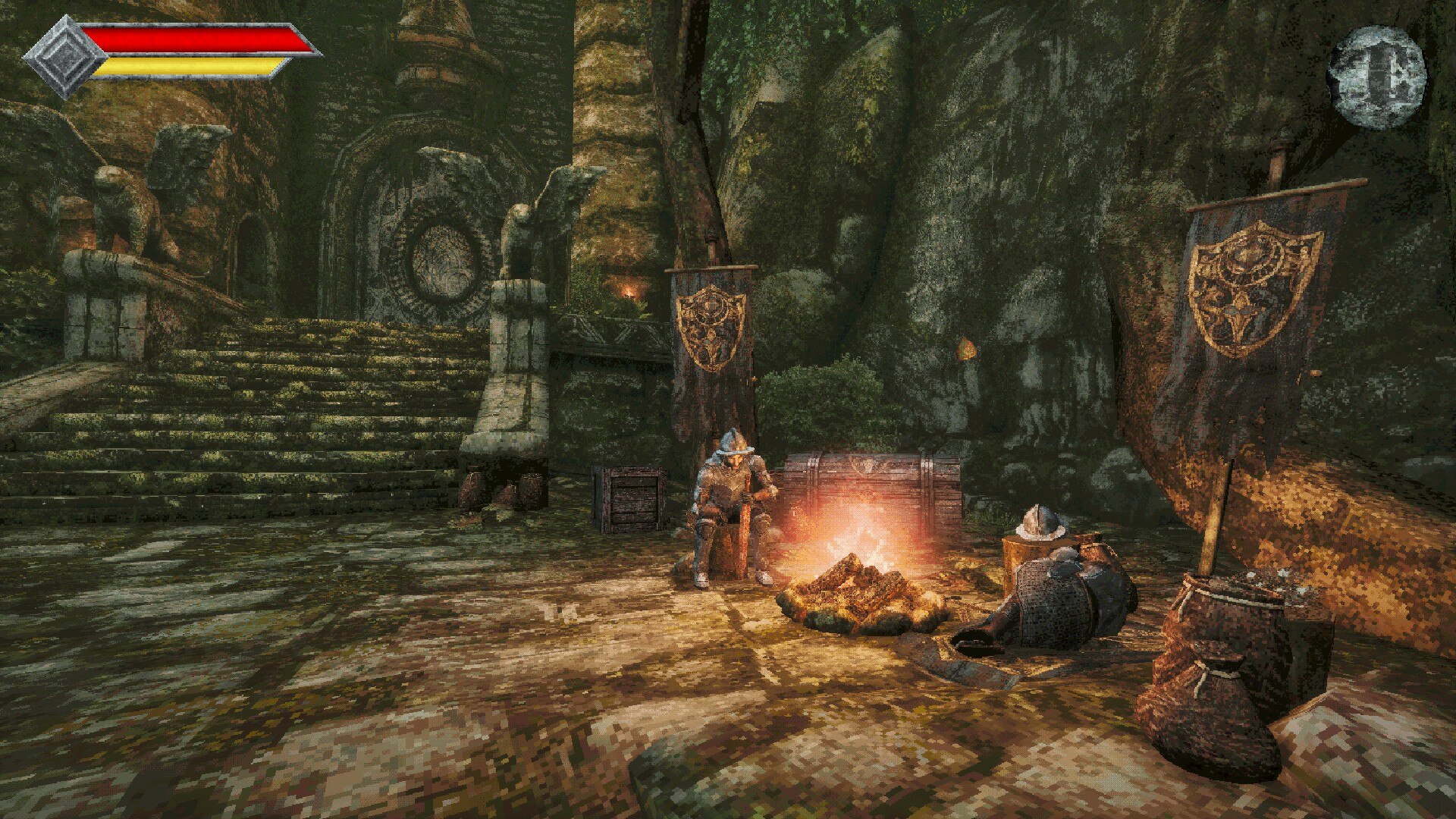
Queen’s Domain adopts a retro-inspired visual style that immediately establishes its identity. Its low-poly models, pixelated textures, and deliberately old-fashioned presentation recall the early days of three-dimensional fantasy RPGs, particularly the original King’s Field games.
However, this is not simply an attempt to recreate the technical limitations of the original PlayStation era. The game makes effective use of modern presentation techniques, particularly its comparatively expansive environments and draw distances. The result is a world that evokes the atmosphere of older dungeon crawlers without feeling quite as restrictive.
The art direction is particularly successful at giving individual locations their own personalities. Outdoor environments provide a welcome contrast to darker underground sections, while the ruins and strange architectural structures help establish a sense of history. Some creatures and environmental designs are also considerably more distinctive than the deliberately rough visual style might initially suggest.
The soundtrack deserves particular attention. With more than 55 tracks composed by Eric Berger, one of the game’s developers, the music contributes considerably to the atmosphere. Rather than relying exclusively on conventional orchestral fantasy compositions, the soundtrack has a distinctive identity that complements the game’s unusual environments and occasionally unsettling encounters.
Its music changes the mood of exploration, providing a welcome contrast between quieter moments and more dangerous encounters. Not every composition is equally memorable, and some players may find certain tracks repetitive over a lengthy adventure. Nevertheless, the soundtrack is an important part of the game’s presentation and deserves more recognition than a passing mention.
Environmental audio is similarly effective. The sounds of nearby creatures, particularly those that can be heard before appearing on screen, add tension to exploration. It is a relatively simple feature, but one that reinforces the importance of paying attention to the environment.
Technical Performance on PC
On PC, Queen’s Domain makes a generally positive technical impression. Its modest system requirements make it accessible to a wide range of hardware, while its retro-inspired visuals allow it to feature relatively expansive environments without requiring particularly powerful components. The official minimum requirements list Windows 10, an Intel or AMD quad-core processor, 4GB of RAM, and an NVIDIA GTX 760 or AMD RX 560 graphics card.
The PC version offers controller support and customisation options, including button remapping. A DirectX 12 launch option was also introduced through an early update. The developers have continued to address technical problems and improve the experience following release.
The initial patches corrected several issues involving progression, collision, weapon evolution, and certain encounters. Subsequent updates addressed additional problems, including enemy behaviour, weapon evolution, graphical and audio issues, and the game’s framerate-limit option. The developers also introduced improvements to late-game puzzles, clearer status-effect indicators, and an option to disable screen shake.
The latest confirmed patch at the time of writing is version 1.01.07, released on November 14, 2026. It addressed a collision problem and a visual issue on the title screen, following several other updates during November.
These improvements are worth acknowledging because some early reports of technical problems may no longer reflect the current version. Nevertheless, the presence of multiple patches also indicates that the launch version had its share of rough edges. Some early reports described problems with collision and enemy behaviour, particularly in later sections, making continued support important.
Overall, the PC release appears to be a solid version of the game. Its technical presentation is not particularly ambitious, but it generally provides a suitable foundation for the exploration and combat systems. The developers’ continued attention to improvements is also encouraging.
Final Verdict: 9/10
Queen’s Domain is a thoroughly enjoyable throwback to a particular kind of RPG that has become increasingly uncommon. Its influences are obvious, but it does more than simply imitate the games that inspired it. The interconnected world, inventive level design, and particularly effective use of the Holy Sword Endu give it an identity of its own.
Exploration is where the game truly excels. Discovering hidden passages, navigating enormous vertical environments, and gradually unlocking new routes through previously explored areas provide a level of satisfaction that few modern action RPGs attempt to replicate. Its weapon progression and extensive selection of equipment also give players plenty of reasons to experiment and investigate every corner of Neasied.
Not everything works quite as well. Combat can feel dated and occasionally repetitive, the saving system is unnecessarily punishing, and the narrative never reaches the same standard as the world-building. Backtracking can also become tiresome, particularly when players are searching for obscure items or trying to uncover the requirements for additional endings.
These shortcomings prevent Queen’s Domain from being a completely polished experience, but they do not diminish what it achieves. Its strongest ideas are implemented with enough confidence and consistency to make the adventure worthwhile, particularly for players who appreciate old-school dungeon crawlers and are willing to invest time in understanding their worlds.
Queen’s Domain is not an RPG designed to appeal to everyone. Its deliberate combat, demanding progression, and occasionally obscure design can be difficult to appreciate if you prefer a more guided and streamlined experience. For those who enjoy the exploratory spirit of King’s Field and the satisfaction of uncovering a world without having every secret explained, however, it is one of the more compelling modern interpretations of that formula.