The bullet-heaven genre has become increasingly crowded since Vampire Survivors popularised its deceptively simple formula. Plenty of games have since attempted to put their own spin on the experience, with varying degrees of success. Some have introduced meaningful mechanical ideas, while others have relied largely on a new setting and a different collection of enemies. Warhammer Survivors, developed by Auroch Digital in collaboration with poncle, the creators of Vampire Survivors, falls somewhere between those approaches. Its foundations are unmistakably familiar, but its use of the Warhammer universe and several worthwhile additions give it an identity of its own.
Bringing together characters, enemies and weapons from Warhammer 40,000 and Warhammer Age of Sigmar, the game offers more than 40 playable champions and an arsenal of over 75 weapons. The premise is straightforward: choose a character, enter a battlefield, survive increasingly dangerous waves of enemies, collect experience and develop a combination of weapons and abilities powerful enough to overwhelm the opposition. The familiar cycle of movement, automatic attacks and increasingly extravagant upgrades remains at the heart of the experience.
What makes the game interesting is how Auroch Digital has adapted that structure. Followers introduce a different approach to weapons and character builds, the two Warhammer settings provide a substantial amount of content, and the more elaborate stages make positioning a greater consideration than it is in many games of the genre. There are shortcomings, particularly in the early progression and the readability of crowded encounters, but there is considerably more here than a simple change of scenery.
Gameplay and Mechanics
Anyone familiar with Vampire Survivors will understand the basic mechanics almost immediately. Characters attack automatically, leaving movement as the player’s primary responsibility. Enemies arrive in increasingly large groups, and defeating them provides experience that can be collected to level up. Each new level offers a selection of weapons, upgrades and passive bonuses, gradually determining how effective a character becomes.
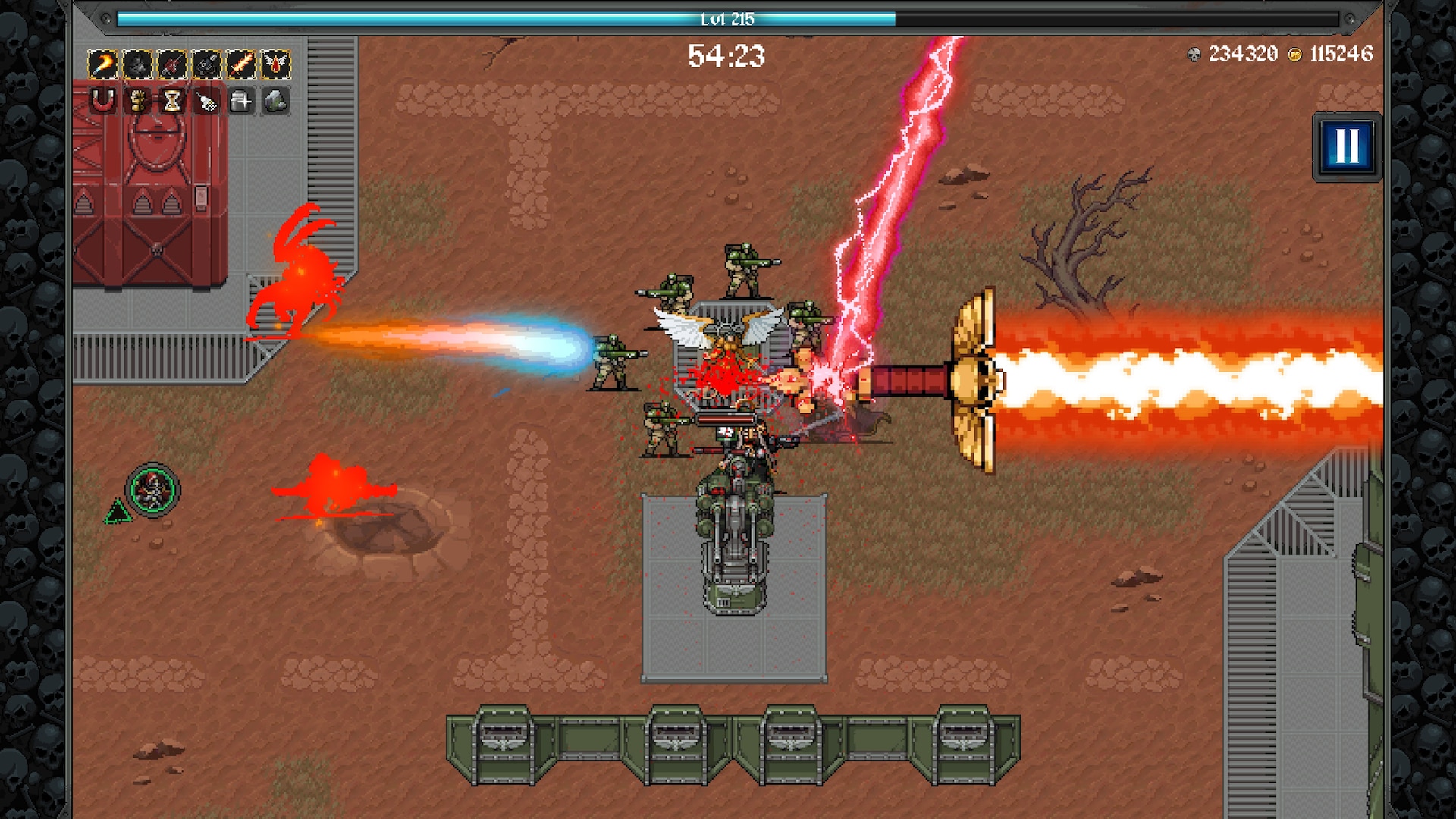
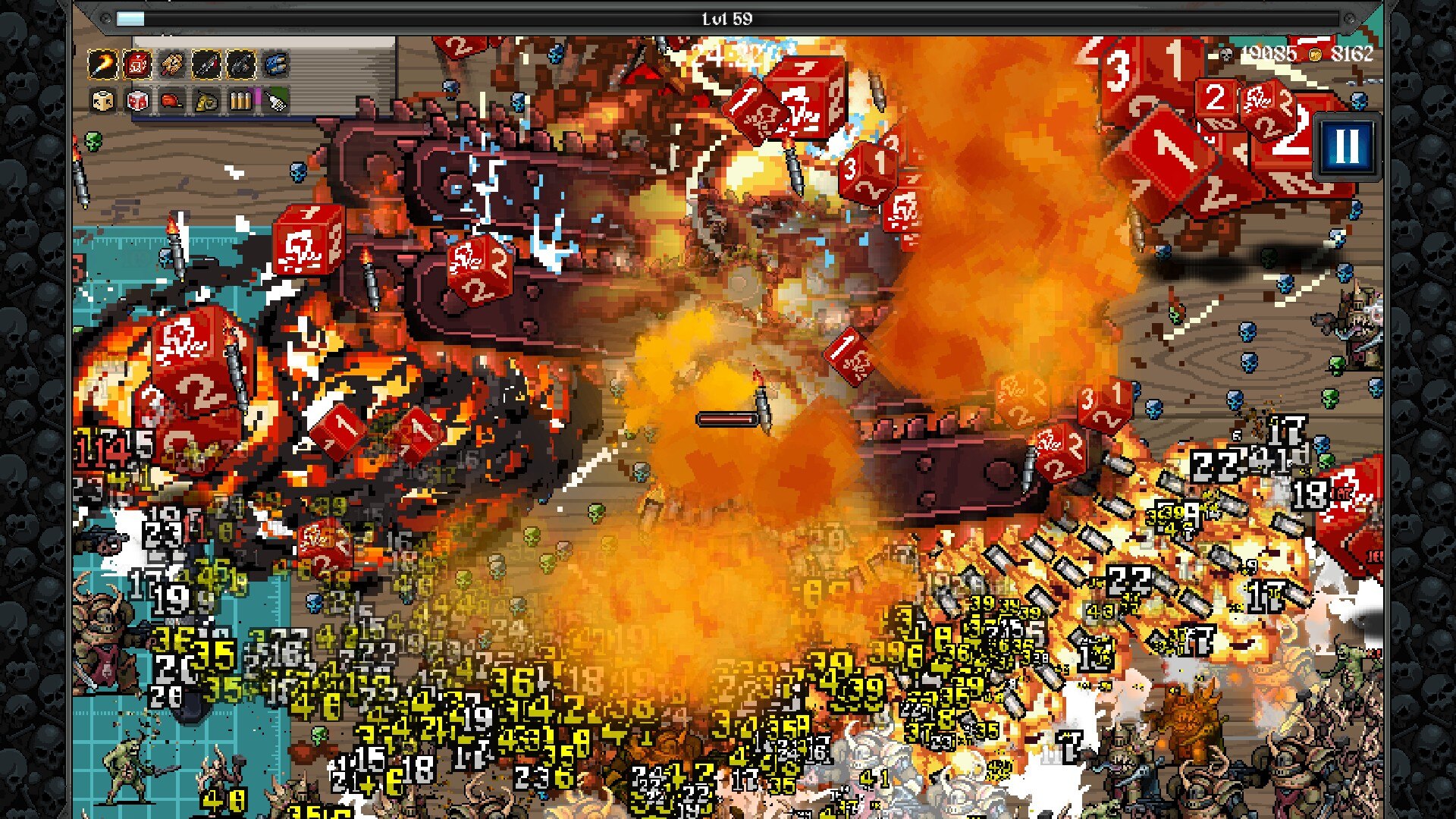
The appeal comes from watching a modest starting loadout develop into an increasingly destructive arsenal. A weapon that initially offers little more than a basic projectile can become a major source of damage after several upgrades, while certain combinations unlock more powerful evolved versions. These transformations are among the most satisfying parts of the experience. They change more than the numbers attached to an attack, often expanding its range, coverage or ability to control approaching enemies. A promising build can eventually fill the screen with projectiles and effects, turning the battlefield into an impressive display of destruction.
There is a degree of strategy beneath the automatic combat. Choosing another weapon may provide an immediate offensive advantage, while a passive item can strengthen existing equipment or help fulfil the conditions for an evolution. The best decision depends on the character, the weapons already acquired and the threats likely to become problematic later in the run. A weapon that appears underwhelming at first can become essential once its supporting item is available. Conversely, spreading upgrades across too many unrelated options can leave a character without the damage or coverage needed to handle stronger enemies.
The random selection system gives individual runs some unpredictability, but it can also make progress feel unnecessarily dependent on luck. A character may have a clear build in mind and spend several level-ups waiting for the right weapon or passive to appear. That uncertainty is part of the genre, but it is less enjoyable when the available choices repeatedly fail to support a workable combination.
The overall structure is familiar, and Warhammer Survivors does not fundamentally change what makes this type of game compelling. Its more interesting contributions come from the way it uses the licence and introduces additional considerations into the combat. The result is a recognisable bullet-heaven experience with enough personality to stand apart from a straightforward imitation.
Setting and Factions
The game’s greatest advantage is its use of two distinct Warhammer settings. Rather than concentrating exclusively on the science-fiction battles of Warhammer 40,000, it also draws from Age of Sigmar. Each universe has its own characters, enemies, stages, weapons and objectives, giving players two substantial collections of content to work through.
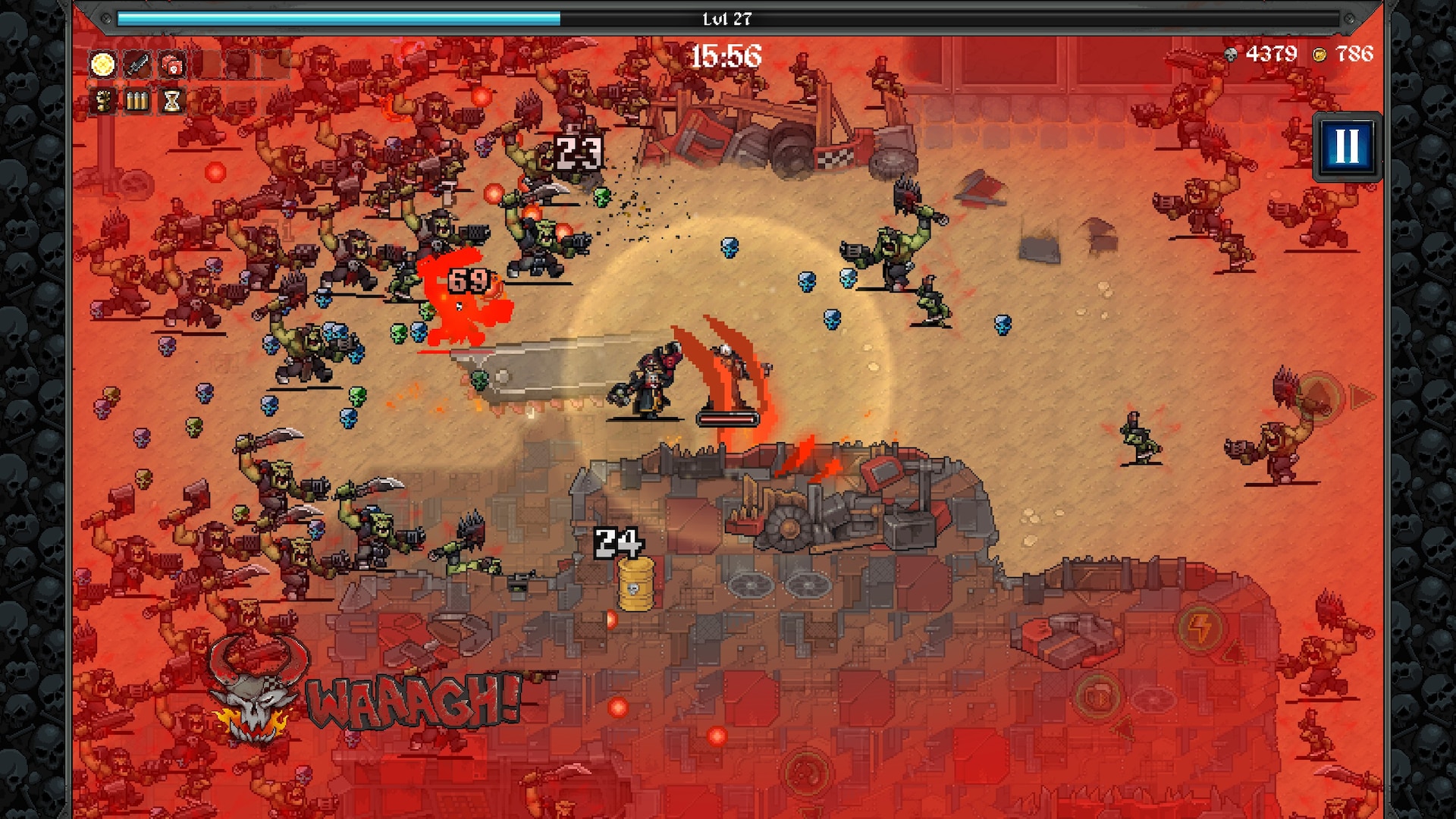
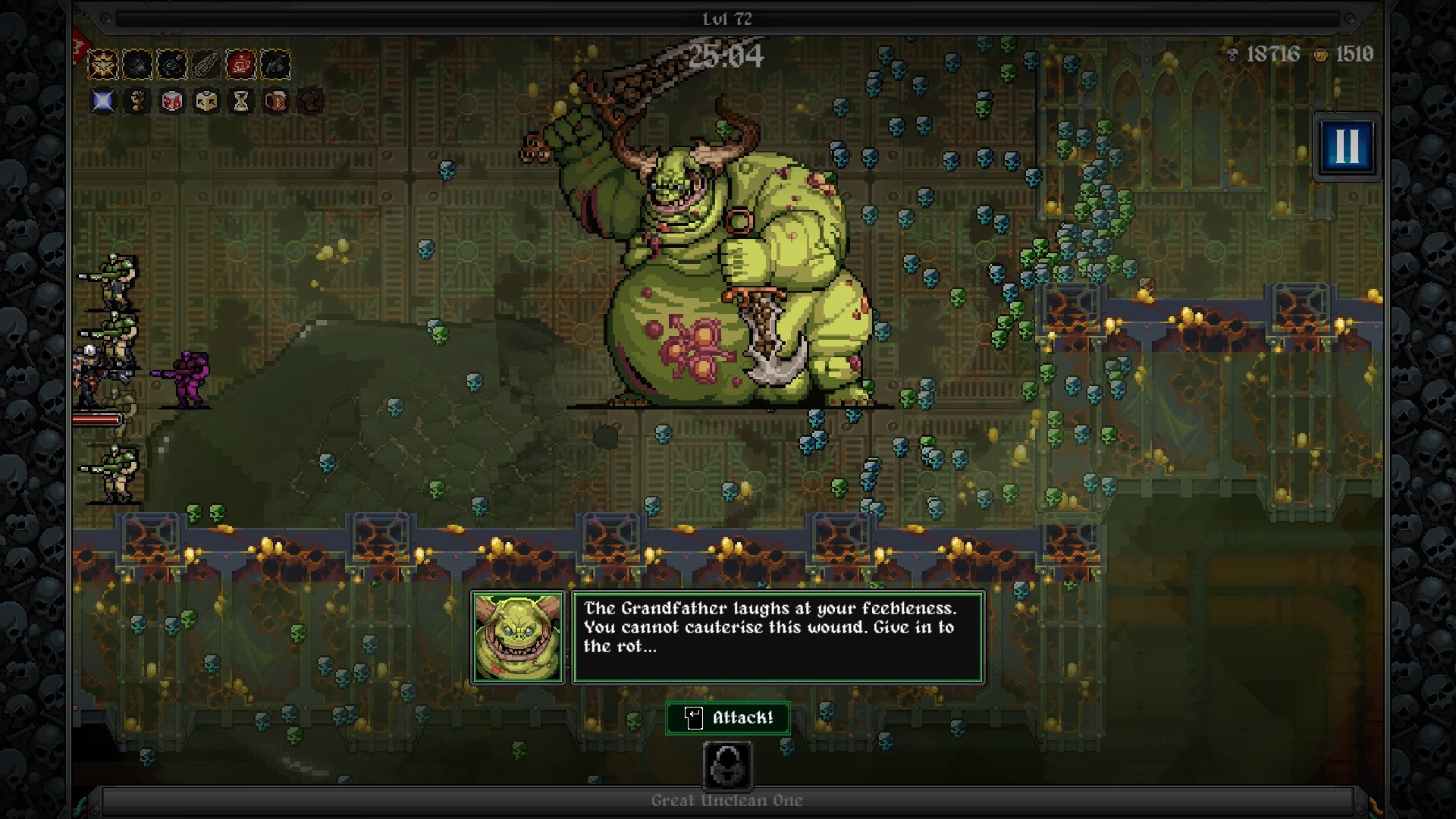
The distinction is more than a change of scenery. The factions and creatures encountered in each setting influence the character of individual stages, while certain enemies introduce additional threats that affect how a run develops. The forces of Nurgle, for example, bring poisonous hazards into encounters, while Orks can become more dangerous through their characteristic WAAAGH! abilities. These details help the settings feel relevant to the gameplay rather than simply providing familiar names and appearances.
There is also a playful understanding of the source material. Alongside recognisable weapons such as the Boltgun and Astartes Chainsword, the game turns objects from Warhammer’s tabletop culture into instruments of destruction. Weaponised dice, tape measures and pots of Nuln Oil are among the more unusual additions. The humour is a good fit for the exaggerated nature of the genre, and these objects are not merely decorative jokes. Nuln Oil, for instance, becomes a particularly effective weapon once evolved, spreading deadly black puddles across the battlefield. It is an amusing and surprisingly effective way to turn a familiar hobby product into a meaningful part of the combat system.
The character roster is similarly generous. More than 40 champions from the two settings offer different starting weapons and individual traits, giving players reasons to experiment with characters beyond their initial favourites. Their differences become more interesting as additional weapons and equipment are unlocked, since a character’s starting loadout is only one part of the possible build.
One of the more distinctive additions is the Follower system. Some weapons bring another character or unit into the run, with attacks originating from that follower rather than directly from the player-controlled champion. This can extend the effective attack area, cover different directions and create opportunities that a conventional weapon would not provide. Followers do not need to be managed or protected, so they add another layer to combat without turning the game into a squad-management exercise.
The system also contributes to character identity. Certain heroes have traits that interact with the number of Followers accompanying them. Cadian Trooper Bartosz Kozlowski benefits from having more Followers, while Witch Hunter Callis gains additional attacks when accompanied by exactly one. These are more meaningful distinctions than simply giving every character a different starting weapon. They encourage players to consider how a particular hero interacts with the equipment available during a run.
Followers are not without drawbacks. Once several are active alongside upgraded weapons and large enemy groups, it becomes increasingly difficult to distinguish individual attacks and approaching threats. Situational transparency helps make them less obstructive, but it cannot completely solve the problem when the screen becomes crowded. The system is one of the game’s better ideas, although its visual cost becomes increasingly noticeable in the later stages of a run.
Progression and Replayability
Progression is built around a familiar cycle of failure, discovery and permanent improvement. Gold collected during runs can be spent on enhancements that strengthen the roster, while completing challenges and exploring stages unlocks additional characters, weapons, items and other content. A failed attempt can therefore make the next one more manageable, even if the immediate result is disappointing.
Unlocking characters is particularly useful because it can introduce their starting weapons into the wider arsenal. Completing the relevant weapon challenges makes that equipment available to other characters, expanding the possible combinations and encouraging further experimentation. Relics, passive items and other unlockables add to the number of ways a run can develop. The game is at its best when a new discovery changes how players approach a familiar character or encourages them to try a combination they had previously overlooked.
The two universes have largely separate progression paths, so completing the 40,000 content does not automatically complete Age of Sigmar. Each has its own roster, stages, enemies, weapons and unlocks. This provides a substantial amount of additional content, although it also means players must work through two progression tracks rather than having everything available from the beginning.
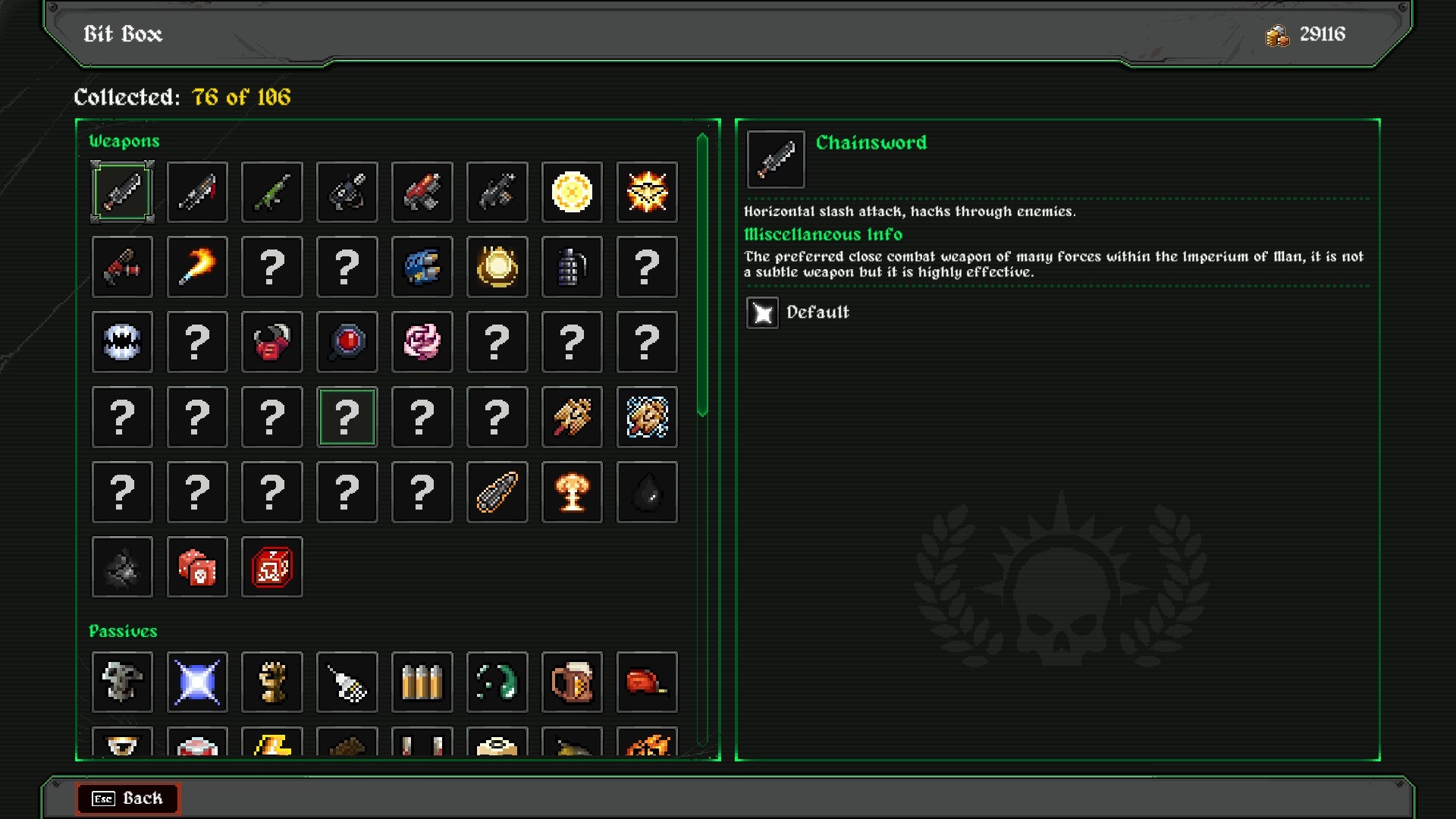
The separation is not absolute. Gold and certain permanent enhancements connect the two settings, and completing enough upgrades in one universe can eventually provide additional benefits in the other. Some collectibles and character unlocks also encourage players to explore both. Moving between the settings is therefore more than a change of scenery, even if the separate progression systems can occasionally make the overall structure feel more fragmented than necessary.
There is plenty to pursue beyond simply surviving for longer. Character-specific challenges, weapon evolutions, hidden items and other secrets give individual runs more defined objectives. The game is effective at making these discoveries feel worthwhile because they can directly affect future attempts. Unlocking a new weapon is not just another entry in a collection; it can introduce an entirely different way to build a character.
The main weakness is the pace at which the progression becomes rewarding. Early runs can feel slow, with starting weapons and passive items taking too long to become effective. Permanent enhancements gradually improve the situation, but they do not entirely remove the initial grind. The game has a substantial amount of content, yet it sometimes takes too long to reveal the combinations that make that content enjoyable.
Difficulty and Boss Encounters
Warhammer Survivors is less forgiving than its familiar formula might suggest. Enemy pressure increases quickly, while the player’s power does not always develop at the same pace. Enemies do not consistently provide experience, and the resulting gaps between level-ups can leave a character vulnerable for longer than expected. When the random upgrade selection also fails to provide useful weapons or supporting items, a run can become difficult before the player has had a reasonable opportunity to establish a coherent build.
This affects the sense of progression that makes the genre so appealing. Early vulnerability should eventually give way to the pleasure of becoming overwhelmingly powerful. Warhammer Survivors delivers that transformation, but the transition can take too long. Some attempts develop smoothly, while others struggle because the necessary upgrades fail to appear. The result is a difficulty curve that can feel uneven rather than consistently demanding.
The game’s major boss encounters provide a welcome change of pace from the constant pressure of ordinary enemy waves. Runs build towards substantial confrontations, including Extremis bosses that can be particularly challenging even for experienced players of the genre. These encounters give stages a clearer objective and make the strength of a character’s build more consequential than simply clearing groups of weaker enemies.
The challenge is not just a matter of accumulating damage. Players need to understand the strengths and limitations of their weapons, maintain enough room to move and avoid being overwhelmed by the surrounding enemies. A build that performs well against ordinary hordes may not necessarily be effective against a major target. Learning which combinations provide the necessary damage and coverage is part of the progression, although the game could do more to make the relationship between preparation and success feel consistent.
The bosses add welcome variety and give successful runs a more satisfying destination. However, their difficulty is tied to the same uneven progression that affects the rest of the experience. Reaching a major encounter without a sufficiently developed build can be frustrating, particularly when the run has otherwise gone well. The encounters are a worthwhile addition, but the opening stretch could be better balanced to make the eventual challenge feel more earned.
Level Design and Enemy Variety
The stages offer more environmental variety than the open arenas commonly associated with the genre. Some feature narrow passages, enclosed spaces and complicated layouts that make movement a more important consideration. Walls and obstacles can interrupt attacks, restrict escape routes and create opportunities to funnel opponents through chokepoints. Finding a useful position and turning it into a temporary defensive stronghold can be satisfying, particularly when a build includes area attacks or knockback effects.
These environments also encourage players to adapt their strategies. A weapon that performs well in an open area may be less useful in a confined space, while attacks that cover a large area can become particularly effective when enemies are funnelled through a narrow entrance. The stages are not simply backdrops for increasingly large groups of enemies; their layouts can influence how a character survives and how effectively a build performs.
The system is not entirely reliable, however. Enemy interactions with obstacles can be inconsistent, with some opponents passing through terrain while others are blocked. The rules are not always immediately apparent, and this can make it difficult to judge whether a particular position is genuinely safe. The player is generally affected by walls and environmental restrictions, so an escape route can become unexpectedly inconvenient or a projectile can be stopped by terrain.
The side-scrolling stages are another departure from the usual open arenas. They provide a different perspective and add variety to the selection of environments, but their restricted movement can make it harder to evade approaching groups. They are a welcome change in principle, although the altered layout does not always produce a more enjoyable encounter.
Enemy variety is one of the stronger aspects of the presentation. The two universes provide a broad selection of recognisable factions and creatures, and their abilities help distinguish stages. Faction-specific effects and more unusual enemy behaviours give encounters additional character beyond simply filling the screen with different sprites and health bars. The underlying objective remains familiar, but the combination of enemies, environmental hazards and stage layouts gives each setting its own flavour.
Visuals and Audio
The pixel-art presentation is a natural fit for the genre and the Warhammer setting. Characters, enemies and weapons are recognisable despite their relatively small size, while the environments communicate the difference between the science-fiction battlefields of 40,000 and the fantasy landscapes of Age of Sigmar. The sprites are detailed enough to give familiar units their own identity without losing the clarity needed for a game that regularly puts large numbers of enemies on screen.
There is a pleasing contrast between the grim source material and the more playful presentation. Familiar Warhammer imagery is transformed into colourful, exaggerated chaos, with weapons and abilities becoming increasingly spectacular as a run progresses. The visual effects provide a satisfying sense of escalation, and the tabletop references add personality without making the game feel like a collection of disconnected jokes.
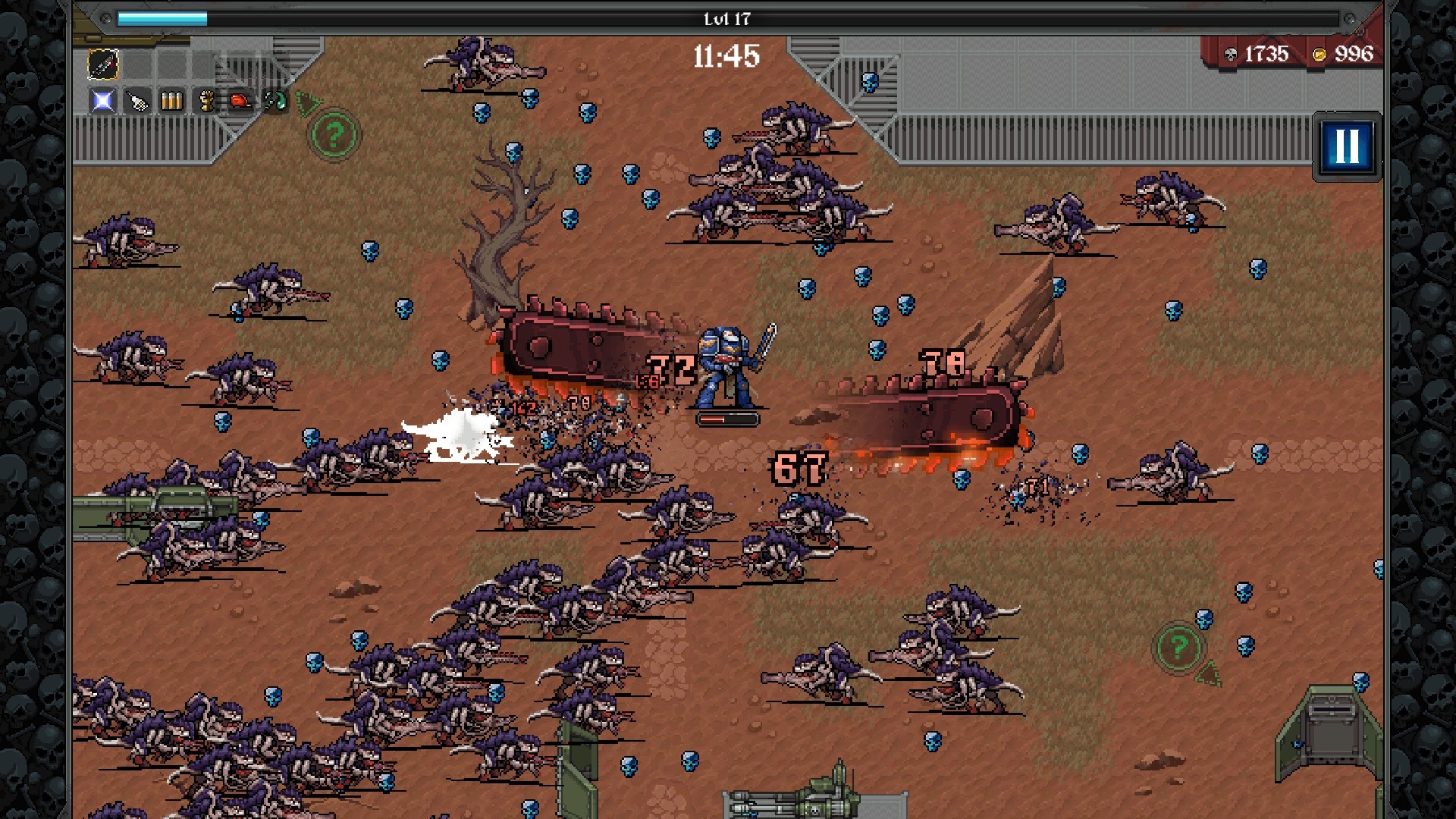
The main weakness is readability. As weapons evolve and more Followers join the battlefield, the number of overlapping effects can make it difficult to identify individual enemies and incoming threats. This is a familiar problem in the genre, but the Follower system makes it particularly noticeable here. Situational transparency helps, although it cannot fully prevent the screen from becoming difficult to read during the busiest encounters.
The audio supports the action without becoming the main attraction. The soundtrack has a more layered presentation than a collection of simple background loops, while the combat effects help reinforce the growing intensity of encounters. It is not necessarily as immediately memorable as the most recognisable music from Vampire Survivors, but it complements the game’s visual style and gives the battles an appropriate sense of energy. The overall presentation is effective, even if neither the visuals nor the audio radically redefines the genre.
Technical Performance on PC
Warhammer Survivors is a relatively undemanding game by modern PC standards, and the available performance reports are encouraging. Its modest system requirements make it accessible to a wide range of machines, while its pixel-art presentation doesn’t place particularly heavy demands on graphics hardware. Reports from users also suggest that the game runs smoothly on desktop Linux through Proton, without requiring special compatibility settings.
The Steam Deck is an especially good fit. The game is officially Steam Deck Verified, and testing by reviewers found that it generally maintains a smooth frame rate even during busy encounters. One performance test reported that the handheld could sustain 60 FPS through crowded late-game sequences, with the OLED model reaching 90 FPS. Another reviewer found that it held close to 90 FPS for most of the time, although occasional stutters appeared when the screen became particularly busy with enemies and visual effects. These reports suggest that performance is generally reliable, even if the most chaotic encounters can still cause some minor interruptions.
The PC version also offers full controller support, Steam achievements and Steam Cloud functionality. Its straightforward controls translate naturally to handheld play, and the short-run structure makes it easy to pick up for a quick session. There are relatively few graphics options to adjust, but given the game’s modest demands, this is unlikely to be a major concern for most players.
There are a few omissions worth mentioning. Warhammer Survivors is single-player only, with no cooperative mode at launch, despite the appeal of taking on its enormous enemy hordes alongside another player. Still, between its low hardware requirements, broad controller support and strong Steam Deck performance, the PC version offers a straightforward and accessible way to play.
Final Verdict: 7/10
Warhammer Survivors understands what makes the bullet-heaven formula so compelling. Its progression encourages repeated attempts, its weapon combinations create satisfying moments of escalation, and its two Warhammer settings provide a generous supply of characters, enemies and references. The Follower system is a particularly welcome addition, giving characters and weapons more ways to interact while adding a little tactical variety to the familiar combat loop.
Its greatest strength is also its most obvious limitation. The Warhammer universe gives the game personality, but the underlying structure remains very close to Vampire Survivors. Players looking for a radical evolution of the genre may find that familiarity disappointing. Those who enjoy the original formula, on the other hand, will find a substantial amount of content and enough new ideas to make another lengthy progression cycle worthwhile.
The weaknesses are difficult to overlook entirely. The opening hours can feel sluggish, early weapons and upgrades do not always provide enough momentum, and the random selection system can make some runs more frustrating than challenging. The more elaborate environments introduce welcome variety but occasionally suffer from inconsistent obstacle interactions. Late-game visual clutter can also make it difficult to understand exactly what is happening, while the lack of cooperative play feels like a missed opportunity.
These problems prevent Warhammer Survivors from becoming a defining entry in the genre, but they do not undermine its central appeal. There is a considerable amount to unlock, the two settings offer distinct reasons to keep playing, and the developers have made a genuine effort to incorporate Warhammer’s characters, factions and tabletop culture into the mechanics. It is more than a licensed reskin, even if it does not always push its inspiration forward.
Ultimately, Warhammer Survivors is a carefully crafted adaptation rather than a reinvention. Its strongest ideas are enough to make it an enjoyable addition to the genre, particularly for Warhammer fans and players who still have an appetite for the Vampire Survivors formula. A slow opening and uneven balance keep it from reaching its full potential, but there is a very entertaining game underneath those frustrations.