Football Manager 27 arrives at an important moment for Sports Interactive. Following the troubled transition to the Unity engine and the considerable criticism directed at Football Manager 26, the studio had plenty to prove. The previous instalment left many longtime supporters frustrated with its interface, performance issues and several design decisions that made familiar management tasks unnecessarily complicated. For a series built around spending hundreds of hours managing a football club, those problems were particularly damaging.
Rather than attempting another dramatic overhaul, Football Manager 27 takes a more measured approach. It retains the foundations introduced with the previous game but makes substantial adjustments to the way players interact with its systems. Navigation is more straightforward, the presentation of information is considerably clearer, and the relationship between tactics, training and player development has received much-needed attention. There are also improvements to the match engine and the return of several familiar features that were conspicuously absent from the previous release.
The result is a noticeably more comfortable experience that feels closer to what longtime fans expect from the franchise. That does not mean everything has been fixed. Some of the match engine’s shortcomings remain, certain management activities still feel repetitive, and the overall experience does not represent a complete return to the series’ strongest years. Nevertheless, Football Manager 27 is a meaningful improvement and a considerably more convincing foundation for the franchise’s future.
Interface and Navigation
The interface is arguably the most important improvement in Football Manager 27, particularly considering how much criticism the previous instalment received in this area. Football Manager has always been a complicated game, but its complexity traditionally came from the enormous amount of information and decisions available to the player. The interface should make that information accessible rather than turn even straightforward tasks into an exercise in navigating menus.
Football Manager 26 struggled to maintain that balance. Its redesigned presentation introduced a different approach to navigation that often made basic information harder to find. Important options were buried behind additional screens, and the experience could become unnecessarily frustrating when moving between squad management, scouting, tactics and transfers.
Football Manager 27 addresses much of this by restoring a more familiar structure. The navigation bar provides direct access to the main management areas, while clearly organised sections and drop-down menus reduce the number of unnecessary steps required to complete everyday tasks. The traditional inbox also returns as a more central part of the experience, giving messages and important developments a more natural place within the management routine.
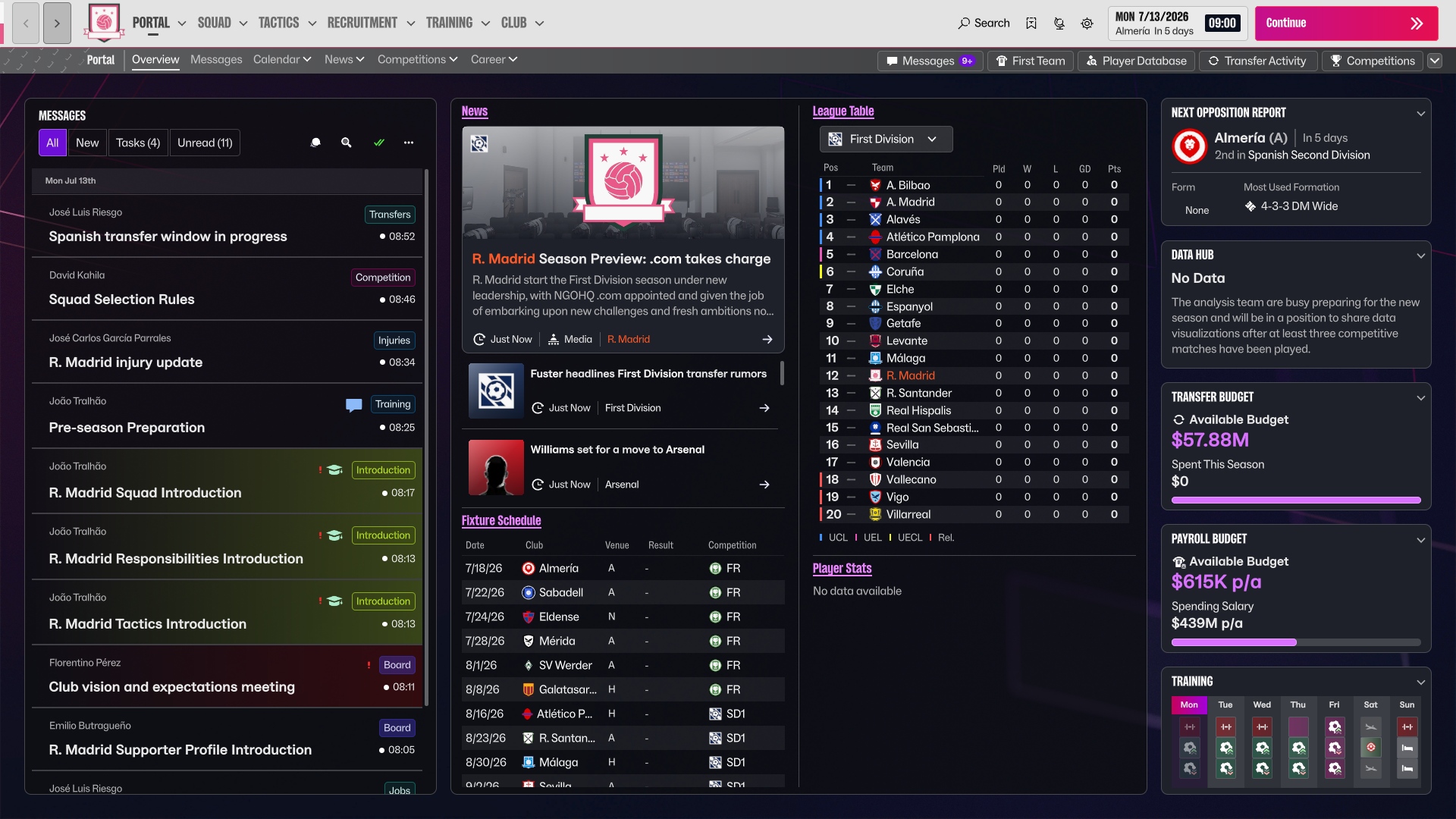
The redesigned interface is also more flexible. Players can customise the information displayed on the main screen, arrange different sections according to their preferences and adjust the amount of information presented in certain views. This is particularly useful for experienced managers who prefer to monitor specific aspects of their club without constantly switching between different screens. The ability to control how frequently the game interrupts progression with news and other notifications is another welcome addition.
These changes might not sound particularly exciting, but they make a considerable difference over the course of a long save. Football Manager is a game in which players repeatedly perform similar actions, sometimes hundreds of times during a single season. Reducing unnecessary clicks and making information easier to locate helps preserve the natural rhythm of the experience.
However, the interface is not entirely free of problems. Although navigation is considerably smoother than in FM26, some information still requires several steps to locate, and experienced players may find that certain statistics are less immediately accessible than they were in older versions. The top navigation system also represents a change that takes some getting used to, particularly for those who preferred the traditional sidebar. Not every section feels equally intuitive, and there is still room for improvement in how information is organised.
The overall structure is nevertheless much easier to understand, and the return to a more conventional approach to presenting information is a sensible decision. Sports Interactive has recognised that accessibility does not necessarily mean removing complexity. It means presenting that complexity in a way that makes sense.
Gameplay and Management
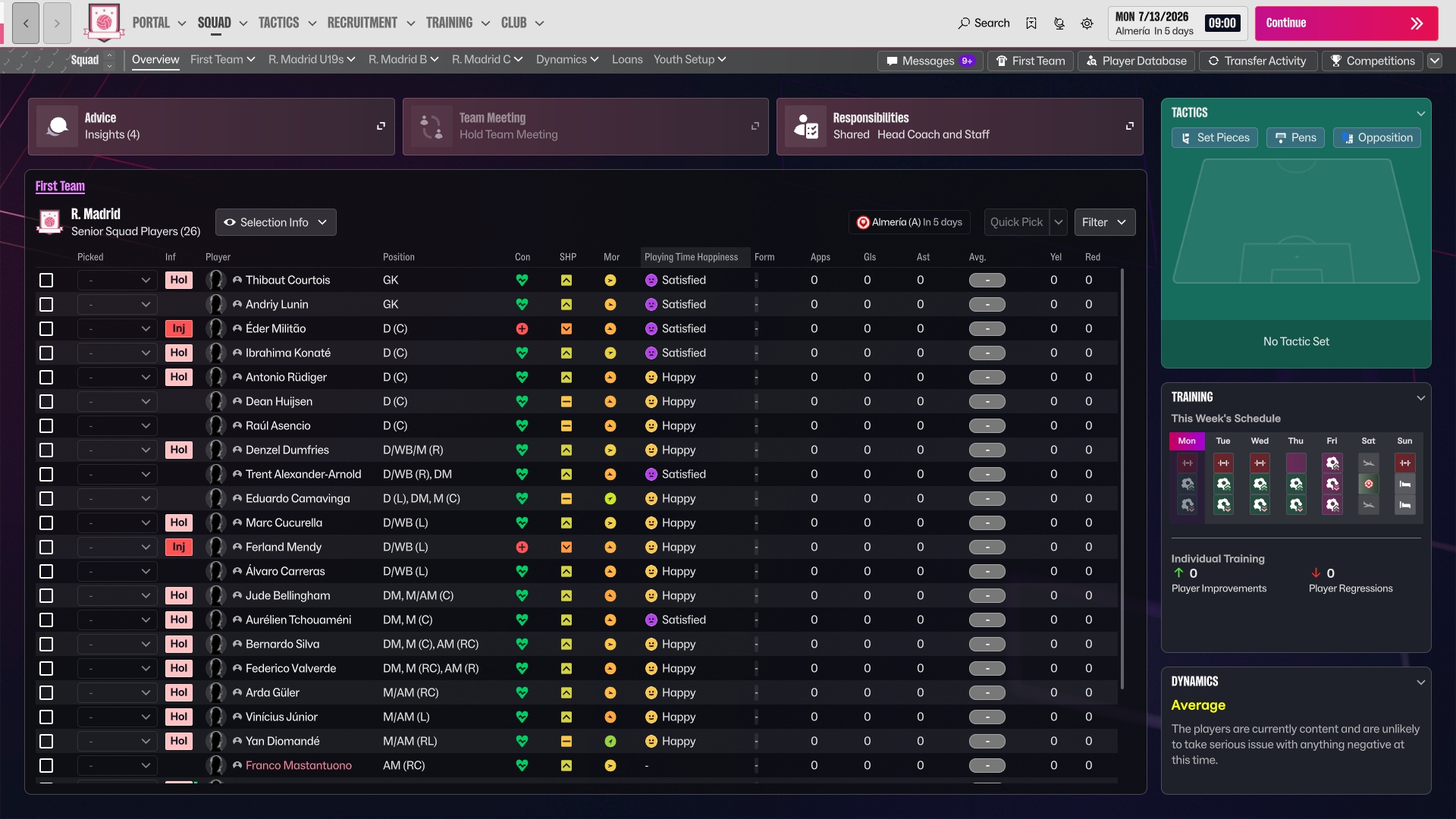
At its core, Football Manager 27 remains the familiar management simulation that has kept the series relevant for so many years. Players take control of a football club, oversee its sporting operations and attempt to build a team capable of achieving its objectives. That involves far more than selecting eleven players and choosing a formation. Squad planning, recruitment, contract negotiations, staff appointments, player development and relationships with the board all contribute to the experience.
The appeal comes from how these responsibilities gradually become interconnected. A promising young player might need a different development pathway, an injury could force a change in tactical approach, and an unexpected transfer opportunity might require adjustments to the club’s financial plans. Football Manager 27 continues to make these decisions the foundation of its gameplay.
One of the more welcome improvements is the way information about players and their suitability for particular roles is presented. Scouting reports offer a clearer picture of how potential signings fit into the team’s tactical approach, while recruitment decisions feel more closely connected to the overall footballing philosophy. The sporting director can also provide guidance on initial transfer offers and payment structures, which is helpful when negotiating deals without removing the player’s control over the process.
The transfer market has received attention as well, with a clearer overview of activity across other clubs, including completed deals and rumours. This helps make the wider football world feel more active rather than limiting the player’s attention to their own squad. The return of Transfer Deadline Day is another welcome touch, restoring some of the urgency and atmosphere that can make the final hours of a transfer window particularly entertaining.
These are not revolutionary changes, but they improve the experience by making the business of running a football club feel more connected. The same applies to the return of traditional cup draws, which once again give domestic and continental competitions a greater sense of occasion. Such moments help establish a stronger connection with the football world outside the player’s own club.
There is still room for improvement in some of the administrative aspects of management. Certain staff attributes and recommendations could communicate their meaning more clearly, while press conferences remain a familiar source of repetition. The questions and answers often provide little meaningful insight, and their limited variety can make them feel like another routine task to complete rather than an important part of managing a club.
Another disappointment for longtime supporters is that some familiar features from older Football Manager games remain absent. Average player positions, which provide a useful way of examining tactical positioning during matches, have not returned. Numerical staff attributes have also been replaced by more general descriptions, making it harder for some managers to compare coaches and other members of their backroom staff in the traditional way. The familiar social media feature and the end-of-season review are also missing. The ability to export player data for external analysis is another feature that has not returned.
Not every omission will affect all players equally, and some of these features are more important to experienced managers than newcomers. Nevertheless, their absence is noticeable, particularly for those who have spent years relying on the detailed information and additional tools available in older versions. The end-of-season review is especially disappointing because it provided a convenient way to look back at a campaign and evaluate its most important moments. These omissions do not undermine the improvements elsewhere, but they show that the transition to the newer interface and engine still involves compromises.
Even so, the overall management experience is considerably more enjoyable than it was in Football Manager 26. The individual systems feel more accessible, and the game does a better job of keeping players involved in the everyday life of their club.
Shuffle Draft
Football Manager 27 also introduces Shuffle Draft, a new multiplayer mode developed in partnership with FIFAe. While the traditional Career mode remains the main attraction for most players, Shuffle Draft offers an alternative for those who want to put their squad-building and tactical knowledge to the test against other managers.
The mode revolves around assembling a team from rotating selections of available players. Rather than building a squad through conventional transfers, participants choose from player pools that can be customised according to different criteria, including quality, experience, potential and particular strengths. Each round presents a new selection, requiring managers to think carefully about positional needs and the overall balance of their developing squad.
Once the drafting process is complete, participants take their teams into a competition. Shuffle Draft supports between two and 32 players, with knockout tournaments, group stages and league formats available. It is also possible to include AI-controlled managers, making the mode accessible to players who would rather practise offline or do not have enough friends available to fill a tournament.
One of its more interesting features is the option to introduce redrafts during a competition. Depending on the tournament settings, managers can return players to the available pool or remove them from the event entirely, creating opportunities to reshape their squads as the competition progresses. This adds another layer of uncertainty and forces participants to reconsider their initial decisions.
Shuffle Draft is not intended to replace the traditional management experience, and it does not have the same long-term appeal as developing a club over multiple seasons. However, it provides a different way to engage with the game’s tactical and squad-building systems. It is also a useful opportunity to experiment with players and formations without committing to a lengthy Career save. For those who enjoy competitive multiplayer, it is a worthwhile addition that gives Football Manager 27 more variety.
Tactics and Training
The most substantial gameplay addition in Football Manager 27 is Tactical Effectiveness, a system designed to establish a clearer relationship between a manager’s preferred style of play and the squad’s ability to execute it.
In previous instalments, it was possible to introduce a relatively complicated tactical system and expect players to adapt to it with limited preparation. While familiarity and tactical understanding were already important considerations, the consequences of asking a squad to play beyond its capabilities were not always communicated particularly well.
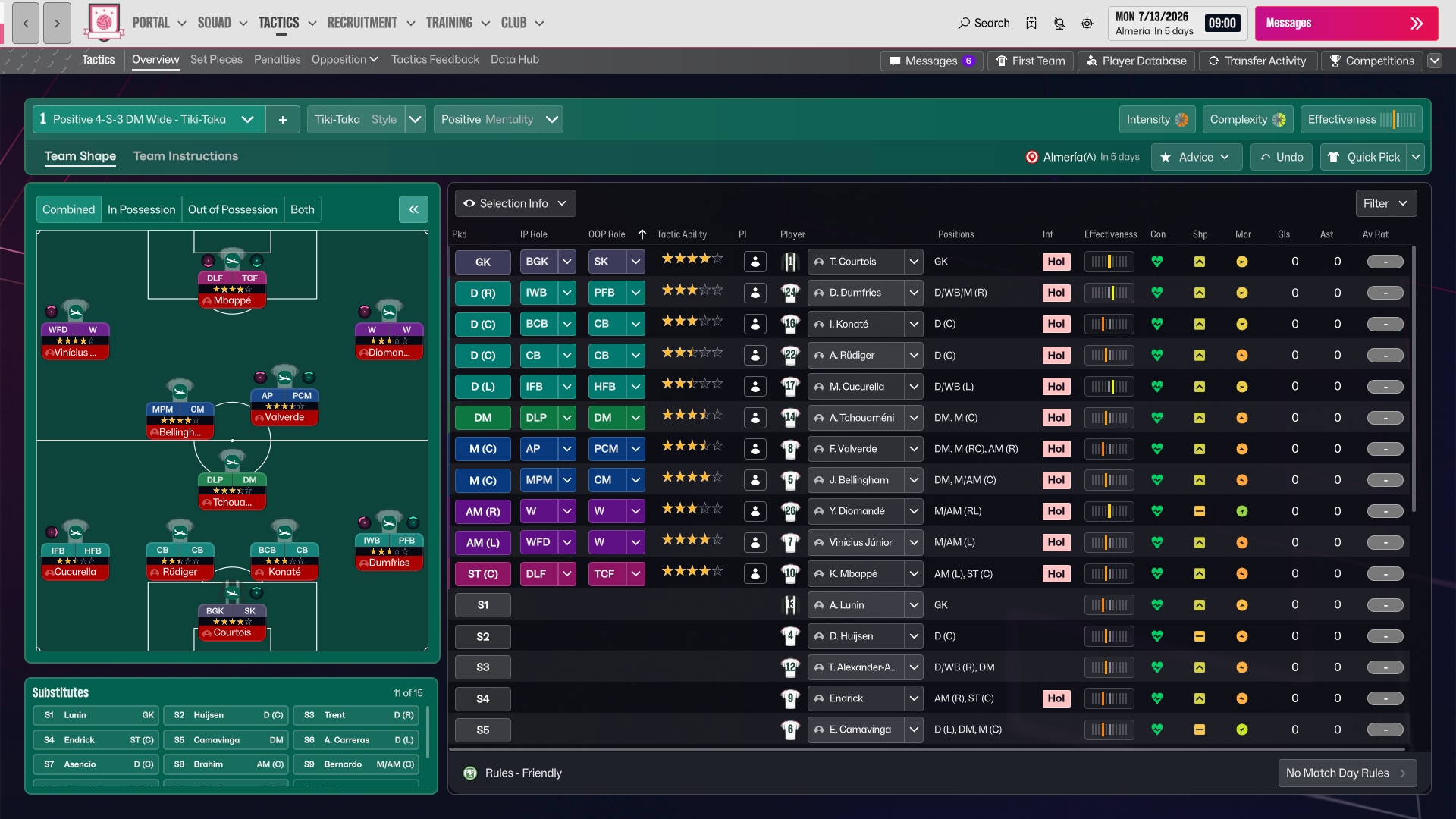
Tactical Effectiveness attempts to address this by evaluating how successfully players understand and implement the team’s instructions on the pitch. It considers factors such as their familiarity with the tactical approach, their suitability for particular roles, their individual abilities in and out of possession and the preparation carried out ahead of a match. Tactical complexity is also taken into account, making it important to consider whether a squad can realistically execute the manager’s preferred system at the highest level.
This creates a more meaningful relationship between tactical ambition and the players available. A manager taking charge of a lower-league club cannot simply introduce the same demanding approach used by an elite European side and expect immediate results. The players might lack the technical ability, tactical understanding or physical qualities required to make it work.
It also makes tactical changes more consequential. Switching formations or introducing several new instructions can take time to become effective, particularly when the squad is unfamiliar with the demands being placed on it. This encourages a more considered approach to management and makes the process of developing a playing identity feel like an ongoing project rather than a collection of instructions that can be changed whenever results become disappointing.
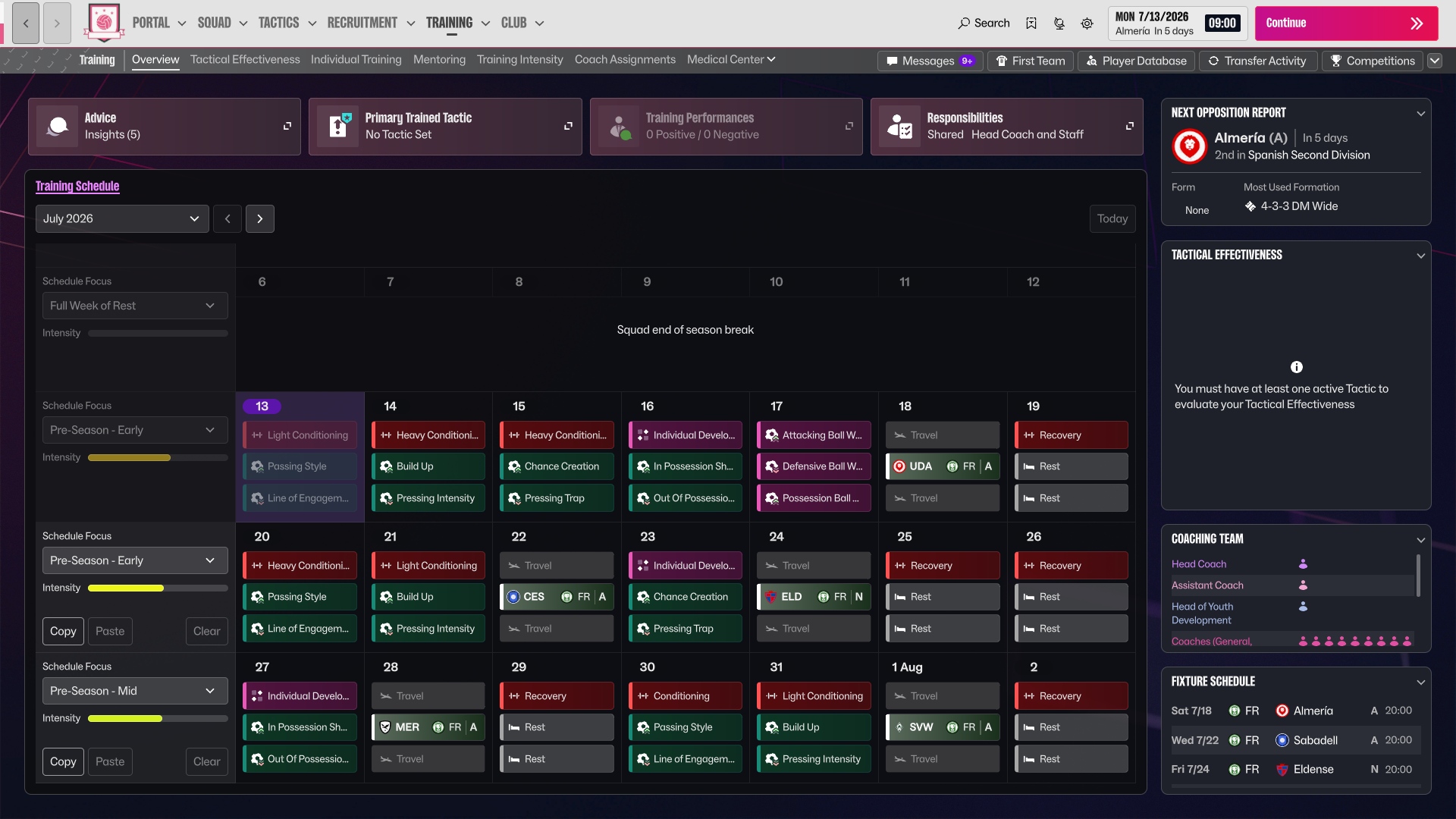
Training has been adjusted to support this philosophy. Preparation is more closely connected to the team’s tactical approach, with sessions designed around specific areas such as pressing, defensive organisation and build-up play. Individual development remains important, but collective preparation receives greater attention, giving training a clearer purpose within the wider management process.
The changes make it easier to understand why certain aspects of a team’s performance might be struggling. If a side is having difficulty playing out from the back or maintaining its defensive structure, training can be adjusted to address those weaknesses. The system also gives managers more reason to think about how their next opponent might influence the preparation process.
There is a potential downside to this added structure. Managers who enjoy experimenting with different formations and instructions may find that the time required to establish tactical familiarity restricts their freedom, particularly when dealing with injuries or unexpected changes in form. It can also be frustrating when a tactical adjustment takes several matches to produce noticeable results.
Nevertheless, Tactical Effectiveness is one of the more worthwhile additions to the game. It gives greater purpose to squad construction, training and tactical planning, making these systems feel like parts of the same management experience rather than separate activities.
Match Engine and Presentation
The match engine remains one of the most important aspects of Football Manager, even though the series has never attempted to compete with dedicated football games in terms of visual presentation. Its purpose is to communicate the consequences of the player’s decisions and provide a reasonably convincing representation of how a team performs on the pitch.
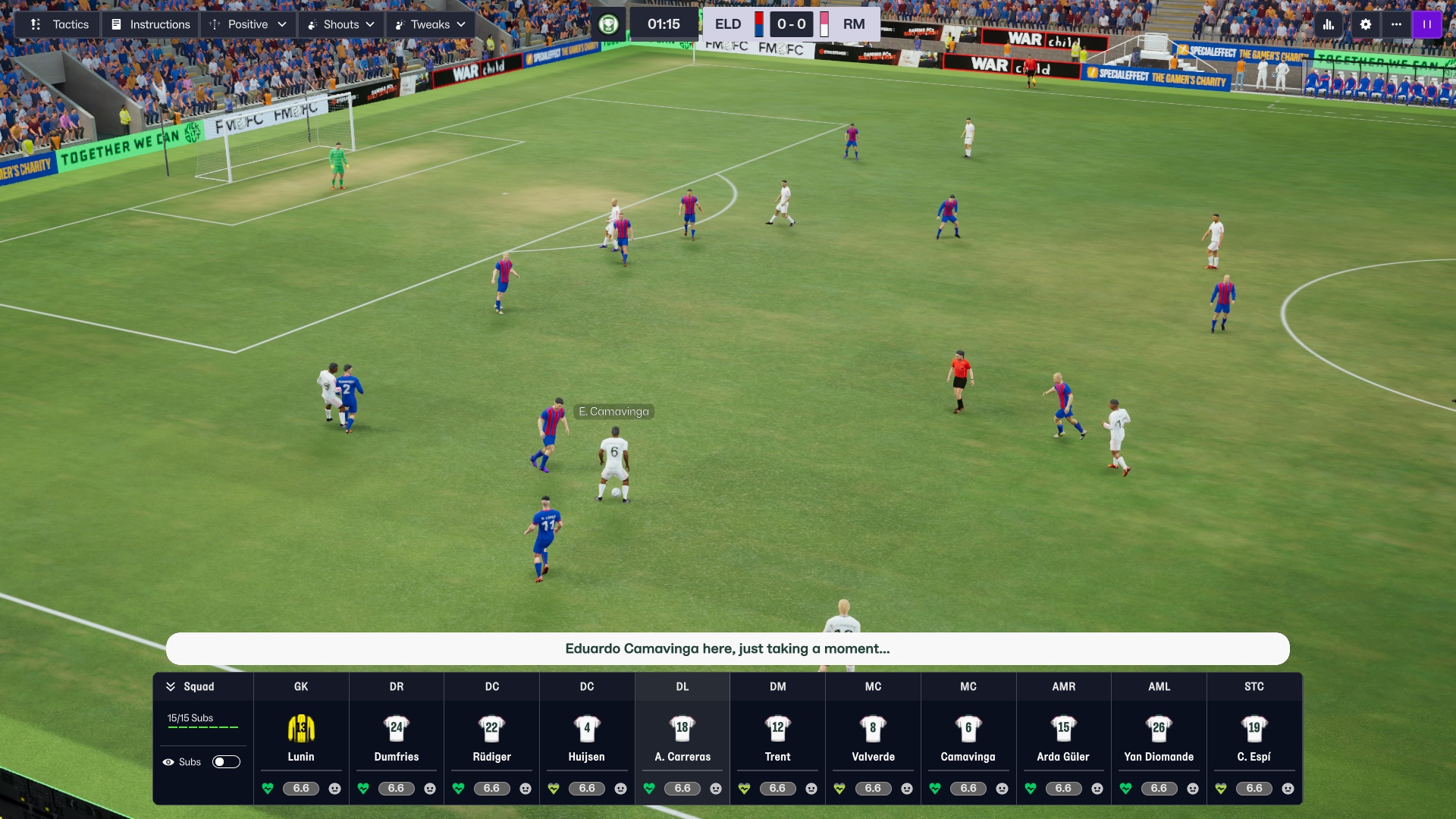
Football Manager 27 makes several improvements in this area. Player animations have been expanded, with additional motion-captured movements intended to make actions such as running, turning and dribbling appear more natural. Physical fatigue is also represented more visibly, helping communicate when players are beginning to struggle rather than relying entirely on statistics and match commentary.
The presentation surrounding matches has received attention too. Updated camera angles, improved lighting and more detailed stadium environments give fixtures a stronger sense of occasion. Weather conditions and changes in lighting contribute to the overall atmosphere, while crowd animations have also been refined. Supporters now react more noticeably to important moments, and their appearance varies according to factors such as the weather, time of day and the significance of the fixture. The variety of stadium designs and more detailed pre-match cutscenes also help make different grounds and competitions feel less interchangeable.
The result is a better-looking matchday experience, although the improvements are evolutionary rather than transformative. The additional environmental details are welcome, but they do not change the fundamental nature of watching a Football Manager match.
The traditional 2D match view also remains available, which is important for players who prefer a clearer tactical overview instead of watching the action from a 3D perspective. It continues to provide a useful alternative, particularly when monitoring the positioning of players and the overall shape of a team.
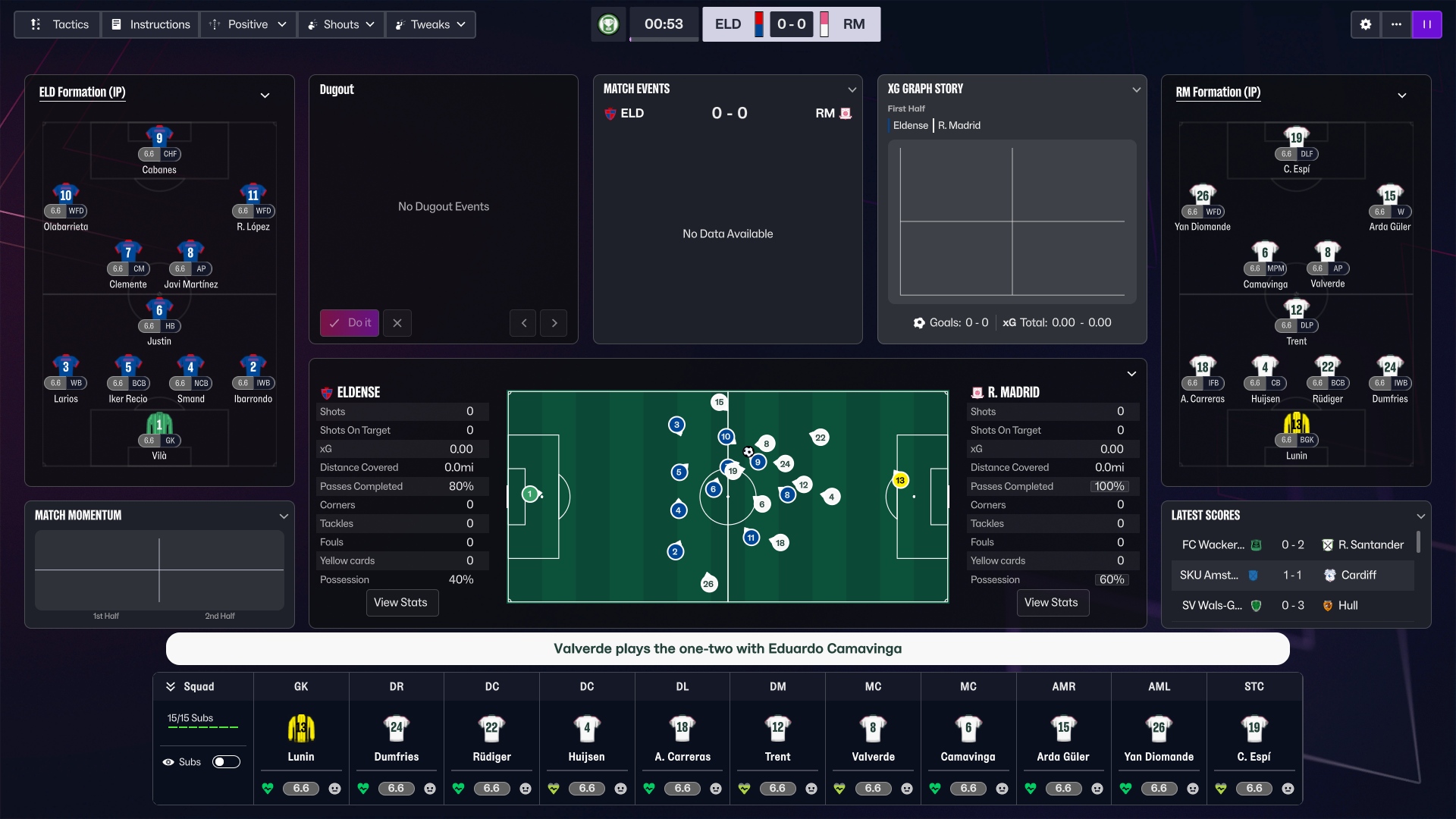
One of the more practical additions is Tactical Tweaks. These allow managers to make quick adjustments during matches without opening the full tactics screen. Wingers can be instructed to switch sides, pressing intensity can be increased, and certain situational changes can be made with considerably less interruption to the action.
Touchline shouts are also available in Football Manager 27, having returned to the previous instalment through a post-launch update. Their implementation has been adjusted, with more contextual explanations and clearer feedback about how players respond to particular instructions. Managers can encourage, calm or motivate players during matches, adding another layer to the interaction between the dugout and the pitch. The game provides more information about how these instructions influence player morale, although understanding exactly when particular shouts are most effective can still be difficult.
Unfortunately, the match engine is not without problems. Defensive positioning and decision-making remain inconsistent in certain situations, with defenders sometimes reacting too slowly to attacking movements or allowing too much space for opponents to exploit. Through balls can also expose defensive lines more frequently than expected, creating situations in which it is difficult to determine whether a goal was the result of poor tactical decisions or questionable match engine behaviour.
Goalkeepers and their animations can occasionally produce similarly frustrating moments. There have also been concerns about low-scoring matches and the frequency of corners in early assessments. VAR interruptions have been another criticism, with reviews occurring often enough to disrupt the flow of certain matches.
These issues do not make the match engine unusable, but they prevent the improvements from feeling entirely convincing. The visual presentation is better, and the additional tactical controls are useful, yet the underlying football still needs further refinement. For a game in which every match is supposed to reflect the player’s decisions, consistency in the way players behave on the pitch remains essential.
Graphics and Audio
Football Manager 27 is not a particularly demanding visual showcase, nor does it need to be. Most of the time is spent navigating menus, analysing statistics and making decisions rather than watching extended sequences of football. Nevertheless, the improvements to the presentation help make the experience more pleasant.
The 3D match engine benefits from more convincing player movements, better lighting and additional stadium details. While individual animations can still look awkward, the overall presentation is more polished than before. The matchday camera work also helps communicate the atmosphere of important fixtures, particularly when playing in larger stadiums.
Crowd reactions and environmental details contribute to the sense that matches are taking place in different footballing environments rather than repeatedly using similar-looking stadiums. The improved crowd models, additional stadium variety, weather effects and more dynamic cutscenes make the matchday presentation feel more closely connected to the occasion. The visual changes are not substantial enough to transform the series, but they represent welcome refinements.
Audio remains functional rather than particularly memorable. Commentary and stadium sounds provide the necessary atmosphere during matches, but the experience is still primarily driven by the information displayed on screen. That is unlikely to disappoint longtime supporters, although there is room for a more varied and dynamic presentation in future editions.
Technical Performance on PC
After the technical problems associated with Football Manager 26, stability is an important consideration for the new release. The previous game suffered from a difficult transition to its new engine, with performance and interface problems contributing to an especially frustrating launch period.
Football Manager 27 appears to be in considerably better condition. Launch-period assessments report a more stable experience, smoother navigation and fewer of the technical interruptions that affected its predecessor. The improvements are particularly noticeable when moving between menus and performing routine management tasks, while the reduction in presentation bugs makes the overall experience feel more polished.
PC performance is another area where the new instalment shows encouraging signs of improvement. The underlying processing experience feels quicker than it did in FM26, and early PC testing has reported faster progression through the simulation, particularly when advancing between matches. This is an important consideration for players who run several active leagues and maintain large databases, where processing time can have a noticeable impact on the pace of a long-term save.
The size of the database, the number of active leagues and the amount of detail included in a save will still influence how quickly the game processes days and advances through a season. Players planning particularly extensive careers should therefore pay attention to the game’s processing demands, as these can become more noticeable as a save develops and the footballing world grows. The reported improvements are encouraging, but they should not be interpreted as a guarantee of identical performance across every PC configuration.
The interface also benefits from being more responsive, although navigating between screens and waiting for the game to process larger amounts of information are two different aspects of performance. The improvements to everyday navigation are welcome, but they should not be confused with a guarantee of equally fast processing across every possible database configuration.
That said, a smoother interface does not automatically mean every technical issue has disappeared. Minor presentation bugs and occasional inconsistencies have still been reported, while the match engine’s remaining problems demonstrate that further refinement is necessary.
The important point is that Football Manager 27 appears to have avoided repeating the same troubled launch experience. That is a significant improvement, although continued updates will be important in addressing the remaining issues.
Final Verdict: 8/10
Football Manager 27 is a welcome correction after a difficult period for Sports Interactive. Rather than attempting to convince players that every previous design decision was the right one, the studio has made meaningful adjustments to the experience and restored several familiar elements that were missing from the previous instalment.
The improved interface is the most immediately noticeable change, making everyday management tasks considerably less frustrating. Tactical Effectiveness gives greater purpose to team preparation and squad construction, while the training adjustments create a more logical connection between the manager’s philosophy and the players’ development. The return of cup draws and Transfer Deadline Day also helps restore some of the atmosphere that makes a long-term Football Manager career so enjoyable. Shuffle Draft provides a welcome alternative for players interested in a more competitive, multiplayer experience.
The match engine remains the biggest area of concern. Although the visual improvements are welcome, inconsistent defensive behaviour and occasional awkward animations prevent it from reaching the standard the rest of the experience deserves. Press conferences and certain administrative activities could also benefit from more variety and meaningful interaction. The absence of several familiar features from older games is another disappointment, particularly for experienced managers who value the series’ detailed statistical tools.
For players who were disappointed by Football Manager 26, the new instalment offers plenty of reasons to reconsider the series. Those who continued playing Football Manager 24 may need more convincing, particularly if they were expecting a completely different experience or a return to everything they enjoyed about the older games. Football Manager 27 is an improvement rather than a reinvention, and its remaining weaknesses should not be overlooked.
Ultimately, Sports Interactive has made the right decisions in addressing the problems that mattered most. The interface is easier to use, the management systems are more cohesive, and the game once again does a better job of making players feel involved in the everyday running of a football club. There is still work to be done, especially on the pitch, but Football Manager 27 is a much stronger entry and a convincing step in the right direction.