Shopkeeping simulators have become a fairly familiar presence in the indie gaming scene. Their appeal is easy to understand: take a relatively ordinary occupation, introduce a handful of management systems, and give players the freedom to turn a modest business into something considerably more profitable. The problem is that many games built around this formula struggle to maintain their appeal once the initial novelty wears off. Stocking shelves, serving customers and watching profits increase can only remain interesting for so long when the underlying activities rarely change.
Probably Stolen, developed by Questing Goose Studio and published by tinyBuild, attempts to address that problem by making its shopkeeping mechanics considerably more complicated than they first appear. Set aboard a dystopian space station divided by wealth, corruption and competing political interests, the game puts players in charge of a small business in the impoverished Lower Levels. The merchandise is often questionable, the customers are not always trustworthy, and the authorities have a habit of showing up at inconvenient moments. Meanwhile, rent continues to rise, and making enough money to eventually purchase the shop outright becomes the central objective.
What initially looks like a straightforward retail simulator gradually develops into a much broader management experience. Players can negotiate with customers, inspect suspicious merchandise, manufacture their own products, establish relationships with different factions and venture outside the shop in search of additional supplies. There are also opportunities to pursue more questionable business practices, including dealing in stolen goods, selling counterfeit merchandise and concealing contraband from security inspections.
The result is a game with considerably more depth than its premise suggests. Its various systems give players plenty of opportunities to experiment with different business strategies, and the freedom to specialize in particular industries makes subsequent playthroughs worthwhile. However, the experience is not without problems. The daily routine can become repetitive, managing an expanding inventory is often cumbersome, and the game’s narrative ambitions are not always matched by the consequences of its decisions.
Despite these shortcomings, Probably Stolen offers a distinctive take on a familiar genre, particularly for players who enjoy simulations that reward experimentation and careful planning.
Gameplay and Mechanics
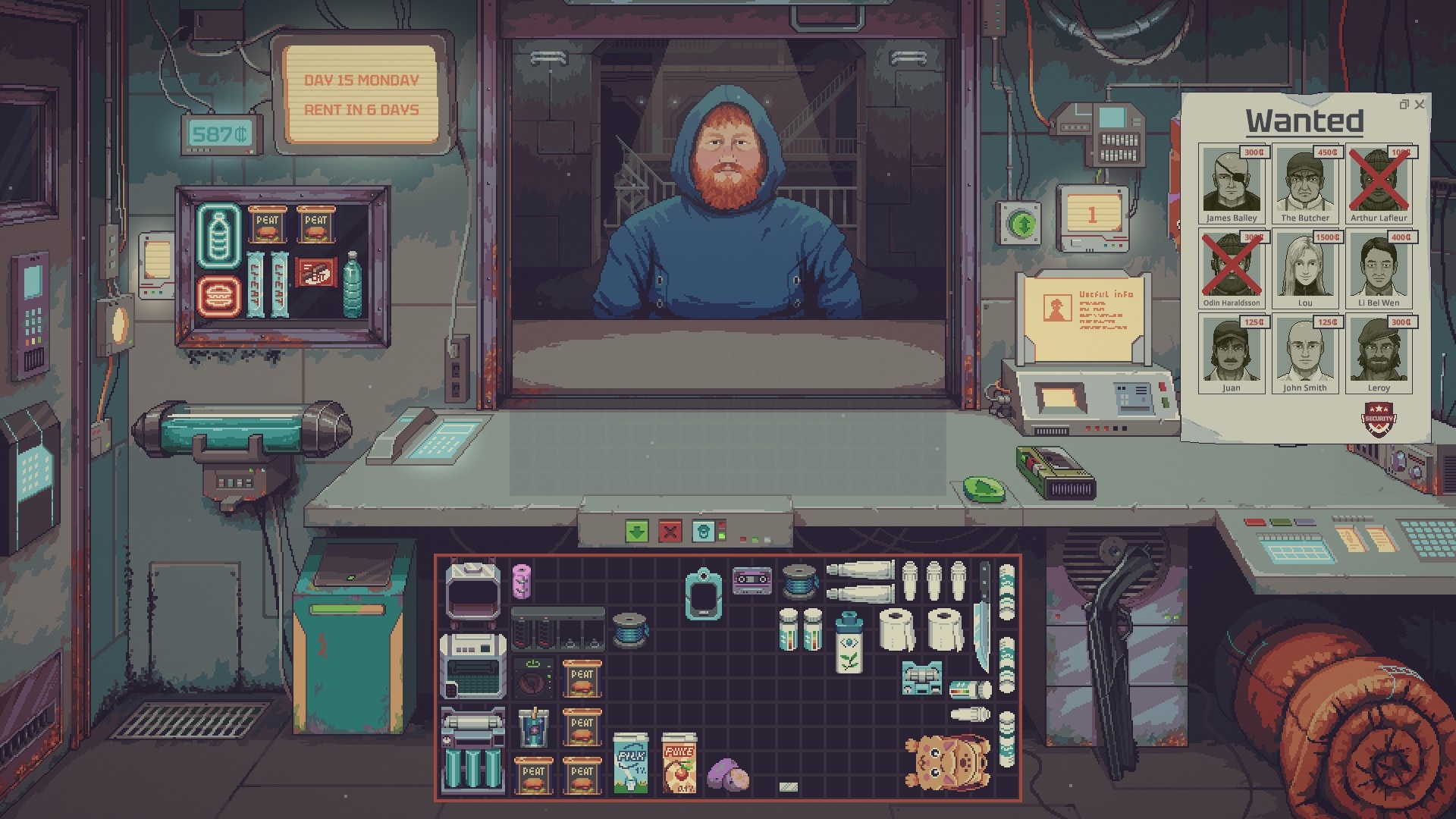
The central gameplay loop revolves around running the shop, managing its inventory and dealing with the customers who arrive throughout the day. Visitors bring merchandise to sell, request particular products or approach the player with opportunities that may or may not be worth accepting. The player must decide what to purchase, how much to charge and whether a transaction is worth the potential financial or legal consequences.
There is more to these interactions than simply buying low and selling high. Customers have different interests and budgets, meaning that not every product will appeal to every visitor. Displaying appropriate merchandise can help attract buyers, while negotiating prices provides opportunities to improve profit margins or secure more favorable deals. Wholesale offers can also be worthwhile, although purchasing larger quantities requires sufficient storage space and confidence that the merchandise will eventually sell.
Haggling is particularly important because it introduces a degree of uncertainty into otherwise routine transactions. Asking for too much can cause customers to walk away, while offering generous terms can help establish goodwill and improve relationships. Consequently, maximizing the immediate profit is not always the smartest approach. Sometimes accepting a less attractive deal can be beneficial if it strengthens a relationship or opens the door to future opportunities.
The game’s economic systems provide additional reasons to pay attention to what is happening around the station. Newspapers report developments that can influence prices and availability, while information gathered from contacts can help players prepare for shortages or changing market conditions. This creates opportunities to purchase certain goods before their value increases or avoid investing heavily in products that are becoming less profitable.
Players can also acquire merchandise through alternative means rather than relying entirely on visiting traders. Scavenging outside the shop provides access to additional resources, although these trips involve their own limitations and potential risks. The player must consider carrying capacity, injuries and the time spent away from the business, particularly when a busy trading day is approaching.
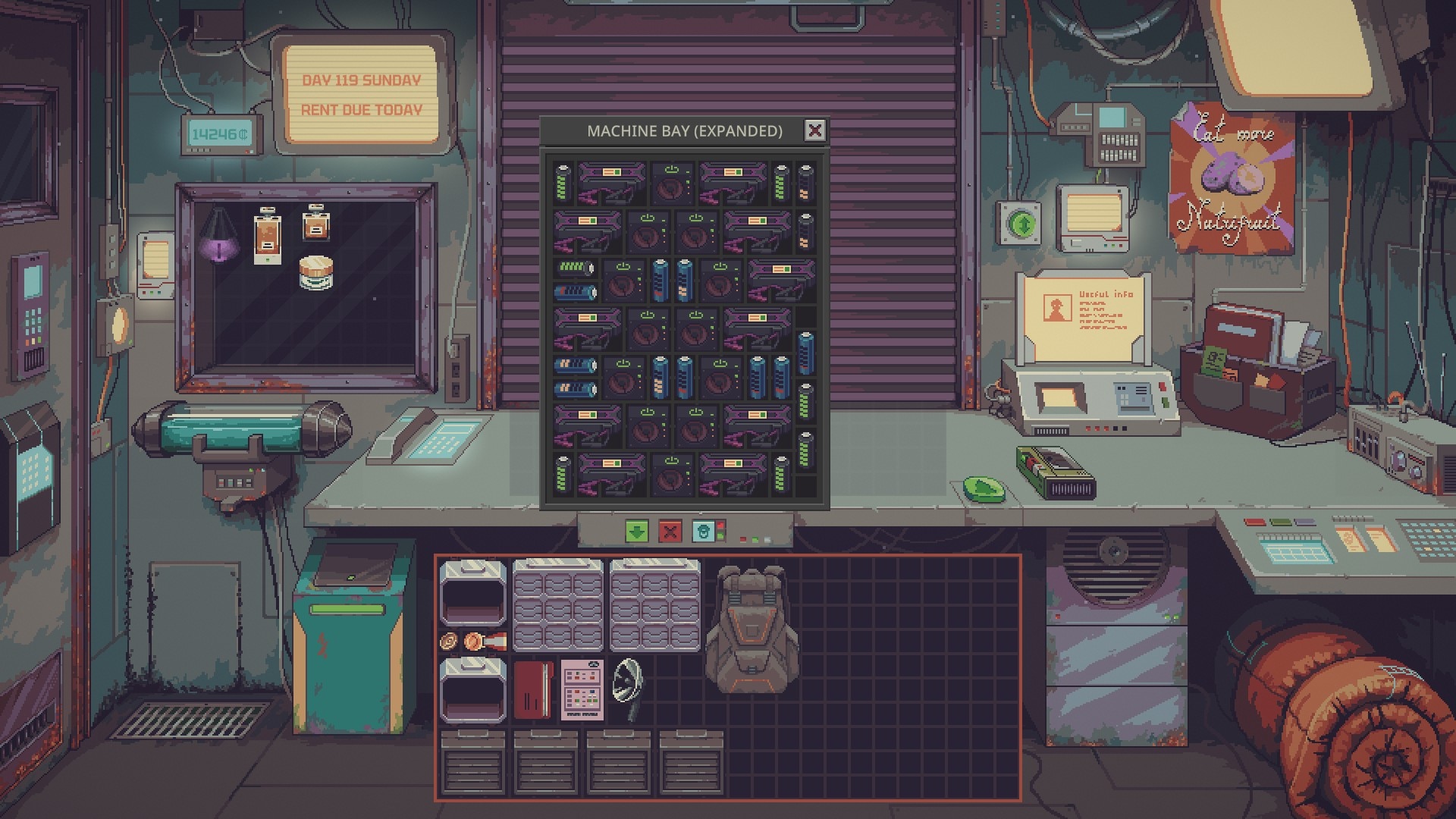
Inventory management is another major part of the experience. Merchandise is stored in a grid-based system, making available space an important consideration as the business grows. Different products require different amounts of room, and players must decide which goods deserve priority. Poor planning can leave valuable merchandise occupying space that could have been used for something more profitable.
These mechanics work well together during the earlier stages of the game, when every purchase and sale feels significant. The player has limited resources, customers are unpredictable, and a poorly judged transaction can have a noticeable effect on the business. As the shop becomes more established, however, the amount of routine management increases. Keeping track of merchandise, checking products and rearranging storage can eventually consume a substantial portion of each working day.
Inspection, Counterfeits and Risk Management
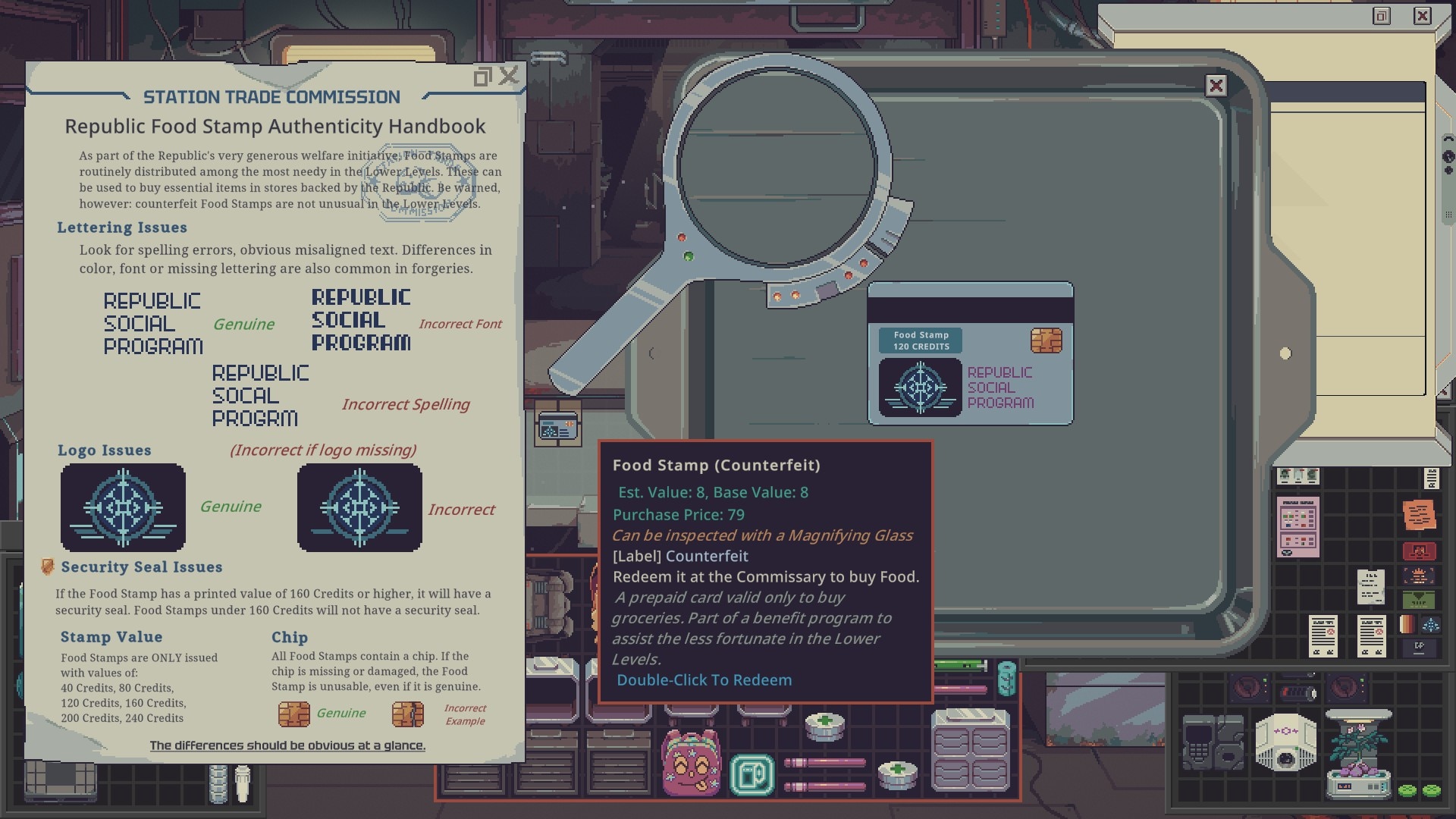
One of the more distinctive elements of Probably Stolen is the importance it places on examining merchandise before accepting or selling it. The shop operates in an environment where legitimate products, counterfeit goods and stolen property regularly find their way across the counter. Players are therefore expected to develop an understanding of what they are purchasing rather than blindly trusting the person offering it.
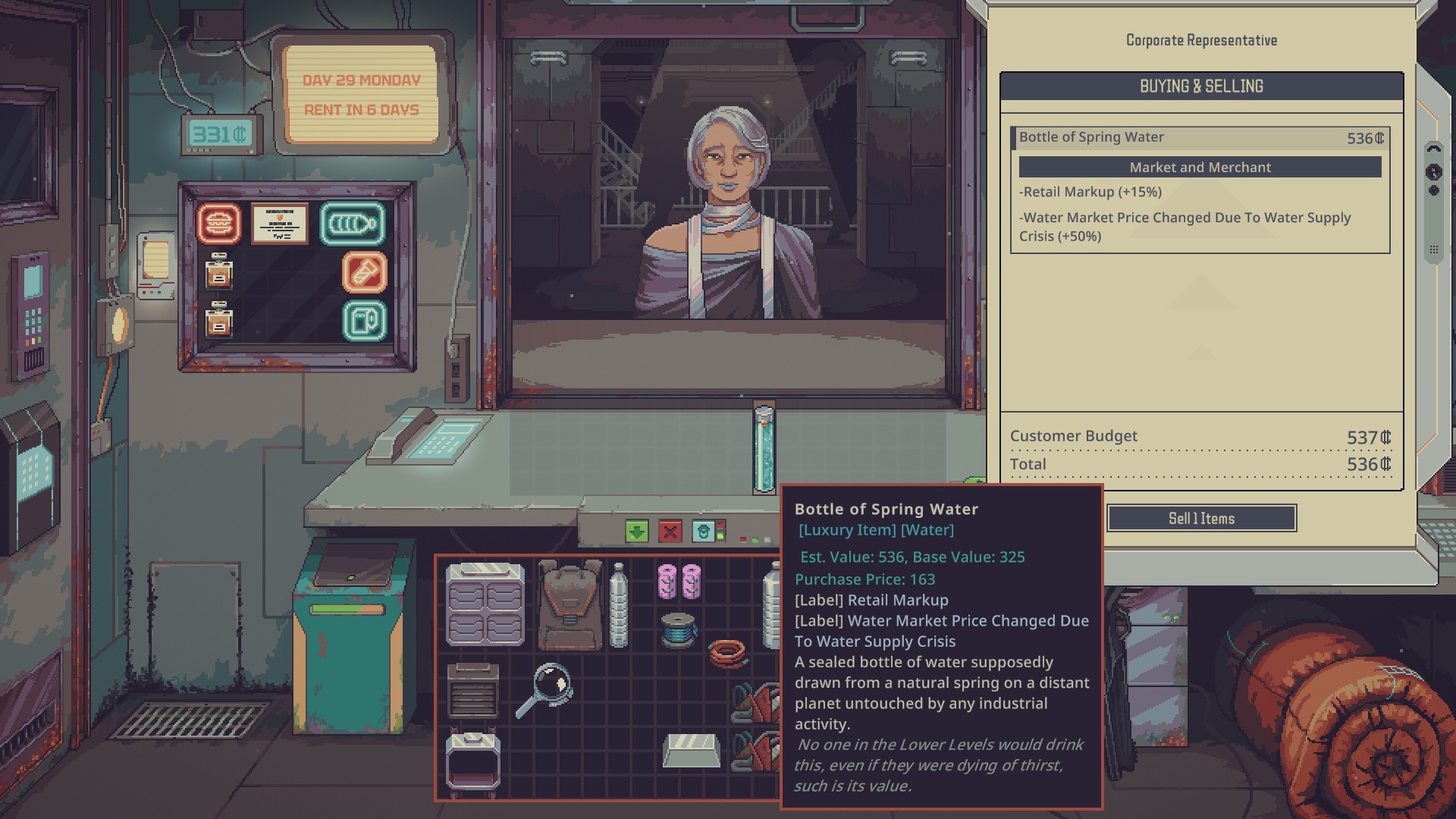
Different products require different forms of attention. Cigarette packs, for example, need to be visually inspected before resale, while water must be tested and purified. Rare objects require proper appraisal to avoid paying more than they are worth, and weapons come with additional requirements involving permits and modifications. Certain chemicals also depend on specialized recipes, adding another layer of preparation to their production and sale.
Authentication and appraisal are particularly worthwhile because they turn what might otherwise be simple transactions into small investigative exercises. Players must examine the available information, identify suspicious details and decide whether an object is worth purchasing. Making the wrong assessment can result in financial losses, especially when expensive merchandise is involved.
The system also works in both directions. Players are not required to maintain an entirely legitimate business, and there are opportunities to misrepresent products, reduce their quality or sell counterfeit merchandise as genuine. Stolen goods can be purchased at attractive prices, but their questionable origins introduce additional risks. Security inspections can result in confiscated merchandise, while particularly suspicious activities may lead to investigations and other financial consequences.
This is where the game’s title becomes especially appropriate. Almost everything in the Lower Levels seems to have some uncertainty attached to it, and players must constantly decide how much risk they are willing to accept for a potentially better return. Hiding contraband, bribing officials and paying for protection can help keep an illegal operation running, but these measures also introduce additional expenses.
Stolen merchandise also involves a system of accumulated Heat, which gradually decreases over time. This encourages players to consider when and how to sell questionable goods rather than immediately placing everything on display. The difference between a profitable purchase and a costly mistake can depend on patience, preparation and a reasonable understanding of how the authorities operate.
There is another unusual threat to consider. A rogue artificial intelligence has taken control of augmented individuals known as Augs, who can disguise themselves among ordinary customers. Players must recognize suspicious behavior and identify these threats before deciding whether to use the weapon kept beneath the counter. This introduces occasional moments of tension into an otherwise management-focused experience and gives the station another problem beyond its corrupt economy.
Crafting, Production and Business Specialization
The ability to manufacture products rather than relying exclusively on external suppliers is one of the strongest aspects of Probably Stolen. Its production systems provide a substantial amount of additional depth and give players several ways to develop a business around particular industries.
Water production is one of the more accessible examples. Players can acquire the necessary equipment, test available supplies and purify water before selling it. Hydroponic farming offers another route, requiring seeds, water and suitable equipment to produce goods for the shop. Aquafarming and animal breeding expand these possibilities further, allowing players to raise fish and rats for additional products and production chains.
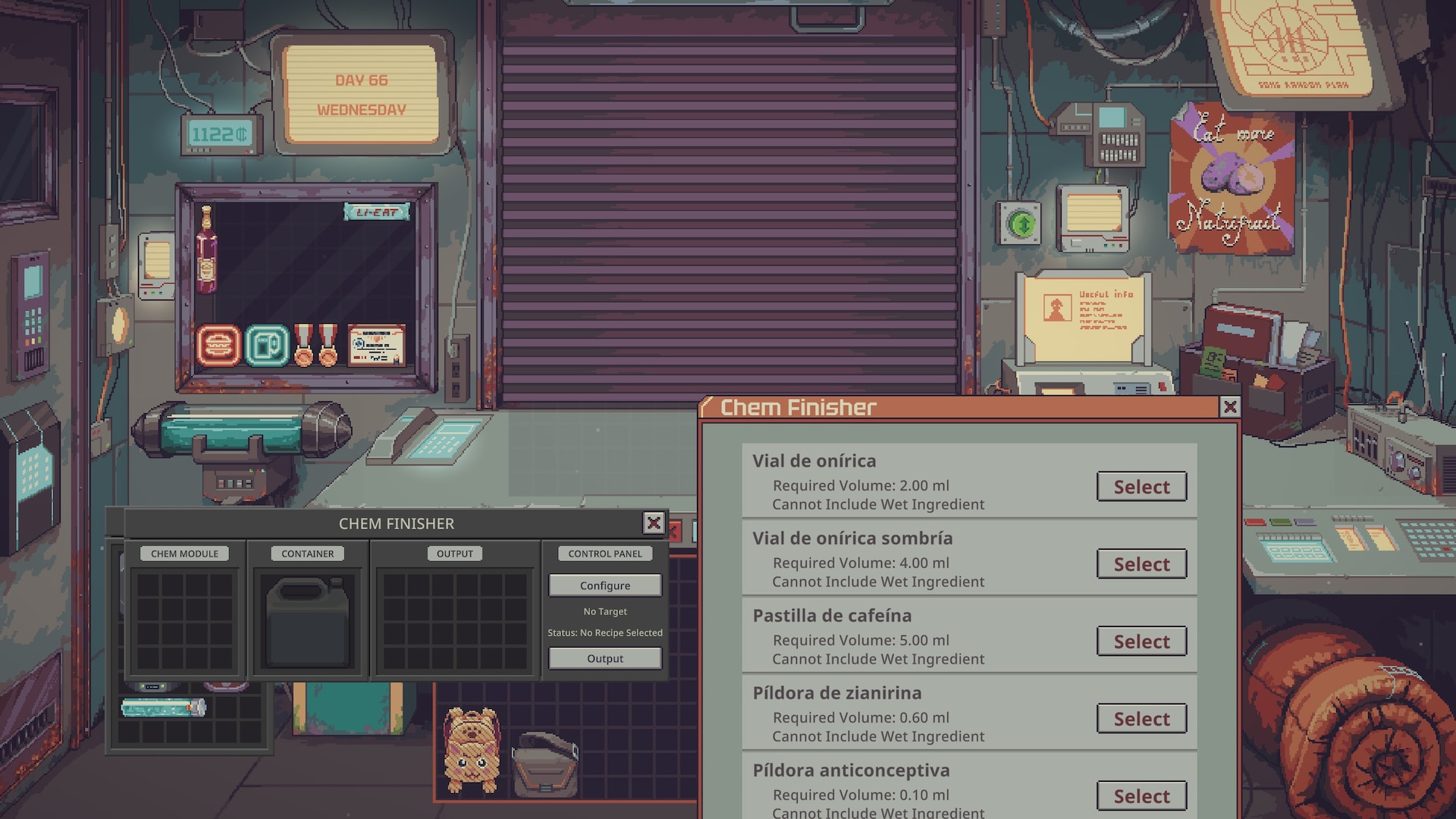
Other industries are considerably more specialized. Chemistry provides access to medical products and narcotics, while metalworking and machinery allow players to process raw materials and manufacture more advanced goods. Brewing and winemaking introduce their own preparation requirements, while certain products depend on specialized equipment, production recipes and sufficient power.
These activities are not entirely separate from the shopkeeping mechanics. Production creates new merchandise to sell, but it also introduces additional costs and organizational responsibilities. Equipment requires resources, production takes time, and finished goods need to be stored until suitable customers arrive. A successful operation therefore requires players to consider the entire process rather than simply focusing on the final selling price.
The different starting specializations make this aspect of the game particularly appealing. Players can begin with a relatively conventional business or select a more focused approach involving water trading, weapons, chemistry or farming. There are also more challenging starting conditions, including Rock Bottom, which removes much of the initial financial support and forces players to build an operation from almost nothing.
These choices are accompanied by four difficulty settings and additional starting perks, allowing players to adjust the challenge and experiment with different approaches. The variety is meaningful because a business focused on water production has different requirements and risks from one dealing primarily in weapons or illegal merchandise.
There is a genuine sense of satisfaction in gradually developing a specialized operation and becoming less dependent on whatever happens to arrive at the counter. However, the production systems also contribute to one of the game’s biggest weaknesses. As more equipment and product lines become available, the amount of maintenance and inventory management increases considerably. What initially feels like an interesting expansion of the gameplay can eventually become another collection of tasks that players must complete before they can get back to the more enjoyable parts of running the business.
Factions, Characters and Moral Choices
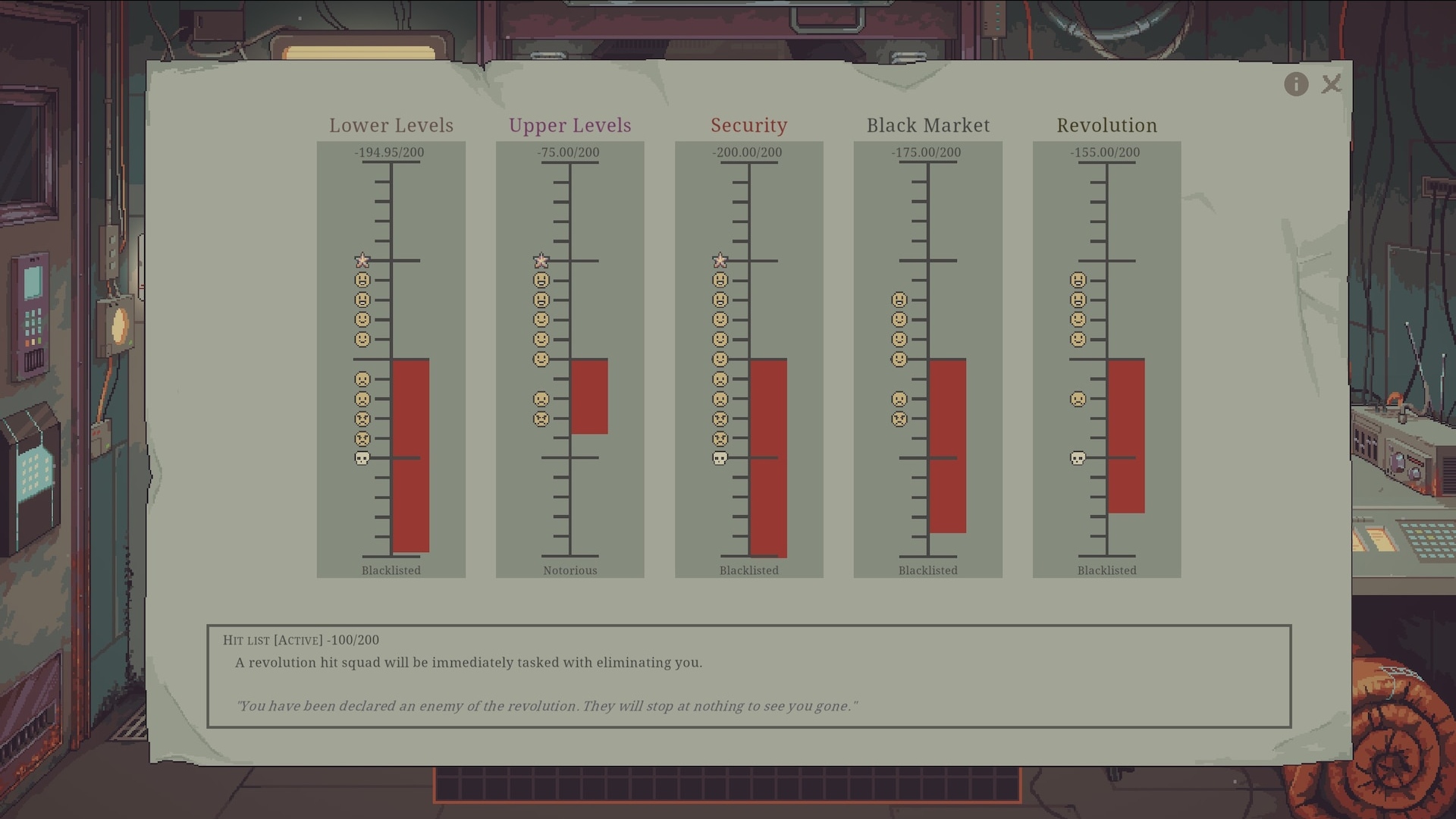
The station’s social and political divisions provide much of the context for the decisions players make. Several factions operate throughout the Lower Levels, each with its own interests, expectations and potential benefits. These include the residents of the Lower and Upper Levels, Security, the Black Market and the Revolution. Supporting one group can improve access to particular customers, services and resources, but it can also complicate relationships elsewhere.
Reputation is therefore an important part of managing the business. Cooperating with Security can provide certain advantages, but reporting suspicious customers may damage relationships with people involved in illegal trading. Supporting the Black Market can create opportunities for more lucrative transactions, although it also increases the importance of avoiding inspections. The Revolution offers another direction, particularly for players who want to oppose the authorities and supply groups working against the existing order.
The important distinction is that these relationships have practical consequences rather than existing solely as dialogue choices. Faction standing can influence available services, discounts, information and protection. It also affects the kinds of visitors and business opportunities that become available. Players must decide which relationships are worth maintaining and which advantages they are willing to sacrifice.
The game also features a recurring cast of characters with individual requests and storylines. Their visits provide some welcome variation between the more routine customer interactions, and helping them can involve supplying merchandise, providing financial assistance or completing other tasks. These encounters give the station a little more personality and make its inhabitants feel less like interchangeable customers.
Unfortunately, the faction system is more successful as a business-management mechanic than as a narrative device. Relationships can meaningfully affect how the shop operates, but their consequences do not always extend far enough into the wider world. Supporting the Revolution or cooperating with Security can change the player’s business opportunities, yet the broader political situation remains relatively limited in how much it responds to those decisions.
The individual character stories provide some additional motivation, but players looking for a deeply branching narrative may find the results less substantial than expected. The game offers plenty of opportunities to decide what kind of business to run and whom to support, although these choices do not always produce the dramatic differences that their premise suggests.
Progression and Replayability
Progression is primarily built around the gradual expansion of the business and the eventual goal of purchasing the shop outright. At the beginning, the player receives assistance from a mysterious figure known as the Mentor, who helps establish the business and provides some initial resources. However, the arrangement does not eliminate the financial pressure. Rent must be paid regularly, and the Landlord continues to increase the amount owed as time passes.
This creates a consistent reason to remain financially responsible. Players cannot simply spend every available credit on new equipment or merchandise, because they must also ensure that enough money remains available for the next rent payment. A confiscated shipment, an expensive mistake or an unsuccessful production investment can therefore have consequences beyond the immediate loss.
The eventual purchase of the shop provides a clear long-term objective, although reaching that point can require a considerable amount of repetitive work. The early stages are generally the most engaging, as players discover new systems, unlock additional opportunities and work out which business strategy suits them best. Later, once most of the available mechanics have become familiar, the remaining financial requirements can make progression feel considerably slower.
Replayability helps compensate for this limitation. Different specializations provide distinct starting conditions, while the difficulty settings and starting perks allow players to approach familiar activities under different circumstances. Someone who initially concentrates on everyday household goods can begin another run as a gunsmith, chemist or farmer, exploring production systems that may have received little attention previously.
The different faction relationships also encourage experimentation. A player who initially cooperates with Security can take a different approach in another run, building connections with the Black Market or supporting the Revolution. These choices influence the kinds of opportunities available and provide some variation in how the business develops.
Mod support provides another avenue for extending the experience. The inclusion of Steam Workshop support and a modding API is welcome, particularly for a game whose long-term appeal depends heavily on the availability of new content and additional ways to approach familiar mechanics. It remains to be seen how extensively the community will expand the game, but the option provides a useful foundation for its future.
Ultimately, replayability is one of the game’s stronger qualities, although it does not completely solve the problem of repetition. Starting over with a different specialization changes the available opportunities, but the underlying daily routine remains largely the same. Players who enjoy mastering economic systems will probably find enough reasons to return, while those who become bored with repeated transactions may struggle to remain interested after completing their first substantial run.
Presentation, Graphics and Sound
Probably Stolen uses a pixel-art visual style that suits its cyberpunk setting without requiring particularly elaborate environments. The shop and its surrounding details communicate the atmosphere of a deteriorating space station, while the merchandise, equipment and characters help establish the distinction between its wealthier and poorer inhabitants.
The first-person perspective places players directly behind the counter, making customer interactions and merchandise inspection the primary focus. This works well for the type of simulation the developers are trying to create, particularly when examining suspicious products or deciding how to handle a potentially dangerous visitor.
However, it is important to understand that the game does not offer a conventional open-world exploration experience. Although players can travel to other locations and scavenge for resources, these activities are handled through specific destinations and interactions rather than unrestricted movement around the station. The world provides context for the business, but the shop remains the center of the experience.
The audio presentation is similarly functional rather than particularly ambitious. Music is associated with cassette tapes that players can collect and use, giving the soundtrack a more personal quality than a conventional continuous background score. It is a fitting detail for the setting, although the limited musical variety means that the atmosphere can become familiar over extended sessions.
Character dialogue is another area where the presentation could be stronger. Recurring visitors help establish some personality, but ordinary customer interactions rely on a relatively limited selection of lines. Since players spend so much time dealing with the same types of transactions, greater dialogue variety would have helped make the station feel more alive.
None of these issues fundamentally undermines the presentation, but they contribute to the repetitive feeling that can emerge after several hours. A broader range of incidental events, conversations and visual changes would have helped maintain the sense that the business exists within a larger and constantly developing environment.
Technical Performance on PC
Probably Stolen is not a particularly demanding game by modern PC standards, and its minimum system requirements are relatively modest. The game asks for a Windows 10 64-bit, an Intel Core i3 or equivalent processor, 8GB of RAM, and a GTX 650 Ti or comparable graphics card. It also requires just 1GB of available storage space. These specifications suggest that the game should be accessible to a wide range of older and entry-level gaming PCs.
In practice, the overall performance appears to be quite good. One PC review reported that the game ran well for most of its playtime, although the reviewer did encounter a few minor technical problems. These included missing audio after loading a save and an occasional issue where the interface disappeared after interacting with certain objects. Reloading the game generally resolved these problems, so they were more inconvenient than seriously disruptive. This is encouraging, though it is worth remembering that individual results can vary depending on hardware and the game version being played.
The developers have also been addressing technical issues through post-launch updates. Early patches corrected problems involving interface scaling, tooltips and fullscreen display behaviour, while later updates introduced additional performance improvements and fixes for occasional input and interface problems. The game also received adjustments to its frame-rate limiter: an October hotfix replaced the previous software-based limit with a VSync-based option that follows the monitor’s refresh rate, with a minimum limit of 60 FPS. This was intended to address stuttering and screen tearing, particularly on high-refresh-rate displays. The same update improved borderless fullscreen support for non-16:9 monitors and fixed certain problems that could occur after switching between the game and other applications.
Steam Deck support is another consideration. The game is officially classified as Playable rather than Verified. Its default graphics configuration performs well on the device, but some functions are less convenient with the standard controller layout, and certain interface text can be difficult to read on the smaller screen. Players may need to use the touchscreen, virtual keyboard or a community controller configuration to get the most comfortable experience.
Overall, Probably Stolen seems to be in a reasonably healthy technical state for a relatively modest PC release. The available reviews do not point to widespread crashes or serious performance problems, and the developers have shown a willingness to address reported issues through regular updates. There are still occasional bugs and some display-related quirks to be aware of, but these do not appear to undermine the experience. It is not possible to give a reliable average FPS figure based on the published reviews, but the available evidence suggests that most players with hardware meeting the minimum requirements should be able to run the game without needing a particularly powerful system.
Final Verdict: 8/10
Probably Stolen is a surprisingly ambitious shopkeeping simulator that manages to find considerably more depth in its premise than the genre’s familiar formula might suggest. What begins as a relatively straightforward exercise in buying and selling merchandise gradually develops into a broader management experience involving production chains, item authentication, faction relationships and the constant financial pressure of running a business in a corrupt space station.
Its strongest quality is the freedom it gives players to approach the business in different ways. Those who prefer a relatively legitimate operation can concentrate on everyday goods, water production and farming, while more adventurous players can explore weapons trading, chemistry and the underground market. The various starting specializations provide meaningful differences between playthroughs, and the production systems give players additional reasons to experiment with their business rather than simply purchasing everything from visiting traders.
The inspection mechanics are another highlight. Examining merchandise, identifying counterfeit products and deciding whether to accept stolen goods add a degree of uncertainty to transactions that would otherwise be fairly routine. The possibility of encountering dangerous augmented individuals also provides occasional interruptions to the management-focused gameplay, although these elements never completely change the game’s fundamental identity.
There are, however, some clear limitations. The daily routine can become repetitive, particularly once players have become familiar with the available customers and transactions. Inventory management becomes increasingly demanding as the business grows, and the amount of time spent organizing stock and navigating menus can detract from the more interesting activities. The faction system offers useful mechanical benefits, but its narrative consequences are not always as substantial as the game’s setting and premise would lead players to expect. Finally, the financial grind involved in reaching the ultimate objective can make the later stages feel longer than necessary.
These shortcomings prevent Probably Stolen from being an exceptional entry in the genre, but they do not erase its considerable strengths. There is a satisfying amount of depth to discover, and the different business specializations provide enough variety to make experimentation worthwhile. Players who enjoy managing resources, negotiating deals and gradually developing a complex operation will find plenty to appreciate.
Ultimately, Probably Stolen is a strong recommendation for fans of shopkeeping and management simulations, particularly those who prefer games that offer multiple interconnected systems rather than a simple progression loop. It is less appealing to anyone looking for a story-driven cyberpunk adventure or a particularly relaxing simulator. Its repetitive routines and occasional interface frustrations are difficult to overlook, but the underlying experience is engaging enough to make it stand out from many of its genre contemporaries.