Real-time strategy games have spent years trying to balance scale with accessibility. Large armies and sprawling battlefields can create memorable confrontations, but they can also turn a match into a constant cycle of unit production, individual orders and administrative work. Ashes of the Singularity II approaches that problem by making the movement of entire armies and the control of territory more important than micromanaging every individual unit.
Developed by Oxide Games and published by Stardock Entertainment, the sequel follows the 2016 original with a new campaign, three playable factions and battles that can involve enormous numbers of units. Its setting remains a future in which humanity, post-human forces and artificial intelligence are fighting for control of the solar system. The scale is familiar, but the sequel makes meaningful changes to how battles are organized and how players manage their forces.
The result is an ambitious strategy game with a clear identity. Its strongest ideas are tied to the relationship between territory, production and large-scale army movement. It is also more approachable than its premise might suggest, thanks to systems designed to reduce repetitive management. However, some of its presentation and technical limitations keep it from feeling like a complete step forward in every area.
Gameplay and Mechanics
The central idea behind Ashes of the Singularity II is that battles should be decided by control of the wider battlefield, not simply by the number of units a player can send into a fight. Territory, production and the positioning of armies all influence the course of a match. Capturing and holding important areas creates opportunities to expand, reinforce the frontline and put pressure on an opponent’s position.
This gives the game a different rhythm from an RTS built around a single base and a series of direct attacks. Players need to think about where their forces are deployed and how their territory connects to the rest of the battlefield. Expanding too quickly can leave important positions exposed, while concentrating too much strength in one area can allow an opponent to make progress elsewhere. The most successful approach is usually to maintain pressure across several fronts while keeping enough forces available to respond when a position comes under threat.
Production is closely tied to this territorial struggle. Moving production buildings toward important areas can shorten the distance between reinforcements and the fighting. It also creates decisions about where to commit resources and infrastructure. A forward production position can help sustain an attack, but it may become vulnerable if the frontline shifts. These decisions give the strategic layer more importance than simply building the largest possible force.
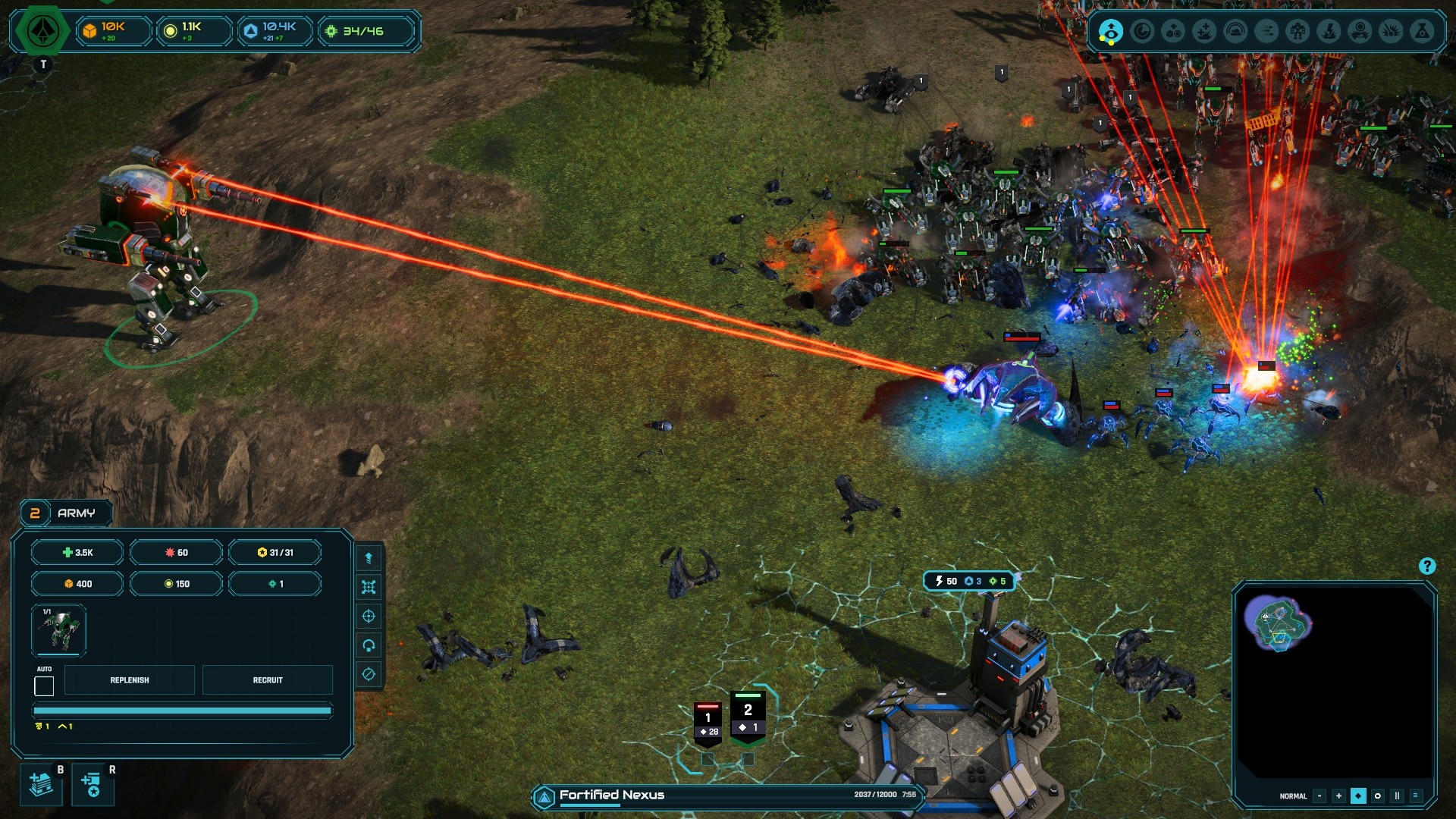
One of the sequel’s most useful features is its approach to army management. Players can organize units into armies and set those armies to replenish automatically as losses occur. New units can be directed toward the army rather than requiring the player to repeatedly select individual reinforcements and send them across the map. This reduces a substantial amount of routine work, particularly during larger battles where several groups may be fighting at once.
The Strategic Zoom also helps make the scale manageable. Players can move between a closer view of the action and a broader perspective that makes it easier to understand the position of armies and the shape of the frontline. This is important in a game where the tactical situation can change in several places at once. The camera is not merely a presentation feature; it supports the way the game expects players to think.
These systems do not remove the need for careful decisions. Army composition, timing and positioning remain important, and a large force is not automatically an effective one. Specialized units can counter particular threats, so sending the same collection of vehicles into every engagement is rarely the best answer. The game still rewards players who understand what their forces can do and recognize when a battle is becoming unfavorable.
There is a learning curve, especially for players unfamiliar with the series. The campaign introduces mechanics gradually, but the number of interacting systems can take time to absorb. Once the basic relationship between territory, production and army reinforcement becomes clear, however, the game is easier to follow. Its automation removes repetitive tasks without removing the strategic decisions that make the genre engaging.
Factions and Unit Variety
The three factions offer distinct approaches to warfare: the United Earth Forces, the Post-Human Coalition and the AI Substrate. Each has its own roster and strategic identity, and the differences are more than cosmetic.
The United Earth Forces are the most conventional of the three. Their forces include recognizable ground troops, tanks and other military vehicles, giving them a comparatively direct approach to building and deploying armies. Their roster makes it easier to understand the basic combat roles of different units, although success still depends on using the right forces for the situation. The UEF also serves as the player’s faction in the campaign, making it the natural introduction to the game’s systems.
The Post-Human Coalition takes a different approach. Its units are generally more expensive and powerful, which makes its forces less suited to simply overwhelming an opponent with large numbers of inexpensive troops. Choosing where and when to commit these units is particularly important. A powerful force can make a major difference in a decisive engagement, but losing expensive units carelessly can be difficult to recover from.
The AI Substrate has a more machine-oriented identity, with access to drone swarms and other artificial constructs. Its approach to expendable forces differs from that of the UEF: Substrate drones function more like autonomous projectiles than conventional individual infantry units. This asymmetry gives the faction its own character rather than forcing all three sides into identical unit categories.
The different rosters encourage players to learn the strengths and weaknesses of each faction. They also give multiplayer matches more variety, since the same battlefield can play out differently depending on the forces involved. Not every unit is equally useful in every situation, and countering an opponent’s composition is an important part of the combat system.
There is room for the factions to feel even more distinct as players become familiar with their full unit selections, but the foundations are solid. The differences in cost, durability and battlefield role create meaningful choices, and the three sides provide enough variety to support different approaches to the same strategic problem.
Campaign and Story
The single-player campaign follows the United Earth Forces as humanity fights to reclaim territory across Earth and other locations in the solar system. It also provides the game’s main introduction to its mechanics. Rather than placing every system in front of the player immediately, the campaign gradually introduces new concepts as missions progress.
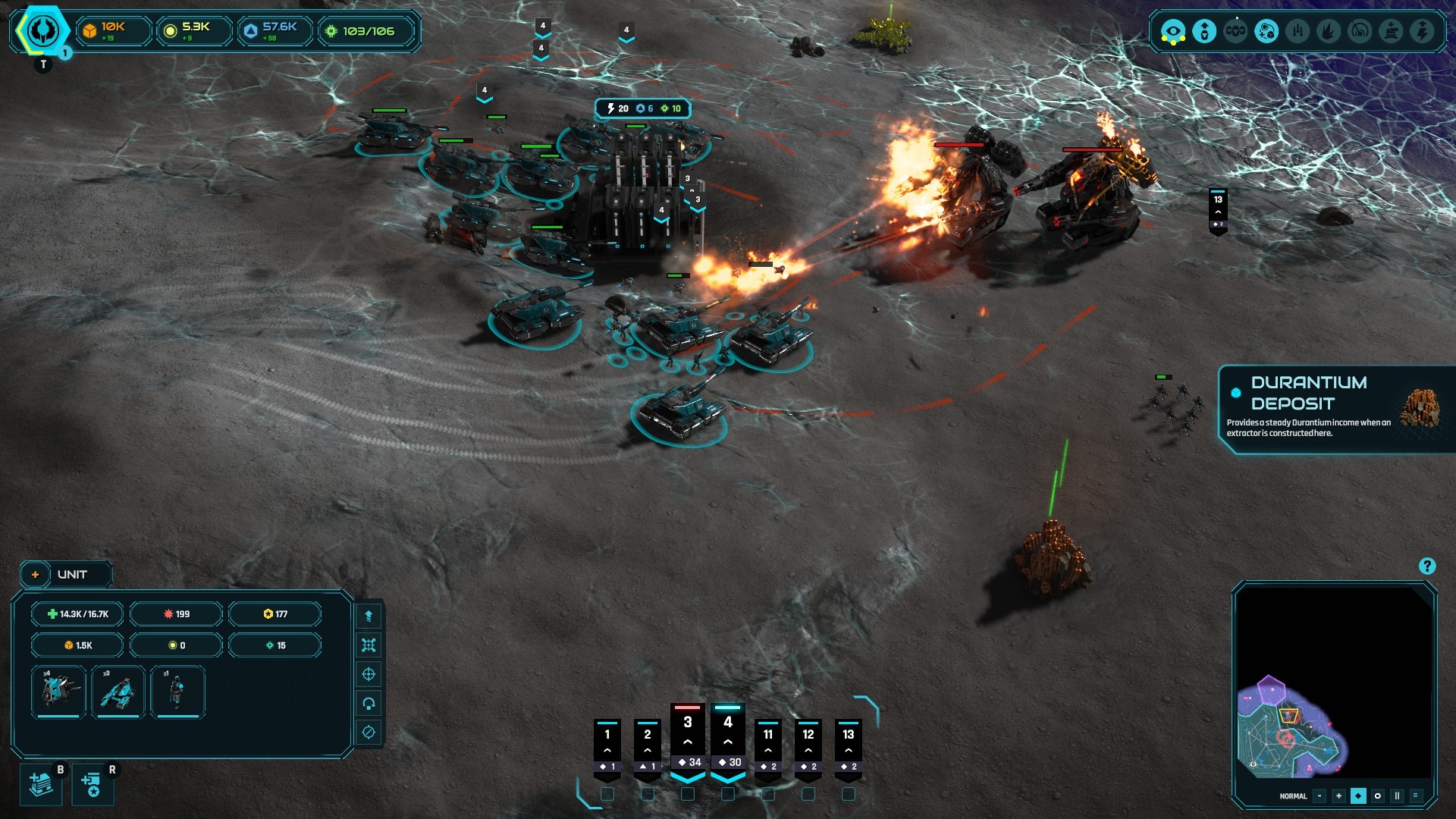
That structure is particularly useful in a strategy game with this many moving parts and interconnected systems. Early missions give players time to become familiar with unit production, army control and the importance of territory before gradually introducing more demanding situations. Later missions make greater use of the game’s larger-scale systems, requiring players to apply what they have learned and providing a better sense of how the different mechanics work together during increasingly complex battles.
The campaign contains ten missions and is relatively short compared with the lengthy story modes found in some other strategy games. Published reviews put the experience in the region of four to five hours, although the actual time will depend on difficulty and how much time a player spends managing each mission. That makes the campaign a useful introduction and a welcome single-player component, but not the main reason to keep returning to the game.
The story establishes the conflict between humanity, post-human forces and the Substrate, but the narrative is not as compelling as the strategic systems surrounding it. The setting provides a suitable backdrop for the battles, and the campaign gives the player a reason to move from one confrontation to the next. Still, the story rarely becomes the game’s strongest feature. Players looking for a character-driven science-fiction narrative may find it functional rather than memorable.
The game’s use of generative AI in some presentation elements is also worth addressing. According to the developers’ disclosure on Steam, AI was used for post-processing effects and animation applied to some campaign cutscenes created by human Stardock artists. Some scenes combine human-made 3D assets with AI-assisted compositing. The disclosure also states that some unit barks, notifications and a few minor characters use pre-generated ElevenLabs stock voices. The dialogue was written by Stardock designers and reviewed before inclusion, and no content is generated live during play.
That distinction matters: the game is not generating dialogue or story content dynamically while a mission is underway. The disclosed use is part of the production process for selected visual and audio elements. Whether players are comfortable with that approach is a separate question, but the scope should be described accurately.
Skirmish and Multiplayer
The campaign is only one part of the package. Skirmish and multiplayer are important to the game’s long-term appeal, particularly because its strategic systems are designed around large battles that can unfold across broad maps.
Skirmish allows players to take on AI opponents, while online play supports both competitive matches and co-op battles against computer-controlled enemies. Multiplayer supports up to eight players. That player limit creates the potential for large confrontations in which alliances, positioning and pressure across several fronts can become just as important as direct combat.
Procedural map generation is one of the game’s more useful features. It is available for offline skirmish and online multiplayer, allowing players to create different battlefields rather than relying entirely on a fixed collection of maps. There are also prebuilt maps intended to provide more consistent conditions for competitive play. The combination gives players some variety while retaining the option of more predictable environments when balance and familiarity matter.
The multiplayer structure suits the game’s emphasis on territory and large-scale coordination. A match can develop in several directions, and players need to pay attention to more than the nearest engagement. Co-op against AI is a welcome alternative for those who prefer working with friends rather than competing directly against them.
The long-term success of these modes will depend on balance, matchmaking and the size of the active player community. Those elements are difficult to judge from the feature list alone. Still, the available modes and procedural maps provide a solid foundation for replayability beyond the campaign.
Graphics and Presentation
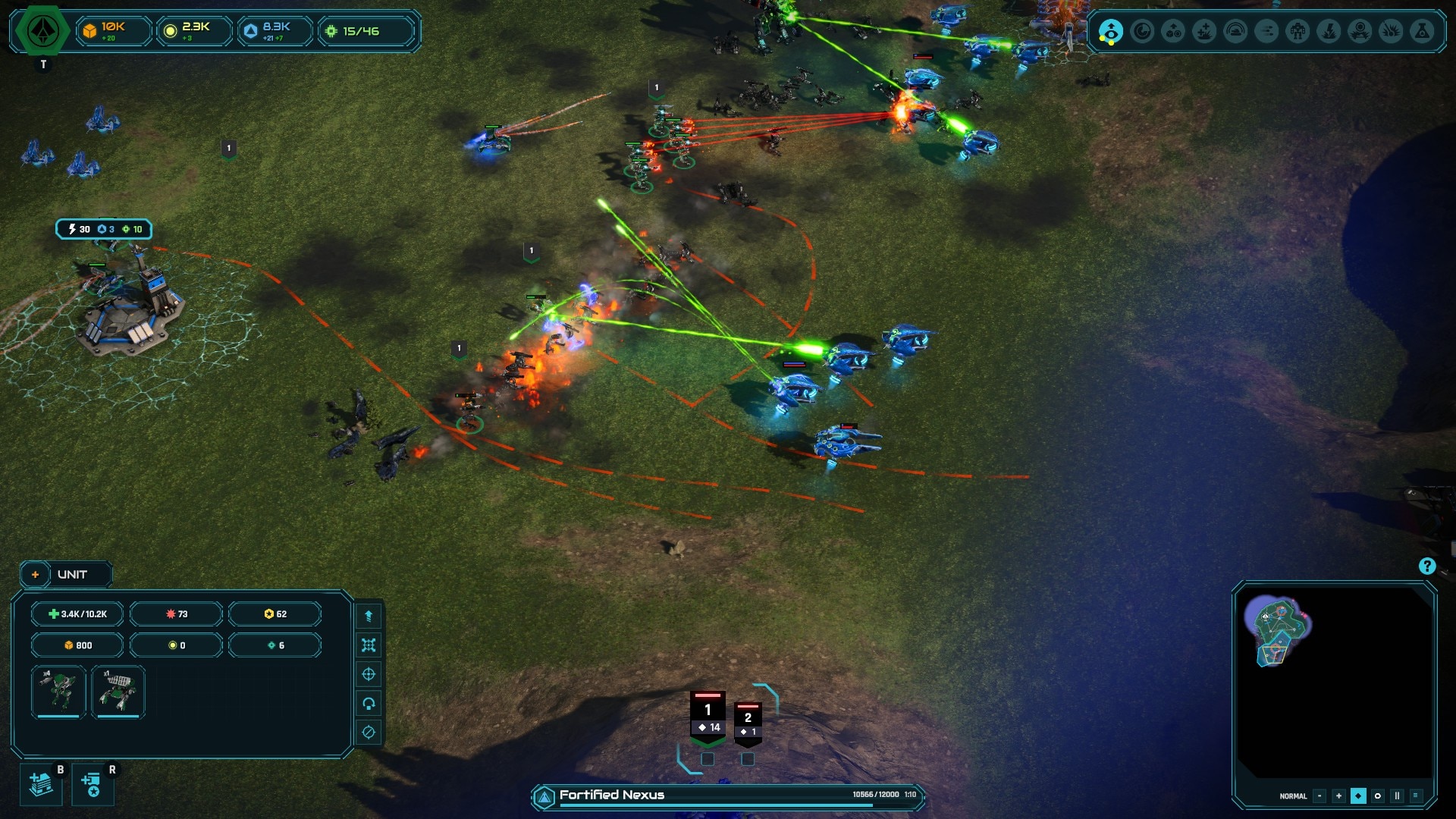
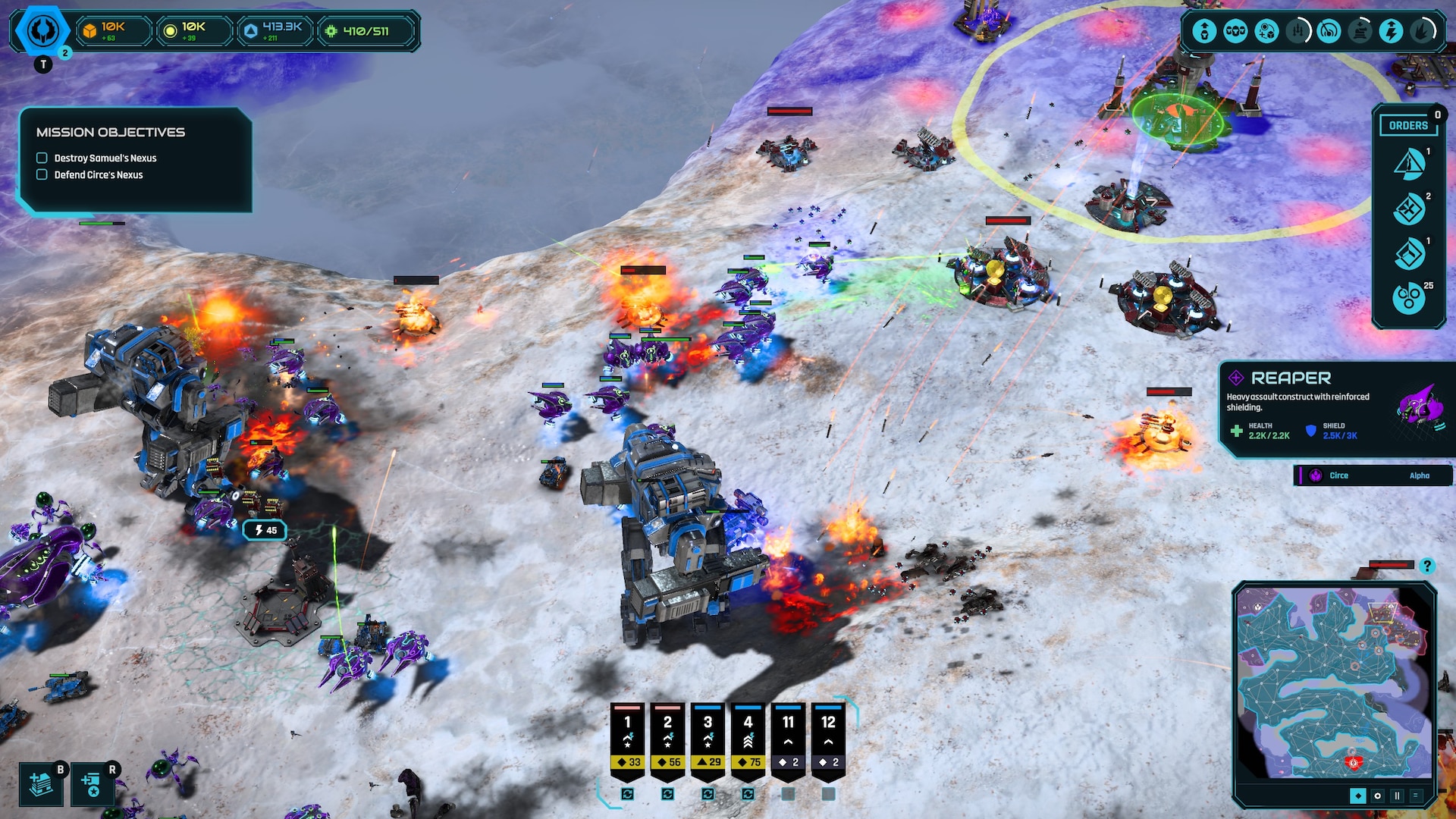
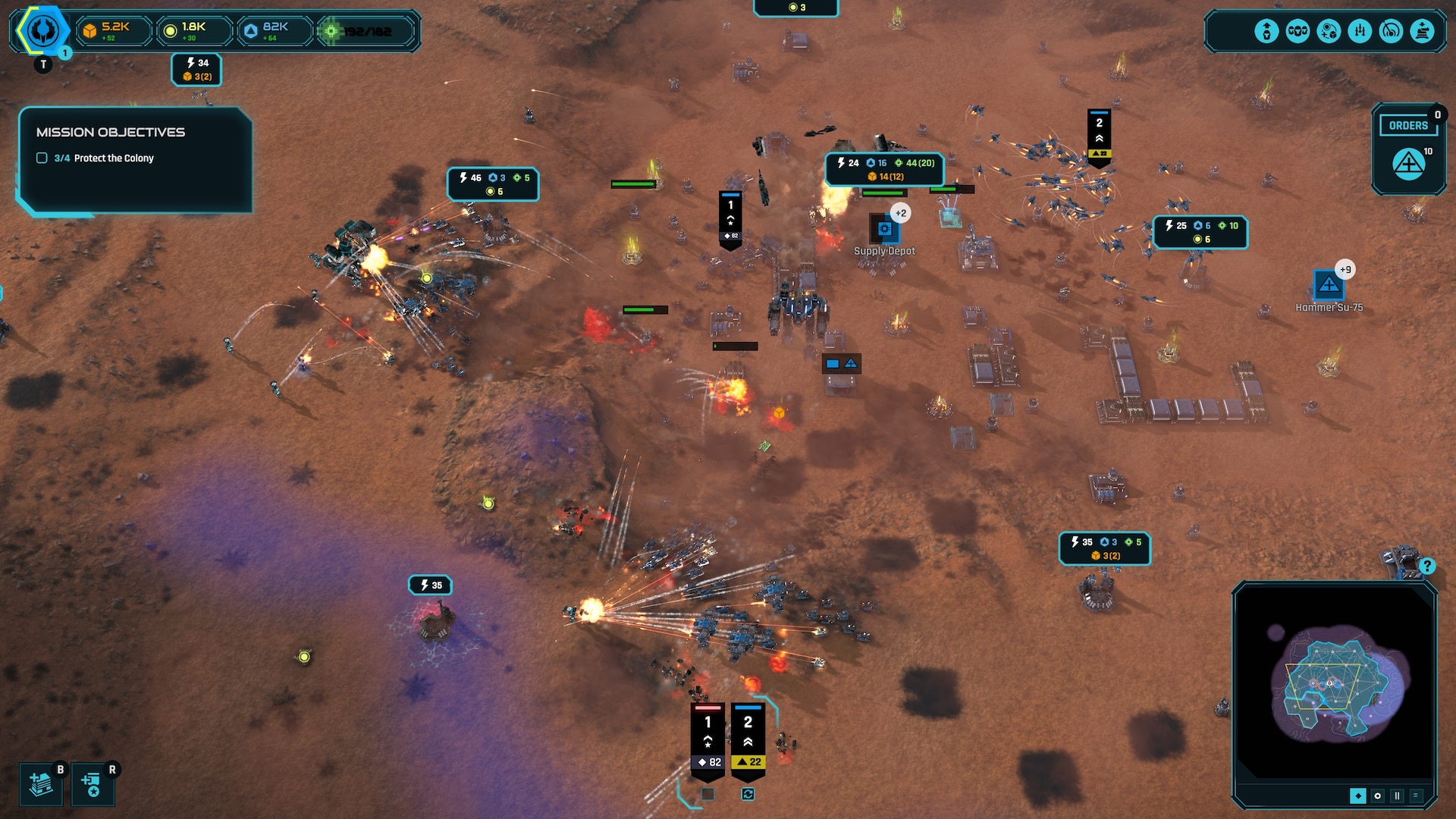
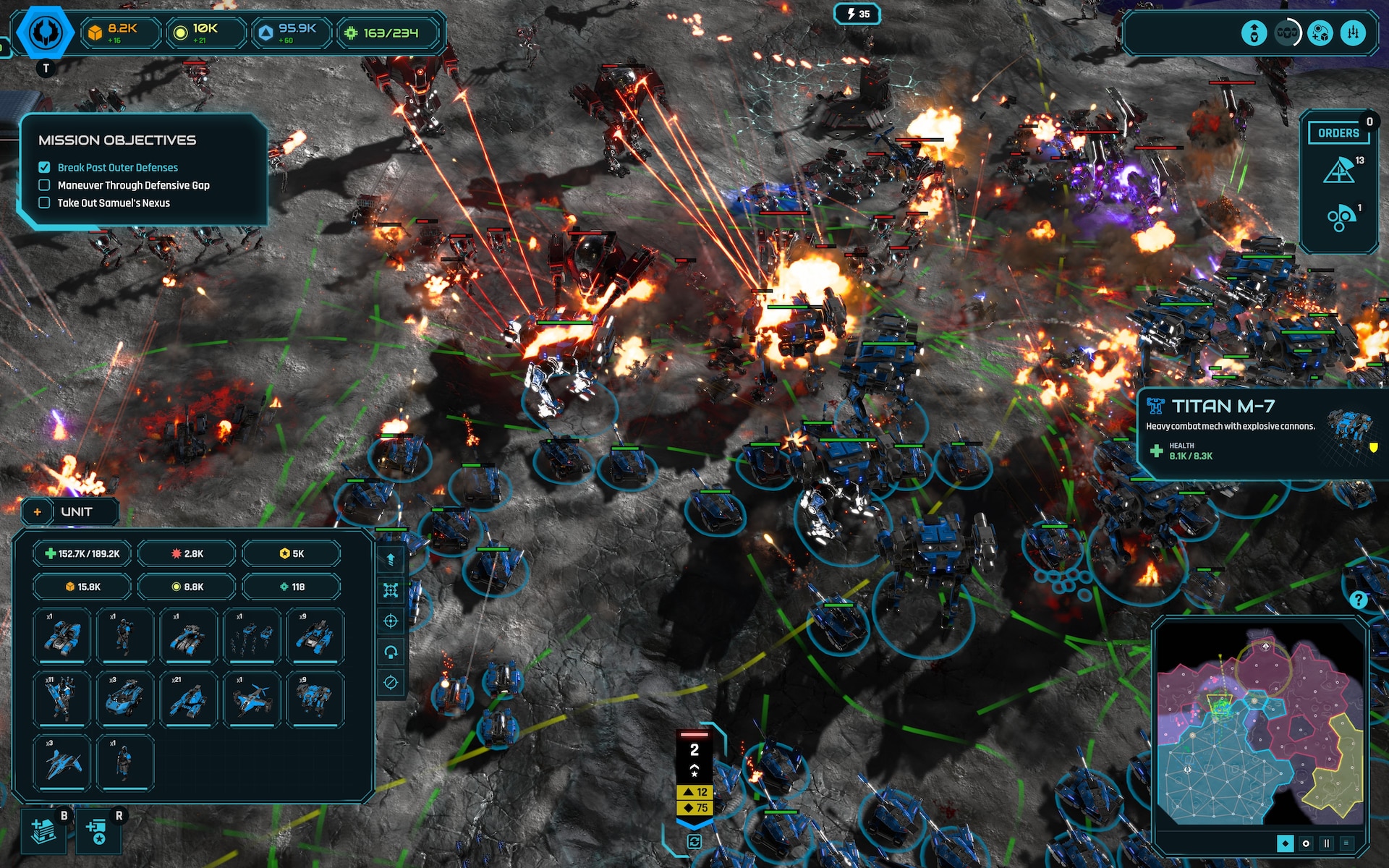
Ashes of the Singularity II is built to communicate scale. Its battlefields contain large numbers of vehicles and other units, and the camera needs to make those forces understandable without losing the sense of a sprawling conflict. The Strategic Zoom helps considerably, allowing players to move between the details of an engagement and the wider battlefield.
The unit designs are functional and generally easy to distinguish during combat. The three factions have recognizable visual identities, which helps players understand what they are facing as battles grow larger. Explosions, weapon effects and the destruction of structures add impact to confrontations, while the changing battlefield gives engagements a sense of progression.
The sequel is not a dramatic visual leap over its predecessor in every respect. Its strengths are more closely connected to scale and the way the engine handles large battles than to a radical change in visual style. The presentation is effective, but some environments and effects lack the detail or polish that would make the game stand out among the most visually impressive modern PC strategy releases.
Terrain also contributes to the sense that battles leave a mark on the map. Structures can crumble, and terrain can transform to or from Turinium as the conflict develops. These changes help reinforce the idea that the battlefield is not simply a static background for unit clashes.
Sound design does its job during combat, giving weapons and explosions enough presence to make large engagements feel active. However, the campaign’s presentation and audio do not always give the story the dramatic weight it needs. The result is a game whose visual and audio design works best when supporting the action rather than carrying the experience on its own.
Technical Performance on PC
Performance is an important consideration for a strategy game built around large numbers of units, particularly during large-scale engagements involving multiple armies. The demands of a battle can change significantly depending on the size of the forces involved and the number of simultaneous engagements, so performance in a quiet opening mission does not necessarily represent what players should expect during a major confrontation.
On a laptop equipped with a mobile GeForce RTX 3060, the game reached around 50 frames per second at 1080p with the Medium preset and 40 frames per second at the High preset in a demanding battle. In the first campaign mission, the same system averaged 52 frames per second at 1080p High, with a reported P1 result of 42 frames per second. These are results from a specific laptop configuration and test scenario, rather than a guarantee for every RTX 3060 system.
The same testing also identified problems with two Intel integrated graphics solutions. The game failed to run on a system using the Arc 140V, while a system with the Arc B390 displayed missing textures even with the latest driver available at the time of testing. Those results suggest that players using Intel integrated graphics should check current compatibility information before buying.
The graphics options are relatively limited. DLSS and other upscaling technologies were absent from the tested launch build, and that changing graphics settings required restarting the game. These are disappointing omissions for a modern PC release, especially for players who need to adjust settings to find a suitable balance between image quality and performance.
The game’s large-scale battles also make CPU performance worth considering. A strategy game has to simulate the behavior and interactions of many units, not simply render them on screen. As the number of forces increases, the demands of the simulation can become as important as the graphics workload. Players should therefore consider their overall system specifications rather than choosing a graphics card in isolation.
The PC version has the essential foundations for an RTS, but its limited graphics options and compatibility concerns leave room for improvement. Future patches and driver updates may change the situation, particularly for affected Intel systems, so it is worth checking for updates before drawing conclusions about long-term compatibility.
Final Verdict: 7/10
Ashes of the Singularity II understands what makes large-scale real-time strategy appealing. Its focus on territory, production and army movement gives battles a clear strategic structure, while automatic reinforcements reduce repetitive management without removing the need to make meaningful decisions. The Strategic Zoom is a practical feature that supports the scale of the game, and the three factions provide different approaches to building and using an army.
The campaign is a useful introduction, but it is short and its story does not leave a particularly strong impression. Skirmish, procedural maps and multiplayer give the game more room to grow, although its long-term appeal will depend on balance and the strength of its player community. The presentation communicates the size of the battles effectively, but it is not a major visual showcase, and the PC version has some technical shortcomings that should be addressed.
For players who enjoy managing large forces and thinking about the battlefield as a connected system, Ashes of the Singularity II offers a satisfying strategy experience. It is less compelling as a narrative-driven game, and its technical limitations make it harder to recommend without qualification. Even so, its core mechanics are strong enough to make it a worthwhile sequel and a promising option for fans of large-scale RTS games.