Valor Mortis takes an unusual route into the Soulslike genre. Developed by One More Level, the studio behind the Ghostrunner series, it combines demanding melee combat, supernatural abilities, platforming, and exploration in an alternate version of Napoleonic Europe. Instead of another fantasy kingdom populated by knights and mythical beasts, players enter a world ravaged by war and a mysterious plague that has transformed soldiers and civilians into grotesque abominations.
You play as William, a soldier who awakens after death in a world that has fallen into ruin. With Napoleon’s voice guiding him and strange powers emerging from his own condition, William must fight through the devastated landscape to uncover what happened. The premise gives the game a strong identity, while its first-person perspective changes the feel of encounters that would be more familiar in a third-person action RPG.
The result is an ambitious action game with several genuinely effective ideas. Its parry-focused combat can be tense and rewarding, its environments have a distinctive visual identity, and the combination of melee weapons, firearms, supernatural abilities, and movement gives encounters more possibilities than a conventional sword-and-shield Soulslike. Yet Valor Mortis does not maintain the same level of quality throughout. Uneven difficulty, frustrating enemy placement, limited build variety, and technical problems reported during its launch period prevent its strongest ideas from developing as fully as they could. It is a promising step into a new genre for One More Level, but not every part of the experience is equally successful.
Gameplay and Mechanics
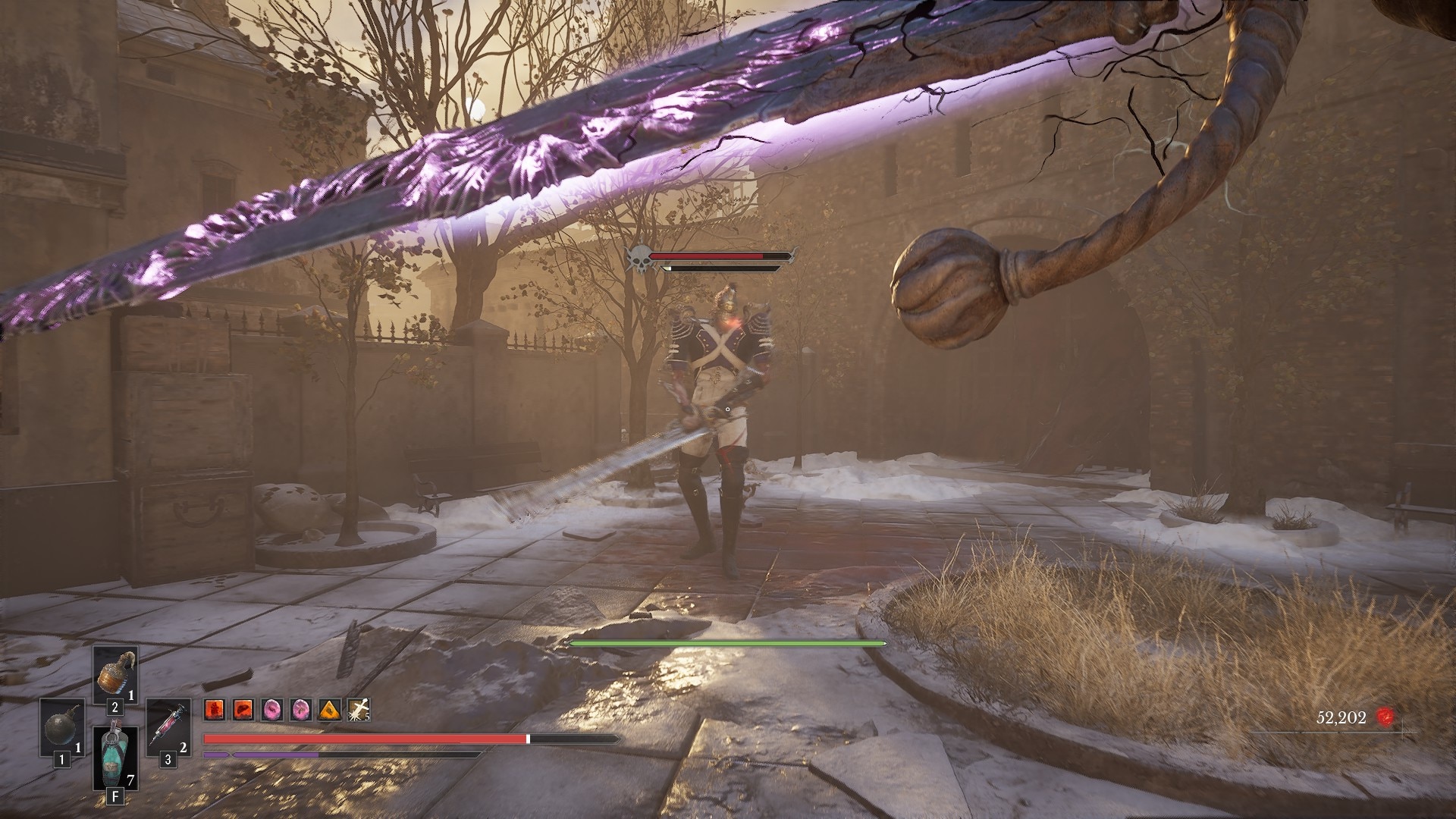
Combat revolves around timing, observation, and the willingness to take risks. Rather than encouraging players to attack continuously, Valor Mortis expects them to study enemy movements, parry incoming strikes, and exploit openings for counterattacks. A successful deflection can turn a dangerous exchange in William’s favour, making the rhythm of a fight more important than simply dealing as much damage as possible.
This approach works particularly well in one-on-one encounters. Enemies telegraph their attacks in different ways, and learning those patterns creates a satisfying sense of progress. A fight that initially seems overwhelming can become manageable once its timing clicks into place. The first-person perspective also gives clashes an immediate quality: weapons fill the screen, impacts feel close, and a mistimed response can quickly turn a promising encounter into a desperate retreat.
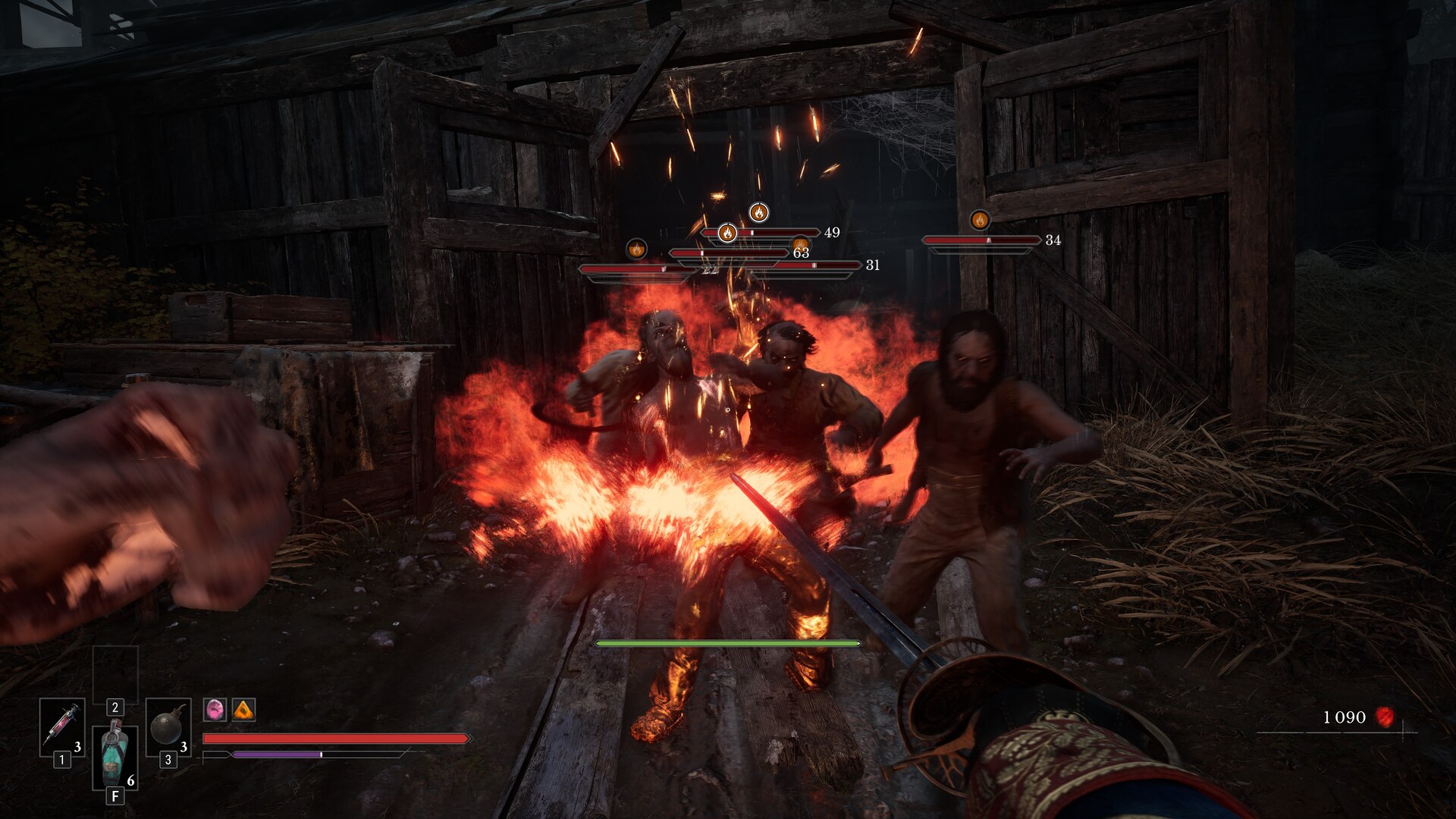
The perspective introduces complications, however. In a third-person Soulslike, the camera provides a useful view of an enemy’s body language and the space around the player. Here, incoming attacks can be harder to judge when several opponents are involved, particularly if enemies approach from different directions. Crowd encounters are consequently less comfortable than duels. The combat system is at its best when players can concentrate on reading one opponent, but it becomes less convincing when the game surrounds William with threats that are difficult to track.
Stamina management adds another layer of restraint. Attacking carelessly can leave William vulnerable, while defensive play requires attention to timing rather than constant retreat. The game encourages a balance between aggression and caution, although its best encounters are those that give players enough room to apply what they have learned. When enemy behaviour becomes difficult to read or several hazards overlap, the distinction between a demanding fight and an unnecessarily frustrating one begins to blur.
Weapons and Supernatural Abilities
William’s arsenal combines melee weapons, firearms, and supernatural powers. The saber, rapier, and claymore offer different approaches to close combat, while ranged weapons provide ways to deal with threats at a distance. Special abilities introduce further tactical options, including powers that can set enemies ablaze or interfere with their movement. Together, these systems help the game move beyond straightforward swordplay.
These tools are most effective when used with a clear purpose. Some opponents are vulnerable to particular attacks, while environmental hazards can sometimes be turned against them. A ranged weapon can interrupt a dangerous enemy or help deal with a distant threat, and a supernatural ability can create an opening that would be difficult to obtain through melee attacks alone. Switching between these options gives combat useful flexibility and encourages players to consider more than their primary weapon.
The limitation is that the arsenal never becomes as broad as the premise might suggest. The available tools have distinct uses, but the overall selection remains restrained. A smaller collection of well-defined weapons is not inherently a problem; the issue is that Valor Mortis does not always make its limited range feel sufficiently varied over the course of the campaign.
Progression helps keep the available equipment relevant, but upgrades cannot completely compensate for the lack of new combat possibilities. Players can improve their capabilities and refine their approach, yet the fundamental rhythm of combat remains largely the same. The weapons and powers complement the parry system rather than replacing it, but anyone expecting extensive weapon experimentation or dramatically different builds may find less room to experiment than anticipated.
Level Design and Exploration
Exploration is one of the game’s more consistent strengths. Rather than presenting a completely open world, Valor Mortis uses a series of interconnected areas that combine clear routes forward with optional paths, hidden items, side encounters, and shortcuts. Progress often involves finding a way around an obstacle, reaching a previously inaccessible ledge, or discovering a route that makes returning to a familiar location less troublesome.
This structure suits the combination of combat and movement. One More Level brings experience from Ghostrunner to the platforming sections, incorporating jumps, climbing, wall-running, and other traversal challenges into a world that otherwise demands methodical fighting. The movement is not as relentlessly fast as it is in the studio’s earlier games, but it gives exploration a welcome sense of physicality. Reaching an item or finding a new route can be satisfying, especially when it requires players to look beyond the most obvious path.
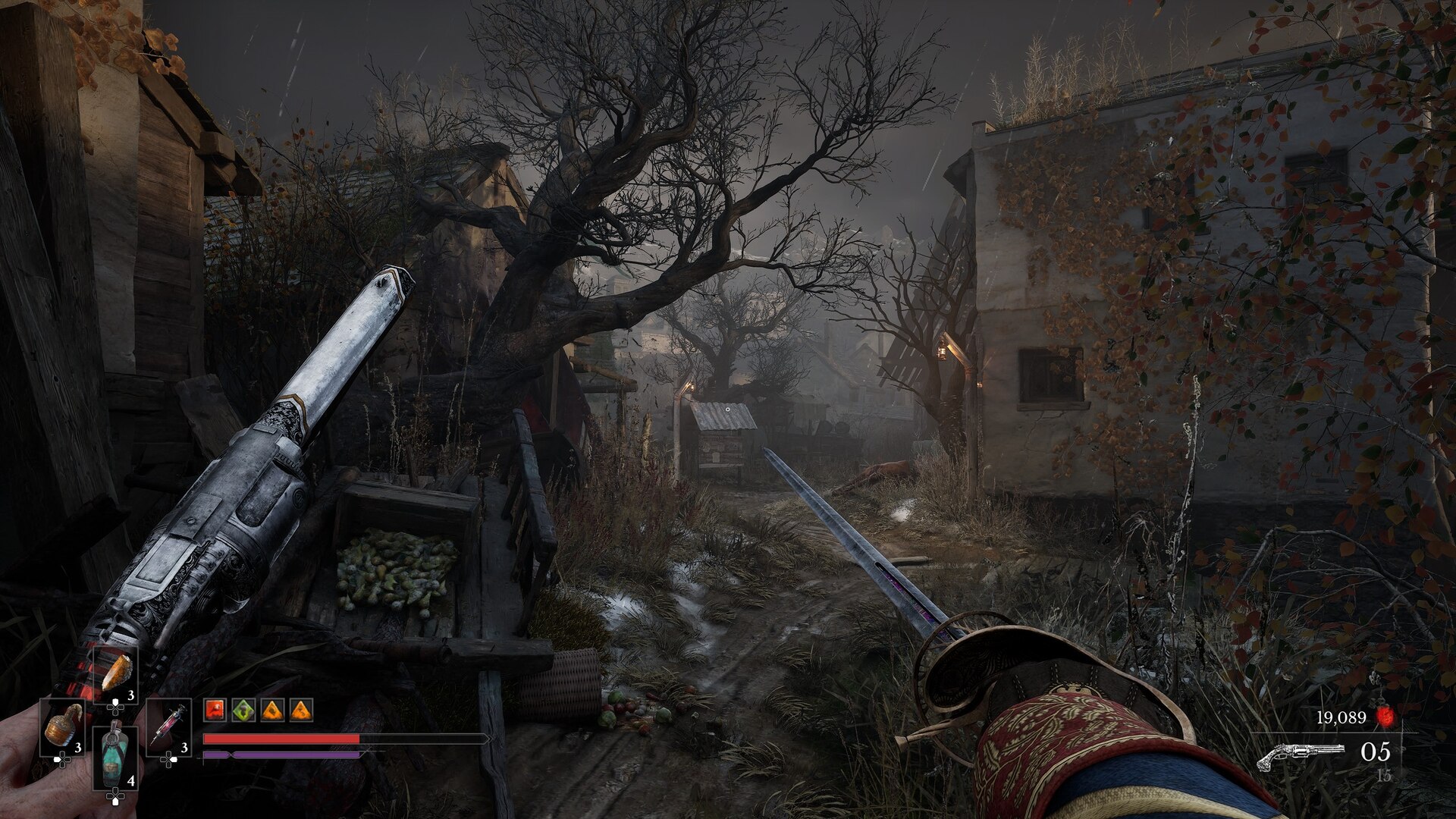
The level design also benefits from its atmosphere. Ruined settlements, battle-scarred landscapes, and strange structures make the world feel like a place shaped by both war and supernatural catastrophe. The strongest areas use their layout to build anticipation, allowing players to glimpse destinations before finding a route towards them. Shortcuts reward exploration with practical benefits, while optional encounters offer useful resources and additional context.
Unfortunately, the design is not always as thoughtful as its strongest sections suggest. Hidden enemies, traps, and sudden environmental hazards appear frequently, and some encounters rely too heavily on surprise. Ambushes can be effective when they encourage players to remain alert, but repeated tricks eventually become predictable. A trap that catches the player off guard can feel unfair when the first warning arrives too late to allow a meaningful response.
The platforming has similar inconsistencies. Some sequences make good use of the first-person perspective and the game’s movement abilities, creating memorable breaks from combat. Others feel rigid, particularly when a traversal challenge depends on a narrow sequence of scripted actions. Valor Mortis is inventive when it combines movement, combat, and environmental design, but less convincing when it relies on hazards that frustrate rather than reward careful play.
Enemies, Bosses, and Difficulty
The enemies draw on the game’s mix of military history and body horror. Reanimated soldiers retain the recognizable outlines of Napoleon’s army, while mutations and supernatural creatures give familiar uniforms and weapons an unsettling twist. Different enemy types demand different responses, and some can be handled more efficiently by exploiting their equipment or vulnerabilities than by relying exclusively on sword attacks.
Boss encounters provide opportunities for the combat system to work at its best. They require close attention to attack patterns, well-timed parries, and a willingness to learn from failure. The more inventive fights also incorporate environmental elements or additional mechanics, preventing every major encounter from becoming a simple test of reaction speed. These battles offer some of the clearest examples of what the game is trying to achieve: demanding action that feels rewarding when players understand the rules.
The difficulty curve is less reliable. Valor Mortis can be punishing even by Soulslike standards, particularly during its earlier sections, when players have fewer options and are still learning how combat works. Challenge is an essential part of the formula, but the game sometimes combines aggressive enemies, restricted visibility, environmental hazards, and awkward encounter layouts in ways that make individual mistakes difficult to understand or correct.
A demanding opponent is satisfying when its attacks can be learned and its openings recognized. An encounter becomes less satisfying when the player is overwhelmed by overlapping threats or punished by a surprise that offers little opportunity to react. This distinction matters because the combat depends on players believing that improvement will lead to success. When difficulty feels inconsistent, repeated attempts become tiring rather than motivating.
The balance can feel more manageable later in the campaign as upgrades provide greater survivability and players become familiar with the combat system. However, this improvement does not eliminate every frustrating encounter. Enemy variety is another limitation. The visual designs are often striking, but a distinctive appearance does not always translate into a substantially different combat experience. As the campaign progresses, some encounters begin to feel familiar, and the limited range of weapons and abilities makes those repetitions more noticeable. The strongest bosses and enemy designs still leave an impression, but the game would benefit from a more consistently varied roster.
Story and World-Building
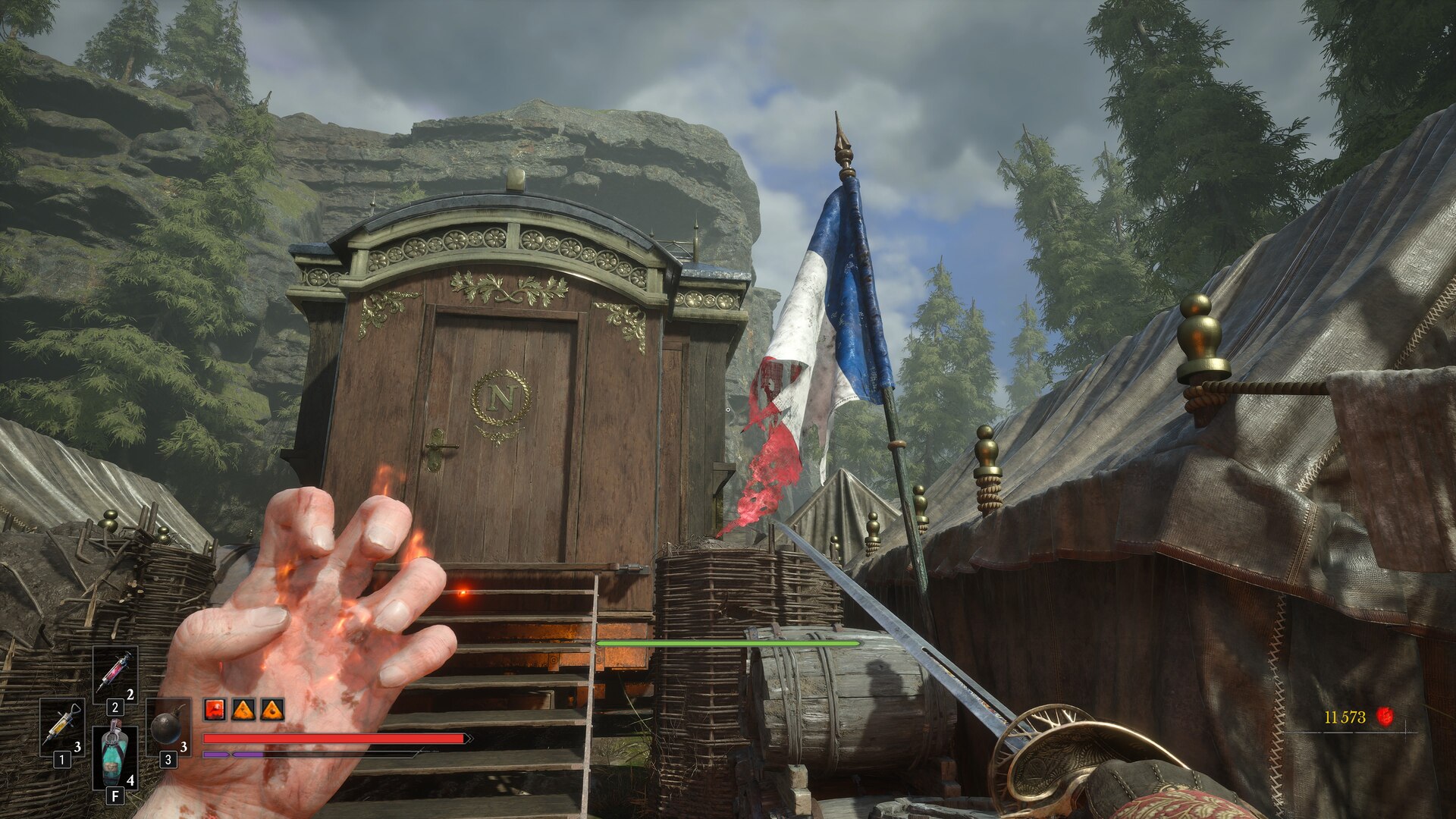
The alternate Napoleonic setting is arguably Valor Mortis’s most distinctive feature. The game takes a recognizable period of European history and transforms it into a nightmare of plague, supernatural corruption, and military devastation. This is more than a cosmetic change of scenery. Soldiers, civilians, and the remnants of wartime institutions contribute to a world in which the familiar consequences of conflict have become something much worse.
William’s condition gives the story a personal point of entry. He awakens without a clear understanding of the catastrophe around him and must piece together information as he travels. Napoleon’s voice provides direction and an unusual connection to the larger conflict, while encounters with other characters and optional quests reveal more about the people struggling to survive. These smaller stories help make the world feel more substantial than a succession of combat arenas.
The narrative is most effective when it allows the setting to carry part of the storytelling. Ruined locations and disturbing enemy designs communicate the scale of the disaster without requiring lengthy explanations. Optional discoveries and side quests also provide welcome context, encouraging players to investigate places they might otherwise pass through on the way to the next objective. Some of these side stories, including a thread involving orphaned children, introduce a more personal perspective on the devastation.
The central premise, however, is stronger than some of the story’s eventual developments. The combination of Napoleon, a supernatural plague, and a soldier caught between life and death creates plenty of room for unexpected revelations. Not every narrative thread makes full use of that potential, and the main plot can feel more conventional than the world surrounding it. The story remains a useful motivation for exploration, but the setting and the details discovered along the way leave the stronger impression.
Graphics, Art Direction, and Atmosphere
Valor Mortis has a clear visual identity. Its version of Napoleonic Europe is bleak without being monotonous, using ruined architecture, abandoned settlements, military equipment, and grotesque creatures to create a world that feels both historically recognizable and deeply unnatural. The contrast between the period setting and the supernatural horror gives the game much of its character.
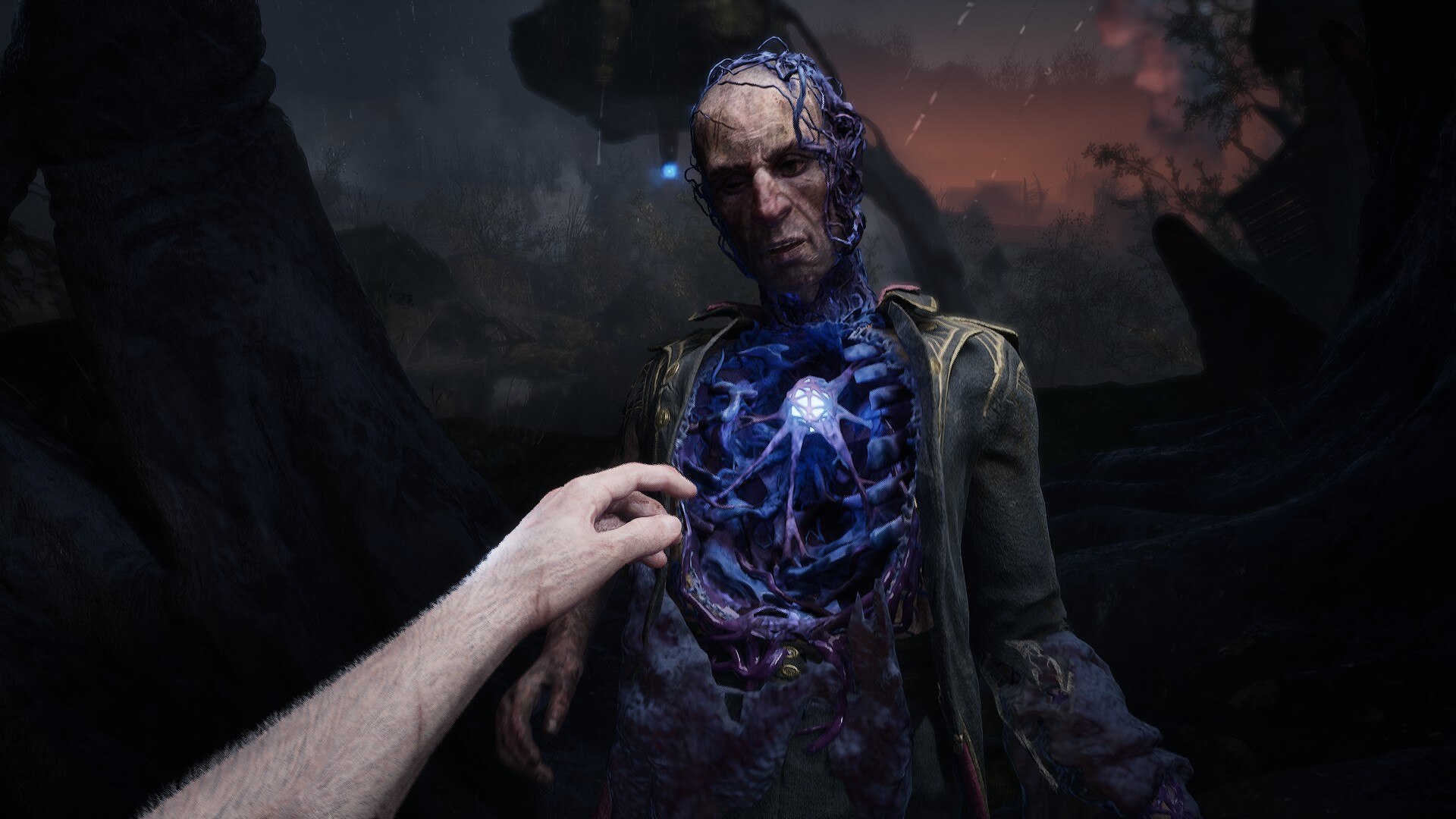
Creature design is a particular highlight. The corrupted soldiers remain connected to the military world they came from, while more unusual enemies push the game towards body horror. This approach makes the setting feel coherent even when its threats become fantastical. The environments similarly communicate devastation without abandoning the practical details that make the world believable.
Atmosphere is strengthened by the first-person perspective, which keeps players close to the environment and makes exploration feel immediate. Dark passages, ruined buildings, and sudden encounters create effective tension, although the same close viewpoint sometimes makes combat and environmental hazards harder to read. That is both an artistic choice and a functional drawback, and the game does not always balance the two successfully.
The presentation is not flawless, but the art direction gives Valor Mortis a stronger identity than its familiar genre foundations might suggest. Even when a section is frustrating to play, the world often provides a reason to keep moving forward and see what lies beyond it.
Sound and Music
Sound plays an important role in making combat readable. The impact of a successful parry provides immediate feedback, helping players recognize when a defensive action has worked. Weapon clashes, enemy noises, and environmental sounds also support the unsettling atmosphere. These details are especially valuable in a first-person action game, where audio can help communicate events that are not always easy to see.
Voice acting contributes to the setting, with Napoleon’s presence giving William’s journey an unusual narrative thread. The writing and delivery can be uneven, and not every exchange carries the weight suggested by the premise, but the characters help break up the long stretches of exploration and combat. The sound design is most effective when it serves a clear purpose, whether reinforcing a successful parry or making a dangerous environment feel more oppressive.
The music is less memorable than the visual and combat presentation. It supports the mood but does not consistently provide a defining theme or a strong emotional counterpoint to the action. This is not a major weakness, since the sound effects and atmosphere do much of the work, but the audio presentation could have made a greater contribution to the game’s identity.
Progression, Side Quests, and Replayability
Progression is tied to checkpoints, upgrades, and the resources collected during exploration. Returning to a safe point allows William to improve his capabilities and adjust aspects of his build, giving players a reason to investigate optional routes and take on additional challenges. The gradual development of weapons and supernatural abilities also provides a sense of growth, even if the overall arsenal remains limited.
Side quests are worth pursuing because they expand the world and offer alternatives to simply following the main route. Some provide additional stories that develop across multiple chapters, while others introduce encounters and rewards that would otherwise be missed. Optional exploration is therefore more than a means of collecting upgrades; it can make the campaign feel more connected and rewarding.
There are limits to how far these systems encourage experimentation. The available equipment and abilities offer some flexibility, but not enough to make every new playthrough feel fundamentally different. Players who enjoy refining a particular combat style will find useful upgrades to pursue, while those expecting a wide range of radically different builds may be disappointed.
Replayability is restricted by the absence of New Game Plus and the availability of only one save slot in the launch version. Players cannot maintain a separate second campaign through the usual save-slot system, and there is no dedicated New Game Plus mode that lets them revisit the adventure with their existing progression. The game also offers a single ending, limiting the incentive to replay the entire campaign for a different conclusion.
Those interested in completing side content should take care before defeating the final boss. Some side missions become unavailable afterwards, making it worth finishing outstanding quests before reaching the end. These restrictions do not undermine the main campaign, but they reduce the flexibility of its endgame and make a second playthrough less appealing than it might otherwise be.
Technical Performance on PC
The PC version’s technical performance has been a concern in several launch-period reviews. Reported problems include traversal stutter, repeated shader-compilation pauses when entering new areas, and occasional crashes. Experiences vary between reviewers and systems, so these issues should not be treated as universal. Nevertheless, they deserve attention in a game built around precise parries and fast reactions, where an interruption or sudden drop in performance can interfere with combat.
An October 16 update addressed some of the most common crashes across platforms, added notifications for outdated graphics drivers, and reduced error logging that could have a minor performance impact in certain circumstances. The developers also acknowledged that further performance issues were still under investigation. The patch is a positive step, but its release does not establish that all stuttering or stability problems have been resolved. Reports from earlier review builds should therefore be read in context rather than assumed to describe every subsequent version.
The official PC requirements call for Windows 10 or 11, 16 GB of RAM, DirectX 12, and an SSD with 60 GB of available storage. The listed minimum graphics cards are the NVIDIA GTX 1660 Ti and AMD RX 5600 XT, while the recommended options are the RTX 3070 and RX 6800. The stated performance targets are 1080p at 30 frames per second on low settings with upscaling for minimum hardware, and 1440p at 60 frames per second on medium settings with upscaling for recommended hardware. These are the developer’s published targets, not a guarantee that every system meeting those specifications will achieve identical results.
Steam Deck testing has also produced a mixed but generally encouraging picture. One published test found the game playable with low settings, FSR upscaling, and a 30fps cap, while noting drops during combat and stuttering when traversing levels. This is a useful indication that the game can run on the handheld with compromises, but it should not be mistaken for a guarantee of stable performance across every area or device.
Overall, the PC version offers a range of hardware configurations to consider, but launch-period technical problems have affected some players. The early patch demonstrates that the developers are responding to reported issues, and the most relevant assessment is the state of the game after those updates rather than the original launch build alone. For a timing-sensitive action game, consistent performance remains important to the quality of the experience.
Final Verdict: 7.5/10
Valor Mortis is an inventive and often satisfying first-person Soulslike whose strongest ideas are easy to appreciate. Its alternate Napoleonic setting gives the familiar formula a distinctive identity, while parry-focused combat, supernatural abilities, and movement-based exploration provide several ways to approach encounters. The best fights reward patience and observation, and the world is compelling enough to make optional paths and side stories worth investigating.
Its weaknesses are just as apparent. The first-person perspective can make groups of enemies difficult to manage, the difficulty is not always fairly calibrated, and repeated ambushes and environmental tricks sometimes undermine the satisfaction of learning an encounter. Weapon and ability variety could also be broader, while the narrative does not always deliver on the promise of its premise. Technical performance has presented additional problems for some PC players, although the first update addressed several crashes and the developers have continued investigating other reported issues.
These flaws stop Valor Mortis from becoming a standout of the genre, but they do not erase what it gets right. One More Level has found a convincing way to combine its experience with fast movement and action with the slower, more deliberate demands of a Soulslike. The result is uneven, but it has enough character and well-executed combat to stand apart from more conventional imitators.
Players who enjoy learning enemy patterns, mastering parries, and exploring a grim, unusual setting will find plenty to appreciate. Those who want consistently fair encounters, extensive build variety, or a technically flawless experience may be less forgiving of its shortcomings. Valor Mortis is a strong first step into a new genre for its developer, even if it does not quite reach the full potential of its ideas.