Star Wars: Galactic Racer combines aggressive arcade racing with a run-based campaign that makes every tournament a test of driving skill and decision-making. Developed by Fuse Games and published by Secret Mode, the game follows Shade, a racer seeking revenge against Galactic League champion Kestar Bool. Its distinct vehicle classes, equipment upgrades, and branching events give the racing a strategic dimension beyond simply finishing first. The result is an entertaining addition to Star Wars gaming, although unreliable assistance systems, difficult-to-read hazards, and an uneven story prevent it from being as consistently rewarding as it could be.
Galactic Racer’s races demand more than simply finding the fastest route to the finish line. Players must balance speed with control, judge when to take risks, and account for rivals who can disrupt a run with offensive equipment. The consequences of a mistake also extend beyond an individual race, as the campaign’s run-based structure makes preparation and vehicle upgrades important to long-term progress. These mechanics give the racing a competitive edge, but their effectiveness depends on how clearly the game communicates hazards and how reliably its assistance systems respond to the player’s decisions.
Gameplay and Mechanics
Speed is the foundation of Star Wars: Galactic Racer, but maintaining it requires more than holding the accelerator. Courses feature sharp turns, narrow passages, jumps, and environmental hazards that demand quick reactions. Players must judge when to drift, when to take a more cautious line, and when to risk a burst of acceleration to overtake a rival. The handling is firmly arcade-oriented, prioritizing immediate feedback and dramatic races over realistic simulation. The different vehicles and equipment combinations nevertheless provide enough complexity to reward practice.
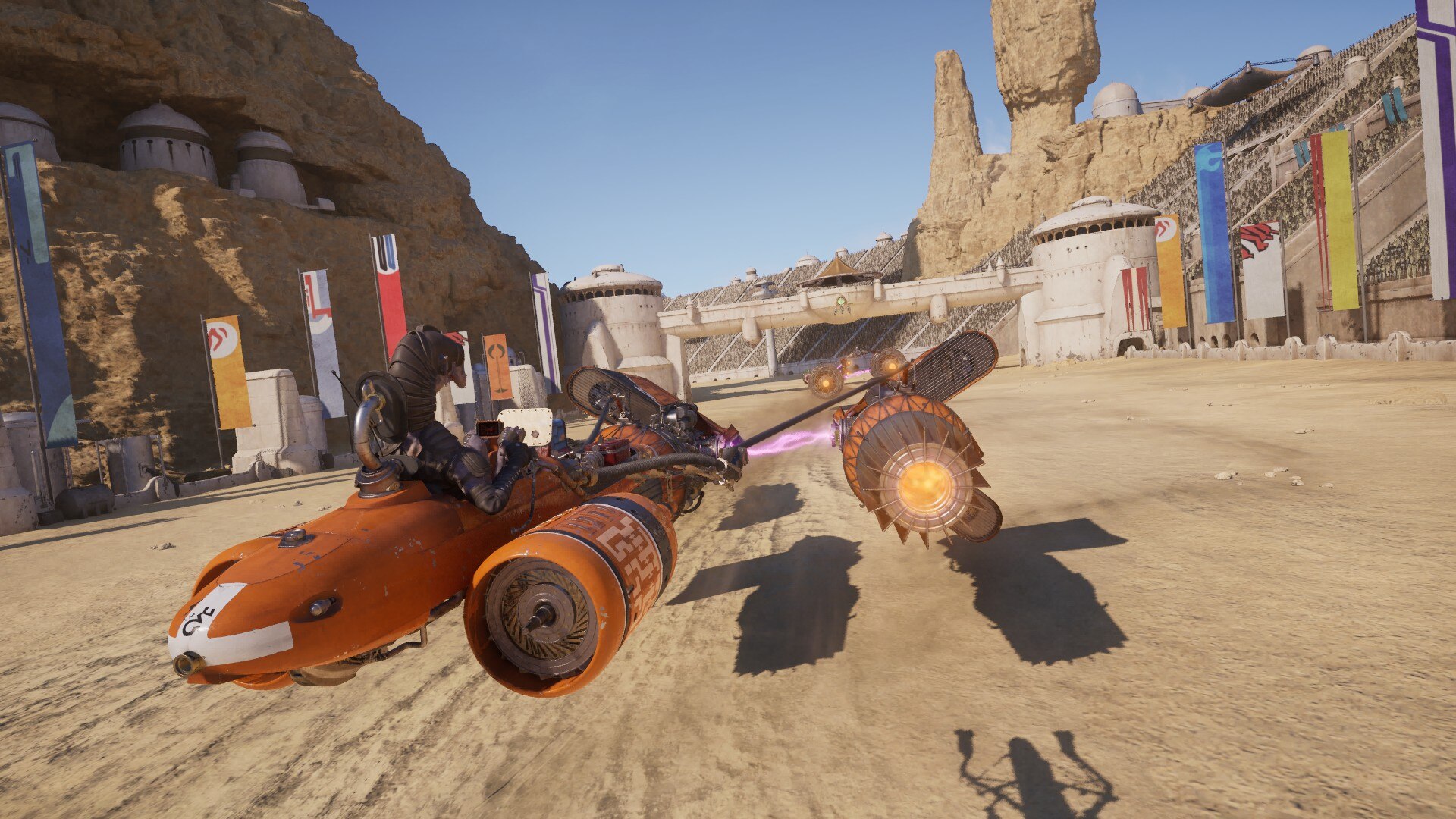
Boost management is particularly important. Afterburners offer a useful increase in speed, while the more powerful ramjet delivers greater acceleration at the risk of overheating. Using the ramjet at the wrong moment can leave a racer struggling to recover, while a carefully timed burst can create the opening needed to pass an opponent. Heat management, equipment choices, and track conditions all influence how aggressively players can drive. These systems encourage experimentation without making speed any less central to the experience.
Combat gives the races a more confrontational character. Players can ram rivals and use abilities such as Ion Bolt and Concussion Mine to interfere with their progress. Ion Bolt locks onto a nearby opponent and applies Disrupted, reducing the target’s speed and preventing them from using abilities. Concussion Mine drops a proximity charge that can inflict Concussed and System Malfunction on nearby opponents. These tools add tactical choices to the usual decisions about positioning and acceleration, but their usefulness depends on the situation. Abilities consume energy and have cooldowns, so spending them carelessly can leave a player without a useful option when a better opportunity appears.
The best races emerge when these mechanics work together. A well-timed attack can force an opponent out of the ideal line, creating room to accelerate past them, while a successful jump can help players manage heat and prepare for the next section. This interaction gives the racing a satisfying rhythm, especially when several rivals are competing for the same narrow route. However, camera transitions during takedowns can interrupt the flow. The dramatic views make collisions more spectacular, but returning to the normal racing perspective can be disorienting when a vehicle is moving at high speed.
The autopilot assistance is another weak point. Rather than reliably helping players maintain control, it can sometimes steer them toward an obstacle or an awkward section of the track. That is particularly frustrating when a collision damages a vehicle or threatens a longer campaign run. Racing games should punish poor decisions, but the punishment feels less convincing when an assistance system contributes to the mistake. These problems do not erase the quality of the core driving, though they can make the experience feel less fair than its demanding design intends.
Vehicle Variety and Customization
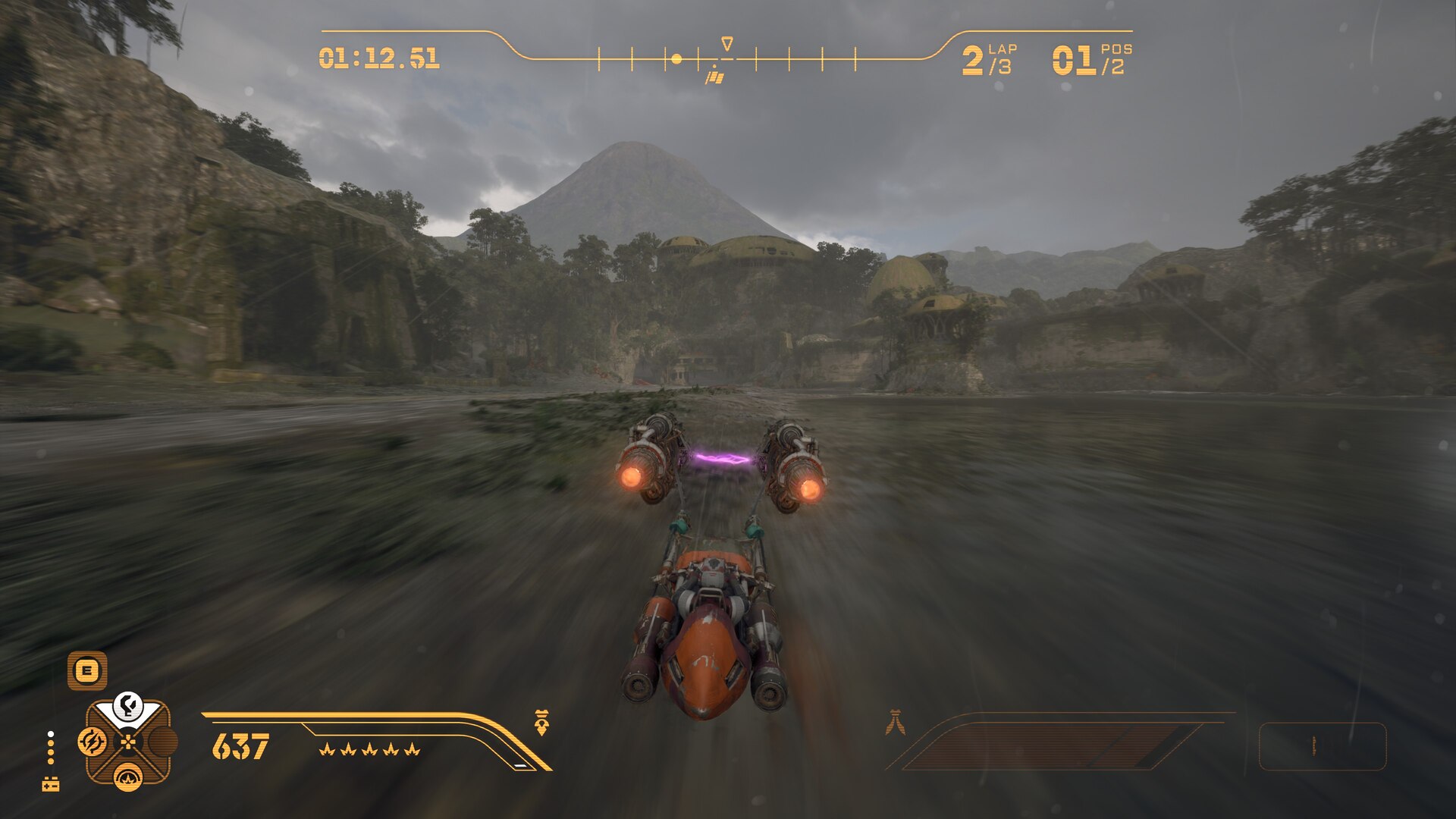
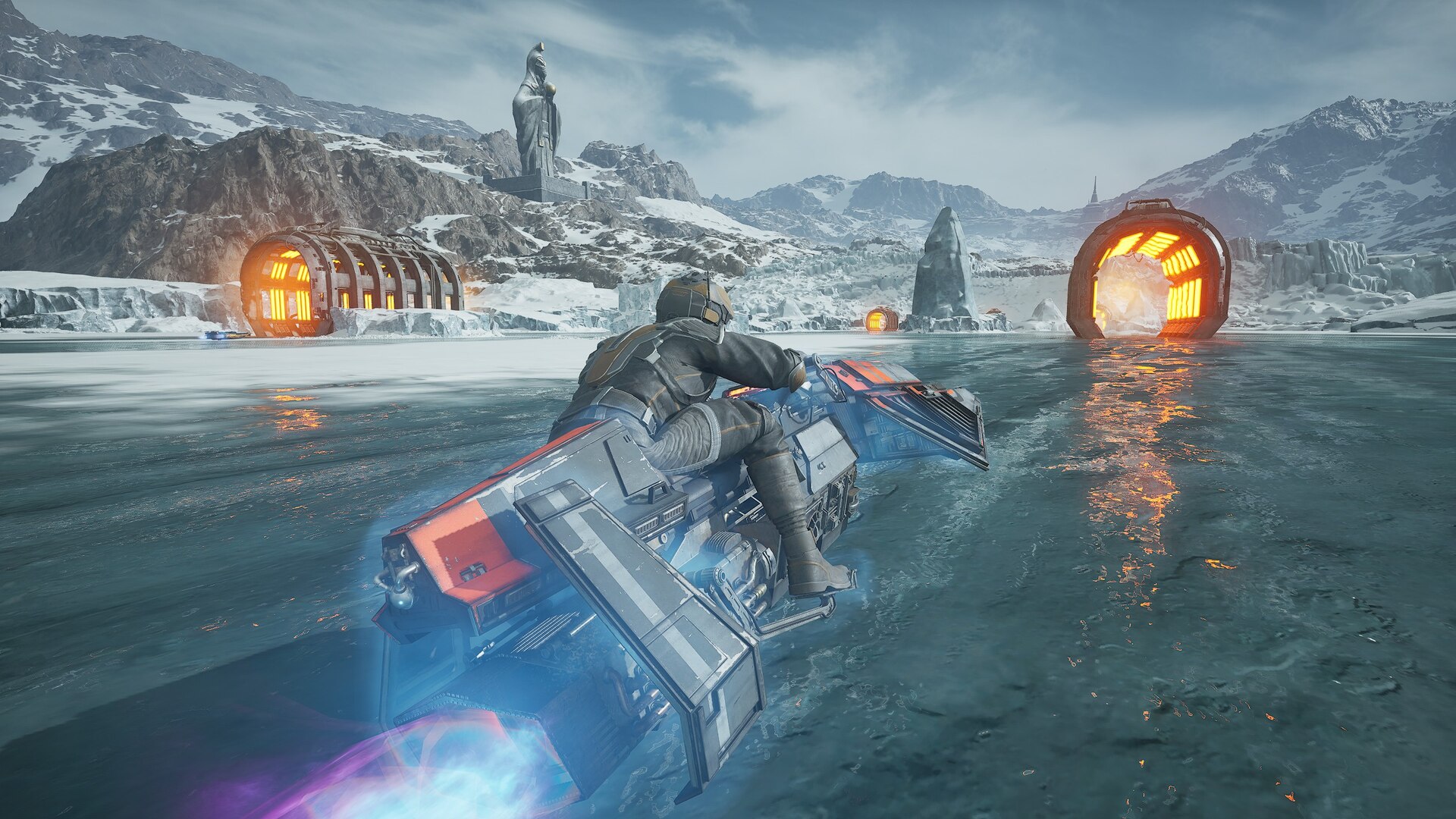
The vehicle selection gives Galactic Racer a useful identity of its own. Landspeeders are the most balanced option, with predictable handling that makes them a dependable choice on a range of courses. Speeder bikes are faster and more fragile, demanding greater precision through corners. Skim speeders introduce a different technique through their Knife Edge ability, which changes the vehicle’s profile to help it negotiate tight spaces. Podracers complete the lineup with the extraordinary speed and difficult handling associated with the franchise’s most famous racing machines.
These differences affect how players approach the track rather than simply changing the appearance of their craft. A landspeeder can feel comfortable through a series of turns where a speeder bike demands more careful control, while a skim speeder’s special handling can prove useful when space is limited. Learning the strengths and weaknesses of each class is part of the challenge, and the variety encourages players to experiment instead of relying on one preferred vehicle for every situation.
Customization adds another layer of strategy. Players can purchase upgrades and equipment that influence handling, resilience, energy management, and offensive capabilities. Certain components work particularly well together, allowing a build to develop around a specific approach to racing. A part that restores afterburner energy following a collision, for instance, can encourage a more aggressive setup, while equipment that reduces heat after a successful landing can support a strategy built around jumps and ramjet use.
The important consideration is how these choices interact with the course. A vehicle built entirely around speed may struggle when environmental hazards threaten its boost or durability. A more resilient setup may sacrifice some immediate performance but prove more dependable across a longer tournament. This makes the garage an important part of the campaign rather than a menu players visit only to increase statistics. The strongest builds reflect an understanding of both the vehicle and the conditions ahead.
Podracing is a more complicated addition. Its speed and difficult handling make it exciting, and its presence connects the game to the racing tradition established by Star Wars: Episode I – The Phantom Menace. Sebulba’s appearance provides a direct link to that history, and the podracing sections offer a welcome change from the other vehicle classes. They appear in specific campaign events and selected Arcade challenges rather than forming the main focus of the story.
The change in handling can be demanding, particularly for players who have become comfortable with the regular vehicles. Podracers move at extraordinary speeds, leaving little room to recover from a poorly judged turn. That makes these races exciting, but it also means they can feel less approachable than the rest of the game. Podracing is a welcome addition, although its limited role and steep learning curve may disappoint players hoping for a full campaign built around it.
Campaign and Progression
The campaign follows Shade into the Galactic League, an unsanctioned racing circuit operating in the Outer Rim during the New Republic era. Shade’s rivalry with champion Kestar Bool provides the main narrative motivation, while the other racers and characters give the league a sense of life beyond the starting line. The premise is straightforward, allowing the game to focus on competition rather than building an elaborate story around every event.
Its run-based structure is the campaign’s strongest idea. Players choose their route through a branching map of events, weighing potential rewards against the difficulty of the challenges ahead. Standard races are joined by Eliminator events, in which competitors are removed from the contest until only a few remain, as well as other special encounters and opportunities to improve a vehicle. The order in which players tackle these events matters because each decision affects their preparation for what follows.
League Tokens give the campaign’s decisions real consequences. Players can lose a token by wrecking out of a standard race, failing to finish in the top three in an Eliminator, or losing certain head-to-head events against rival racers. The conditions depend on the event, so players need to consider the risks before committing to a route. Eliminators are particularly dangerous because a finish outside the top three costs a token, while rival duels can put a token on the line. Their potential rewards can make these events tempting, but a poor result may bring a promising run to an abrupt end. Standard races allow more room for mistakes, since finishing outside the top positions does not automatically cost a token if the player avoids wrecking out.
Between races, the paddock provides opportunities to buy parts, make repairs, and interact with other competitors. The decisions made here can be as important as those on the track. An upgrade that addresses a vehicle’s weaknesses may be more valuable than one that simply improves its strongest attribute, particularly when the next event introduces a different set of hazards. The campaign rewards players who consider the whole run rather than treating every race as an isolated contest.
The structure also gives repeated attempts a purpose. Players become more familiar with the courses, learn which events suit their preferred vehicles, and gradually improve their equipment choices. Some unlocks carry over after a failed run, making subsequent attempts easier. Nevertheless, repetition is unavoidable, and familiar events can lose some of their appeal after several attempts. The campaign works best when players discover a new strategy or meaningful upgrade, rather than simply repeating a sequence they already understand.

The story is less compelling than the progression systems overall. Kestar provides a clear rival, and the surrounding cast helps establish the personalities and tensions within the league. Sebulba, the podracing veteran familiar from The Phantom Menace, is a particularly welcome connection to the franchise’s racing history. His presence gives the game a recognizable and meaningful link to the films without requiring the entire campaign to rely too heavily on nostalgia or familiar faces.
However, Shade remains relatively underdeveloped, and the central rivalry does not deliver a particularly powerful payoff. The conversations and character interactions add atmosphere, but some dialogue becomes repetitive, and the story ultimately contributes less to the experience than the racing itself. That is not necessarily a serious problem for this genre, but it means the campaign’s appeal rests primarily on its mechanics and progression rather than its narrative.
Track Design and Environmental Hazards
The courses provide more than attractive Star Wars backdrops. Their terrain, layout, and hazards affect how players handle their vehicles, making knowledge of a planet useful when choosing upgrades and deciding how aggressively to drive. Narrow passages and sharp turns test control, while jumps create opportunities for overtaking and managing a vehicle’s heat. Different environments demand different approaches, helping the races avoid becoming interchangeable laps around the same type of circuit.
Environmental hazards are especially important to the game’s strategic layer. Sentinel I features corrosive acid that can dramatically reduce ramjet boost on contact, making resilience more valuable than a build focused exclusively on speed. The final race on Derven Acos combines hazards associated with other environments, including ice, lava, and acid. These conditions reward players who prepare their vehicles for the course rather than assuming that one powerful setup will work everywhere.
At its best, the design creates a satisfying relationship between preparation and execution. A suitable build gives players a better chance of surviving difficult sections, but it cannot compensate for poor cornering or mistimed boosts. Learning the route remains essential, and players who understand when to accelerate, where to position their vehicle, and how to avoid hazards gain a tangible advantage. The courses offer variety through their conditions, even if their overall structure becomes more familiar over repeated attempts.
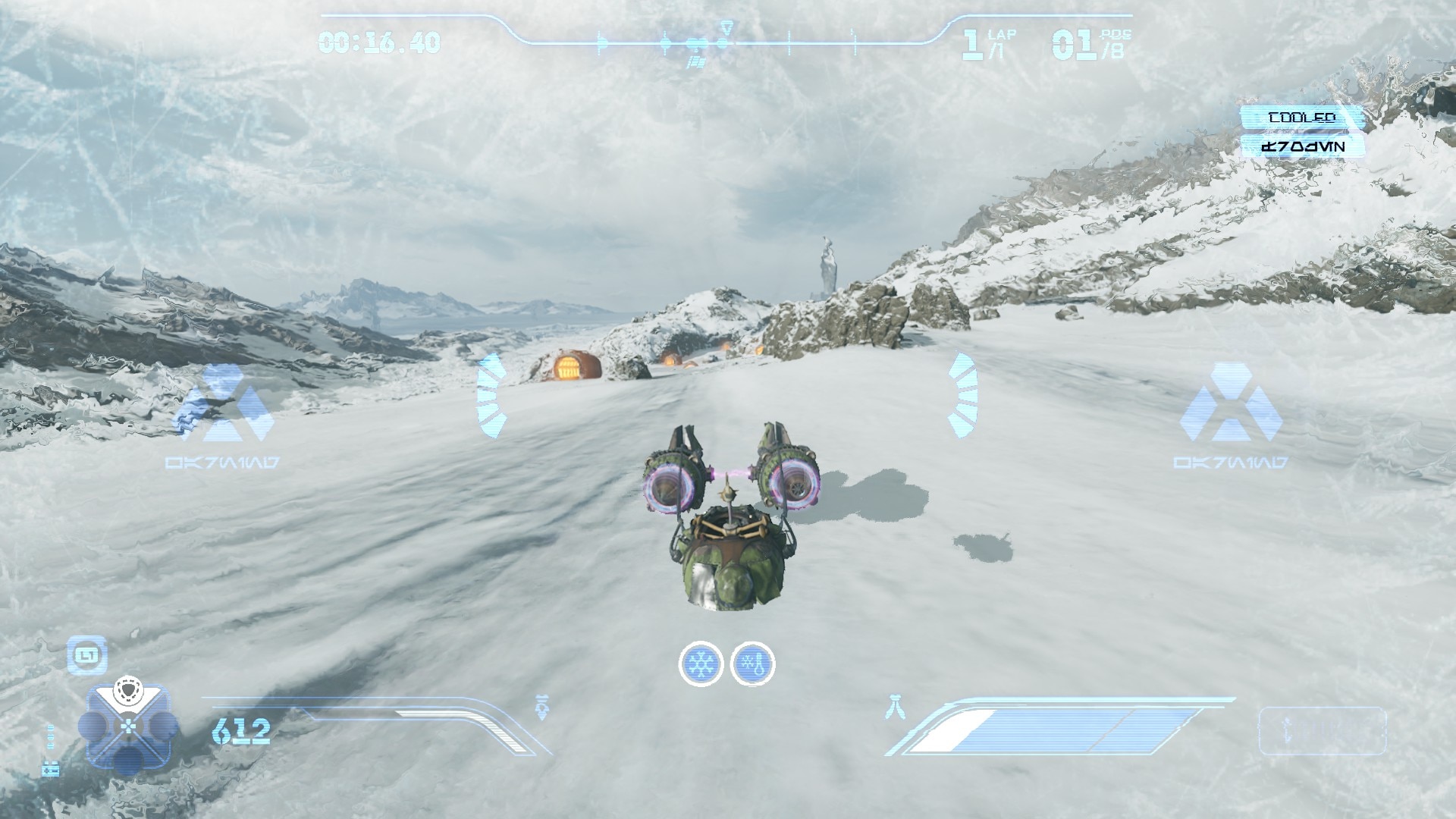
The main problem is visual clarity. Some obstacles blend into the surrounding scenery, making them difficult to identify at speed. Snow and ice can obscure the distinction between the racing surface and nearby hazards, while rocks and uneven terrain may be difficult to read in the brief moment available to react. Repeated attempts help players memorize these sections, but memorization is not a complete substitute for clear visual communication.
This weakness becomes more serious when combined with the campaign’s consequences. A collision on a difficult course can damage a vehicle or compromise an entire run, so an obstacle that is hard to see can turn a strategic decision into an abrupt setback. The game is more satisfying when players lose because they misjudged a corner or used a boost poorly. It is less satisfying when they have little opportunity to recognize a hazard before hitting it. Better visual distinction would preserve the challenge while making failures easier to understand and learn from.
Multiplayer and Additional Modes
Multiplayer extends the game’s racing and customization systems into competitive tournaments. Tours link multiple races together, requiring players to develop their vehicles and adapt to different courses throughout a competition. This format gives consistency a role alongside outright speed. A strong result in one race can help establish an advantage, but a poor choice of equipment or a mistake on a later course can still undermine the tournament.
The same build decisions that matter in the campaign also influence multiplayer performance. A setup designed for speed may struggle on a hazardous planet, while a more resilient vehicle may be better equipped to finish consistently. Abilities and aggressive driving create opportunities to disrupt opponents, but players must still handle the course effectively. Vehicle preparation and racing skill remain closely connected, particularly when a tournament requires racers to adjust their builds between events.
Arcade and Scenario modes offer further ways to race without relying entirely on the main campaign. They provide opportunities to try different challenges and vehicles, including racing as other characters, and broaden the package beyond Shade’s story. For players who enjoy improving their times, experimenting with builds, or competing against other racers, there is a reason to keep playing after completing the campaign.
Replayability will depend on individual preferences. Players who enjoy repeated runs and gradual mastery should find the structure appealing, while those who prefer a campaign that constantly introduces new events may become less enthusiastic as familiar challenges return. Even so, the variety of vehicles, equipment combinations, and course hazards gives the game a solid foundation for repeat play.
Presentation and Sound
The presentation captures the appeal of Star Wars racing without depending entirely on familiar characters and locations. The vehicles have distinct designs, and the environments give each course a recognizable identity. The paddock adds texture between races, presenting the Galactic League as a community of competing personalities rather than a collection of anonymous opponents. These details help the setting feel connected to the wider universe while keeping the action focused on racing.
Sound contributes substantially to the sense of speed. Engine noise gives the different craft character, while the music adds urgency as races approach their conclusion. The takedown camera makes major collisions more dramatic, reinforcing the destructive nature of the competition. These touches work best when they complement the driving, although cinematic effects can become distracting when players need to regain their bearings or identify an approaching obstacle.
The audiovisual presentation supports the game’s central appeal, making the races feel like part of a recognizable corner of the Star Wars universe rather than a generic arcade racer with familiar names attached. It cannot solve the problems with track visibility or camera transitions, but it gives the different vehicles and environments a distinct personality.
Technical Performance on PC
The PC version of Star Wars: Galactic Racer includes a range of graphics options and support for NVIDIA DLSS 4.5. Built with Unreal Engine 5, the game uses detailed environments, complex lighting, and reflective vehicle surfaces to give its races a strong visual identity. The game launched with DLSS 4.5 Super Resolution and Dynamic Multi Frame Generation, alongside hardware-accelerated, ray-traced Lumen lighting refined by DLSS Ray Reconstruction. Support for individual DLSS features depends on the graphics hardware: Multi Frame Generation is available on GeForce RTX 50-series cards, while other DLSS features have different hardware requirements. These technologies offer additional ways to balance image quality and performance, but their benefits depend on the GPU and settings used.
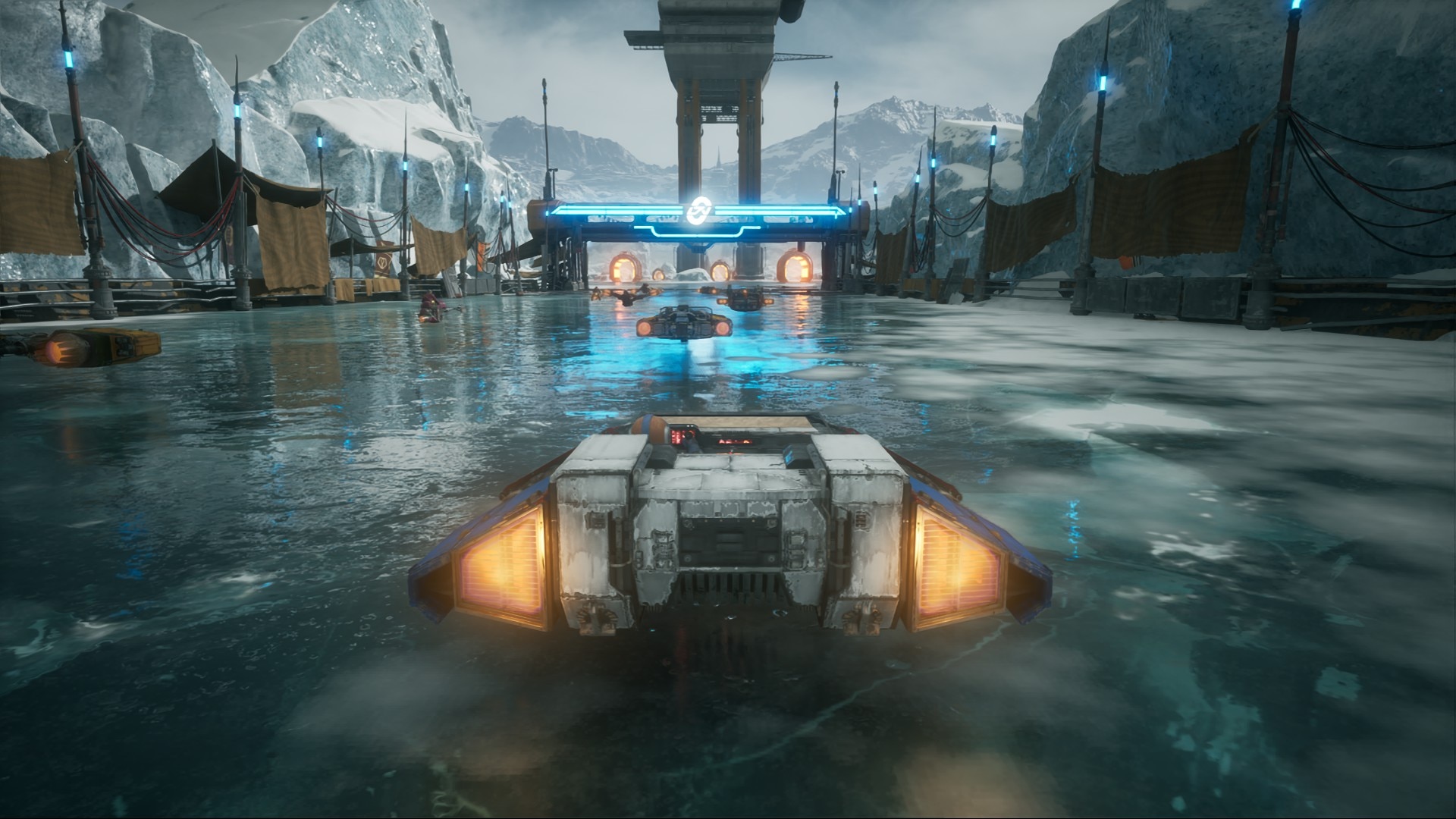
The graphics menu offers control over settings including shadows, reflections, foliage, global illumination, textures, visual effects, and view distance. Resolution scaling and upscaling provide further flexibility for systems that struggle with demanding scenes. In a racing game, a stable frame rate matters more than maximizing every visual setting. A performance drop can make it harder to judge a corner, avoid an obstacle, or line up an attack, so consistent responsiveness should take priority over minor graphical improvements.
The published system requirements provide a starting point for assessing compatibility. The minimum specification calls for Windows 10, an Intel Core i5-8400 or AMD Ryzen 5 2600 processor, 12GB of RAM, and an NVIDIA RTX 2060, Intel Arc A580, or AMD Radeon RX 5600 XT with 6GB of memory. The game requires 50GB of storage on an SSD. The recommended specification raises the processor requirement to an Intel Core i7-10700 or AMD Ryzen 7 3700X, with 16GB of RAM and an NVIDIA RTX 3060 Ti, Intel Arc B580, or AMD Radeon RX 6700 XT. These figures are useful reference points, but they do not guarantee a particular frame rate at a given resolution or graphics preset.
Third-party testing suggests that performance varies with the hardware and configuration. GamingOnLinux reported that a desktop running Linux through Proton, with a Ryzen 7 5800X and Radeon RX 6800 XT, delivered close to a consistent 60 frames per second at 1440p on the High preset with AMD FSR set to Native AA. The tester also encountered substantial stuttering during some early races, along with initial texture pop-in. On the Steam Deck OLED, the same publication found that the game could approach 30 frames per second with the lowest graphics settings and FSR Balanced, although image quality suffered. Because these results were obtained on Linux using Proton, they should be treated as a useful reference point rather than a direct indication of performance on a Windows PC. They also reflect testing during the game’s launch period, not necessarily its behavior after subsequent updates.
A PC hotfix released on October 8 addressed stability issues with the DLSS options and raised the minimum graphics-driver requirements, which the game checks at startup. Players who need to update their drivers may experience a longer first launch while the game rebuilds its shader cache. Performance and stability reports should therefore be considered in the context of the version tested, as updates and driver changes can affect the experience.
A gamepad is a natural fit for a game built around rapid steering corrections, drifting, and precise boost timing. GamingOnLinux also reported positive results using a Steam Controller on desktop Linux. The game supports controllers, and the developers recommend playing with one, although players should check the control options for their preferred setup rather than assuming that every input can be customized. Ultimately, reliable performance and responsive controls matter most. The PC version offers useful options for adjusting its presentation, but the game’s fast pace makes stuttering and inconsistent responsiveness particularly noticeable.
Final Verdict: 8/10
Star Wars: Galactic Racer is a compelling arcade racer with a campaign structure that gives individual events meaningful consequences. Its different vehicle classes encourage players to adapt their driving, customization creates useful strategic choices, and aggressive combat makes close races more unpredictable. The run-based progression is particularly effective, turning upgrades, route selection, and risk management into an important part of the experience. When the driving, equipment, and course design work together, the game delivers the fast, demanding racing its premise promises.
Its shortcomings are equally clear. Difficult-to-read hazards can make certain crashes feel unfair, autopilot assistance is not always dependable, and the steep learning curve of the podracing sections may frustrate players who prefer the handling of the other vehicles. Repeated events also lose some of their appeal over time, while Shade’s rivalry with Kestar never becomes as engaging as the underlying competition.
For players who enjoy arcade racing, equipment experimentation, and the challenge of improving across repeated attempts, these problems are unlikely to erase the game’s considerable strengths. Those who prefer forgiving races or a more substantial story may find the experience less satisfying. Star Wars: Galactic Racer succeeds because it makes speed and preparation work together, but its weaker design decisions sometimes get in the way. It is a strong racing game with a distinctive structure, held back by problems that better visual clarity and more consistent assistance could have avoided.