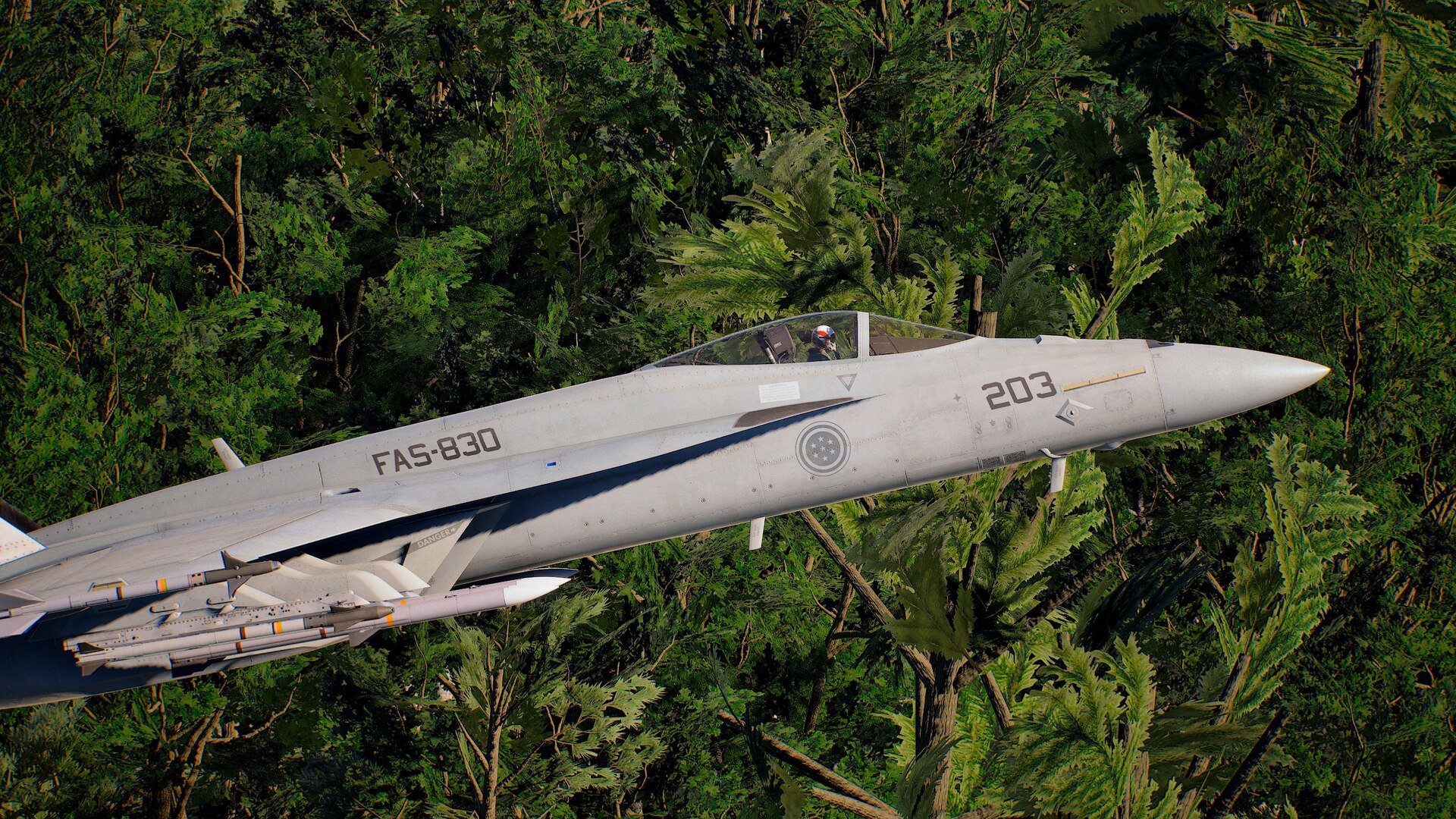
It has been seven years since Ace Combat 7: Skies Unknown, but Ace Combat 8: Wings of Theve wastes little time reminding you why the series has lasted this long. The premise remains wonderfully straightforward: climb into a fighter jet, find something that needs destroying, and do it while missiles fill the sky around you. What makes the series special is how effortlessly it turns that simple idea into spectacular aerial battles without requiring the player to learn the complexities of a flight simulator.
Wings of Theve does not attempt to reinvent Ace Combat, and that is probably the right decision. Instead, it expands the established formula with a longer campaign, a more personal story, dynamic weather that has a genuine effect on combat, more useful squadron commands and a substantially larger multiplayer component. It also makes full use of modern hardware to create some of the most impressive skies the series has produced.
The result is a game that feels familiar from the first sortie but gradually reveals enough new ideas to make the wait worthwhile. It remains an arcade flight game rather than a simulation, and it still embraces the exaggerated storytelling that has always defined Ace Combat. For anyone willing to meet it on those terms, Wings of Theve is an unusually effective combination of accessible flight combat, military spectacle and melodrama.

Story and Campaign
Wings of Theve takes place in 2029, when the Federation of Central Usea is invaded by the Republic of Sotoa. The FCU has already lost its capital and much of its military is struggling to survive, leaving the aircraft carrier Endurance as one of the remaining bases from which resistance can be organised. The situation is desperate enough that military leaders turn to something other than conventional strategy: they create a hero.
The player character, Rex, begins as the navigator for Jan Cope, the pilot publicly known as the Wings of Theve. Cope is presented to the population as a legendary ace, but the reality is considerably less impressive. His reputation is largely manufactured, with his real role being to act as a symbol capable of maintaining morale. When a routine mission goes badly and Cope is killed, the FCU cannot afford to let the legend disappear with him, so Rex is given his callsign and placed in command of Joker Flight.
It is an effective setup because it gives the protagonist a role in the story without turning Rex into a conventional voiced hero. The player remains largely silent, while the people around them provide the personality and emotional context. The first-person presentation of the scenes between missions also puts more emphasis on the experience of actually being part of the squadron rather than simply watching events happen from a detached camera.
Joker Flight is consequently much more important to the campaign than a typical collection of supporting pilots. Ellington Baxter, Tasha Severskya, William Coster and the other characters receive enough attention to establish their personalities and relationships with Rex. Their conversations continue through briefings and radio chatter, while smaller choices can affect how the squadron responds to the player. It is a more intimate approach to storytelling than the series has traditionally used.
The writing still occasionally goes too far. Ace Combat has never been particularly interested in subtle military drama, and Wings of Theve continues the tradition of grand speeches, dramatic revelations and increasingly spectacular threats. There are moments when the dialogue could have used a little restraint, but the difference this time is that the characters have been developed enough for those dramatic moments to carry more weight.
The campaign contains 30 missions, giving it considerably more room than Ace Combat 7. That length is put to good use, with the game moving between conventional dogfights, ground attacks, defensive operations, escorts and larger battles that gradually increase the scale of the conflict. Checkpoints also help prevent longer sorties from becoming frustrating, since failure does not necessarily mean starting a lengthy mission from the beginning.
The story and missions generally complement each other well. As Rex’s reputation grows, so does the importance of Joker Flight, and the campaign increasingly makes the player feel responsible for the pilots flying alongside them. It is still a game about shooting down enormous numbers of enemy aircraft, but there is more context surrounding those encounters than there was in some of the series’ earlier entries.
Gameplay and Mechanics
At its foundation, Wings of Theve remains an arcade flight game, and that remains its greatest strength. You do not need to understand real-world aerodynamics or spend hours learning complicated procedures before you can enjoy yourself. The aircraft respond immediately to your inputs, allowing you to make tight turns, rapidly change altitude and perform aggressive manoeuvres without fighting the controls.
That accessibility does not mean the flying is completely weightless. Speed and positioning still matter, particularly during close dogfights, and heavier aircraft handle differently from smaller fighters. Managing your speed while keeping an enemy in sight can make the difference between lining up a missile shot and ending up helplessly out of position.
The most significant gameplay addition is the expanded weather system. Clouds have always been an important part of Ace Combat’s presentation, but Wings of Theve turns them into a much more meaningful part of the battlefield. Dense cloud formations can severely reduce visibility, while rain, moisture and icing effects make flying through bad weather more than a cosmetic change.
This has a direct effect on dogfights. An enemy aircraft can disappear into cloud cover just as easily as you can, forcing you to rely more heavily on radar and situational awareness. Pursuing an opponent into a dense cloud may give you an opportunity to escape from another attacker, but it can also leave you unable to see what is happening around you. Weather therefore becomes something you have to account for rather than simply something you fly through.
Loadout management has also been expanded. Players can take multiple special weapons into missions, which is particularly useful when a sortie contains both air and ground targets. Instead of committing your entire loadout to one type of enemy, you have greater freedom to prepare for different situations. It is a relatively simple change, but it gives aircraft selection and weapon management more significance.
The aircraft progression system remains familiar, with missions providing the resources needed to unlock new aircraft, weapons and upgrades. There is nothing revolutionary about the system, but it provides a useful incentive to experiment. Different aircraft can dramatically alter how you approach a mission, while special weapons can make the same sortie feel very different on a second playthrough.
Wingmen are also more useful than they have been in some previous entries. Basic commands allow you to direct your squadmates toward targets, order them to attack or ask them to cover you. They are not capable of winning missions on your behalf, but their presence becomes useful during the larger engagements when there are too many threats for one aircraft to handle efficiently.

Mission Design
Mission design remains one of Ace Combat’s greatest strengths, and Wings of Theve generally knows when to rely on the series’ established formula and when to complicate it. Some missions are straightforward exercises in air-to-air combat, while others involve ground targets, escorts or several objectives that have to be handled in sequence, giving the campaign enough variety to keep its familiar combat loop from becoming repetitive.
The strongest missions are the ones that refuse to remain predictable. A routine objective can become a much larger battle once additional enemy forces arrive, while an apparently manageable dogfight can turn into a struggle simply because the weather changes. These transitions are familiar to the series, but they remain effective because the game is exceptionally good at making the player feel as though they are part of a much larger military operation.
The scale of the battles is particularly impressive. Aircraft formations fill the sky while ships and ground forces fight below, and some missions introduce enormous military machines that dwarf the aircraft attacking them. The player is still flying a single fighter, but the battlefield surrounding that fighter can feel enormous.
Not every mission is equally memorable, and the underlying structure remains recognisably Ace Combat throughout the campaign. Nevertheless, the 30-mission structure provides enough variation to keep the familiar combat loop from becoming monotonous. Returning to earlier missions with different aircraft and weapons also gives the campaign some replay value, particularly at higher difficulties.
Visuals and Presentation
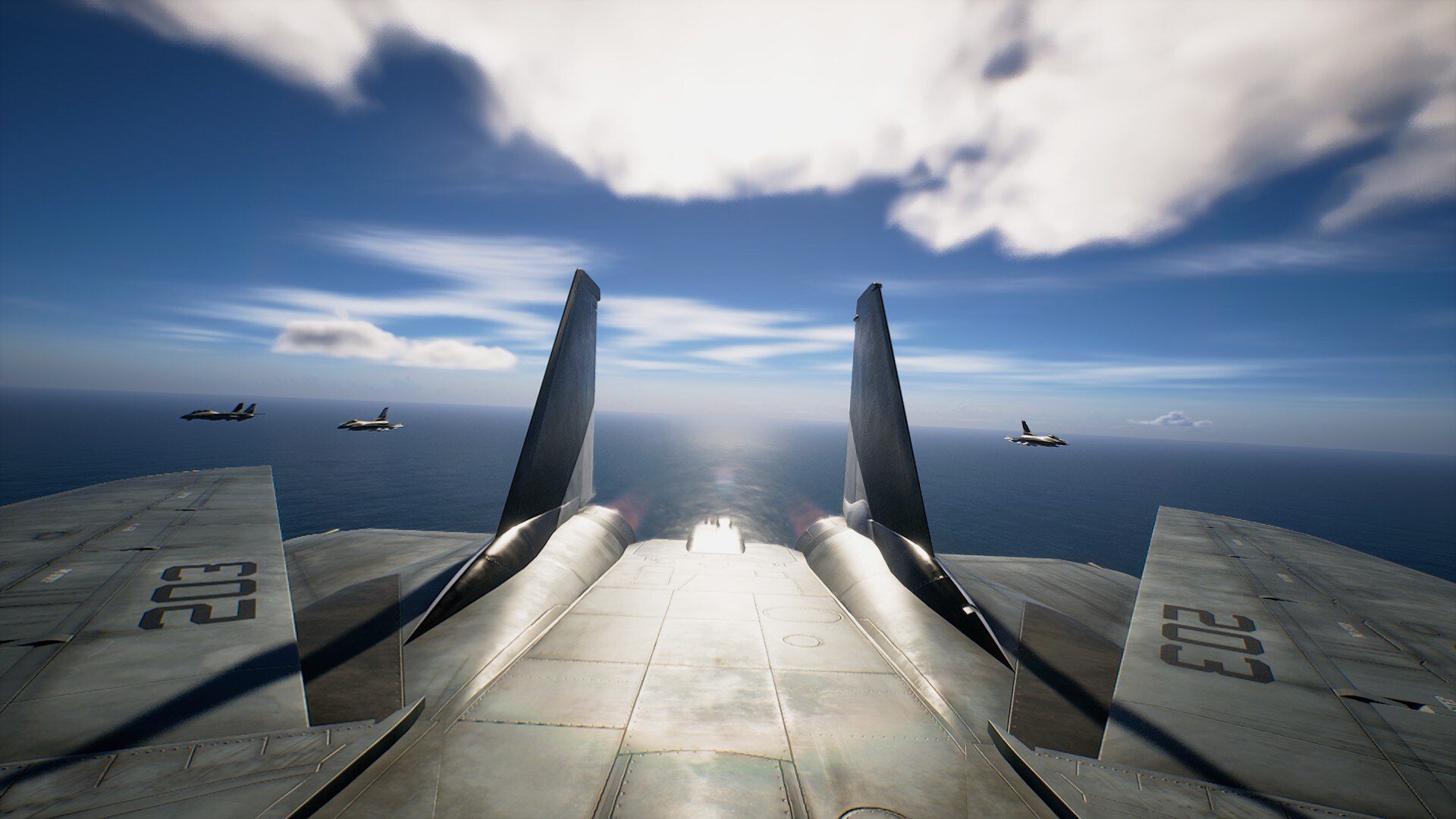
Wings of Theve is a substantial visual improvement over Ace Combat 7, with the biggest gains visible in the skies. The aircraft models are highly detailed, but it is the clouds and weather that make the greatest impression. Large formations stretch across the horizon with convincing depth, and flying through them changes the appearance of the aircraft and the surrounding battlefield rather than simply placing a grey filter over the screen.
The environments also hold up well when viewed from different altitudes. Cities, coastlines, mountains and military installations provide varied scenery, while low-altitude flying gives you a much better appreciation of the detail in the terrain. The enormous draw distances also help establish the sense of scale that is so important to the series.
The presentation is particularly effective during major battles. Large formations, explosions and enormous weapons can occupy the same stretch of sky, yet the game generally maintains a clear visual hierarchy that makes it possible to understand what is happening. The spectacle is impressive without becoming completely unreadable.
The first-person scenes between missions are another significant change. Rather than presenting every story sequence as a conventional cinematic, Wings of Theve frequently places the player directly in the scene. You can look around, interact with characters and experience the events from Rex’s perspective, which makes the time spent aboard the Endurance feel considerably more personal.
Sound and Music
The sound design does a great deal to sell the game’s sense of scale. Jet engines have considerable weight, missile launches are immediately recognisable and explosions have enough impact to make large engagements feel appropriately chaotic. The cockpit warnings also remain an essential part of the experience, especially when several enemies are attacking at once.
Radio communication is equally important. During intense missions, the cockpit can fill with warnings, instructions and conversations between pilots. There is sometimes a lot happening at once, but that is appropriate for a game where the player is supposed to feel as though they are operating inside a larger battle rather than fighting isolated targets in an empty sky.
The soundtrack continues Ace Combat’s long-standing tradition of dramatic orchestral music mixed with more distinctive vocal and thematic pieces. It knows when to stay in the background and when to become part of the spectacle, particularly during the larger encounters. The music can be unabashedly dramatic, but that suits the game’s tone far better than a restrained score would.
Multiplayer Experience
Ace Combat Online is considerably more ambitious than the multiplayer component of previous entries. The game introduces an online air-base lobby where players can use customised avatars before entering multiplayer activities, while cross-platform play allows pilots on different platforms to participate together.
The multiplayer offering includes both cooperative and competitive activities, giving players several ways to use the aircraft and progression systems outside the campaign. Large battles and cooperative missions make particularly good use of the game’s combat system because they can place many aircraft and targets into the same battlefield.
The air-base concept is somewhat unusual for Ace Combat, and whether it adds much will depend on how interested you are in the social side of the online game. The actual flying remains the important part, but the additional lobby, customisation and progression systems give the multiplayer component a more persistent identity than simply selecting a versus match from a menu.
There is also more progression to work through online, and that can make multiplayer feel considerably more demanding than the campaign. Players who want to build up a substantial collection of aircraft and equipment will need to invest significant time in the online modes. For some players that will provide a reason to keep returning, while others may find the grind less appealing once the novelty wears off.
Technical Performance on PC
The PC version is demanding by modern standards. The minimum specification calls for Windows 11, 16GB of RAM and a graphics card with hardware ray tracing support, with an RTX 2060 or Radeon RX 6600 XT listed as the minimum GPU. The recommended specification rises to 32GB of RAM and an RTX 3070 or Radeon RX 6800, with an SSD and DirectX 12 required in both cases.
Those requirements make more sense once you see the game running at its highest settings. The combination of detailed environments, volumetric weather, large battles and modern lighting can place considerable pressure on a system. The official minimum target is only 30fps at 1080p using upscaling on low settings, while the recommended specification targets 60fps at 1080p using upscaling and medium settings.
Performance is generally playable on appropriate hardware, but the game is not perfectly consistent. Demanding scenes can produce noticeable dips, and reports from PC players show considerable variation depending on hardware and settings. The game can look excellent when running well, but anyone close to the minimum specification should not expect to simply install it and run everything at high settings.
The PC version also lacks some flexibility that would have been welcome, most notably a field-of-view slider. That is particularly noticeable for players using ultrawide displays, where the ability to adjust the cockpit and external view would have made the game more comfortable. A controller is also the more natural input method for the flight model, although keyboard and mouse controls are available.
Final Verdict: 8/10
Ace Combat 8: Wings of Theve does not reinvent the series, but it does a good job of expanding it without losing sight of what makes the games enjoyable. The core flight model remains immediately accessible, while the deeper weather system, broader loadout options and more useful wingmen add meaningful variety around it.
The campaign is the biggest reason to play. Its 30 missions provide enough room for different types of encounters, while the greater focus on Joker Flight gives the story more personality than the series has sometimes managed. The writing can still become overly dramatic, but the characters are developed well enough that the more emotional moments generally have something behind them.
The weather is arguably the most successful mechanical addition because it changes how the player approaches the sky rather than merely making it prettier. Clouds can hide enemies, disrupt visibility and alter the flow of a dogfight, while the impressive presentation makes flying through them one of the game’s most convincing visual experiences.
The PC version is less polished in a few areas. Its hardware requirements are high, performance can vary considerably between systems, and the limited display options are disappointing on a platform that normally provides greater control. None of those issues changes the quality of the underlying flight combat, but they are worth considering before buying the game.
For everything else, Wings of Theve is a confident continuation of the series. It gives Ace Combat a longer campaign, stronger character work, more useful battlefield systems and a much more ambitious online component without burying the aerial combat beneath unnecessary complexity. Most importantly, it retains the simple pleasure at the heart of the series: climbing into a fighter, pointing the nose toward an impossible target and trying to bring it down before the next missile warning starts screaming.