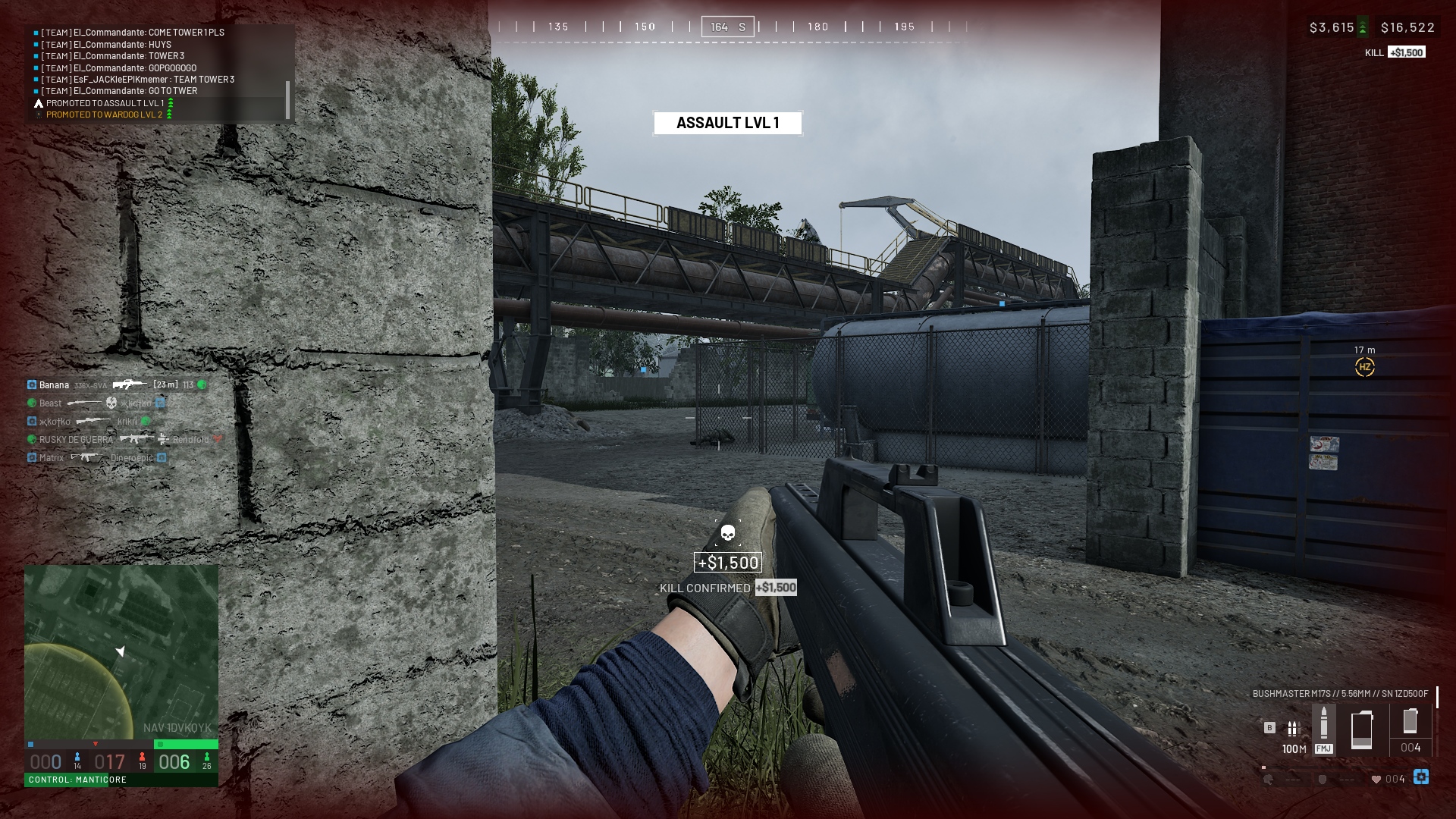
Wardogs is a multiplayer shooter built around a simple idea that has surprisingly far-reaching consequences: everything you do has value, and almost everything has a price. Killing an enemy is useful, but so is spotting one, reviving a teammate, transporting soldiers, building a forward operating base or simply holding the right position. The money earned from those actions can then be spent on weapons, equipment and vehicles, while whatever remains carries over into future matches.
That economic layer gives Wardogs a very different rhythm from the usual large-scale military shooter. Developed by Bulkhead and published by Team17, it puts up to 100 players into three competing teams and drops them onto large, destructible battlefields set in the industrial mountains of Eastern Europe. The objective is inspired by King of the Hill, with teams fighting over randomized 2×2-kilometre Control Zones inside a much larger map. The team with the most players inside the zone earns points, and the first to reach 100 wins.
Wardogs entered Steam Early Access on September 10, 2026, and it is important to judge it as an evolving game rather than a finished product. The developers currently expect Early Access to last roughly one to two years, with additional maps, weapons, vehicles, objective variations and deeper progression planned along the way. Yet the current version already has a clear identity. Its launch infrastructure struggled under an unexpectedly enormous player population, and several systems still need refinement, but there is a thoughtful shooter underneath those rough edges.
Gameplay and Mechanics
The fundamentals are straightforward. Three teams fight for control of a designated area, with the location changing from match to match. Because the Control Zone is randomized, there is no single route or defensive position that can be memorized and reused indefinitely. Teams have to establish their approach according to where the objective appears and how the other two factions respond.
The three-team structure is particularly important because it changes the usual logic of an objective shooter. In a two-team match, the enemy is obvious and the frontline usually develops naturally. Wardogs has another variable constantly interfering with that relationship. Two teams can become locked in a firefight while the third quietly moves into the objective, or a team that appears to have secured an advantage can suddenly find itself surrounded.
That unpredictability is one of the game’s better qualities. It is not simply chaos for its own sake. The position of the third team changes the value of almost every decision. Attacking one faction may give the other an opportunity to take the objective. Defending against one enemy may leave you exposed to another. Even retreating can be the correct decision if continuing a fight would cost too many resources.
The Control Zone itself is large enough to accommodate different approaches, while the smaller Hot Zone inside it provides an additional incentive to take greater risks. Players inside the Hot Zone can earn double cash, giving the most dangerous part of the objective a direct economic reward as well as its importance to the team’s score.
That relationship between objective control and personal finances is central to Wardogs. You are not simply deciding where to fight; you are constantly weighing what you might gain against what you might lose.
The Economy
The persistent cash system is Wardogs’ defining mechanic. Every player begins with $10,000, and each life involves purchasing a custom loadout from the available weapons, equipment, utilities and vehicles. Money carries over between matches, so spending decisions have consequences beyond the current battle.
This immediately makes equipment feel different. In most shooters, a weapon is something you select because it suits your preferences and then use until the match ends. There is little reason to worry about whether a particular gun is worth the risk because it costs nothing to replace. Wardogs makes that calculation part of the game.
Taking expensive equipment into a dangerous area can be worthwhile if the situation demands it, but dying with that equipment means spending again. A player who repeatedly chooses the most expensive options without earning enough money can find themselves in a difficult position. Conversely, someone who uses cheaper equipment and consistently contributes to the team can gradually build a much healthier financial position.
The important detail is that kills are not the only source of income. Wardogs rewards actions such as reviving teammates, transporting friendly players and controlling the objective. Spotting enemies, building FOBs and providing logistical support can also generate money.
That gives support roles a purpose beyond the usual scoreboard statistics. A medic who keeps a squad alive is not simply helping somebody else achieve a kill. They are actively generating resources. A driver can spend an entire match transporting soldiers and still be making meaningful progress. A player who prefers reconnaissance can earn money by identifying targets for teammates rather than engaging everything they see.
The system is not without drawbacks. New players have a lot to learn, and understanding the relationship between spending and earning takes time. There is also a natural temptation to become overly cautious once you appreciate how much equipment can cost. A shooter needs aggression to remain exciting, and an economy that punishes every unnecessary death too heavily could encourage players to sit back rather than take useful risks.
For the most part, Wardogs avoids that problem because the objective itself rewards participation. The Hot Zone, in particular, creates a direct reason to accept danger in exchange for greater financial returns. The result is an economy that actually changes how players behave rather than simply functioning as another progression screen.
Equipment and Player Roles
Wardogs does not lock players into traditional predefined classes. Instead, equipment can be purchased and combined according to the role a player wants to perform. The game therefore allows someone to specialize in medical support, reconnaissance, construction, anti-vehicle combat or frontline fighting without permanently selecting a single class at the beginning of a match.
That flexibility is valuable because the battlefield can change rapidly. A squad that encounters heavy armour may suddenly need anti-vehicle capability. A team attempting to hold a position may need additional medical support. A group preparing an assault may benefit from reconnaissance or transportation.
The downside is that Wardogs expects players to make those decisions themselves. A traditional class system can guarantee that a team has access to certain basic functions. Wardogs cannot. If too many players choose similar equipment, there is no automatic system correcting the imbalance.
That can make the experience somewhat intimidating for newcomers, particularly when combined with the economic system. You are learning the weapons, maps and objectives at the same time as learning which equipment is worth buying and what your team actually needs.
Once those systems become familiar, however, the freedom is one of the game’s strengths. You are encouraged to adapt rather than simply repeat the same class setup every match. Progression also rewards different kinds of participation, with players able to develop specializations through the way they play rather than relying exclusively on kills.
Combat and Gunplay
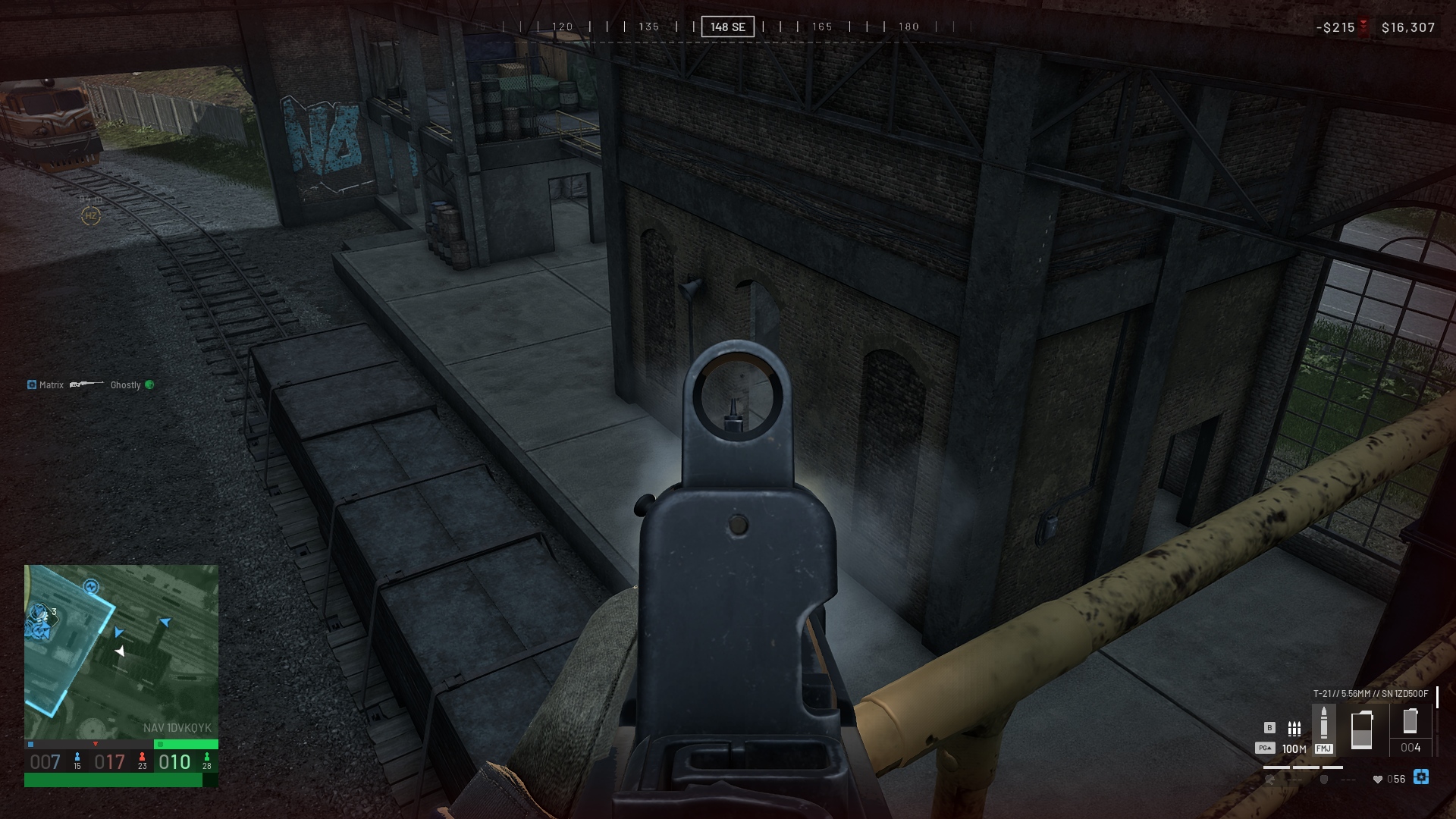
The actual gunplay is more accessible than Wardogs’ military presentation might initially suggest. The developers describe it as realistic gunplay balanced for gameplay rather than strict simulation, and that distinction is noticeable. The weapons have enough weight to make positioning and awareness important, but the game does not demand the procedural knowledge associated with the most uncompromising military simulations.
Firefights can still be unforgiving. The large environments create long sightlines, while towns, industrial structures and defensive positions can produce much tighter engagements. Visibility and positioning matter, particularly when approaching the Control Zone, where several teams can converge on the same area.
The combat works best when it is supported by the game’s other systems. Spotting an enemy before opening fire can be more valuable than immediately attempting the kill. Getting a squad into position can matter more than taking a risky shot. A well-placed FOB can turn an otherwise difficult attack into a manageable one.
That makes Wardogs less obsessed with individual combat performance than many multiplayer shooters. You can still spend an entire match fighting, but the game constantly provides alternatives for players who prefer to contribute in other ways.
Vehicles and Logistics
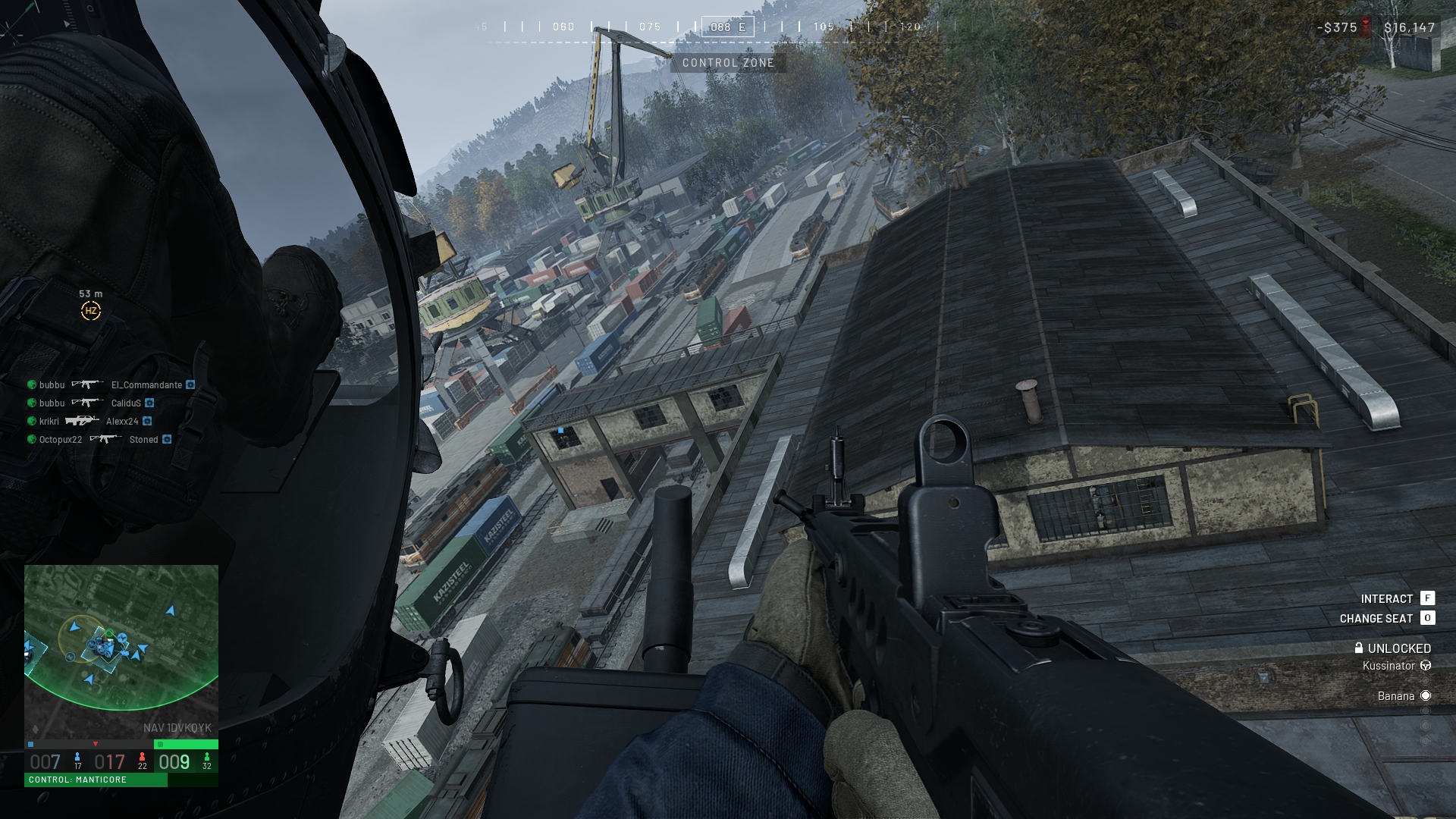
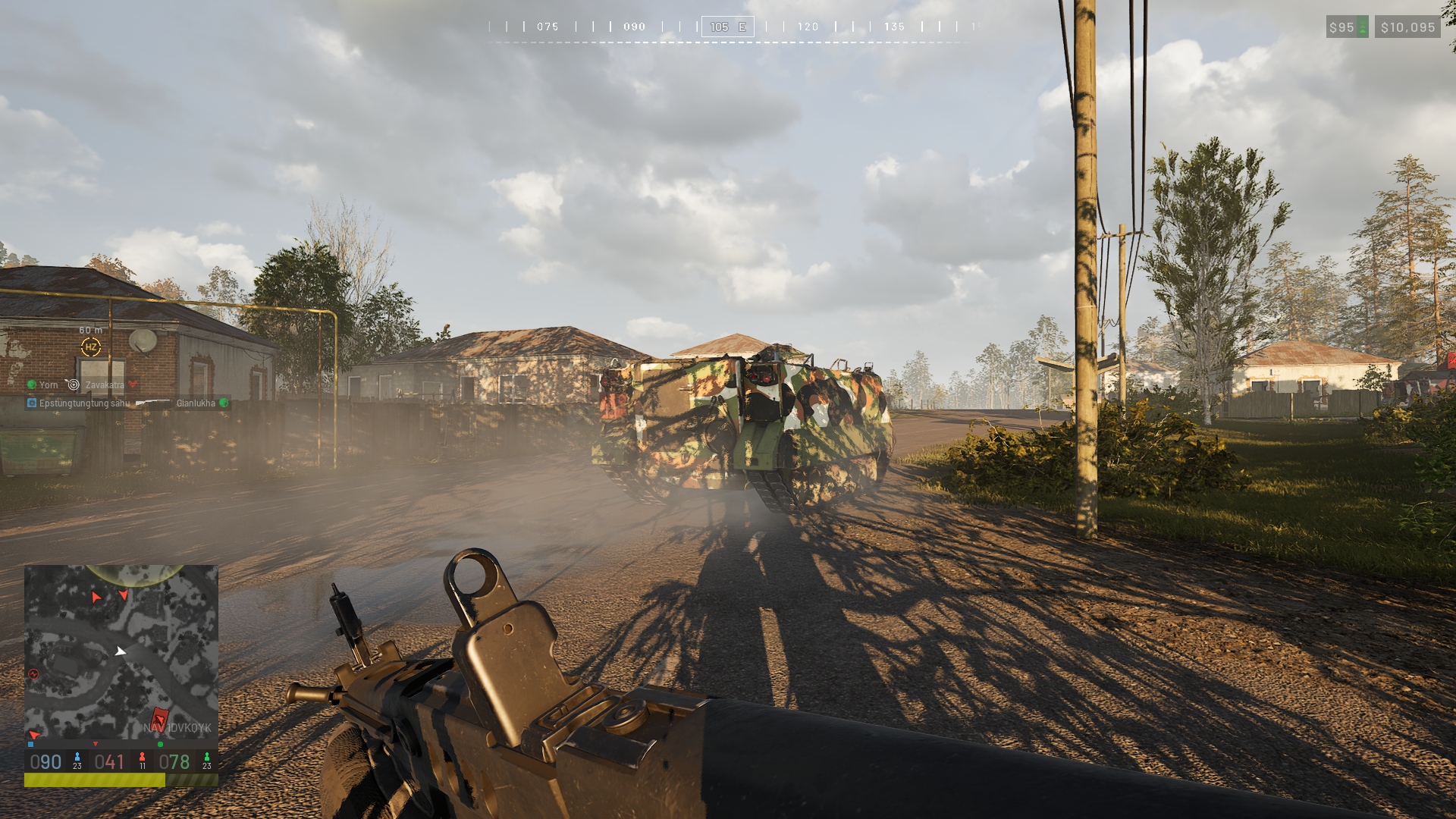
Vehicles are essential to making Wardogs’ enormous maps work. Transport vehicles can move squads toward the objective, helicopters can cover greater distances quickly, and heavier vehicles provide firepower that infantry cannot replicate.
The important distinction is that transportation is not merely a convenience. It is part of the economy. Players can earn money by transporting teammates, which turns driving and flying into genuine support roles rather than something players do only when they happen to find a vehicle.
This creates some of the game’s most satisfying teamwork. A squad can organize around a driver or pilot, move toward a contested area and arrive together rather than trickling in individually. The vehicle operator benefits financially while the passengers reach the battle more quickly.
Vehicle handling is less polished. Driving can feel awkward, and flying with keyboard and mouse is not always as precise as the importance of helicopters would suggest. Those problems become more noticeable because vehicles are so deeply integrated into the game’s design.
The economic cost of vehicles is another interesting factor. Buying one represents a substantial investment, and losing it has consequences. That makes vehicle use feel less like spawning a temporary weapon and more like making a strategic commitment.
Construction and Destruction
Construction gives players a practical way to influence the battlefield. Forward operating bases can provide useful staging areas and reduce the distance between a team’s position and the Control Zone. Defensive structures can also strengthen important locations and create new angles from which to fight.
Destruction prevents those preparations from becoming permanent. Buildings can be damaged or destroyed, while heavy weapons and vehicles can change the shape of an engagement. A position that is secure at the beginning of a battle may become exposed after enough punishment.
The combination works because neither side completely dominates. Building provides players with a way to shape the environment, while destruction ensures that those changes can be undone. That makes the battlefield feel more dynamic than a static collection of buildings and cover.
There is still room for these mechanics to become more important. Because the Control Zone remains the central objective, much of the construction ultimately exists to support movement toward or defence of that area. The potential is there for a more elaborate logistical game, but the current structure does not always demand it.
Map Design and Scale
Wardogs’ map scale is both one of its greatest strengths and one of its biggest problems. The large environments provide room for vehicles, infantry, construction and long-range combat to coexist. They also make it possible for several separate engagements to develop around the same objective.
When the systems connect properly, the result can be impressive. A squad can establish a forward base, organize transportation, move toward the objective and arrive while another team is already attacking. The battlefield feels like a connected space rather than a collection of isolated combat arenas.
The opposite is also true. A player who dies without access to transport can spend a considerable amount of time simply travelling. The large map becomes distance rather than gameplay, and the next meaningful engagement can feel unnecessarily far away.
The randomized Control Zone helps considerably because it prevents the entire map from becoming irrelevant. The precise 2×2-kilometre objective changes position, forcing teams to rethink their routes and defensive plans. Still, there are stretches of the environment that can feel underused because the majority of players naturally gravitate toward the current objective.
That is less a problem with the maps themselves than with how much the current mode asks players to use them. Future objective variations could make better use of the available space, and the developers have already indicated that additional objective variations are planned for the full game.

Technical Performance on PC
The timing of this review matters because Wardogs is only a few days into Early Access. The game immediately attracted a much larger audience than its infrastructure was prepared to handle. More than 300,000 players were playing concurrently on launch day, and that figure climbed to 428,666 concurrent players by 3 days. The resulting demand overwhelmed the servers, producing long queues, connection problems and periods when the game was temporarily taken offline.
Those problems were particularly frustrating because Wardogs is an online-only multiplayer game. When the servers are unavailable, there is no way to access the game at all. The situation improved after launch, but the server problems are still relevant when considering the state of the Early Access release.
The PC performance itself has been a different story in my testing. Running Wardogs on modern hardware, I experienced smooth and consistent performance without significant frame-rate problems during normal play. That remained true during the larger battles, where up to 100 players can occupy the same battlefield alongside vehicles, explosions, destructible environments and the various systems supporting the fight. Wardogs is clearly asking a lot from the hardware, but on the modern hardware used for this review, it handled that workload without becoming a distraction.
The scale of the game makes that particularly important. Wardogs is not simply placing a large number of players onto a map and letting them fight. Three teams compete across the battlefield while players can operate vehicles, transport teammates, establish forward operating bases, provide reconnaissance, revive allies and perform logistical tasks. The combination creates a battlefield where a great deal can be happening simultaneously, and the PC version needs to keep all of those systems running without compromising the responsiveness expected from a first-person shooter.
The official PC requirements are also relatively demanding. The minimum specification calls for a GTX 1660 or Radeon RX 590 alongside 16GB of RAM, while the recommended specification moves up to hardware such as an RTX 3070 or Radeon RX 6700 XT and a Core i7-12700K or Ryzen 7 5700X. That puts the game’s technical requirements in perspective, particularly given the amount of activity that can take place during a 100-player battle.
There are reports from some players of stuttering and inconsistent frame times, including on relatively powerful systems, so performance is not necessarily identical across every PC configuration. That has not been representative of my own experience, however. On the modern hardware used for this review, Wardogs ran well and remained responsive throughout my time with it.
There is still plenty of room for further technical work. Bulkhead is treating Wardogs as a long-term Early Access project, with development continuing on performance and stability alongside additional content and other improvements. The distinction between server performance and PC performance is therefore important. The enormous launch population exposed serious problems with the game’s online infrastructure, but those issues should not be confused with the actual performance of the PC client.
For now, Wardogs provides a solid technical foundation for the large-scale battles it is trying to deliver. On the modern hardware used for this review, Wardogs handled the combination of players, vehicles and environmental activity smoothly, while the remaining technical work is more about refining an Early Access foundation than fixing a fundamentally broken PC version.
Final Verdict: 7/10
Wardogs’ best idea is not its 100-player battles, huge maps or vehicle combat. It is the decision to connect the player’s economy directly to the way they participate in those battles.
The money system gives equipment weight. Death has a financial consequence, while support actions can be profitable. That makes a medic, driver, spotter or builder more than a player filling a secondary role. Their work has a direct effect on both the team and their own resources.
The three-team structure complements that economy surprisingly well. There is always another faction to consider, and the randomized Control Zone prevents every match from following the same sequence of attacks and defences. The Hot Zone adds another layer by offering greater financial rewards to players willing to fight in the most dangerous area.
The weaknesses are largely connected to the game’s scale and its Early Access state. Vehicles need refinement, new players have a considerable amount to learn, and the enormous maps can sometimes leave too much space between meaningful engagements. The current objective system also means that some of the wider battlefield can feel less important than its size suggests.
None of that undermines the core concept, though. Wardogs does not simply put 100 players on a giant map and expect the spectacle to carry the experience. Its economy, logistics, construction and three-team structure give players reasons to think about what they are doing and how much risk they are willing to accept.
The game is particularly effective when those systems overlap. A squad uses a helicopter to reach the objective, establishes an FOB, pushes into the Hot Zone, loses its position to an armoured assault and then has to decide whether the remaining money is worth spending on another attempt. That sequence is interesting because every part of it is connected. The economy affects the equipment, the equipment affects the tactics, and the tactics affect how the team uses the battlefield.
There is still considerable work ahead. Wardogs is explicitly designed to evolve during Early Access, and its current version does not make equally good use of all of its systems. The launch problems also showed that supporting a game of this scale can be almost as difficult as designing one.
Even so, the foundation is strong. Wardogs offers a large-scale tactical shooter where success is not measured solely by how many opponents you eliminate. It gives players meaningful alternatives to direct combat and makes those alternatives matter through its economy. For players prepared to learn its systems and accept the occasional rough edge, that makes Wardogs a notably different proposition from the standard multiplayer FPS.
It is not a finished game, and it should not be judged as one. What it already provides, however, is a convincing core experience with enough depth to make its future development worth watching. Wardogs still needs refinement, but it has something many multiplayer shooters struggle to establish: a reason to play it differently from everything else.