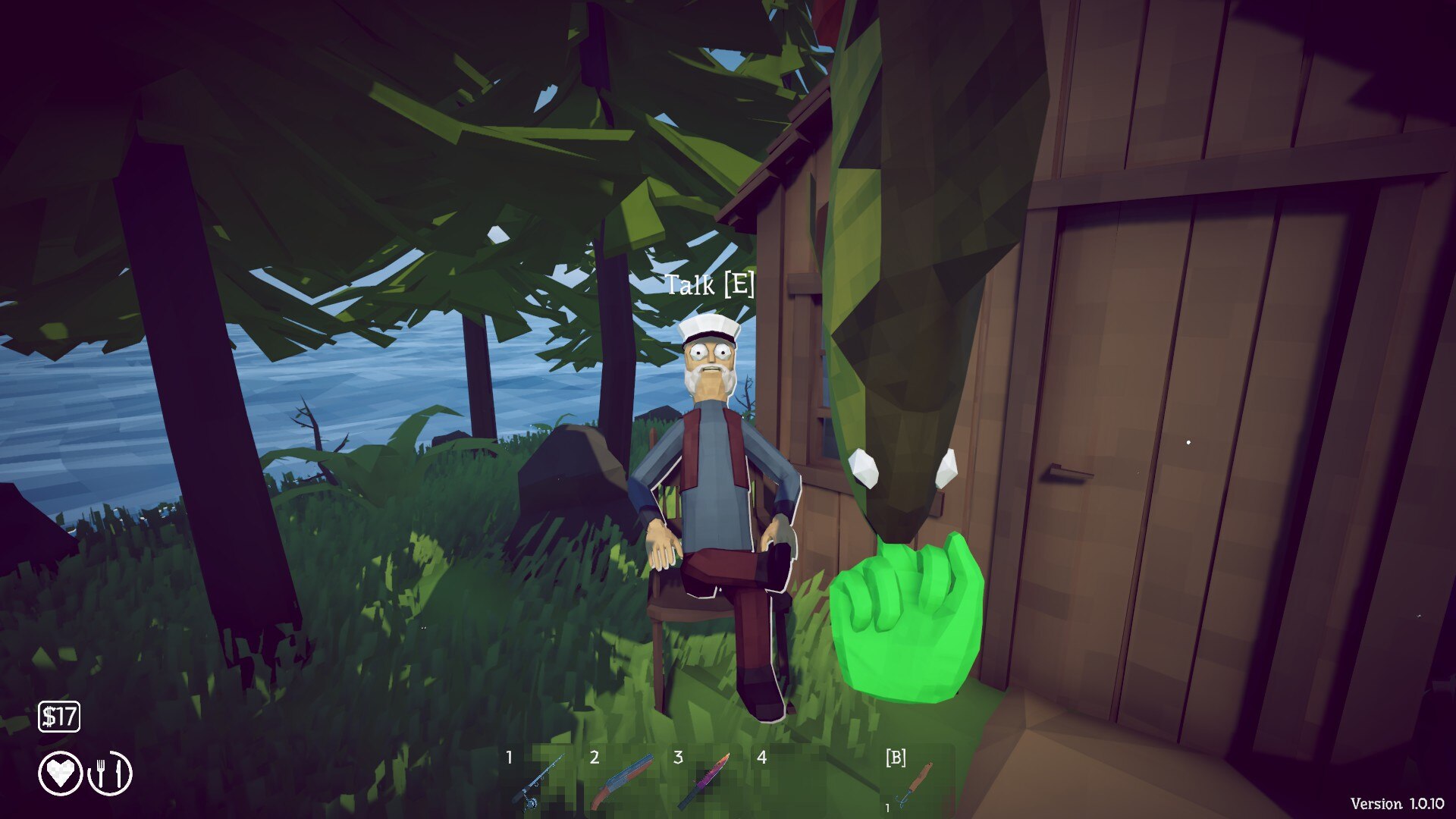
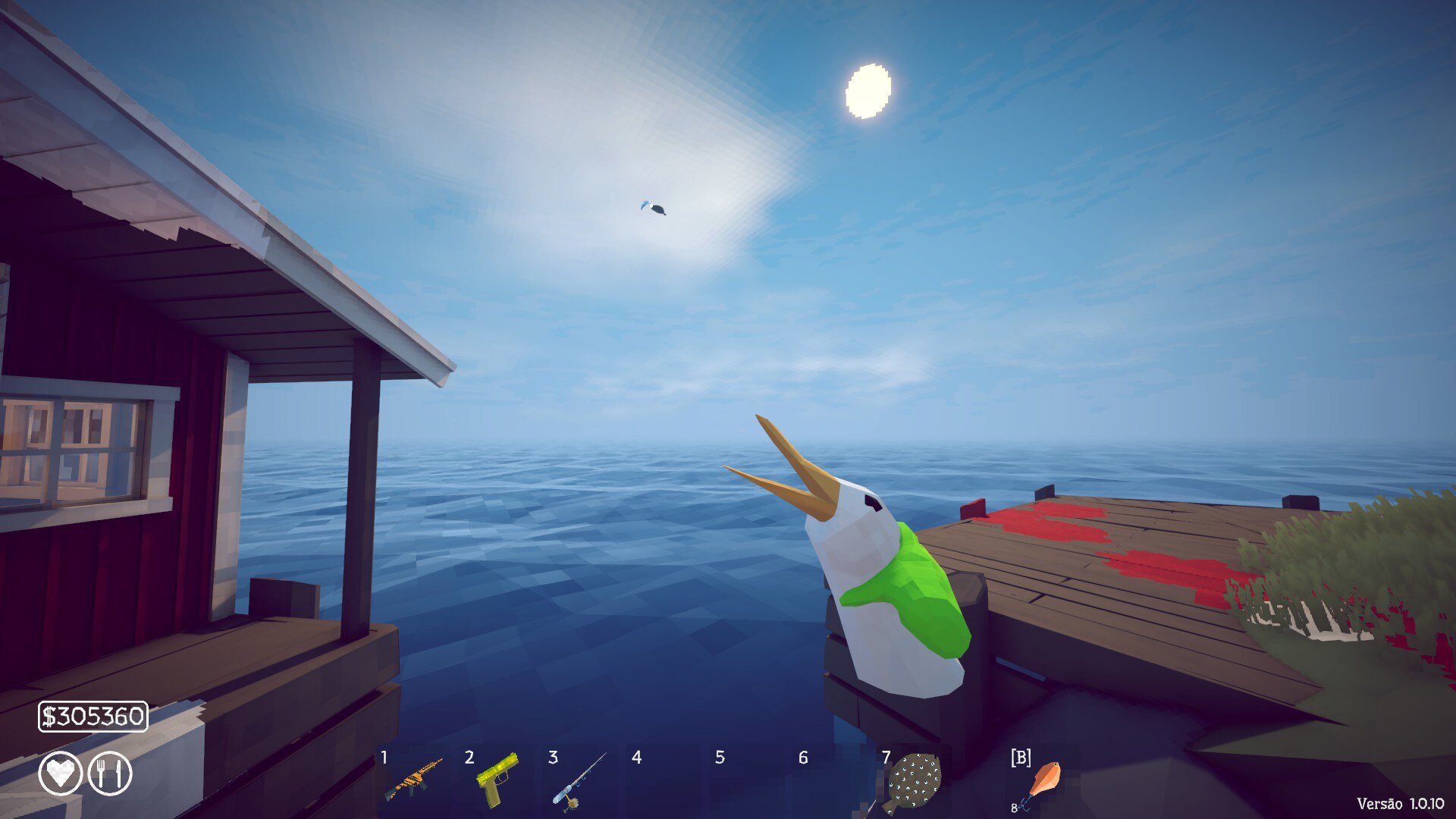
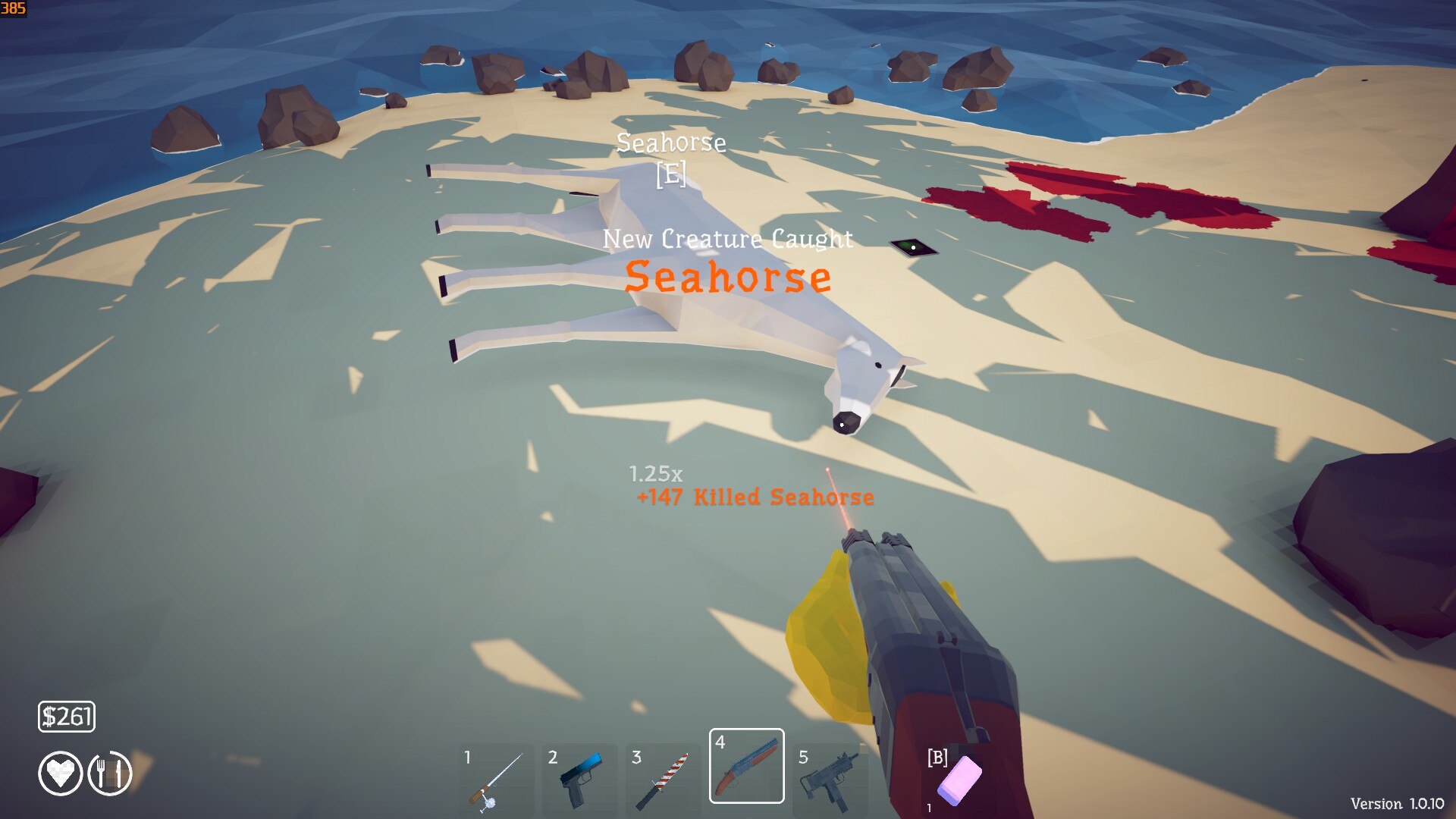
How to Fish is built around a simple idea: catch fish, sell them, buy better equipment and use that equipment to make your way home. The difference is what happens between catching something and getting paid for it. Fish do not simply disappear into an inventory. They remain physical objects in the world, and the player is free to deal with them using increasingly ridiculous methods. Fishing rods eventually share space with knives, brass knuckles and guns, while trick shots turn catches into opportunities to earn more money. There are quests to complete, bosses to defeat and several islands to work through, giving the game more structure than its deliberately silly premise initially suggests.
The game begins with the player stranded on a small island after a drunken boating accident. The objective is to find a way home, and the route forward involves learning how to fish and earning enough money to improve the equipment available to you. Dazed Games has clearly designed the game around short, uncomplicated sessions rather than a large-scale adventure. The official Steam listing describes it as a one-to-four-player physics-based fishing simulator, and that description is useful because it places the emphasis where it belongs. How to Fish is less interested in simulating fishing than in using fishing as the foundation for a physics-driven co-op game.
That approach works surprisingly well. The fishing itself is basic, but it does not need to be complicated because the game becomes more interesting immediately after a catch is landed. What starts as a simple fishing loop gradually incorporates combat, equipment upgrades, quests, boss fights and physical experimentation. It is a small game with a narrow focus, but it generally understands what makes that focus entertaining.
Gameplay and Mechanics
The basic progression is straightforward. Players begin with little or no useful equipment and have to earn money from the creatures they catch. That money can then be spent on better gear and weapons. Quests provide direction, while defeating bosses allows the player to progress to new islands containing more dangerous creatures and improved equipment. The system does not attempt to bury the player under multiple currencies, elaborate skill trees or complicated character statistics. There is a clear relationship between what the player does and what they get in return.
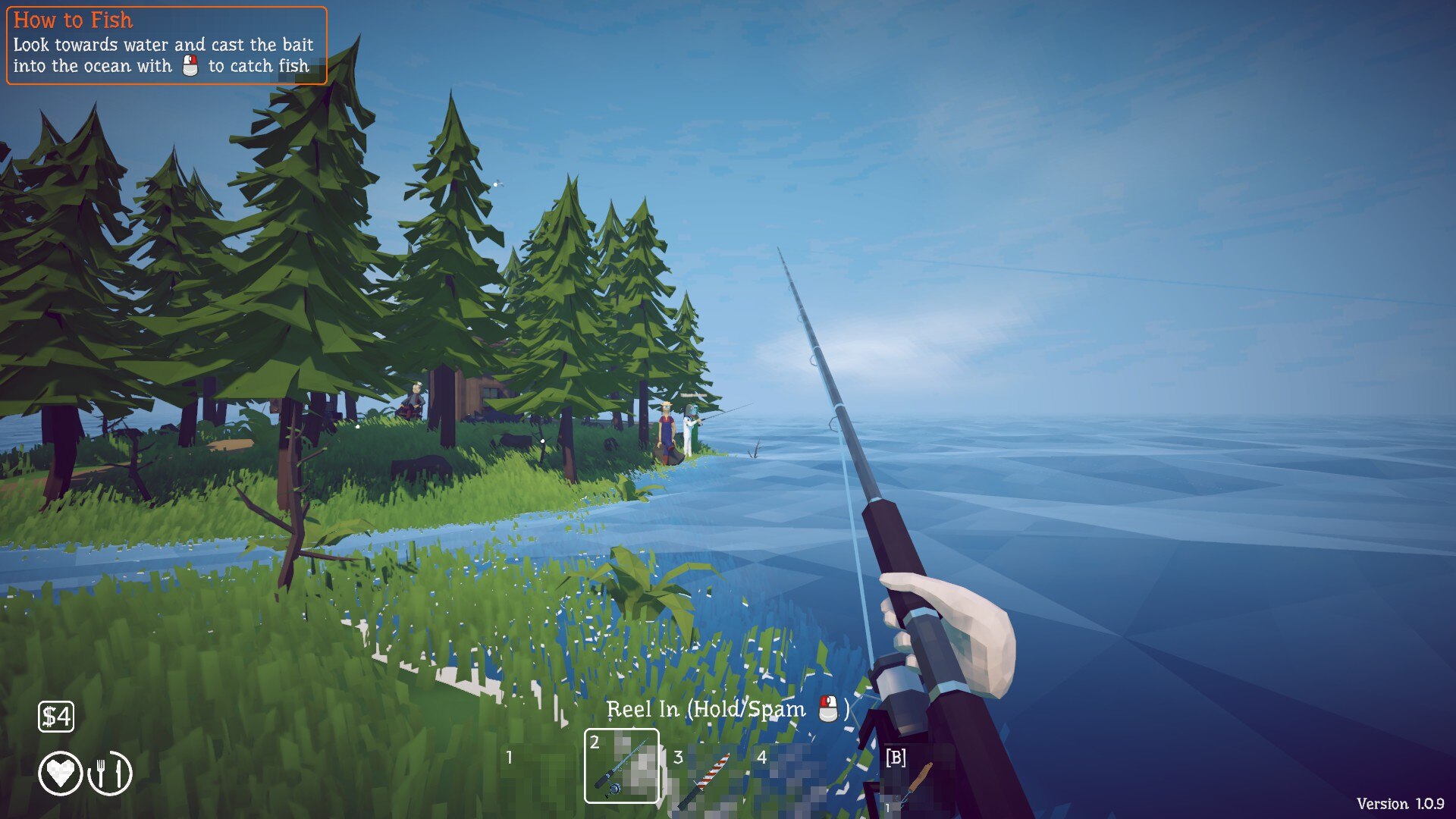
This simplicity is important because How to Fish does not have a particularly elaborate tutorial. Much of the appeal comes from discovering what the game’s systems allow you to do rather than being presented with a long list of mechanics at the beginning. The result can occasionally be confusing, especially when an objective is not immediately obvious, but it also encourages experimentation. Players are given enough information to start making money and progressing, then left to work out how much more there is to the systems.
The physical nature of the catches is the game’s most important design decision. Once a creature has been brought in, it remains in the environment rather than simply becoming an icon in a menu. That means the player has to interact with it physically, and the game gradually provides more ways to do so. What would be a routine inventory transaction in another fishing game becomes an opportunity to experiment with weapons, positioning and the environment.
This is also where the physics become important. How to Fish is not consistently precise, and objects can behave in ways that are difficult to predict. In a conventional game that could be a serious problem, but here it is often part of the entertainment. A creature flying somewhere unexpected can create a funny situation, particularly when several players are involved. The problem occurs when the same unpredictability interferes with progression or makes an objective unnecessarily difficult. The game works best when its physics create possibilities rather than obstacles.
The simplicity of the underlying systems also makes the game easy to introduce to other people. A new player does not need to understand a complicated build or learn a large collection of abilities before contributing. They can fish, earn money and gradually discover the other mechanics through play. That makes How to Fish particularly suitable for groups who want something that can be picked up quickly.
Fishing and Combat
Anyone approaching How to Fish as a serious fishing simulator should adjust their expectations. The fishing mechanics are deliberately uncomplicated. Casting, hooking and reeling in a catch provide the foundation of the game, but there is little interest in reproducing the technical details of real-world angling. The fishing exists primarily to give the player access to creatures, money and the rest of the game’s systems.
That becomes clear almost immediately once the player starts acquiring weapons. Catches are not simply collected; they can be subdued using whatever equipment the player has available. The official description makes this progression explicit, starting players with no gear or weapons and allowing them to earn money for increasingly useful equipment.
The combination is more effective than it sounds because fishing and combat give each other a reason to exist. Fishing provides the resources required to buy weapons, while weapons make it possible to deal with creatures and bosses more effectively. Neither system is especially deep in isolation, but together they create a loop that is easy to understand and satisfying to repeat.
The trick-shot mechanics add another layer to that loop. Players can launch catches into the air and attempt to kill them with more difficult shots, including using firearms. The game rewards this kind of experimentation, giving players a reason to take a more complicated approach when a simple kill would otherwise be enough. Recent coverage of the game has highlighted this as one of its defining mechanics, and it is easy to understand why. The system turns an ordinary catch into a small challenge without requiring a separate mini-game.
There is a useful choice between efficiency and experimentation. A player who wants to progress quickly can deal with a catch in the simplest available way. Someone who enjoys the game’s physics can spend more time trying to produce better shots and earn more money. That flexibility helps prevent the basic fishing loop from becoming completely repetitive during the campaign.
The combat itself is not sophisticated enough to carry a dedicated action game. Enemy behavior is relatively straightforward, and the weapons are primarily there to support the wider mechanics. That is perfectly acceptable here. The appeal is not the quality of the shooting in isolation but the absurd situations created by combining shooting with fishing and physics.
Progression and Level Design
How to Fish has a compact progression structure built around five islands. The player completes quests and defeats bosses before moving onward, with each new area providing more dangerous creatures and better equipment. The progression is essentially linear, giving the campaign a clear beginning, middle and end rather than turning the islands into a large open world. Current game guides and the official game information consistently identify five main stages in the route.
That structure suits the game’s scope. The islands are not designed as huge environments filled with optional activities. They function as contained spaces where the player can fish, complete objectives, earn money and prepare for the next encounter. This keeps the campaign focused on the game’s actual mechanics instead of padding the experience with long stretches of travel.
The progression also gives the fishing system a practical purpose. The player is not simply catching fish because the game happens to be about fishing. The money earned from those catches directly affects the equipment available for later challenges. The relationship is uncomplicated, but it gives the otherwise simple economy a clear purpose.
The downside is that the environments themselves are not especially deep. There is some satisfaction in moving into a new area and discovering what creatures and objectives it contains, but exploration is not strong enough to become a major reason to keep playing. How to Fish is better thought of as a collection of compact gameplay spaces than as a large adventure world.
There are also moments when the lack of guidance works against the game. Discovering a solution can be enjoyable when the player has enough information to form a reasonable guess. It becomes frustrating when there is little indication of what the game expects. That issue does not ruin the progression, but a little more clarity in some objectives would make the campaign easier to navigate without making it feel overly guided.
Boss Fights
Boss encounters provide the campaign with its most important combat challenges. They also give the equipment progression a clear purpose. After spending time earning money and improving gear, the player eventually has to put those upgrades to use against creatures that cannot be handled as casually as ordinary catches.
The Spider Crab provides an early test of the combat system, while later encounters increase the pressure on movement and equipment. The Pufferfish is a particularly significant step up in difficulty, requiring players to keep moving and make better use of the surrounding environment. Current coverage of the encounter also notes that an upgraded SMG can be substantially more useful against it than some other weapons.
These are not elaborate boss fights by the standards of a dedicated action game. Their patterns are relatively simple, and the challenge comes more from understanding the available equipment and movement options than from learning complicated attack sequences. That works within the context of How to Fish because the bosses are there to interrupt the fishing loop and test progression rather than become the main attraction.
The larger issue is balance between solo and multiplayer. Some of the later encounters are considerably more comfortable with several players, while a solo player has to handle the same basic challenges without anyone else sharing the workload. Recent player and review feedback has repeatedly identified this as one of the game’s weaker areas. The developers have responded with difficulty options, which give players more control over the amount of damage they receive and deal.
That makes the solo experience more manageable, but it does not completely change the game’s underlying design. How to Fish clearly gets more comfortable as a group experience, and the boss encounters make that especially obvious.
Multiplayer and Co-op Experience
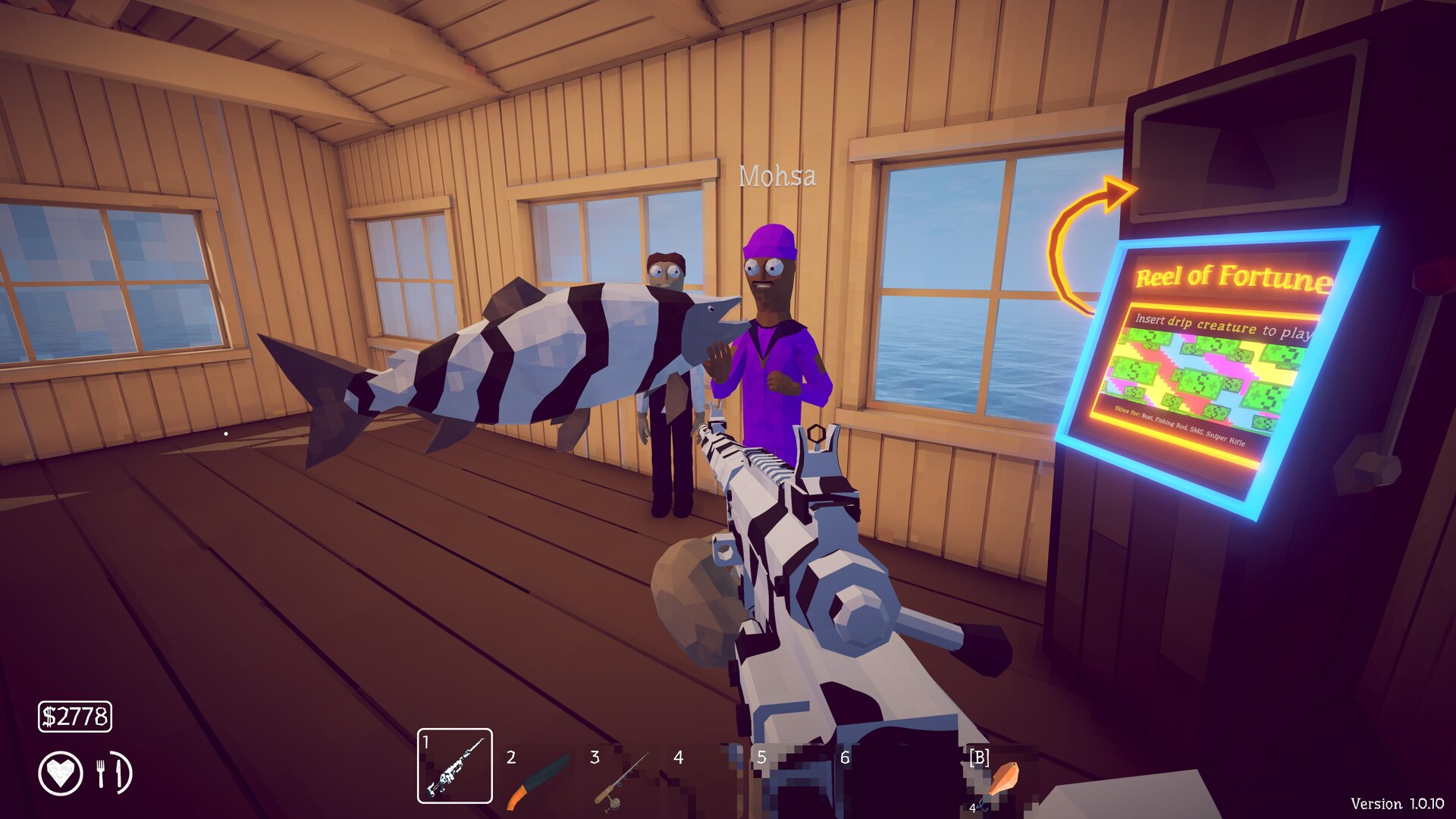
Multiplayer is where How to Fish makes the strongest case for itself. The official Steam listing supports one to four players, and the game’s mechanics are designed around everyone occupying the same physical space. Players can fish together, help with creatures, work toward better equipment and interfere with one another simply by interacting with the same objects. Having several players in the same area also changes how the game’s basic activities feel.
Fishing can become a shared task, with one player concentrating on catching a creature while another prepares to deal with it or helps clear the area. There is no need for complicated roles or carefully planned teamwork, so everyone can contribute without having to learn a specialized character or build.
The shared physics make co-op considerably more unpredictable than playing alone. A fish can be knocked away, an attempted trick shot can be interrupted, or several players can accidentally make a simple objective more difficult than it needs to be. Not every unexpected interaction is useful, but many of them create the kind of situations that make a multiplayer session more memorable.
How to Fish does not rely on scripted events to create variety between players; much of it comes from giving everyone access to the same objects and allowing them to interact with the environment freely. That approach works particularly well for groups of friends because the game remains easy to understand while still leaving plenty of room for experimentation, mistakes and improvised solutions.
There are no formal co-op roles to manage. Players are not divided into classes, and the game does not require elaborate coordination. Instead, cooperation happens naturally. One person can fish while another prepares to deal with the catch, or everyone can simply work on the same objective. When something goes wrong, the physics frequently create another problem for everyone to deal with.
That unpredictability is the game’s greatest multiplayer asset. A fish can be knocked out of position, an attempted trick shot can go wrong, or a simple fight can become chaotic because several players are moving around the same area. The game does not need to manufacture comedy through scripted sequences when its physical systems are already capable of producing unexpected situations.
The enormous response to the game shortly after release reinforces how well this approach connected with players. It reportedly reached a peak of 373,971 concurrent Steam players within five days of launch, an extraordinary result for a small independently developed game. That popularity is not evidence that every mechanic is exceptional, but it does demonstrate that the basic co-op concept has broad appeal.
The important thing is that the multiplayer does not require players to be particularly skilled. It works because everyone can understand what to do almost immediately, while the physical systems provide enough freedom for experienced players to find their own ways of approaching the game. It is a good fit for a group that wants something easy to start without being completely predictable.
Singleplayer Experience
Playing alone is considerably less compelling. The campaign remains functional, and a solo player can still fish, earn money, purchase equipment, complete quests and fight the bosses. Nothing fundamental is removed from the game. What changes is the context in which those mechanics operate.
The physics are naturally more interesting when several people are interacting with them. A group creates opportunities for accidental interference, unexpected solutions and shared experimentation. Alone, the same systems tend to become more functional. The player catches something, deals with it, sells it and moves on.
The difficulty issue also becomes more noticeable. A group can divide attention and damage across several players, while a solo player has to handle every task personally. The developers’ addition of difficulty settings helps, but the underlying balance still favors multiplayer. Recent reviews have made the same distinction, generally finding the game substantially more appealing with friends than alone.
There are reasons to continue playing after the main objectives, including achievements, collecting creatures and experimenting with trick shots. Those activities can provide additional time with the game, but they do not introduce an entirely new progression system. Once the player understands the basic loop, the main question becomes whether they enjoy repeating and experimenting with it.
For that reason, How to Fish is best approached as a co-op game that happens to support solo play rather than as a game equally designed around both experiences.
Presentation and Technical Performance
The visual style is deliberately simple. The environments and creatures use a low-poly aesthetic that keeps the game readable while allowing the physics to remain the focus. There is little attempt to make the islands look realistic, which is appropriate because the game’s tone and mechanics quickly move away from realism anyway.
The presentation is at its most effective when several physical objects are moving around the environment. The uncomplicated visuals make it relatively easy to see what is happening, even when a multiplayer session becomes chaotic. There is not a huge amount of environmental detail, but the game does not need it to support its central mechanics.
The PC requirements are also modest. Steam lists Windows 10 or later, 8GB of RAM, a GTX 1050 or RX 460-class graphics card and only 1GB of storage. The game is therefore accessible to players with relatively modest gaming hardware.
The more important technical consideration is the physics. They are central enough to the game that some unpredictability is inevitable. When an object behaves strangely and produces an entertaining result, it feels like part of the game’s design. When the same behavior disrupts progression, it becomes much harder to overlook. That distinction is one of the areas where future patches can make a meaningful difference without changing the game’s identity.
Replay Value
The main campaign is compact, and that limits the amount of traditional replay value on offer. Once the five islands and their major objectives have been completed, there is not a large endgame system waiting to occupy the player. Achievements, creature collection and trick-shot experimentation provide additional goals, but they are all built around the same mechanics.
The better source of replayability is multiplayer. Returning to an earlier island with friends can produce different situations simply because the physical interactions are difficult to reproduce exactly. A group can also spend time attempting more difficult trick shots or experimenting with equipment rather than following the most efficient route through the campaign.
That makes replayability dependent on the player’s relationship with the mechanics. Someone who enjoys experimenting with physics and playing with friends can get considerably more out of the game than someone looking for a long progression system. The campaign itself is not substantial enough to carry the experience indefinitely.
This is easier to accept because the game is priced as a small indie co-op title rather than a full-priced adventure. Its value comes from how much entertainment the core mechanics can generate, not from the amount of content on a checklist.
Value for Money
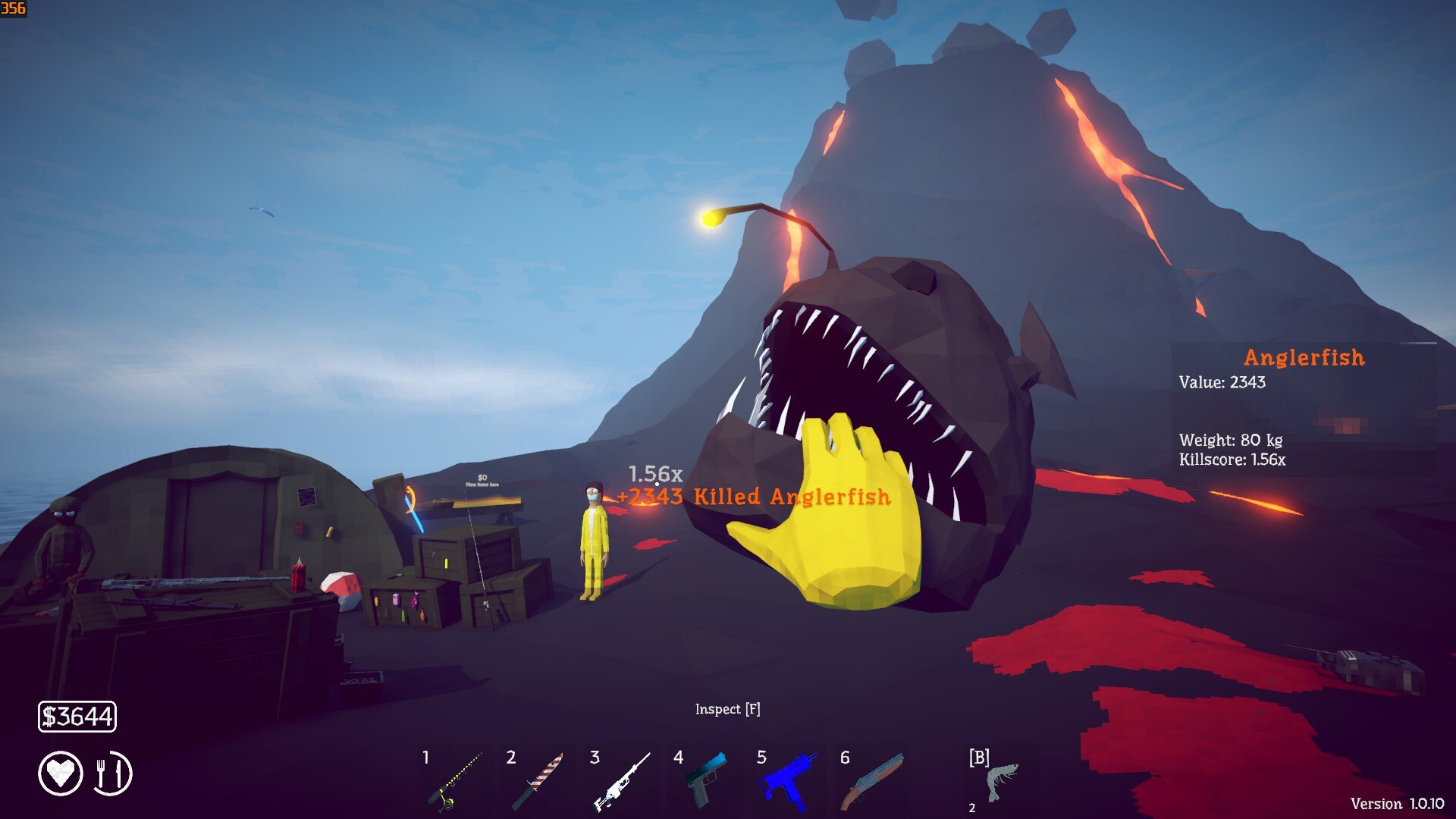
How to Fish makes considerably more sense at its relatively low asking price than it would as a full-priced release. The campaign is compact, the fishing is simple and the combat lacks the depth of a dedicated shooter, but the game does not pretend to be something larger than it is. It provides a straightforward progression system, several islands, boss encounters, equipment upgrades and a co-op sandbox that can produce a surprising number of different situations.
The value is strongest for people who already have friends to play with. A group can understand the game quickly and spend more time experimenting than learning. That is a good quality for an inexpensive multiplayer game, particularly when the physics provide enough unpredictability to prevent every session from feeling identical.
The value is weaker for someone interested exclusively in realistic fishing or a substantial solo campaign. The fishing mechanics are not detailed enough to satisfy simulation fans, while the solo experience loses much of the interaction that makes the game distinctive.
Final Verdict: 8/10
How to Fish succeeds because it understands that its fishing mechanics do not need to be particularly deep. The rod and the catch provide the starting point, while the game’s real entertainment comes from everything that happens afterward. Fish become physical objects, weapons become part of the fishing process, trick shots turn routine catches into optional challenges, and the progression gives players a reason to keep improving their equipment.
The multiplayer design is the strongest part of the package. The game is easy to understand, does not require formal co-op roles and gives players enough freedom to create their own situations. Its physics are sometimes unpredictable in ways that can be frustrating, but they are also responsible for much of the game’s appeal. With friends, a minor mistake can become a problem for everyone, and dealing with that problem is often more entertaining than simply completing the original objective.
The limitations are clear. The actual fishing is basic, the combat is functional rather than deep, the environments are relatively small and the campaign does not provide a large amount of long-term progression. Solo play is also noticeably less effective, particularly once the more demanding boss encounters begin. These weaknesses prevent How to Fish from being a particularly strong recommendation for players looking for a substantial single-player game or a serious fishing simulation.
For the audience it is actually aimed at, however, those limitations are easier to accept. How to Fish is a compact co-op game built around a simple set of physical systems, and it gets more mileage from those systems than might reasonably be expected. The fishing gives the game its structure, the progression keeps the campaign moving and the physics provide the situations that make individual sessions memorable.
It is not a game that needs dozens of hours of content or a complicated progression tree to justify itself. Its appeal is much narrower than that. It gives a group of players a small world, some fishing equipment, increasingly strange ways to deal with their catches and enough objectives to give the chaos some direction. When those elements work together, the result is genuinely entertaining.
How to Fish is therefore easy to recommend to players looking for an inexpensive co-op game, particularly if they have a regular group to play with. It is a much less convincing choice for solo players and anyone expecting realistic fishing mechanics. Within its modest scope, though, Dazed Games has made a game with a clear identity and a gameplay loop that understands where its fun actually comes from.