Star Wars has covered almost every major video game genre, but turn-based tactics has remained one of the more obvious gaps. Star Wars Zero Company finally fills it, putting a small team of mercenaries in the middle of the Clone Wars and giving players control over their movement, abilities, equipment and relationships. Developed by Bit Reactor, a studio founded by veterans of the modern XCOM games, Zero Company clearly understands the tactical formula it is working with. It borrows familiar ideas without pretending that they are entirely new, then builds enough of its own systems around them to give the campaign a distinct identity.
Players take the role of Hawks, a former Republic officer who leads Zero Company, an unconventional group operating from the Den, a decommissioned cargo freighter permanently docked at the Ring of Kafrene. The company takes on contracts while becoming increasingly involved with the Infinite Coil, a Separatist-aligned paramilitary cult led by Kundri Fathom. Rather than building the campaign around established heroes from the films or animated series, Bit Reactor has created an original cast whose members come from very different backgrounds. That gives the story room to explore the Clone Wars from the perspective of people who are not necessarily fighting for the Republic out of duty or following the usual heroic path.

That choice works in the game’s favor. Zero Company feels most distinctive when it focuses on its own characters and lets the Star Wars setting influence the mechanics rather than simply providing familiar scenery. Force abilities, unusual weapons, droids and specialized Operators all affect how battles are played, while relationships between characters can eventually influence their effectiveness in combat. The result is a tactical RPG that clearly belongs to the same family as modern squad-based strategy games without feeling like a simple Star Wars reskin.
The game is not without limitations. Its tactical foundations are familiar, some encounters can be less demanding than experienced strategy players might expect, and the larger story is less consistently developed than its cast. The PC version is also demanding, with performance tied heavily to CPU capability rather than graphics hardware alone. Even so, Zero Company makes a convincing case that Star Wars and turn-based tactics are a natural combination, and its strongest ideas come from connecting its combat, progression and character systems rather than attempting to reinvent the genre.
Gameplay and Mechanics
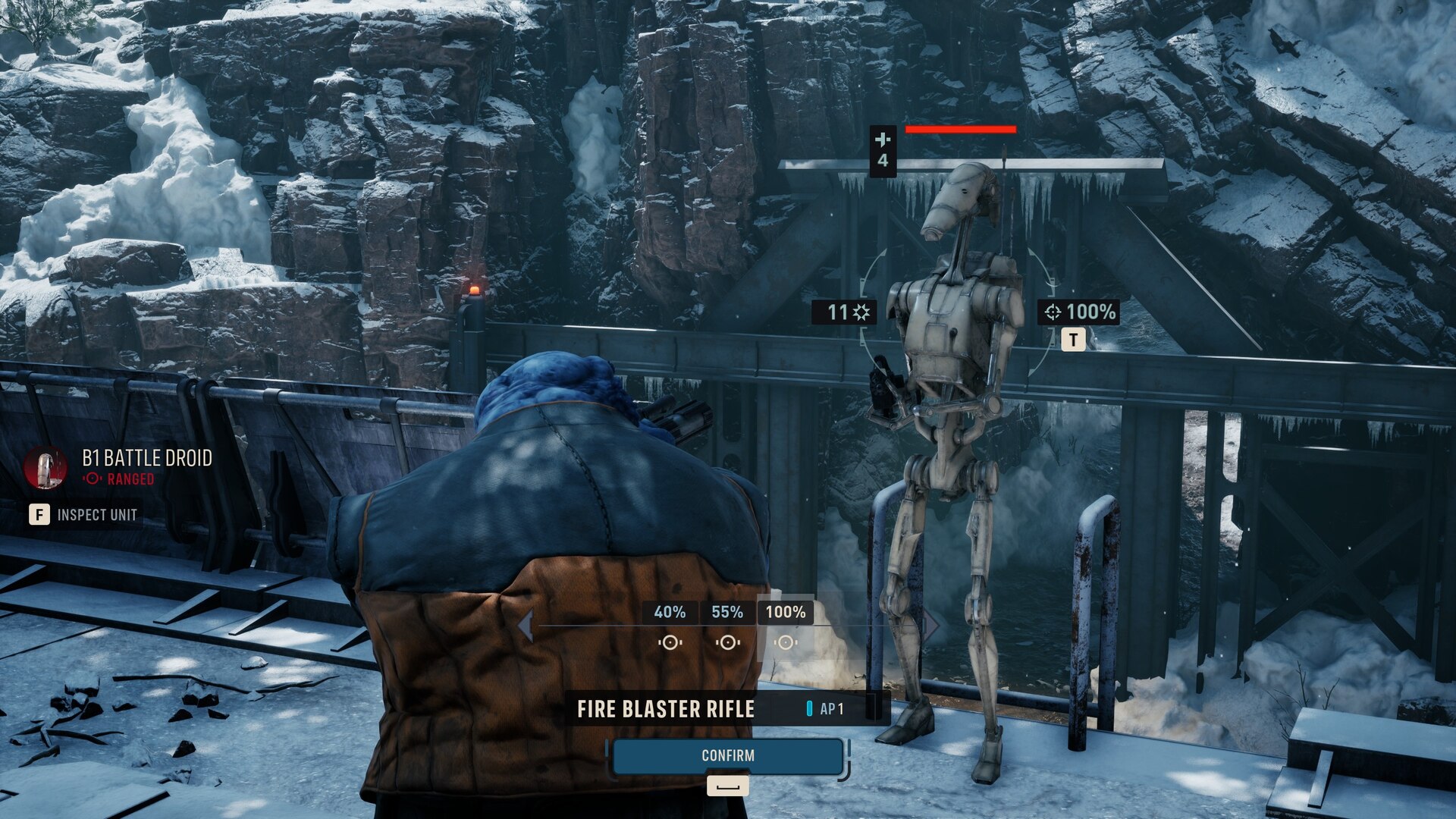
Zero Company’s tactical battles use a structure that will be immediately recognizable to players of modern squad-based strategy games. Missions are fought with a team of four Operators, and each character receives three Action Points on their turn. Those points can be spent on movement, attacks and abilities, allowing characters to perform several actions in the same turn rather than being restricted to a simple move-and-shoot sequence. The system makes the order of actions important because one character’s first move can create an opportunity for another Operator to exploit.
That flexibility is one of the game’s strengths. A turn is rarely just about selecting the strongest available attack. Players can move into position, weaken an enemy, use a Backup attack with another Operator, then spend remaining Action Points on another ability or defensive action. The result is a combat system that rewards planning several steps ahead without requiring players to calculate every possible outcome before acting.
Advantage adds another resource to this system. Operators gain Advantage when they inflict damage, and it can then be spent on more powerful abilities. Because the resource is built during combat rather than simply replenishing every turn, players have to decide when an ability is worth using and when it is better to save Advantage for a more dangerous situation. It is a relatively simple mechanic, but it gives attacks and abilities a sense of connection across a battle.
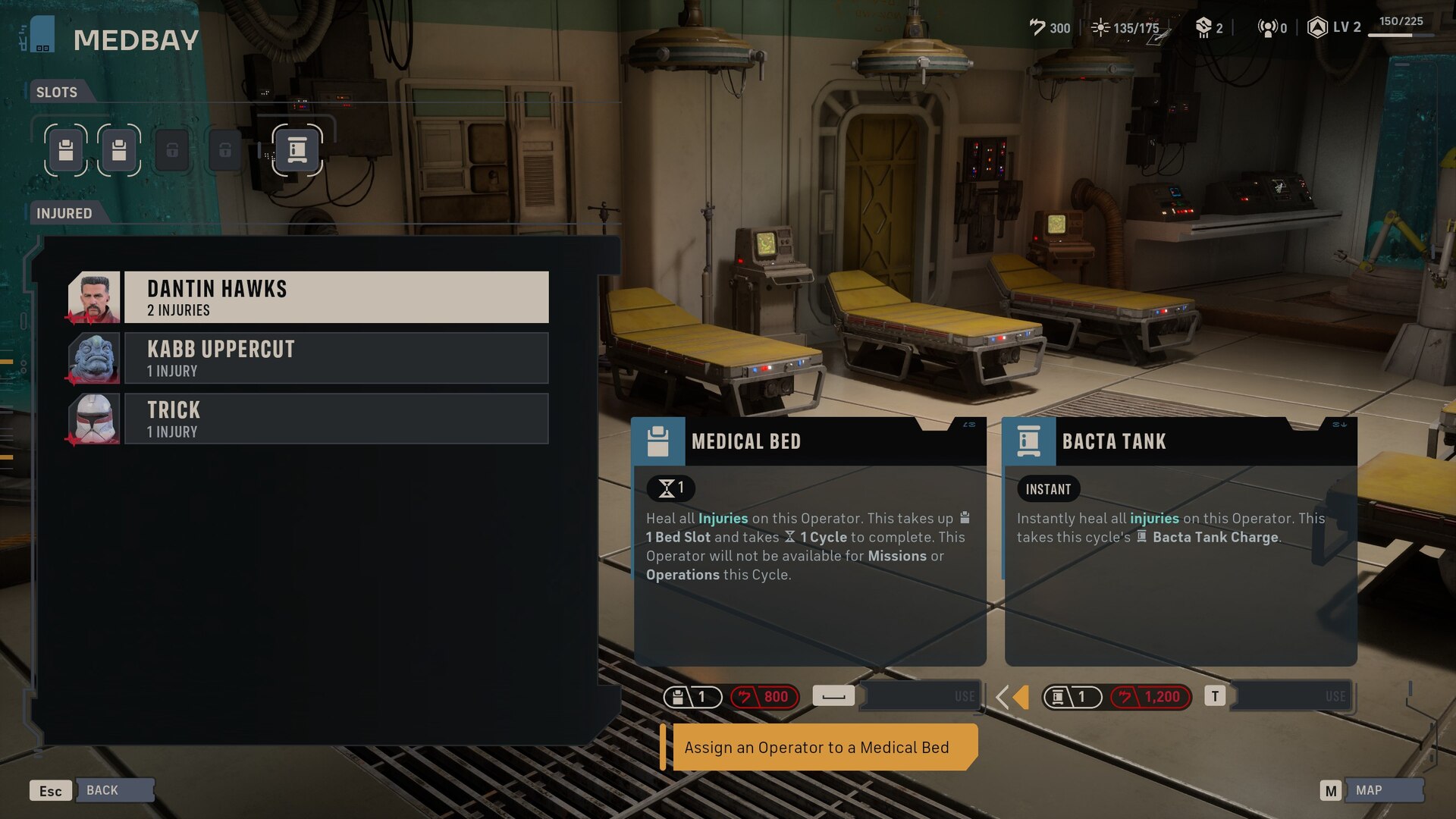
The four-person squad limit makes those decisions more significant. Players cannot take every possible role into a mission, so choosing the right combination of Operators becomes an important part of preparation. A team built around heavy damage may lack support, while a defensive group can have trouble dealing with certain high-priority targets. Injuries make the roster even more important because a favored character can become unavailable and force the player to rethink how the squad operates.
The Star Wars setting gives the tactical systems their most distinctive elements. Force users can manipulate enemies and the battlefield in ways that ordinary soldiers cannot, while other Operators rely on specialized weapons and abilities. The game does not simply place blasters and lightsabers on top of an existing tactics system; many of its most interesting possibilities come from the fact that the characters belong to a universe where technology, the Force and unusual alien abilities coexist.
Cover and positioning remain central, but Zero Company also introduces useful variations on familiar tactics conventions. Overwatch can be used to control areas of the battlefield, Backup attacks allow Operators to support one another, and destructible elements can alter the value of defensive positions as a battle develops. These mechanics are not revolutionary individually, but they become more interesting when combined with the Action Point system and character abilities.
The ability to chain several actions in a turn is particularly effective. A character can create an opening, another can exploit it, and a third can use the resulting Advantage to finish the job. The best turns therefore come from recognizing how different abilities interact rather than simply choosing whichever attack has the highest damage number.
That distinction matters when considering the game’s relationship with XCOM. The underlying language of cover, positioning, Overwatch, squad composition and resource management is familiar, but Zero Company is not content to reproduce it unchanged. Its Bond system, multiclassing, Star Wars abilities, Backup attacks and mission-specific objectives give the formula a different emphasis. It is better described as an evolution of a familiar tactical framework than as a direct imitation.
Difficulty is where that approach becomes more complicated. The game offers several difficulty settings, and permadeath can be enabled or disabled. With permadeath active, an Operator who suffers three injuries will die permanently, making squad management considerably more consequential. Players looking for a relaxed story-driven experience can turn the system off, while those who want greater pressure can leave it enabled.
Experienced tactics players will probably want to increase the difficulty if they are looking for a serious challenge. Some encounters on the lower settings can be solved without demanding the same degree of careful optimization found in the genre’s harsher examples. That accessibility is useful for newcomers and players primarily interested in the Star Wars setting, but it can occasionally reduce the tension that the game’s systems are capable of creating.
At higher difficulty, however, the underlying mechanics have more room to show their strengths. Managing Advantage, keeping Operators in useful positions, exploiting Bonds and deciding when to commit powerful abilities become more important when mistakes are harder to recover from. The game therefore offers more tactical depth than its accessible presentation might initially suggest, even if it does not push that depth as relentlessly as the most demanding games in the genre.
Character Development and Squad Customization
Character progression is where Zero Company develops a stronger personality of its own. Hawks and the rest of the roster can be customized through equipment, abilities and specializations, while custom Operators allow players to create characters suited to particular roles. The system is broad enough to encourage experimentation without becoming so complicated that character development turns into another game in itself.
Operators can specialize in different combat roles, and the game gives players meaningful choices about how those roles develop. The important thing is that these choices change the way characters function on the battlefield. A specialist built around damage will encourage a different approach from one focused on support or control, and those differences become more noticeable because only four Operators can be deployed at once.
Multiclassing gives the roster additional flexibility. Characters can develop beyond a single specialization, allowing players to create unusual combinations and adapt Operators to the needs of the squad. This is particularly useful later in the campaign, when a preferred lineup may need to change because of injuries, mission requirements or simple experimentation.
The progression system also gives players room to adjust their choices rather than permanently locking them into an early mistake. That makes experimentation less intimidating and encourages players to test different combinations. The result is a system that is substantial enough to reward players who want to optimize their squad without becoming inaccessible to people who simply want to develop characters in a way that feels appropriate to them.
The Bond system is arguably even more important. Operators can build relationships through their time together, and those Bonds can eventually provide combat benefits. This means that squad selection is not determined entirely by class and statistics. There can be a reason to keep two characters together because their relationship has developed into something mechanically useful.
That connection between relationships and combat is one of Zero Company’s smartest design decisions. The player becomes attached to a character because of their personality and dialogue, then has another reason to care about them because of the effect they can have on the squad. When an important Operator is injured, the loss is therefore felt on both sides of the game.
The character creator is useful, although it is not as completely open-ended as a dedicated RPG character creator. Players have control over the appearance and development of custom Operators, while Hawks has his own customization options. The focus is appropriately placed on how characters play rather than on creating an endlessly detailed avatar.
Mission Design and Campaign Structure
The campaign is structured around Tactical Missions and Operations, with the Den serving as the company’s central hub. From the Holotable, Hawks chooses which opportunities to pursue, and the player cannot simply complete everything available during a cycle. That creates a useful sense of prioritization because resources, squad health and available Operators all have to be considered when deciding where the company should focus.
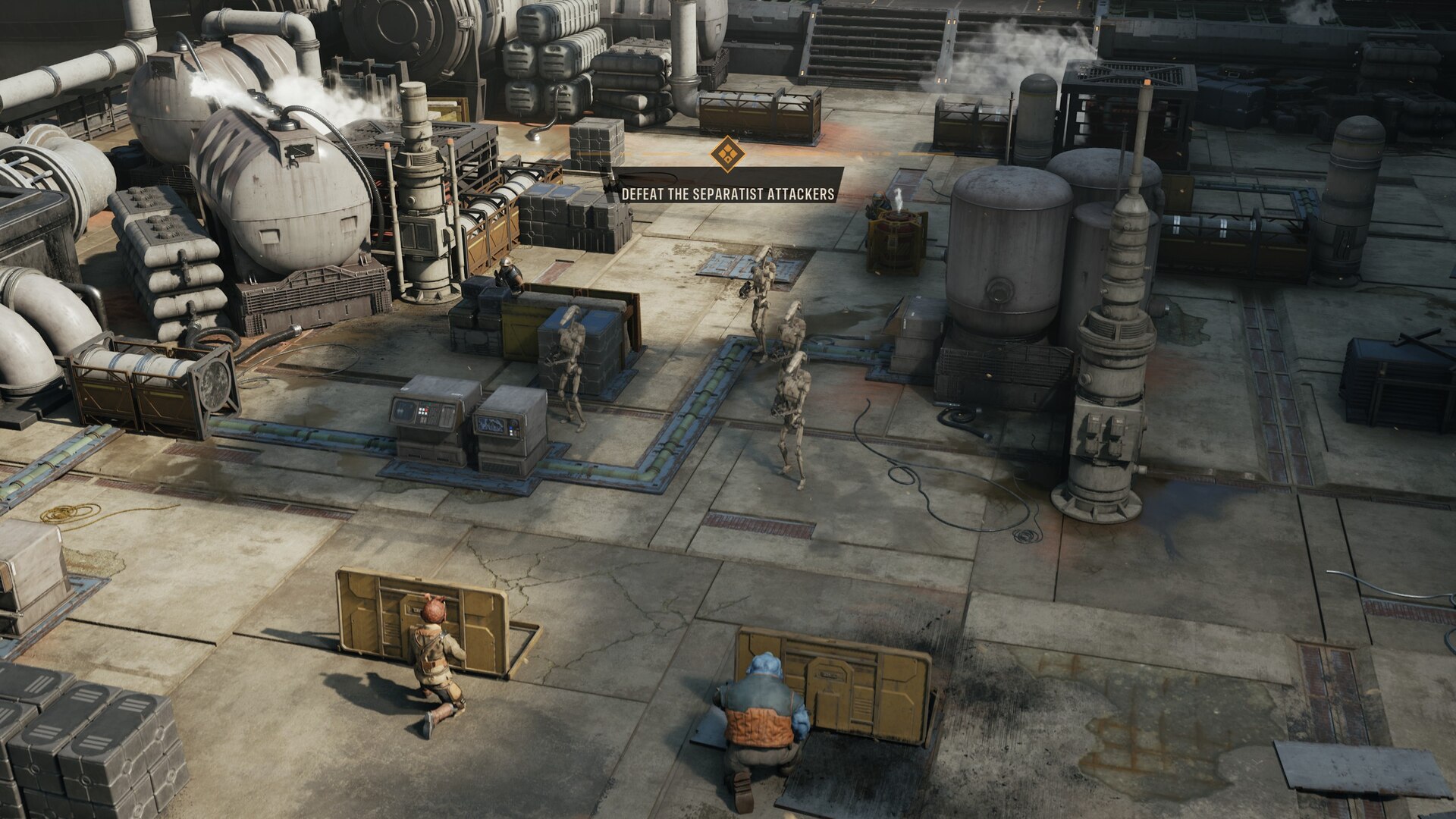
Tactical Missions are the main combat encounters. Objectives vary, and the game does not always require players to eliminate every enemy on the map. Extraction, defense, movement and other objectives can change the priorities of an encounter, which prevents every mission from becoming a straightforward exercise in wiping out the opposing force.
The better missions use those objectives to create pressure between safety and progress. A squad may have an excellent defensive position, but remaining there too long can make it impossible to reach the objective. Moving forward can expose characters to attacks that could have been avoided. These decisions give the battlefield a purpose beyond simply providing places to stand and shoot.
Operations provide a different kind of decision-making. They are non-combat assignments that require Intel and can reward the company with items, credits and influence. Some Operations can also affect relationships between Operators or open additional opportunities. They are relatively small compared with the tactical missions, but they provide a useful layer between battles and make the company feel as though it is doing more than waiting for the next combat encounter.
The Den itself is important to the campaign’s rhythm. Players can manage their Operators, examine available opportunities and talk with squad members before returning to the battlefield. Personal conversations can reveal more about the characters and unlock missions connected to their individual stories. The result is a clear loop of preparation, deployment, recovery and development that gives the campaign a steady structure without becoming an elaborate management simulation.
The third-person sections are another useful part of the campaign. Some story missions include small free-roam sections in which players can move through an environment before the tactical encounter begins. These sections are fairly limited and are not intended to compete with a dedicated action-adventure game, but they give locations more personality and provide opportunities to gather information or resources before the fighting starts.
That matters in Star Wars. Walking through a location before fighting there gives it more identity than a tactical map alone can provide, while conversations and interactions help develop the members of Zero Company outside combat. The exploration is not deep enough to be a major gameplay pillar, but it provides a welcome change of pace and helps connect the tactical missions to the wider campaign.
The campaign is deliberately focused rather than an endless procedural sandbox. There is no traditional New Game Plus mode, but completing the campaign can unlock certain customization options for subsequent playthroughs. More importantly, different difficulty settings, squad combinations, character builds and optional permadeath give players reasons to approach the campaign differently. The replayability is therefore more about experimentation and alternate approaches than generating a completely different war each time.
Story and Characters
The decision to use an original cast rather than center the campaign around familiar Star Wars heroes is one of the game’s best narrative choices. Hawks is a former Republic officer who has left that life behind, and the people he gathers have their own histories and reasons for joining Zero Company. This gives the story a different perspective on the Clone Wars, one that is less concerned with the galaxy’s most famous figures and more interested in people trying to survive within the conflict.
Hawks works well as the center of that group. He has enough personality to avoid feeling like a blank player avatar, while customization allows players to shape his appearance and development. His history with the Republic also gives the campaign a reason to explore the consequences of war without making the story dependent on retelling events from the films.
The rest of the cast is generally the stronger part of the narrative. Characters have distinct personalities, personal objectives and relationships, and the game gives them enough dialogue to make them feel like members of a team rather than interchangeable tactical units. Conversations between missions provide context for characters who might otherwise be defined entirely by their combat abilities.
The Infinite Coil provides the larger conflict, with Kundri Fathom at its center. The cult gives Zero Company an antagonist that exists outside the familiar Republic-versus-Separatist structure, while the threat surrounding it gradually expands into something much larger. This allows the story to use the Clone Wars as its setting without simply repeating the same political conflict seen elsewhere in Star Wars.
The larger storyline is not quite as strong as its characters. Kundri Fathom is an effective presence, but the antagonist does not always receive the same depth and screen time that the members of Zero Company receive. The result is a campaign where the personal stories are often more compelling than the central conspiracy.
That is not a fatal problem because the squad provides enough reason to keep playing. The player cares about what happens to individual Operators, and the Bond system reinforces that investment by making relationships relevant to combat. The story succeeds most when it stays close to the people carrying out the missions rather than attempting to make every development feel like a galaxy-changing event.
The Clone Wars setting is consequently used well. Familiar technology, factions and locations establish the period, but the original cast allows Zero Company to explore a part of the era that has not been covered as extensively. It feels like a new story within the Star Wars universe rather than another attempt to recreate something that has already been told.
Graphics and Sound
Zero Company is a polished-looking tactical game, with detailed character models, varied environments and a visual style that fits comfortably within the Star Wars universe. The presentation is not trying to compete with the most technically ambitious action games, but it has enough detail and visual variety to make the campaign feel substantial.
The third-person sections help considerably because they allow the environments to be viewed at ground level rather than only from the tactical camera. Locations become more recognizable, characters feel more present, and the transition between exploration and combat gives the campaign a stronger sense of scale.
The tactical presentation is also clear. Cover, movement, objectives and enemy positions are easy to read without making the battlefield difficult to parse. That balance is important because a tactics game can easily become confusing when too much visual detail is placed on top of its gameplay information.
The audio work does much of the rest. Blaster fire, explosions, weapons and Force abilities have the expected Star Wars character, while the voice performances help distinguish the members of Zero Company. The soundtrack supports both the quieter character scenes and the larger battles without overwhelming the gameplay.
Most importantly, the audiovisual presentation reinforces the game’s identity rather than compensating for weak mechanics. The game looks and sounds like Star Wars, but the presentation works because it is supporting a solid tactical and character-driven foundation.

Technical Performance on PC
The PC version requires more attention than a simple statement about whether the game “runs well.” Official specifications list a minimum target of 1080p at 30 FPS on Low settings, while the recommended configuration targets 1440p at 60 FPS on High settings. The recommended hardware includes an Intel Core i7-10700K or Ryzen 7 3700X, 32GB of memory and an RTX 3080 or Radeon RX 7800 XT. Those are substantial requirements for a turn-based strategy game.
The reason is that Zero Company is particularly CPU-bound. The developers explain that changing individual graphics settings does not necessarily have the same effect on frame rate that it would in a more GPU-heavy game. For the recommended 1440p/60 target, they recommend using TSR or a vendor upscaler such as DLSS or FSR rather than assuming native rendering will provide the desired result.
That is important for PC players because it changes how the game’s performance should be judged. A powerful graphics card alone does not guarantee that the game will maintain its target frame rate, and players should pay attention to their CPU as well as their GPU when assessing whether their system is suitable.
Launch reports have been mixed. Some reviewers have experienced smooth performance with relatively minor problems, while others have encountered crashes, stuttering or other technical issues. The game is demanding enough that lower-powered hardware can struggle considerably, and it is not Steam Deck verified at launch.
The turn-based nature of the game makes frame-rate fluctuations less disruptive than they would be in a competitive action game, but stability remains important. A short stutter during a tactical turn is hardly disastrous; a crash after completing a lengthy mission is considerably more frustrating. That is especially true when playing with optional permadeath, where losing progress for technical reasons is very different from losing a character because of a tactical mistake.
The PC version is therefore best described as demanding rather than inherently poorly optimized. Its recommended hardware is substantial, and the CPU-heavy design means performance can vary considerably between systems. Players with hardware around the recommended specification should not assume that the stated 60-FPS target automatically translates into a flawless experience, but the game provides the necessary settings and upscaling options to help capable systems reach its intended performance target.
Final Verdict: 8/10
Star Wars Zero Company succeeds because it understands that turn-based tactics does not need to be reinvented simply because the setting has changed. The game takes familiar ideas and puts them into a universe where they make immediate sense. Cover, squad composition, special abilities, injuries and permadeath all fit naturally into a Star Wars story about a small group operating in the shadows of the Clone Wars.
The combat is consistently enjoyable. Three Action Points give players flexibility within each turn, Advantage provides another resource to manage, and the four-person squad limit makes team composition meaningful. Force abilities, Backup attacks, destructible environments and specialized Operators give the tactical structure enough personality to stand on its own.
It is also important not to oversell the game’s innovation. Zero Company does not completely redefine turn-based tactics, and experienced players will recognize much of its underlying language. Its achievement is more practical: it takes a proven structure and combines it with multiclassing, Bonds, Star Wars abilities and varied objectives in ways that generally work. The result feels like a thoughtful expansion of the formula rather than a simple imitation.
Character development is arguably more distinctive. Specializations, multiclassing, equipment and talents give Operators room to develop, while Bonds make relationships mechanically relevant. The result is a squad that gradually becomes more personal. Characters are not simply statistics on a deployment screen; their personalities, histories and relationships can influence which people the player wants to keep fighting together.
The campaign structure complements that approach. Tactical Missions provide the main challenges, Operations create meaningful decisions between battles, and the Den gives the company a place to develop. The third-person sections are limited, but they give the world more presence and allow the game to move naturally between tactical combat and character-focused scenes.
The story is less consistent, although the cast is strong enough to carry it. Hawks and the members of Zero Company are generally engaging, and their personal relationships give the campaign its best moments. The larger Infinite Coil storyline provides an effective reason to keep moving forward, but Kundri Fathom does not always feel as fully developed as the characters surrounding her.
The PC version is the most significant caveat. Its official requirements are high, its CPU-heavy design means that performance does not always scale in the way PC players might expect, and launch reports vary from smooth experiences to technical problems. The game is capable of running well on suitable hardware, but prospective PC players should pay close attention to their CPU and be prepared to use upscaling to reach the recommended performance target.
That leaves Star Wars Zero Company in an interesting position. It is not quite a genre-defining tactical game, nor does it need to be. Its 8/10 score comes from how consistently well its individual parts work together. The combat is satisfying, the customization has genuine depth, the cast is worth spending time with, and the Star Wars setting is integrated into the mechanics rather than treated as decoration. Against that, the familiar tactical foundation, uneven central story and demanding PC requirements keep it from reaching the highest tier.
For Star Wars fans, it offers a different way to experience the Clone Wars without relying on the franchise’s most familiar heroes. For strategy fans, it provides a polished and approachable take on a proven formula with enough original systems to make it worthwhile. For players who have been waiting for a serious Star Wars tactics game, it delivers on the basic idea remarkably well.
Star Wars Zero Company may not revolutionize turn-based tactics, but it understands the genre well enough to make its familiar systems feel at home in the Star Wars universe. Its strongest achievement is not inventing a new way to play tactical strategy; it is creating a campaign where combat, customization and character relationships consistently reinforce one another. That is enough to make Zero Company one of the stronger entries in modern Star Wars gaming and an easy recommendation for fans of tactical RPGs.