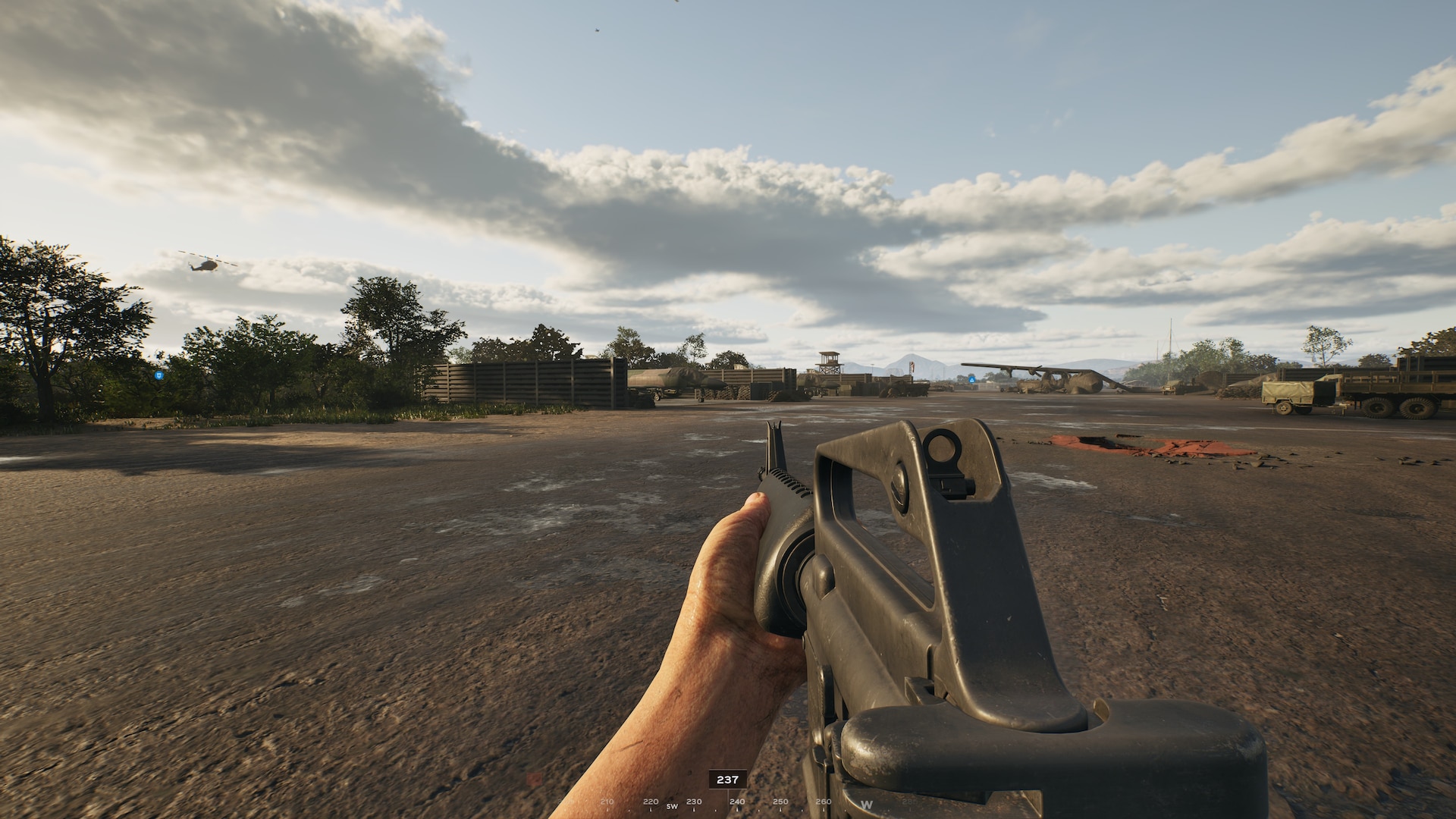
Hell Let Loose: Vietnam takes the large-scale multiplayer formula established by its World War II predecessor and applies it to a conflict that demands a different approach to movement, visibility and battlefield organisation. Developed by Expression Games and published by Team17, the standalone follow-up puts up to 100 players into battles between the US Armed Forces and North Vietnamese Army (NVA) across six maps, with helicopters, river combat, tunnel networks and a mixture of infantry, reconnaissance, armour, mortar and helicopter units. The fundamental structure remains familiar: teams fight over territory, squads coordinate through a command structure and individual kills matter considerably less than maintaining useful positions and keeping the wider attack or defence functioning.
That familiarity is both the game’s greatest strength and its most obvious limitation. Vietnam does not attempt to reinvent Hell Let Loose, and players expecting a faster or more accessible military shooter will find much of the same deliberate pace here. What the new setting does provide is a reason to alter how those established systems interact. Dense vegetation reduces visibility, rivers create alternative routes, helicopters change the importance of mobility, and NVA tunnel systems allow NVA forces to establish concealed positions and launch surprise attacks in ways that conventional military shooters rarely accommodate. The result is not a completely different game, but it is sufficiently different from the original to give the Vietnam setting its own identity.
The important distinction is that Hell Let Loose: Vietnam is still primarily a game about organisation rather than individual performance. It can be frustrating, particularly for newcomers, but most of its frustrations are tied directly to the design that makes its better matches work. If a squad communicates, understands the terrain and establishes sensible spawn and supply positions, the game can become unusually involving. If everyone simply runs toward the nearest objective, the same systems can make a match feel slow and directionless. That dependence on player cooperation is not a minor feature of the game; it is the foundation on which almost everything else is built.
Gameplay and Mechanics
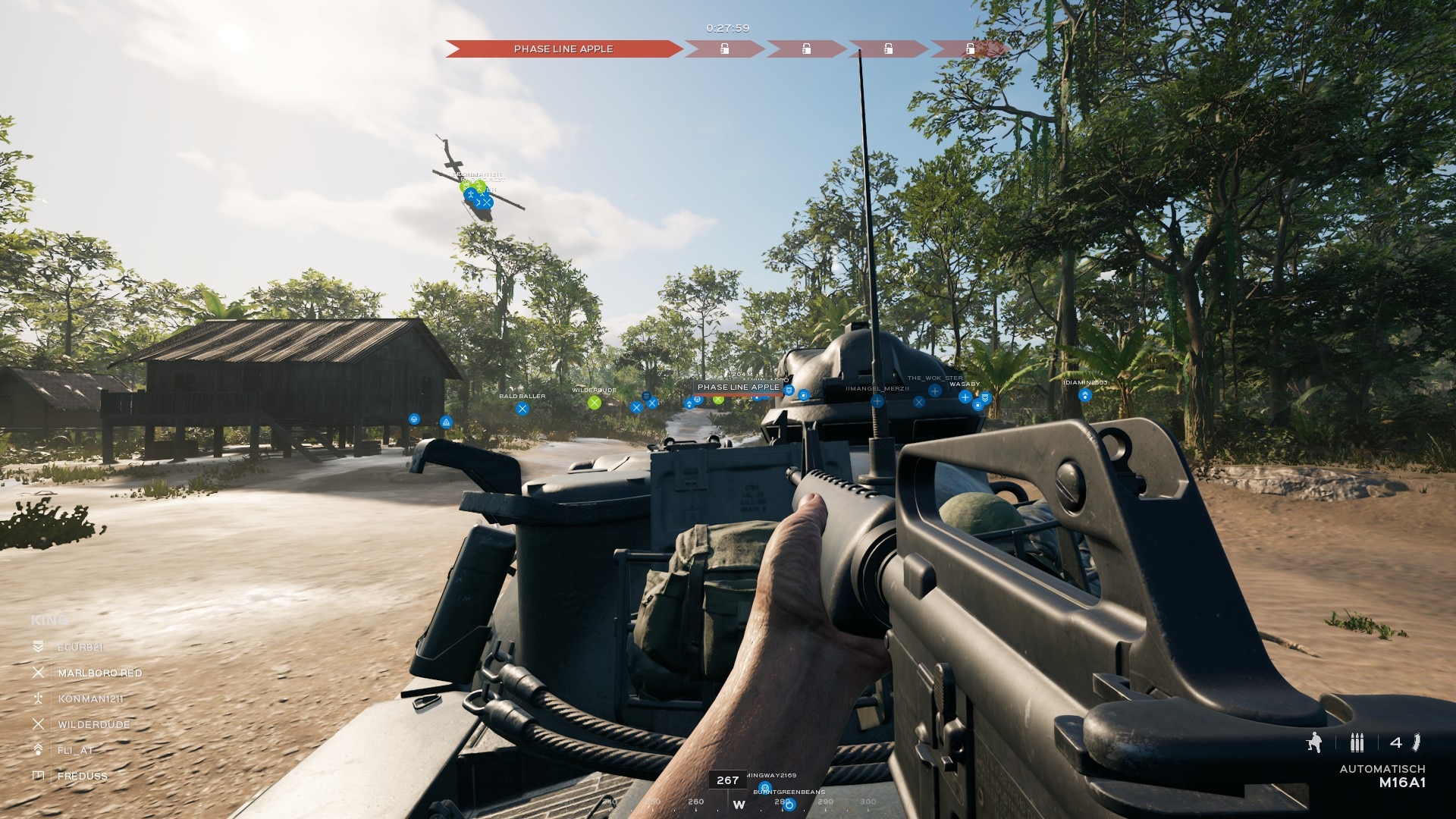
The basic structure remains recognisably Hell Let Loose. Warfare has two teams fighting over five sectors in a territorial tug-of-war, while Offensive assigns one side to attack and the other to defend. The launch game contains six modes in total, with the additional modes altering the circumstances under which players approach objectives. There are also specialised roles covering infantry, reconnaissance, armour, mortars and helicopters, which means that a squad’s effectiveness depends on how well its players complement one another rather than simply how accurately they shoot.
That design makes seemingly ordinary decisions unusually important. A squad leader who places an effective spawn point can influence an entire section of the battlefield without firing a weapon. A player who provides the resources needed to establish that position may contribute more to the team’s eventual success than someone who spends the match chasing kills. Engineers, medics, reconnaissance players and vehicle crews similarly have responsibilities that only become valuable when they are considered as part of the wider battle. The game therefore rewards players for understanding what the team needs rather than asking what they can personally accomplish.
This is also why the game’s relatively low time-to-kill works. When an enemy can kill you quickly, charging into a position without knowing what is there becomes a poor decision rather than an invitation to test your reflexes. Movement, observation and communication become ways of reducing the number of situations in which you have to rely on reflexes at all. The game is still a first-person shooter, and good aim matters, but positioning generally determines who gets the opportunity to use that aim effectively.
For players coming from Call of Duty or Battlefield, this can require a significant adjustment. Approaching the game like a conventional shooter is likely to result in repeated deaths, particularly when players move toward gunfire without understanding where it is coming from. The experience becomes considerably more rewarding once players start following the squad-based structure, paying attention to their surroundings and working with the people around them.
The problem is that the game does not always make that lesson easy to learn. New players can join a squad with little communication, die repeatedly without understanding where the enemy is positioned and spend considerable amounts of time travelling between objectives. A tutorial helps, but it cannot reproduce the experience of playing alongside a competent squad leader and commander. The quality of the team therefore remains an important variable, and that is something players should understand before committing to the game’s slower approach.
Combat and Gunplay
The gunplay is deliberately less accommodating than that of mainstream shooters, but it is not trying to turn weapon handling into a simulation for its own sake. Weapons from the period have distinct characteristics, recoil needs to be controlled and engagements are often decided by awareness rather than prolonged exchanges of fire. The best firefights frequently end quickly because one player saw the other first or occupied a better position. That makes reconnaissance and cautious movement part of combat rather than activities that happen before combat begins.
This approach is particularly effective in Vietnam because the environment constantly interferes with visibility. A weapon can be perfectly suited to an engagement, but that does not help if the enemy is concealed in vegetation and already watching the route ahead. Likewise, firing at an uncertain target may give away your own position without achieving anything. The game consequently rewards restraint in a way that most competitive shooters do not. Knowing when not to shoot can be as useful as knowing how to shoot.
The downside is that deaths can sometimes feel arbitrary. When vegetation is thick enough to conceal an opponent, there will be occasions when a player dies without being able to identify the source of the shot. That is partly a consequence of the setting and partly a consequence of the game’s approach to information. It can create excellent ambushes when you are the one doing the hiding, but it is considerably less satisfying when you are on the receiving end. The game therefore creates a tension between rewarding concealment and frustrating players who cannot identify where they were shot from.
Audio is therefore more important than it would be in a conventional shooter. Rifle fire, automatic weapons, explosions, helicopters and distant engagements provide information about what is happening outside the player’s immediate field of view. Learning to recognise where combat is occurring and what kind of weapon is being used can help determine whether a route is safe. The soundscape therefore has a practical gameplay role, helping players understand what is happening beyond their immediate field of view rather than simply adding atmosphere.
The Vietnam Battlefield
The maps are where Hell Let Loose: Vietnam makes its strongest case for being more than a change of setting. The developers have designed the launch environments around the geography associated with the conflict, using jungle, waterways, settlements, agricultural areas and elevated terrain to create different kinds of engagements. That variety matters because dense jungle alone would quickly become exhausting. The most effective environments are those that make players move between concealed and exposed terrain, forcing them to change their approach as the battlefield changes around them.

Vegetation has an obvious effect on visibility, but its importance extends further. It changes how squads move, where defensive positions can be established and how much confidence players can have in information from reconnaissance. A road that appears to be the fastest route toward an objective may also be the most predictable. A river may provide a useful approach but expose anyone using it to fire from the banks. A settlement can offer much clearer sightlines and more readable combat, but it can also become the obvious location for both sides to concentrate their forces.
This creates a different rhythm from the European battlefields of the original game. Players spend less time relying on distant sightlines and more time dealing with uncertainty at relatively short ranges. That makes movement more deliberate, but it can also make navigation harder. A squad can spend several minutes moving toward an objective only to discover that the actual fight is happening somewhere else, or arrive at the front and immediately be stopped by an enemy position that was almost impossible to see from a distance.
That tension between concealment and readability is one of the game’s most persistent design problems. The maps are successful when the terrain creates tactical choices, but less successful when it simply hides information from both teams. Urban areas and more open sections tend to produce clearer firefights because players can understand where the threats are coming from. Dense jungle is at its best when there are multiple routes through it rather than when the only meaningful choice is whether to risk moving forward without knowing what is ahead.
Factions and Asymmetrical Warfare
The US Armed Forces and NVA are not simply two versions of the same faction with different weapons. Their most important differences come from how they use the battlefield. American forces have access to helicopters and substantial firepower, while the NVA can make use of tunnel networks that allow troops to establish concealed positions and approaches in ways the Americans cannot directly reproduce. Rivers also become strategically useful because both sides can make use of water-based movement.
The American advantage in mobility is significant, but it does not guarantee an easy victory. Helicopters can move troops and supplies quickly, but they also make the movement of those troops more visible. A poorly chosen landing zone can expose an entire squad, while an inexperienced pilot can waste the mobility advantage entirely. The helicopter therefore becomes most useful when it is coordinated with the people on the ground rather than treated as a separate vehicle-based activity.
The NVA tunnel system provides an interesting counterbalance because it attacks the American advantage indirectly. Rather than attempting to compete with helicopters in terms of speed, the NVA can make the battlefield itself more difficult to secure. Pushing an enemy squad away from a position does not necessarily mean the area is secure if the NVA can use its tunnel network to establish concealed approaches and launch another attack. That changes how an attacking force has to think about clearing territory.
The asymmetry is therefore more interesting than simply giving one faction better equipment. American players have to make effective use of mobility and firepower, while NVA players can use concealment, positioning and tunnel networks to compensate for their technological disadvantage. The effectiveness of either side ultimately depends on how well its players understand those strengths, which again ties the faction design back to the game’s emphasis on teamwork.
Helicopters, Vehicles and Logistics
Helicopters are the most obvious addition to the Hell Let Loose formula, combining transportation, logistics and aerial fire support. They allow troops and supplies to move across the map quickly while also giving the US side additional ways to influence the battlefield. That matters because travel time has always been an important part of Hell Let Loose, and helicopters alter that equation without eliminating the need for careful positioning.
A helicopter does not automatically make a squad more effective. It still needs a competent pilot, a sensible destination and coordination with the infantry waiting on the ground. A transport that lands in an exposed position can lose an entire squad before the players have time to establish themselves, while a pilot who spends too much time searching for the right landing zone can negate the advantage of using the helicopter in the first place. The system therefore creates another specialised responsibility rather than simply providing faster movement.
The river systems provide a similar purpose for the patrol boats, giving squads another way to approach parts of the battlefield. Water is treated as another potential route, allowing squads to reach areas from directions that might otherwise be predictable. At the same time, waterways can create obvious lines of movement that the opposing team can monitor. Their usefulness therefore depends on the same principles that govern the rest of the game: knowing where the enemy is, understanding the terrain and making sure the route actually improves your position.
These additions work because they are integrated into the game’s broader logistics rather than presented as isolated toys. Their value comes from how they affect movement, supply and battlefield positioning, rather than simply serving as vehicles associated with the setting.
Teamwork and Communication
Communication remains the central mechanic that is not presented as a conventional mechanic at all. Voice chat is essential for squads that want to operate efficiently, allowing players to report enemy movement, identify positions and coordinate attacks without relying entirely on the interface. Command communication becomes more important when multiple squads need to approach the same objective from different directions. A player who understands the information being passed through those channels will generally have a much better understanding of the battle than one who plays entirely alone.

The system also exposes one of the game’s biggest weaknesses: the player cannot control the quality of the team they are placed with, and a poorly organised squad can quickly undermine the experience. A well-organised squad can make the game feel remarkably coherent, with players covering different routes, moving together, sharing information and responding to changes in the battle. A silent or poorly coordinated squad can make the same map feel much larger because everyone is travelling independently, missing opportunities to support one another and lacking a clear understanding of what the rest of the team is trying to achieve.
This is where the game differs most sharply from conventional multiplayer shooters. In those games, a highly skilled player can often compensate for weak teammates by winning enough individual engagements. Hell Let Loose: Vietnam makes that considerably harder. A good player can certainly make a difference, but they cannot personally replace missing spawn points, logistics, reconnaissance or coordinated movement. The game therefore places a practical limit on individual skill.
That limitation will be appealing to players who want a genuinely cooperative shooter and frustrating to those who prefer personal agency. It also means that team culture matters. The same game can feel completely different depending on whether squad leaders are communicating and whether commanders are actively managing the wider battle. That is not something Expression Games can entirely solve through design, although better onboarding can help new players understand why those roles matter.
Graphics, Audio and PC Performance
On PC, the move to Unreal Engine 5 gives Hell Let Loose: Vietnam an effective technical foundation for its large environments. The most obvious benefit is environmental detail. Jungle vegetation, water, settlements and open terrain can all be rendered as part of large continuous spaces rather than feeling like separate combat arenas. The visual quality is strongest when the environment is contributing to gameplay, because foliage and terrain are not merely decorative; they determine how easily players can move and how much information they can gather.
The audio presentation is equally important. The combination of distant gunfire, nearby weapons, explosions, helicopters and voice communication gives the battlefield a sense of scale without requiring constant visual spectacle. More importantly, sound frequently helps compensate for the game’s limited visibility. Players can hear activity before they see it, and experienced players can use those sounds to judge where an engagement is developing.
Performance is an important consideration on PC, particularly given the scale of the battles and the game’s demanding environments. Expression Games delayed the game’s release from June 18 to August 13 following the open beta, citing the need for additional time to improve performance, stability and overall gameplay quality. More than 350,000 players took part in the beta, giving the developer a substantial amount of feedback and technical data to address before launch.
The additional development time was intended to address those concerns, but performance remains an important consideration on PC. Large 50-player-per-side battles, dense environments and extensive foliage place considerable demands on the hardware, particularly during major engagements. The game also offers PC graphics options including TSR, DLSS, Frame Generation on supported NVIDIA hardware and Hardware Lumen for higher-end systems, giving players additional control over the balance between image quality and performance.
The game’s system requirements also reflect its technical demands. The minimum specification calls for an Intel Core i5-11600K or AMD Ryzen 5 5600X paired with an RTX 2060 or Radeon RX 5700, targeting 1080p at 60 frames per second. The recommended specification steps up to an Intel Core i5-12600K or AMD Ryzen 5 7600X with an RTX 3070 or Radeon RX 6700 XT, targeting 1440p at 60fps. These are fairly substantial requirements for a multiplayer shooter, particularly for players hoping to maintain a stable frame rate during the game’s larger battles.
PC players also benefit from the game’s cross-platform multiplayer, which expands the potential player pool beyond the PC community. That is particularly useful for a multiplayer game whose long-term health depends heavily on maintaining an active population across its servers.
Maps, Modes and Longevity
The six launch maps provide a reasonable foundation, particularly because the different terrain types change the way battles develop. The more important question is whether that variety will continue to feel meaningful once players have learned the common routes and defensive positions. Tactical shooters can have long lifespans because their communities continually develop new strategies, but they can also become predictable if the same objectives repeatedly produce the same approaches.
The six modes help reduce that risk, although Warfare and Offensive remain the core experiences. Warfare’s shifting front line allows teams to create different battles from the same map, while Offensive provides a more structured attacking and defensive scenario. The additional modes give players alternatives without abandoning the underlying emphasis on controlling territory and working with other players.

The current maps also benefit from the way objectives can change the flow of a match. A sector that is relatively easy to capture in one battle can become much harder in another depending on where teams establish defensive positions, how quickly reinforcements arrive and which routes are being watched. This helps prevent the maps from feeling completely fixed, even after players become familiar with their layouts. The terrain may remain the same, but the behaviour of the two teams can make each battle develop differently.
The launch faction selection is narrower than the historical conflict itself. With the US Armed Forces and NVA currently representing the opposing sides, there is obvious room for the roster to grow. The setting leaves considerable scope for additional forces, weapons and equipment in the future, but those possibilities should not be treated as confirmed content unless Expression Games formally announces them. For now, the two launch factions provide the foundation for the game’s asymmetrical approach to the conflict.
That future support will matter. The original Hell Let Loose has demonstrated that a dedicated community can sustain a large-scale tactical shooter, but Vietnam cannot rely entirely on the reputation of its predecessor. Continued technical improvements, additional content and a stable server population will be important if it is going to remain a long-term alternative rather than simply a new setting for the existing audience.
Final Verdict: 7.5/10
Hell Let Loose: Vietnam succeeds because its Vietnam setting changes the game’s tactical problems instead of merely changing its scenery. Jungle vegetation makes observation harder, waterways create new movement routes, helicopters alter American mobility and NVA tunnels complicate attempts to secure territory. None of these mechanics exists in isolation. They influence where squads move, how commanders establish positions and how each faction attempts to exploit its advantages.
The result is still a demanding game. There are long periods of movement, deaths that can be difficult to explain and matches in which the quality of the squad has more influence over your enjoyment than anything you personally do. Those are not incidental shortcomings. They are consequences of a design that deliberately refuses to make every player equally independent.
For players who want a faster shooter, that will remain a problem. The game does not provide enough constant feedback or immediate action to compete directly with Battlefield or Call of Duty on their terms. Even compared with other tactical shooters, it occupies a relatively accessible but still demanding position. It expects players to understand objectives, logistics, communication and positioning, but it does not require the level of simulation that would make the game inaccessible to anyone unfamiliar with the genre.
Its more significant weaknesses are technical and structural. Performance and stability still deserve attention, and the game’s reliance on effective voice communication can make poor public matches considerably less enjoyable than well-organised ones. The limited launch faction selection also leaves obvious room for expansion. None of these issues invalidates the core design, but they are important considerations for anyone deciding whether to buy the game.
The strongest matches demonstrate why the formula works. A squad establishes a useful position, reconnaissance identifies an enemy route, logistics keep the attack supplied and several players coordinate their movement instead of approaching the objective independently. The eventual capture is satisfying not because the game has awarded the individual player an elaborate reward, but because the sequence of decisions leading to it made sense. That is a very different source of satisfaction from the one offered by most multiplayer shooters.
Ultimately, Hell Let Loose: Vietnam is a strong continuation of the series rather than a radical reinvention. Expression Games has taken the original’s emphasis on large-scale teamwork and applied it to a setting where concealment, asymmetry and mobility naturally create new tactical problems. Some of those problems are also responsible for the game’s frustrations, particularly when the environment hides too much information or when a poorly organised team turns the large maps into long stretches of travel.
For the right audience, however, those compromises are worthwhile. Players who enjoy tactical multiplayer combat, historical settings and games where communication genuinely affects the outcome will find a substantial shooter here. Players looking for instant action or a game that rewards individual performance above everything else should look elsewhere.
The most convincing thing about Hell Let Loose: Vietnam is how effectively its setting influences the way the game is played. Its best mechanics are rooted in the conditions of the battlefield, and that gives the game an identity of its own. It remains demanding, occasionally frustrating and technically in need of continued attention, but when its players work together, the design has considerably more depth than its familiar 50v50 structure initially suggests.