For nearly a decade, Square Enix’s HD-2D label has been associated with turn-based RPGs such as Octopath Traveler and Triangle Strategy. The Adventures of Elliot: The Millennium Tales represents a significant departure from that template. Developed by Square Enix and Claytechworks, it replaces menus and party management with real-time combat, dungeon exploration, environmental puzzles, and a structure that owes as much to classic action-adventure games as it does to Japanese RPGs. The result is one of the publisher’s most interesting experiments in years: a game that feels immediately familiar yet surprisingly difficult to categorize.
Set on the continent of Philabieldia, the story begins in the Kingdom of Huther, humanity’s last protected stronghold against the surrounding beast tribes. Elliot, an adventurer with more enthusiasm than status, is tasked with investigating newly discovered ruins beyond the kingdom’s barrier. Accompanied by the fairy Faie, he soon uncovers the Doorway of Time, an artifact that transforms a straightforward expedition into a journey spanning multiple eras. Square Enix has emphasized that the game combines action-oriented gameplay with a narrative that unfolds across different points in history, and that premise becomes the foundation for both the story and the exploration design.

Story and World
The narrative is strongest when it focuses on the consequences of moving between time periods. Rather than treating time travel as a simple plot device, the game repeatedly asks the player to observe how places, cultures, and conflicts evolve. Certain locations gain additional meaning once you have seen them in another age, and quests that initially appear self-contained often reveal broader connections later. This structure gives Philabieldia a sense of historical depth that many RPG worlds struggle to achieve.
Elliot himself is a fairly traditional protagonist. He is brave, earnest, and occasionally naive, but he avoids becoming completely bland thanks to a handful of quieter scenes that show uncertainty beneath the heroic exterior. Faie is more divisive. She serves as companion, guide, commentator, and occasional comic relief, which means she speaks frequently. Early demo feedback from players criticized her tendency to interrupt exploration, and the final release includes an option to reduce how often she talks, a welcome quality-of-life improvement that many players will probably enable within the first hour.
The supporting cast is uneven. A few characters, particularly those tied to the kingdom’s leadership and the mysteries surrounding the Doorway of Time, leave a strong impression. Others exist largely to deliver exposition or quest objectives. Even so, the overall plot remains engaging because the central mystery unfolds at a steady pace and consistently rewards curiosity.
Gameplay and Mechanics
The biggest surprise is how confidently the game commits to being an action RPG. Elliot can equip two weapons at once and switch between them instantly, creating a flexible combat rhythm that encourages experimentation. The available weapon types include swords, bows, chains, sickles, and several others, each with distinct attack patterns and utility. Shields allow blocking and parrying, while bombs are used both in combat and for environmental puzzles. Magicite upgrades add elemental effects and other modifiers, letting players tailor weapons toward different playstyles.
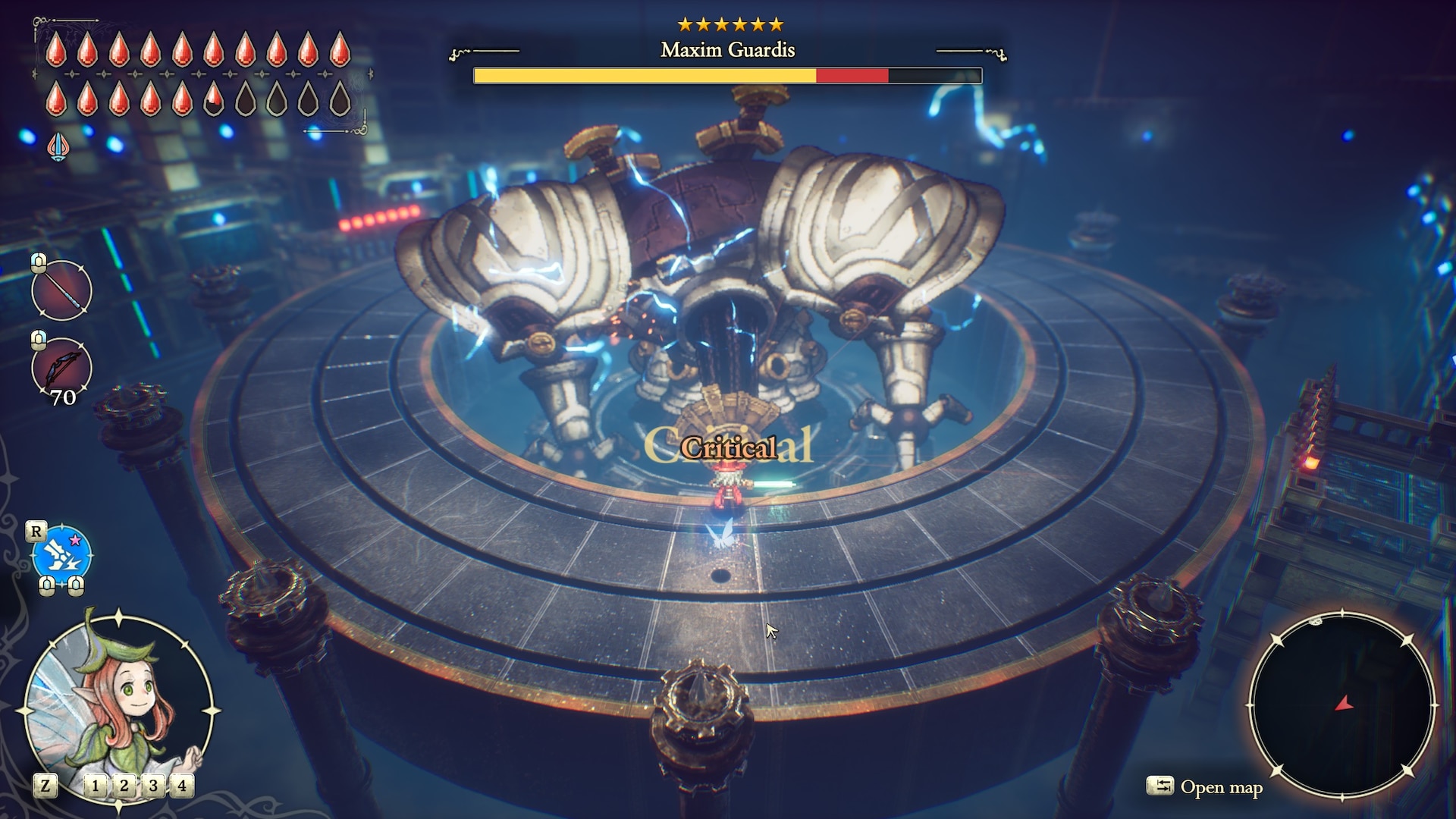
Combat feels noticeably more deliberate than the frantic button-mashing found in some action RPGs. Enemy attacks are generally readable, positioning matters, and successful parries create satisfying openings. Boss encounters are where the system shines most clearly. Many combine attack patterns, environmental hazards, and puzzle-like mechanics in ways that require more than simply dealing damage as quickly as possible.
Difficulty was another area that changed during development. Early versions were criticized for being too forgiving, with generous checkpoints and inexpensive revives reducing the tension of combat. The final game adds multiple difficulty options ranging from Easy to Extra Hard, allowing players to choose whether they want a relaxed adventure or a more demanding action experience. On the default setting, the balance feels reasonable: challenging enough to require attention without becoming punishing.
Faie is integrated into gameplay more effectively than expected. She can assist in combat, retrieve items, activate mechanisms, and enable a teleport-like warp ability that lets Elliot instantly move to her position. A second player can also control Faie in local co-op, turning the game into a surprisingly competent cooperative adventure rather than a token sidekick mode.
Exploration and Dungeons
If the combat evokes classic action RPGs, the exploration openly embraces the spirit of top-down The Legend of Zelda. You cut grass, break pots, bomb cracked walls, discover hidden caves, and solve compact environmental puzzles. The influence is impossible to miss, and the developers themselves acknowledged that they expected comparisons, even while pointing to Square Enix’s own Mana series as a primary inspiration.
Fortunately, imitation is not the whole story. The time-travel structure adds a layer that classic Zelda-style games rarely explore. Actions performed in one era can affect another, opening new routes or revealing secrets that were previously inaccessible. Some of the game’s best moments come from revisiting familiar locations and realizing that a small change in the past has transformed the present.
The dungeons are generally well designed, though not every one reaches the same level of creativity. The strongest combine combat, traversal, and puzzle-solving into a cohesive whole, while the weaker ones rely a bit too heavily on repeated switch-and-key mechanics. Still, the overall quality remains comfortably above average for the genre.
Exploration is also supported by a steady stream of rewards. Hidden shrines, treasure chests, weapon upgrades, and optional challenges provide enough incentive to wander off the critical path. The game rarely feels empty, and completionists will find plenty to uncover.

Visuals and Audio
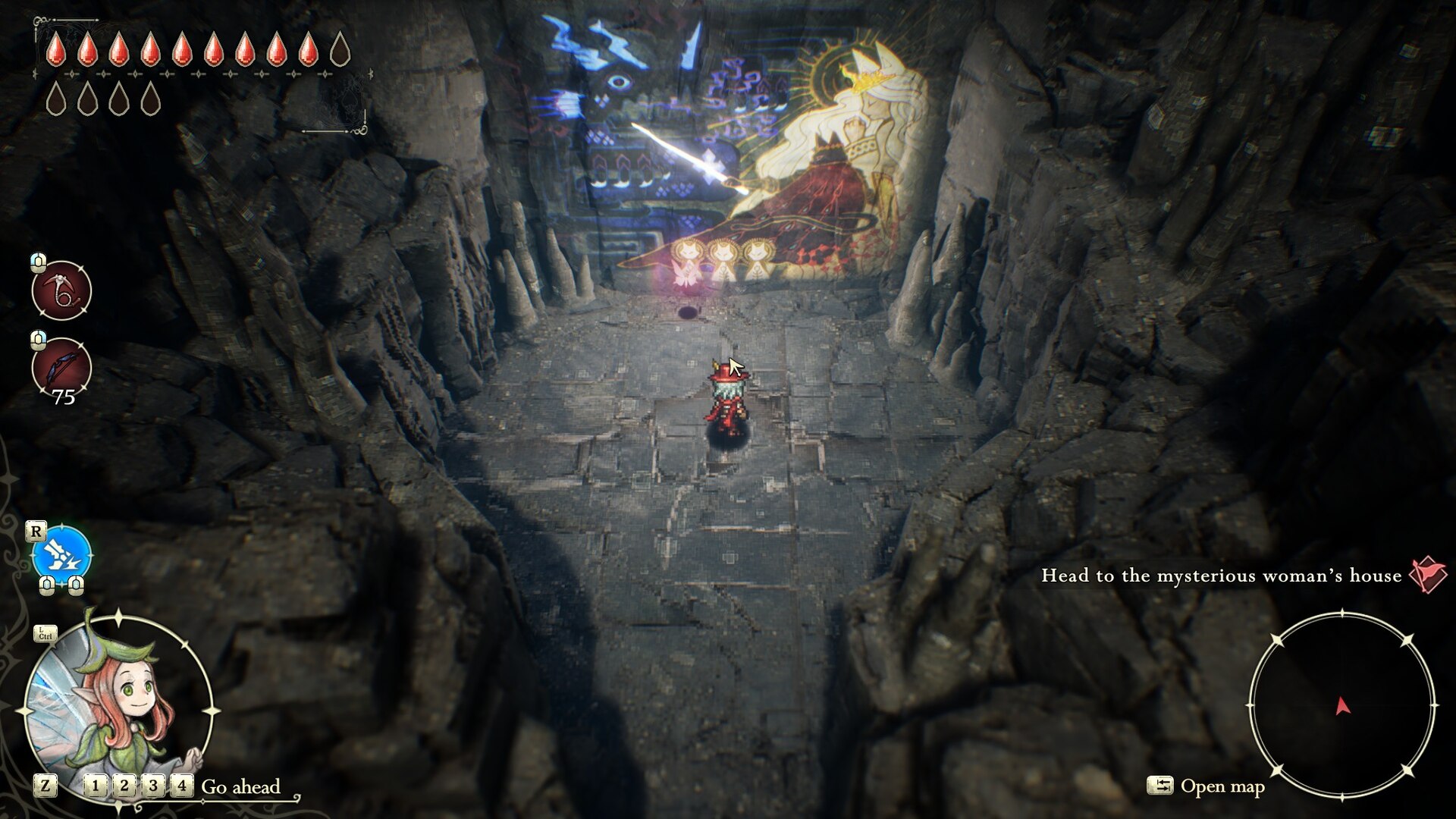
If there is one area where The Adventures of Elliot: The Millennium Tales consistently exceeds expectations, it is its presentation. Square Enix has become increasingly confident in the HD-2D aesthetic over the past several years, and this is easily one of its most refined showcases to date. Earlier games built around the technology often emphasized nostalgia above all else, recreating the look of 16-bit RPGs with modern lighting effects layered on top.
Here, the developers appear less interested in recreating the past than in using pixel art as the foundation for something distinctly modern. The result is a visual style that feels less like a tribute to older hardware limitations and more like a deliberate artistic language of its own. Environments are built with a stronger sense of depth and layering than in previous HD-2D projects, with foreground and background elements working together to create scenes that feel physically constructed rather than simply illustrated.
Lighting is also used with more restraint and intent, shaping mood instead of constantly drawing attention to itself, whether it is the soft diffusion of daylight across open fields or the harsh, directional glow inside ancient ruins. Even small environmental details contribute to this cohesion, from subtle particle effects drifting through the air to the way water surfaces and reflective materials react to movement. Rather than feeling like a retro template enhanced with modern effects, the presentation consistently reads as a fully realized world that happens to be expressed through pixel art, which marks a clear step forward for the style.
Every region possesses its own visual identity without relying on exaggerated color palettes or excessive environmental detail. Ancient ruins feel appropriately weathered, forests are dense without becoming visually cluttered, and towns convey a genuine sense of daily life despite the deliberately stylized presentation. Dynamic lighting plays a particularly important role throughout the adventure. Sunlight filtering through trees, flickering torches illuminating underground chambers and weather effects subtly transforming familiar landscapes all contribute to an impressive sense of atmosphere without drawing unnecessary attention to themselves.
The shifting timelines also give the artists opportunities that many action adventures simply do not have. Revisiting locations centuries apart allows environmental storytelling to take center stage. Buildings that once stood proudly become forgotten ruins, battlefields slowly disappear beneath nature, and seemingly insignificant landmarks acquire entirely different meanings once players understand their history. These changes rarely rely on lengthy exposition. Instead, the environments communicate the passage of time through architecture, vegetation and geography, making exploration rewarding even when no immediate gameplay reward awaits.
Character animation complements this presentation well. Elliot moves with satisfying responsiveness, attacks transition naturally between weapon types and enemies communicate their intentions clearly through movement rather than exaggerated visual effects. Larger creatures in particular benefit from careful animation work that makes learning their attack patterns feel intuitive instead of arbitrary. The game occasionally reuses enemy archetypes across different regions, but subtle behavioral differences usually keep encounters from feeling completely repetitive.
The soundtrack follows a similarly restrained philosophy. Rather than attempting to dominate every scene with sweeping orchestral pieces, many compositions quietly reinforce the mood of each location. Peaceful settlements feature warm, understated melodies, while ancient ruins lean toward quieter arrangements that emphasize mystery over spectacle. Combat music becomes more energetic without overwhelming the rest of the soundscape, and several late-game themes rank among the strongest compositions produced for an HD-2D title so far.
Sound design deserves recognition as well. Weapons produce distinct impact sounds that help communicate their weight, magical abilities carry satisfying audio feedback, and environmental effects—from rushing rivers to collapsing stonework—give the world a convincing sense of physicality. Voice acting is consistently competent, even if the script occasionally settles for familiar fantasy dialogue. Performances generally support the material rather than elevate it, but they never become a distraction.
Technical Performance on PC
The PC version arrives in considerably better condition than many recent releases in the genre. Performance is stable throughout the majority of the adventure, and the game avoids the shader compilation stutter, excessive loading times and widespread instability that have become increasingly common during high-profile launches.

The graphics options provide enough flexibility to accommodate a broad range of hardware without becoming unnecessarily complex. Resolution scaling, adjustable graphical presets, frame-rate options and ultrawide monitor support are all present, while keyboard and mouse controls can be fully remapped. Even so, the control scheme clearly favors a gamepad. Movement feels more natural through analog sticks, switching between weapons is more intuitive, and combat generally benefits from the precision offered by a controller.
Loading times remain brief on modern SSDs, allowing exploration to maintain a satisfying pace without constant interruptions. Transitions between regions are quick, menus respond immediately and extended play sessions rarely expose meaningful stability problems. While no PC release is entirely free of minor technical issues, they are infrequent enough here that they seldom distract from the adventure itself.
That said, the technical polish does not entirely compensate for several design issues that become more noticeable as the campaign progresses. Backtracking increases during the middle chapters as objectives repeatedly send players between previously visited regions. The time-travel mechanic often justifies these revisits narratively, but the gameplay occasionally struggles to maintain the same sense of discovery once an area has been thoroughly explored. Likewise, several side quests rely on familiar fetch objectives or repeated conversations rather than introducing new gameplay scenarios. These activities provide useful rewards, yet they rarely approach the creativity displayed by the main story.
The interface generally fares better. Equipment management is straightforward, crafting systems remain easy to understand without sacrificing depth, and inventory organization rarely becomes cumbersome despite the growing collection of materials and upgrades. The map is also well designed, providing enough information to support exploration without removing the satisfaction of discovering hidden locations independently.
Final Verdict: 7/10
The Adventures of Elliot: The Millennium Tales is at its best when it stops trying to compete directly with the classics that inspired it and instead focuses on the strengths that make it unique. The time-travel premise gives its world a welcome sense of history, combat remains satisfying from beginning to end, and the HD-2D presentation continues to demonstrate remarkable versatility outside the turn-based RPG genre. Few moments feel revolutionary in isolation, yet the various systems complement one another well enough that the overall experience remains consistently enjoyable.
It is also a game that occasionally feels more conservative than its premise suggests. The ability to explore multiple historical eras opens exciting possibilities, but those ideas are not always explored to their fullest extent. Puzzle design rarely becomes as inventive as the setting deserves, several dungeons rely on familiar conventions, and the supporting cast never develops into one of the adventure’s defining strengths. None of these shortcomings seriously undermine the experience, though they do prevent it from reaching the same level as the genre’s most enduring classics.
Perhaps the game’s greatest achievement is that it never depends solely on nostalgia. While its influences are immediately recognizable, it demonstrates a genuine understanding of why those games remain beloved decades later. Exploration is consistently rewarding because curiosity is almost always acknowledged. Combat remains engaging because new weapons and abilities meaningfully expand player options instead of simply increasing statistics. Progression feels natural because every new mechanic builds upon those introduced earlier rather than replacing them altogether. Even when individual ideas are familiar, their execution is confident enough to keep the adventure moving at an enjoyable pace.
For Square Enix, the game also represents an encouraging step forward for the HD-2D initiative. After several role-playing games built around similar visual foundations, The Adventures of Elliot: The Millennium Tales shows that the technology is flexible enough to support entirely different genres without losing its distinctive character. Hopefully it will encourage the publisher to continue experimenting rather than treating HD-2D as a style reserved exclusively for nostalgic RPG revivals.
PC players looking for a polished action adventure will find plenty to appreciate here. It may not redefine the genre or surpass the classics that inspired it, but it understands the fundamentals remarkably well. Strong combat, rewarding exploration, an attractive presentation and a compelling central premise are enough to outweigh an uneven supporting cast and occasionally conservative dungeon design. It is the kind of game that becomes steadily more enjoyable as its systems open up, rewarding patience with an adventure that remains consistently entertaining from its opening hours to its conclusion.