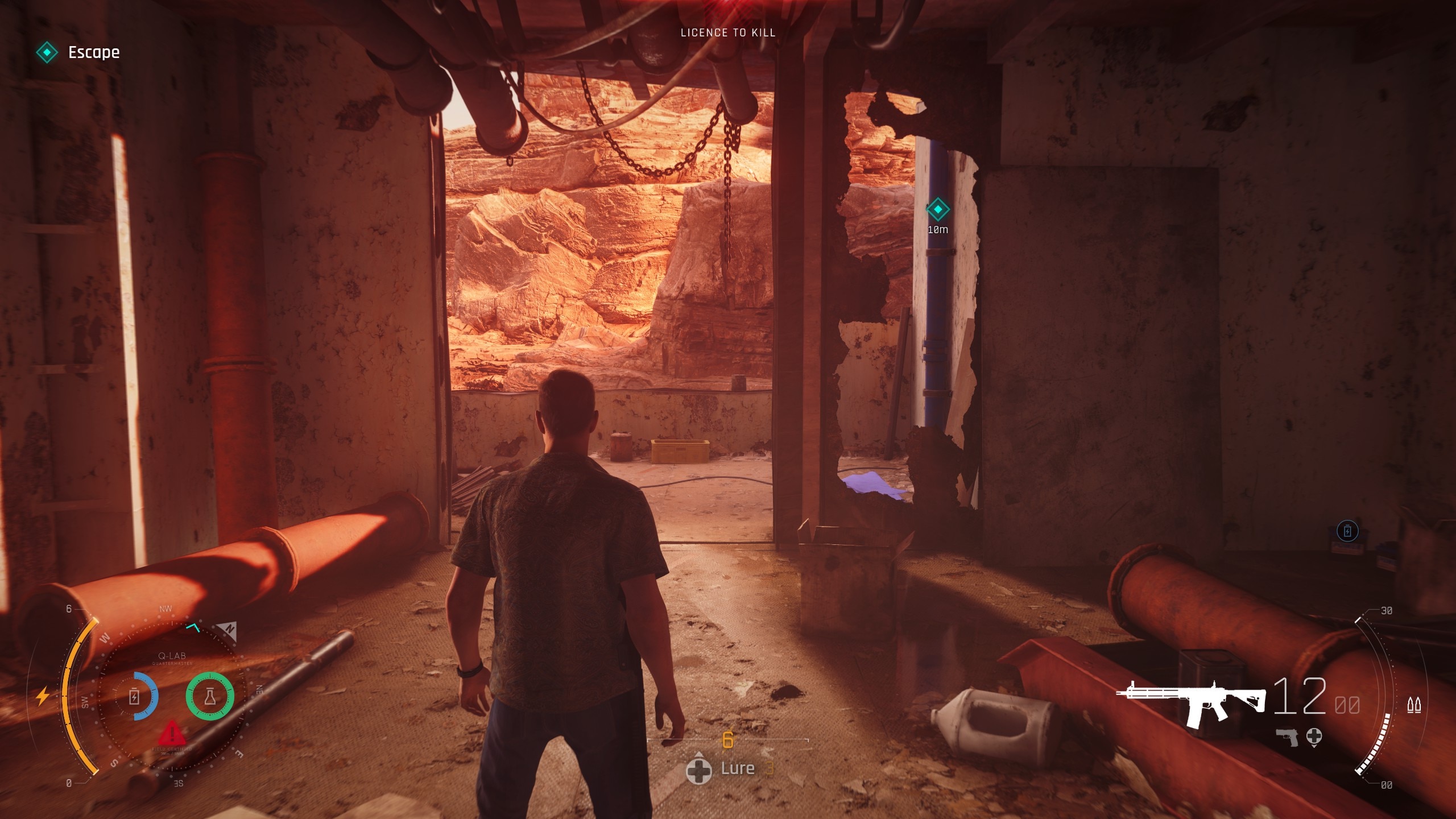
James Bond games have struggled to maintain relevance for years. While the film franchise successfully reinvented itself multiple times across different generations, Bond’s presence in gaming gradually faded after a series of uneven adaptations and forgettable shooters. That long absence placed unusual pressure on 007 First Light, which marks IO Interactive’s first attempt at building a full-scale Bond game after years spent refining the Hitman formula. The pairing always appeared logical on paper because IO Interactive already specialized in stealth, espionage, social infiltration, and highly detailed environments, but there was still a legitimate concern that the studio would simply create a version of Hitman with Bond branding attached to it.
Fortunately, 007 First Light avoids that problem almost immediately. Although traces of IO Interactive’s earlier work are visible throughout the experience, this is not a sandbox assassination simulator disguised as a Bond game. Instead, the studio delivers a cinematic but mechanically flexible action-adventure that understands the character’s identity far better than most licensed games manage. The result is a modern espionage thriller that balances stealth, action, investigation, and spectacle without losing sight of what makes James Bond distinctive.

Rather than focusing entirely on nostalgia or fan service, First Light introduces a younger and less experienced Bond who is still developing into the legendary MI6 operative audiences recognize. That creative decision gives the story room to explore the character’s flaws and insecurities in ways that feel refreshing instead of forced. Bond is reckless, impulsive, and occasionally arrogant, but he is also intelligent, adaptable, and capable of learning from failure. The game does not spend its runtime repeatedly reminding players about familiar Bond iconography. It treats him as a character first and an icon second.
That approach ultimately becomes the foundation for the entire experience. First Light succeeds because it prioritizes strong mission design, flexible gameplay systems, and believable character work over shallow references to earlier Bond media. It is not a perfect game, but it is easily the most convincing interpretation of James Bond seen in gaming for a very long time.
Gameplay and Mechanics
Gameplay in 007 First Light revolves around a combination of stealth, social infiltration, third-person shooting, hand-to-hand combat, and environmental interaction. What makes the system work particularly well is the way IO Interactive blends those mechanics together without forcing players into a rigid structure. Missions regularly allow multiple approaches, and the game rarely punishes experimentation unless players completely ignore the systems being presented.
Stealth is clearly the strongest component. IO Interactive’s experience with the Hitman series is immediately visible in the way environments are constructed. Large mission spaces contain layered security systems, multiple infiltration routes, hidden pathways, surveillance opportunities, and civilian crowds that can either conceal Bond or expose him depending on the situation. Unlike Hitman, however, the goal here is not absolute precision or perfectly controlled assassinations. First Light is more interested in improvisation and adaptability.
Bond can forge credentials, manipulate conversations, sabotage electronics, distract guards, and exploit environmental weaknesses to gain access to restricted areas. Many encounters can be resolved quietly through observation and planning, but the game also understands that Bond is not Agent 47. He is more reckless, more visible, and more willing to improvise under pressure. As a result, getting detected does not automatically feel like failure. Some of the game’s best moments emerge when carefully planned infiltrations collapse into desperate attempts to regain control.
The social stealth systems are especially effective because they reinforce the fantasy of being Bond rather than simply another generic stealth protagonist. Walking through a crowded casino while maintaining a cover identity feels fundamentally different from sneaking through military corridors. Conversations matter. Timing matters. Environmental awareness matters. The game successfully creates tension through human interaction instead of relying entirely on crouching behind cover.
Combat is also stronger than expected. Third-person gunplay feels responsive and appropriately weighty, with weapons delivering enough impact to make firefights satisfying throughout the campaign. The cover system is simple but dependable, which becomes important during the game’s larger action sequences. IO Interactive wisely avoids excessive mechanical complexity in combat, allowing the focus to remain on movement, positioning, and quick decision-making.
Close-quarters combat deserves particular praise because it captures Bond’s physicality remarkably well. Melee encounters are fast, aggressive, and visually convincing without becoming excessively scripted. Bond can counter attacks, disarm opponents, and use environmental objects during fights in ways that create a strong sense of momentum. The animations consistently sell the brutality of close-range combat while maintaining enough player control to prevent encounters from feeling automated.
Gadgets naturally play a major role, but the game handles them with restraint. Rather than overwhelming players with endless equipment, First Light introduces tools gradually and integrates them directly into mission design. Hacking devices, surveillance tools, lock-breaking technology, and specialized watches all serve practical gameplay functions instead of existing purely for nostalgia. More importantly, most gadgets support multiple playstyles instead of functioning as single-use puzzle solutions.
The progression system remains relatively restrained compared to many modern action games. Bond gains access to new tools and abilities over time, but the game never becomes obsessed with skill trees or loot systems. Improvements feel meaningful without disrupting pacing, and players are encouraged to master mechanics rather than grind for statistical upgrades.
Mission Design and Structure
Mission design is where 007 First Light consistently demonstrates its highest level of quality. The campaign alternates between tightly scripted cinematic sequences and larger semi-open levels that emphasize player choice and exploration. The best missions combine both approaches effectively, using strong narrative pacing while still allowing enough freedom for players to improvise.
Several major locations stand out immediately because of how detailed and reactive they feel. Luxury hotels, crowded nightclubs, fortified compounds, casinos, and international urban environments all contain multiple layers of activity occurring simultaneously. Guards patrol dynamically, civilians react naturally to disturbances, and environmental storytelling constantly reinforces the atmosphere of each location.

The larger infiltration-focused missions represent the game’s strongest material. These chapters allow players to gather information through eavesdropping, discover hidden pathways, manipulate NPC behavior, and choose between stealth or direct confrontation depending on personal preference. Objectives rarely rely on only one solution, which makes experimentation rewarding throughout the campaign. Some situations can be resolved quietly through social manipulation and careful timing, while others encourage more aggressive improvisation when plans begin to fall apart.
The level design consistently supports that flexibility, giving players enough freedom to adapt organically without making missions feel unfocused or overly open-ended.
Importantly, the game avoids overwhelming players with unnecessary complexity. While environments are large enough to support multiple approaches, objectives remain clearly communicated and pacing stays focused. IO Interactive understands that Bond stories require momentum, so missions consistently move forward without becoming exhausting sandboxes.
The more linear sequences are slightly less memorable but still entertaining. Chase scenes, collapsing environments, scripted escapes, and large-scale firefights clearly take inspiration from modern cinematic action games like Uncharted and Tomb Raider. These sections occasionally sacrifice mechanical depth in favor of spectacle, but they are usually brief enough to avoid disrupting the overall pacing.
A few missions become too combat-heavy during the later portions of the campaign, and those chapters lack some of the espionage identity that makes the game distinctive. Standard cover shooting sequences are mechanically competent, but they are not as memorable as the slower infiltration-focused levels where the game’s systems have room to interact naturally.
Replayability is surprisingly strong for a narrative-driven action game. Several missions contain optional objectives, alternate routes, hidden intel, and multiple outcomes that encourage repeated playthroughs. The scoring system quietly rewards clean execution and stealth efficiency without aggressively punishing players who prefer more chaotic approaches.
Story and Characters
The story in 007 First Light focuses on Bond’s early years as an MI6 operative before he fully develops into the iconic 007 agent. That premise gives the narrative room to explore Bond’s weaknesses and emotional immaturity without undermining the character’s confidence or intelligence. The result is a version of Bond who feels recognizably familiar while still possessing genuine room for growth.
Patrick Gibson delivers an excellent performance in the lead role. Instead of imitating earlier actors who played Bond, Gibson presents a younger and less polished interpretation of the character. Early in the game, Bond often appears impatient and emotionally reactive, but the performance gradually becomes more controlled and confident as the story progresses. That evolution feels earned because the script allows Bond to make mistakes and learn from them.
The supporting cast is equally strong overall. M is portrayed as authoritative and demanding without becoming emotionally distant, while Moneypenny receives significantly more meaningful involvement than many earlier Bond adaptations allowed. Q is also handled well because the character contributes to the story without descending into exaggerated comic relief.
The villains are somewhat less impressive. The central antagonist has a commanding presence and several strong scenes, but the character never fully reaches the level of memorability associated with classic Bond villains. Some secondary antagonists actually leave stronger impressions simply because they receive more focused screen time and clearer motivations.
Dialogue throughout the campaign is generally sharp and restrained. The script understands that Bond should sound confident and charismatic without constantly delivering forced one-liners. Humor appears regularly, but it emerges naturally through character interaction instead of relying on excessive quipping.
The plot itself is solid rather than exceptional. Conspiracies, betrayals, political manipulation, and covert organizations all play major roles, but the larger narrative mainly exists to support the missions and character relationships. Certain twists become predictable before the final act, and some exposition-heavy scenes slow the pacing slightly during the middle chapters.
Even so, the story succeeds because it consistently maintains the correct tone. First Light understands that Bond stories work best when they balance tension, charm, danger, and momentum instead of leaning too heavily into either realism or parody.
Visual Design and Atmosphere
Visual presentation is one of the game’s most consistently impressive achievements. IO Interactive demonstrates a clear understanding of how important style is to the Bond identity, and nearly every major location carries a distinct visual personality.
Luxury hotels glow with warm lighting and polished architecture, nightclubs pulse with movement and music, and fortified military facilities feel appropriately cold and intimidating. The contrast between elegance and violence becomes one of the defining characteristics of the game’s atmosphere.
Color grading deserves particular praise because the game avoids the washed-out visual style common in many modern action titles. Night scenes remain readable without becoming overly dark, while daytime environments retain strong color contrast and clarity. Lighting is used carefully to reinforce mood without sacrificing gameplay visibility.

Environmental detail consistently supports immersion. Crowded locations feel alive because NPC behavior, background conversations, and small environmental interactions combine to create believable spaces. Civilians react naturally to nearby disturbances, guards communicate with each other convincingly, and background activity continues even when the player is not directly involved in a mission objective. Even quieter locations contain enough visual storytelling to reinforce the broader world without relying heavily on exposition.
Offices, hotel suites, underground facilities, and safehouses are filled with subtle details that hint at the personalities, routines, and motivations of the people occupying them, which helps every environment feel more grounded and authentic rather than functioning as a simple gameplay arena.
Character animation quality also contributes significantly to the atmosphere. Bond moves differently depending on the situation, appearing relaxed and controlled during undercover social interactions before shifting into faster and more aggressive movement during combat sequences. Small touches like posture changes and subtle facial reactions help sell the idea that Bond is constantly adapting his behavior to fit different environments.
Cutscene direction remains impressive throughout the campaign. Action scenes are clearly staged, conversations are visually engaging without excessive camera movement, and choreography remains readable even during larger combat encounters. IO Interactive consistently prioritizes clarity over chaotic editing, which greatly benefits both storytelling and gameplay.
The Balance Between Hitman and Bond
One of the most interesting aspects of 007 First Light is the way it balances IO Interactive’s established design strengths with the very different identity of James Bond.
The similarities to Hitman are obvious in several systems. Social stealth, layered mission design, crowd simulation, and environmental manipulation all reflect the studio’s earlier work. However, the overall tone and pacing are fundamentally different.
Hitman revolves around precision, patience, and emotional detachment. Agent 47 succeeds through methodical execution and near-perfect control. Bond, by comparison, operates through improvisation, charisma, and adaptability. First Light understands that distinction and builds its systems accordingly.
In Hitman, being detected often feels like catastrophic failure. In First Light, detection frequently becomes part of the experience. Escaping collapsing cover identities, improvising during firefights, and recovering from mistakes all reinforce Bond’s personality in ways that feel appropriate for the character.
The game also places much heavier emphasis on narrative pacing and cinematic momentum than Hitman ever attempted. Dialogue scenes are more prominent, scripted action sequences appear regularly, and missions generally move faster overall. Some players hoping for enormous systemic sandboxes may initially find the structure more restrictive than expected.
At the same time, that balance is probably the main reason the game succeeds. A completely open-ended Hitman-style Bond game might have struggled to capture the spectacle and pacing audiences associate with the franchise. First Light instead finds a middle ground between authored cinematic storytelling and player-driven improvisation.
That hybrid structure gives the game a distinct identity instead of making it feel like a simple variation of IO Interactive’s previous work.
Technical Performance on PC
The PC version of 007 First Light launches in noticeably better condition than many recent AAA releases, although it still contains some technical issues that prevent the experience from feeling completely polished.
IO Interactive’s Glacier engine continues to produce impressive results. Environmental detail is consistently strong, crowd density remains high without overwhelming performance, and lighting quality contributes heavily to the atmosphere of each location. Interior environments benefit particularly from detailed reflections, high-quality materials, and carefully controlled lighting design.
Character models and facial animations are also excellent. Close-up conversations carry emotional weight because performances are supported by convincing animation work and detailed facial expressions. Motion capture quality remains consistently strong across both major story scenes and smaller interactions.
Performance is generally stable on modern hardware, although the game places significant demands on CPUs during crowded urban levels and large social environments. Frame rate drops occasionally appear in the densest areas, particularly during missions containing large civilian populations or extensive environmental effects. Still, overall optimization is substantially better than many recent high-budget PC releases.
Load times are fast on SSDs, texture streaming issues are relatively uncommon, and traversal stutter remains limited compared to several competing games in the same genre. IO Interactive also provides an extensive graphics settings menu with detailed scalability options for shadows, reflections, crowd density, textures, and post-processing features.

Support for DLSS, FSR, and XeSS is available at launch, which helps performance across a broad range of hardware configurations and makes the game far more scalable than many recent AAA releases. Players using mid-range systems can achieve stable frame rates without sacrificing too much visual quality, while high-end hardware is capable of delivering consistently impressive image clarity and lighting detail at higher resolutions. Ultrawide support is reliable, field-of-view customization is included, and keyboard-and-mouse controls generally feel responsive during both stealth and combat encounters.
Menu navigation is also clean and intuitive on PC, with extensive graphics settings that allow players to fine-tune performance based on their preferred balance between visual fidelity and frame rate stability.
There are still technical flaws worth mentioning. Enemy AI occasionally behaves inconsistently during stealth sequences, with guards sometimes failing to react properly to suspicious activity or nearby takedowns. Checkpoint behavior can also create awkward situations after reloads, especially during larger combat-heavy chapters.
Ray tracing implementation improves visual quality in certain environments, particularly reflective interiors and nighttime locations, but the performance impact is substantial depending on hardware specifications. Fortunately, the game still looks excellent even without maximum ray tracing settings enabled.
Audio design is another major strength. Weapons sound appropriately heavy, environmental ambience adds texture to every location, and the orchestral soundtrack captures the spirit of Bond without relying excessively on nostalgia. Voice acting quality remains consistently strong throughout the campaign, which is important because the game includes extensive dialogue during missions and cinematic sequences.
Strengths and Weaknesses
Despite its many strengths, 007 First Light still contains several noticeable weaknesses. The largest issue is inconsistency between mission types. The espionage-focused infiltration levels are excellent, but some of the later combat-heavy chapters feel comparatively generic. Standard firefights are mechanically solid, yet they lack the creativity and personality present during stealth-oriented missions.
Enemy AI also lacks sophistication in certain situations. Guards occasionally fail to communicate effectively during stealth encounters, and some combat scenarios can be manipulated too easily through aggressive positioning or predictable enemy behavior.
Vehicle gameplay represents another missed opportunity. Driving sequences look visually impressive and contribute to cinematic pacing, but the mechanics themselves remain relatively shallow. Bond’s vehicles function more as narrative tools than fully developed gameplay systems.
The story, while enjoyable, also plays things relatively safe. Character relationships are handled well, but the larger conspiracy narrative rarely takes major risks. Several twists become predictable early, and the villains never achieve the iconic status associated with the strongest Bond antagonists.
There are also occasional pacing issues caused by forced walking sequences and heavily scripted transitions between gameplay sections. These moments rarely become frustrating because they are usually brief, but they still interrupt player momentum unnecessarily.
None of these flaws ruin the experience, but they do prevent First Light from reaching the absolute top tier of modern action-adventure games.
Final Verdict: 8.5/10
007 First Light succeeds because it understands that James Bond cannot be reduced to a single gameplay style or tonal approach. Bond stories rely on a mixture of espionage, violence, charm, intelligence, spectacle, and improvisation, and IO Interactive manages to combine those elements more effectively than most developers likely could.
The game delivers excellent stealth mechanics, strong mission design, impressive atmosphere, flexible gameplay systems, and convincing character performances while still maintaining the cinematic pacing expected from a modern Bond adaptation. At the same time, it avoids becoming either an overly nostalgic tribute or a generic cinematic shooter wearing Bond branding.
The PC version also deserves credit for launching in relatively solid technical condition. Performance is generally stable, customization options are extensive, and the Glacier engine continues to produce visually impressive environments without the severe optimization problems affecting many contemporary AAA releases.
There are certainly flaws. Some combat encounters become repetitive, vehicle gameplay lacks depth, enemy AI can behave inconsistently, and the narrative occasionally falls back on predictable genre conventions. However, those issues are not significant enough to undermine the overall experience.
Most importantly, First Light establishes a strong foundation for future Bond games. IO Interactive clearly understands the character, understands the tone, and understands how to translate that identity into interactive systems that feel modern without abandoning what makes Bond distinctive.
After years of disappointing adaptations and failed reinventions, 007 First Light finally gives James Bond a genuinely strong presence in modern gaming again.