There are very few games that sound less exciting on paper than Euro Truck Simulator 2, because it is fundamentally a game about hauling cargo across Europe at legal speeds, obeying traffic laws, stopping for rest, managing fuel consumption, and carefully reversing trailers into loading bays rather than engaging in traditional action-oriented gameplay. There are no explosions, dramatic story twists, or cinematic set pieces constantly competing for the player’s attention, and yet more than a decade after release it remains one of the most beloved simulation games on PC, supported by an enormous community and years of ongoing updates from SCS Software.
The reason becomes obvious after spending a few hours behind the wheel, because Euro Truck Simulator 2 understands something that many modern games seem to overlook, which is that satisfying mechanics can carry an experience entirely on their own when they are refined to an exceptional level. The game transforms ordinary driving into something deeply absorbing, to the point where a successful delivery through narrow roads during heavy rain can feel more rewarding than many scripted action sequences in blockbuster titles. Managing a difficult turn with a fully loaded trailer creates a constant sense of tension, while something as simple as maintaining proper lane discipline on a crowded motorway develops a surprisingly calming rhythm over time.
What makes Euro Truck Simulator 2 special is not simply the novelty of driving trucks across Europe, but the way SCS Software built an experience that balances realism, accessibility, atmosphere, and progression so naturally that entire evenings can disappear without the player noticing. Depending on how it is approached, the game can feel relaxing, stressful, meditative, or surprisingly intense, yet it consistently maintains an authenticity that many driving games fail to achieve because it never exaggerates its mechanics simply to create spectacle.
Even after all these years, Euro Truck Simulator 2 remains one of the finest vehicle simulations available on PC because it succeeds through confidence in its core systems rather than through constant attempts to distract the player with artificial excitement.
Gameplay and Mechanics
At its core, Euro Truck Simulator 2 revolves around a relatively simple gameplay loop in which players accept delivery contracts, transport cargo between cities, earn money, purchase better trucks, hire drivers, expand garages, and slowly build a transportation company across Europe. On paper, that structure sounds repetitive almost immediately, but the brilliance of the game lies in how naturally the systems evolve alongside the player’s growing familiarity with the roads, vehicles, and business mechanics.
Early on, every delivery matters because money is limited and mistakes can have noticeable consequences, which creates genuine tension during even straightforward contracts. Players begin by taking quick jobs using borrowed trucks, gradually learning how to navigate roads while adjusting to the sheer size and weight of the vehicles themselves. Trucks in ETS2 do not behave like lightweight racing cars from arcade racers, because they feel appropriately heavy, slow, and cumbersome in believable ways that demand patience and precision from the player. Wide turns require planning well in advance, braking distances are substantial, and reversing with a trailer initially feels intimidating enough that successfully parking becomes rewarding on its own.
The progression system is gradual and intelligently paced because new skills unlock access to more specialized jobs involving fragile cargo, hazardous materials, and longer-distance contracts that significantly increase profits. Eventually players can purchase their own trucks and begin customizing them extensively, both visually and mechanically, which adds a strong sense of ownership that strengthens the overall immersion. Although the economic systems are not especially complex compared to hardcore management simulators, they provide enough structure to make every delivery feel meaningful rather than disconnected from long-term progression.
What keeps the game engaging for such a long period of time is the way the simulation systems naturally support the driving experience itself rather than distracting from it. Fuel management, fatigue systems, toll roads, maintenance costs, weather conditions, and traffic laws all contribute to immersion without overwhelming the player with excessive micromanagement. Most realism features can be disabled for players who prefer a more casual approach, but the game feels significantly more compelling when those systems are fully enabled because they reinforce the sensation of operating a real commercial vehicle across long distances.
Driving for several in-game hours through heavy rain while monitoring fatigue levels, managing fuel reserves, and trying not to damage expensive cargo creates a unique kind of tension that very few games manage to replicate successfully, largely because the challenge comes from concentration and responsibility rather than raw speed or reflexes. The experience is not traditionally exciting in the way racing games or action titles are exciting, but it becomes compelling through its consistency and mechanical depth.
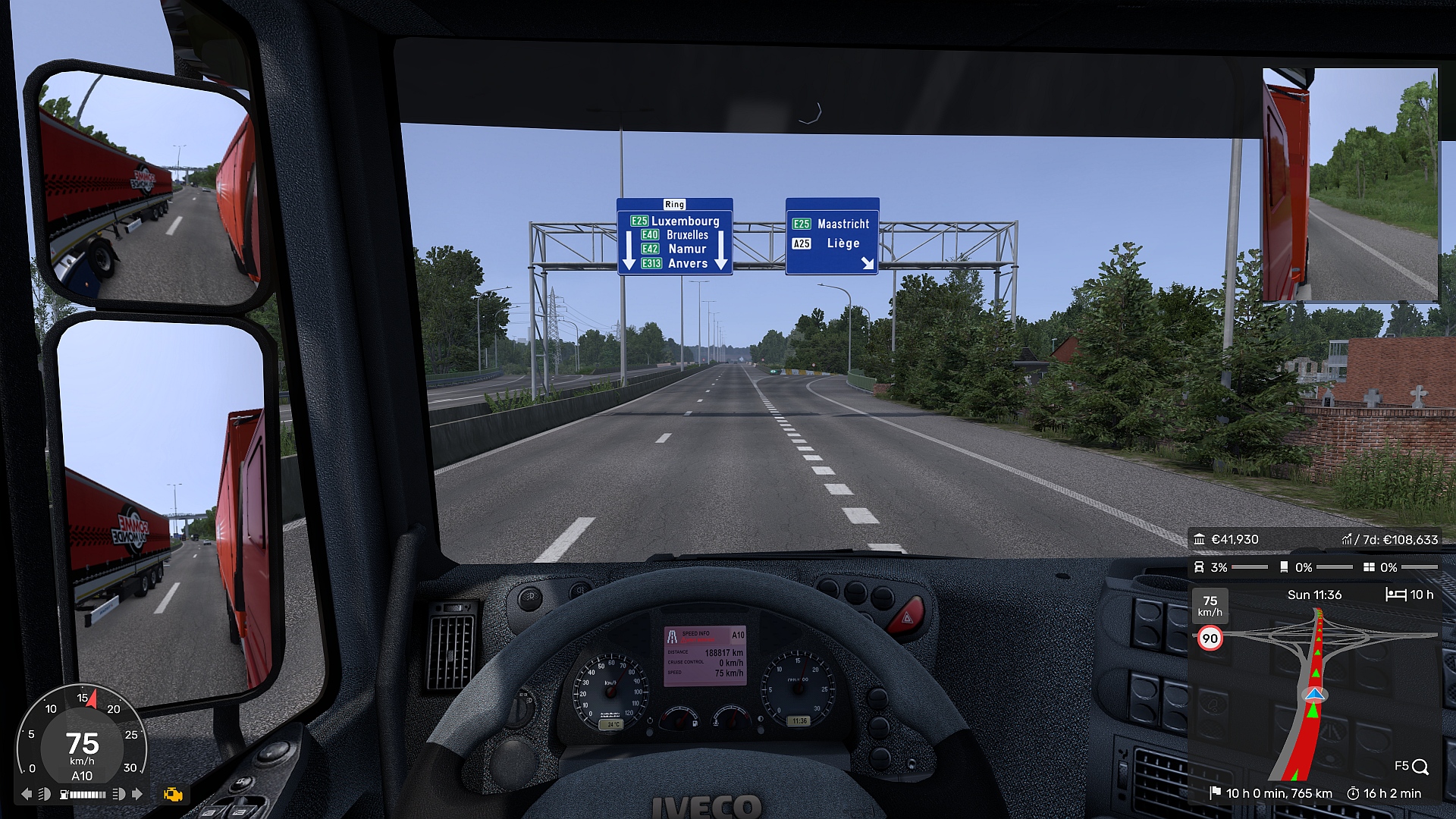
The map itself plays a massive role in the game’s appeal because ETS2 captures the sensation of crossing countries remarkably well despite the compressed scale of its world design. Cities may be condensed versions of their real-world counterparts, but they retain enough identity through road layouts, architecture, signage, and environmental detail that traveling between regions genuinely feels meaningful. Driving through busy German motorways feels noticeably different from navigating narrow rural roads in Scandinavia or maneuvering through tighter routes in Italy, and those regional differences help prevent the game from becoming visually or mechanically repetitive.
The overall scale of the map has become enormous thanks to years of expansions, and that sense of distance is essential to the experience because long-haul deliveries genuinely feel long. Players gradually settle into the rhythm of the road, adjusting speed, monitoring traffic, listening to the radio, and becoming absorbed in the journey itself rather than focusing entirely on reaching the destination as quickly as possible.
Driving Physics and Vehicle Handling
This is ultimately the area where Euro Truck Simulator 2 separates itself from almost every other driving game on the market, because the vehicle handling and physics model are exceptional in ways that are immediately noticeable even to players who are not normally interested in simulation games.
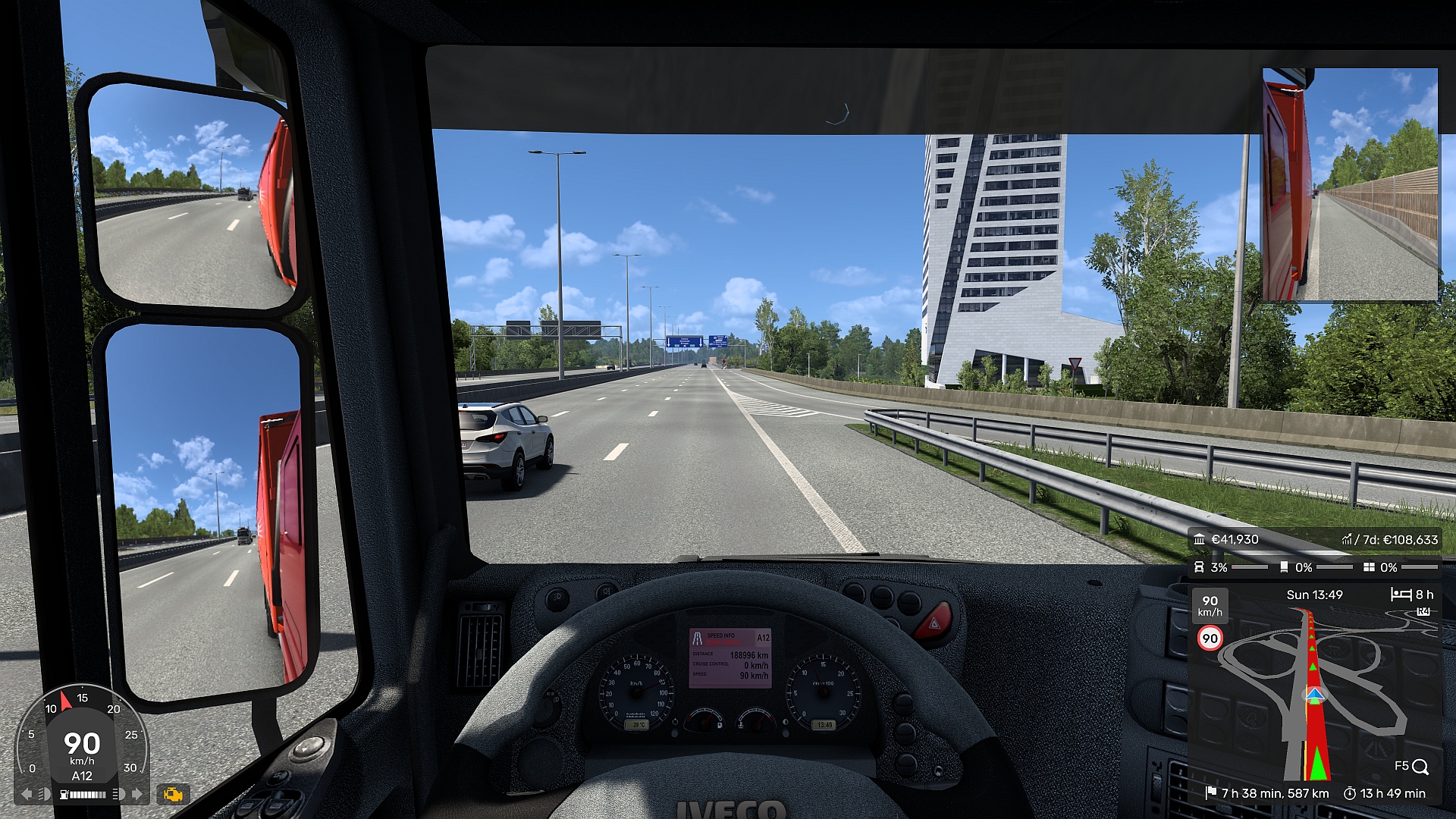
The trucks have weight in a way that many racing games still struggle to communicate convincingly, because every movement feels connected to the enormous mass of the vehicle itself. Acceleration depends heavily on engine power and cargo weight, braking requires anticipation rather than quick reactions, and driving downhill with a fully loaded trailer attached feels fundamentally different from cruising on flat highways with lighter cargo. The game constantly reminds players that they are operating massive industrial machinery rather than lightweight performance vehicles designed for aggressive driving.
SCS Software has spent years refining the physics model, and the result is a driving experience that feels believable without becoming inaccessible or frustrating. Trucks react differently depending on wheel configurations, trailer weight, cargo type, and road conditions, while wet surfaces subtly affect handling in ways that encourage more careful driving. Sudden steering inputs can destabilize trailers, curves require proper speed management, and uneven terrain influences the balance of the truck enough that players naturally begin adapting their driving habits over time.
The steering model deserves particular praise because it captures the slow, deliberate nature of operating large commercial vehicles better than almost any comparable game. Turning is never instant, the cabin sways naturally during movement, and weight transfer consistently affects handling in believable ways that reinforce the sensation of scale. Even basic lane positioning feels important because the trucks occupy so much physical space on the road, which creates constant low-level tension during busy traffic conditions or narrow urban routes.
There is an impressive level of nuance here that surprises many first-time players, because Euro Truck Simulator 2 may not simulate every mechanical detail of real-world trucking, but it communicates the feeling of controlling heavy machinery with remarkable accuracy. The trucks consistently feel physical and grounded, which is something many driving games fail to achieve despite having significantly larger budgets.
All of this becomes even more impressive when using a proper steering wheel setup, because Euro Truck Simulator 2 transforms dramatically once force feedback, pedals, and realistic steering rotation are introduced into the experience. The game already feels immersive with a keyboard or controller, but a steering wheel elevates it into something genuinely special because the slower steering ratios and wide turning angles suddenly make complete physical sense.
Force feedback communicates road texture, suspension movement, steering resistance, and weight shifts in subtle but highly effective ways that constantly reinforce immersion. Reversing trailers becomes an actual skill rather than an awkward minigame, while long motorway drives feel relaxing instead of monotonous because the physical interaction keeps the player engaged throughout the journey. Unlike many racing games that are clearly designed primarily around controllers, ETS2 feels naturally suited to steering wheel hardware because the deliberate pacing of trucking complements realistic steering input perfectly.
A high-quality wheel with extensive rotation dramatically improves immersion because trucks require controlled movements, careful hand positioning, and constant steering adjustments that feel satisfying in a tactile way. Even simple maneuvers such as entering roundabouts, navigating tight intersections, or parking trailers become engaging because the handling model consistently communicates the weight and momentum of the vehicle through the wheel itself.
Very few driving games benefit from steering wheel support as much as Euro Truck Simulator 2, largely because the realistic handling model gives constant meaningful feedback rather than relying on exaggerated effects designed purely for spectacle.
Visuals and Environmental Design
Euro Truck Simulator 2 originally launched in 2012, which means its age occasionally becomes noticeable in certain areas, particularly in older map regions, simplified character models, and environmental assets that still reflect the technical limitations of the game’s original release. Despite those shortcomings, however, the game remains surprisingly atmospheric because its presentation succeeds through consistency and environmental cohesion rather than raw graphical fidelity alone.
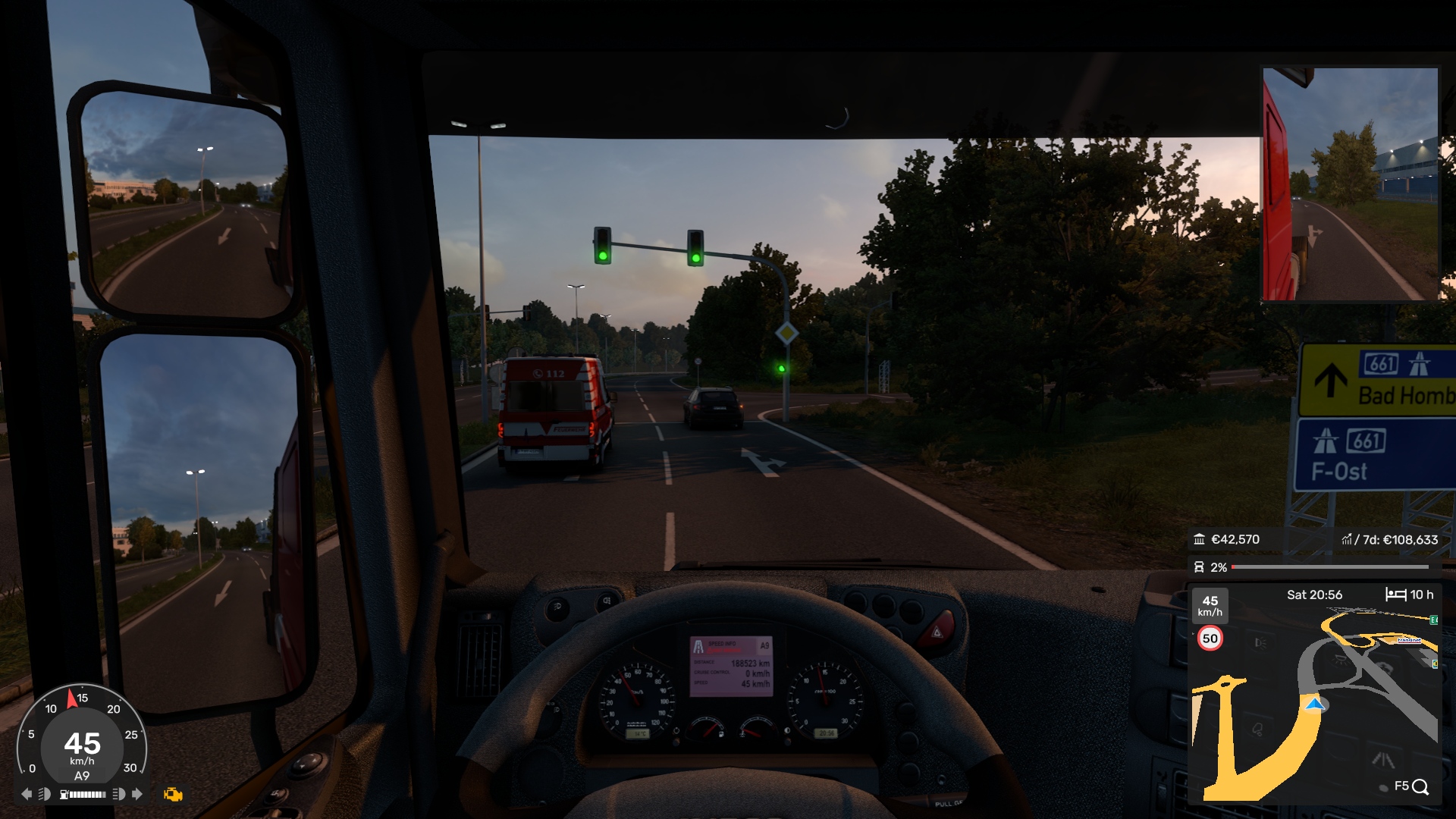
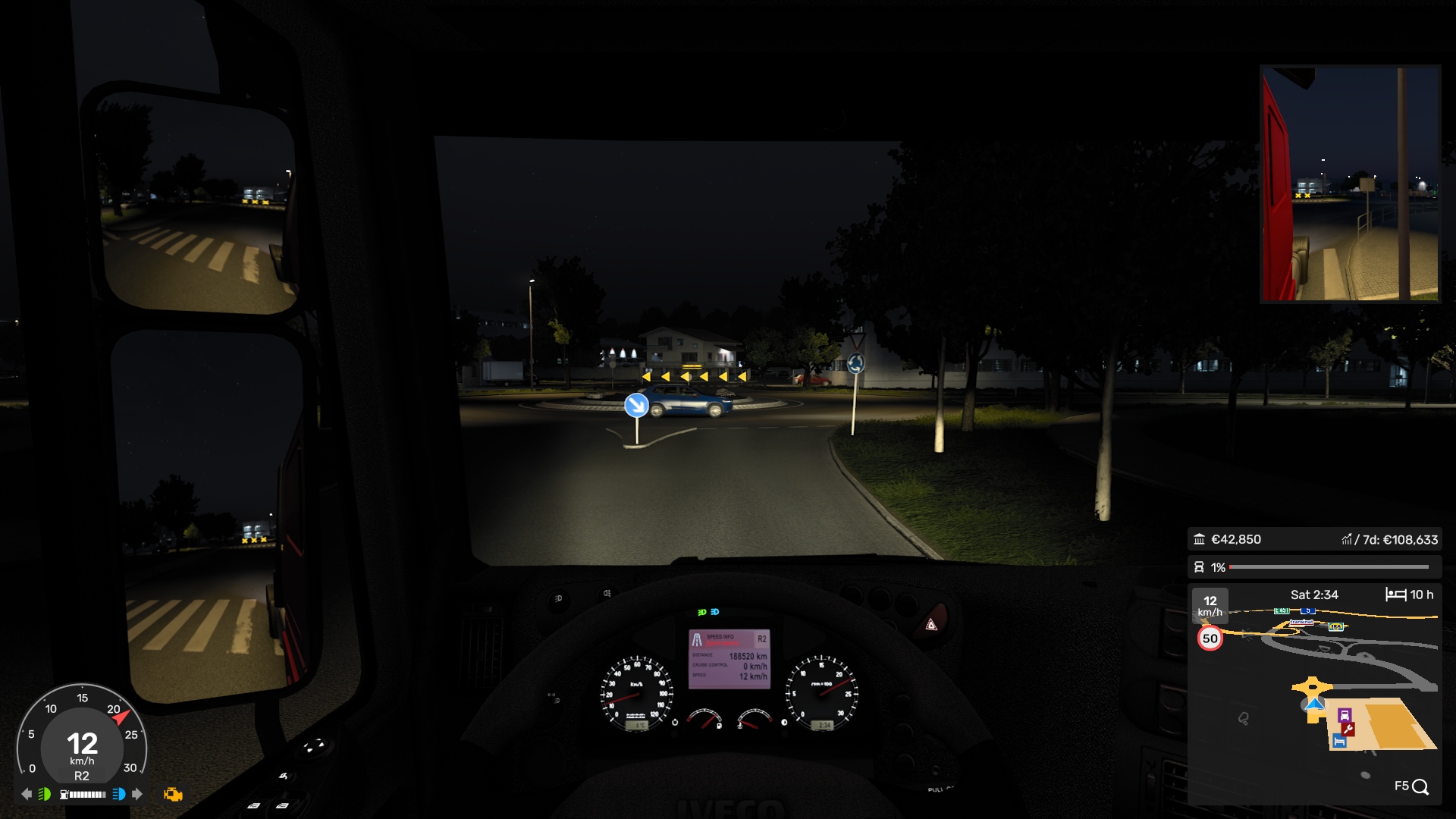
The lighting system has improved dramatically over the years, and it now plays a huge role in establishing atmosphere during long drives. Sunrises and sunsets cast warm natural lighting across highways, rainstorms reduce visibility in convincing ways, and nighttime driving creates a strong sense of isolation, especially on rural roads illuminated only by headlights and distant traffic. These moments may sound ordinary in description, but they become incredibly effective within the slower pacing of the game because the player spends so much time observing the world from inside the cabin.
Environmental variety also contributes heavily to immersion because the game successfully captures the feeling of traveling across different parts of Europe through regional details such as architecture, vegetation, road signage, and infrastructure design. Different countries genuinely feel distinct from one another, while gas stations, industrial zones, toll booths, and rest areas vary enough to maintain a believable sense of place across hundreds of hours of gameplay.
The scale of the environments strengthens the illusion even further because highways stretch convincingly into the distance, industrial areas feel functional rather than decorative, and urban intersections create believable traffic flow despite the compressed nature of the world itself. The game understands which details matter most for immersion and consistently prioritizes those elements effectively.
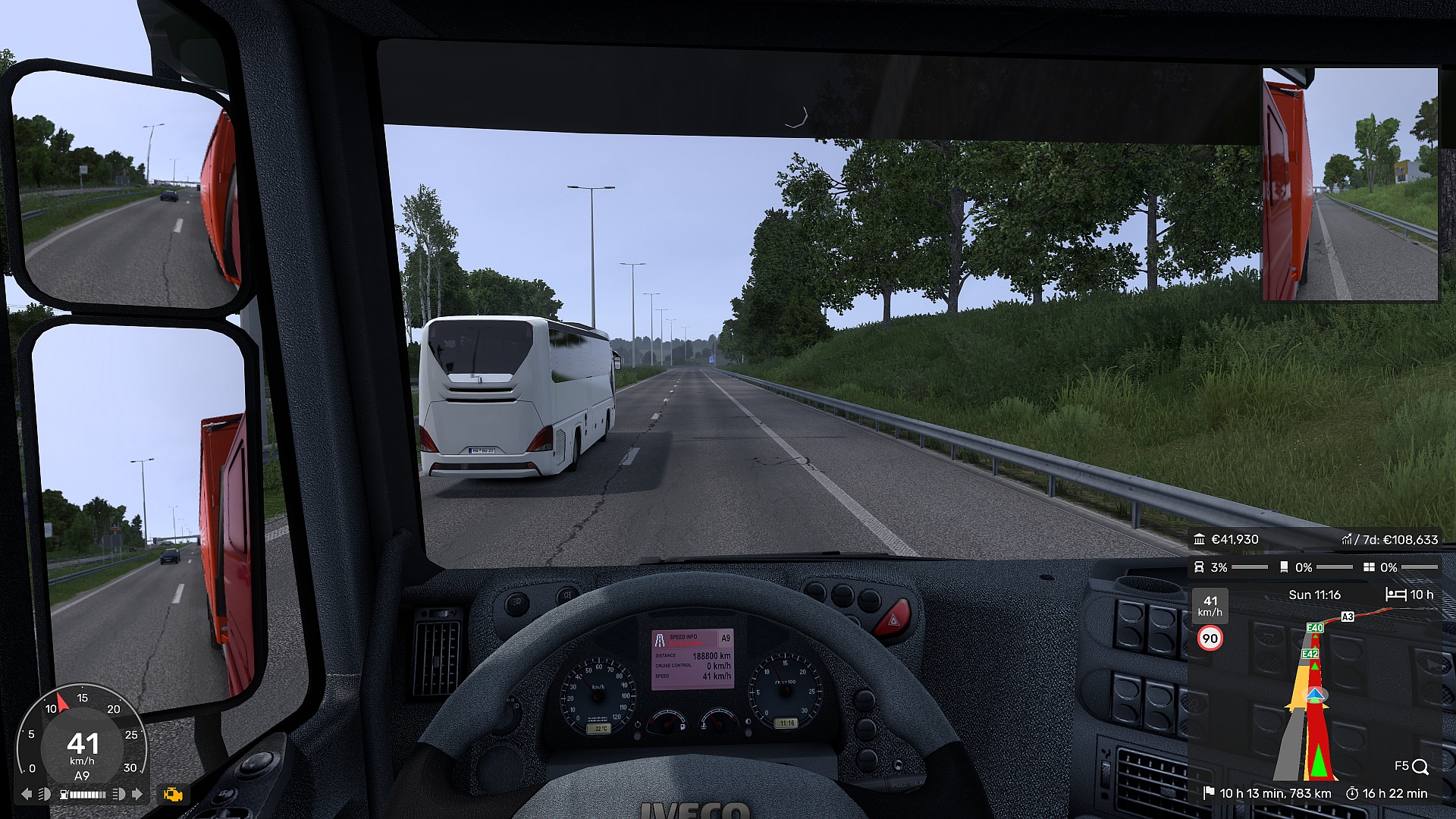
Truck interiors deserve particular recognition because cabin detail is excellent across most vehicles, featuring readable dashboards, functional GPS systems, realistic mirrors, and convincing animations that significantly strengthen immersion. Since players spend the overwhelming majority of the game inside the cabin, this attention to detail becomes essential to the overall experience. Looking around the cockpit while driving through heavy rain at night creates some genuinely immersive moments that many larger-budget driving games still struggle to replicate successfully.
The sense of motion also feels remarkably convincing because motorway speeds feel appropriately fast without becoming exaggerated or arcade-like. Passing vehicles create believable pressure and movement, while the trucks themselves respond with convincing body roll and suspension behavior that reinforces the sensation of operating heavy machinery.
Although pedestrians are almost entirely absent and traffic AI can sometimes appear robotic, Euro Truck Simulator 2 succeeds visually because it prioritizes atmosphere, scale, and consistency over cinematic spectacle, allowing the world to feel believable enough that the simulation remains immersive for extremely long periods of time.
Audio and Sound Design
Sound design is one of the game’s most underrated strengths because it quietly reinforces immersion during every second spent behind the wheel. Truck engines have satisfying depth and variation across different manufacturers and configurations, while engine braking, turbo whine, transmission shifts, and subtle cabin rattles all contribute to the sensation of driving something genuinely mechanical and heavy.
The audio avoids exaggerated Hollywood-style effects in favor of believable industrial soundscapes that reinforce the physicality of the vehicles themselves. The difference between hauling empty trailers and carrying heavy cargo becomes audible through the way engines strain under load, while road surfaces subtly alter tire noise and cabin acoustics in ways that help the trucks feel grounded within the environment.
Environmental audio matters just as much because rain striking the windshield, distant traffic noise, passing vehicles, turn signals, and subtle ambient sounds all combine to create a convincing atmosphere during long journeys. Cabin acoustics change depending on speed, weather, and camera position, helping the player feel physically connected to the vehicle rather than simply controlling it from a detached perspective.
The radio system is another major reason the game works so well during long sessions because internet radio integration naturally complements the slower pacing of the experience. Listening to real radio stations while driving across different countries adds a surprising amount of immersion, particularly during nighttime deliveries or long motorway stretches where the atmosphere becomes almost hypnotic.
The restrained use of music is also an important creative decision because Euro Truck Simulator 2 understands that silence, engine noise, and environmental ambience are often more effective than constant background soundtracks. The game trusts players to settle into the rhythm of the road naturally, and that restraint contributes heavily to the calming atmosphere that defines so much of the experience.
Progression, Customization, and Long-Term Appeal
One of the primary reasons Euro Truck Simulator 2 has remained successful for such a long time is its ability to support different playstyles without forcing players into a rigid structure. Some players treat the game almost entirely as a driving simulator, focusing purely on the experience of operating trucks across Europe, while others become heavily invested in expanding their companies, optimizing routes, managing employees, and maximizing profits.
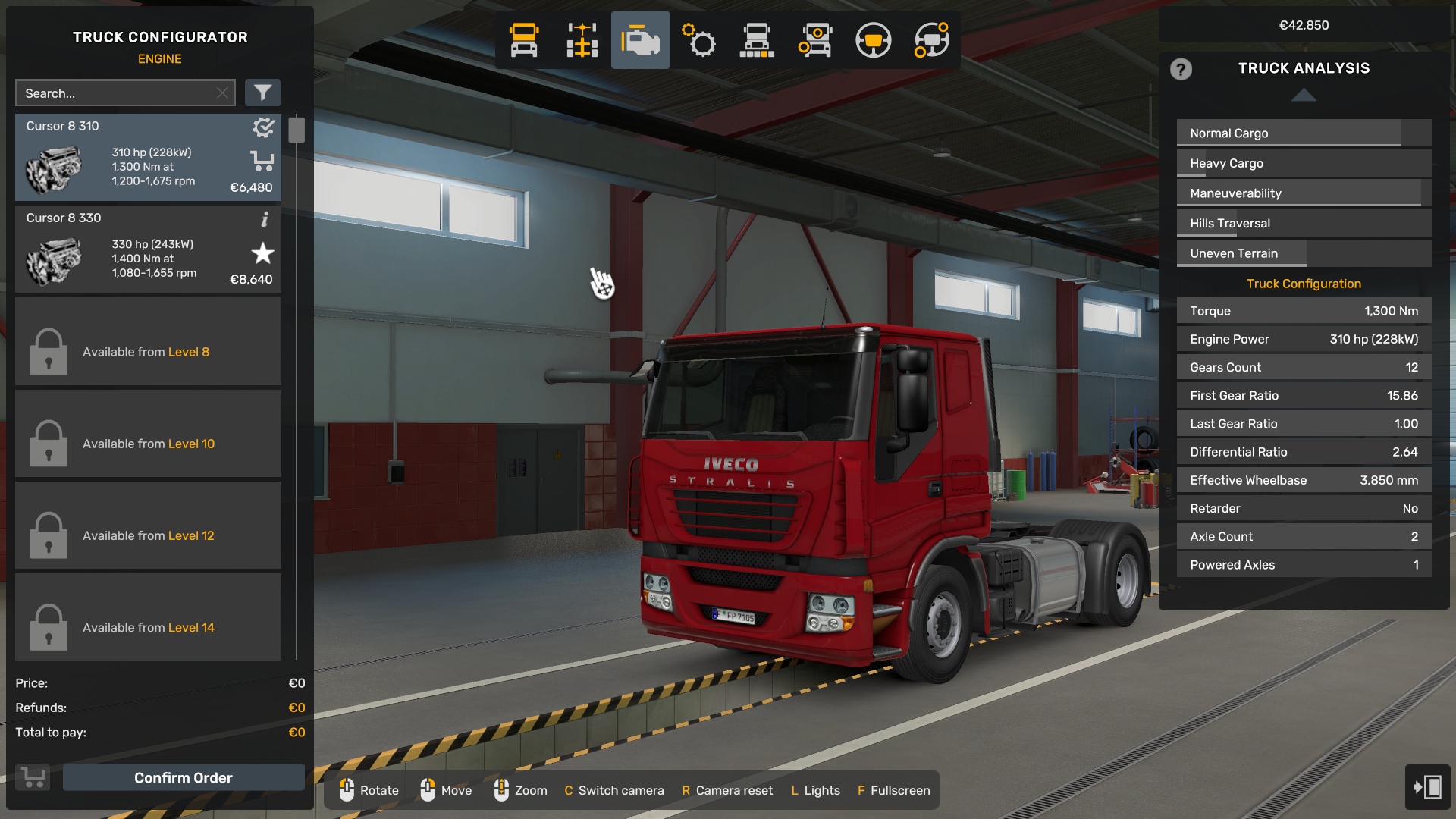
Truck customization is extensive without becoming overwhelming, allowing players to modify paint jobs, chassis layouts, engines, transmissions, interiors, accessories, and countless cosmetic details that personalize each vehicle. The inclusion of licensed truck manufacturers adds a huge amount of authenticity because the vehicles feel grounded within the real-world trucking industry rather than resembling generic fictional substitutes.
Owning a truck eventually becomes genuinely meaningful because players spend such a large amount of time inside their vehicles that gradual upgrades create a strong sense of attachment. Over time, the truck stops feeling like a disposable gameplay tool and starts feeling like a familiar workspace shaped by the player’s preferences and driving habits.
The long-term support from SCS Software deserves enormous credit because very few simulation games continue receiving meaningful updates at this scale for so many years. New map expansions, visual upgrades, gameplay improvements, reworked regions, and additional systems continue to evolve the experience without fundamentally changing its identity.
The modding community extends the lifespan even further by introducing visual enhancements, realistic physics modifications, custom trucks, expanded maps, weather systems, and gameplay tweaks that allow players to shape the experience according to their own preferences. Combined with multiplayer convoy support, which turns long-distance deliveries into surprisingly enjoyable social experiences, ETS2 becomes a game capable of sustaining hundreds or even thousands of hours of playtime.
Technical Performance on PC
Euro Truck Simulator 2 is not a technically demanding game by modern standards, which is one of the reasons it has maintained such a large and active player base over the years, but that does not mean its performance is flawless or entirely free from technical quirks. On reasonably modern hardware, the game generally runs very well, particularly during standard highway driving where frame rates remain stable even with higher graphical settings enabled. The overall optimization is solid enough that players with mid-range PCs can comfortably enjoy the experience without constantly adjusting settings or compromising visual quality too heavily.
The game benefits significantly from the fact that its slower pace places more importance on frame consistency than on extremely high refresh rates. Maintaining smooth performance while driving long distances is crucial because even minor stuttering becomes far more noticeable in a simulator where the player spends extended periods focusing on road movement, steering precision, and traffic flow. Fortunately, ETS2 usually delivers a stable experience during normal gameplay, especially when compared to many larger open-world driving games that struggle with streaming environments and inconsistent performance.
That said, the engine does occasionally show its age in certain situations. Larger cities, dense traffic areas, and heavily modded setups can still cause frame drops or CPU bottlenecks, particularly because the game relies heavily on processor performance in busy environments. The aging engine architecture is more noticeable when using extensive graphics mods, high traffic density modifications, or massive map expansions, where performance inconsistencies can become more frequent even on powerful systems.
Loading times are generally short, and the game runs reliably for long sessions without major stability problems, which is especially important for a simulator designed around extended play sessions lasting several hours at a time. Crashes and severe bugs are relatively uncommon in the base game, although mod compatibility can occasionally introduce instability depending on how heavily customized the installation becomes.
Support for steering wheels, pedals, shifters, and additional peripherals is another major technical strength because ETS2 handles driving hardware exceptionally well. Force feedback configuration is flexible, input customization is extensive, and the game supports a wide variety of wheel setups without requiring complicated workarounds. Whether using an entry-level wheel or a more advanced sim-racing setup, the game scales naturally with the hardware and consistently feels responsive during driving.
Ultrawide monitor support, head tracking, and VR compatibility also contribute heavily to immersion, particularly for players who want a more simulation-focused experience. Virtual reality support is still somewhat experimental compared to dedicated VR simulators, but even in its current state it can create an incredibly immersive sense of scale inside the truck cabin, especially during nighttime driving or difficult parking maneuvers.
Visually, ETS2 continues to evolve through ongoing updates, but some technical limitations remain visible because the underlying engine technology is still rooted in an older framework. Lighting improvements, texture upgrades, and environmental enhancements have significantly improved the presentation over the years, yet certain animations, AI behaviors, and rendering systems still feel dated compared to newer simulation titles built on more modern engines.
Even so, Euro Truck Simulator 2 performs its most important technical task extremely well, which is maintaining a smooth and immersive driving experience across long sessions without constantly distracting the player with technical problems. For a game built around atmosphere, concentration, and mechanical consistency, that reliability matters far more than cutting-edge graphical technology.
Strengths and Limitations
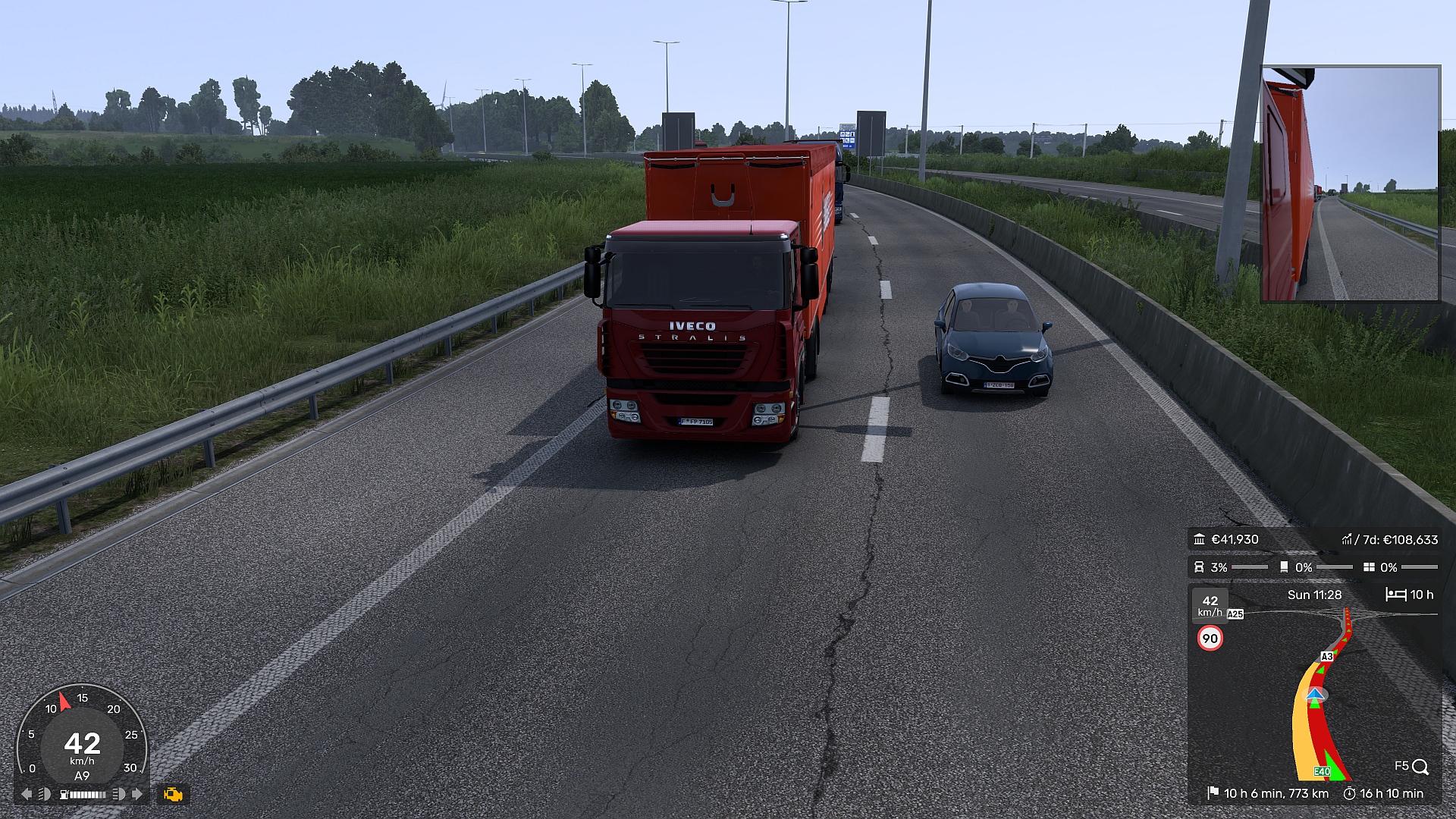
For all its strengths, Euro Truck Simulator 2 is not without flaws, and the most obvious issue remains the traffic AI, which can still behave unpredictably despite years of improvements. Computer-controlled drivers occasionally brake suddenly, merge awkwardly, or create frustrating accidents that feel artificial rather than believable, which can disrupt immersion during otherwise excellent driving sequences.
Some gameplay systems also lack the same depth as the driving mechanics themselves because company management eventually becomes fairly passive once enough employees are hired, while economic systems remain functional rather than especially sophisticated. Players hoping for highly detailed logistics simulation may eventually find the business side of the game somewhat limited compared to the richness of the driving experience.
The structure can also become repetitive depending on player expectations, because the game fundamentally revolves around transporting cargo between locations over and over again. Euro Truck Simulator 2 succeeds precisely because of repetition and routine rather than despite them, which means players who do not connect with that slower rhythm may eventually lose interest regardless of the quality of the mechanics.
Older regions of the map also show their age more clearly than newer expansions, featuring simpler road layouts, weaker environmental density, and less visual detail overall. SCS Software has reworked several older areas over time, but inconsistencies between old and new content remain noticeable during long journeys across multiple countries.
Even with those shortcomings, however, the core driving experience remains so consistently satisfying that most of the game’s flaws become easier to overlook because the act of operating the trucks itself never stops feeling engaging.
Final Verdict: 9.5/10
Euro Truck Simulator 2 remains one of the best simulation games ever made because it fully understands its own appeal and never attempts to compromise its identity in pursuit of broader mainstream trends. Rather than turning trucking into exaggerated action or artificial spectacle, the game focuses entirely on delivering an authentic and deeply satisfying driving experience built around exceptional vehicle handling, immersive atmosphere, and remarkably convincing road physics.
The realism of the trucks forms the foundation that supports everything else because the handling feels heavy, deliberate, and believable in ways that very few driving games manage to achieve successfully. When combined with a proper steering wheel setup, the game becomes even more impressive, offering one of the most convincing and rewarding vehicle simulation experiences currently available on PC.
Although the structure is repetitive by design and some surrounding systems remain relatively simplistic, the core act of driving is so enjoyable that those issues rarely undermine the overall experience. Long after many games would become exhausting or monotonous, Euro Truck Simulator 2 remains consistently absorbing because the mechanics themselves continue to feel satisfying hour after hour.
More than a decade after release, Euro Truck Simulator 2 still feels unmatched within its niche because it succeeds through confidence, atmosphere, and mechanical depth rather than spectacle, ultimately establishing itself not only as an outstanding trucking simulator, but as one of the finest driving games available on PC.