
There’s a particular kind of confidence you notice almost immediately when playing Replaced, and it comes not from spectacle or an overload of systems, but from a clear and consistent creative vision that rarely wavers. From the opening sequence onward, the game establishes a tone that feels deliberate and carefully constructed, presenting a world where every visual layer, animation, and sound cue contributes to a unified atmosphere. It is the kind of experience that does not try to overwhelm you with scale or complexity, but instead draws you in through cohesion and attention to detail.
After a long development cycle marked by delays and growing expectations, Sad Cat Studios’ debut arrives on PC carrying the weight of anticipation that often proves difficult for indie titles to meet. What makes Replaced stand out is not that it attempts to radically redefine the 2.5D action-platformer, but that it understands the strengths of the genre and refines them with an emphasis on cinematic presentation and environmental storytelling. The result is a game that feels purposeful in nearly every aspect, even when its limitations become more apparent over time.
While it does not escape criticism, particularly in the depth of its combat systems and the pacing of certain sections, Replaced succeeds in delivering an experience that feels distinct and memorable, largely because it knows exactly what it wants to be and rarely strays from that identity.
Setting and Narrative
Set in an alternate version of 1980s America shaped by nuclear catastrophe and unchecked corporate dominance, Replaced presents a world that feels both grounded and surreal, blending familiar cultural elements with a darker, more oppressive reality. Society has fractured into sharply defined layers, where those with power exist in controlled environments that preserve a sense of order, while the rest are left navigating a decaying urban landscape filled with uncertainty and quiet desperation.

You take control of R.E.A.C.H., an artificial intelligence placed into a human body against its will, and this premise immediately establishes a sense of detachment that defines the narrative experience. Rather than presenting a traditional hero with clear motivations and emotional grounding, the game places you in the role of an observer trying to understand both the world and the concept of humanity itself. This perspective proves to be one of the game’s strongest narrative tools, as it allows the story to unfold naturally through discovery rather than exposition.
The storytelling approach relies heavily on environmental detail, subtle interactions, and fragmented information, which encourages players to pay attention to their surroundings rather than simply follow a linear sequence of events. Conversations often feel incidental rather than staged, and much of the world-building is conveyed through implication rather than direct explanation, creating a sense of authenticity that strengthens immersion.
At the same time, this restrained approach occasionally works against the game, as certain characters and narrative threads feel underdeveloped, leaving the impression that there is more depth beneath the surface that is never fully explored. While this ambiguity can be effective in maintaining tone, it sometimes results in a lack of emotional payoff, particularly in moments that seem designed to carry more narrative weight.
Despite these shortcomings, the writing maintains a consistent voice, avoiding excessive exposition and resisting the urge to over-explain its themes. Ideas surrounding identity, control, and the nature of consciousness are present throughout, but they are handled with subtlety, allowing the player to interpret them without being guided too directly.
Gameplay and Mechanics
At its foundation, Replaced is built around a combination of traversal, combat, and light puzzle-solving, all of which are integrated into a structure that prioritizes flow and readability over mechanical complexity. Movement feels grounded and deliberate, with animations that emphasize weight and physicality, making even simple actions like running or climbing feel connected to the world.
Platforming sequences are designed to be challenging enough to remain engaging without becoming frustrating, as the game consistently communicates its expectations clearly. The controls are responsive, and the level layouts are structured in a way that minimizes ambiguity, ensuring that failures feel like the result of player error rather than unclear design.
Exploration, while limited by the game’s linear framework, is still encouraged through the inclusion of optional paths and environmental details that reward curiosity. These moments do not significantly alter the overall progression, but they add texture to the experience, giving players a reason to slow down and engage more deeply with the world.
Combat serves as the primary mechanical focus, built around timing-based interactions that emphasize counters, dodges, and pattern recognition. Encounters are typically confined to specific areas, allowing the game to control pacing and presentation while encouraging players to engage with the system on its own terms. When executed well, combat feels fluid and visually dynamic, with transitions between actions that reinforce the game’s cinematic ambitions.
However, the system’s limitations become more noticeable over time, as the introduction of new abilities does not significantly expand the core mechanics. While upgrades provide incremental improvements, they rarely change how encounters are approached, leading to a sense of repetition that becomes more pronounced in the latter half of the game. This lack of evolution does not diminish the quality of individual encounters, but it does affect the overall sense of progression.
Level Design and World Structure
The structure of Replaced is intentionally controlled, favoring curated sequences over open-ended exploration. This approach allows the developers to maintain a consistent pace and ensure that each segment of the game contributes to the overall experience, but it also limits the sense of player agency in how the world is navigated.
Environments are carefully designed to support both gameplay and storytelling, with each area offering a distinct visual identity that reinforces its role within the broader world. The use of depth within the 2.5D perspective adds variation without complicating navigation, occasionally shifting the player into different planes to create a sense of movement through space.
Pacing is generally effective, with the game alternating between action-heavy sequences and quieter moments of exploration, although there are instances where this balance feels uneven. Some sections extend beyond their natural endpoint, while others move too quickly to fully develop their ideas, resulting in a rhythm that occasionally feels inconsistent.
Despite these issues, the overall design remains cohesive, with each area contributing to the sense of progression and reinforcing the game’s thematic focus.
Visuals, Art Direction, and Presentation
Visually, Replaced stands out as one of the most striking examples of modern pixel art, not simply because of its technical quality, but because of how deliberately every visual element contributes to the overall tone of the experience. The environments are built with an impressive level of density, layering foreground, midground, and background details in a way that creates a tangible sense of depth without compromising clarity. Rather than feeling like flat backdrops, each location has a physical presence, with subtle motion, environmental effects, and carefully placed lighting that make the world feel active even when the player is standing still.
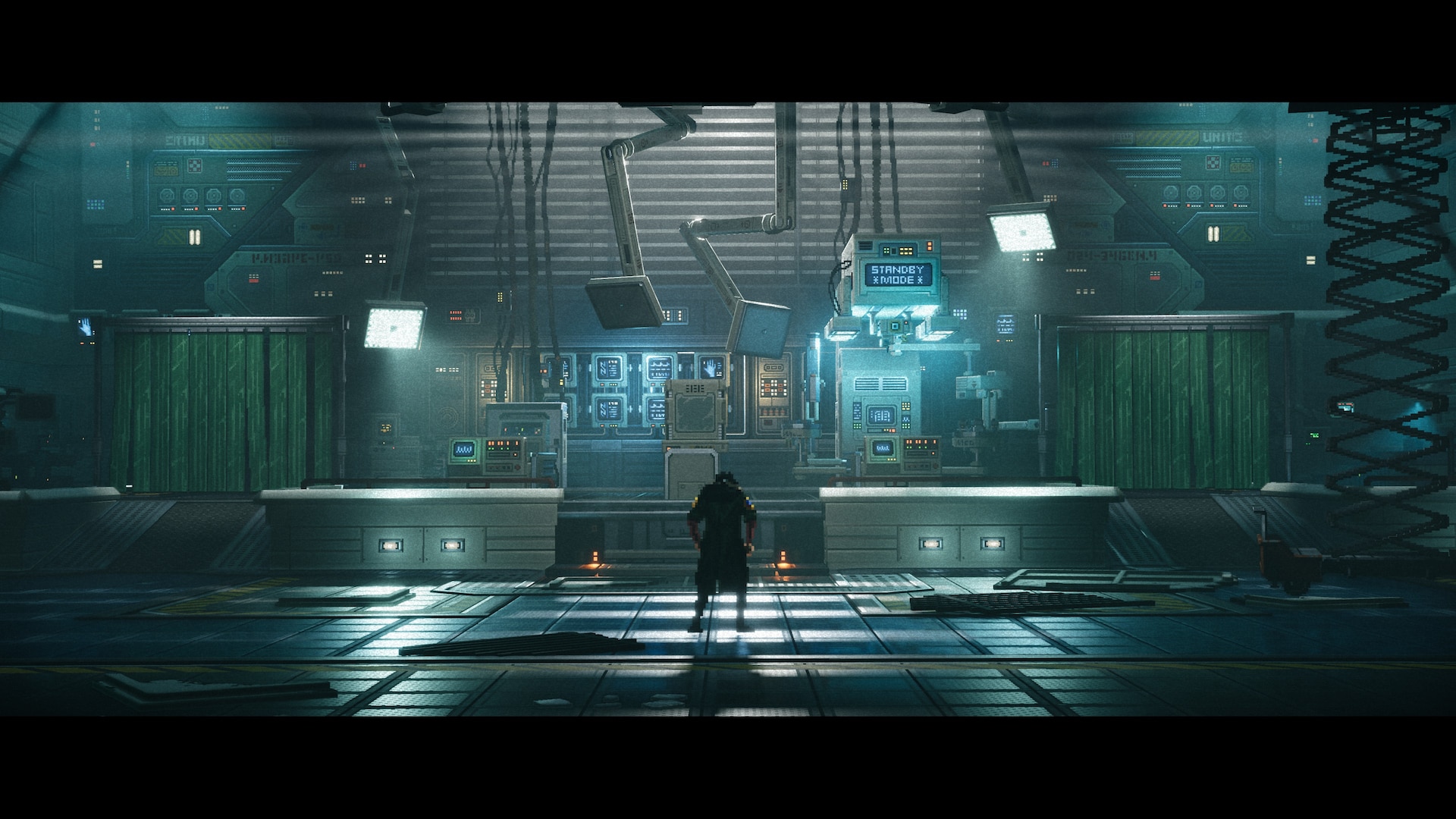
The art direction leans heavily into a retro-futuristic aesthetic, drawing clear inspiration from classic science fiction and cyberpunk imagery, yet it avoids feeling derivative by maintaining a consistent and restrained visual language. Neon signage, industrial decay, and muted urban palettes are used thoughtfully, ensuring that no single element overwhelms the scene. Color is applied with precision, often contrasting warm artificial lighting against colder environmental tones, which helps guide the player’s attention while reinforcing the emotional tone of each area.
Lighting is arguably the most defining component of the game’s presentation, as it does far more than illuminate the environment. Dynamic light sources, reflections, and shadow work are used to shape mood, highlight movement, and add dimensionality to the pixel art in a way that elevates it beyond traditional expectations of the style. Rain-soaked streets reflect flickering neon lights, interiors are punctuated by harsh artificial illumination, and darker areas rely on subtle gradients to maintain visibility without sacrificing atmosphere. This careful balance ensures that the game remains readable while still preserving its visual identity.
Animation quality further enhances the experience, with character movements that feel fluid, weighty, and grounded. Every action, from running and climbing to combat interactions, is animated with a level of detail that reinforces the physicality of the world. Transitions between animations are smooth and often seamless, which helps maintain immersion and supports the game’s cinematic ambitions. Enemy movements and environmental animations are given similar attention, ensuring that the world feels cohesive rather than segmented.
The game also makes effective use of cinematic framing and camera movement, subtly adjusting angles, zoom levels, and perspectives to emphasize key moments or guide the player’s focus. These shifts are never intrusive, but they add a layer of intentionality to the presentation that makes the experience feel more curated. Certain sequences lean more heavily into this cinematic approach, blurring the line between gameplay and scripted moments without taking control away from the player.
User interface design follows the same philosophy of restraint and cohesion, remaining minimal and unobtrusive while still providing the necessary information. Menus are clean and consistent with the overall aesthetic, avoiding overly modern design elements that would clash with the game’s setting. Transitions between gameplay, menus, and cutscenes are handled smoothly, maintaining visual continuity and preventing jarring shifts in presentation.
What ultimately sets Replaced apart is not just the quality of its visuals, but the consistency with which they are applied. Every element, from lighting and animation to color grading and camera work, feels aligned with a singular vision. This level of cohesion ensures that the presentation never feels like a collection of impressive features, but rather a unified whole that supports the game’s atmosphere and narrative at every moment.
Audio and Sound Design
The audio design in Replaced complements its visual presentation with a soundtrack that leans heavily on synth-driven compositions, creating a soundscape that aligns with the game’s retro-futuristic setting while maintaining its own identity. Music is used dynamically, shifting in intensity to match the tone of each moment, whether during combat or exploration.
Environmental audio adds further depth, with ambient sounds that reinforce the sense of place and contribute to immersion. From the hum of machinery to distant voices and subtle background noise, the world feels alive in a way that supports the game’s narrative approach.
Voice acting is used sparingly, allowing environmental storytelling to remain the primary method of narrative delivery. Performances are solid, though not particularly memorable, serving their purpose without drawing unnecessary attention.
Technical Performance on PC
On PC, Replaced offers a stable and generally well-optimized experience that benefits from the inherent efficiency of its 2.5D design, while still showcasing enough visual complexity to take advantage of modern hardware. The game runs smoothly across a wide range of configurations, maintaining consistent frame rates even during more visually dense scenes that combine layered pixel art, dynamic lighting, and multiple animated elements. This balance between visual fidelity and performance is one of the more understated strengths of the PC version, as it allows the presentation to shine without demanding excessively high-end components.
Load times are minimal, and transitions between gameplay segments and cinematic sequences are handled seamlessly, reinforcing the game’s cinematic flow without unnecessary interruptions. This is particularly important in a title so focused on immersion, as even brief technical disruptions could otherwise break the carefully constructed atmosphere. In most cases, the experience remains fluid from start to finish, with no major performance drops or instability during extended play sessions.
The graphical settings menu provides a reasonable level of flexibility, allowing players to adjust key options such as resolution, lighting effects, and overall quality presets. While the range of customization is not as extensive as in more technically demanding PC titles, it is sufficient to accommodate different setups without overcomplicating the experience. Support for ultrawide resolutions is a welcome inclusion, enhancing the sense of scale in certain environments, although the impact varies depending on the scene composition.

Control implementation is solid across both keyboard and mouse and controller setups, though the latter tends to feel more natural, particularly during combat, where timing and directional input play a crucial role. Keyboard controls are responsive and fully functional, but the analog precision of a controller better complements the game’s movement and combat systems. Input latency is minimal, and actions register consistently, which is essential for maintaining the rhythm of both platforming and combat encounters.
There are occasional technical issues, including minor visual glitches, brief animation hiccups, and rare collision inconsistencies, which can momentarily disrupt immersion, especially given the game’s emphasis on presentation. These issues are not frequent enough to significantly impact overall enjoyment, but they are noticeable when they occur, largely because the rest of the experience is so polished. Some players may also encounter minor stuttering during scene transitions or when entering new areas, although these instances are typically brief and do not persist.
In terms of system stability, crashes and major bugs appear to be rare, and the game handles extended sessions without noticeable degradation in performance. This reliability contributes to a sense of confidence in the PC version, as players can engage with the game without needing to account for frequent technical interruptions.
Overall, the PC experience of Replaced is strong and consistent, delivering a level of performance that supports its artistic ambitions without drawing attention away from them. While it may not push hardware to its limits or offer an extensive suite of advanced graphical options, it succeeds in providing a smooth, accessible, and visually impressive experience that aligns well with the game’s overall design philosophy.
Final Verdict: 8/10
Replaced succeeds primarily because of how well it brings its individual elements together into a cohesive and carefully directed experience, rather than because of any single standout system that dominates the design. Its strongest qualities lie in its atmosphere, visual identity, and overall presentation, all of which work in harmony to create a world that feels distinctive and consistently engaging from beginning to end. The combination of detailed pixel art, thoughtful lighting, and strong audio design ensures that the game maintains a sense of immersion that few titles in its genre manage to sustain so effectively.
At the same time, the game’s more restrained approach to mechanics reveals clear limitations, particularly in its combat system, which, while polished and satisfying in shorter bursts, does not evolve enough over time to maintain a strong sense of progression. Encounters remain visually impressive, but the lack of meaningful mechanical expansion can lead to repetition, especially in the later stages, where players may begin to feel that they have already seen most of what the system has to offer.
The narrative follows a similar pattern, delivering a compelling premise and a well-realized setting, yet occasionally falling short in fully developing its characters and ideas. While the decision to rely on subtle storytelling and environmental detail strengthens the overall tone, it also results in moments where emotional impact feels somewhat muted, as certain narrative threads are not explored as deeply as they could have been.
Despite these shortcomings, Replaced remains a highly memorable experience that demonstrates a clear creative vision and a strong understanding of its strengths. It does not attempt to compete through scale or complexity, but instead focuses on delivering a tightly constructed journey that emphasizes mood, pacing, and presentation. For players who value atmosphere and artistic direction as much as gameplay depth, it stands as an easy recommendation, offering a polished and thoughtfully crafted experience that leaves a lasting impression even after its limitations become apparent.


