
The WWE 2K series has spent the better part of the last few years rebuilding itself, slowly recovering from a period that nearly derailed it entirely. What once felt like a franchise struggling to justify its annual release schedule has, more recently, started to regain a sense of purpose, leaning into stronger in-ring mechanics and a broader suite of modes designed to keep players invested long after the novelty wears off. With WWE 2K26, the expectations have shifted accordingly. This is no longer about proving the series can function—it is about proving it can excel.
On the surface, this year’s entry appears to be exactly what longtime fans have been asking for, as it refines the core gameplay, expands nearly every major mode, and takes advantage of more modern hardware to deliver a cleaner and more consistent technical experience on PC. It is, in many respects, the most complete version of the WWE 2K formula to date, offering a staggering amount of content alongside a wrestling system that feels more deliberate and grounded than it has in years.
However, beneath that surface lies a familiar tension that the series still has not fully resolved. While the moment-to-moment action inside the ring often feels fantastic, the systems that surround it—from progression to monetization—sometimes undermine the sense of satisfaction that should come from investing time into the game. The result is a release that feels both polished and frustrating, confident in its strengths but still weighed down by decisions that hold it back from true greatness.
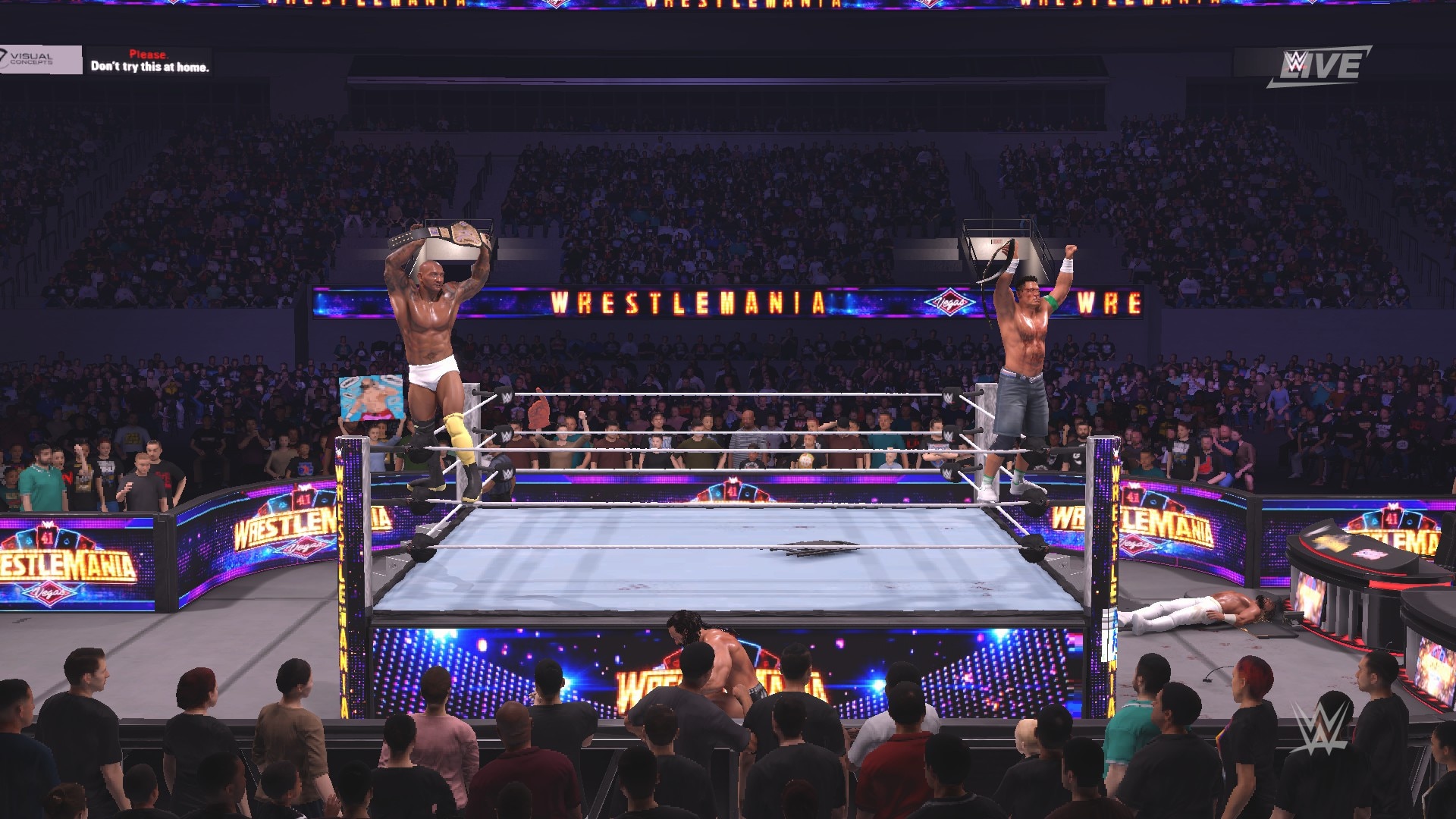
Gameplay and Mechanics
The most important question for any wrestling game is whether it captures the rhythm and drama of a match, and in this regard, WWE 2K26 makes a strong case for itself almost immediately. Rather than attempting to reinvent the wheel, this year’s installment focuses on refining the mechanics introduced in recent entries, smoothing out rough edges while introducing subtle changes that have a surprisingly meaningful impact on how matches unfold.
The pacing, in particular, has seen noticeable improvement. Matches no longer devolve into endless cycles of reversals and counters, which had become a common frustration in previous games. Instead, the revised stamina system forces players to think more carefully about their actions, as aggressive playstyles can quickly lead to exhaustion, leaving wrestlers vulnerable at critical moments. This creates a more natural ebb and flow, where bursts of offense are followed by periods of recovery, giving matches a structure that feels closer to what fans expect from televised wrestling.
At the same time, this shift toward a more deliberate pace comes with a trade-off that not every player will appreciate. Compared to the faster, more arcade-like energy of the WWE SmackDown! vs. Raw series, WWE 2K26 can feel noticeably slower, and at times, less immediately exciting. Where those earlier games thrived on responsiveness, exaggerated momentum, and a constant sense of escalation, the current simulation-leaning approach prioritizes control and realism, sometimes at the expense of spontaneity. As a result, matches can occasionally feel drawn out, and for players who prefer a more pick-up-and-play style of wrestling game, the experience may come across as somewhat restrained, or even dull during longer sessions.
Reversals themselves have also been rebalanced in a way that encourages timing and awareness rather than pure reflex. While the system is still accessible enough for newcomers to grasp, it rewards players who take the time to learn animations and anticipate their opponent’s moves, which adds a layer of strategy that has often been missing from the series. When everything clicks, the back-and-forth exchanges feel tense and satisfying, with each successful counter carrying real weight.
The expanded use of environmental interactions further enhances the sense of spectacle, allowing players to incorporate the arena itself into their matches in more dynamic ways. Whether it is slamming an opponent into the barricade, setting up elaborate table spots, or using weapons to escalate the intensity of a bout, these additions contribute to a sandbox-like quality that fits naturally within the exaggerated world of professional wrestling. Importantly, these features are integrated in a way that feels optional rather than intrusive, meaning players can engage with them as much or as little as they prefer.
Animation work has also seen incremental improvements, with transitions between moves appearing smoother and less prone to the awkward pauses that have historically plagued the series. While there are still occasional moments where character models clip or behave unpredictably, these instances are less frequent than before, allowing matches to maintain their momentum more consistently.
Despite these advances, the gameplay is not without its shortcomings. Certain match types still rely on mechanics that feel outdated, particularly those that emphasize rapid button inputs over timing or strategy. These sequences can disrupt the otherwise measured pacing of the game, reducing key moments to frantic input rather than meaningful interaction. Additionally, while the reversal system is generally more balanced, there are still instances where it behaves inconsistently, leading to situations where players feel as though they have been punished despite making the correct read.
Even with these issues, the core experience remains compelling. The act of wrestling—of building a match, controlling its tempo, and delivering its climactic moments—has rarely felt this cohesive in a WWE game. It is a foundation strong enough to support everything else, even when the surrounding systems do not always live up to the same standard.

Game Modes and Content
If there is one area where WWE 2K26 leaves little room for complaint in terms of sheer quantity, it is the breadth of its content. The game offers an extensive lineup of modes that cater to a wide range of playstyles, from narrative-driven experiences to open-ended sandbox systems and competitive multiplayer environments. Rather than treating these modes as isolated features, the game attempts to weave them into a broader ecosystem, though the results of this approach are somewhat mixed.
The Showcase mode serves as a curated historical experience, focusing this year on the career and rivalries of CM Punk. It combines traditional match objectives with documentary-style presentation, blending gameplay with archival footage to recreate key moments while also exploring hypothetical scenarios that deviate from real-world events. This willingness to experiment gives the mode a sense of novelty, even for players who have engaged with similar offerings in previous entries. The pacing is generally effective, although the reliance on repeated objectives can occasionally make the experience feel formulaic over time.
MyRISE continues to function as the game’s primary narrative mode, offering players the chance to guide a custom superstar through a branching storyline filled with rivalries, alliances, and career-defining moments. This year’s iteration introduces multiple story paths and a greater emphasis on player choice, which helps create a sense of agency that has sometimes been lacking in the past. However, while the structure is more streamlined, it can also feel somewhat constrained, as the underlying systems do not always support the level of variation that the premise suggests. The writing, while generally solid, occasionally falls into predictable patterns, and repetition becomes more noticeable the longer the mode is played.
Universe mode remains one of the most flexible and enduring features in the series, allowing players to create and manage their own version of WWE programming. With improved tools for setting up rivalries, scheduling matches, and customizing events, it offers a level of control that few sports games can match. The addition of new management tools simplifies the setup process, making it more accessible without sacrificing depth. For players who enjoy crafting their own narratives, this mode continues to be a standout, even if its underlying systems have not changed dramatically.
MyGM builds on its previous iterations by expanding the scope of its management mechanics, introducing additional match types, deeper roster management options, and more variables to consider when booking shows. Balancing budgets, managing wrestler morale, and competing against rival brands adds a strategic layer that contrasts nicely with the in-ring action. While it does not reach the complexity of dedicated management simulations, it strikes a balance that makes it engaging without becoming overwhelming.
The Island, a more experimental addition, attempts to blend elements of online multiplayer, progression systems, and social interaction into a shared space where players can complete objectives, participate in matches, and develop their custom characters. While the concept is ambitious, its execution is uneven. The progression system is heavily reliant on grinding, and the structure can feel repetitive, particularly for players who are not invested in its long-term rewards.
MyFACTION continues to evolve as a card-based mode centered around collecting and upgrading wrestlers to build competitive teams. While new mechanics add strategic depth, the mode is closely tied to the game’s monetization systems, which can make progression feel uneven depending on how much time or money players are willing to invest. This tension is one of the most divisive aspects of the overall package, as it introduces a layer of friction that is difficult to ignore.
Taken together, these modes form a package that is undeniably comprehensive, offering something for nearly every type of player. However, the quality of these experiences varies, and the more systems the game introduces, the more noticeable its inconsistencies become.

Visuals and Presentation
From a technical standpoint, the PC version of WWE 2K26 represents a clear step forward for the series, benefiting from the decision to focus on more modern hardware. Character models are more detailed than ever, with improved textures, lighting, and facial animations that help bring the roster to life. Wrestlers show visible signs of wear during matches, with sweat and damage accumulating in ways that enhance the sense of realism.
That said, the improvements are not entirely uniform. While many top-tier wrestlers look remarkably close to their real-world counterparts, others still suffer from stiffness or minor inaccuracies that prevent them from reaching the same level of fidelity. Hair physics, in particular, remain inconsistent, occasionally behaving in ways that break immersion.
The presentation as a whole continues to be one of the game’s strongest aspects. Entrances are elaborate and faithful to their real-world counterparts, commentary is more dynamic than in previous years, and the overall broadcast style does an effective job of replicating the feel of WWE programming. The inclusion of a wide range of arenas, both modern and classic, adds variety and helps reinforce the sense of history that the series aims to capture.
Performance on PC is generally stable, with smooth frame rates in most scenarios, although larger matches with multiple wrestlers can still lead to occasional slowdowns. These issues are not frequent enough to significantly impact the experience, but they serve as a reminder that optimization is still an ongoing process.
Roster and Creation Suite
Few games can match the sheer scale of WWE 2K26’s roster, which includes hundreds of wrestlers spanning multiple generations. This breadth allows players to recreate classic matches, explore dream scenarios, or simply experiment with different combinations of characters. The attention to detail in movesets and entrances ensures that most wrestlers feel distinct, which adds to the overall authenticity of the experience.
The Creation Suite remains one of the most powerful tools in the game, offering extensive customization options that allow players to design their own wrestlers, arenas, championships, and more. The depth of these tools is impressive, and the ability to share creations with the community extends the game’s lifespan considerably. For many players, this feature alone provides enough content to keep them engaged for months.
Technical Performance on PC
The PC version benefits from improved visuals and faster load times, making it one of the best ways to experience the game. While it is not entirely free of technical issues, it offers a more consistent experience than previous entries, particularly for players with high-end hardware. Modding potential, while not officially supported in a comprehensive way, continues to be a major advantage, allowing the community to expand and refine the game over time.
One of the more noticeable improvements on PC comes from overall stability during standard one-on-one matches and smaller-scale encounters, where the game is able to maintain a smooth frame rate with very few interruptions. Load times between entrances, matches, and menus are generally quick, especially when installed on an SSD, which helps keep the flow of play intact. The responsiveness of controls also benefits from higher frame rates, making timing-based mechanics like reversals feel more reliable when performance is consistent. For players with mid-to-high-end systems, this results in an experience that feels noticeably more fluid than its console counterparts.

However, the experience becomes less consistent as match complexity increases. Multi-man matches, particularly those involving six or more wrestlers, can introduce performance dips that disrupt the otherwise steady pacing. These moments are not constant, but they occur frequently enough to be noticeable, especially in modes that rely heavily on larger match cards. In addition, certain transitions—such as camera cuts during entrances or sudden shifts in animation—can still produce minor stuttering.
There are also occasional technical quirks that persist despite the overall improvements. Collision detection can sometimes behave unpredictably, leading to moves connecting in ways that look unnatural, while rare glitches involving character positioning or referee behavior can break immersion. None of these issues are severe enough to render the game unplayable, but they contribute to a sense that the engine is still being pushed to its limits.
Even with these drawbacks, the PC version remains the most flexible way to play WWE 2K26. The ability to fine-tune graphical settings, combined with the potential for community-driven enhancements, ensures that players can tailor the experience to suit their preferences. Over time, as patches address some of the lingering issues and the modding scene continues to evolve, the PC version is likely to become even stronger, reinforcing its position as the definitive platform for players willing to invest in it.
Monetization and Progression
One of the most contentious aspects of WWE 2K26 lies in its approach to progression and monetization. The introduction of a battle pass-style system changes how players unlock content, shifting the focus from direct rewards to tiered progression that often requires significant time investment. While this system can provide a sense of ongoing engagement, it also risks turning the game into a grind, particularly for those who prefer to unlock content at their own pace.
This approach is most noticeable in modes like MyFACTION and The Island, where progression is closely tied to both time and optional purchases. While it is possible to enjoy these modes without spending additional money, doing so often requires a level of commitment that may not appeal to all players. The result is a system that can feel at odds with the otherwise generous amount of content the game provides.
Final Verdict: 6/10
WWE 2K26 is a game that succeeds in many of the areas that matter most, delivering a refined wrestling experience supported by an impressive range of content and improved technical performance on PC. Its gameplay strikes a satisfying balance between accessibility and depth, and its various modes ensure that there is always something to engage with, regardless of player preference.
At the same time, it is difficult to ignore the issues that persist beneath the surface. Monetization systems feel more intrusive than they should, certain mechanics remain outdated, and not all of its ambitious features reach their full potential. These shortcomings do not overshadow the game’s strengths, but they do prevent it from achieving the level of consistency that would make it truly exceptional.
For fans of wrestling games, WWE 2K26 is an easy recommendation, offering one of the strongest core experiences the series has produced in years. However, it is also a reminder that even as the series continues to improve, there is still work to be done before it can fully deliver on its potential.


