The CRPG genre has experienced a quiet resurgence over the past decade. While mainstream gaming has leaned toward cinematic action and sprawling open worlds, a different tradition has continued to evolve in parallel—one rooted in dense writing, player choice, and mechanics inspired by tabletop role-playing. Games in this lineage often prioritize conversation and consequence over spectacle. They rarely chase the broadest audience, but when they succeed, they tend to leave a lasting impression.
Esoteric Ebb belongs squarely within this tradition. Developed by Christoffer Bodegård and published by Raw Fury, the PC release arrives with clear ambitions: to create a narrative-driven role-playing experience that places investigation, dialogue, and personal expression at the center of the experience. It is a game built on words and ideas as much as mechanics. Instead of presenting players with an endless stream of battles and loot, it focuses on conversations, internal debates, and the strange consequences of a world where magic exists alongside mundane social structures.

At first glance, it is difficult not to think of Disco Elysium. The influence is evident in the game’s emphasis on skill-driven dialogue, internal voices that comment on the player’s choices, and a story structured around solving a central mystery. Yet Esoteric Ebb does not simply recreate that formula in a different setting. It moves the concept into a fantasy environment and approaches its themes with a different tone. Where some narrative RPGs dwell heavily on bleak introspection or philosophical monologues, this game leans toward dry humor, eccentric worldbuilding, and a sense of playful experimentation.
The result is an RPG that feels unusually flexible. It invites players to try strange approaches, embrace failure, and see how the narrative reacts. It is less concerned with presenting a perfect heroic arc and more interested in letting the player inhabit an unpredictable role within a living city. This freedom is both the game’s greatest strength and the source of some of its rough edges.
Like many ambitious role-playing games, Esoteric Ebb can be messy at times. Its systems occasionally feel overwhelming, and its pacing sometimes slows under the weight of its own dialogue. Yet those imperfections are part of what makes it interesting. The game is not trying to smooth every corner or streamline every mechanic. Instead, it embraces complexity in a way that feels refreshingly old-fashioned.
For players who enjoy narrative-heavy RPGs and the freedom to shape a character through conversation and decision-making, Esoteric Ebb offers an experience that is both unusual and memorable.
Premise and Setting
The story begins with a moment that is deliberately disorienting. Your character awakens in a morgue after being pulled from a river, surrounded by corpses and medical staff who seem only mildly surprised by the situation. It is not a dramatic resurrection scene or a heroic beginning. Instead, it feels slightly absurd, as if the game wants to establish immediately that the world does not operate according to typical fantasy conventions.
The protagonist is known simply as The Cleric, an investigator affiliated with a religious order that deals with unusual incidents within the city of Norvik. The title suggests spiritual authority, but the job itself resembles something closer to a mixture of detective work, bureaucracy, and arcane troubleshooting. When magical events spiral out of control or mysterious disturbances threaten the public order, the Cleric is sent to figure out what happened.
Your first assignment involves an explosion at a tea shop, an event that might seem minor compared to the apocalyptic threats common in fantasy RPGs. Yet the timing makes it significant. The incident occurs just days before Norvik’s first democratic election, a political milestone that has already created tension throughout the city. Local authorities are eager to avoid scandal, but they also cannot ignore the possibility that something more dangerous is unfolding beneath the surface.
From that starting point, the investigation slowly expands. What initially appears to be a simple case of sabotage begins to reveal deeper political conflicts, hidden agendas, and traces of ancient magical systems that still influence the city’s structure. The narrative unfolds gradually, allowing the player to uncover details piece by piece rather than presenting a single dramatic revelation.
Norvik itself is one of the most compelling aspects of the game. It is not a typical fantasy metropolis filled with towering castles and heroic legends. Instead, it feels more like a working city shaped by economic pressures, social tensions, and the practical consequences of living in a world where magic exists.
Magic in Norvik is not treated as an abstract force reserved for epic battles. It is part of daily life, integrated into infrastructure, religion, and commerce. Spells can influence trade, law enforcement, and even social hierarchies. This integration gives the setting a sense of internal logic. The world feels constructed rather than decorative, with institutions and systems that respond to the presence of supernatural abilities.
The city also has a layered political environment. Different factions compete for influence, and the upcoming election has intensified existing rivalries. While the player begins with a fairly narrow investigative task, it soon becomes clear that the tea shop explosion intersects with broader struggles over power, ideology, and control of magical knowledge.
What makes the setting particularly effective is how grounded it feels despite its fantasy elements. Characters worry about rent, complain about bureaucracy, and argue about local politics. The result is a city that feels inhabited rather than staged.
Narrative Structure and Writing
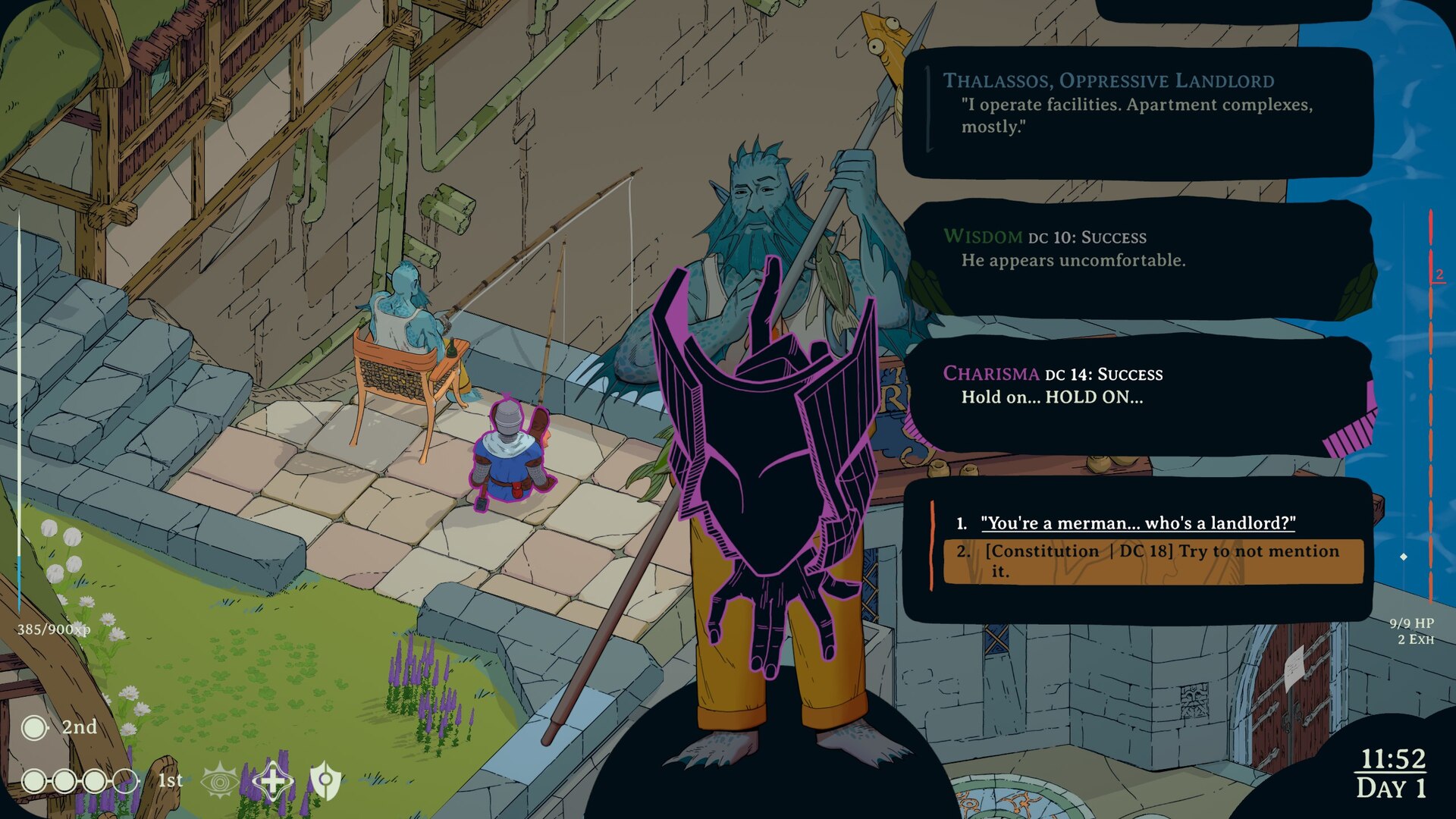
The writing in Esoteric Ebb carries much of the game’s weight. Dialogue is not simply a way to deliver information between action sequences; it is the primary method through which the story unfolds. Conversations can be lengthy, branching into multiple directions depending on the player’s choices, character abilities, and the subtle dynamics of each interaction.
One of the game’s defining mechanics is the presence of internal voices tied to the player’s skills. Each ability—whether it represents perception, knowledge, charisma, or something more mystical—has its own personality. During conversations, these voices may interrupt with advice, observations, or occasionally reckless suggestions.
This system serves several purposes at once. Mechanically, it allows the game to translate character statistics into narrative moments. A character with strong perception might notice subtle clues in a room, while a character with high empathy could interpret emotional cues that others miss. At the same time, the voices create a sense of internal conflict, turning the player’s thought process into part of the dialogue.
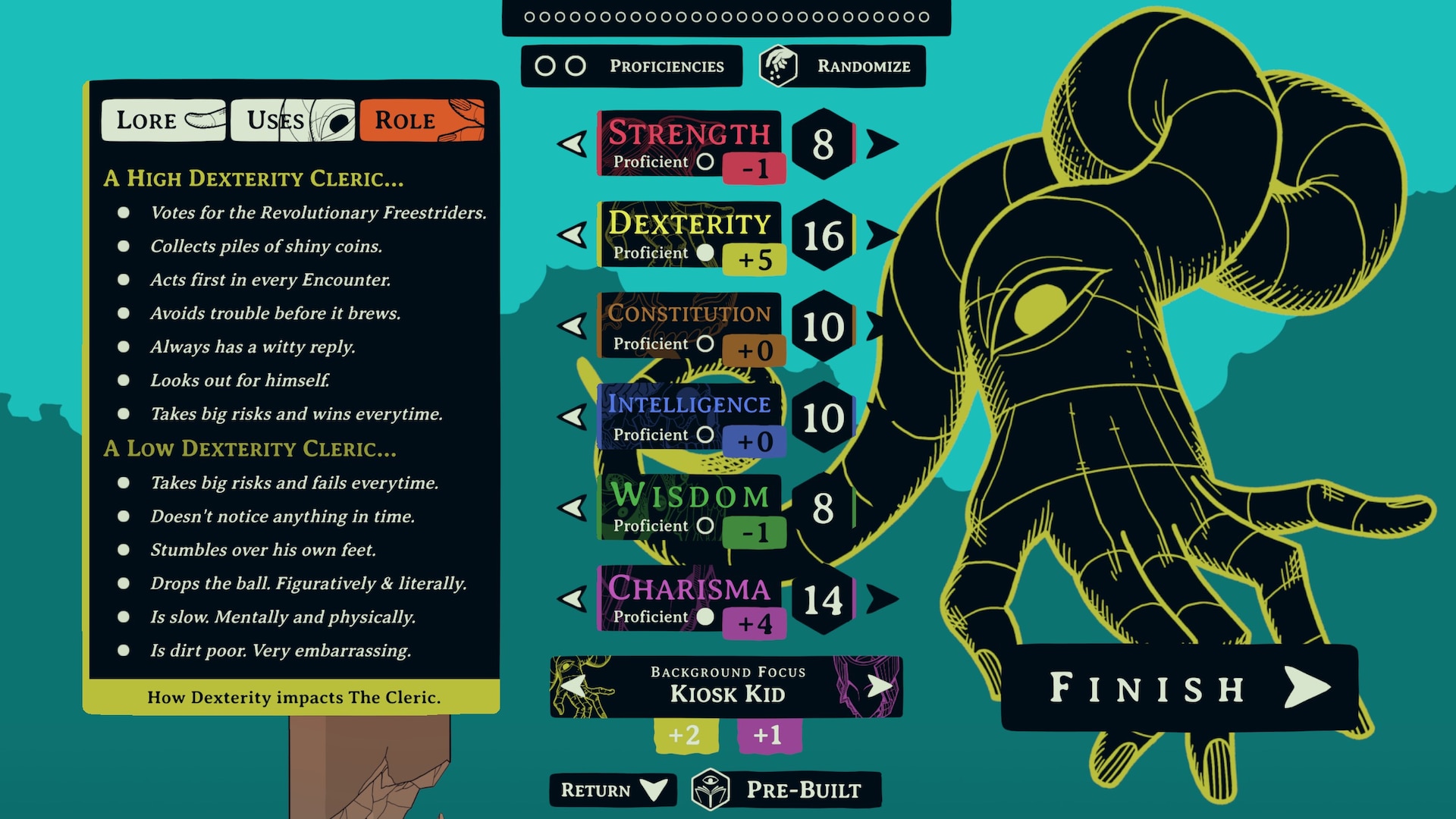
The result is a protagonist who feels less like a blank slate and more like a collection of competing instincts. Depending on how the player distributes their skill points, the Cleric’s internal commentary can shift dramatically. One playthrough might feature a thoughtful investigator guided by careful reasoning, while another might produce a character constantly pushed toward impulsive or strange behavior.
The tone of the writing leans heavily on dry humor and understated absurdity. Characters rarely deliver grand speeches about destiny or heroism. Instead, they talk about mundane concerns, argue over trivial details, and occasionally react to magical events with surprising indifference.
This approach makes the dialogue feel natural even when the subject matter becomes strange. A conversation about arcane energy might suddenly veer into a discussion about municipal regulations or the cost of repairing magical infrastructure. These shifts give the world a lived-in quality that many fantasy settings struggle to achieve.
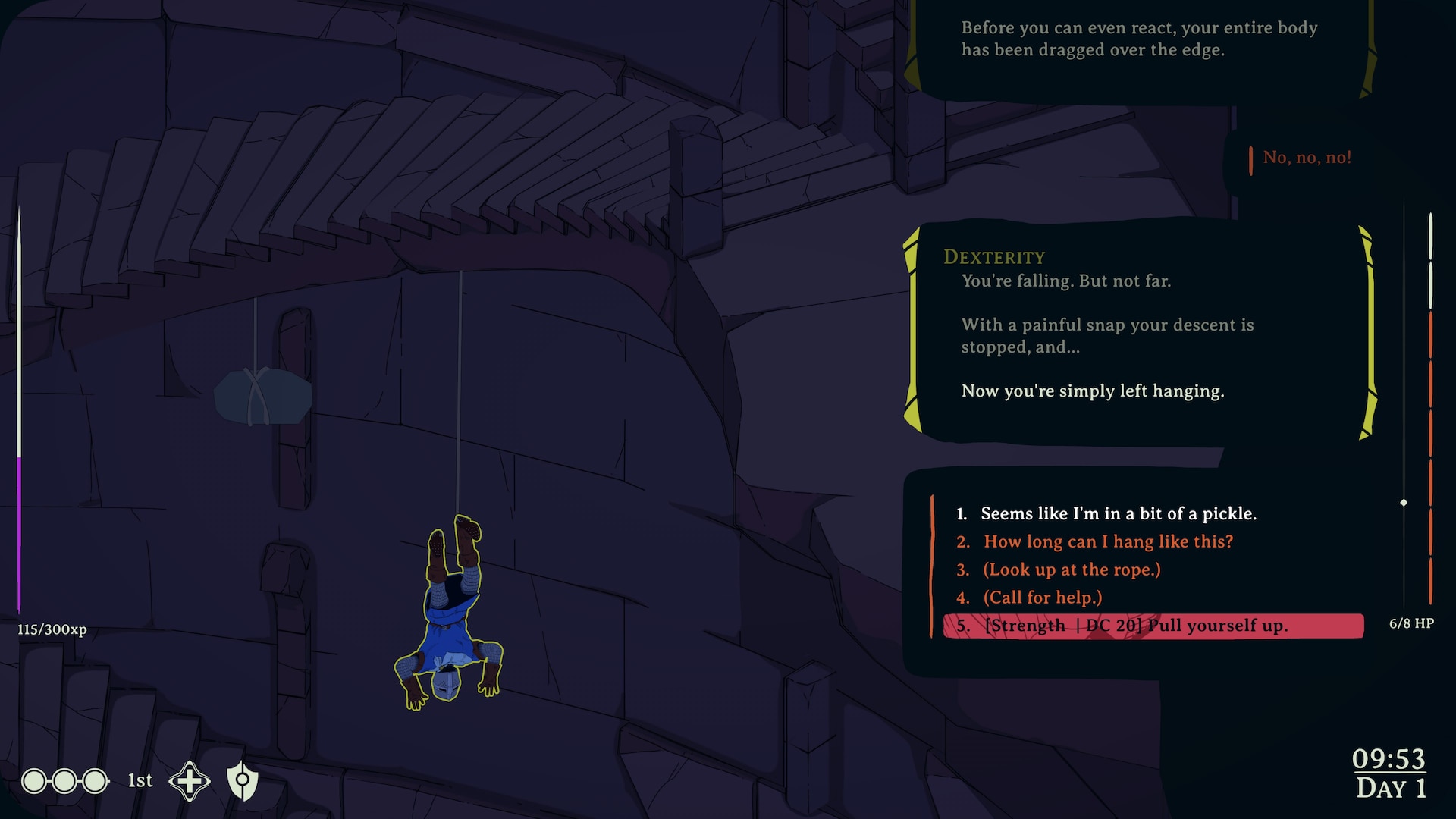
The narrative structure also encourages experimentation. Failing a skill check rarely ends the conversation outright. Instead, failure often leads to alternate outcomes that can be just as interesting as success. A botched attempt to intimidate a suspect might cause them to mock the player rather than cooperate. A failed magical experiment might produce chaotic results that alter the situation entirely.
This design philosophy treats failure as part of the storytelling process rather than a punishment. Players are encouraged to take risks, knowing that even disastrous choices will likely produce new narrative paths rather than simple dead ends.
Gameplay and Mechanics
Mechanically, Esoteric Ebb draws heavily from tabletop role-playing traditions. Dice rolls determine the outcome of many actions, from persuading a witness to examining magical artifacts. These checks compare the player’s skill levels against hidden difficulty values, creating moments of uncertainty that mirror the unpredictability of tabletop campaigns.
However, the game does not revolve around combat encounters in the way many RPGs do. Instead, most challenges occur within conversations or investigative actions. Players spend much of their time gathering information, questioning characters, and testing different approaches to solving problems.

One of the more distinctive systems is the “Questing Tree,” a hybrid mechanic that functions simultaneously as a quest log, skill progression system, and narrative map. Rather than simply listing objectives, the tree represents theories and investigative directions that the player can pursue. For example, discovering a suspicious detail might unlock a branch suggesting a particular explanation for the tea shop explosion. Following that branch could reveal additional dialogue options or abilities that support that interpretation. In this way, the player’s understanding of the story becomes part of the gameplay.
This structure creates a sense that the investigation is shaped by the player’s reasoning rather than predetermined objectives. You are not simply completing tasks handed down by the game. Instead, you are forming hypotheses and testing them through exploration and conversation.
Spellcasting also plays an important role. As a cleric, the protagonist has access to abilities that manipulate reality in subtle ways. Some spells reveal hidden information, others influence characters’ emotions or memories, and a few allow direct interaction with supernatural forces lingering in the environment.
These abilities rarely function as straightforward tools. Using them often carries social or narrative consequences. Casting a spell during a conversation might intimidate a character or raise suspicion among witnesses. In some cases, the results are unpredictable, adding another layer of risk to the decision.
Overall, the mechanics reward curiosity rather than optimization. There is no single correct way to build a character, and the game seems designed to accommodate a wide range of approaches.
Exploration and Player Freedom
Although Norvik is not enormous in scale, it is densely packed with interactions. Each district contains numerous characters, hidden details, and optional stories that expand the world beyond the central investigation.
Exploration often feels more like wandering through a theatrical set than traversing a typical open world. Locations are carefully constructed spaces filled with small narrative moments. A tavern might contain several conversations happening simultaneously, while a residential building might hide personal stories behind closed doors.
The player is free to pursue leads in many different orders. It is possible to focus on the main mystery, or to spend hours exploring side stories that reveal more about the city’s culture and politics. Some of these stories intersect with the central plot, while others exist simply to enrich the setting.
This freedom contributes to the sense that the city operates independently of the player’s actions. Characters continue their routines, political tensions evolve, and new information appears as time passes.
However, the open structure can occasionally feel overwhelming. The game does not always provide clear guidance about which leads are most important. Players who prefer structured objectives may find themselves uncertain about where to go next.
For others, this ambiguity is part of the appeal. The investigation feels organic, driven by curiosity rather than strict instructions.
Combat and Conflict
While dialogue dominates the experience, combat does appear occasionally. When conflicts escalate into violence, the game shifts into a turn-based system where positioning, spells, and dice rolls determine the outcome.
These encounters are relatively rare, but they are designed to feel consequential. The Cleric is not a traditional warrior, and many confrontations carry genuine risk. Entering a fight without preparation can lead to swift defeat.
Interestingly, combat often includes opportunities for negotiation or unconventional tactics. A player might intimidate an opponent mid-battle, manipulate the environment, or escape entirely rather than finishing the fight.
This design reinforces the game’s broader philosophy. Violence is not the default solution, but when it occurs, it feels meaningful.
Art Direction and Visual Style
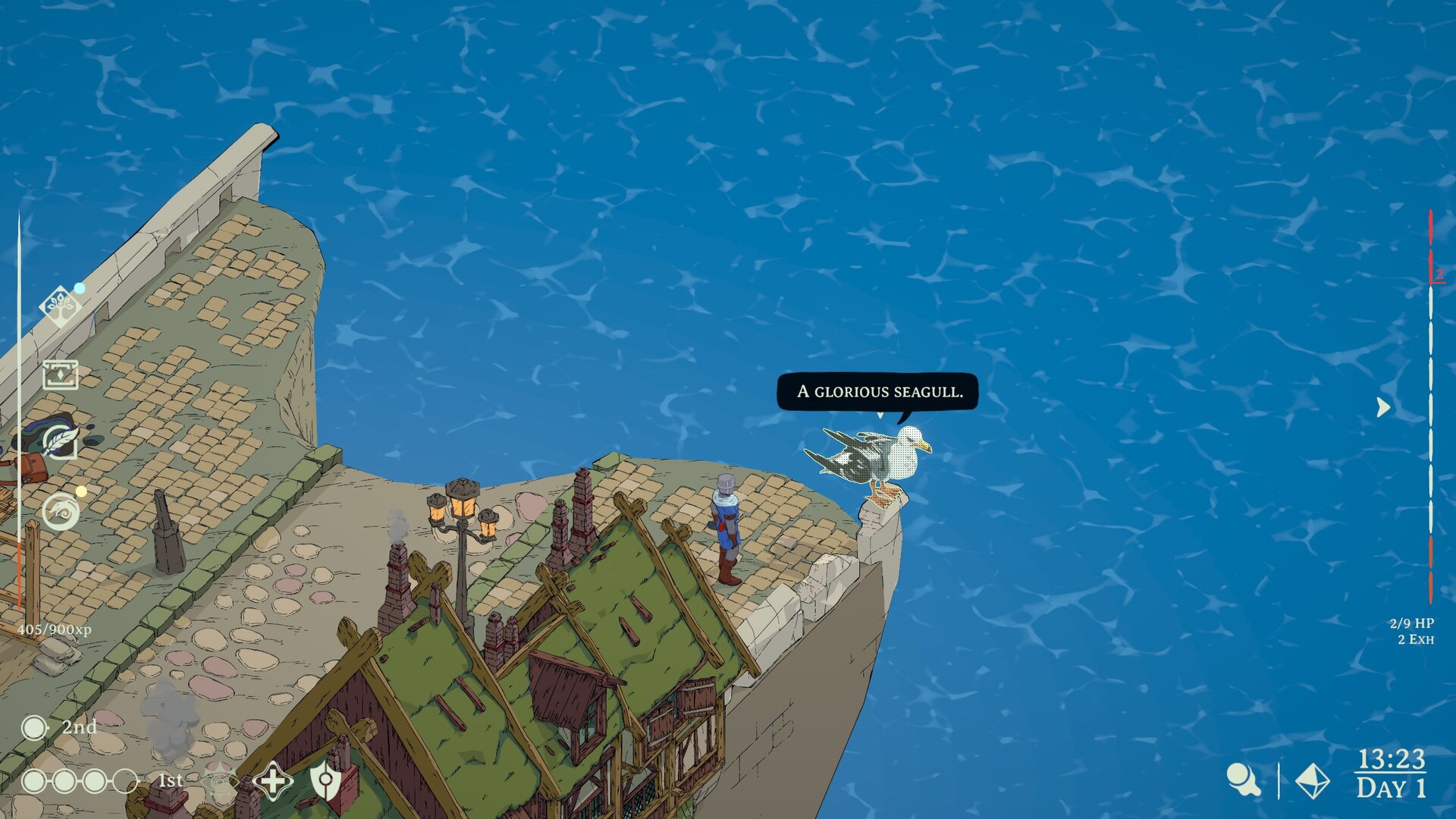
Visually, Esoteric Ebb embraces a hand-painted isometric style reminiscent of classic CRPGs. Buildings and streets appear slightly stylized, with exaggerated proportions that give the city a distinctive personality. The color palette favors subdued tones, reflecting the gritty atmosphere of Norvik’s districts. Yet magical elements introduce flashes of vivid color that stand out against the muted background. This contrast helps emphasize moments when supernatural forces intrude into everyday life.
Character portraits deserve particular mention. Conversations frequently shift to illustrated close-ups that capture subtle emotional expressions. These portraits add depth to interactions that might otherwise feel abstract in a dialogue-heavy game.
Environmental design also contributes to the sense of immersion. Narrow streets, cluttered interiors, and weather-worn architecture create the impression of a city that has evolved over centuries rather than being constructed purely for gameplay.
Sound and Music
The soundtrack of Esoteric Ebb takes a restrained approach, focusing on atmospheric compositions rather than dramatic orchestral themes. Soft strings, ambient tones, and occasional experimental sounds create a background that supports the narrative without dominating it.
Music often fades into the background during conversations, allowing the dialogue to remain the focus. Yet subtle changes in tone signal shifts in mood, particularly when the investigation takes darker or more mysterious turns.
Sound design also enhances the sense of place. Footsteps echo through narrow alleys, doors creak open in quiet buildings, and magical effects produce distinctive audio cues. These details help bring Norvik to life.
Voice acting is limited, with most dialogue presented as text. While this choice may disappoint players who prefer fully voiced performances, it allows the game to include a vast amount of written dialogue without sacrificing nuance.
Technical Performance
From a technical standpoint, the PC version of Esoteric Ebb performs reliably. The game does not demand particularly powerful hardware, and it runs smoothly on a wide range of systems.
Loading times between districts are brief, allowing exploration to flow naturally without frequent interruptions. Most of the technical issues encountered during extended play are minor, such as occasional interface glitches or dialogue triggers that require a brief reset.
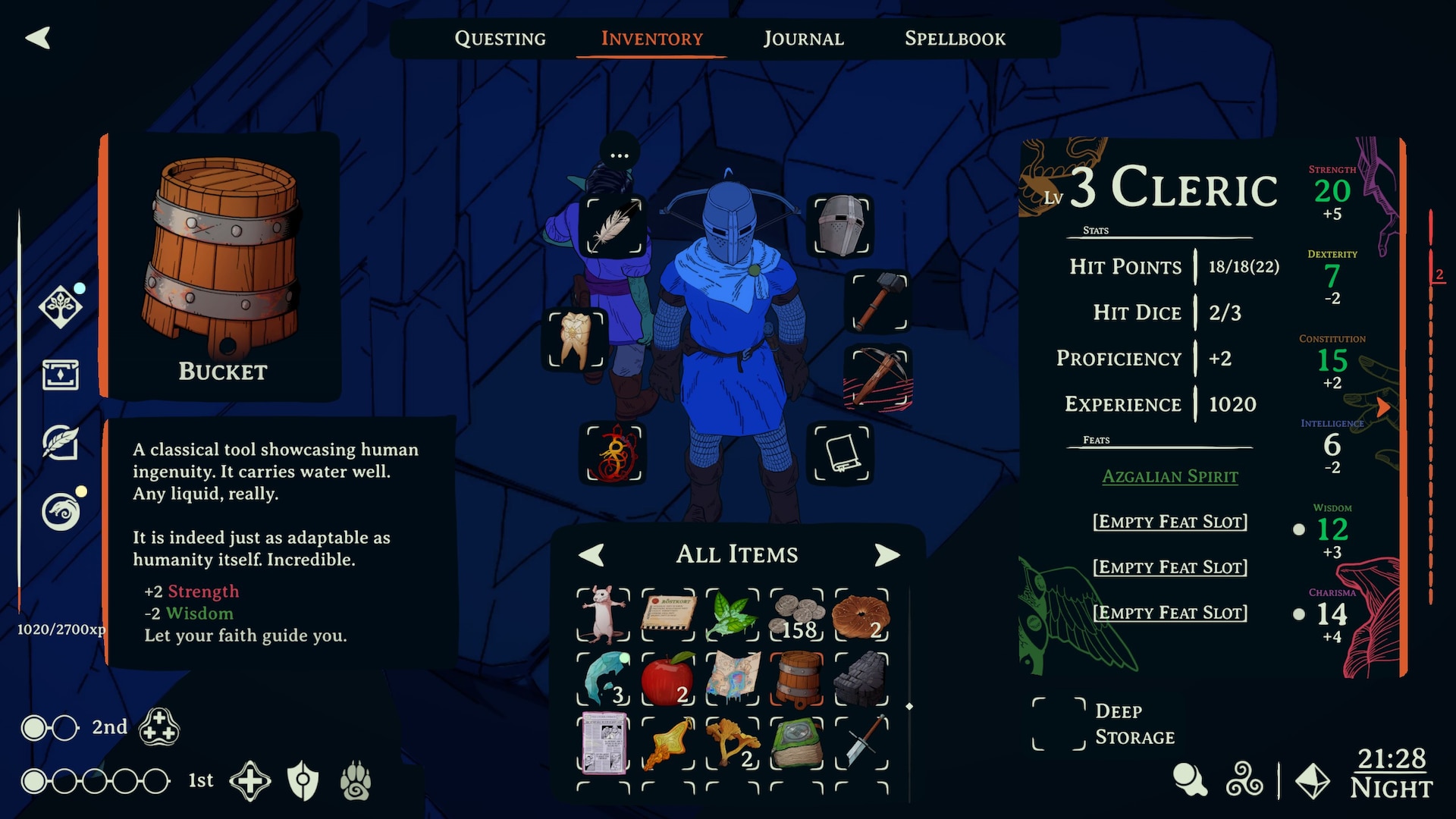
The user interface, however, can initially feel cluttered. Skill notifications, dialogue options, and quest updates sometimes compete for attention on the screen. While players gradually become accustomed to the layout, the early hours may feel visually busy.
Despite these minor issues, the overall technical experience is stable and accessible.
Influences and Identity
It is impossible to discuss Esoteric Ebb without acknowledging the influence of Disco Elysium. The similarities in structure, tone, and mechanics are too obvious to ignore. Yet the game does not attempt to hide these inspirations.
Instead, it uses them as a starting point for something slightly different. Where Disco Elysium focused heavily on existential themes and the psychology of its protagonist, Esoteric Ebb adopts a lighter, more chaotic tone. Its humor is more playful, and its fantasy setting introduces new narrative possibilities.
The game also draws inspiration from older narrative RPGs, particularly those that prioritized dialogue and philosophical exploration over combat. Elements of Planescape: Torment can be felt in the emphasis on character identity and moral ambiguity.
Yet despite these influences, Esoteric Ebb develops its own identity through its worldbuilding and investigative structure. The Questing Tree system, in particular, gives the narrative a unique rhythm that distinguishes it from its predecessors.
Pacing and Replayability
The pacing of Esoteric Ebb reflects its narrative focus. Players who concentrate on the main investigation can reach the ending relatively quickly, but the game encourages a slower approach. Side stories, optional conversations, and hidden details add significant depth to the experience. Many of these elements reveal additional context for the city’s political tensions or the personal histories of its inhabitants.
Replayability comes from the game’s branching structure. Different character builds unlock unique dialogue options, and certain investigative paths only appear under specific conditions. As a result, a second playthrough can feel surprisingly different from the first.
Because failure often produces alternate outcomes rather than blocking progress, players may discover entirely new scenes simply by taking different risks.
Areas for Improvement
Despite its many strengths, Esoteric Ebb is not a flawless experience. The most noticeable issue is pacing. With such a heavy emphasis on dialogue, the game occasionally slows to a crawl during extended conversations.
While the writing is generally strong, some scenes feel longer than necessary. Players who prefer faster gameplay may find themselves impatient during particularly dense sections.
The interface also requires some adjustment. New players may struggle to interpret the constant flow of skill notifications and dialogue prompts. Although the system becomes clearer over time, the learning curve can be steep.
Finally, the game’s limited emphasis on combat may disappoint players expecting a more traditional RPG structure. Those who prefer frequent battles and character progression through combat will likely find the experience quieter and more reflective than anticipated.
Final Verdict: 8.5/10
Esoteric Ebb is a strange and ambitious RPG that prioritizes storytelling and player expression above all else. It does not attempt to compete with blockbuster fantasy epics or action-heavy RPGs. Instead, it focuses on the quieter pleasures of conversation, investigation, and character development.
The game’s greatest achievement is the sense of freedom it gives the player. Rather than forcing a predetermined heroic narrative, it allows the story to emerge from the player’s choices, successes, and failures. Every decision contributes to a version of the Cleric that feels personal and unpredictable.
Its flaws—occasional pacing issues, a busy interface, and limited combat—are real but rarely overwhelming. For players willing to embrace a slower, dialogue-driven experience, the game offers a rich and unusual journey through one of the more distinctive fantasy cities in recent RPGs.
In many ways, Esoteric Ebb feels like a tabletop campaign translated into digital form. It captures the sense of experimentation and improvisation that makes role-playing games memorable. The experience can be messy, surprising, and occasionally chaotic—but it is rarely dull.
For fans of narrative-driven CRPGs, it stands as one of the most intriguing releases of its kind in recent years.