
CloverPit is a striking indie roguelike that takes one of the most familiar symbols of chance—the slot machine—and transforms it into a tense, strategy-driven survival experience. Developed by Panik Arcade and published by Future Friends Games, the game strips its premise down to the essentials: you are trapped, in debt, and your only means of escape is a cursed slot machine that demands both luck and careful planning.
From the moment the first run begins, CloverPit establishes a tone of quiet hostility. There is no grand introduction or cinematic flourish, only the cold reality of numbers, quotas, and limited opportunities. This deliberate restraint gives the game a distinct identity, allowing its mechanics to communicate meaning more effectively than exposition ever could. Each failed run reinforces the same central message: the system is stacked against you, and survival is temporary unless you learn how to bend that system in your favor.
Rather than leaning on flashy visuals, overt horror, or narrative exposition, CloverPit succeeds by building sustained pressure through repetition and consequence. It is a game about control—specifically, the illusion of it—and about learning when restraint is wiser than ambition. Every spin feels loaded with intent, and every decision carries weight beyond its immediate outcome.
Gameplay and Mechanics
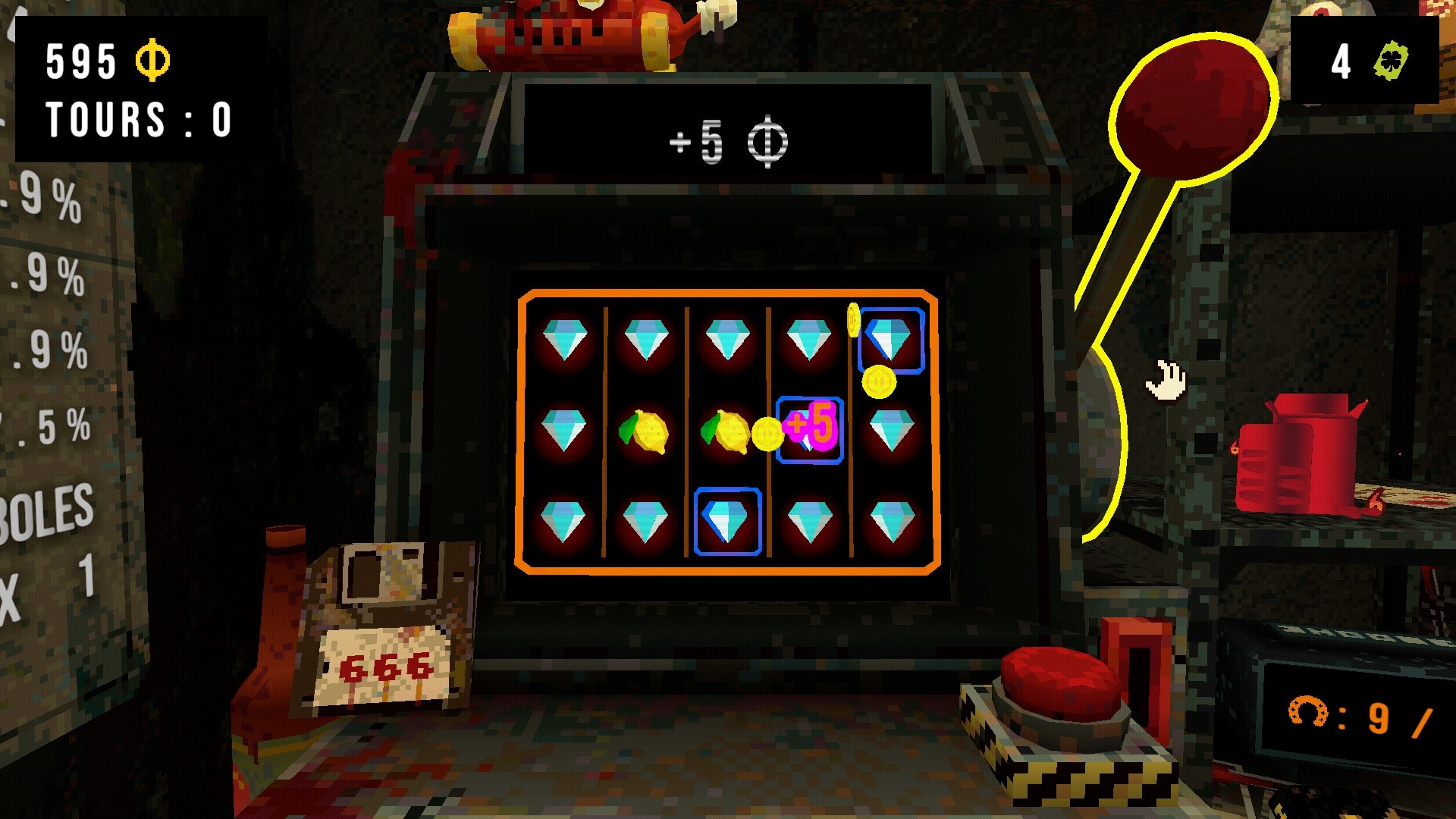
At its core, CloverPit revolves around a deceptively simple loop. Each round provides a limited number of slot machine spins, producing coins that must be used to pay off an ever-increasing debt at the end of the round. The required payment escalates steadily, leaving little margin for error and forcing players to extract maximum value from every decision. Fail to meet the quota, and the run ends immediately, reinforcing the game’s unforgiving nature.
What transforms this structure from a novelty into a compelling strategy game is its roguelike layering and the way its systems interact over time. Between rounds, players earn tickets that can be exchanged for a wide range of charms, modifiers, and passive effects. These upgrades fundamentally alter the rules of engagement—changing symbol distributions, enabling conditional bonuses, introducing multipliers, or triggering cascading effects that reward specific patterns, timing, or restraint.
Crucially, CloverPit encourages commitment rather than improvisation. Successful runs are built around identifying a viable strategy early and reinforcing it consistently, rather than chasing every available upgrade. Many charms are designed to scale over time, meaning that early investment can pay off dramatically later, while unfocused builds often collapse under rising debt demands. This design rewards foresight and long-term planning, pushing players to think several rounds ahead rather than reacting spin by spin.
As players grow more familiar with these systems, the experience shifts from reactive decision-making to deliberate engineering. Strong runs feel less like gambling and more like carefully constructed machines, where each spin activates a web of interconnected effects. The most satisfying moments come when a previously fragile setup stabilizes and begins to generate overwhelming returns, transforming desperation into momentum.
Despite this depth, chance never fully disappears. Early-game spins can still dictate the trajectory of a run, sometimes ending it before meaningful strategy can emerge. Bad rolls can feel brutal, particularly in the opening rounds, and the game offers limited tools for immediate recovery. This creates an intentionally uncomfortable balance between agency and randomness. The challenge lies not in eliminating bad luck, but in learning how to survive it long enough for planning, optimization, and system mastery to assert themselves.

Progression and Replayability
Progression in CloverPit is driven primarily by unlocks and accumulated knowledge rather than permanent power gains. A broad and steadily expanding pool of items ensures that each run introduces new variables, encouraging experimentation and adaptation rather than rote repetition. Unlocking new charms does not simply make the game easier; instead, it increases the complexity of available decisions, widening the strategic space and offering new ways to manipulate risk.
This design places emphasis on player understanding rather than numerical progression. As familiarity grows, players begin to recognize which upgrades complement one another, which are situational, and which can become liabilities if taken at the wrong time. The process of learning these interactions becomes the game’s most rewarding form of progression, turning early confusion into informed confidence.
Replayability is rooted in this system mastery. Each run presents opportunities to explore alternative approaches, test unusual synergies, or deliberately push unstable builds to see how long they can be sustained. Some of the game’s most powerful combinations are not immediately obvious and only emerge through repeated experimentation. Failure, rather than feeling wasted, often provides valuable insight into how future runs can be optimized.
However, CloverPit is intentionally rigid in its broader structure. The environment, objectives, and pacing remain consistent throughout, with no branching paths, alternate modes, or major rule variations to significantly alter the experience. For players who appreciate focus and thematic cohesion, this consistency reinforces the game’s oppressive tone. For others, it may limit long-term variety, particularly once dominant strategies are identified and reliably executed.
That said, the game’s short, self-contained runs make it highly replayable in practice. Even familiar strategies can unfold differently due to item availability and early outcomes, and the constant pressure of rising debt ensures that no run ever feels completely safe. This balance allows CloverPit to remain engaging well beyond its surface simplicity, provided players are invested in mastering its systems rather than seeking novelty alone.

Presentation and Atmosphere
Visually, CloverPit adopts a deliberately minimalist and bleak aesthetic that prioritizes mood over detail. The environment is stark and oppressive, offering little in the way of visual comfort or distraction. This restrained presentation is not merely a stylistic choice but a functional one, keeping the player’s focus firmly on the slot machine and the numbers that dictate survival. The lack of environmental variety reinforces the feeling of entrapment, making each run feel less like an adventure and more like an ongoing ordeal.
Lighting and color are used sparingly, emphasizing cold tones and harsh contrasts that mirror the game’s unforgiving mechanics. There is a sense that the world exists solely to facilitate the system that exploits you, with no space for warmth or relief. This visual austerity ensures that moments of success feel sharp and fleeting, while failure feels heavy and inescapable.
Sound design plays an equally critical role in maintaining tension. The mechanical rhythms of spinning reels, clicking levers, and grinding machinery form a constant auditory backdrop, creating a sense of relentless motion even when nothing is happening on screen. Each spin is punctuated with weight, making outcomes feel consequential rather than abstract. Ambient sounds fill the silence just enough to prevent comfort, turning even idle moments into sources of unease.
The audio design also reinforces the psychological pressure of decision-making. As debt increases and margins for error shrink, familiar sounds take on new intensity, subtly amplifying stress without resorting to traditional horror cues. However, the impact of this soundscape is somewhat undermined by limited audio controls and accessibility options. Given how central audio feedback is to the experience, the lack of granular customization may be frustrating for some players.
Narratively, CloverPit avoids direct storytelling entirely, opting instead for implication and theme-driven design. There are no characters to interact with and no explicit explanations offered, yet the game’s underlying ideas—debt, exploitation, desperation, and the illusion of control—are communicated with remarkable clarity. Every mechanic reinforces these themes, allowing players to internalize them through play rather than exposition. This subtle approach gives the game a lingering psychological impact, encouraging reflection long after a run has ended.
Final Verdict: 7.5/10
CloverPit is a confident, uncompromising indie title that understands the power of focus. It does not attempt to broaden its appeal through spectacle, narrative complexity, or excessive content. Instead, it delivers a tightly designed roguelike experience built around tension, risk, and the gradual mastery of chaotic systems.
Players who enjoy systems-driven gameplay, high-stakes decision-making, and the satisfaction of turning unfavorable odds into a winning strategy will find CloverPit deeply rewarding. Those looking for rich storytelling, evolving environments, or a gentler learning curve may find its approach demanding.
Ultimately, CloverPit stands out not because of what it adds, but because of what it refines. By transforming a simple, familiar mechanic into a sustained psychological and strategic challenge, it offers an experience that is both unsettling and compelling—one that constantly asks how much risk you are willing to accept for the promise of escape, one spin at a time.


