The life simulation genre occupies a unique position within the medium of video games. Its success has rarely been determined by mechanical difficulty or competitive balance, but rather by its ability to foster emotional attachment, emergent storytelling, and the illusion that virtual characters possess inner lives of their own. For decades, The Sims franchise has defined this space through stylization, humor, and carefully tuned chaos. Into this well-established territory enters inZOI, a project that deliberately rejects caricature in favor of realism and technological ambition.
Developed by inZOI Studio and published by Krafton, inZOI positions itself as a next-generation reinterpretation of the life simulation formula. Built on Unreal Engine 5, it promises expansive open cities, photorealistic characters, advanced AI systems, and creative tools that rival professional design software. Rather than emphasizing absurdity or playful exaggeration, inZOI seeks to simulate contemporary urban life with cinematic presentation and grounded aesthetics.
This vision immediately sets the game apart, but it also raises critical questions. A life simulator must do more than replicate reality visually; it must produce believable social dynamics, emotional consequence, and unscripted moments that resonate with players. As an Early Access title, inZOI currently exists as a sophisticated framework rather than a complete experience. The challenge it faces is not one of ambition, but of identity.

Presentation and Visual Design
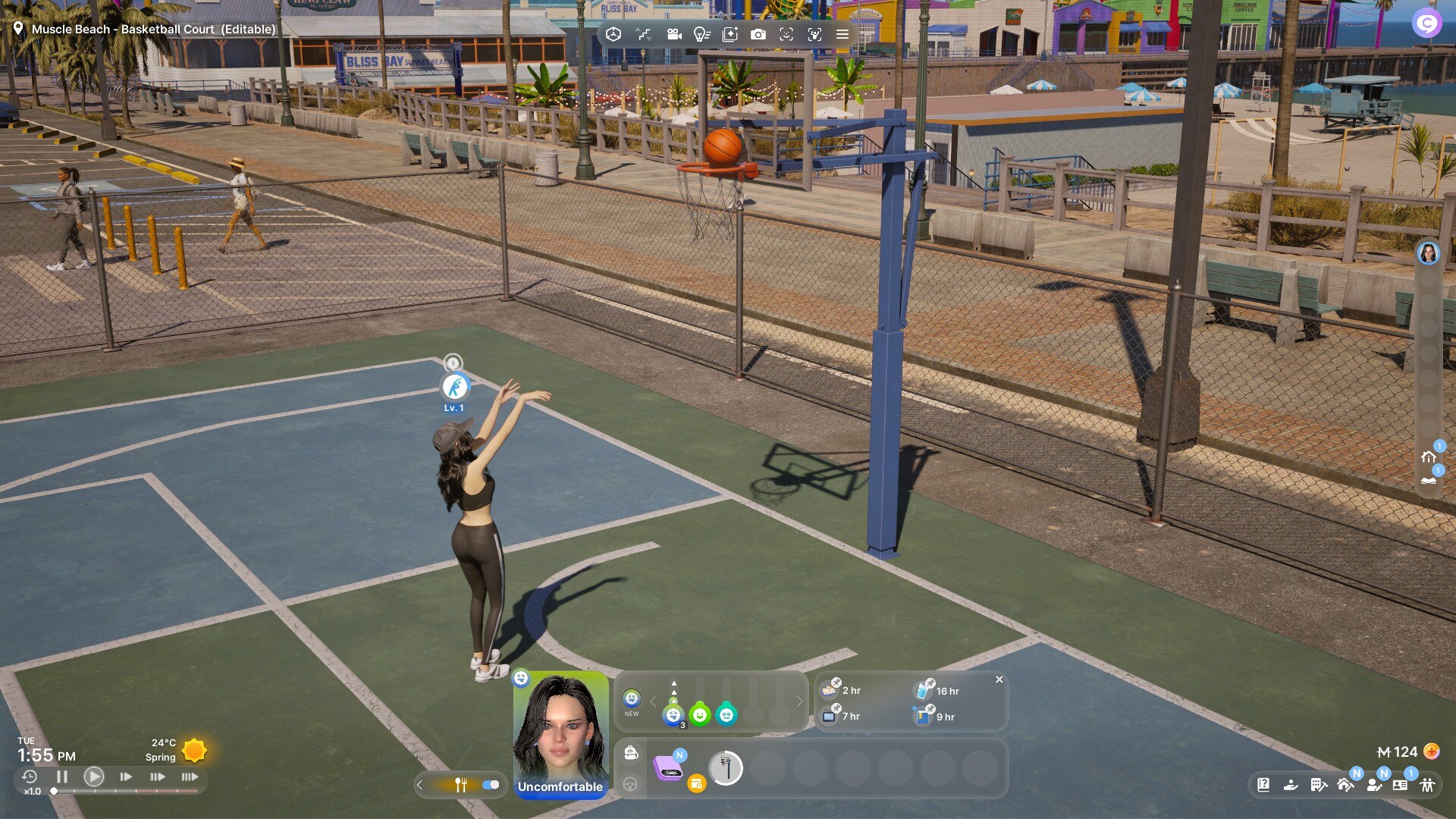
From a technical perspective, inZOI represents a remarkable achievement for the genre. The game leverages Unreal Engine 5 to deliver advanced lighting, realistic reflections, and high-quality materials that create a convincing modern urban environment. Cities feel dense and contemporary, with architecture that reflects real-world design sensibilities rather than stylized abstraction. Weather effects, time-of-day transitions, and ambient environmental animation contribute to a strong sense of place.
Character models are equally impressive. Zois are rendered with detailed facial structures, realistic proportions, and high-resolution clothing assets. Skin shading, fabric behavior, and hair simulation all demonstrate a level of care uncommon in life simulation games. At its best, inZOI approaches the visual fidelity of narrative-driven AAA titles rather than genre peers.
However, this realism introduces limitations. Emotional expression is often understated, with facial animations and body language remaining subtle even during moments that should convey heightened feeling. Without the benefit of exaggeration or stylization, characters can appear reserved to the point of emotional opacity. The world looks alive, but it does not always communicate emotion effectively, which can distance players from their Zois despite the visual realism.
Character Creation and Building Tools
The creative tools offered by inZOI are among the most sophisticated currently available in a life simulation. The character creator provides granular control over facial structure, skeletal proportions, and fine aesthetic detail, encouraging players to sculpt realistic individuals rather than exaggerated archetypes. This system rewards patience and precision, making it especially appealing to players interested in realism, virtual photography, or cinematic storytelling.
Clothing and cosmetic customization emphasize texture quality and believable materials over flamboyant design. While this approach reinforces the game’s grounded tone, it may feel restrained to players accustomed to more expressive or whimsical fashion systems. Nevertheless, the technical execution is consistently strong.
Building and interior design tools further reinforce inZOI’s identity as a creative platform. Players can construct modern homes and apartments with a high degree of architectural control, supported by flexible layouts, precise object placement, and lighting systems that significantly affect atmosphere. The experience of designing spaces is intuitive and visually rewarding.
The inclusion of AI-assisted content generation, allowing players to create custom textures or objects, represents a forward-looking experiment. While currently niche in its application, it hints at a future where players act as collaborators in content creation rather than passive consumers. Even in its current state, the overall toolset stands as one of the game’s most compelling features.
World Design and Simulation Scope
One of inZOI’s defining design decisions is its commitment to open, continuous city environments. Rather than relying on segmented neighborhoods or frequent loading screens, the game allows Zois to navigate urban spaces freely, moving between residential areas, workplaces, and public locations in real time. This structure significantly enhances immersion and supports the illusion of a shared, functioning city.
Players are also given control over macro-level city variables such as traffic density, cleanliness, and social atmosphere. These systems suggest a simulation that operates not only at the individual level, but at the scale of urban life itself. In theory, such mechanics should meaningfully shape daily routines and social behavior.
In practice, their impact is currently limited. While the city feels active and visually convincing, interactivity remains shallow. Many locations serve primarily as visual backdrops, and available activities lack depth and variety. The city’s scale exceeds the complexity of the systems that inhabit it, creating a sense that the environment is waiting for its simulation to mature.
Life Simulation and AI Behavior
The core life simulation systems represent inZOI’s most significant weakness at present. Basic mechanics such as needs management, careers, relationships, and daily routines are implemented competently, but they lack depth and long-term consequence. Activities tend to repeat with little variation, and progression follows predictable patterns that rarely generate tension or surprise.
Social interactions are particularly restrained. Conversations proceed mechanically, relationships develop smoothly, and conflict is minimal. Zois do not yet exhibit strong personal motivations, contradictory desires, or emotional memory that meaningfully shapes future behavior. As a result, characters feel functional rather than expressive.
The game’s concept of “Smart Zois” implies adaptive and intelligent behavior, but current AI patterns remain conservative. Characters respond logically to situations, yet seldom behave unpredictably or impulsively. The absence of friction and failure undermines the emergent storytelling that defines the genre’s most memorable moments. While the systems work, they rarely produce stories worth retelling.
User Interface and Technical Performance
The user interface reflects the game’s broader design philosophy: clean, modern, and visually consistent, but not always intuitive. Some mechanics are hidden behind layered menus, and key information is not always communicated clearly. New players may struggle to understand the relationships between systems without experimentation, which can disrupt the game’s pacing.
From a technical standpoint, inZOI is demanding but relatively stable for an Early Access release. High-end hardware is rewarded with impressive performance and visual fidelity, while mid-range systems may experience frame rate instability. Bugs and AI inconsistencies are present, but generally fall within expectations for an unfinished product. Optimization remains an area in need of continued attention.

Early Access Context
As an Early Access title, inZOI should be understood as a foundation rather than a final statement. Its strengths lie in its tools, presentation, and ambition, while its weaknesses stem from incomplete or underdeveloped simulation systems. Krafton’s public roadmap suggests ongoing refinement and expansion, but the ultimate success of the project will depend on whether future updates prioritize depth, personality, and emotional engagement as strongly as visual and technical improvements.
At present, the game feels more like a sophisticated framework than a fully realized life simulator, offering glimpses of what it could become without consistently delivering on that promise.
Final Verdict: 7.5/10
inZOI is a bold and visually impressive entry into the life simulation genre, distinguished by its commitment to realism, advanced technology, and creative freedom. It excels as a design and customization platform, offering industry-leading character creation and building tools within a striking open-city environment.
However, its core simulation systems currently lack the unpredictability, emotional resonance, and emergent storytelling that define the genre at its best. For players interested in experimentation, aesthetics, and watching an ambitious project evolve, inZOI represents a compelling Early Access experience. For those seeking rich, dramatic digital lives filled with memorable moments, it remains a work in progress.