Unbeatable is a rhythm-driven narrative adventure that attempts to fuse two traditionally distinct experiences: arcade-style musical gameplay and character-focused storytelling. Set in a stylized dystopian city where music is outlawed, the game follows Beat and her band as they struggle to survive, create, and perform in a society that actively suppresses artistic expression. From its opening moments, Unbeatable makes its priorities clear—it is a game about music not merely as entertainment, but as identity, rebellion, and emotional release.
Developed by D-Cell Games, Unbeatable arrives with a strong artistic identity and a clear creative vision. It does not aim to be a conventional rhythm game, nor does it fully conform to the expectations of a narrative adventure. Instead, it exists somewhere between those spaces, embracing experimentation and tone over strict structural efficiency. The result is a game that feels personal and expressive, but also one that occasionally struggles to reconcile its ambitions with cohesive execution.

Gameplay and Mechanics
At its mechanical core, Unbeatable is built around a two-button rhythm system that emphasizes timing, musicality, and pattern recognition over complex input sequences. One button corresponds to high notes, the other to low, creating a control scheme that is immediately approachable while still capable of considerable depth. This simplicity is one of the game’s greatest strengths: players are encouraged to focus on the music itself rather than on memorizing elaborate control layouts.
As difficulty increases, the game introduces denser note patterns, faster tempos, and more demanding rhythmic variations. Success depends less on reflex alone and more on the player’s ability to internalize the rhythm and flow of each track. When Unbeatable is at its best, it achieves a sense of synchronization between player and music that feels natural and rewarding.
The game is divided primarily into Story Mode and Arcade Mode, each serving a distinct purpose. Story Mode integrates rhythm encounters into a broader narrative framework that includes exploration, dialogue, and environmental interaction. Arcade Mode, by contrast, removes narrative framing entirely, presenting Unbeatable as a pure rhythm experience with progression systems, difficulty modifiers, and score-based challenges.
Arcade Mode is where the game’s mechanical strengths are most clearly expressed. Without narrative interruptions, the rhythm design shines, offering sustained engagement and strong replay value. Story Mode, while thematically rich, sometimes sidelines gameplay for extended stretches, creating an uneven rhythm of its own—one that can dilute the impact of the game’s strongest systems.
Narrative and Structure
Narratively, Unbeatable is driven by themes of creative resistance, emotional authenticity, and the personal cost of self-expression. Beat and her band are not framed as heroic revolutionaries so much as flawed individuals navigating a world that is actively hostile to their existence. The writing demonstrates a strong understanding of character voice, with dialogue that often feels grounded, expressive, and emotionally sincere.
Character interactions form the emotional backbone of the experience. Moments of humor, frustration, intimacy, and doubt are handled with care, and the game frequently succeeds at making its cast feel human rather than symbolic. These strengths give the story genuine emotional weight, particularly during its quieter, more introspective moments.
However, Unbeatable’s structural pacing undermines its narrative impact. Long sequences of dialogue and traversal can interrupt momentum, and the spacing between rhythm segments is often inconsistent. While the game’s story benefits from moments of stillness, it does not always balance them effectively against player engagement. As a result, sections that are meant to feel contemplative may instead feel protracted.
The narrative ambition is evident and commendable, but the execution lacks refinement. The story would benefit from tighter editing and a more deliberate integration of gameplay and narrative, rather than treating them as alternating modes.

Audio and Music
Music in Unbeatable is not merely a component of the experience—it is its structural and emotional foundation, shaping how the game is played, perceived, and ultimately understood. The soundtrack is consistently excellent, drawing from punk, rock, electronic, and experimental influences to create a soundscape that feels raw, defiant, and intensely personal. Each track reinforces the game’s core themes of rebellion and individuality, not only through tone and style, but through rhythm and momentum that directly inform gameplay.
Rather than functioning as background accompaniment, the music establishes pacing, signals emotional shifts, and transforms performance into an act of self-expression. Sound becomes the primary lens through which Unbeatable’s world is experienced, framing both player action and narrative intent.
Each track is carefully charted to reflect its musical structure, encouraging engagement with rhythm and phrasing rather than rote memorization. Audio cues are clear, responsive, and precisely timed, while the surrounding sound design provides intuitive feedback that reinforces player performance without distraction.
Crucially, the music succeeds not only on a mechanical level but on an emotional one. Tracks convey mood, tension, and release with remarkable clarity, often communicating more effectively than dialogue alone. It is rare for a game’s soundtrack to feel so inseparable from both gameplay and narrative, and Unbeatable excels in this regard. For many players, the music will remain the most enduring and defining aspect of the experience.
Visual Presentation
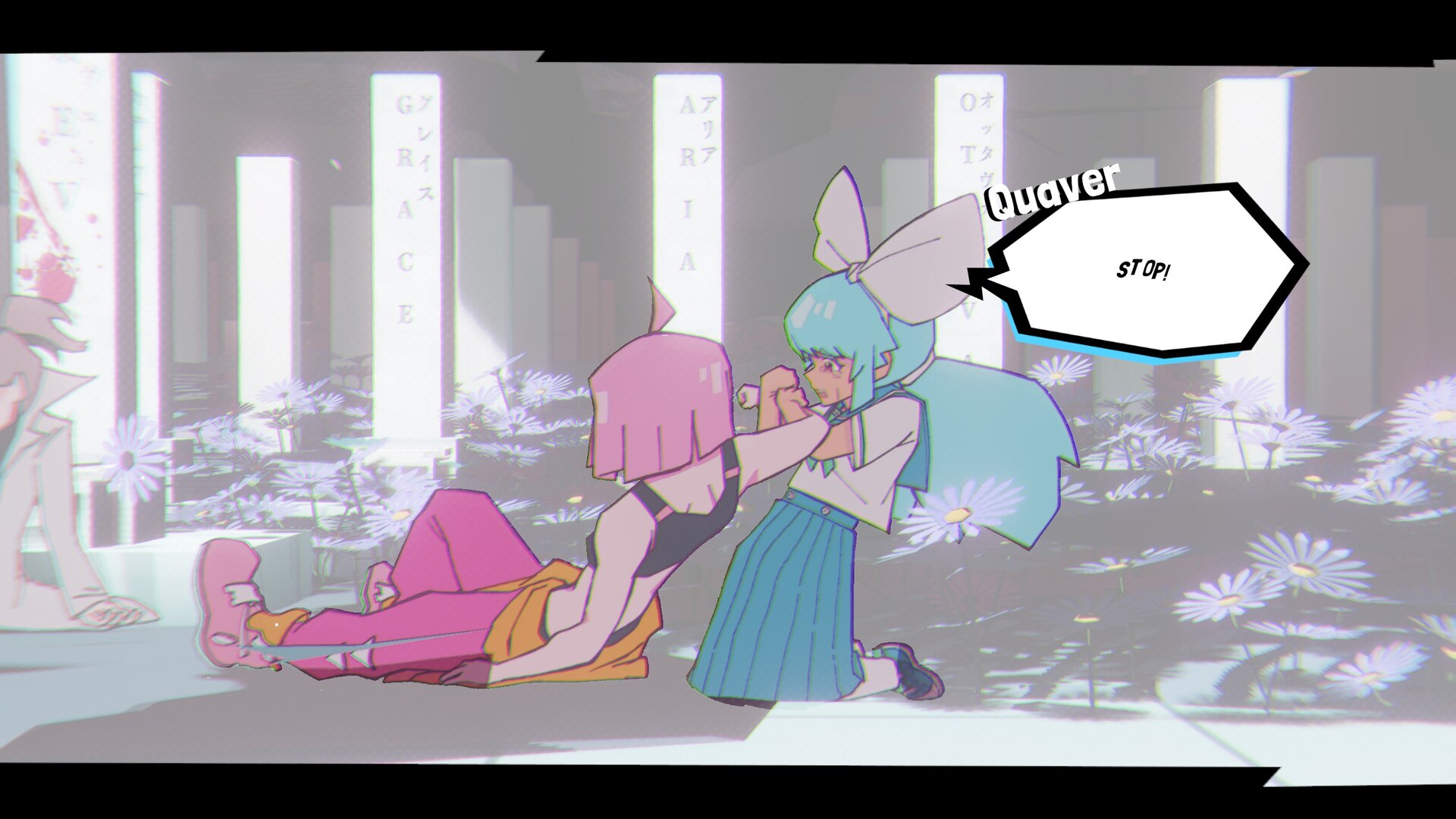
Unbeatable’s visual identity is bold and immediately recognizable. Drawing heavily from anime-inspired character design and punk aesthetics, the game presents a world defined by sharp contrasts, expressive animation, and a vibrant color palette. Character art is particularly strong, conveying personality and emotion with minimal animation through effective pose and expression.
The user interface complements this style, using striking typography and visual effects that reinforce the game’s tone without compromising readability during rhythm gameplay. In motion, the game often looks striking, especially during musical sequences where visuals and sound align most effectively.
That said, environmental design is comparatively restrained. Backgrounds and locations, while stylistically consistent, sometimes lack detail or variation, making sections of the world feel more like thematic backdrops than lived-in spaces. Minor visual inconsistencies and limited environmental interaction occasionally weaken immersion, though they rarely detract from the overall presentation.
Technical Performance (PC)
On PC, Unbeatable delivers a generally stable experience. Rhythm gameplay is responsive, input timing feels accurate, and frame rates remain consistent during performance-heavy sections. Load times are reasonable, and the game runs comfortably on a wide range of hardware configurations.

However, technical polish is not uniform. Occasional animation stutters, UI irregularities, and abrupt transitions between gameplay and narrative scenes are noticeable. While these issues are minor and rarely disruptive, they contribute to an overall impression that the game could have benefited from additional refinement prior to release. Importantly, none of these shortcomings compromise the core rhythm mechanics, which remain reliable throughout.
Replayability and Value
Replay value in Unbeatable is largely driven by Arcade Mode, which offers difficulty scaling, modifiers, and score-based challenges that encourage mastery and repetition. Players who engage primarily with the rhythm systems will find substantial value here, as the mechanics reward continued practice and musical familiarity.
Story Mode, by contrast, is more linear and self-contained. While emotionally impactful, it offers limited incentive for repeat playthroughs beyond revisiting favorite moments or experiencing the narrative with greater contextual understanding.
As a complete package, Unbeatable offers solid value, particularly for players who appreciate rhythm games and music-driven design. Its longevity depends heavily on how much weight the player places on mechanical mastery versus narrative exploration.
Final Verdict: 8/10
Unbeatable is an ambitious and expressive indie title that succeeds most when it trusts its strengths: rhythm design, music, and emotional sincerity. Its minimalist mechanics and exceptional soundtrack create moments of genuine connection between player and performance, while its narrative ambition lends the experience a distinctive personal voice.
At the same time, uneven pacing, structural inconsistencies, and minor technical issues prevent the game from fully realizing its potential. The divide between Story Mode and Arcade Mode is more pronounced than it should be, resulting in an experience that feels slightly fragmented despite its cohesive themes.
Even so, Unbeatable stands out in a crowded genre through clarity of vision and creative confidence. It may not be flawless, but it is memorable, heartfelt, and musically compelling.