Every few years, an unassuming indie title slips past the noise of big-budget releases and quietly takes over the gaming world. In 2022, that game was Vampire Survivors. In 2023, HoloCure had its moment. And in 2025, Megabonk has emerged as the latest in that proud lineage — an addictive, over-the-top “bullet heaven” that thrives on chaos, humor, and the pure dopamine rush of exponential power growth.
Developed almost entirely by a solo creator under the name vedinad, Megabonk doesn’t pretend to be polished or cinematic. Its visuals are low-poly and goofy. Its arenas are simple. Its music loops endlessly. And yet, beneath that irreverent presentation lies a perfectly tuned feedback loop — one that turns repetition into compulsion and simplicity into joy.
This is not a game about subtlety. Megabonk is about escalation — the transformation from weak to unstoppable, from nervous dodging to screen-shaking destruction. It’s the digital equivalent of shaking a bottle of soda until it explodes, then laughing as it sprays everywhere.
Gameplay and Core Loop
The premise could not be more straightforward. You choose a character, spawn into a 3D arena, and survive. Enemies pour in from all sides, increasing in number and aggression as time passes. Defeating them drops orbs that serve as experience points. Each level-up allows you to select new weapons or passive bonuses, creating a build that grows increasingly absurd with every choice.
The moment-to-moment experience is deceptively simple, but that simplicity is Megabonk’s secret weapon. Movement is snappy and responsive, and most attacks fire automatically, allowing you to focus on positioning rather than precise aiming. The player’s task is to dance — weaving between mobs, gathering XP orbs, and deciding how to evolve your arsenal before the next wave arrives.
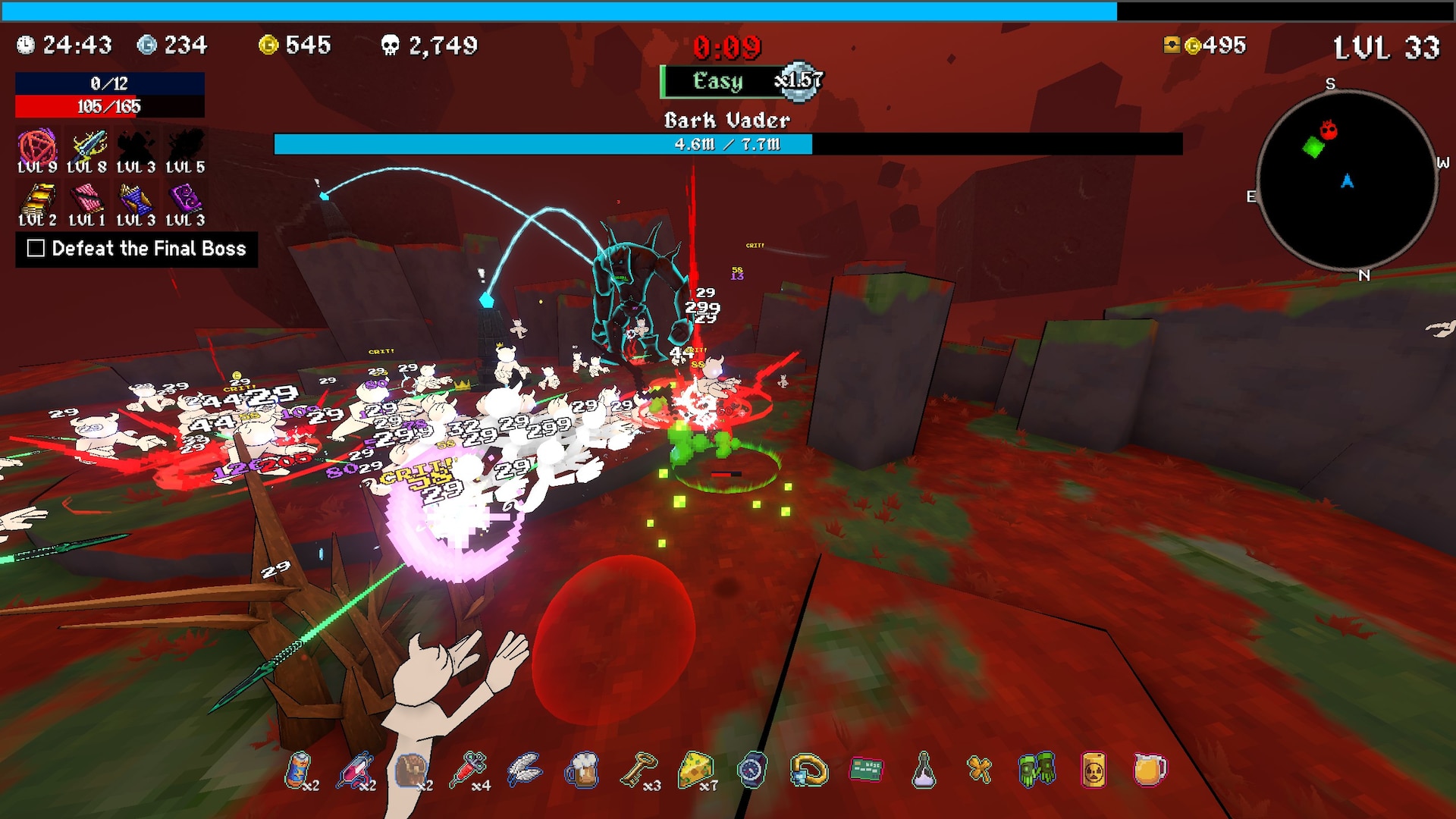
What elevates Megabonk beyond imitation is the synergy system. Weapons and items aren’t isolated upgrades; they interact. Pairing certain abilities can transform modest tools into devastating combinations. A fireball launcher might combine with a damage-over-time relic to set entire crowds ablaze. A boomerang may evolve into a screen-wide arc that ricochets endlessly. Runs begin with humble sparks of power and end with fireworks displays of absurd magnitude.
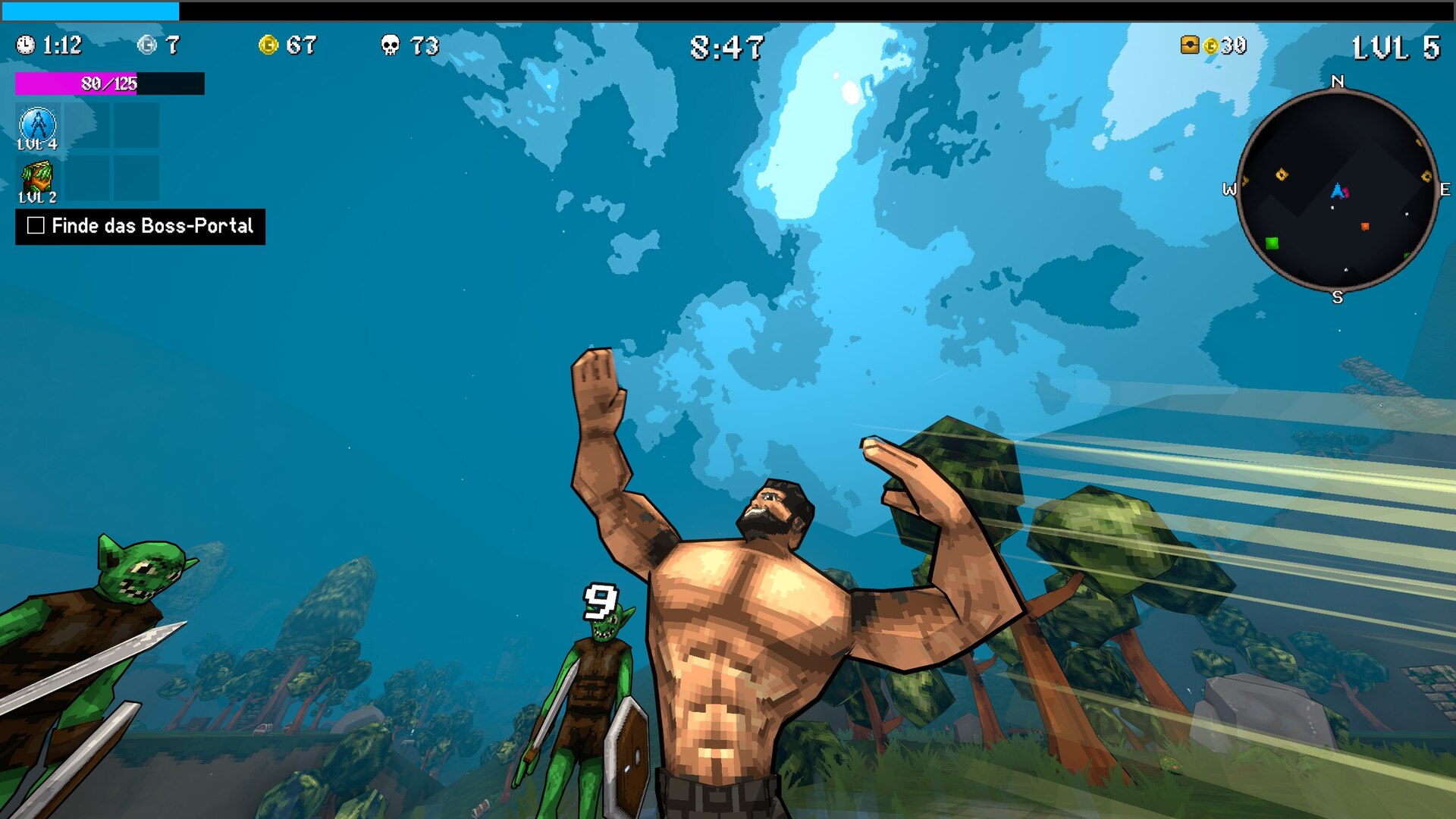
Each of the game’s twenty playable characters adds a new layer of experimentation. Some specialize in ranged control, others in speed or melee burst damage. Every character’s starting stats and passives dramatically shift the rhythm of a run, encouraging players to continually revisit familiar items in new contexts. That interplay of predictability and surprise is what makes Megabonk so engaging — you never quite know when a run will turn from manageable to magnificently broken.
The Art of Progression
If the moment-to-moment gameplay is Megabonk’s heartbeat, its progression systems are the bloodstream. The game thrives on the illusion of constant improvement. Even a failed run yields something — a bit of currency, a new quest ticked off, or a permanent unlock that subtly alters your next attempt.
The meta-progression is anchored by a robust quest system, boasting more than two hundred unique objectives. Some are simple (”Defeat 100 enemies with the Hammer weapon”), while others demand deeper experimentation (”Survive for ten minutes without collecting health items”). Completing these tasks rewards players with new characters, weapons, and passive items. The result is a layered sense of advancement that stretches across dozens of hours.
What makes this system work is its generosity. Nothing feels out of reach. Every run produces some forward motion, and the game’s structure ensures that you’re always a few minutes away from something new. The reward cadence is relentless — by the time you’re considering ending a session, you’ve likely unlocked another trinket or hit a milestone that begs for “just one more run.”
This design philosophy mirrors the best aspects of roguelikes like Dead Cells and Slay the Spire: the marriage of short-term experimentation with long-term progression. Megabonk borrows from those lessons but wraps them in a tone that’s far sillier, lighter, and more approachable.

Pacing and Difficulty
The pacing of Megabonk is a slow burn. Early on, the player’s growth feels incremental — a steady trickle of upgrades and mild power increases. Then, around the ten-minute mark, the tempo changes dramatically. Enemies begin spawning in vast hordes, and the player’s damage output surges in kind. It’s a feedback loop that transforms tension into release, and that shift in energy defines the Megabonk experience.
The difficulty is largely self-modulating. Skilled players can push deeper into longer survival sessions, facing denser enemy patterns and occasional boss encounters. Newcomers can enjoy shorter runs without feeling punished. The game’s accessibility is part of its charm; it’s easy to pick up, rewarding to play casually, but also filled with hidden depth for players who love optimization.
Admittedly, some balance issues persist. Certain combinations of weapons and passives can trivialize late-game waves, while others remain underpowered. But the developer has embraced this imbalance as part of the game’s chaotic spirit. Megabonk doesn’t pretend to be finely tuned; it wants you to break it — and to laugh when you do.
Aesthetic and Tone
On the surface, Megabonk looks like a lost Dreamcast prototype. The low-poly environments, bright colors, and cartoonish animations harken back to an era of games that valued personality over realism. Yet that style choice serves a practical purpose: amidst the chaos, the screen remains remarkably readable. Every orb, explosion, and projectile stands out clearly, making the action visually comprehensible even at its most overwhelming.
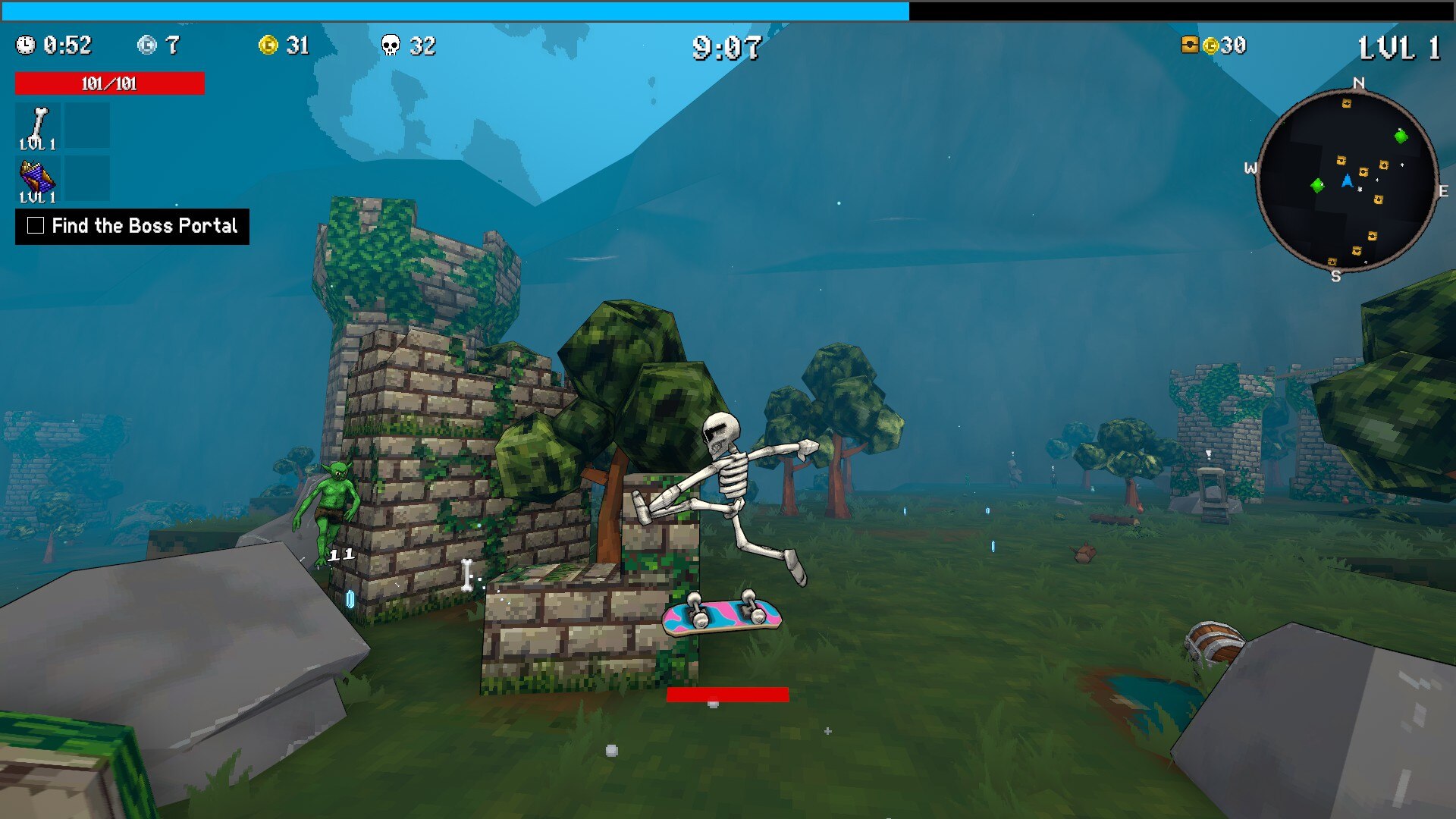
The game’s humor is as distinctive as its art style. Enemies range from absurd — skeletons on skateboards, flying pigs, disco-dancing blobs — to outright surreal. The tone never takes itself seriously. Even the character names and descriptions drip with deadpan absurdity. It’s the kind of humor that evokes Katamari Damacy or Untitled Goose Game: weird, joyful, and strangely endearing.
Sound design contributes heavily to that personality. The soundtrack blends upbeat electronic loops with crunchy effects that give each impact a tactile punch. While the limited number of tracks can grow repetitive during marathon sessions, the overall soundscape perfectly complements the game’s hyperactive energy.
Technical Performance and Stability
For a game that fills the screen with hundreds of moving objects, Megabonk runs astonishingly well. Its system requirements are modest, and performance remains stable even during the most chaotic sequences. Frame drops are rare, and load times are nearly instantaneous. This optimization makes Megabonk highly accessible — a critical factor in its viral success.
Equally important is the developer’s post-launch support. In the weeks following release, Megabonk received frequent patches addressing balance, bug fixes, and community feedback. The tone of these updates is as playful as the game itself, with patch notes written in tongue-in-cheek style that keeps the fanbase engaged. The result is a thriving, positive community that feels connected to the developer’s process — a relationship reminiscent of Celeste’s or Hades’ early access eras.

Balance and Design Philosophy
Where many roguelikes emphasize punishment and mastery, Megabonk embraces generosity. Failure rarely feels punishing, and success never feels unearned. The game’s balance leans intentionally toward empowerment. By the halfway point of a strong run, you are no longer merely surviving — you are orchestrating carnage. This philosophy, while potentially divisive among purists, is central to Megabonk’s identity.
That said, there are times when the systems threaten to collapse under their own excess. The screen can become so cluttered with visual effects that precision is lost, and certain builds can eliminate all challenge entirely. Yet even in these moments, Megabonk retains its charm. Watching the game buckle under the weight of your own absurd power is its own form of satisfaction — a victory lap rather than a flaw.
Weaknesses and Limitations
For all its strengths, Megabonk isn’t without flaws. The first few hours can feel repetitive, especially before key items and characters are unlocked. The soundtrack, while energetic, lacks variety, and extended sessions may leave players wishing for new arenas or more visual diversity.
Balance can also be inconsistent. Some weapons feel underwhelming until fully evolved, while others dominate from the start. These quirks are common in games of this type, but they can momentarily break the sense of progression. Still, none of these issues significantly detract from the game’s core appeal: its ability to make chaos feel cathartic.
Final Verdict: 8/10
Megabonk is a triumph of design clarity and joyful excess. It understands precisely what makes “bullet heaven” games so satisfying — the rhythm of accumulation, the spectacle of escalation, and the euphoria of overwhelming victory — and distills those elements into a tightly constructed loop that’s impossible to resist.
It’s a rare game that can be both utterly ridiculous and mechanically sharp. Beneath the slapstick humor and low-poly chaos lies a carefully tuned progression system that respects the player’s time and rewards experimentation. Megabonk doesn’t reinvent the roguelike formula, but it perfects its core pleasures. It is the ultimate “one more run” machine — the kind of game that steals evenings, then entire weekends.
For less than ten dollars, it delivers a level of satisfaction that rivals titles many times its price. Megabonk isn’t just a surprise hit; it’s a small masterpiece of controlled chaos, proof that passion and clarity of vision can still outshine technical spectacle.