Dune: Awakening represents a bold step forward for survival MMOs, merging deep resource management with narrative ambition in a setting as unforgiving as it is iconic. Developed by Funcom, the studio behind Conan Exiles, the game offers a new vision of Frank Herbert’s universe—one where Paul Atreides was never born, and the fate of Arrakis hangs in the balance.
Set in an alternate timeline within the Dune mythos, Dune: Awakening invites players to carve their own path across the sands of Arrakis, balancing survival, political intrigue, and emergent multiplayer dynamics. The result is a fascinating, if occasionally uneven, experience that blends narrative-driven RPG elements with a truly punishing survival sandbox.
Narrative & World-Building
Funcom has taken creative liberties with the source material, introducing a what-if scenario where the Bene Gesserit bore a daughter instead of Paul. This divergence allows the developers to explore the universe without being tethered to the original plotline, and it works to the game’s advantage. Players take on the role of a sleeper agent sent to infiltrate Arrakis and uncover the fate of the Fremen and the mysterious “sleeper” of prophecy.
While the core MMO loop drives much of the player experience, Dune: Awakening uses its narrative foundations to deliver a compelling sense of place. Environmental storytelling is strong, with Fremen outposts, Harkonnen patrols, and spice-harvesting operations all contributing to the authenticity of this treacherous world.
Gameplay & Survival Systems
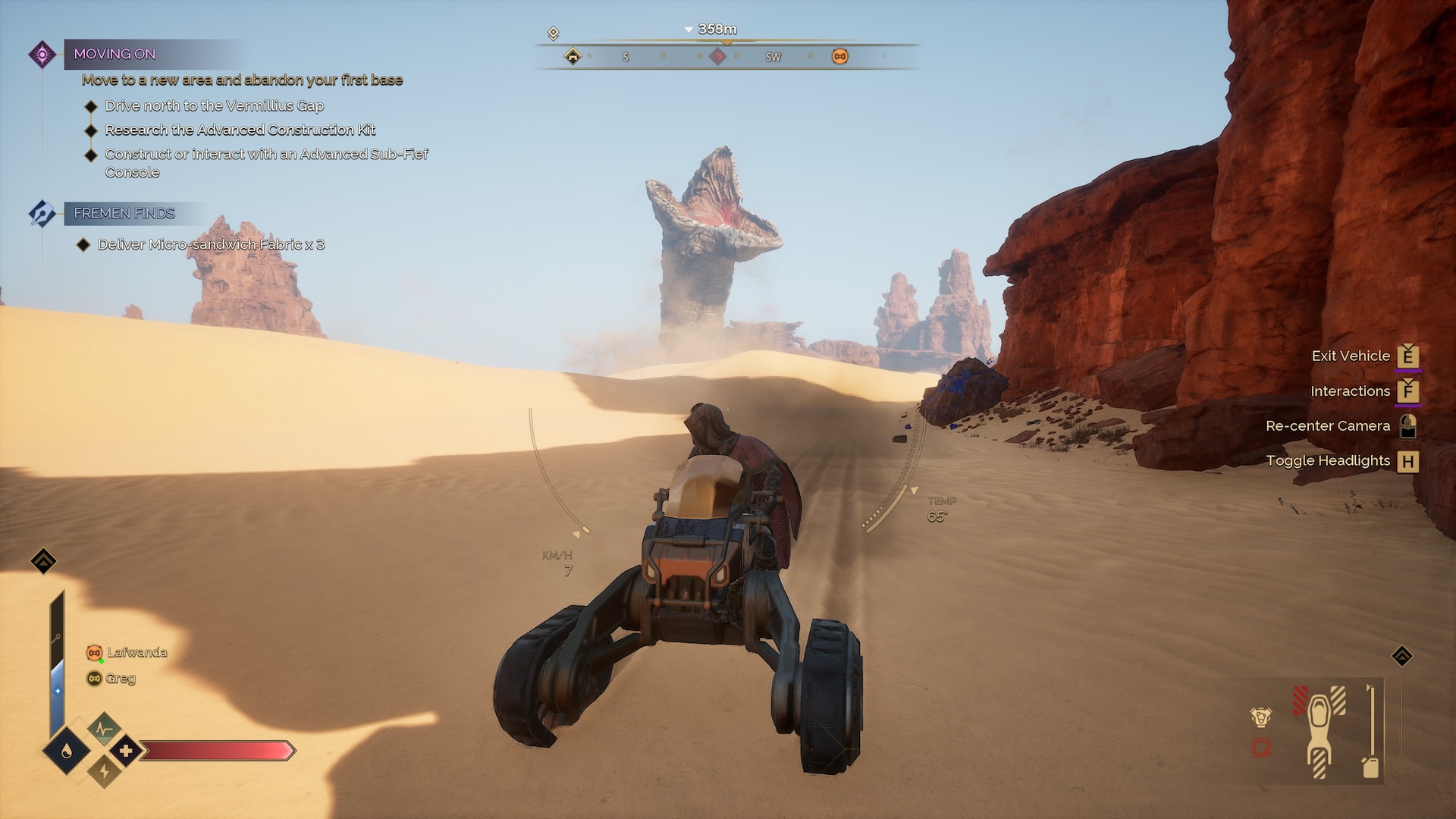
At its heart, Dune: Awakening is a survival game—and it does not take that designation lightly. Players are introduced to a harsh ecosystem where water is the ultimate currency. The desert heat, dehydration, and the looming threat of sandworms create a palpable tension. Early hours are marked by scavenging desert flora for moisture and avoiding environmental hazards like quicksand or disorienting sandstorms.
Water discipline, construction, combat, and vehicle systems each have their own progression trees. These RPG-lite systems encourage specialization, whether you’re a builder, fighter, or nomadic explorer. The survival mechanics are well-integrated into gameplay, although new players may find the early hours particularly unforgiving.

Combat & Progression
Combat in Dune: Awakening is deliberately paced and steeped in the lore of the franchise. Holtzman shields render traditional firearms ineffective, pushing players toward melee combat using slow, deliberate strikes with daggers and swords. Range weapons exist in the form of dart guns capable of bypassing shields, but even these require precision and timing.
Players choose archetypes inspired by the lore—Mentats, Bene Gesserit, Swordmasters—each offering unique perks and progression paths. The Bene Gesserit “Voice” mechanic, for instance, allows players to influence NPCs and manipulate combat dynamics, offering a refreshing depth beyond simple stat boosts.
While the melee combat feels weighty and intentional, it can also feel sluggish at times, particularly in PvP. Future balancing patches may refine the pacing further.
Multiplayer & Faction Systems
The MMO component is structured around persistent, shard-based regions hosting up to 40 players. Unlike traditional MMOs, there are no central quest hubs. Instead, players cooperate or compete organically—through harvesting spice, claiming territory, or building communal bases.
Guilds (called “Circles”) play a pivotal role. By aligning with factions like House Harkonnen or House Atreides, players can gain access to exclusive technologies and influence. Weekly political cycles in the Landsgraad Council allow players to enact laws, manipulate economies, and summon rare NPCs. These systems give Dune: Awakening a surprising amount of political and economic depth, which feels appropriate for a franchise known for its intrigue.

Base Building & Crafting
Base construction is satisfying and necessary for survival. Structures provide shelter from the elements and serve as functional hubs for crafting, research, and water storage. The game allows for both individual homesteads and co-op settlements, and aesthetic customization varies depending on your chosen faction allegiance.
The crafting system itself is robust, but not needlessly convoluted. Unlocking better tools and machines is tied directly to exploration and technological progression, lending a sense of purpose to every foray into the desert.
Visuals & Performance
Built with Unreal Engine 5, Dune: Awakening delivers a visually stunning interpretation of Arrakis. Sand dunes ripple under dynamic lighting, while distant spice harvesters and ornithopters punctuate the horizon. The art direction stays true to the source material while introducing new visual language that complements the alternate timeline.
Performance on PC is generally stable, though some animations—particularly with flying vehicles—feel underdeveloped. Occasional clipping and physics bugs were present during our time with the game, but none were immersion-breaking. Optimization for mid-range systems is solid, though loading times could be improved.
Final Verdict: 8.5/10
Dune: Awakening is an ambitious and atmospheric survival MMO that largely succeeds in delivering a deep and faithful Dune experience. Its strengths lie in its environmental storytelling, thoughtful combat design, and faction-driven multiplayer systems. While not without its rough edges—particularly in animation quality and early-game pacing—it stands out as one of the more intelligent entries in the survival genre.
For fans of Dune, this is a worthy expansion of the mythos. For MMO players seeking something fresh and grounded in narrative, Awakening may very well be the sleeper hit of the year.