Multiplayer games built around open worlds and player freedom are hardly a new idea, but relatively few manage to create an environment where criminal activities, law enforcement, economic progression, and territorial competition all contribute to the same experience. Rob Run, developed and published by Kefir, attempts to bring these elements together in a large online crime sandbox. Set in the fictional city of Looty Bay, the game allows thousands of players to share the same world, taking on the roles of criminals, police officers, or ordinary citizens. Everyone has their own objectives, and the resulting encounters can range from organized robberies and police pursuits to unexpected confrontations between rival players.
The premise is straightforward, but there is more to Rob Run than simply stealing valuables and fighting other people. Players can establish criminal organizations, purchase property, construct hideouts, collect vehicles, and gradually build their influence. Those who prefer a more conventional approach can join the police force and attempt to control the city’s criminal activity, while civilians have their own opportunities to explore the environment and participate in its economy. The game also incorporates extraction mechanics, meaning that collecting valuable items is only part of the challenge. Getting them out safely is often considerably harder.
There is an interesting foundation here, particularly for players who enjoy unpredictable multiplayer experiences in which cooperation and confrontation can emerge naturally. However, Rob Run entered Early Access with several noticeable problems. Its balance, technical stability, and treatment of solo players have attracted considerable criticism, while cheating has also become a significant concern. The central concept has the potential to support an engaging online sandbox, but the current experience is inconsistent, and several of its systems need further refinement before the game can deliver on that promise.
Gameplay and Mechanics
Rob Run combines third-person shooter mechanics with extraction gameplay and a persistent multiplayer environment. Players enter Looty Bay with limited resources and must gradually improve their equipment, financial situation, and overall position. Searching buildings, collecting valuable items, completing criminal activities, and selling stolen goods form the foundation of the gameplay loop.
The objective is not simply to gather as much loot as possible, but to make it out alive and convert those possessions into meaningful progress. This gives even relatively ordinary activities a degree of tension, since the value of a successful run depends on getting its rewards back safely.
The extraction mechanics provide much of that tension. Valuable items can be found throughout the city, but carrying them around makes players potential targets. Other criminals may attempt to steal their possessions, while police officers can intervene when illegal activities attract attention. Dying can mean losing the equipment and loot carried during an operation, making preparation and situational awareness particularly important. Players need to consider what they are willing to risk, how much equipment to bring, and whether a particular opportunity is worth pursuing. The system gives decisions outside direct combat a meaningful purpose, although losing a valuable loadout can also make setbacks feel disproportionately punishing.
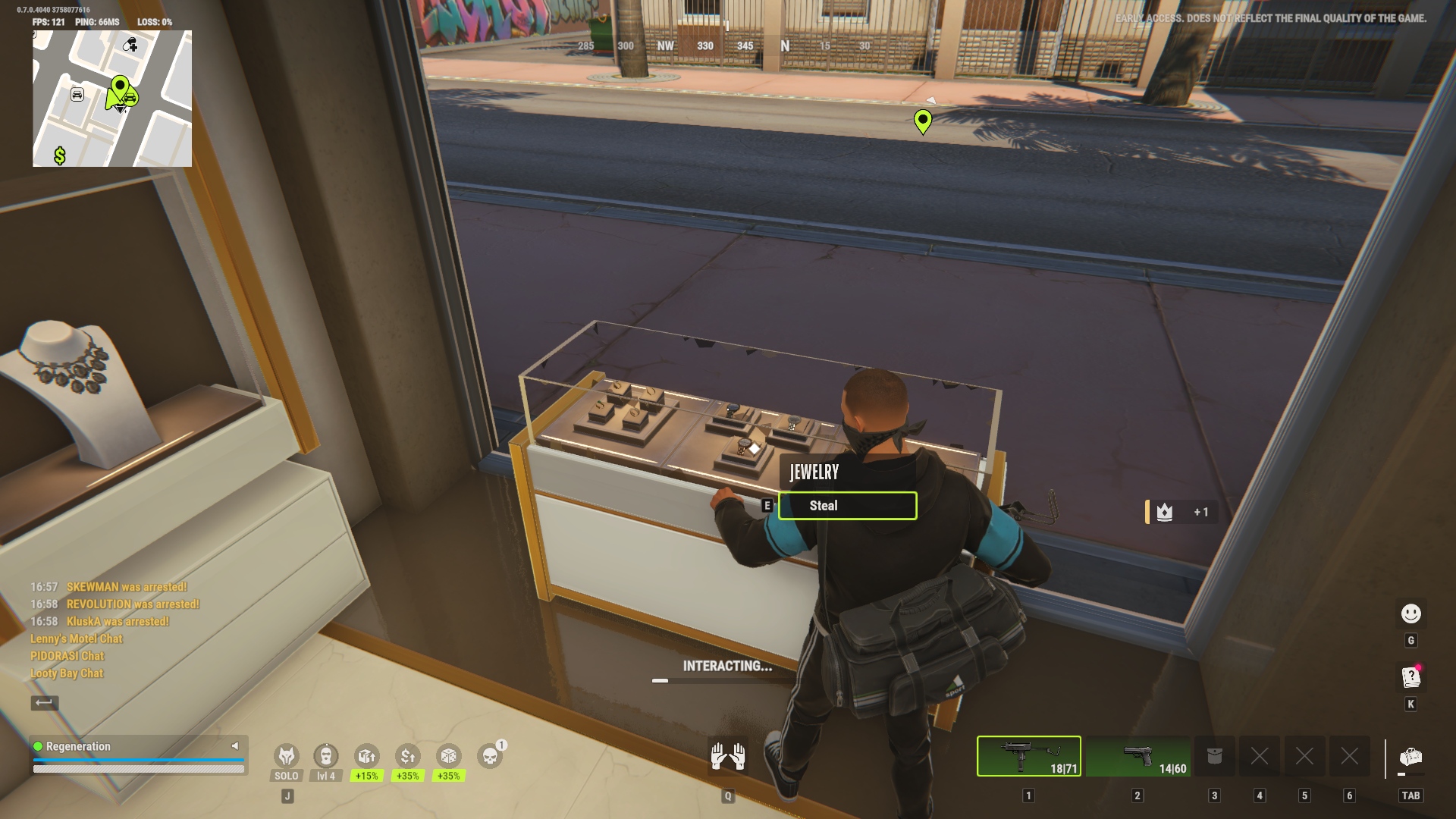
Criminal activities are not limited to straightforward confrontations. Robberies, store break-ins, bank heists, and raids on rival hideouts provide opportunities to acquire valuable possessions. Some locations require specific equipment, such as keys or drills, to access more desirable loot. Better equipment can make operations easier, but it also increases the potential cost of failure. Taking expensive weapons and armor into a dangerous area is a calculated risk rather than an automatic advantage. This relationship between preparation and potential loss is one of the game’s more effective ideas, giving players a reason to think carefully before committing their resources.
The strongest moments emerge when these systems interact. An operation that initially appears straightforward can quickly turn into a confrontation with police officers or rival criminals. Players may need to abandon their original plans, find another escape route, or decide that surviving with a smaller amount of loot is preferable to risking everything. These encounters are among Rob Run’s most appealing features because they emerge from the decisions of other players rather than relying entirely on scripted events. The unpredictability makes the city feel like a shared environment in which plans can change at any moment.
However, the same mechanics can also create unnecessary frustration. Popular locations become predictable places for ambushes, and players carrying valuable possessions are attractive targets. Extraction and selling points can therefore turn into camping grounds where experienced players wait for others to arrive. This is a natural consequence of a competitive extraction system, but it becomes a problem when the risk is difficult for less experienced players to manage. The game needs to make these encounters feel dangerous without allowing routine progression to become an exercise in repeatedly losing equipment to better-prepared opponents.
Solo play highlights this problem. Players who enter the city alone are at an obvious disadvantage when facing coordinated groups, particularly during activities that require several people or involve contested locations. Kefir has acknowledged this and provides solo players with a higher starting Notoriety level, along with bonuses that improve their ability to earn money and access certain benefits. That is a useful adjustment, but it does not remove the fundamental disadvantage of being outnumbered. Rob Run can be played alone, but players who prefer that approach should expect to rely more heavily on caution, selective engagements, and avoiding unnecessary confrontations.
Multiplayer and Game Modes
The relationship between criminals and law enforcement is central to Rob Run’s identity. Rather than treating police officers as computer-controlled enemies, the game allows players to take on the role themselves. This creates a more unpredictable environment, since criminals must contend with opponents who can make their own decisions, communicate with teammates, and react to changing circumstances. It also gives police work a purpose beyond simply providing another type of combat encounter.
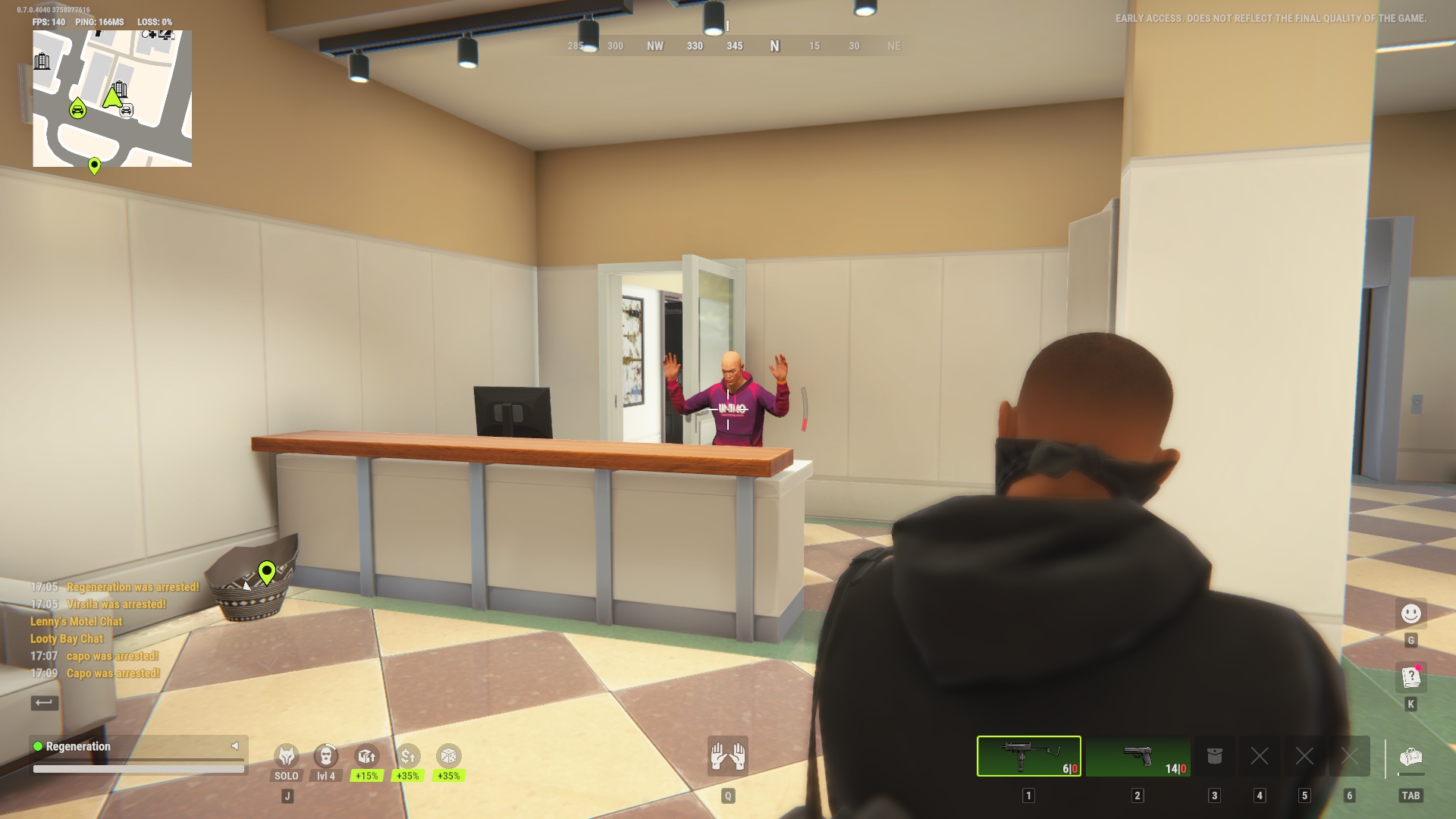
Playing as a criminal involves finding opportunities, organizing robberies, collecting valuables, and attempting to escape before the police arrive. Officers, meanwhile, are responsible for responding to alarms, pursuing offenders, and recovering stolen property. Arresting criminals and confiscating their loot also provide financial rewards. The two roles therefore have different objectives, but their activities are closely connected. Successful robberies create work for law enforcement, while effective policing makes criminal operations more dangerous. This relationship is a strong foundation for the game’s multiplayer design, even if the balance between the two sides is not always convincing.
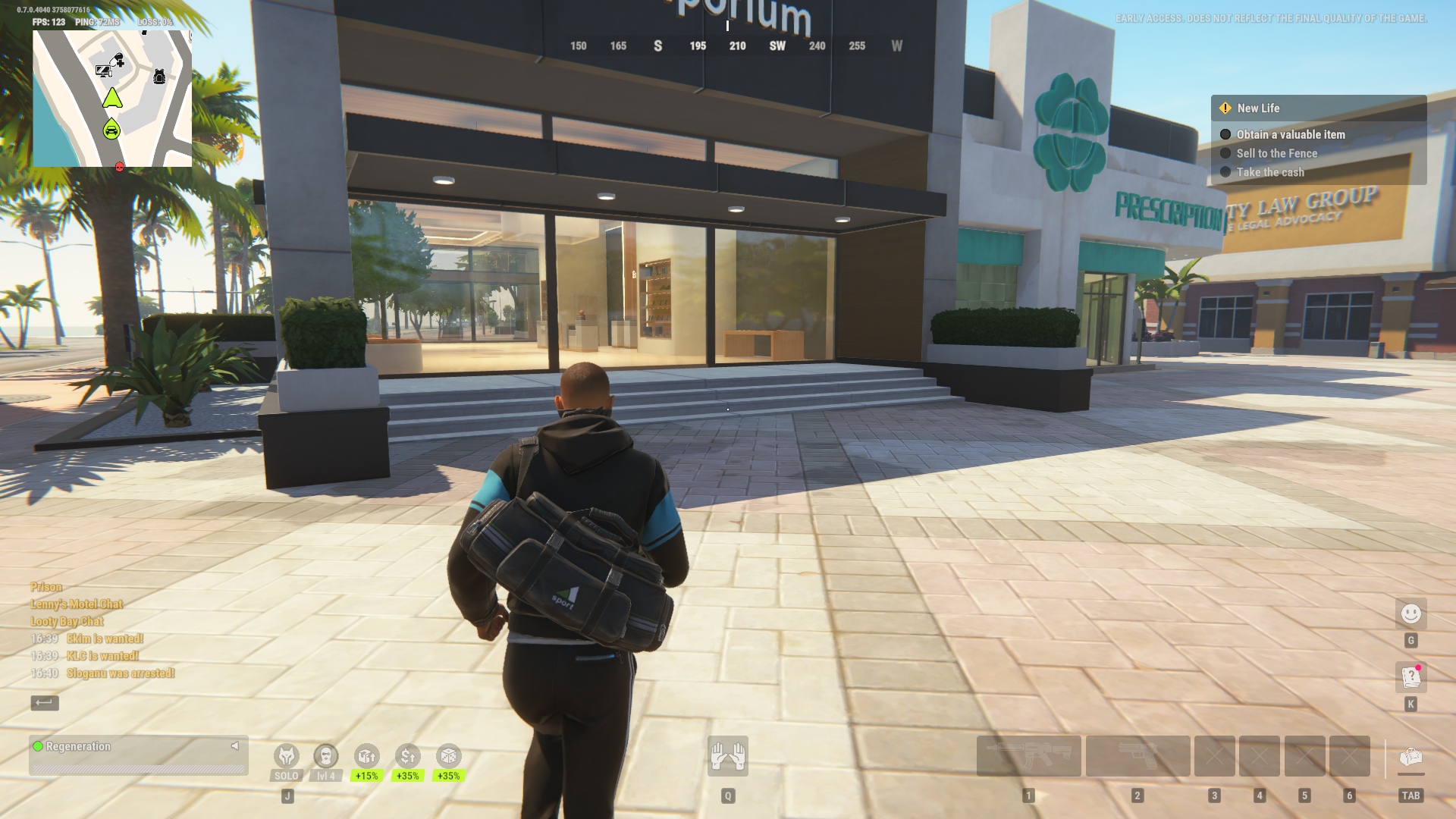
Ordinary citizens provide another alternative. Players who do not want to immediately participate in criminal activities can explore the city, visit shops, and make use of banking facilities. Although this role is less immediately exciting than participating in robberies or police pursuits, it helps establish the idea of a shared environment rather than a collection of separate combat scenarios. Its long-term appeal depends on how many worthwhile activities civilians can pursue, however. If the more rewarding parts of the game remain concentrated around crime and combat, the civilian role risks feeling like a less developed alternative.
Cooperation is particularly important for players who want to participate in larger activities. Rob Run allows players to create clans or join existing organizations. Groups can coordinate raids, compete for territory, negotiate agreements, and establish their influence within a server. However, the actual party system is limited to three players. Kefir has explained that larger parties were tested during development but reduced the number of unexpected encounters between players. The studio has said it has no plans to increase the limit for now.
This decision is understandable from a design perspective. Restricting party size can prevent large groups from dominating every encounter and preserve some of the uncertainty that makes the city interesting. At the same time, it may disappoint players who want to participate in organized activities with larger groups of friends. Clans provide a way to maintain a wider network of allies, but the smaller party limit still affects how many people can directly cooperate during an individual session.
The biggest challenge is balancing these different roles. Police officers need enough opportunities to participate, criminals need room to operate, and civilians should not feel like convenient targets for everyone else. Kefir has capped the maximum number of police officers allowed in a city at four, but the availability of police positions remains a concern. The developers have acknowledged that waiting for an opening can be inconvenient and have indicated that improving police duty is part of their future plans. The limit may help prevent law enforcement from overwhelming criminal activity, but it also restricts access to a role that is an important part of the game’s identity.
Progression and Economy
Progression gives players a reason to return to Rob Run beyond the immediate excitement of individual robberies. Money, equipment, vehicles, property, and other resources contribute to a wider system in which players gradually establish themselves within the city’s criminal underworld. Starting with limited possessions and eventually developing a substantial operation provides a clear sense of direction. The prospect of building something that belongs to the player also gives the game a longer-term objective beyond individual encounters.
The economy is closely connected to the extraction mechanics. Players acquire valuables through exploration and criminal activities, then attempt to sell them or use them to improve their equipment and properties. Weapons, armor, vehicles, and construction materials all contribute to progression, while blueprints provide access to additional possibilities. There is also an incentive to establish a permanent hideout rather than simply collecting equipment and repeatedly entering the city. Ideally, each successful operation should contribute to a larger plan, giving players a reason to take calculated risks rather than treating every session as an isolated activity.
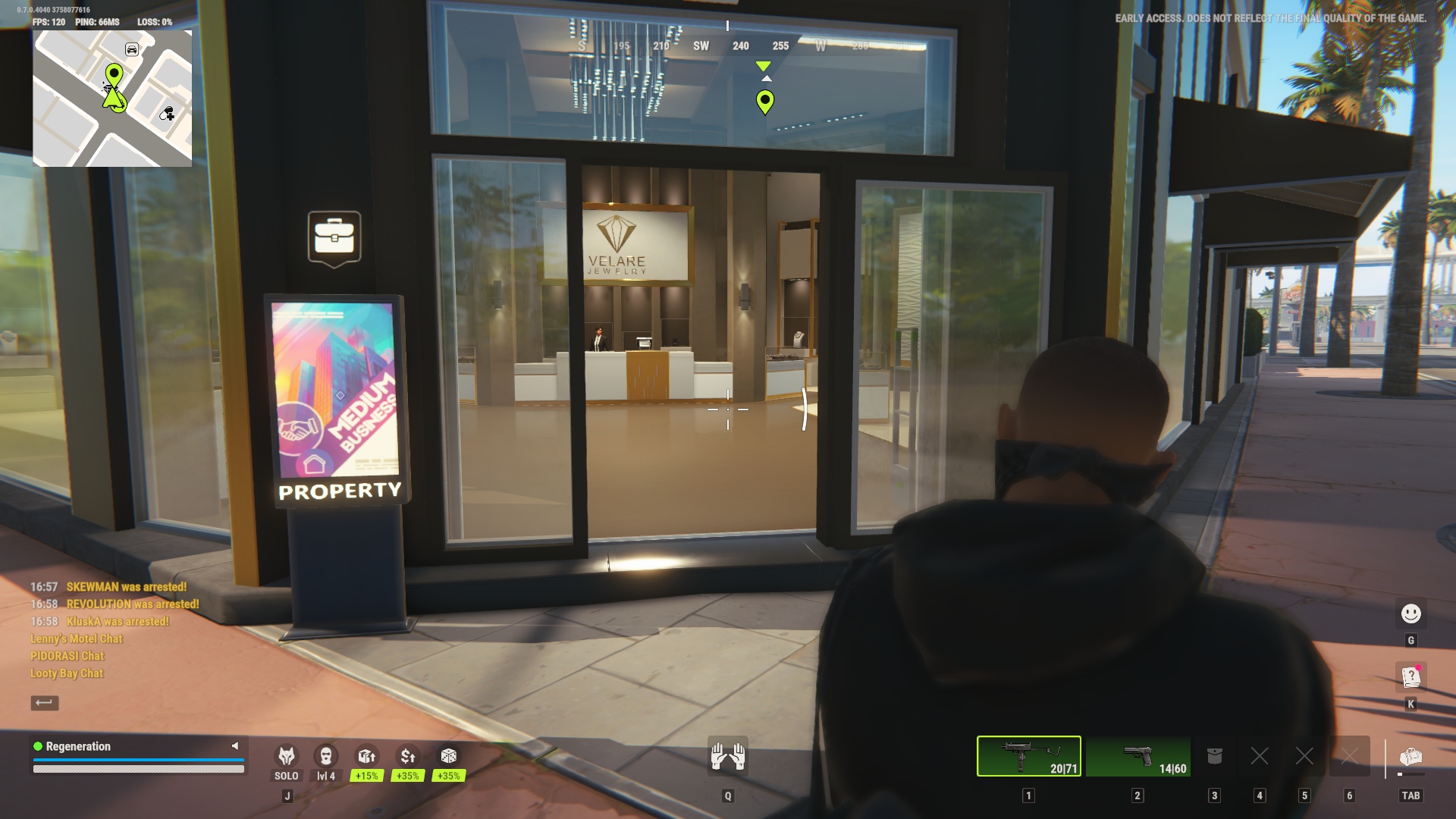
Base building is one of the more appealing aspects of the experience. Players can acquire settlements or rent plots, construct and upgrade their hideouts, and install facilities such as workbenches and safes. Vehicles and valuable possessions can also be stored there. These properties become important investments, providing practical benefits while giving players something more substantial to work towards. The system adds a welcome layer of ownership to the experience, although its value naturally depends on how much time players are willing to invest in a server’s progression cycle.
Of course, ownership also creates additional risks. Other players can raid hideouts and attempt to steal stored possessions, meaning that a successful criminal organization needs to think about protection as well as expansion. Defensive structures and upgrades are therefore important, although the effectiveness of these systems has been a subject of community criticism. Raids can create some of the game’s most memorable confrontations, but they also need to feel reasonably fair. If players cannot adequately protect the time and resources invested in their properties, the appeal of base building can quickly diminish.
Another unusual aspect of progression is the seven-day server cycle. Each server eventually undergoes a Federal Raid, resetting much of the accumulated progress and forcing players to begin another cycle. The schedule is tied to when an individual server opens, rather than a single global reset. This approach prevents established groups from maintaining an overwhelming advantage indefinitely and gives newcomers regular opportunities to compete. At the same time, it limits the appeal of long-term progression. Players who spend considerable time developing their properties and collecting equipment may find the prospect of losing much of that investment frustrating.
The first Federal Raid took place on November 11 for the servers that opened on November 4. Not everything is lost during a reset, as certain elements, including cosmetic purchases and B-coins, are retained. Nevertheless, the wipe system has a substantial influence on how players approach the economy. It encourages short-term planning and makes the timing of major investments important. Some players may appreciate the regular opportunity to start over, while others will find that the limited lifespan of their progress reduces their motivation to build a lasting operation.
Graphics and Sound
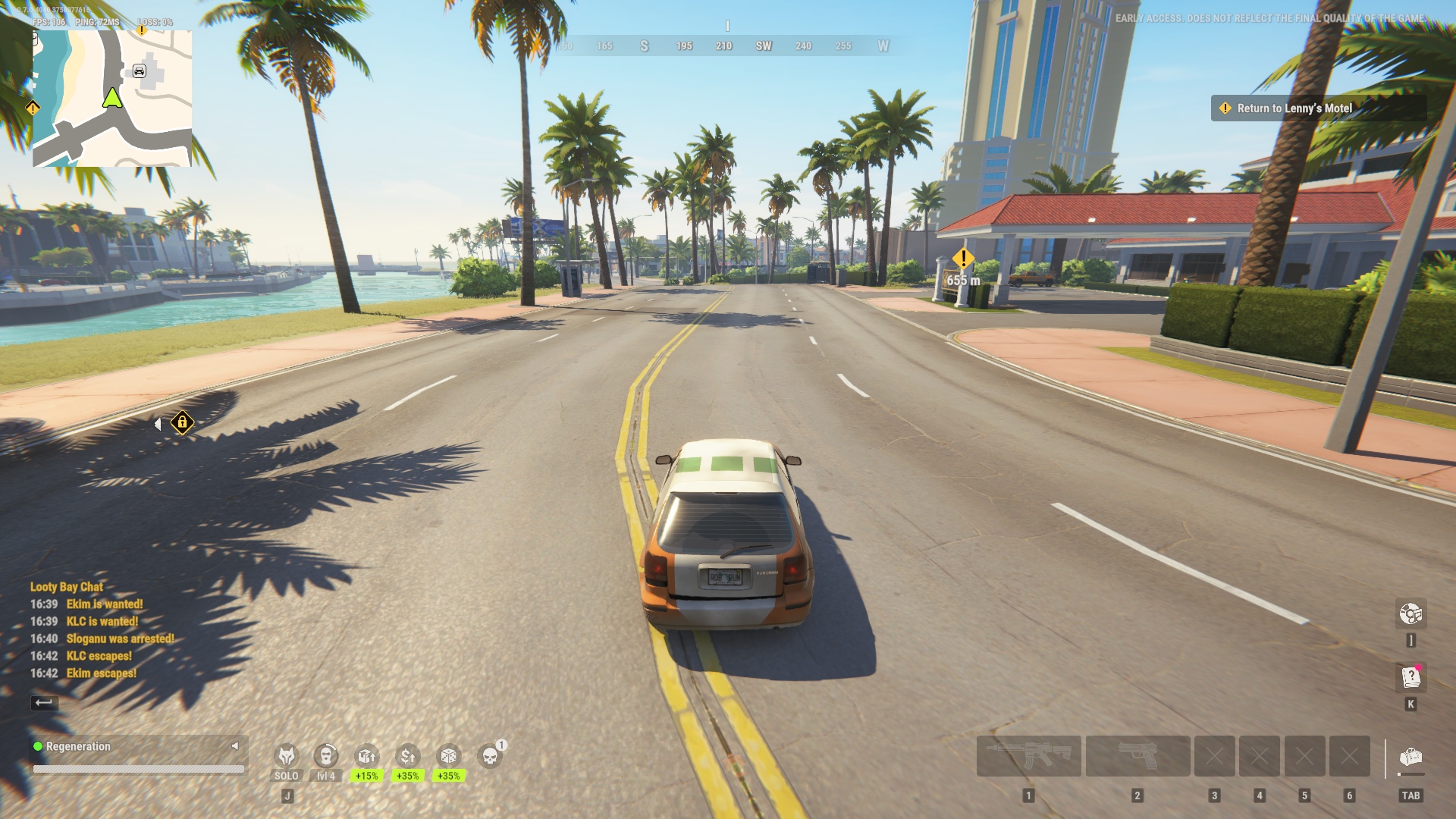
Rob Run’s presentation is functional, with its visual identity primarily serving the needs of its multiplayer environment. Looty Bay provides the setting for robberies, police pursuits, exploration, and the various activities that take place between players. The city needs to accommodate a large number of people and provide recognizable locations for different types of encounters, rather than simply functioning as an attractive backdrop. Its effectiveness therefore depends as much on navigation and readability as it does on visual detail.
The overall visual presentation is not particularly impressive when compared with more ambitious open-world productions. However, graphical sophistication is not necessarily essential for this type of experience. Clear environments, readable character models, and recognizable objects are more important than elaborate visual effects, especially when players need to identify threats and react quickly during confrontations. The presentation does its job, but it is not a major selling point, and the city could benefit from more visual variety and polish as development continues.
The interface also has an important role to play. Players regularly need to manage their inventory, check their equipment, monitor their financial progress, and understand the requirements of different activities. Making these systems straightforward is essential, particularly for newcomers who may already find the game’s mechanics somewhat overwhelming. Any friction in inventory management or navigation can become especially inconvenient when players are under pressure or trying to make quick decisions.
One production detail worth mentioning is that Kefir has disclosed using AI-generated content in the creation of certain graphic elements. This has attracted criticism from some players, although the use of AI-generated assets does not automatically determine the quality of the overall presentation. What matters more to the finished game is whether the assets are consistent with its visual identity and whether they meet an acceptable standard of quality.
Audio has a practical role in a multiplayer game where nearby gunfire, police activity, and approaching players can influence decisions. Sound cues need to communicate useful information without becoming confusing, while music and ambient effects help establish the atmosphere of the city. Rob Run provides separate controls for music, radio, player voices, and sound effects, along with options related to sound-effect visualization and voice communication. Steam lists full audio support in English and Russian, although language availability alone says nothing about the quality of the sound design. Without a reliable firsthand assessment, it would be misleading to make strong claims about the soundtrack, voice work, or the clarity and impact of individual effects. Audio remains an area where a more definitive judgment requires direct evaluation.
Technical Performance on PC
Technical stability is one of the most important factors determining whether Rob Run can succeed. Its large multiplayer environment is an ambitious undertaking, and the game attracted substantial attention immediately after its release. However, the launch period was accompanied by server connection problems, crashes, lag, and reports of lost progress. For a game built around persistent progression and the risk of losing equipment, these are particularly damaging problems.
Losing valuable equipment because of an ordinary gameplay mistake is one thing, but losing it because of a server problem is considerably harder to accept. Players already have to deal with other criminals, police officers, and the possibility of being ambushed. Technical problems should not become another unpredictable source of financial loss. Reliable servers are not simply a convenience in Rob Run; they are fundamental to the fairness of its central gameplay loop.
Kefir has acknowledged server instability and DDoS attacks during the launch period, explaining that these incidents contributed to connection problems and lag. The studio also confirmed that some server crashes caused progress rollbacks and item duplication. Although the developers reported improvements, they acknowledged that the situation required further attention. This communication is welcome, but players will ultimately judge the response by whether the problems are resolved consistently rather than by the number of updates explaining them.
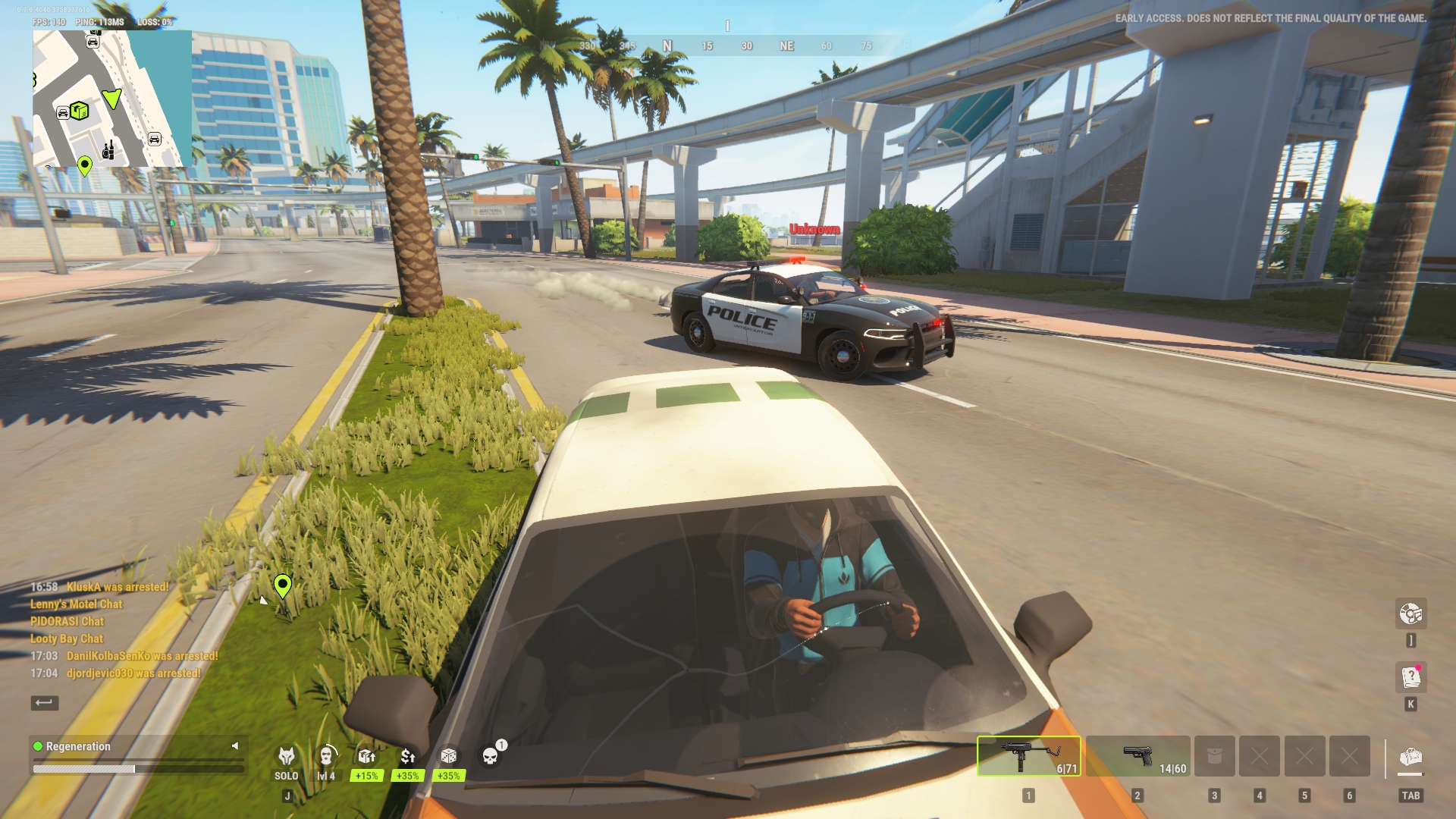
Performance complaints have not been limited to server stability. Players have also reported severe frame-rate drops when moving the mouse, with Kefir’s troubleshooting guidance identifying excessively high mouse polling rates as a possible cause. The developer recommends lowering the polling rate through the mouse’s configuration software and checking whether the problem improves. This is an unusual issue for a PC release and one that should ideally be addressed through further optimization, rather than leaving affected players to troubleshoot their peripheral settings. It is also important to distinguish local frame-rate problems from network latency: a drop in FPS and a high ping or packet-loss reading are different issues, even though both can make online play feel unresponsive.
Kefir’s troubleshooting guidance also provides a useful way to approach performance problems. Players can monitor frame rate, network latency, and packet loss separately through the game’s performance metrics. This makes it easier to identify whether a problem is related to local rendering performance or the network connection. For players experiencing movement-related frame drops, lowering the mouse polling rate is the first specific workaround worth trying. If performance remains inconsistent, reducing demanding graphical options may help, although the effectiveness of individual settings will depend on the hardware being used.
The official PC requirements provide a more concrete indication of the hardware needed to run the game. The minimum specification calls for Windows 10 or later, an Intel Core i5-6600K or AMD Ryzen 5 1600 processor, 12GB of RAM, and a GeForce GTX 1050 Ti, Radeon RX 580, or Intel Arc A380 graphics card. The recommended specification moves up to an Intel Core i5-9600K or AMD Ryzen 5 3600, 16GB of RAM, and a GeForce RTX 2070, Radeon RX 5700 XT, or Intel Arc B570. These are the developer’s published requirements rather than independently verified performance targets, so they should be treated as a starting point rather than a guarantee of a particular frame rate.
Cheating has been another serious problem. On November 13, Kefir announced that more than 20,000 accounts had been banned for cheating. This is a substantial number and illustrates how significant the problem has become during the game’s early period. The developers have continued working on cheat detection and have encouraged players to report suspicious behavior. They have also temporarily disabled the purchase of smoke grenades after cheaters exploited them to gain unfair advantages.
The response is encouraging, but the situation illustrates how much work remains. In a game where equipment and loot can represent hours of progression, cheating can undermine the entire experience. Players need confidence that confrontations are reasonably fair and that the developers are capable of responding effectively when exploits are discovered. A large number of bans is evidence of enforcement activity, but it is not, by itself, proof that cheating has been brought under control.
The good news is that Kefir has demonstrated a willingness to communicate with its community. The studio has published explanations of its decisions, introduced balance changes, and acknowledged several of the problems raised by players. This is a positive sign for an Early Access title, although communication alone cannot compensate for technical shortcomings. Server stability, performance optimization, and effective anti-cheat measures need to remain priorities if the game is to retain the trust of its player base.
Final Verdict: 6/10
Rob Run is an ambitious multiplayer crime sandbox with a concept that deserves attention. Its combination of extraction mechanics, criminal activities, police pursuits, property ownership, and clan progression creates opportunities for unpredictable encounters that are difficult to reproduce in more conventional multiplayer games. When its different systems work together, the experience can be genuinely entertaining. The tension of carrying valuable loot through a dangerous city, the possibility of an unexpected police response, and the opportunity to build a criminal operation give the game a distinctive identity.
Unfortunately, the current Early Access version is considerably less consistent than its premise suggests. Solo players and newcomers can struggle against established groups, extraction camping can make progression frustrating, and the balance between criminals and law enforcement still needs attention. The seven-day wipe cycle may also discourage players who prefer long-term progression, while technical instability and cheating concerns undermine an experience that depends heavily on fair and reliable multiplayer interactions. The reported mouse-related frame-rate issue adds another concern for PC players, particularly those affected by the polling-rate problem.
Kefir appears aware of these problems and has already taken steps to address several of them. The solo-player bonuses, balance adjustments, server work, and anti-cheat actions show that the developer is responding to feedback. These are encouraging developments, but they should be viewed as the beginning of the work required rather than proof that the underlying problems have been solved. Rob Run needs more consistent server performance, fairer encounters, better support for newcomers, and further refinement of its police and criminal systems.
The free-to-play model makes it relatively easy to give Rob Run a chance, and players who enjoy extraction shooters, criminal sandbox games, and unpredictable online encounters may find something worthwhile here. Those who mainly play alone should be aware that the experience can still be demanding despite the additional progression bonuses. Players looking for a polished and consistently balanced multiplayer game, meanwhile, would be better off waiting for further development.
Rob Run has the foundation of an interesting game, but its current version feels more like a promising work in progress than a polished online experience. Its best moments demonstrate why the concept is appealing, while its less successful systems show how much can go wrong when progression, competition, and technical reliability are not yet working together. Whether it can develop into something genuinely special will depend on how effectively Kefir addresses those problems during Early Access.